
Atmosphere Chapter 11 Notes Composition of the Atmosphere


- Slides: 15
Atmosphere Chapter 11 Notes
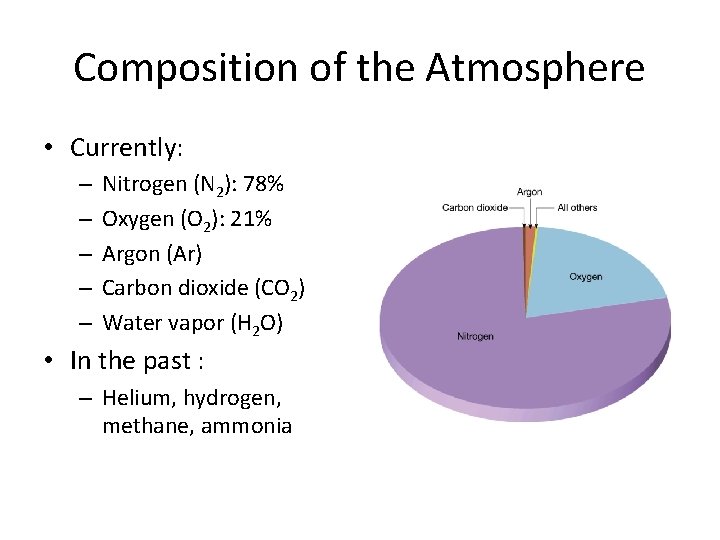
Composition of the Atmosphere • Currently: – – – Nitrogen (N 2): 78% Oxygen (O 2): 21% Argon (Ar) Carbon dioxide (CO 2) Water vapor (H 2 O) • In the past : – Helium, hydrogen, methane, ammonia
Variable Atmospheric Components • The following gases change over time: – Water vapor – Carbon dioxide: increase from 0. 028% to 0. 039% – Ozone • Upper atmosphere: protection from ultraviolet radiation • Lower atmosphere: pollutant – Particles: • • • Dust Salt Ice Fungi Bacteria
Atmospheric Layers • Troposphere – Weather • Stratosphere – Ozone layer • Mesosphere • Thermosphere • Exosphere – Transition between atmosphere and space
Thermal Energy Transfer (Heat) • Radiation: transfer of heat by electromagnetic waves (example: heat lamp) – Visible and infrared EMR is absorbed and reflected by clouds, atmosphere, and Earth’s surface – Rate of absorption varies from place to place, and seasonally • Conduction: heat transferred through direct contact • Convection: movement of heat through currents in a liquid or gas
Radiation of Thermal Energy
Temperature and air pressure in the atmosphere • Temperature = average kinetic energy of particles in a material, measured in ⁰C, ⁰F, or K • Temperature increases if pressure is increased • Pressure increases if density is increased • Density decreases if temperature increases – Hot air rises • Adiabatic heating and cooling: Air changing temperature without being heated or cooled —by changing pressure
Temperature Inversion • Rapid cooling of land on a cold, clear night can cause a temperature inversion • Temperature inversions can cause fog, haze, and smog • Air pollution is trapped under the inversion layer
Wind • Air moves from high pressure to low pressure: wind • Pressure differences are caused by unequal heating and cooling of different regions • Friction causes wind to slow down near Earth’s surface • Wind speeds increase at higher altitudes
Humidity • Amount of water vapor relative to the amount needed to reach saturation • The dew point is the temperature to which air must be cooled to reach saturation
Cloud Formation • Rising air cools, causing water vapor to condense • Condensation nuclei (dust, ice, salt, or other solid particles) must be present for water droplets to stick to • Rising air is unstable • Sinking air is stable (fair weather)
Clouds form from rising air
Types of Clouds
Types of Clouds • High clouds (ice crystals): – Cirrus: wispy horse tails – Cirrostratus: fish scales • Middle clouds: – Altocumulus: wavy rows or masses – Altostratus: thin layered sheets • Low clouds: – Cumulus: puffy – Stratus: layers
Types of Precipitation • Rain, snow, sleet, and hail are four main types of precipitation. • Droplets in clouds grow through the process of coalescence when droplet collide and stick together, forming rain drops • Hail forms when droplets move up and down through freezing and non-freezing air