
ATM An Introduction to ATM Asynchronous Transfer Mode
- Slides: 21
ATM An Introduction to ATM Asynchronous Transfer Mode John A. Clark
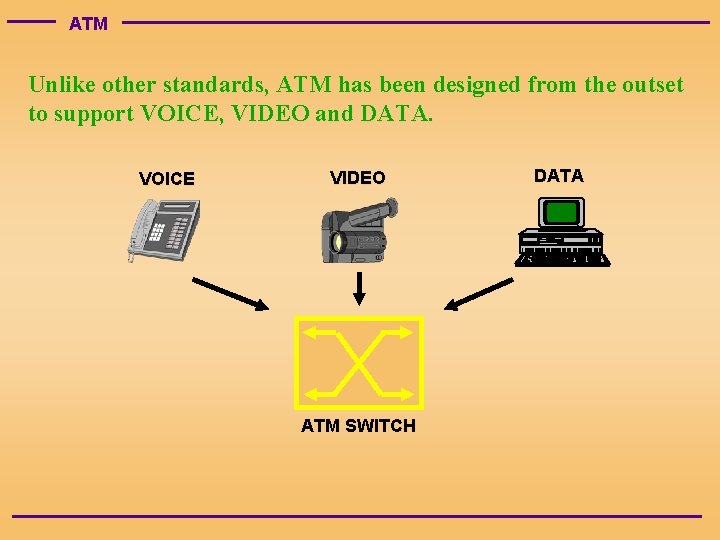
ATM Unlike other standards, ATM has been designed from the outset to support VOICE, VIDEO and DATA. VOICE VIDEO ATM SWITCH DATA
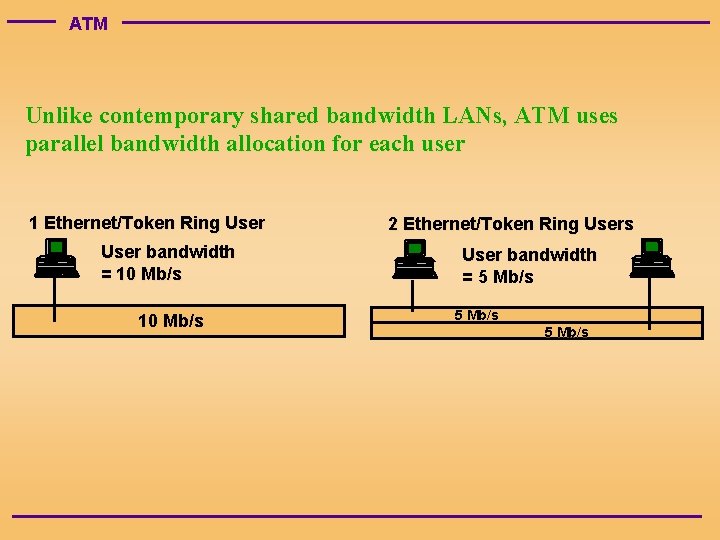
ATM Unlike contemporary shared bandwidth LANs, ATM uses parallel bandwidth allocation for each user 1 Ethernet/Token Ring User bandwidth = 10 Mb/s 2 Ethernet/Token Ring Users User bandwidth = 5 Mb/s
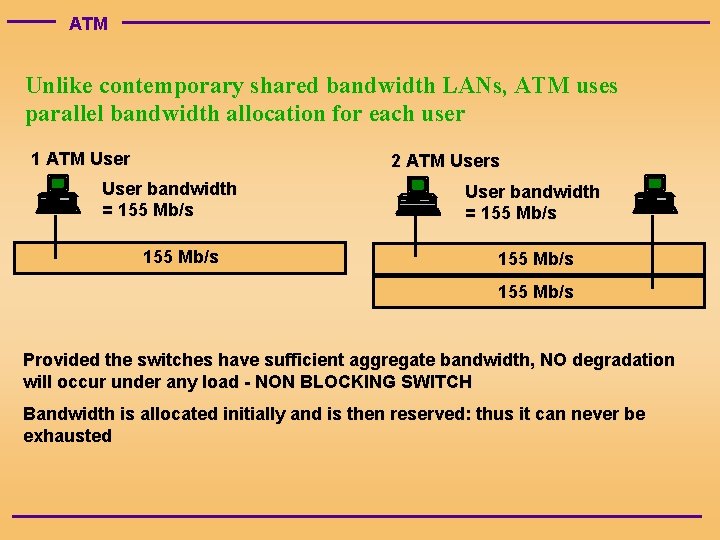
ATM Unlike contemporary shared bandwidth LANs, ATM uses parallel bandwidth allocation for each user 1 ATM User 2 ATM Users User bandwidth = 155 Mb/s 155 Mb/s Provided the switches have sufficient aggregate bandwidth, NO degradation will occur under any load - NON BLOCKING SWITCH Bandwidth is allocated initially and is then reserved: thus it can never be exhausted
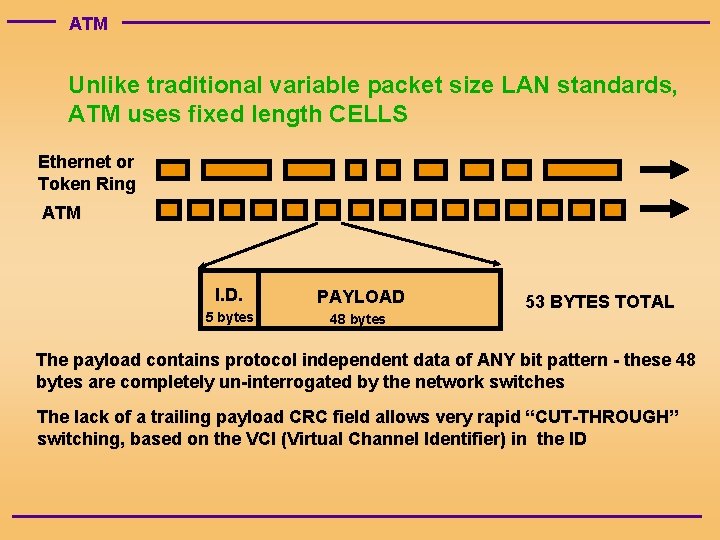
ATM Unlike traditional variable packet size LAN standards, ATM uses fixed length CELLS Ethernet or Token Ring ATM I. D. PAYLOAD 5 bytes 48 bytes 53 BYTES TOTAL The payload contains protocol independent data of ANY bit pattern - these 48 bytes are completely un-interrogated by the network switches The lack of a trailing payload CRC field allows very rapid “CUT-THROUGH” switching, based on the VCI (Virtual Channel Identifier) in the ID
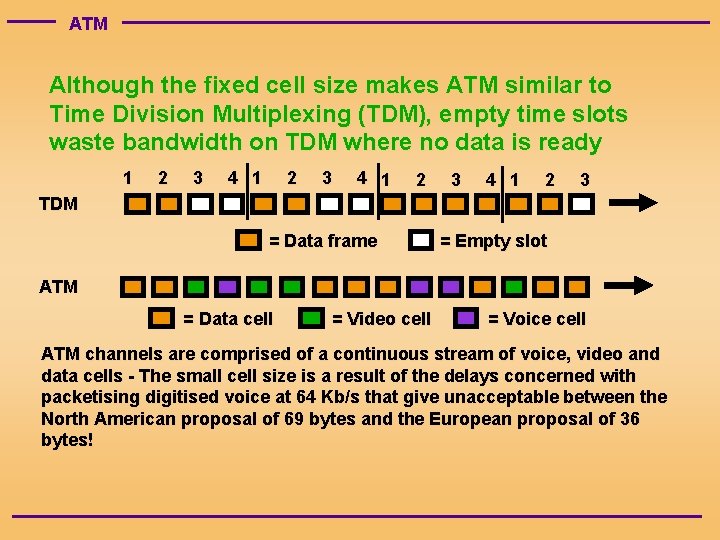
ATM Although the fixed cell size makes ATM similar to Time Division Multiplexing (TDM), empty time slots waste bandwidth on TDM where no data is ready 1 2 3 4 1 2 3 TDM = Data frame = Empty slot ATM = Data cell = Video cell = Voice cell ATM channels are comprised of a continuous stream of voice, video and data cells - The small cell size is a result of the delays concerned with packetising digitised voice at 64 Kb/s that give unacceptable between the North American proposal of 69 bytes and the European proposal of 36 bytes!
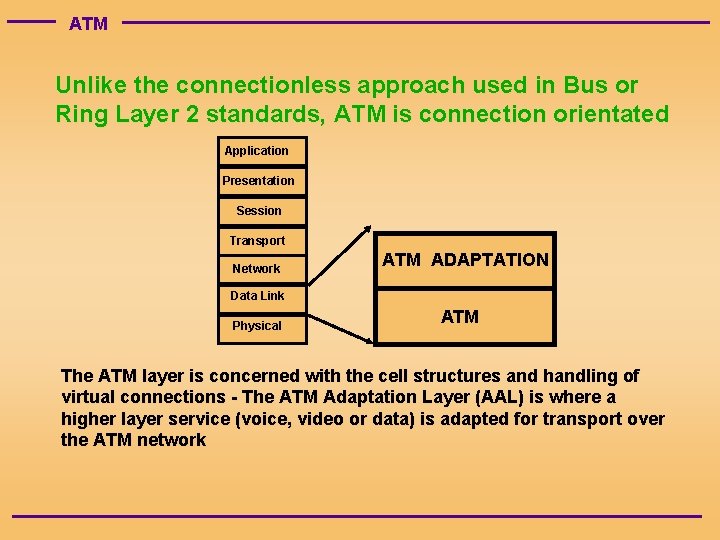
ATM Unlike the connectionless approach used in Bus or Ring Layer 2 standards, ATM is connection orientated Application Presentation Session Transport Network ATM ADAPTATION Data Link Physical ATM The ATM layer is concerned with the cell structures and handling of virtual connections - The ATM Adaptation Layer (AAL) is where a higher layer service (voice, video or data) is adapted for transport over the ATM network
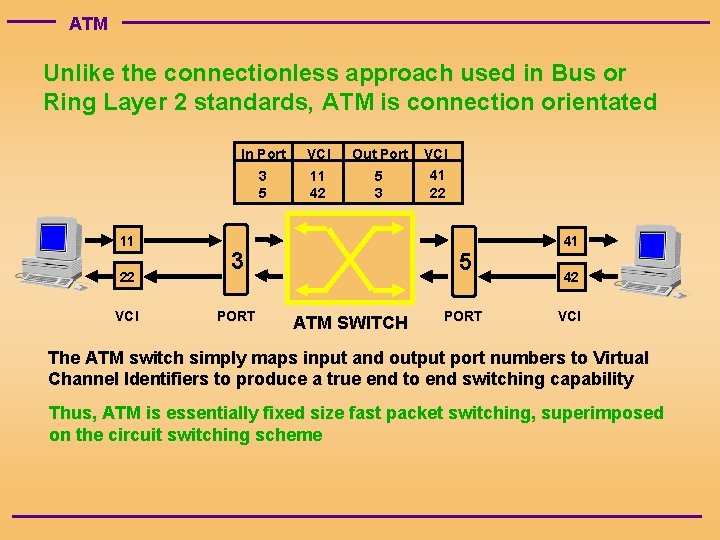
ATM Unlike the connectionless approach used in Bus or Ring Layer 2 standards, ATM is connection orientated 11 22 VCI In Port VCI Out Port 3 5 11 42 5 3 3 PORT VCI 41 22 5 ATM SWITCH PORT 41 42 VCI The ATM switch simply maps input and output port numbers to Virtual Channel Identifiers to produce a true end to end switching capability Thus, ATM is essentially fixed size fast packet switching, superimposed on the circuit switching scheme
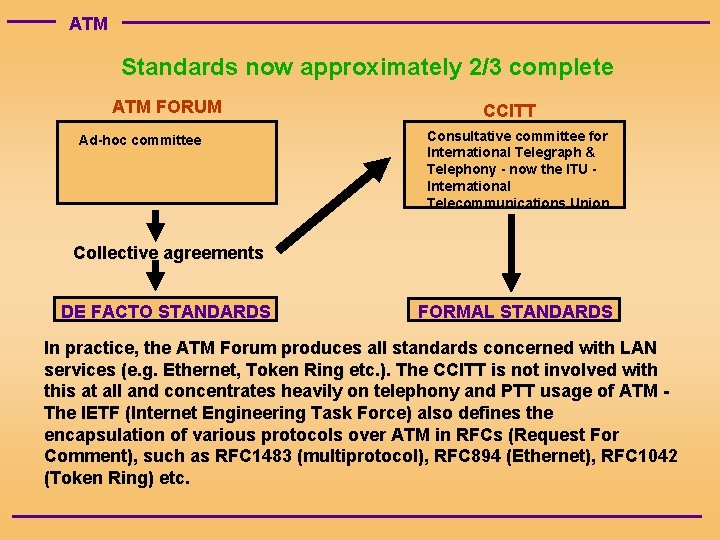
ATM Standards now approximately 2/3 complete ATM FORUM Ad-hoc committee CCITT Consultative committee for International Telegraph & Telephony - now the ITU International Telecommunications Union Collective agreements DE FACTO STANDARDS FORMAL STANDARDS In practice, the ATM Forum produces all standards concerned with LAN services (e. g. Ethernet, Token Ring etc. ). The CCITT is not involved with this at all and concentrates heavily on telephony and PTT usage of ATM The IETF (Internet Engineering Task Force) also defines the encapsulation of various protocols over ATM in RFCs (Request For Comment), such as RFC 1483 (multiprotocol), RFC 894 (Ethernet), RFC 1042 (Token Ring) etc.
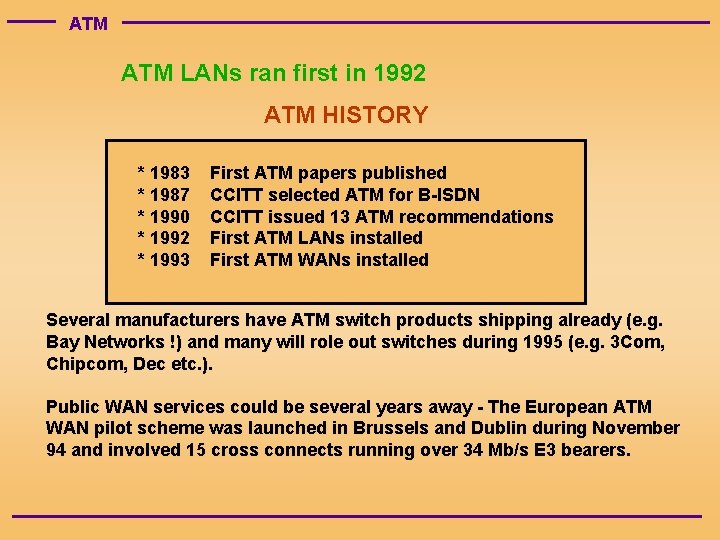
ATM LANs ran first in 1992 ATM HISTORY * 1983 * 1987 * 1990 * 1992 * 1993 First ATM papers published CCITT selected ATM for B-ISDN CCITT issued 13 ATM recommendations First ATM LANs installed First ATM WANs installed Several manufacturers have ATM switch products shipping already (e. g. Bay Networks !) and many will role out switches during 1995 (e. g. 3 Com, Chipcom, Dec etc. ). Public WAN services could be several years away - The European ATM WAN pilot scheme was launched in Brussels and Dublin during November 94 and involved 15 cross connects running over 34 Mb/s E 3 bearers.
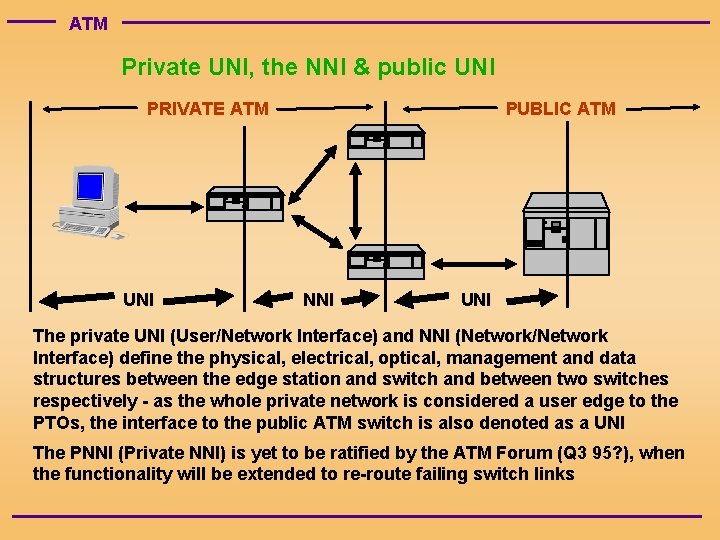
ATM Private UNI, the NNI & public UNI PRIVATE ATM UNI PUBLIC ATM NNI UNI The private UNI (User/Network Interface) and NNI (Network/Network Interface) define the physical, electrical, optical, management and data structures between the edge station and switch and between two switches respectively - as the whole private network is considered a user edge to the PTOs, the interface to the public ATM switch is also denoted as a UNI The PNNI (Private NNI) is yet to be ratified by the ATM Forum (Q 3 95? ), when the functionality will be extended to re-route failing switch links
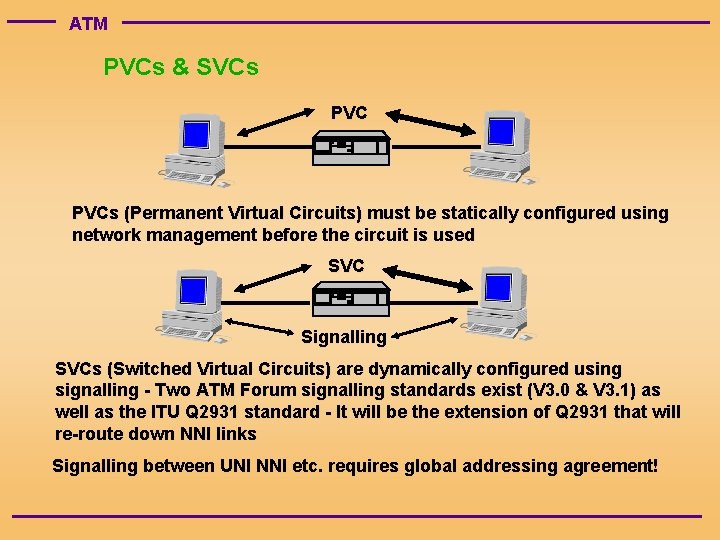
ATM PVCs & SVCs PVCs (Permanent Virtual Circuits) must be statically configured using network management before the circuit is used SVC Signalling SVCs (Switched Virtual Circuits) are dynamically configured using signalling - Two ATM Forum signalling standards exist (V 3. 0 & V 3. 1) as well as the ITU Q 2931 standard - It will be the extension of Q 2931 that will re-route down NNI links Signalling between UNI NNI etc. requires global addressing agreement!
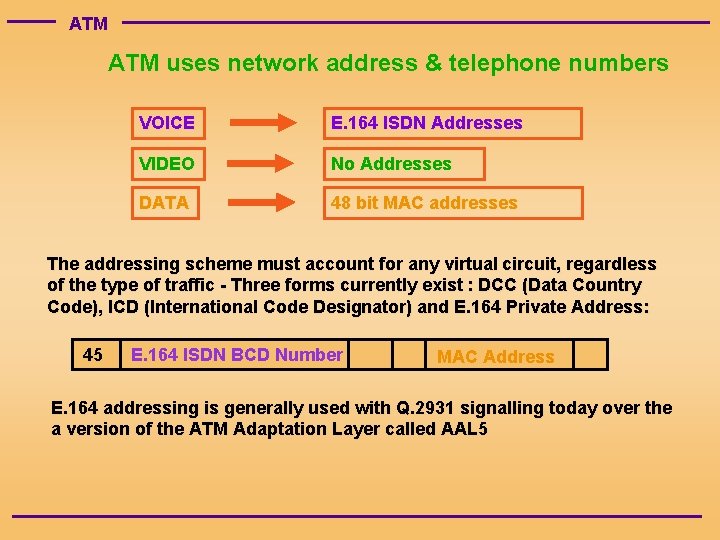
ATM uses network address & telephone numbers VOICE E. 164 ISDN Addresses VIDEO No Addresses DATA 48 bit MAC addresses The addressing scheme must account for any virtual circuit, regardless of the type of traffic - Three forms currently exist : DCC (Data Country Code), ICD (International Code Designator) and E. 164 Private Address: 45 E. 164 ISDN BCD Number MAC Address E. 164 addressing is generally used with Q. 2931 signalling today over the a version of the ATM Adaptation Layer called AAL 5
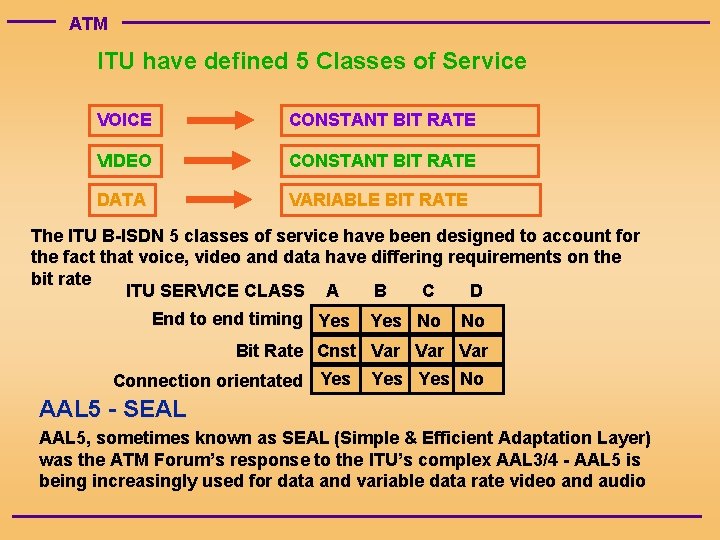
ATM ITU have defined 5 Classes of Service VOICE CONSTANT BIT RATE VIDEO CONSTANT BIT RATE DATA VARIABLE BIT RATE The ITU B-ISDN 5 classes of service have been designed to account for the fact that voice, video and data have differing requirements on the bit rate ITU SERVICE CLASS A B C D End to end timing Yes No No Bit Rate Cnst Var Var Connection orientated Yes Yes No AAL 5 - SEAL AAL 5, sometimes known as SEAL (Simple & Efficient Adaptation Layer) was the ATM Forum’s response to the ITU’s complex AAL 3/4 - AAL 5 is being increasingly used for data and variable data rate video and audio
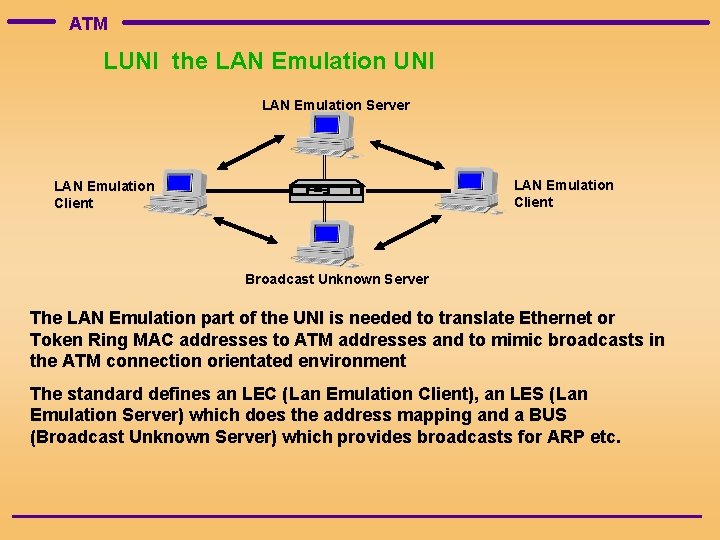
ATM LUNI the LAN Emulation UNI LAN Emulation Server LAN Emulation Client Broadcast Unknown Server The LAN Emulation part of the UNI is needed to translate Ethernet or Token Ring MAC addresses to ATM addresses and to mimic broadcasts in the ATM connection orientated environment The standard defines an LEC (Lan Emulation Client), an LES (Lan Emulation Server) which does the address mapping and a BUS (Broadcast Unknown Server) which provides broadcasts for ARP etc.
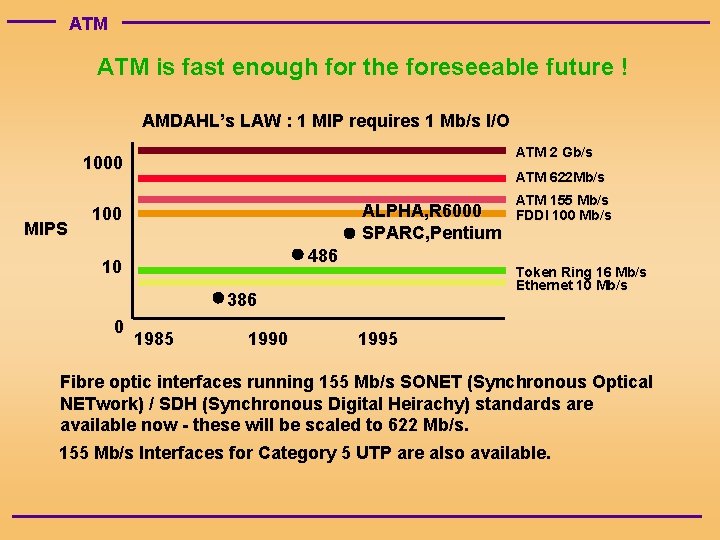
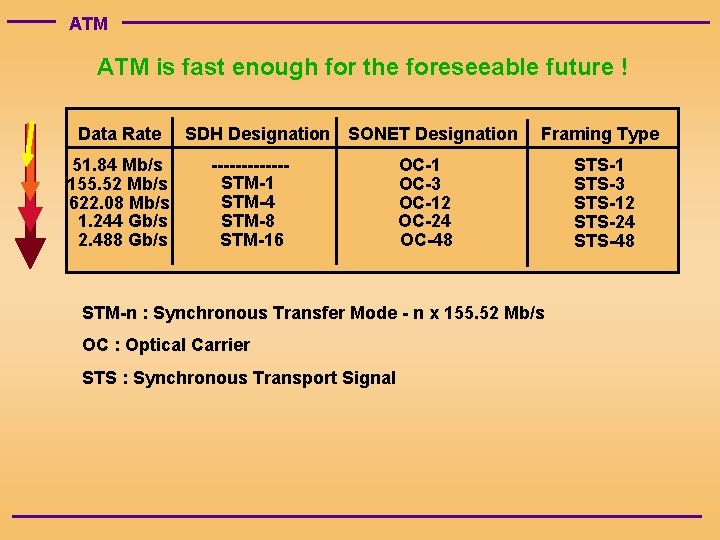
ATM is fast enough for the foreseeable future ! AMDAHL’s LAW : 1 MIP requires 1 Mb/s I/O ATM 2 Gb/s 1000 MIPS ATM 622 Mb/s ALPHA, R 6000 SPARC, Pentium 100 486 10 Token Ring 16 Mb/s Ethernet 10 Mb/s 386 0 1985 1990 ATM 155 Mb/s FDDI 100 Mb/s 1995 Fibre optic interfaces running 155 Mb/s SONET (Synchronous Optical NETwork) / SDH (Synchronous Digital Heirachy) standards are available now - these will be scaled to 622 Mb/s. 155 Mb/s Interfaces for Category 5 UTP are also available.
ATM is fast enough for the foreseeable future ! Data Rate 51. 84 Mb/s 155. 52 Mb/s 622. 08 Mb/s 1. 244 Gb/s 2. 488 Gb/s SDH Designation SONET Designation ------STM-1 STM-4 STM-8 STM-16 Framing Type OC-1 OC-3 OC-12 OC-24 OC-48 STM-n : Synchronous Transfer Mode - n x 155. 52 Mb/s OC : Optical Carrier STS : Synchronous Transport Signal STS-1 STS-3 STS-12 STS-24 STS-48
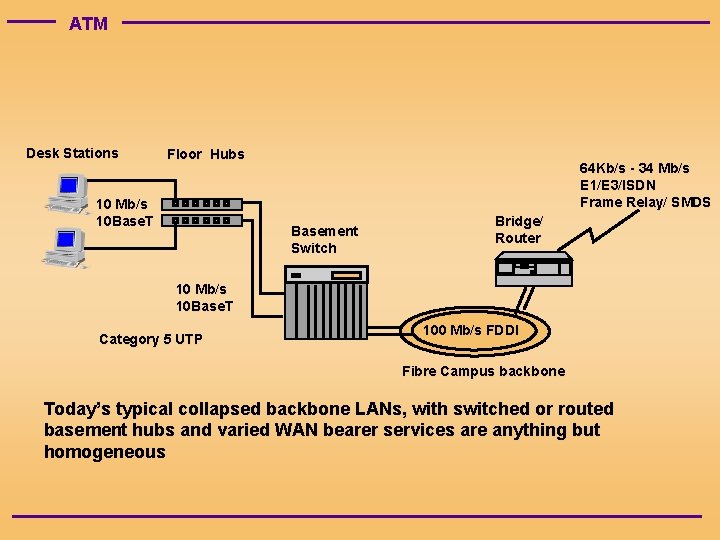
ATM Desk Stations Floor Hubs 10 Mb/s 10 Base. T 64 Kb/s - 34 Mb/s E 1/E 3/ISDN Frame Relay/ SMDS Basement Switch Bridge/ Router 10 Mb/s 10 Base. T Category 5 UTP 100 Mb/s FDDI Fibre Campus backbone Today’s typical collapsed backbone LANs, with switched or routed basement hubs and varied WAN bearer services are anything but homogeneous
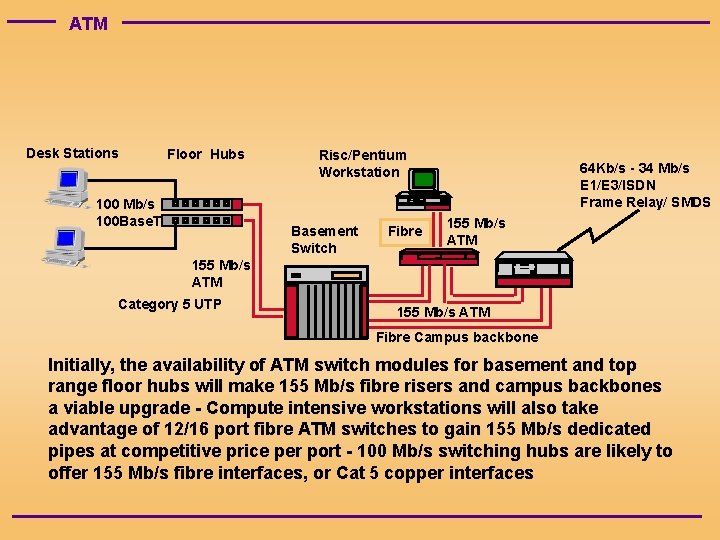
ATM Desk Stations Floor Hubs 100 Mb/s 100 Base. T Risc/Pentium Workstation Basement Switch Fibre 64 Kb/s - 34 Mb/s E 1/E 3/ISDN Frame Relay/ SMDS 155 Mb/s ATM Category 5 UTP 155 Mb/s ATM Fibre Campus backbone Initially, the availability of ATM switch modules for basement and top range floor hubs will make 155 Mb/s fibre risers and campus backbones a viable upgrade - Compute intensive workstations will also take advantage of 12/16 port fibre ATM switches to gain 155 Mb/s dedicated pipes at competitive price per port - 100 Mb/s switching hubs are likely to offer 155 Mb/s fibre interfaces, or Cat 5 copper interfaces
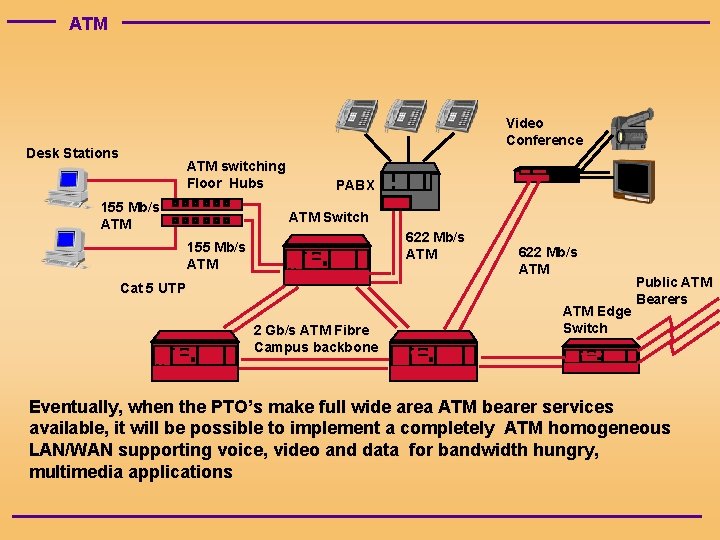
ATM Video Conference Desk Stations ATM switching Floor Hubs 155 Mb/s ATM PABX ATM Switch 622 Mb/s ATM 155 Mb/s ATM 622 Mb/s ATM Cat 5 UTP 2 Gb/s ATM Fibre Campus backbone ATM Edge Switch Public ATM Bearers Eventually, when the PTO’s make full wide area ATM bearer services available, it will be possible to implement a completely ATM homogeneous LAN/WAN supporting voice, video and data for bandwidth hungry, multimedia applications
ATM THE GIGABIT PER SECOND FUTURE FOR MULTIMEDIA ENTERPRISE NETWORKS