
ATLAS through first data Fabiola Gianotti on behalf
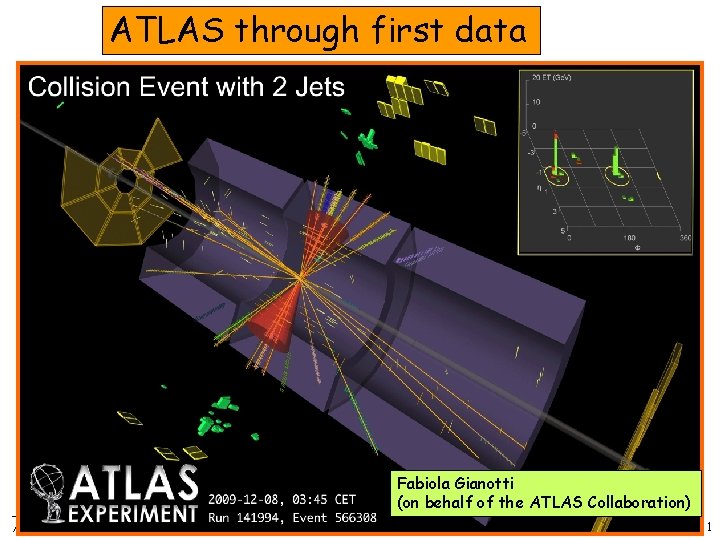
ATLAS through first data Fabiola Gianotti (on behalf of the ATLAS Collaboration) ATLAS, 18 -12 -2009 1
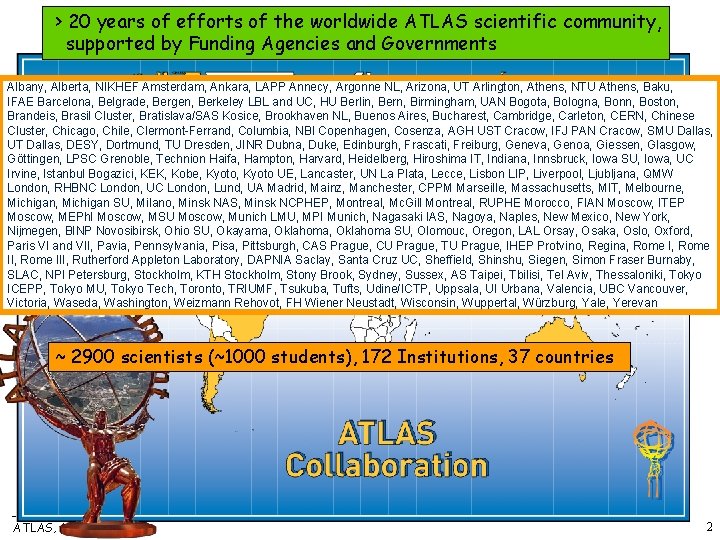
> 20 years of efforts of the worldwide ATLAS scientific community, supported by Funding Agencies and Governments Albany, Alberta, NIKHEF Amsterdam, Ankara, LAPP Annecy, Argonne NL, Arizona, UT Arlington, Athens, NTU Athens, Baku, IFAE Barcelona, Belgrade, Bergen, Berkeley LBL and UC, HU Berlin, Bern, Birmingham, UAN Bogota, Bologna, Bonn, Boston, Brandeis, Brasil Cluster, Bratislava/SAS Kosice, Brookhaven NL, Buenos Aires, Bucharest, Cambridge, Carleton, CERN, Chinese Cluster, Chicago, Chile, Clermont-Ferrand, Columbia, NBI Copenhagen, Cosenza, AGH UST Cracow, IFJ PAN Cracow, SMU Dallas, UT Dallas, DESY, Dortmund, TU Dresden, JINR Dubna, Duke, Edinburgh, Frascati, Freiburg, Geneva, Genoa, Giessen, Glasgow, Göttingen, LPSC Grenoble, Technion Haifa, Hampton, Harvard, Heidelberg, Hiroshima IT, Indiana, Innsbruck, Iowa SU, Iowa, UC Irvine, Istanbul Bogazici, KEK, Kobe, Kyoto UE, Lancaster, UN La Plata, Lecce, Lisbon LIP, Liverpool, Ljubljana, QMW London, RHBNC London, UC London, Lund, UA Madrid, Mainz, Manchester, CPPM Marseille, Massachusetts, MIT, Melbourne, Michigan, Michigan SU, Milano, Minsk NAS, Minsk NCPHEP, Montreal, Mc. Gill Montreal, RUPHE Morocco, FIAN Moscow, ITEP Moscow, MEPh. I Moscow, MSU Moscow, Munich LMU, MPI Munich, Nagasaki IAS, Nagoya, Naples, New Mexico, New York, Nijmegen, BINP Novosibirsk, Ohio SU, Okayama, Oklahoma SU, Olomouc, Oregon, LAL Orsay, Osaka, Oslo, Oxford, Paris VI and VII, Pavia, Pennsylvania, Pisa, Pittsburgh, CAS Prague, CU Prague, TU Prague, IHEP Protvino, Regina, Rome II, Rome III, Rutherford Appleton Laboratory, DAPNIA Saclay, Santa Cruz UC, Sheffield, Shinshu, Siegen, Simon Fraser Burnaby, SLAC, NPI Petersburg, Stockholm, KTH Stockholm, Stony Brook, Sydney, Sussex, AS Taipei, Tbilisi, Tel Aviv, Thessaloniki, Tokyo ICEPP, Tokyo MU, Tokyo Tech, Toronto, TRIUMF, Tsukuba, Tufts, Udine/ICTP, Uppsala, UI Urbana, Valencia, UBC Vancouver, Victoria, Waseda, Washington, Weizmann Rehovot, FH Wiener Neustadt, Wisconsin, Wuppertal, Würzburg, Yale, Yerevan ~ 2900 scientists (~1000 students), 172 Institutions, 37 countries ATLAS, 18 -12 -2009 2
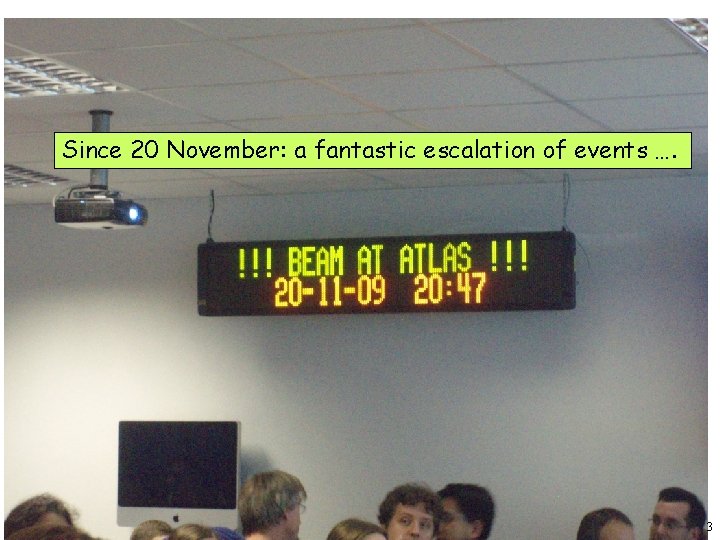
Since 20 November: a fantastic escalation of events …. ATLAS, 18 -12 -2009 3
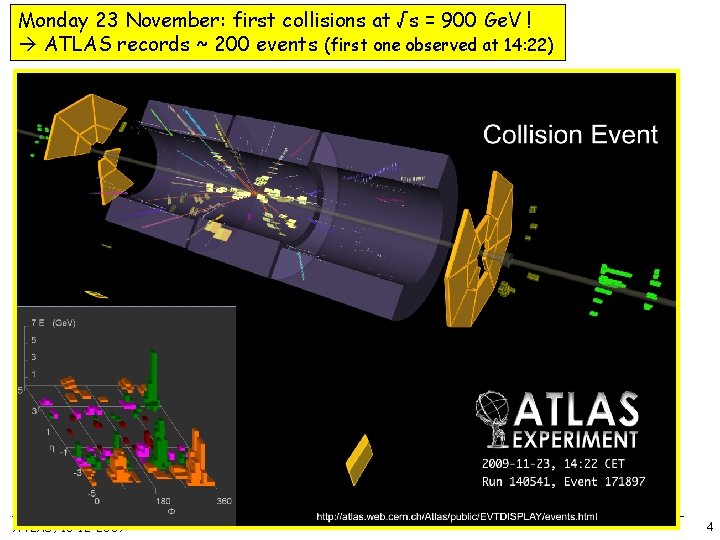
Monday 23 November: first collisions at √s = 900 Ge. V ! ATLAS records ~ 200 events (first one observed at 14: 22) ATLAS, 18 -12 -2009 4
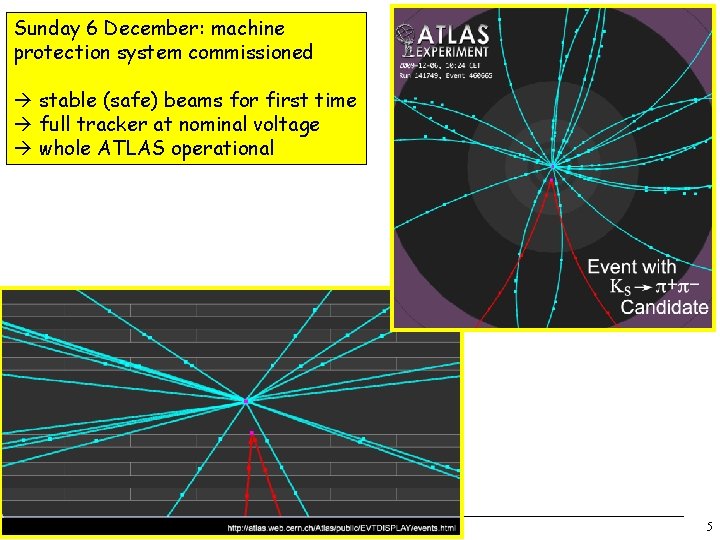
Sunday 6 December: machine protection system commissioned stable (safe) beams for first time full tracker at nominal voltage whole ATLAS operational ATLAS, 18 -12 -2009 5
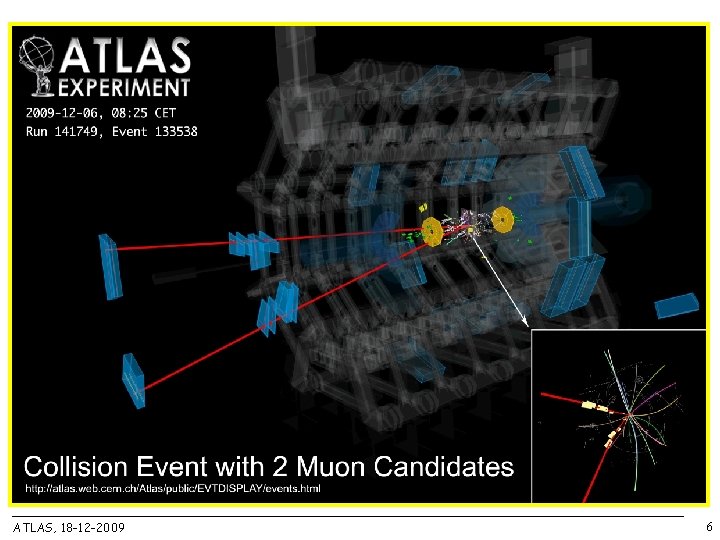
ATLAS, 18 -12 -2009 6
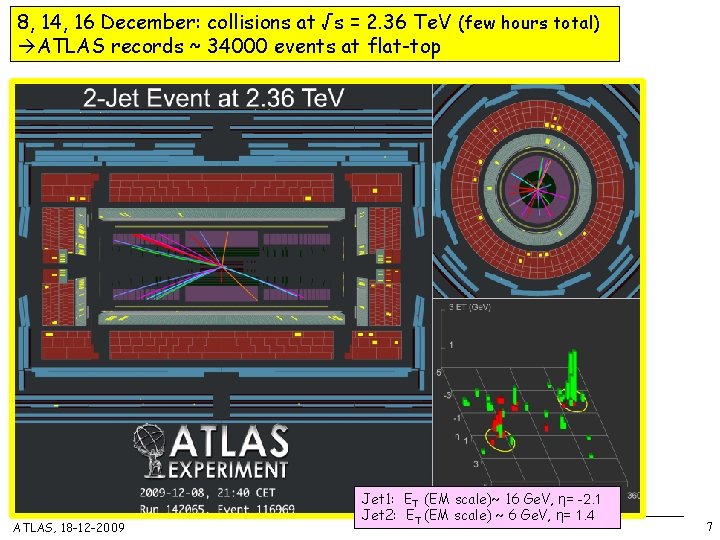
8, 14, 16 December: collisions at √s = 2. 36 Te. V (few hours total) ATLAS records ~ 34000 events at flat-top ATLAS, 18 -12 -2009 Jet 1: ET (EM scale)~ 16 Ge. V, η= -2. 1 Jet 2: ET (EM scale) ~ 6 Ge. V, η= 1. 4 7
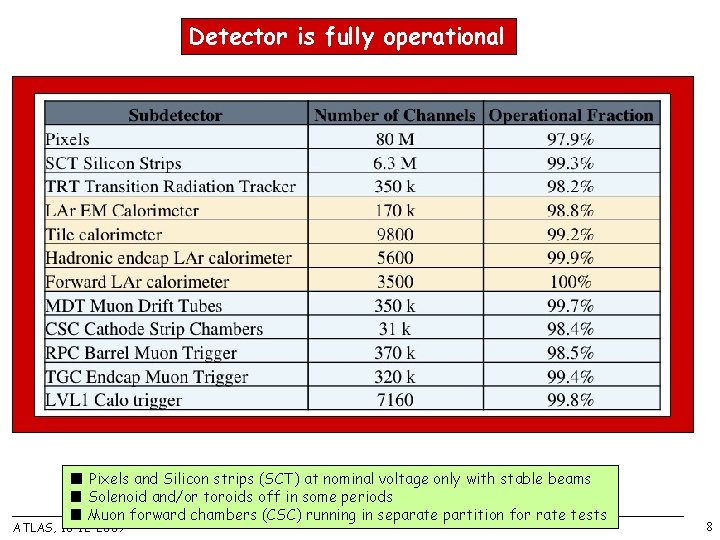
Detector is fully operational Online detector control panel ■ Pixels and Silicon strips (SCT) at nominal voltage only with stable beams ■ Solenoid and/or toroids off in some periods ■ Muon forward chambers (CSC) running in separate partition for rate tests ATLAS, 18 -12 -2009 8
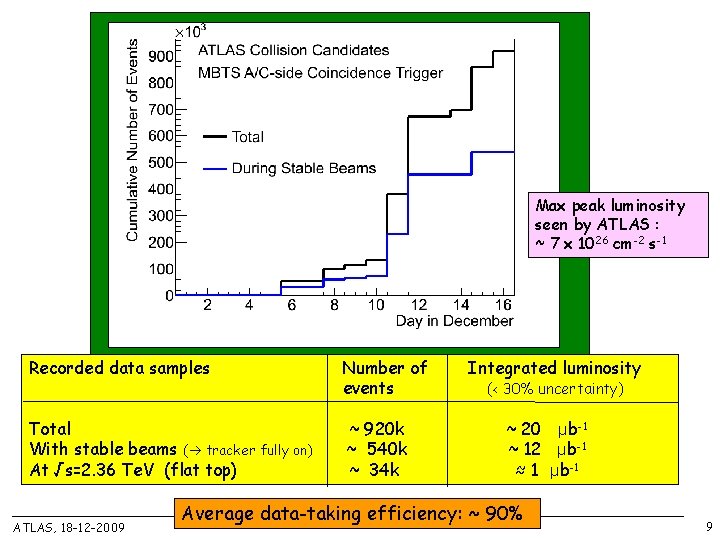
Max peak luminosity seen by ATLAS : ~ 7 x 1026 cm-2 s-1 Recorded data samples Number of events Total With stable beams ( tracker fully on) At √s=2. 36 Te. V (flat top) ~ 920 k ~ 540 k ~ 34 k ATLAS, 18 -12 -2009 Integrated luminosity (< 30% uncertainty) ~ 20 μb-1 ~ 12 μb-1 ≈ 1 μb-1 Average data-taking efficiency: ~ 90% 9
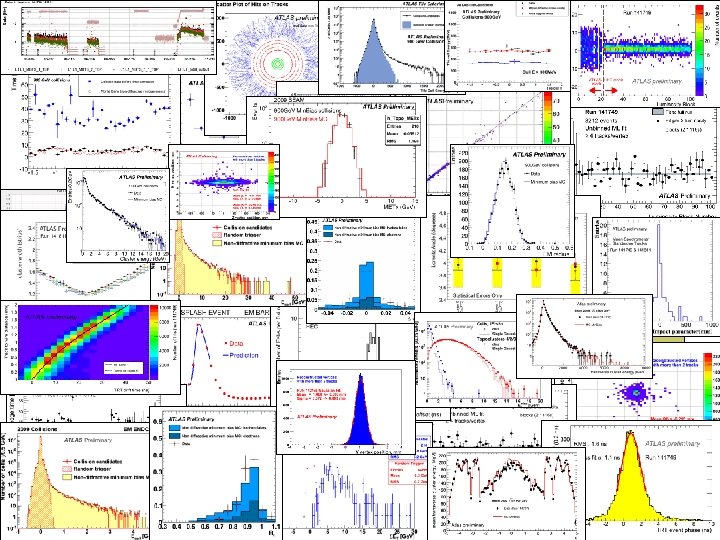
In the following: few examples from large number of (preliminary) detector performance results obtained in only a few days …. ATLAS, 18 -12 -2009 10
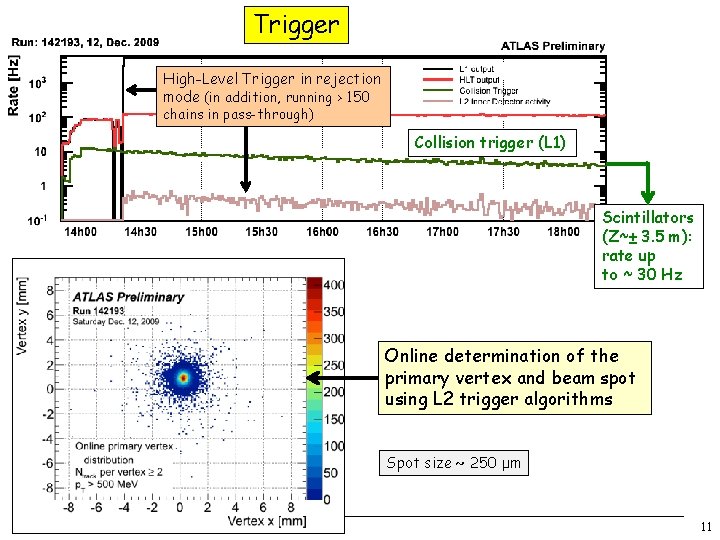
Trigger High-Level Trigger in rejection mode (in addition, running > 150 chains in pass-through) Collision trigger (L 1) Scintillators (Z~± 3. 5 m): rate up to ~ 30 Hz Online determination of the primary vertex and beam spot using L 2 trigger algorithms Spot size ~ 250 μm ATLAS, 18 -12 -2009 11
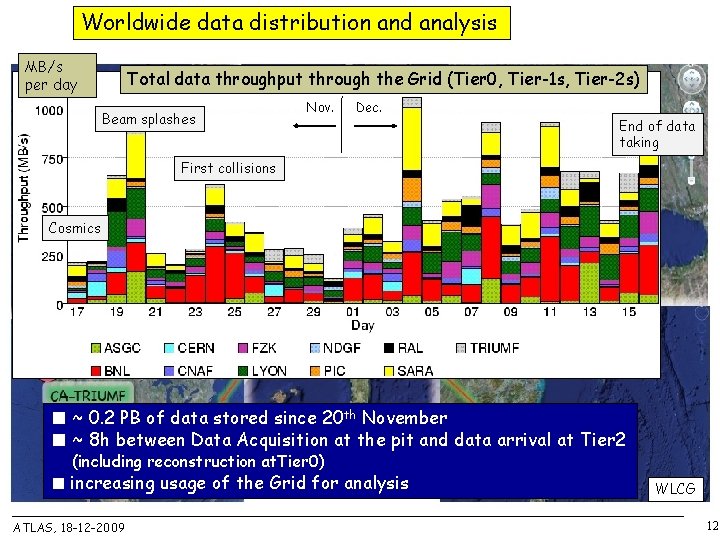
Worldwide data distribution and analysis MB/s per day Total data throughput through the Grid (Tier 0, Tier-1 s, Tier-2 s) Beam splashes Nov. Dec. End of data taking First collisions Cosmics ■ ~ 0. 2 PB of data stored since 20 th November ■ ~ 8 h between Data Acquisition at the pit and data arrival at Tier 2 (including reconstruction at. Tier 0) ■ increasing usage of the Grid for analysis ATLAS, 18 -12 -2009 WLCG 12
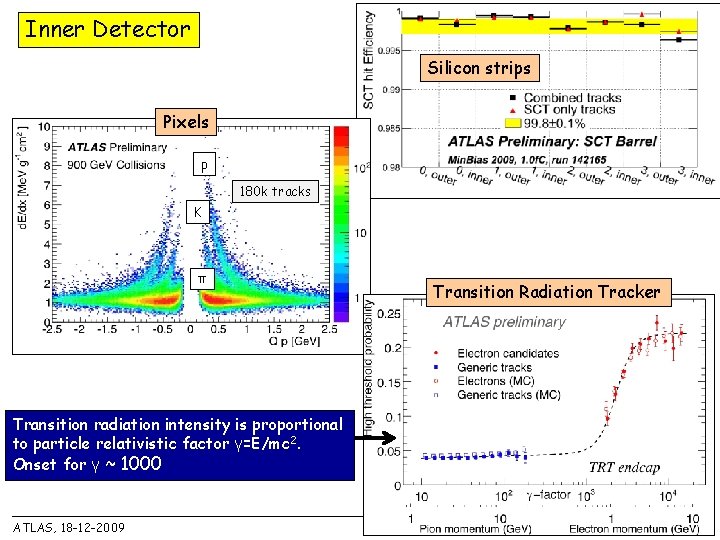
Inner Detector Silicon strips Pixels p 180 k tracks K π Transition Radiation Tracker Transition radiation intensity is proportional to particle relativistic factor γ=E/mc 2. Onset for γ ~ 1000 ATLAS, 18 -12 -2009 13
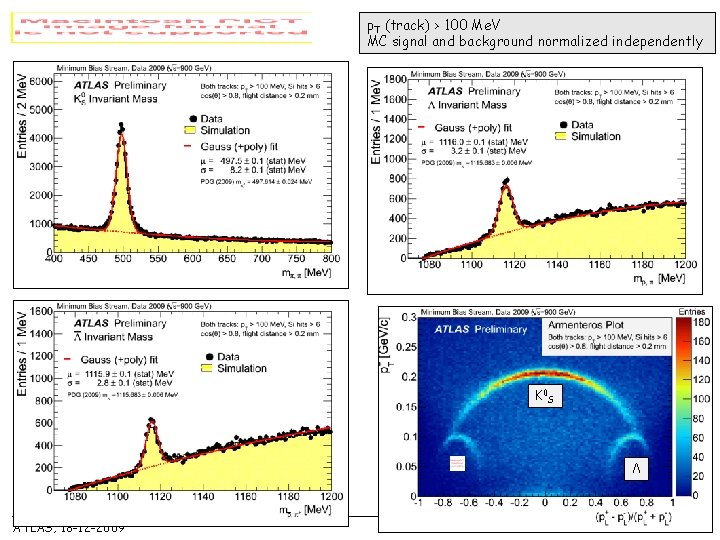
p. T (track) > 100 Me. V MC signal and background normalized independently K 0 S Λ ATLAS, 18 -12 -2009 14
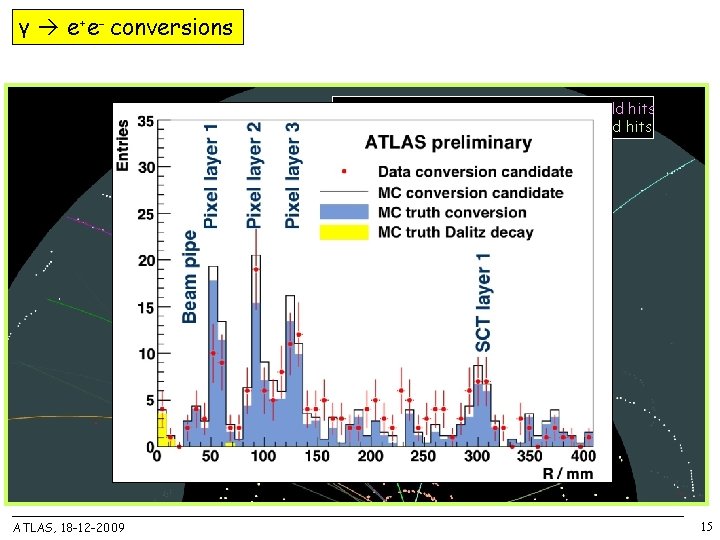
γ e+e- conversions p. T (e+) = 1. 75 Ge. V, 11 TRT high-threshold hits p. T (e-) = 0. 79 Ge. V, 3 TRT high-threshold hits ee+ ATLAS, 18 -12 -2009 γ conversion point R ~ 30 cm (1 st SCT layer) 15
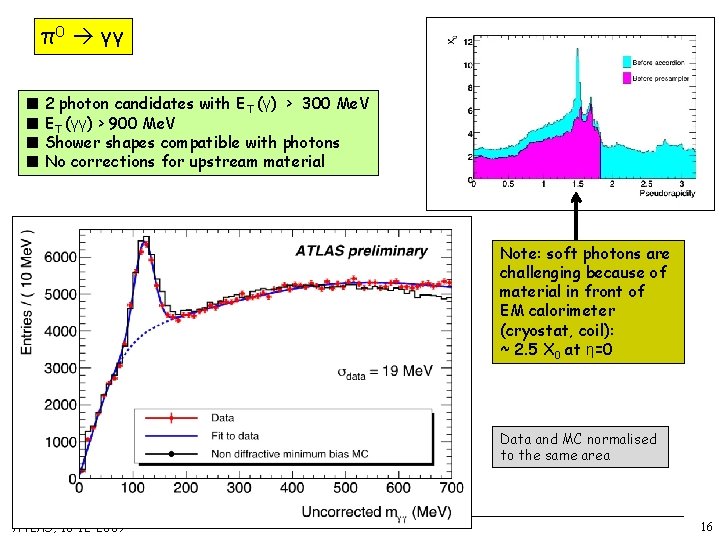
π0 γγ ■ 2 photon candidates with ET (γ) > 300 Me. V ■ ET (γγ) > 900 Me. V ■ Shower shapes compatible with photons ■ No corrections for upstream material Note: soft photons are challenging because of material in front of EM calorimeter (cryostat, coil): ~ 2. 5 X 0 at η=0 Data and MC normalised to the same area ATLAS, 18 -12 -2009 16
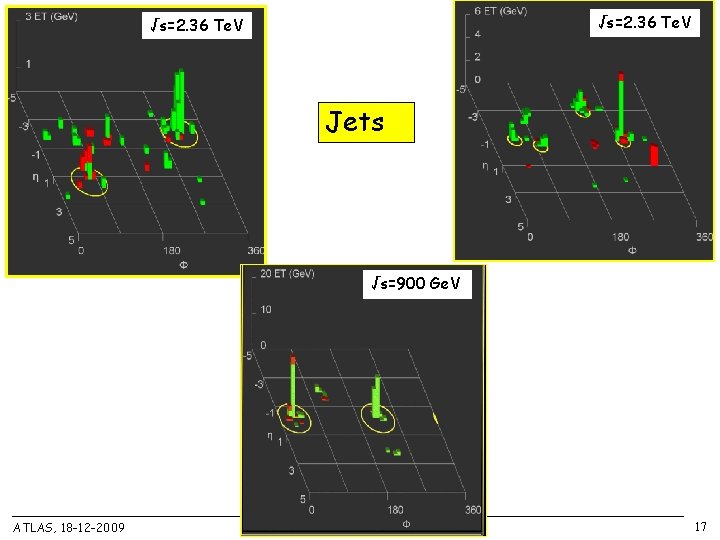
√s=2. 36 Te. V Jets √s=900 Ge. V ATLAS, 18 -12 -2009 17
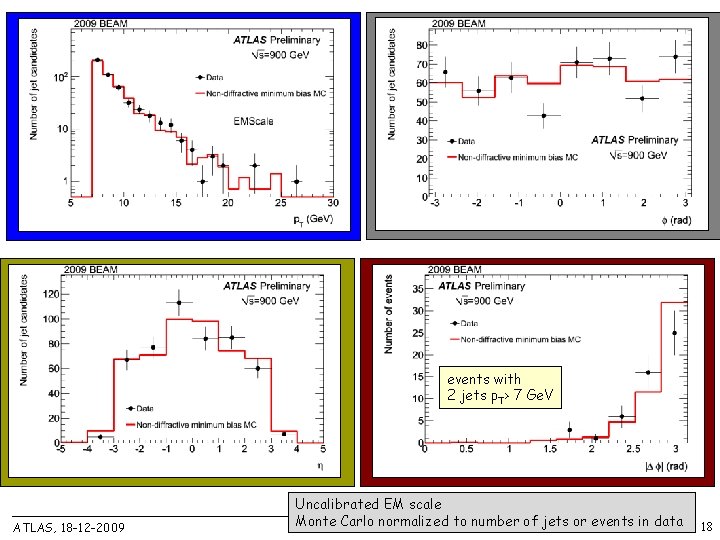
events with 2 jets p. T> 7 Ge. V ATLAS, 18 -12 -2009 Uncalibrated EM scale Monte Carlo normalized to number of jets or events in data 18
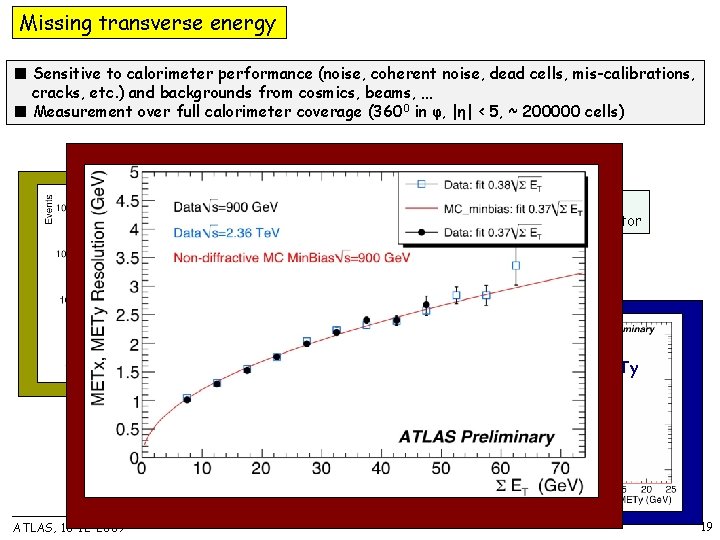
Missing transverse energy ■ Sensitive to calorimeter performance (noise, coherent noise, dead cells, mis-calibrations, cracks, etc. ) and backgrounds from cosmics, beams, … ■ Measurement over full calorimeter coverage (3600 in φ, |η| < 5, ~ 200000 cells) METx / METy indicate x/y components of missing ET vector METx METy ATLAS, 18 -12 -2009 19
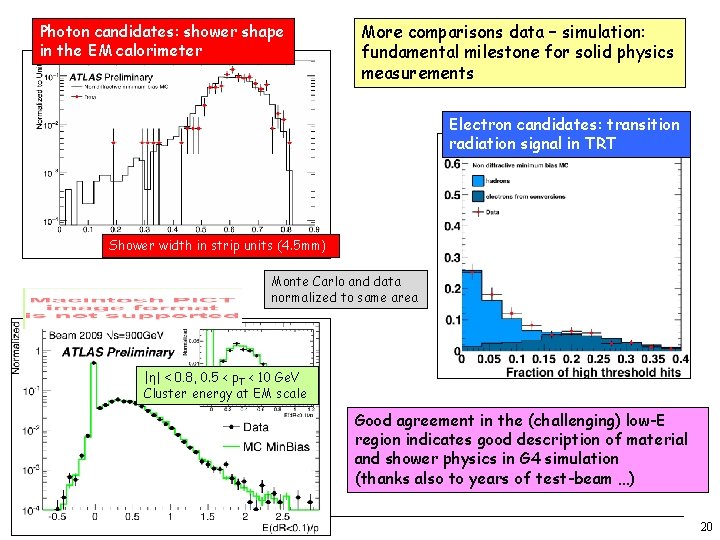
Photon candidates: shower shape in the EM calorimeter More comparisons data – simulation: fundamental milestone for solid physics measurements Electron candidates: transition radiation signal in TRT Shower width in strip units (4. 5 mm) Monte Carlo and data normalized to same area |η| < 0. 8, 0. 5 < p. T < 10 Ge. V Cluster energy at EM scale Good agreement in the (challenging) low-E region indicates good description of material and shower physics in G 4 simulation (thanks also to years of test-beam …) ATLAS, 18 -12 -2009 20
Conclusions ■ ATLAS has successfully collected first LHC collision data. ■ The whole experiment operated efficiently and fast, from data taking at the pit, to data transfer worldwide, to the production of first results (on a very short time scale … few days). ■ First LHC data indicate that the performance of the detector, simulation and reconstruction (including the understanding of material and control of instrumental effects) is far better than expected at this (initial) stage of the experiment and in an energy regime ATLAS was not optimized for. ■ Years of test beam activities, increasingly realistic simulations, and commissioning with cosmics to understand optimize the detector performance and validate the software tools were fundamental to achieve these results. ■ The enthusiasm and the team spirit in the Collaboration are extraordinary. This is only the beginning of an exciting physics phase and a major achievement of the worldwide ATLAS Collaboration after > 20 years of efforts to build a detector of unprecedented technology, complexity and performance. ATLAS, 18 -12 -2009 21
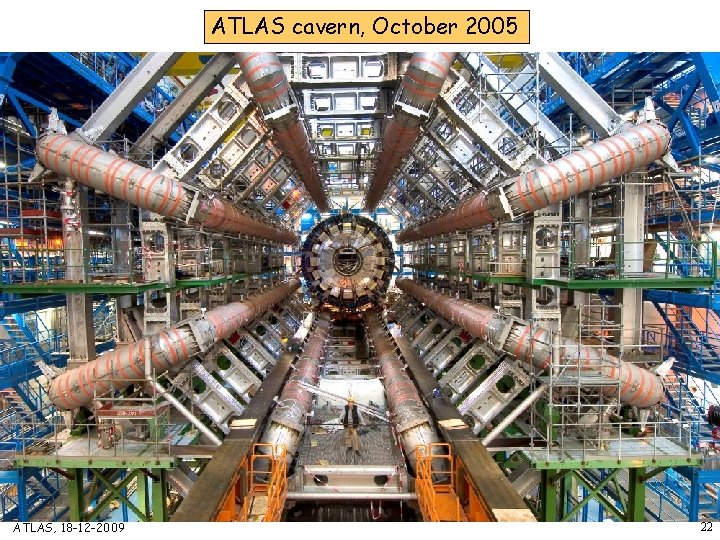
ATLAS cavern, October 2005 ATLAS, 18 -12 -2009 22
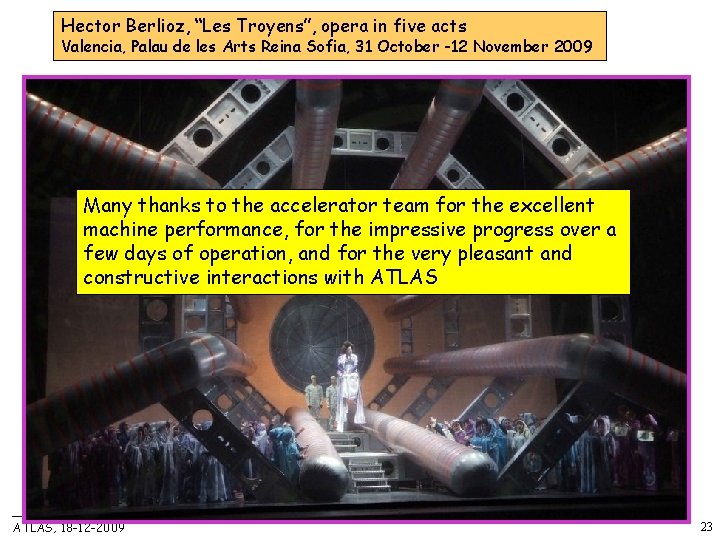
Hector Berlioz, “Les Troyens”, opera in five acts Valencia, Palau de les Arts Reina Sofia, 31 October -12 November 2009 Many thanks to the accelerator team for the excellent machine performance, for the impressive progress over a few days of operation, and for the very pleasant and constructive interactions with ATLAS, 18 -12 -2009 23
Back-up ATLAS, 18 -12 -2009 24
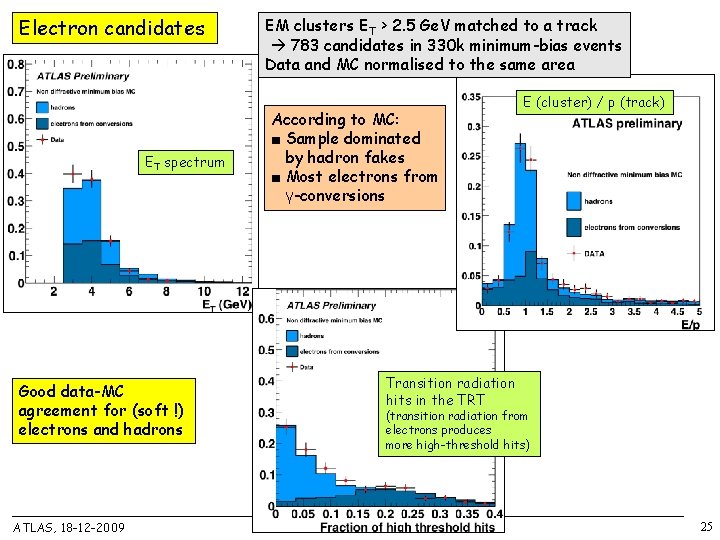
Electron candidates ET spectrum Good data-MC agreement for (soft !) electrons and hadrons ATLAS, 18 -12 -2009 EM clusters ET > 2. 5 Ge. V matched to a track 783 candidates in 330 k minimum-bias events Data and MC normalised to the same area According to MC: ■ Sample dominated by hadron fakes ■ Most electrons from γ-conversions E (cluster) / p (track) Transition radiation hits in the TRT (transition radiation from electrons produces more high-threshold hits) 25
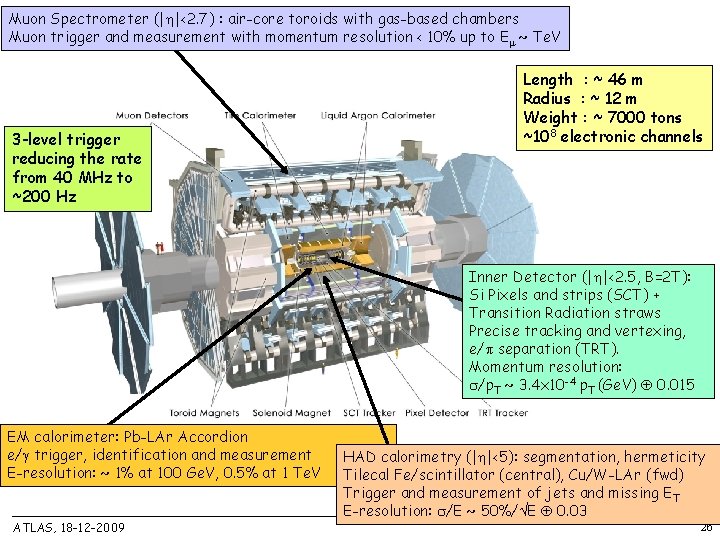
Muon Spectrometer (| |<2. 7) : air-core toroids with gas-based chambers Muon trigger and measurement with momentum resolution < 10% up to E ~ Te. V 3 -level trigger reducing the rate from 40 MHz to ~200 Hz Length : ~ 46 m Radius : ~ 12 m Weight : ~ 7000 tons ~108 electronic channels Inner Detector (| |<2. 5, B=2 T): Si Pixels and strips (SCT) + Transition Radiation straws Precise tracking and vertexing, e/ separation (TRT). Momentum resolution: /p. T ~ 3. 4 x 10 -4 p. T (Ge. V) 0. 015 EM calorimeter: Pb-LAr Accordion e/ trigger, identification and measurement E-resolution: ~ 1% at 100 Ge. V, 0. 5% at 1 Te. V ATLAS, 18 -12 -2009 HAD calorimetry (| |<5): segmentation, hermeticity Tilecal Fe/scintillator (central), Cu/W-LAr (fwd) Trigger and measurement of jets and missing ET E-resolution: /E ~ 50%/ E 0. 03 26
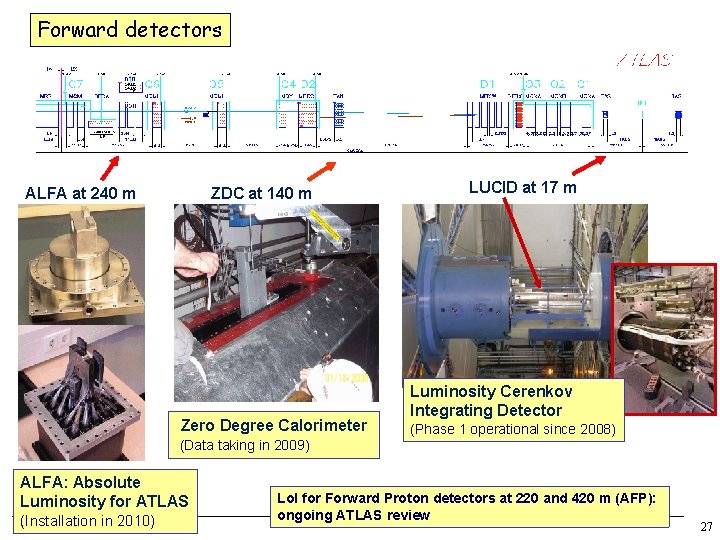
Forward detectors ALFA at 240 m ZDC at 140 m Zero Degree Calorimeter LUCID at 17 m Luminosity Cerenkov Integrating Detector (Phase 1 operational since 2008) (Data taking in 2009) ALFA: Absolute Luminosity for ATLAS (Installation in 2010) ATLAS, 18 -12 -2009 Lo. I for Forward Proton detectors at 220 and 420 m (AFP): ongoing ATLAS review 27
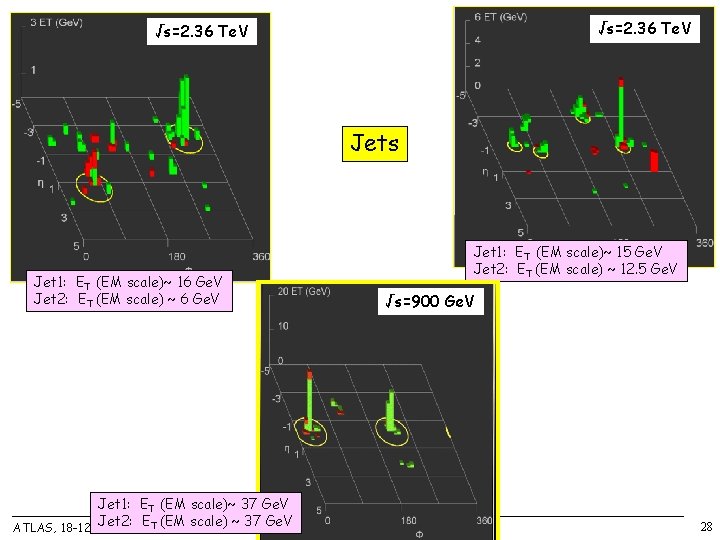
√s=2. 36 Te. V Jets Jet 1: ET (EM scale)~ 16 Ge. V Jet 2: ET (EM scale) ~ 6 Ge. V Jet 1: ET (EM scale)~ 37 Ge. V Jet 2: ET (EM scale) ~ 37 Ge. V ATLAS, 18 -12 -2009 Jet 1: ET (EM scale)~ 15 Ge. V Jet 2: ET (EM scale) ~ 12. 5 Ge. V √s=900 Ge. V 28
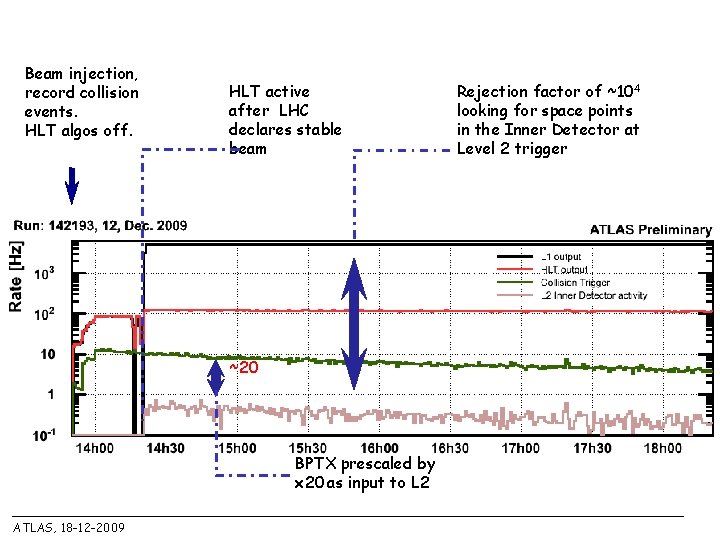
Beam injection, record collision events. HLT algos off. HLT active after LHC declares stable beam ~20 BPTX prescaled by x 20 as input to L 2 ATLAS, 18 -12 -2009 Rejection factor of ~104 looking for space points in the Inner Detector at Level 2 trigger
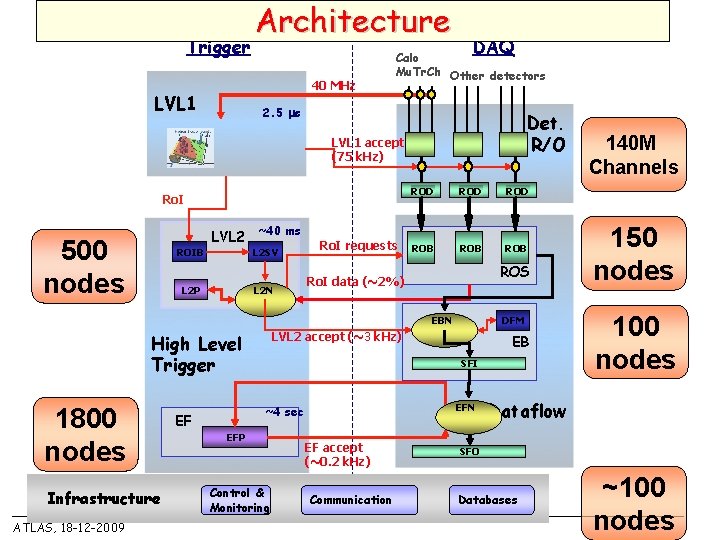
Trigger Architecture 40 MHz LVL 1 DAQ Calo Mu. Tr. Ch Other detectors 2. 5 ms Det. R/O LVL 1 accept (75 k. Hz) Ro. I 500 nodes ROIB LVL 2 ~40 ms L 2 SV L 2 N L 2 P Ro. I requests ROD ROD ROB ROB ROS Ro. I data (~2%) DFM EBN LVL 2 accept (~3 k. Hz) High Level Trigger 1800 nodes Infrastructure ATLAS, 18 -12 -2009 SFI EFN ~4 sec EF EB EFP Control & Monitoring EF accept (~0. 2 k. Hz) Communication 140 M Channels 150 nodes 100 nodes Dataflow SFO Databases ~100 nodes
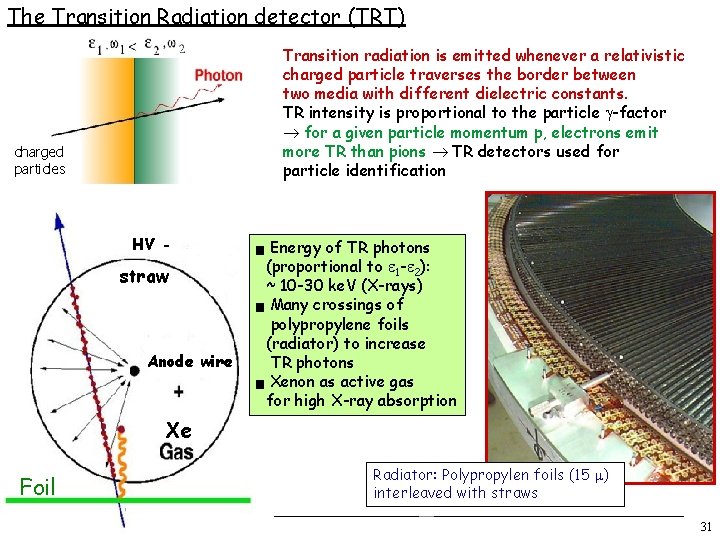
The Transition Radiation detector (TRT) Transition radiation is emitted whenever a relativistic charged particle traverses the border between two media with different dielectric constants. TR intensity is proportional to the particle -factor for a given particle momentum p, electrons emit more TR than pions TR detectors used for particle identification charged particles HV - straw Anode wire Energy of TR photons (proportional to 1 - 2): ~ 10 -30 ke. V (X-rays) g Many crossings of polypropylene foils (radiator) to increase TR photons g Xenon as active gas for high X-ray absorption g Xe Foil ATLAS, 18 -12 -2009 Radiator: Polypropylen foils (15 ) interleaved with straws 31
ATLAS, 18 -12 -2009 32
- Slides: 32