
ATLAS Forum SLAC April 2007 Hadron Collisions Inside
- Slides: 41
ATLAS Forum, SLAC, April 2007 Hadron Collisions Inside and Out Peter Skands Fermilab / Particle Physics Division / Theoretical Physics Sjöstrand, PS : NPB 659(2003)243, JHEP 03(2004)053, EPJC 39(2005)129; PS, Wicke : hep-ph/0703081; Plehn, Rainwater, PS : PLB 645(2007)217 + hep-ph/0511306
Overview ► Introduction • QCD & Event Generators ► Towards Improved Event Generators • Parton Showers • Combining Matrix Elements and Parton Showers (1) • Second part in theory seminar tomorrow • Minimum Bias and the ‘Underlying Event’ ► The Event Generator Outlook • The move to C++ Peter Skands Event Generator Status 2
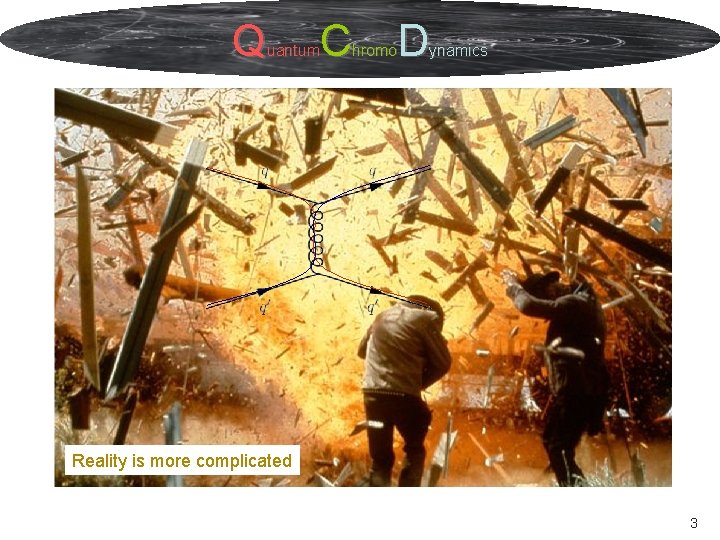
Q C D uantum hromo ynamics ► Main Tool • Matrix Elements in perturbative Quantum Field Theory • Example: Reality is more complicated Peter Skands Event Generator Status 3
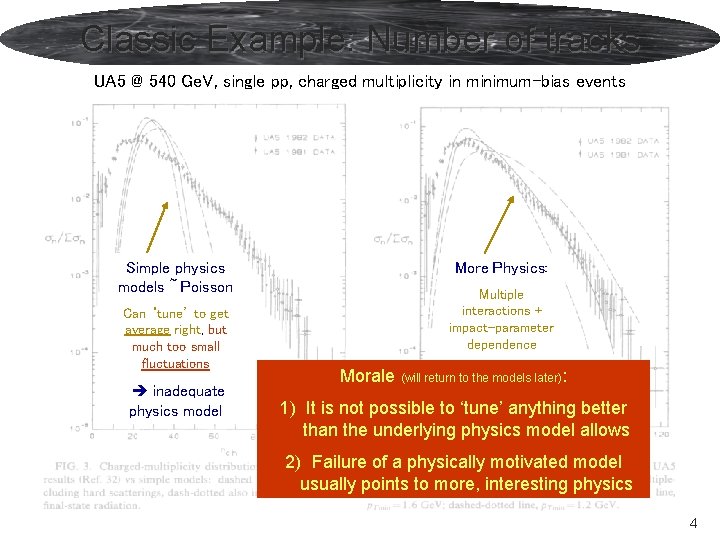
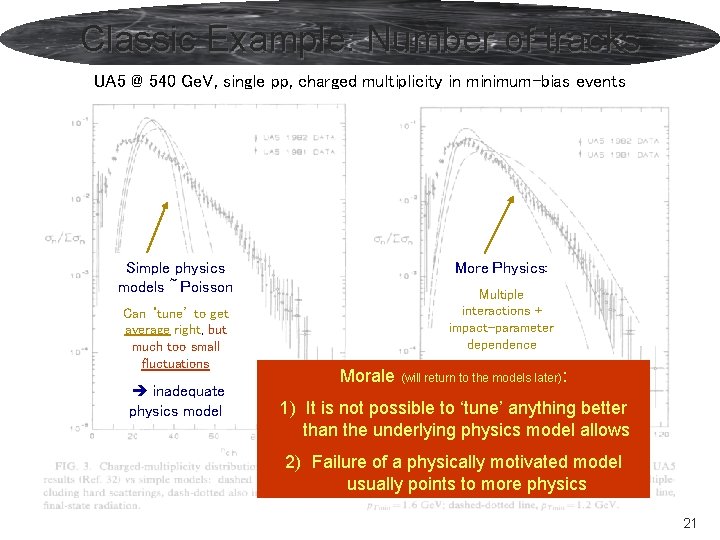
Classic Example: Number of tracks UA 5 @ 540 Ge. V, single pp, charged multiplicity in minimum-bias events Simple physics models ~ Poisson Can ‘tune’ to get average right, but much too small fluctuations inadequate physics model More Physics: Multiple interactions + impact-parameter dependence Morale (will return to the models later): 1) It is not possible to ‘tune’ anything better than the underlying physics model allows 2) Failure of a physically motivated model usually points to more, interesting physics Peter Skands Event Generator Status 4
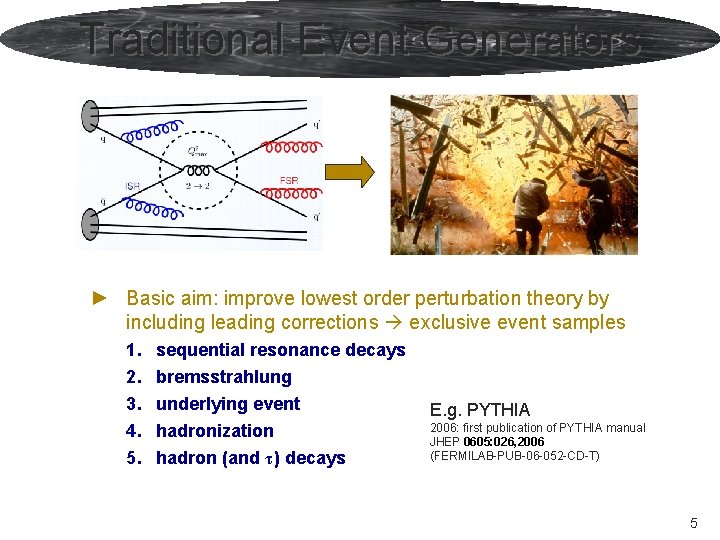
Traditional Event Generators ► Basic aim: improve lowest order perturbation theory by including leading corrections exclusive event samples 1. 2. 3. 4. 5. Peter Skands sequential resonance decays bremsstrahlung underlying event hadronization hadron (and τ) decays Event Generator Status E. g. PYTHIA 2006: first publication of PYTHIA manual JHEP 0605: 026, 2006 (FERMILAB-PUB-06 -052 -CD-T) 5
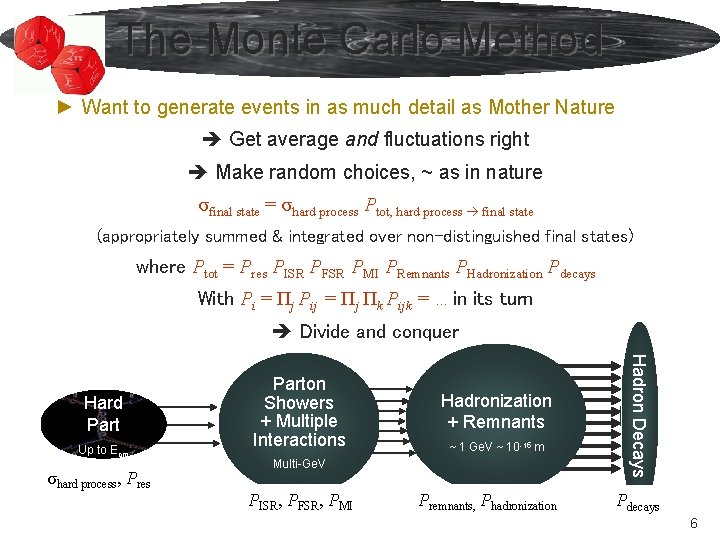
The Monte Carlo Method ► Want to generate events in as much detail as Mother Nature Get average and fluctuations right Make random choices, ~ as in nature σfinal state = σhard process Ptot, hard process final state (appropriately summed & integrated over non-distinguished final states) where Ptot = Pres PISR PFSR PMI PRemnants PHadronization Pdecays With Pi = Πj Pij = Πj Πk Pijk = …in its turn Divide and conquer Up to Ecm σhard process, Pres Peter Skands Hadronization + Remnants ~ 1 Ge. V ~ 10 -15 m Multi-Ge. V PISR, PFSR, PMI Event Generator Status Premnants, Phadronization Hadron Decays Hard Parton Showers + Multiple Interactions Pdecays 6
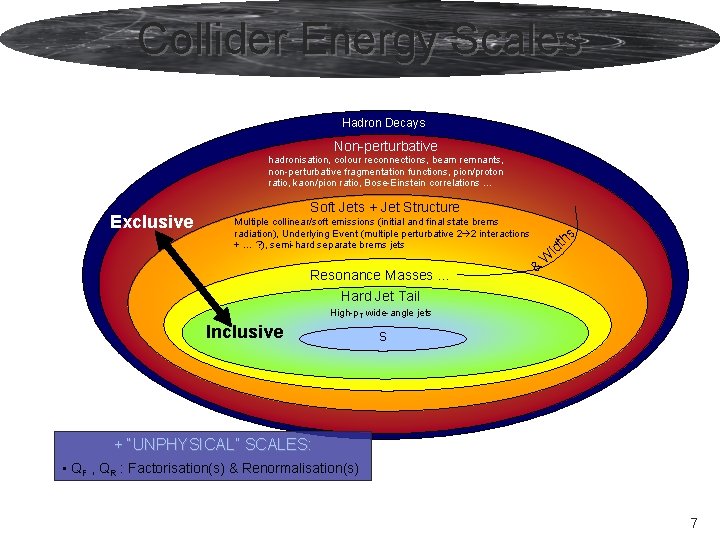
Collider Energy Scales Hadron Decays Non-perturbative hadronisation, colour reconnections, beam remnants, non-perturbative fragmentation functions, pion/proton ratio, kaon/pion ratio, Bose-Einstein correlations. . . Exclusive Soft Jets + Jet Structure Multiple collinear/soft emissions (initial and final state brems radiation), Underlying Event (multiple perturbative 2 2 interactions + … ? ), semi-hard separate brems jets Resonance Masses … hs t d i & W Hard Jet Tail High-p. T wide-angle jets Inclusive s + “UNPHYSICAL” SCALES: • QF , QR : Factorisation(s) & Renormalisation(s) Peter Skands Event Generator Status 7
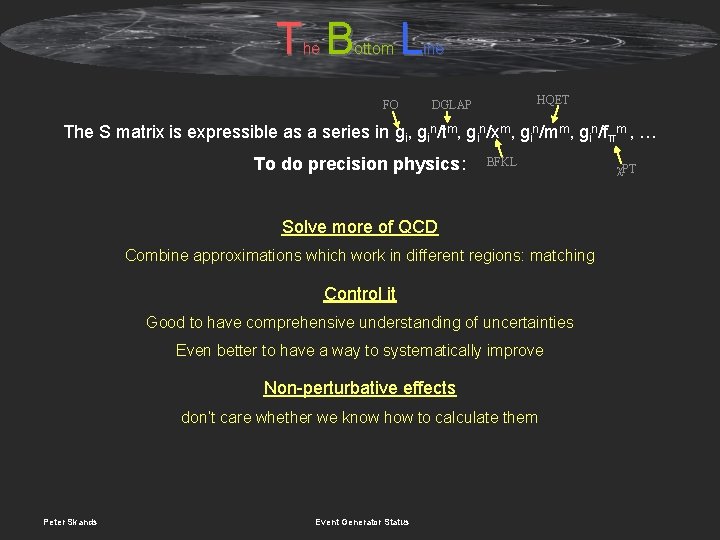
T B L he ottom FO ine HQET DGLAP The S matrix is expressible as a series in gi, gin/tm, gin/xm, gin/mm, gin/fπm , … To do precision physics: BFKL χPT Solve more of QCD Combine approximations which work in different regions: matching Control it Good to have comprehensive understanding of uncertainties Even better to have a way to systematically improve Non-perturbative effects don’t care whether we know how to calculate them Peter Skands Event Generator Status 8
QCD-based Event Generators Parton Showers & Matching
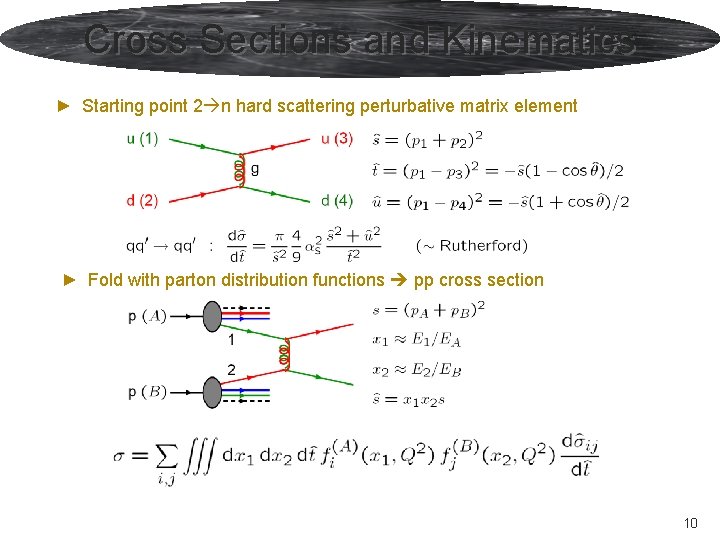
Cross Sections and Kinematics ► Starting point 2 n hard scattering perturbative matrix element ► Fold with parton distribution functions pp cross section Peter Skands Event Generator Status 10
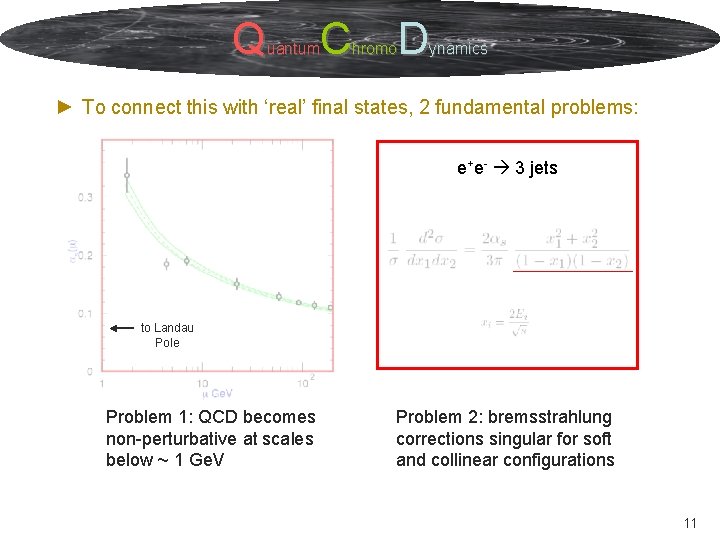
Q C D uantum hromo ynamics ► To connect this with ‘real’ final states, 2 fundamental problems: e+e- 3 jets to Landau Pole Problem 1: QCD becomes non-perturbative at scales below ~ 1 Ge. V Peter Skands Problem 2: bremsstrahlung corrections singular for soft and collinear configurations Event Generator Status 11
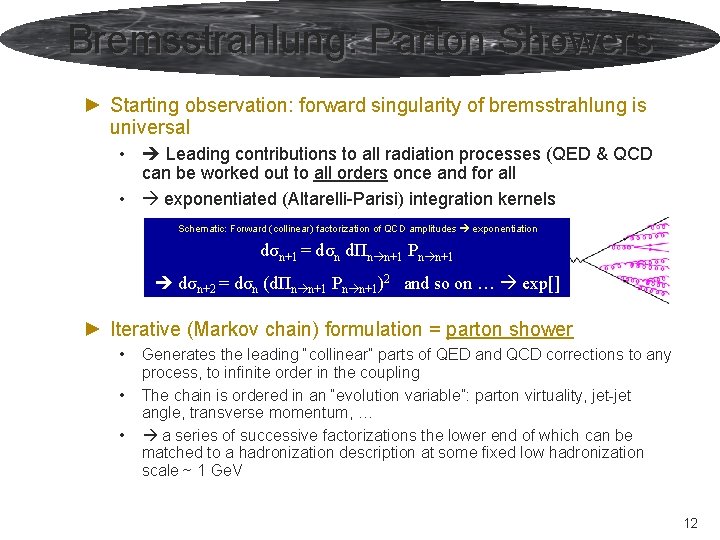
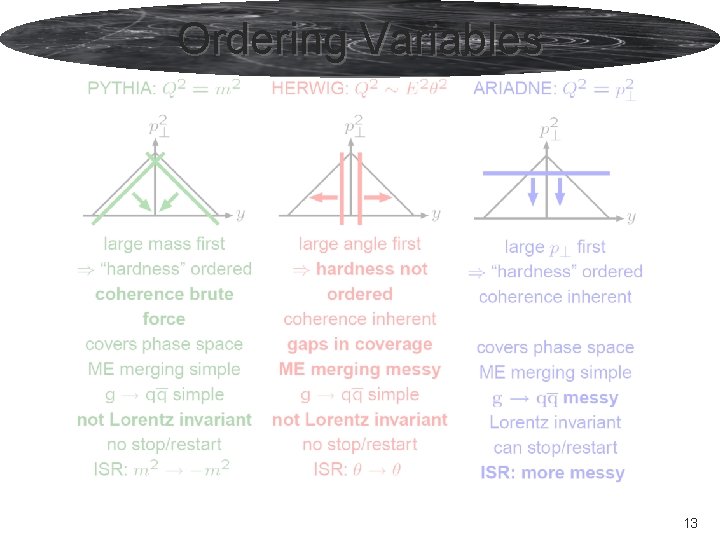
Bremsstrahlung: Parton Showers ► Starting observation: forward singularity of bremsstrahlung is universal • Leading contributions to all radiation processes (QED & QCD can be worked out to all orders once and for all • exponentiated (Altarelli-Parisi) integration kernels Schematic: Forward (collinear) factorization of QCD amplitudes exponentiation dσn+1 = dσn dΠn n+1 Pn n+1 dσn+2 = dσn (dΠn n+1 Pn n+1)2 and so on … exp[] ► Iterative (Markov chain) formulation = parton shower • • • Peter Skands Generates the leading “collinear” parts of QED and QCD corrections to any process, to infinite order in the coupling The chain is ordered in an “evolution variable”: parton virtuality, jet-jet angle, transverse momentum, … a series of successive factorizations the lower end of which can be matched to a hadronization description at some fixed low hadronization scale ~ 1 Ge. V Event Generator Status 12
Ordering Variables Peter Skands Event Generator Status 13
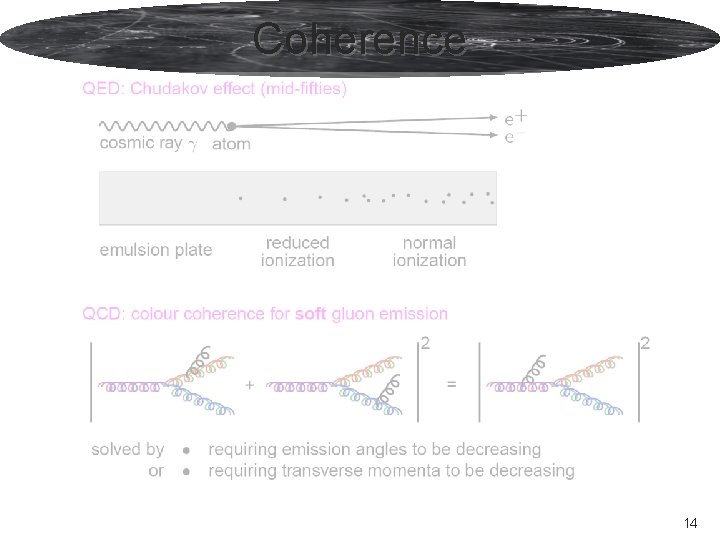
Coherence Peter Skands Event Generator Status 14
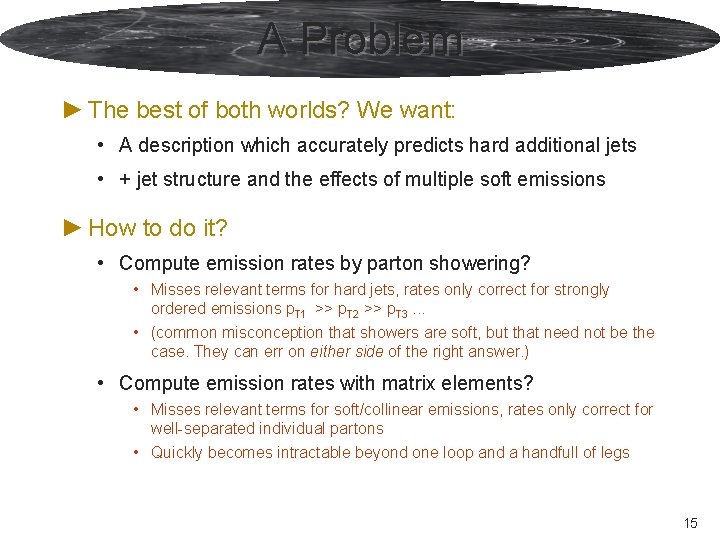
A Problem ► The best of both worlds? We want: • A description which accurately predicts hard additional jets • + jet structure and the effects of multiple soft emissions ► How to do it? • Compute emission rates by parton showering? • Misses relevant terms for hard jets, rates only correct for strongly ordered emissions p. T 1 >> p. T 2 >> p. T 3. . . • (common misconception that showers are soft, but that need not be the case. They can err on either side of the right answer. ) • Compute emission rates with matrix elements? • Misses relevant terms for soft/collinear emissions, rates only correct for well-separated individual partons • Quickly becomes intractable beyond one loop and a handfull of legs Peter Skands Event Generator Status 15
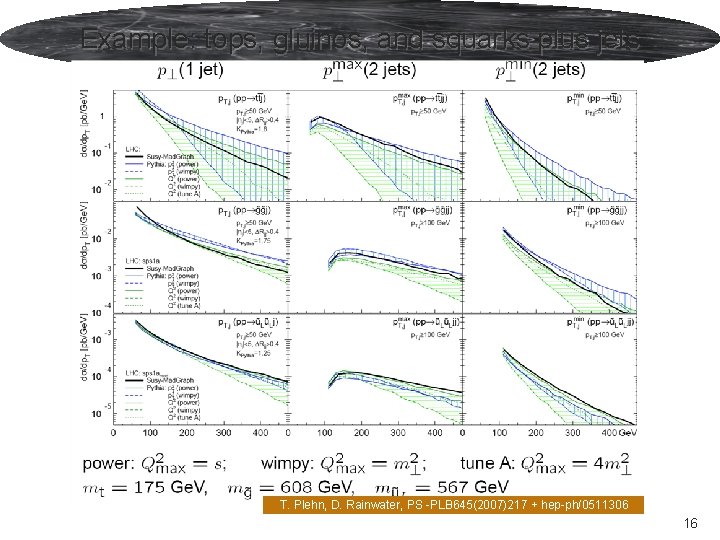
Example: tops, gluinos, and squarks plus jets T. Plehn, D. Rainwater, PS -PLB 645(2007)217 + hep-ph/0511306 Peter Skands Event Generator Status 16
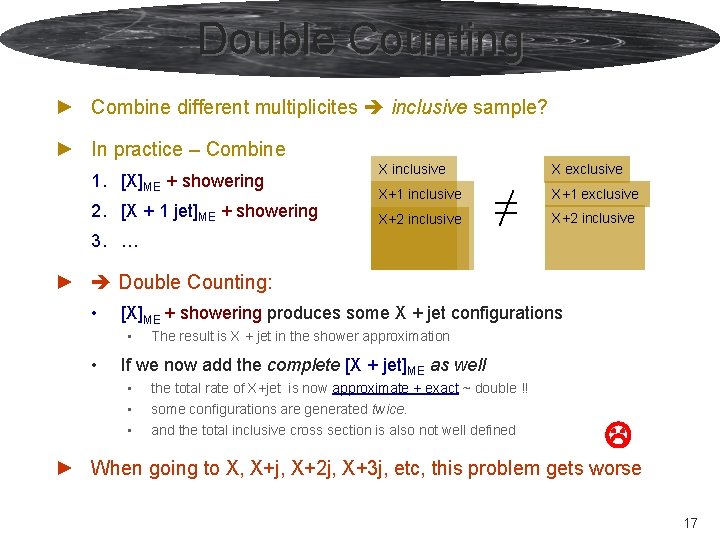
Double Counting ► Combine different multiplicites inclusive sample? ► In practice – Combine X inclusive 1. [X]ME + showering 2. [X + 1 jet]ME + showering X+1 inclusive X+2 inclusive X exclusive ≠ X+1 exclusive X+2 inclusive 3. … ► Double Counting: • [X]ME + showering produces some X + jet configurations • • The result is X + jet in the shower approximation If we now add the complete [X + jet]ME as well • • • the total rate of X+jet is now approximate + exact ~ double !! some configurations are generated twice. and the total inclusive cross section is also not well defined ► When going to X, X+j, X+2 j, X+3 j, etc, this problem gets worse Peter Skands Event Generator Status 17
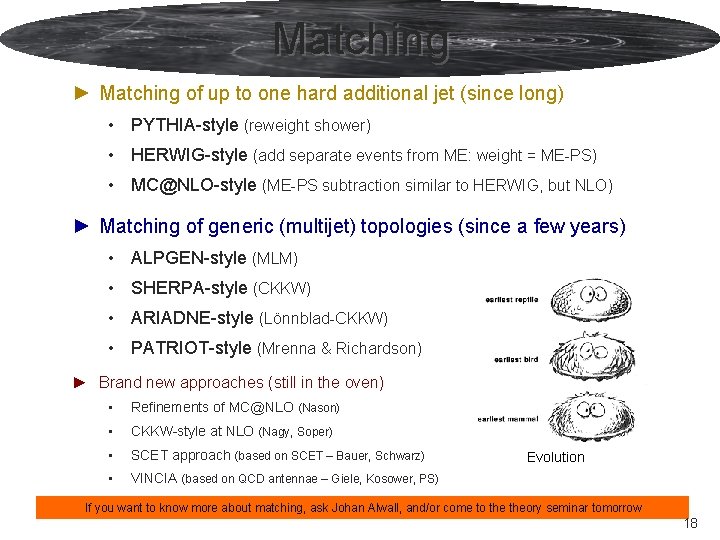
Matching ► Matching of up to one hard additional jet (since long) • PYTHIA-style (reweight shower) • HERWIG-style (add separate events from ME: weight = ME-PS) • MC@NLO-style (ME-PS subtraction similar to HERWIG, but NLO) ► Matching of generic (multijet) topologies (since a few years) • ALPGEN-style (MLM) • SHERPA-style (CKKW) • ARIADNE-style (Lönnblad-CKKW) • PATRIOT-style (Mrenna & Richardson) ► Brand new approaches (still in the oven) • Refinements of MC@NLO (Nason) • CKKW-style at NLO (Nagy, Soper) • SCET approach (based on SCET – Bauer, Schwarz) • VINCIA (based on QCD antennae – Giele, Kosower, PS) Evolution If you want to know more about matching, ask Johan Alwall, and/or come to theory seminar tomorrow Peter Skands Event Generator Status 18
The Underlying Event Towards a complete picture of hadron collisions
Additional Sources of Particle Production ► Domain of fixed order and parton shower calculations: hard partonic scattering, and bremsstrahlung associated with it. ► But hadrons are not elementary ► + QCD diverges at low p. T ► multiple perturbative parton-parton collisions should occur e. g. 4 4, 3 3, 3 2 ► Normally omitted in explicit perturbative expansions ► + Remnants from the incoming beams ► + additional (non-perturbative / collective) phenomena? • • Peter Skands Bose-Einstein Correlations Non-perturbative gluon exchanges / colour reconnections ? String-string interactions / collective multi-string effects ? Interactions with “background” vacuum / with remnants / with active medium? Event Generator Status 20
Classic Example: Number of tracks UA 5 @ 540 Ge. V, single pp, charged multiplicity in minimum-bias events Simple physics models ~ Poisson Can ‘tune’ to get average right, but much too small fluctuations inadequate physics model More Physics: Multiple interactions + impact-parameter dependence Morale (will return to the models later): 1) It is not possible to ‘tune’ anything better than the underlying physics model allows 2) Failure of a physically motivated model usually points to more physics Peter Skands Event Generator Status 21
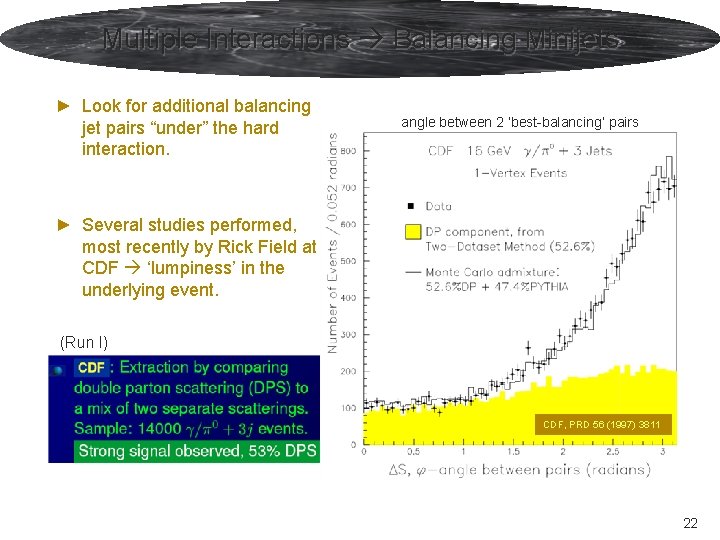
Multiple Interactions Balancing Minijets ► Look for additional balancing jet pairs “under” the hard interaction. angle between 2 ‘best-balancing’ pairs ► Several studies performed, most recently by Rick Field at CDF ‘lumpiness’ in the underlying event. (Run I) CDF, PRD 56 (1997) 3811 Peter Skands Event Generator Status 22
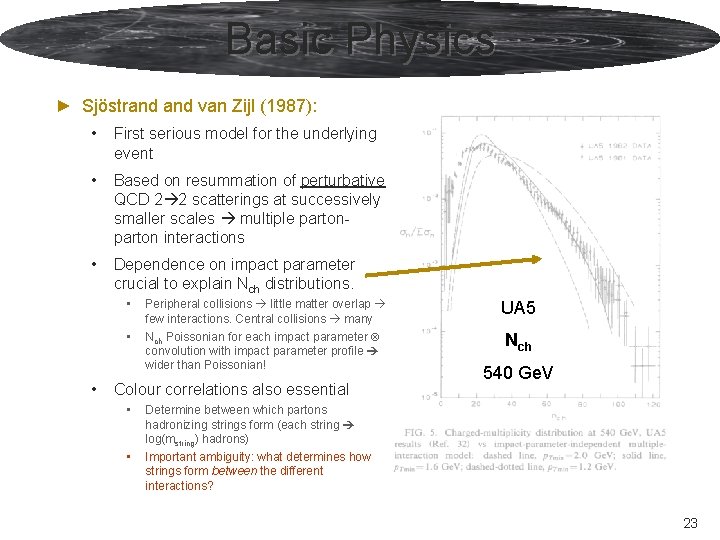
Basic Physics ► Sjöstrand van Zijl (1987): • First serious model for the underlying event • Based on resummation of perturbative QCD 2 2 scatterings at successively smaller scales multiple parton interactions • Dependence on impact parameter crucial to explain Nch distributions. • • Peripheral collisions little matter overlap few interactions. Central collisions many UA 5 • Nch Poissonian for each impact parameter convolution with impact parameter profile wider than Poissonian! Nch Colour correlations also essential • • Peter Skands 540 Ge. V Determine between which partons hadronizing strings form (each string log(mstring) hadrons) Important ambiguity: what determines how strings form between the different interactions? Event Generator Status 23
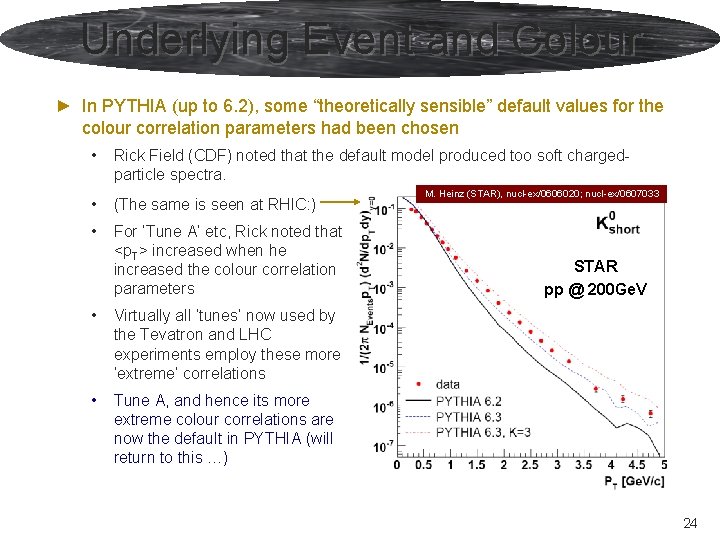
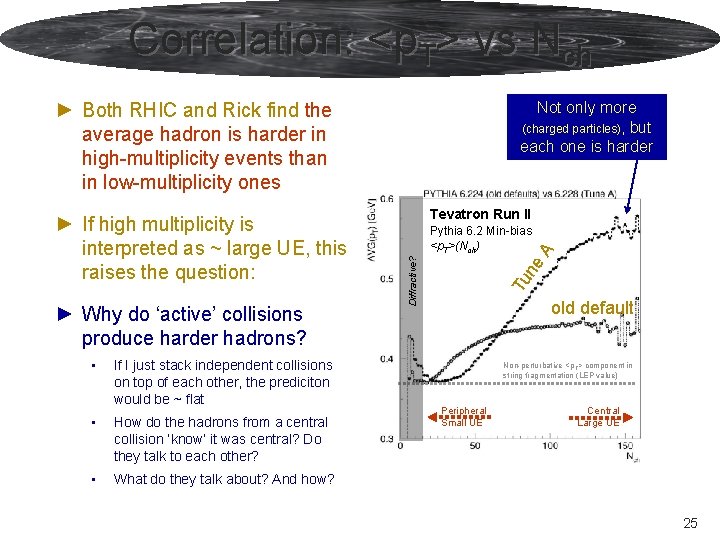
Underlying Event and Colour ► In PYTHIA (up to 6. 2), some “theoretically sensible” default values for the colour correlation parameters had been chosen • Rick Field (CDF) noted that the default model produced too soft chargedparticle spectra. • (The same is seen at RHIC: ) • For ‘Tune A’ etc, Rick noted that <p. T> increased when he increased the colour correlation parameters • Virtually all ‘tunes’ now used by the Tevatron and LHC experiments employ these more ‘extreme’ correlations • Tune A, and hence its more extreme colour correlations are now the default in PYTHIA (will return to this …) Peter Skands Event Generator Status M. Heinz (STAR), nucl-ex/0606020; nucl-ex/0607033 STAR pp @ 200 Ge. V 24
Correlation: <p. T> vs Nch ► Both RHIC and Rick find the average hadron is harder in high-multiplicity events than in low-multiplicity ones ► Why do ‘active’ collisions produce harder hadrons? • If I just stack independent collisions on top of each other, the prediciton would be ~ flat • How do the hadrons from a central collision ‘know’ it was central? Do they talk to each other? • What do they talk about? And how? Peter Skands Pythia 6. 2 Min-bias <p. T>(Nch) Event Generator Status Tu ne A Tevatron Run II Diffractive? ► If high multiplicity is interpreted as ~ large UE, this raises the question: Not only more (charged particles), but each one is harder old default Non-perturbative <p T> component in string fragmentation (LEP value) Peripheral Small UE Central Large UE 25
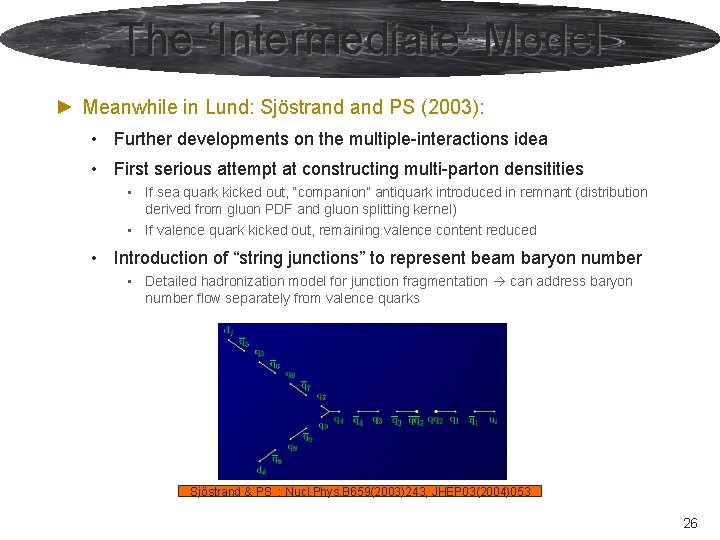
The ‘Intermediate’ Model ► Meanwhile in Lund: Sjöstrand PS (2003): • Further developments on the multiple-interactions idea • First serious attempt at constructing multi-parton densitities • If sea quark kicked out, “companion” antiquark introduced in remnant (distribution derived from gluon PDF and gluon splitting kernel) • If valence quark kicked out, remaining valence content reduced • Introduction of “string junctions” to represent beam baryon number • Detailed hadronization model for junction fragmentation can address baryon number flow separately from valence quarks Sjöstrand & PS : Nucl. Phys. B 659(2003)243, JHEP 03(2004)053 Peter Skands Event Generator Status 26
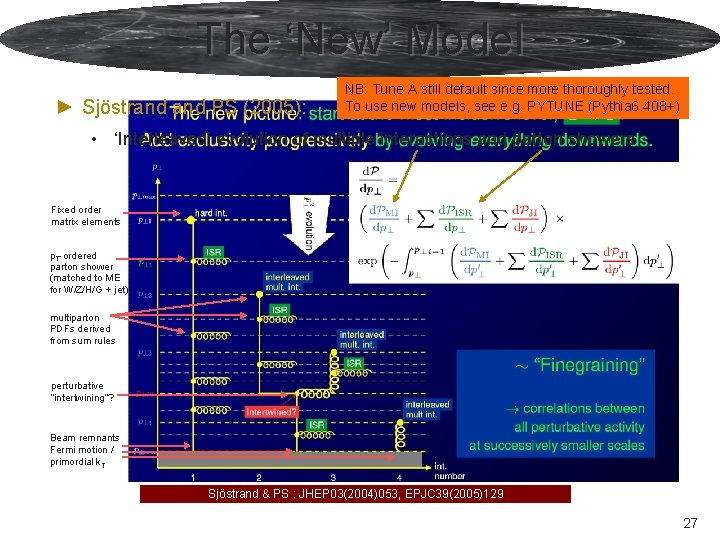
The ‘New’ Model ► Sjöstrand PS (2005): NB: Tune A still default since more thoroughly tested. To use new models, see e. g. PYTUNE (Pythia 6. 408+) • ‘Interleaved’ evolution of multiple interactions and parton showers Fixed order matrix elements p. T-ordered parton shower (matched to ME for W/Z/H/G + jet) multiparton PDFs derived from sum rules perturbative “intertwining”? Beam remnants Fermi motion / primordial k. T Sjöstrand & PS : JHEP 03(2004)053, EPJC 39(2005)129 Peter Skands Event Generator Status 27
Hooking it Up ► But the old ambiguity remained. • How are the interaction initiators (and thereby their final states) correlated in colour? • Fundamentally a non-perturbative question, so hard to give definite answers ► Simple-minded guess • There are many partons in the proton. Only a few interact to first approximation their colour correlations should just be random ► But random connections produced the usual flat <p. T>(Nch) behaviour • Clearly, the new model and showers did not change the fact that some nontrivial colour correlations appear to be necessary ► We also tried deliberately optimizing the correlations between the initiators to give the most highly correlated final states • This did lead to a small rise in the <p. T>(Nch) distribution, but too little ► One place left to look • Peter Skands Could there be some non-trivial physics at work in the final state itself? Event Generator Status 28
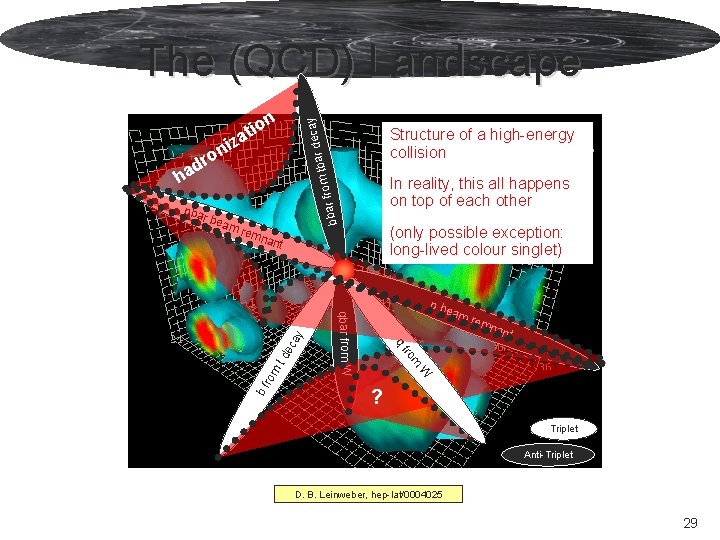
The (QCD) Landscape n h pba am rem In reality, this all happens on top of each other (only possible exception: long-lived colour singlet) nan t rem nan t m fro td ec am q W bf rom p be qbar from W ay r be Structure of a high-energy collision ec tbar d m o r f bbar niz o r ad ay o ati ? Triplet Anti-Triplet D. B. Leinweber, hep-lat/0004025 Peter Skands Event Generator Status 29
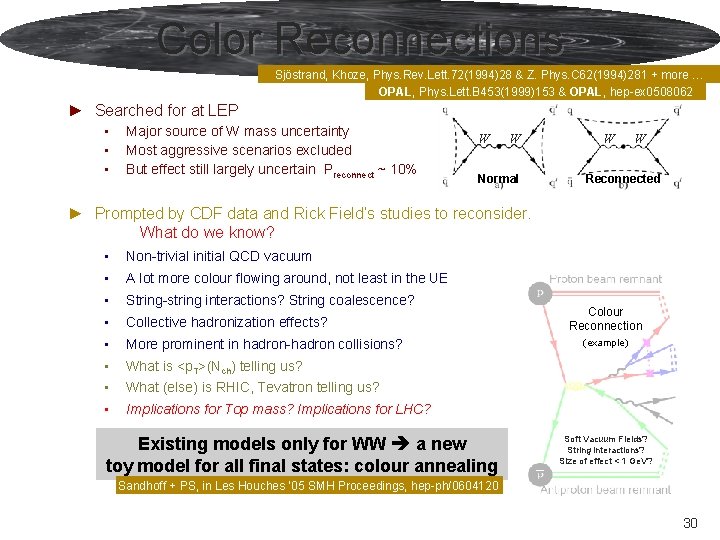
Color Reconnections Sjöstrand, Khoze, Phys. Rev. Lett. 72(1994)28 & Z. Phys. C 62(1994)281 + more … OPAL, Phys. Lett. B 453(1999)153 & OPAL, hep-ex 0508062 ► Searched for at LEP • • • Major source of W mass uncertainty Most aggressive scenarios excluded But effect still largely uncertain Preconnect ~ 10% W W Normal W W Reconnected ► Prompted by CDF data and Rick Field’s studies to reconsider. What do we know? • Non-trivial initial QCD vacuum • A lot more colour flowing around, not least in the UE • String-string interactions? String coalescence? • Collective hadronization effects? • More prominent in hadron-hadron collisions? • What is <p. T>(Nch) telling us? • What (else) is RHIC, Tevatron telling us? • Implications for Top mass? Implications for LHC? Existing models only for WW a new toy model for all final states: colour annealing Colour Reconnection (example) Soft Vacuum Fields? String interactions? Size of effect < 1 Ge. V? Sandhoff + PS, in Les Houches ’ 05 SMH Proceedings, hep-ph/0604120 Peter Skands Event Generator Status 30
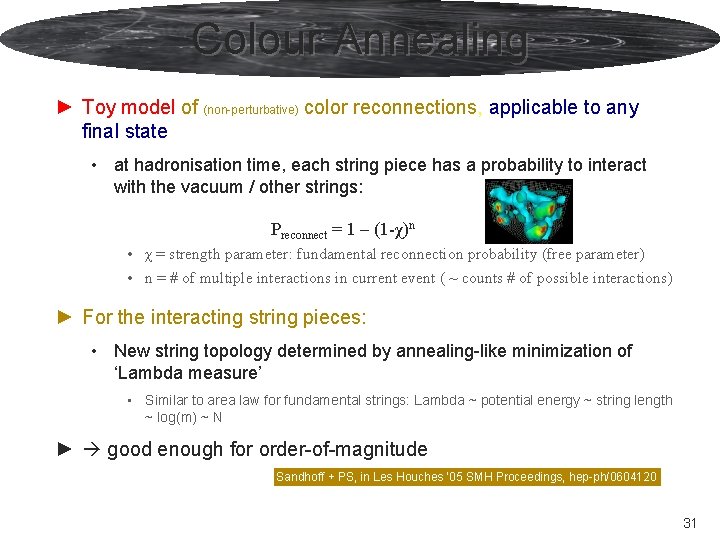
Colour Annealing ► Toy model of (non-perturbative) color reconnections, applicable to any final state • at hadronisation time, each string piece has a probability to interact with the vacuum / other strings: Preconnect = 1 – (1 -χ)n • χ = strength parameter: fundamental reconnection probability (free parameter) • n = # of multiple interactions in current event ( ~ counts # of possible interactions) ► For the interacting string pieces: • New string topology determined by annealing-like minimization of ‘Lambda measure’ • Similar to area law for fundamental strings: Lambda ~ potential energy ~ string length ~ log(m) ~ N ► good enough for order-of-magnitude Sandhoff + PS, in Les Houches ’ 05 SMH Proceedings, hep-ph/0604120 Peter Skands Event Generator Status 31
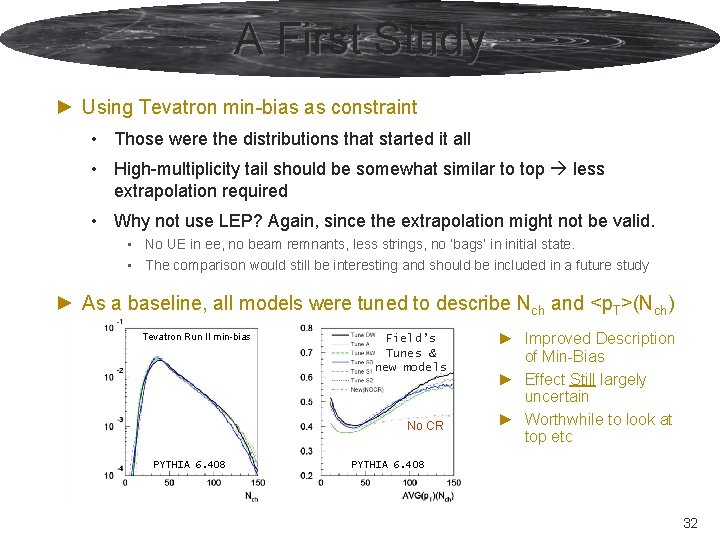
A First Study ► Using Tevatron min-bias as constraint • Those were the distributions that started it all • High-multiplicity tail should be somewhat similar to top less extrapolation required • Why not use LEP? Again, since the extrapolation might not be valid. • No UE in ee, no beam remnants, less strings, no ‘bags’ in initial state. • The comparison would still be interesting and should be included in a future study ► As a baseline, all models were tuned to describe Nch and <p. T>(Nch) Tevatron Run II min-bias Field’s Tunes & new models No CR PYTHIA 6. 408 Peter Skands ► Improved Description of Min-Bias ► Effect Still largely uncertain ► Worthwhile to look at top etc PYTHIA 6. 408 Event Generator Status 32
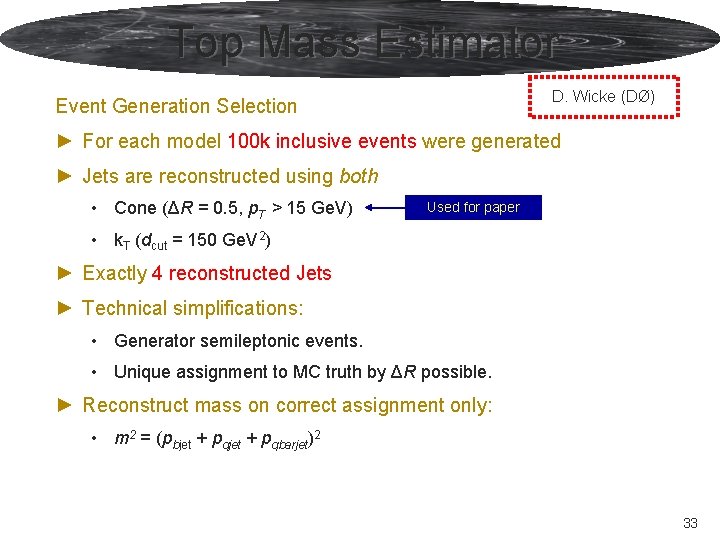
Top Mass Estimator D. Wicke (DØ) Event Generation Selection ► For each model 100 k inclusive events were generated ► Jets are reconstructed using both • Cone (ΔR = 0. 5, p. T > 15 Ge. V) Used for paper • k. T (dcut = 150 Ge. V 2) ► Exactly 4 reconstructed Jets ► Technical simplifications: • Generator semileptonic events. • Unique assignment to MC truth by ΔR possible. ► Reconstruct mass on correct assignment only: • m 2 = (pbjet + pqbarjet)2 Peter Skands Event Generator Status 33
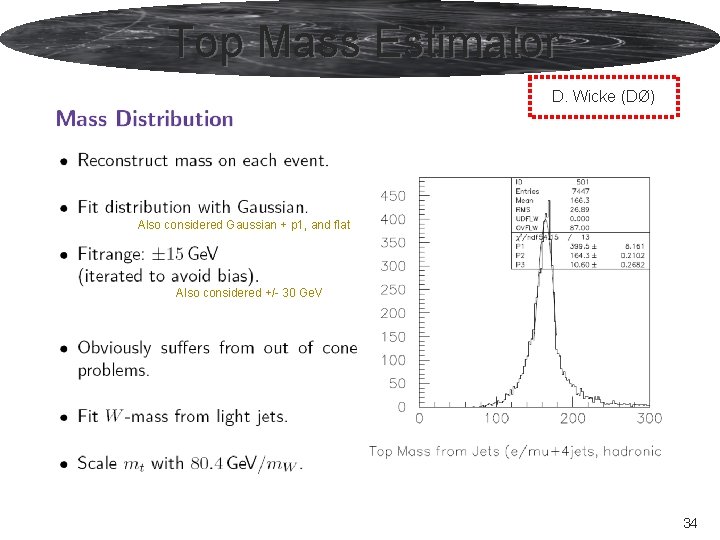
Top Mass Estimator D. Wicke (DØ) Also considered Gaussian + p 1, and flat Also considered +/- 30 Ge. V Peter Skands Event Generator Status 34
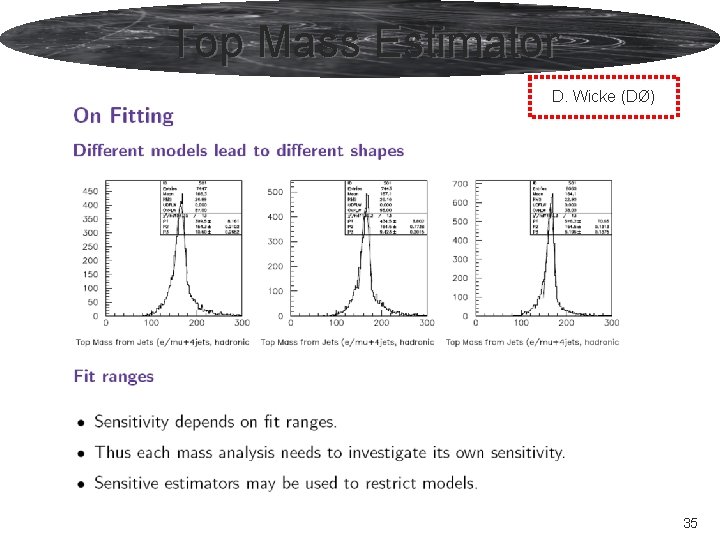
Top Mass Estimator D. Wicke (DØ) Peter Skands Event Generator Status 35
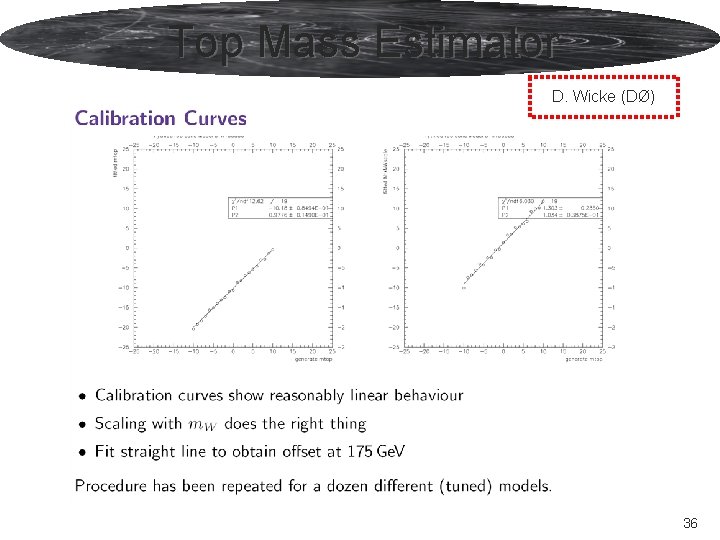
Top Mass Estimator D. Wicke (DØ) Peter Skands Event Generator Status 36
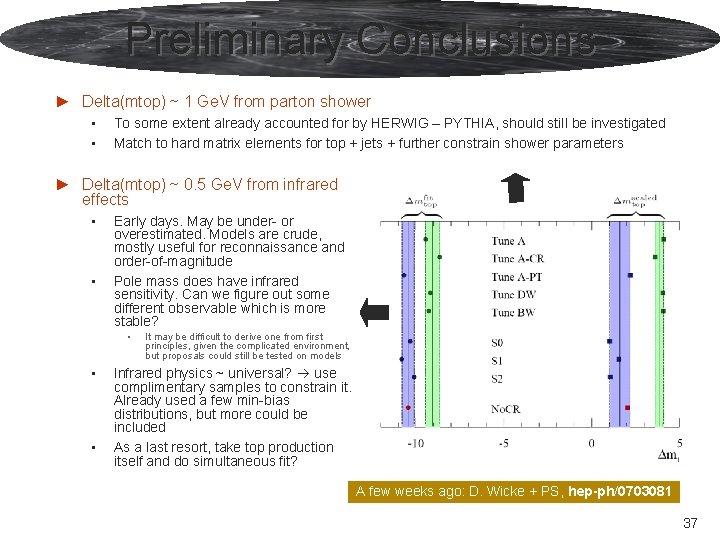
Preliminary Conclusions ► Delta(mtop) ~ 1 Ge. V from parton shower • • To some extent already accounted for by HERWIG – PYTHIA, should still be investigated Match to hard matrix elements for top + jets + further constrain shower parameters ► Delta(mtop) ~ 0. 5 Ge. V from infrared effects • • Early days. May be under- or overestimated. Models are crude, mostly useful for reconnaissance and order-of-magnitude Pole mass does have infrared sensitivity. Can we figure out some different observable which is more stable? • • • It may be difficult to derive one from first principles, given the complicated environment, but proposals could still be tested on models Infrared physics ~ universal? use complimentary samples to constrain it. Already used a few min-bias distributions, but more could be included As a last resort, take top production itself and do simultaneous fit? A few weeks ago: D. Wicke + PS, hep-ph/0703081 Peter Skands Event Generator Status 37
The Generator Outlook The C++ Monte Carlos
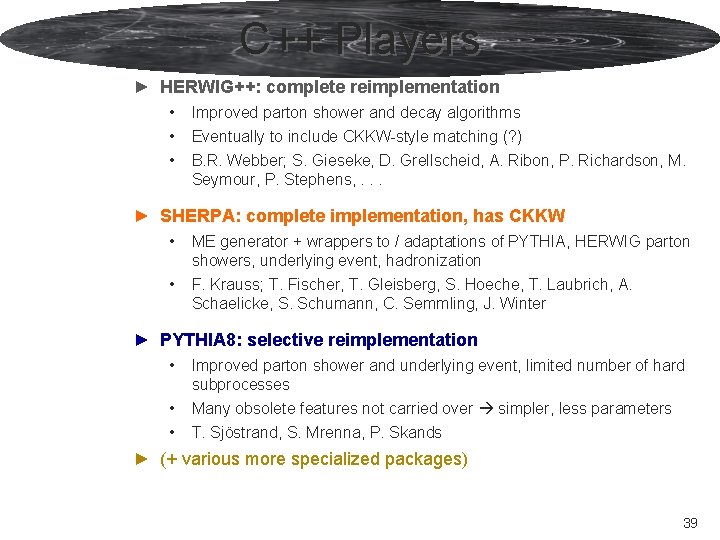
C++ Players ► HERWIG++: complete reimplementation • • • Improved parton shower and decay algorithms Eventually to include CKKW-style matching (? ) B. R. Webber; S. Gieseke, D. Grellscheid, A. Ribon, P. Richardson, M. Seymour, P. Stephens, . . . ► SHERPA: complete implementation, has CKKW • • ME generator + wrappers to / adaptations of PYTHIA, HERWIG parton showers, underlying event, hadronization F. Krauss; T. Fischer, T. Gleisberg, S. Hoeche, T. Laubrich, A. Schaelicke, S. Schumann, C. Semmling, J. Winter ► PYTHIA 8: selective reimplementation • • • Improved parton shower and underlying event, limited number of hard subprocesses Many obsolete features not carried over simpler, less parameters T. Sjöstrand, S. Mrenna, P. Skands ► (+ various more specialized packages) Peter Skands Event Generator Status 39
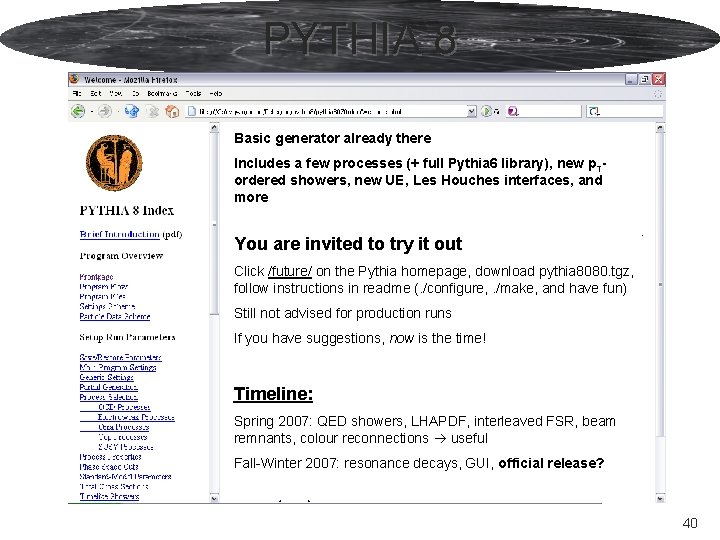
PYTHIA 8 Basic generator already there Includes a few processes (+ full Pythia 6 library), new p. Tordered showers, new UE, Les Houches interfaces, and more You are invited to try it out Click /future/ on the Pythia homepage, download pythia 8080. tgz, follow instructions in readme (. /configure, . /make, and have fun) Still not advised for production runs If you have suggestions, now is the time! Timeline: Spring 2007: QED showers, LHAPDF, interleaved FSR, beam remnants, colour reconnections useful Fall-Winter 2007: resonance decays, GUI, official release? Peter Skands Event Generator Status 40
The Generator Outlook ► Generators in state of continuous development: ► Better & more user-friendly general-purpose matrix element calculators+integrators ► Improved parton showers and improved matching to matrix elements ► Improved models for underlying events / minimum bias ► Upgrades of hadronization and decays ► Moving to C++ ► Data needed to constrain models & rule out crazy ideas • New methods could QCD become a precision science? ► Important for virtually all other measurements + can shed light on fundamental & interesting aspects of QCD (e. g. string interactions) Peter Skands Event Generator Status 41