
Atlantic Seabed Mapping Status Direction Towards a CANEUUS
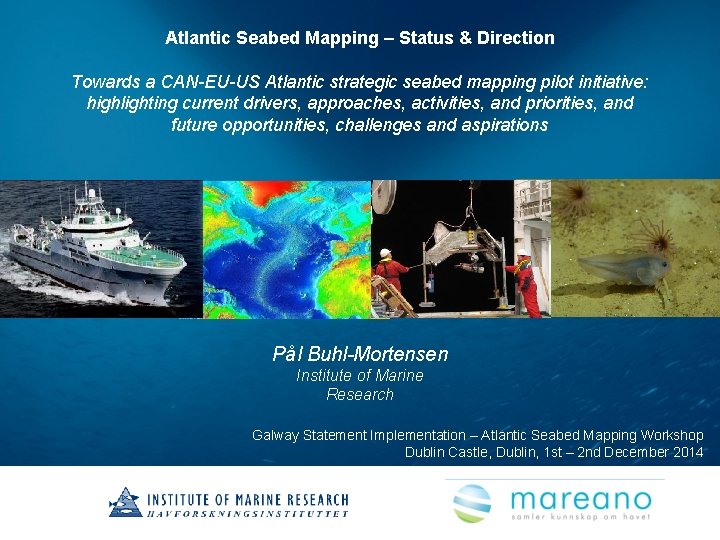
Atlantic Seabed Mapping – Status & Direction Towards a CAN-EU-US Atlantic strategic seabed mapping pilot initiative: highlighting current drivers, approaches, activities, and priorities, and future opportunities, challenges and aspirations Pål Buhl-Mortensen Institute of Marine Research Galway Statement Implementation – Atlantic Seabed Mapping Workshop Dublin Castle, Dublin, 1 st – 2 nd December 2014
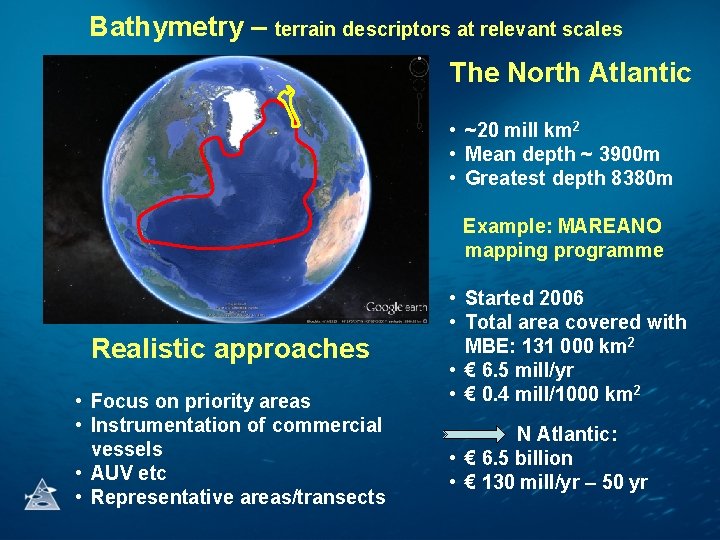
Bathymetry – terrain descriptors at relevant scales The North Atlantic • ~20 mill km 2 • Mean depth ~ 3900 m • Greatest depth 8380 m Example: MAREANO mapping programme Realistic approaches • Focus on priority areas • Instrumentation of commercial vessels • AUV etc • Representative areas/transects • Started 2006 • Total area covered with MBE: 131 000 km 2 • € 6. 5 mill/yr • € 0. 4 mill/1000 km 2 N Atlantic: • € 6. 5 billion • € 130 mill/yr – 50 yr
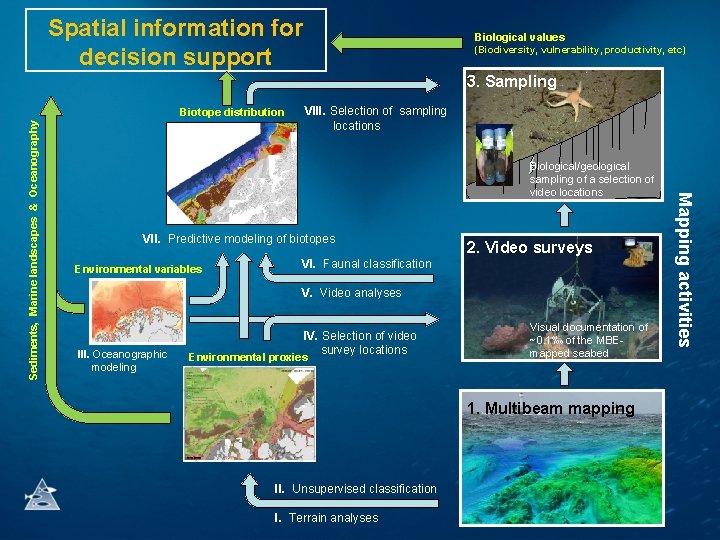
Spatial information for decision support Biological values (Biodiversity, vulnerability, productivity, etc) 3. Sampling VIII. Selection of sampling locations Biological/geological sampling of a selection of video locations VII. Predictive modeling of biotopes Environmental variables 2. Video surveys VI. Faunal classification V. Video analyses III. Oceanographic modeling IV. Selection of video survey locations Environmental proxies Visual documentation of ~0. 1‰ of the MBEmapped seabed 1. Multibeam mapping II. Unsupervised classification I. Terrain analyses Mapping activities Sediments, Marine landscapes & Oceanography Biotope distribution
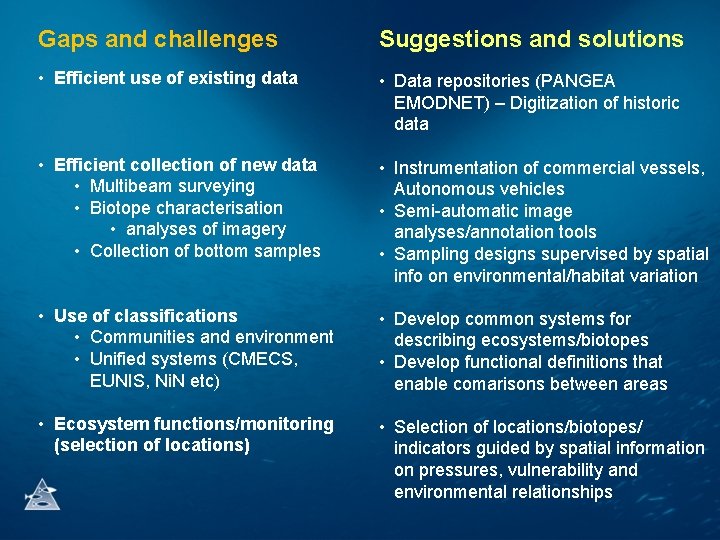
Gaps and challenges Suggestions and solutions • Efficient use of existing data • Data repositories (PANGEA EMODNET) – Digitization of historic data • Efficient collection of new data • Multibeam surveying • Biotope characterisation • analyses of imagery • Collection of bottom samples • Instrumentation of commercial vessels, Autonomous vehicles • Semi-automatic image analyses/annotation tools • Sampling designs supervised by spatial info on environmental/habitat variation • Use of classifications • Communities and environment • Unified systems (CMECS, EUNIS, Ni. N etc) • Develop common systems for describing ecosystems/biotopes • Develop functional definitions that enable comarisons between areas • Ecosystem functions/monitoring (selection of locations) • Selection of locations/biotopes/ indicators guided by spatial information on pressures, vulnerability and environmental relationships
- Slides: 4