
Atlanta Diabetes Associates New Title GLUCOMMANDER A COMPUTERDIRECTED
Atlanta Diabetes Associates New Title GLUCOMMANDER: A COMPUTER-DIRECTED IV INSULIN SYSTEM SHOWN TO BE SAFE, SIMPLE, AND EFFECTIVE IN 120, 618 HOURS OF OPERATION Paul C. Davidson, R. Dennis Steed, and Bruce W. Bode Frequently Asked Questions
Abstract Intensive IV insulin therapy reduces mortality and morbidity when used in the surgical ICU and when used post-myocardial infarction. The methods of regulating IV insulin are complex and their application is usually limited to ICU’s. We have developed and tested a computerized algorithm utilizing bedside blood glucoses and programming an IV pump, which limits the need for ICU housing and large amounts of nursing time. BG’s are obtained at variable intervals related to trending of the values. We have data on 3473 patients over 82, 078 hours showing correction of hyperglycemia from an median level of 292 mg/dl (range 181 -1568) to <180 mg/dl in a median time of 3. 1 hours with subsequent stability in target range for 60 hours. The overall percent rate of BG <60 was 1. 5%. No severe hypoglycemia occurred. The algorithm has been used in 70 hospitals for DKA, HHNK, peri-operative management including CABG, labor and delivery, post-myocardial infarction, TPN, and reversing glucose toxicity. In hospitals where it is available, the system is universally accepted by nurses, anesthesiologists, surgeons, intensivists, and PCP’s. We have attempted to commercialize the system. This was precluded by the FDA who will not approve a device for dosing and delivery of IV insulin off label, A demonstration of the algorithm is viewable at http: //glucommander. com.
What is the Glucommander? l Glucommander is a computer-based system for controlling blood glucose in hospital patients on IV or tube-feeding. l Works by prompting the on-site measurement of glucose and advising an intravenous insulin infusion rate. l Located in a computer at the patient’s bedside or nearby nursing station.
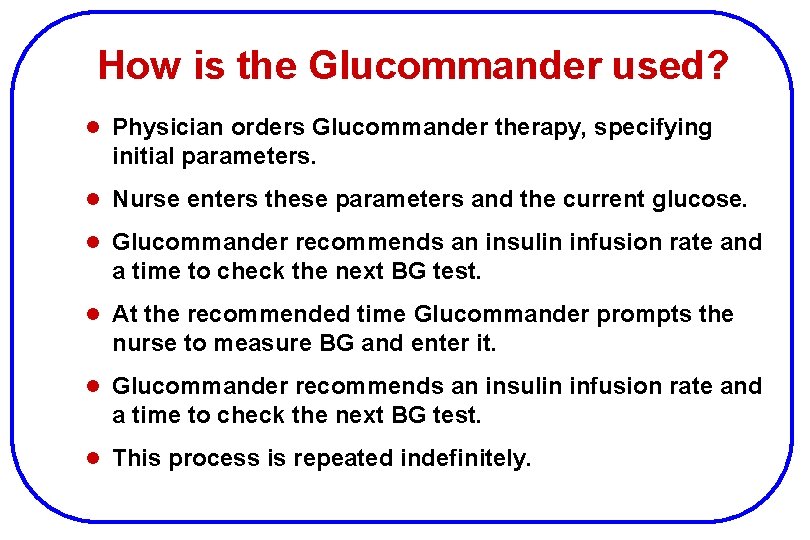
How is the Glucommander used? l Physician orders Glucommander therapy, specifying initial parameters. l Nurse enters these parameters and the current glucose. l Glucommander recommends an insulin infusion rate and a time to check the next BG test. l At the recommended time Glucommander prompts the nurse to measure BG and enter it. l Glucommander recommends an insulin infusion rate and a time to check the next BG test. l This process is repeated indefinitely.

How much insulin is infused with the Glucommander? Infusion follows the formula: Insulin / hr = multiplier x (BG – 60) “Multiplier” is a parameter which is automatically adjusted based on the glucose pattern and response to insulin.
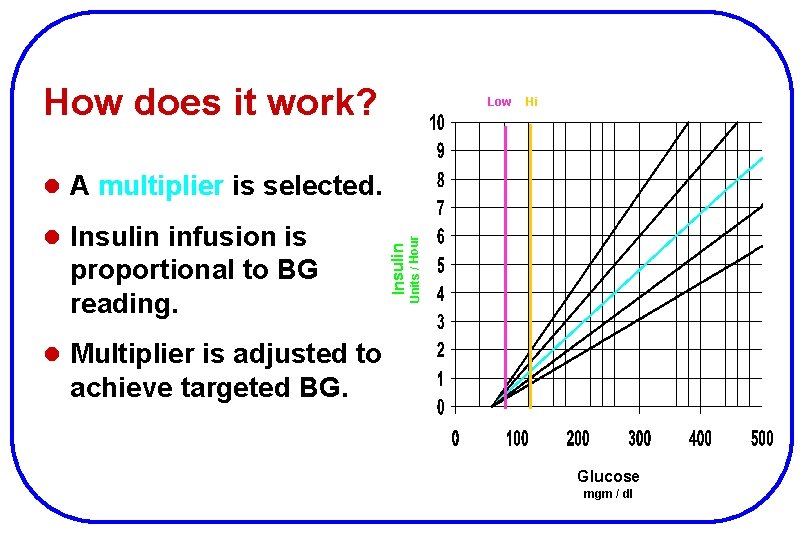
How does it work? Low Hi Insulin proportional to BG reading. Units / Hour l Insulin infusion is Insulin l A multiplier is selected. l Multiplier is adjusted to achieve targeted BG. Glucose mgm / dl
How does the Glucommander adjust the multiplier? l If the BG is above target and failing to decrease, the multiplier will increase. l If the BG is below target and failing to increase, the multiplier will decrease.
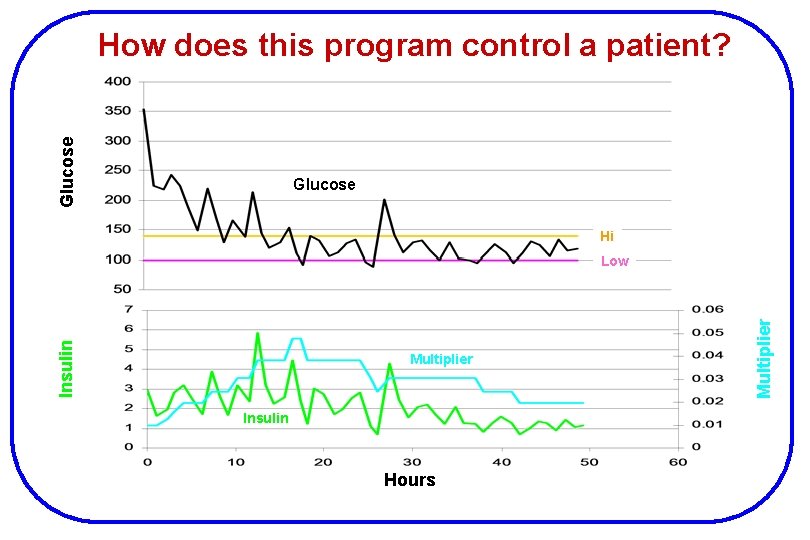
Glucose How does this program control a patient? Glucose Hi Multiplier Insulin Hours Multiplier Insulin Low
How is the Glucommander ordered? To order, the physician must specify five parameters: l The low end of the target range for BG. l The high end of the target range for BG. l The initial multiplier. This reflects the physician’s best estimate for the multiplier, although the Glucommander will adjust this based on the glucose response. l The maximum time interval between BG measurements. l The insulin concentration (used to translate the units per hour to milliliters per hour).
How should I set the target range? A higher target range will result in less risk of hypoglycemia (at the expense of a higher average glucose). Our experience: l As low as 80 to 95 for healthy patients being stabilized overnight in preparation for testing. l As high as 140 to 200 for patients undergoing surgery with an anesthesiologist who is uncomfortable with BG’s in the normal range.
How do I choose initial multiplier? l Normal adult: A multiplier of 0. 01 is a good initial choice. It is a bit low, but it will be automatically adjusted upwards as needed. l It is possible to solve for the multiplier from experience? Multiplier = insulin rate / (BG – 60) For example, if you know that a patient on an insulin pump has previously required 0. 5 units per hour to maintain a glucose of 100, a multiplier of 0. 5 / (100 – 60) = 0. 0125 could be used.
How should I set maximum time interval? l Depends on perceived risk of sudden shift in the blood glucose. l 120 minutes is reasonable for most patients. l 60 minutes for patients in surgery or critically ill. l BG can be entered more frequently than the Glucommander requests.
What is an appropriate insulin concentration? l Dependent on infusion device. l Select to allow adjustment of the infusion rate by increments of less than 0. 1 units per hour. l Currently using 0. 5 units per cc solution in infusers that are adjustable to the nearest 0. 1 ml per hour. – Infusion can be adjusted by 0. 05 unit per hour. l Higher concentrations can be used in volume critical patients with insulin resistance.
What else must be ordered? l An appropriate IV or tube feeding. l To ensure a constant glucose flux, a controller should be used. The insulin drip is typically “piggy backed” into a maintenance IV at a side port close to the infusion catheter to eliminate lag in insulin delivery.
How often are blood sugars checked? l From 20 minutes to Maximum Interval specified in the initial orders. l Typically about an hour. Interval is programmed by Glucommander to increase when BG’s stabilize in the target range and decrease if BG’s are low or falling rapidly.
Can the patient eat or receive glucose in IV fluids? Works well when the rate that glucose enters patient’s system is constant. l Constant rate of infusion of glucose- containing IV solutions. l Constant enteral tube feeding. l No discrete meals.
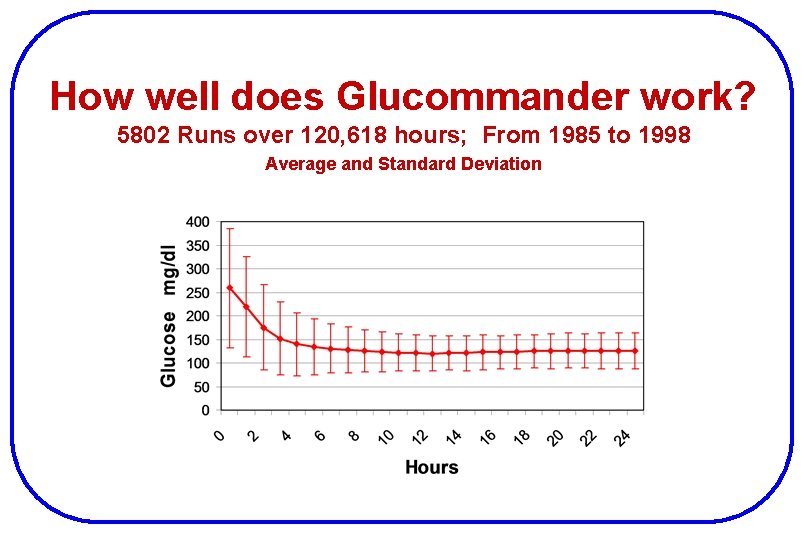
How well does Glucommander work? 5802 Runs over 120, 618 hours; From 1985 to 1998 Average and Standard Deviation
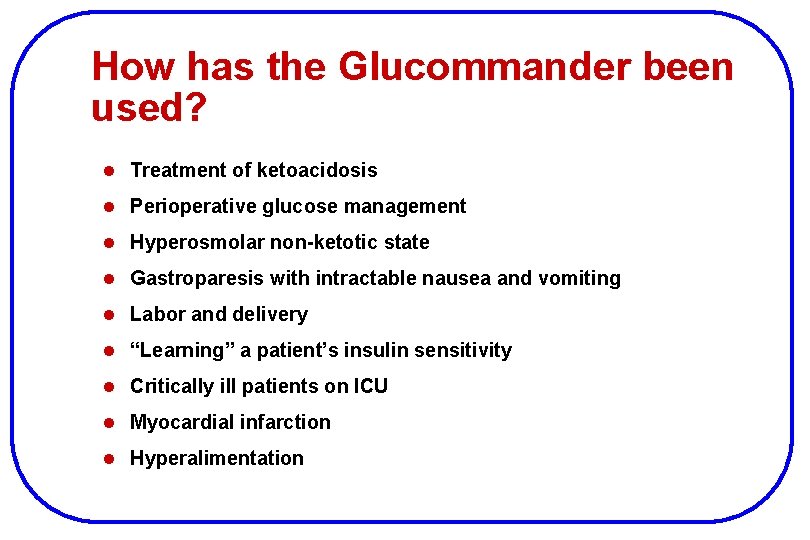
How has the Glucommander been used? l Treatment of ketoacidosis l Perioperative glucose management l Hyperosmolar non-ketotic state l Gastroparesis with intractable nausea and vomiting l Labor and delivery l “Learning” a patient’s insulin sensitivity l Critically ill patients on ICU l Myocardial infarction l Hyperalimentation
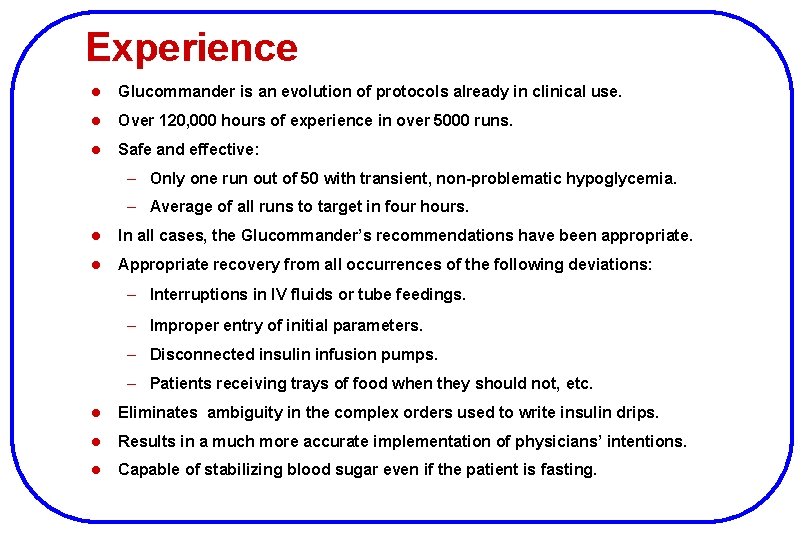
Experience l Glucommander is an evolution of protocols already in clinical use. l Over 120, 000 hours of experience in over 5000 runs. l Safe and effective: – Only one run out of 50 with transient, non-problematic hypoglycemia. – Average of all runs to target in four hours. l In all cases, the Glucommander’s recommendations have been appropriate. l Appropriate recovery from all occurrences of the following deviations: – Interruptions in IV fluids or tube feedings. – Improper entry of initial parameters. – Disconnected insulin infusion pumps. – Patients receiving trays of food when they should not, etc. l Eliminates ambiguity in the complex orders used to write insulin drips. l Results in a much more accurate implementation of physicians’ intentions. l Capable of stabilizing blood sugar even if the patient is fasting.

Why hasn’t Glucommander been available? l Mini. Med and Boehringer Manheim Corp contracted for exclusive rights. l Roche purchased Boehringer Manheim. l Medtronic Purchased Mini. Med. l Roche and Medtronic “divorced”. l Neither Lilly nor Novo are willing to fund clinical safety studies for IV insulin. l FDA will not approve commercialization of device for IV use of insulin off-label. How can I get use of Glucommander? l Available for review on internet, www. glucommander. com l For how to market a dedicated computer application we need your advice. We, as clinicians, do not know how to get this valuable tool to the patient with diabetes. Contact us: Glucommander@adaendo. com
- Slides: 20