
Athome Transcranial Direct Current Stimulation t DCS Improves
- Slides: 1
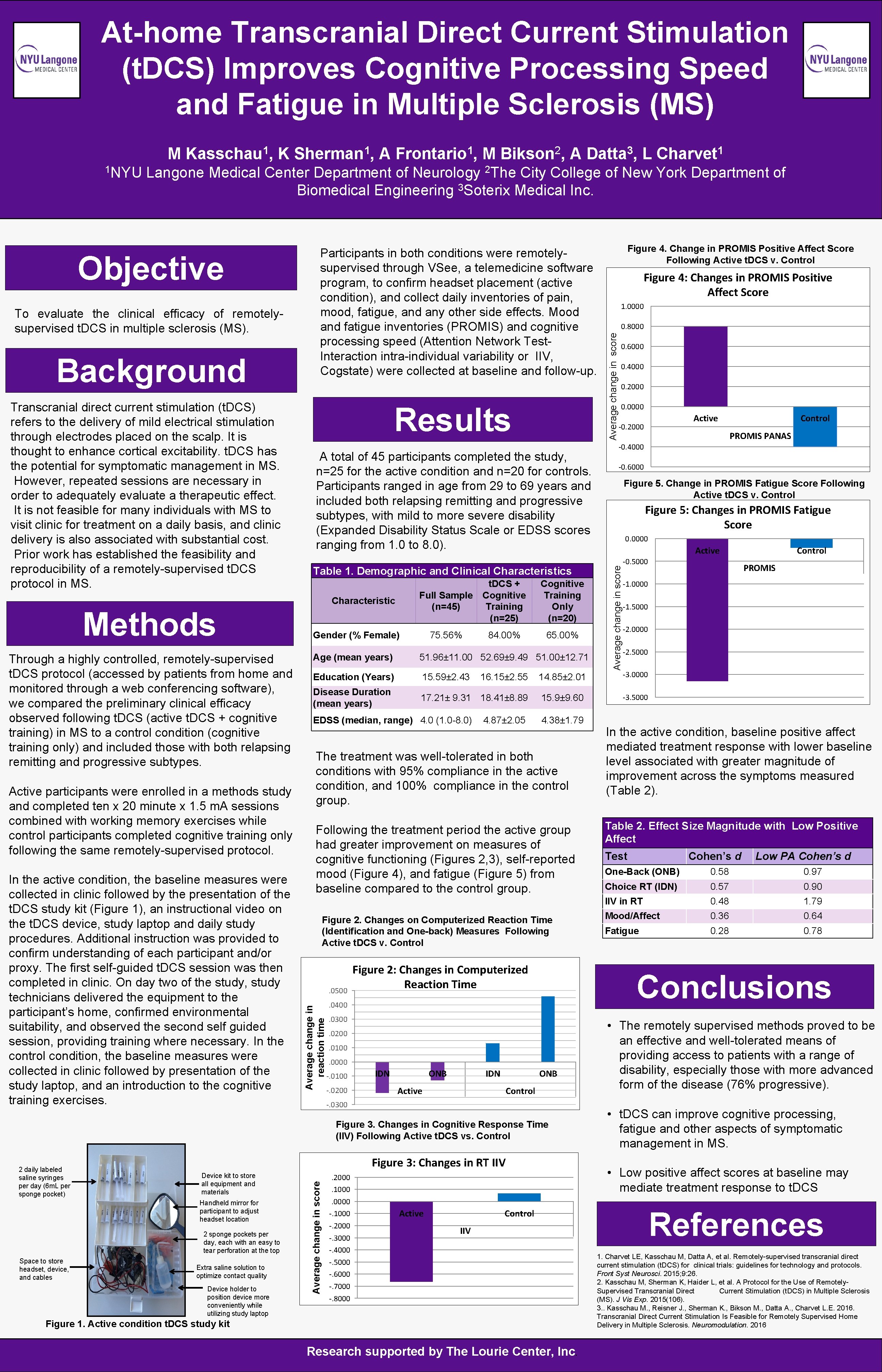
At-home Transcranial Direct Current Stimulation (t. DCS) Improves Cognitive Processing Speed and Fatigue in Multiple Sclerosis (MS) M Kasschau 1, K Sherman 1, A Frontario 1, M Bikson 2, A Datta 3, L Charvet 1 1 NYU Langone Medical Center Department of Neurology 2 The City College of New York Department of Biomedical Engineering 3 Soterix Medical Inc. Transcranial direct current stimulation (t. DCS) refers to the delivery of mild electrical stimulation through electrodes placed on the scalp. It is thought to enhance cortical excitability. t. DCS has the potential for symptomatic management in MS. However, repeated sessions are necessary in order to adequately evaluate a therapeutic effect. It is not feasible for many individuals with MS to visit clinic for treatment on a daily basis, and clinic delivery is also associated with substantial cost. Prior work has established the feasibility and reproducibility of a remotely-supervised t. DCS protocol in MS. Methods Through a highly controlled, remotely-supervised t. DCS protocol (accessed by patients from home and monitored through a web conferencing software), we compared the preliminary clinical efficacy observed following t. DCS (active t. DCS + cognitive training) in MS to a control condition (cognitive training only) and included those with both relapsing remitting and progressive subtypes. Active participants were enrolled in a methods study and completed ten x 20 minute x 1. 5 m. A sessions combined with working memory exercises while control participants completed cognitive training only following the same remotely-supervised protocol. In the active condition, the baseline measures were collected in clinic followed by the presentation of the t. DCS study kit (Figure 1), an instructional video on the t. DCS device, study laptop and daily study procedures. Additional instruction was provided to confirm understanding of each participant and/or proxy. The first self-guided t. DCS session was then completed in clinic. On day two of the study, study technicians delivered the equipment to the participant’s home, confirmed environmental suitability, and observed the second self guided session, providing training where necessary. In the control condition, the baseline measures were collected in clinic followed by presentation of the study laptop, and an introduction to the cognitive training exercises. Results A total of 45 participants completed the study, n=25 for the active condition and n=20 for controls. Participants ranged in age from 29 to 69 years and included both relapsing remitting and progressive subtypes, with mild to more severe disability (Expanded Disability Status Scale or EDSS scores ranging from 1. 0 to 8. 0). Table 1. Demographic and Clinical Characteristics Full Sample (n=45) Characteristic Gender (% Female) 75. 56% t. DCS + Cognitive Training (n=25) 84. 00% Cognitive Training Only (n=20) 65. 00% 2 sponge pockets per day, each with an easy to tear perforation at the top Space to store headset, device, and cables Extra saline solution to optimize contact quality Device holder to position device more conveniently while utilizing study laptop 0. 4000 0. 2000 0. 0000 Active -0. 2000 -0. 4000 -0. 6000 Figure 5. Change in PROMIS Fatigue Score Following Active t. DCS v. Control Figure 5: Changes in PROMIS Fatigue Score 0. 0000 Active -0. 5000 -2. 0000 -2. 5000 14. 85± 2. 01 -3. 0000 Disease Duration (mean years) 17. 21± 9. 31 18. 41± 8. 89 15. 9± 9. 60 -3. 5000 4. 38± 1. 79 The treatment was well-tolerated in both conditions with 95% compliance in the active condition, and 100% compliance in the control group. Following the treatment period the active group had greater improvement on measures of cognitive functioning (Figures 2, 3), self-reported mood (Figure 4), and fatigue (Figure 5) from baseline compared to the control group. Figure 2. Changes on Computerized Reaction Time (Identification and One-back) Measures Following Active t. DCS v. Control . 0500 Figure 2: Changes in Computerized Reaction Time . 0300. 0200. 0100. 0000 -. 0200 IDN ONB Active Control -. 0300 . 2000. 1000. 0000 -. 1000 -. 2000 -. 3000 -. 4000 -. 5000 -. 6000 -. 7000 -. 8000 Active In the active condition, baseline positive affect mediated treatment response with lower baseline level associated with greater magnitude of improvement across the symptoms measured (Table 2). Table 2. Effect Size Magnitude with Low Positive Affect Test Cohen’s d Low PA Cohen’s d One-Back (ONB) 0. 58 0. 97 Choice RT (IDN) 0. 57 0. 90 IIV in RT 0. 48 1. 79 Mood/Affect 0. 36 0. 64 Fatigue 0. 28 0. 78 Conclusions . 0400 -. 0100 PROMIS -1. 5000 16. 15± 2. 55 4. 87± 2. 05 Control -1. 0000 15. 59± 2. 43 EDSS (median, range) 4. 0 (1. 0 -8. 0) Control PROMIS PANAS Education (Years) Average change in score Handheld mirror for participant to adjust headset location 0. 6000 51. 96± 11. 00 52. 69± 9. 49 51. 00± 12. 71 Figure 3: Changes in RT IIV Device kit to store all equipment and materials 0. 8000 Age (mean years) Figure 3. Changes in Cognitive Response Time (IIV) Following Active t. DCS vs. Control 2 daily labeled saline syringes per day (6 m. L per sponge pocket) 1. 0000 Average change in score Background Figure 4: Changes in PROMIS Positive Affect Score Average change in score To evaluate the clinical efficacy of remotelysupervised t. DCS in multiple sclerosis (MS). Average change in reaction time Objective Participants in both conditions were remotelysupervised through VSee, a telemedicine software program, to confirm headset placement (active condition), and collect daily inventories of pain, mood, fatigue, and any other side effects. Mood and fatigue inventories (PROMIS) and cognitive processing speed (Attention Network Test- Interaction intra-individual variability or IIV, Cogstate) were collected at baseline and follow-up. Figure 4. Change in PROMIS Positive Affect Score Following Active t. DCS v. Control IIV • The remotely supervised methods proved to be an effective and well-tolerated means of providing access to patients with a range of disability, especially those with more advanced form of the disease (76% progressive). • t. DCS can improve cognitive processing, fatigue and other aspects of symptomatic management in MS. • Low positive affect scores at baseline may mediate treatment response to t. DCS References 1. Charvet LE, Kasschau M, Datta A, et al. Remotely-supervised transcranial direct current stimulation (t. DCS) for clinical trials: guidelines for technology and protocols. Front Syst Neurosci. 2015; 9: 26. 2. Kasschau M, Sherman K, Haider L, et al. A Protocol for the Use of Remotely. Supervised Transcranial Direct Current Stimulation (t. DCS) in Multiple Sclerosis (MS). J Vis Exp. 2015(106). 3. . Kasschau M. , Reisner J. , Sherman K. , Bikson M. , Datta A. , Charvet L. E. 2016. Transcranial Direct Current Stimulation Is Feasible for Remotely Supervised Home Delivery in Multiple Sclerosis. Neuromodulation. 2016 Figure 1. Active condition t. DCS study kit Research supported by The Lourie Center, Inc.