
ATHLETICS CANADA LONG TERM ATHLETE DEVELOPMENT IMPLEMENTATION STRATEGY

- Slides: 19
ATHLETICS CANADA LONG TERM ATHLETE DEVELOPMENT IMPLEMENTATION STRATEGY
WHY WE NEED A LONG TERM ATHLETE DEVELOPMENT MODEL • Adult training and competition structures are superimposed on young athletes • Preparation is geared to short-term outcome of winning, not the process • Chronological , rather than developmental age , is used in training/competition planning • Fundamental movement skills and sport skills are not taught properly • Parents are not educated about LTAD • Many sports specialize too early in an attempt to attract and retain participants
Long Term Athlete Development (LTAD) requires … • Optimal development requires balanced training, competition and recovery programming • A balanced programming approach that should relate to biological development and maturation • Equal opportunity for recreation and competition • Programs to be athlete centred, coach driven and administration, sport science and sponsor supported
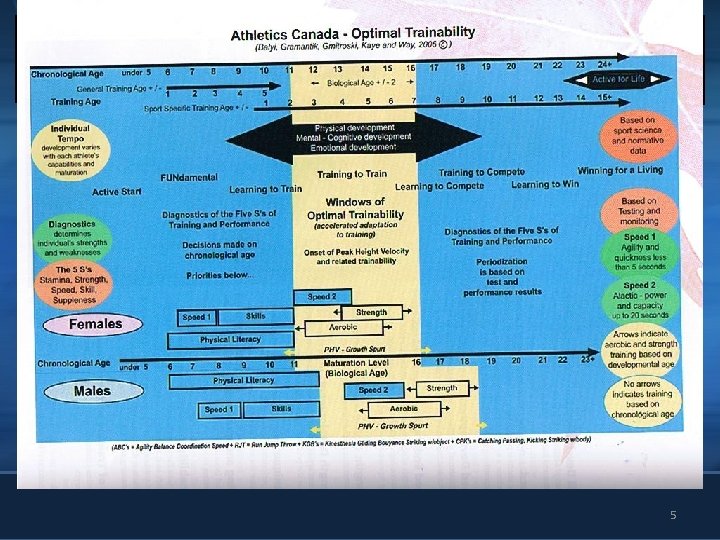
Coaches who Follow LTAD Principles. . . • Develop programs based on developmental age, not biological age • Are aware of the critical windows of trainability and design programs to maximize athlete’s development • Develop the 5 S’s (skill, speed, strength, stamina, suppleness) • Consider the role of Peak Height Velocity (the growth spurt) in training progressions 4
5
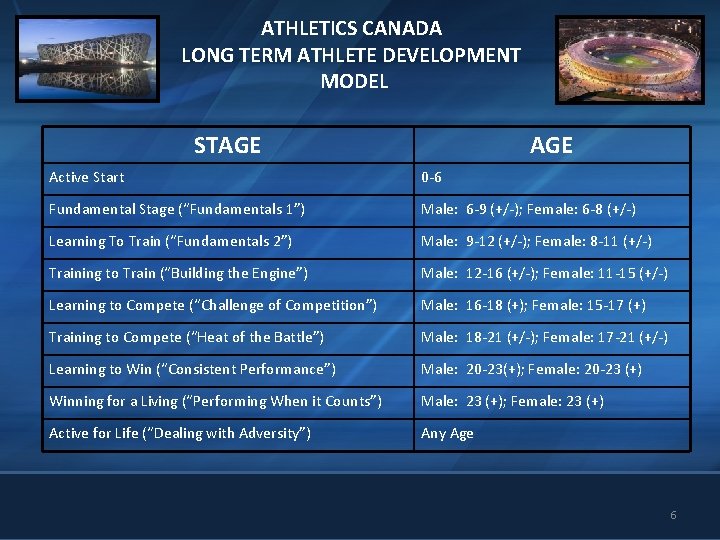
ATHLETICS CANADA LONG TERM ATHLETE DEVELOPMENT MODEL STAGE Active Start 0 -6 Fundamental Stage (“Fundamentals 1”) Male: 6 -9 (+/-); Female: 6 -8 (+/-) Learning To Train (“Fundamentals 2”) Male: 9 -12 (+/-); Female: 8 -11 (+/-) Training to Train (“Building the Engine”) Male: 12 -16 (+/-); Female: 11 -15 (+/-) Learning to Compete (“Challenge of Competition”) Male: 16 -18 (+); Female: 15 -17 (+) Training to Compete (“Heat of the Battle”) Male: 18 -21 (+/-); Female: 17 -21 (+/-) Learning to Win (“Consistent Performance”) Male: 20 -23(+); Female: 20 -23 (+) Winning for a Living (“Performing When it Counts”) Male: 23 (+); Female: 23 (+) Active for Life (“Dealing with Adversity”) Any Age 6
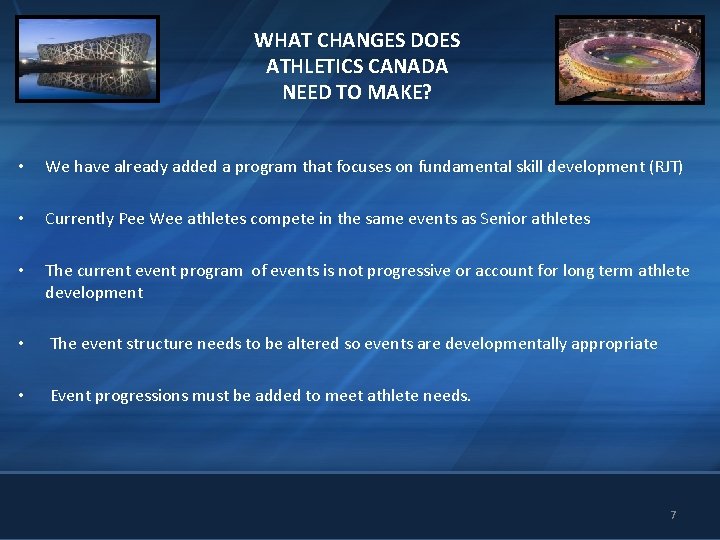
WHAT CHANGES DOES ATHLETICS CANADA NEED TO MAKE? • We have already added a program that focuses on fundamental skill development (RJT) • Currently Pee Wee athletes compete in the same events as Senior athletes • The current event program of events is not progressive or account for long term athlete development • The event structure needs to be altered so events are developmentally appropriate • Event progressions must be added to meet athlete needs. 7
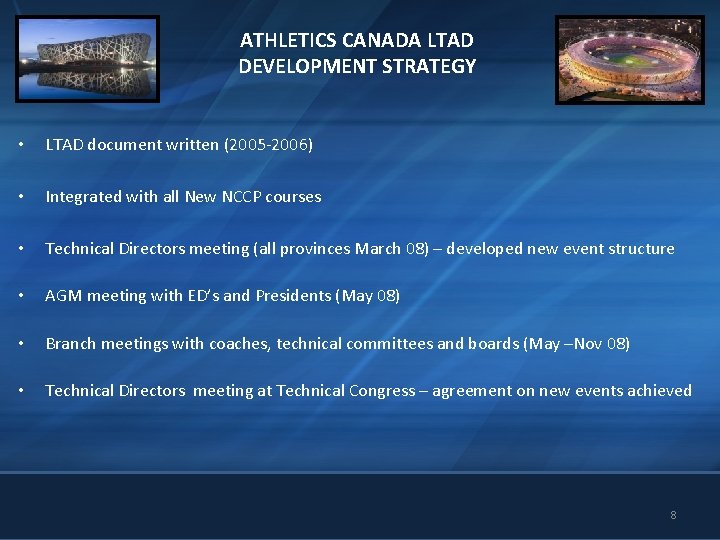
ATHLETICS CANADA LTAD DEVELOPMENT STRATEGY • LTAD document written (2005 -2006) • Integrated with all New NCCP courses • Technical Directors meeting (all provinces March 08) – developed new event structure • AGM meeting with ED’s and Presidents (May 08) • Branch meetings with coaches, technical committees and boards (May –Nov 08) • Technical Directors meeting at Technical Congress – agreement on new events achieved 8
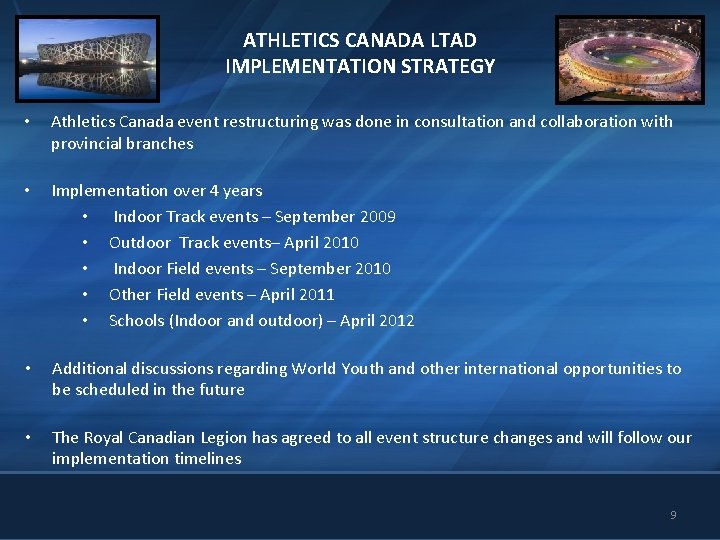
ATHLETICS CANADA LTAD IMPLEMENTATION STRATEGY • Athletics Canada event restructuring was done in consultation and collaboration with provincial branches • Implementation over 4 years • Indoor Track events – September 2009 • Outdoor Track events– April 2010 • Indoor Field events – September 2010 • Other Field events – April 2011 • Schools (Indoor and outdoor) – April 2012 • Additional discussions regarding World Youth and other international opportunities to be scheduled in the future • The Royal Canadian Legion has agreed to all event structure changes and will follow our implementation timelines 9
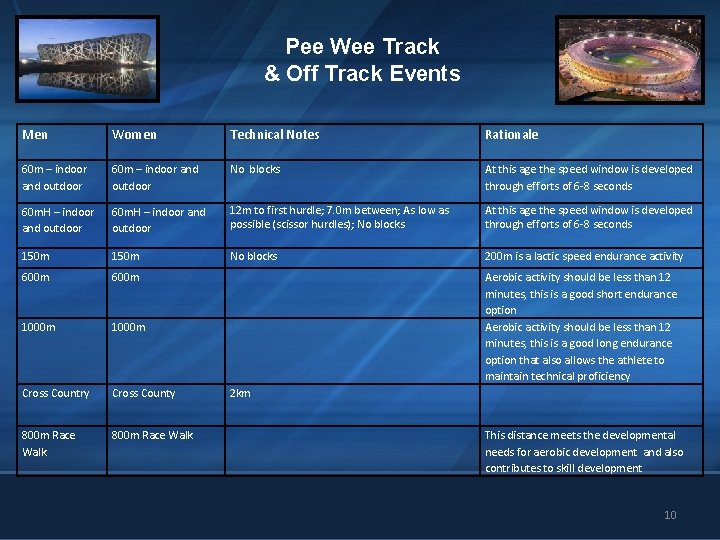
Pee Wee Track & Off Track Events Men Women Technical Notes Rationale 60 m – indoor and outdoor No blocks At this age the speed window is developed through efforts of 6 -8 seconds 60 m. H – indoor and outdoor 12 m to first hurdle; 7. 0 m between; As low as possible (scissor hurdles); No blocks At this age the speed window is developed through efforts of 6 -8 seconds 150 m No blocks 200 m is a lactic speed endurance activity 600 m 1000 m Cross Country Cross County 800 m Race Walk Aerobic activity should be less than 12 minutes, this is a good short endurance option Aerobic activity should be less than 12 minutes, this is a good long endurance option that also allows the athlete to maintain technical proficiency 2 km This distance meets the developmental needs for aerobic development and also contributes to skill development 10
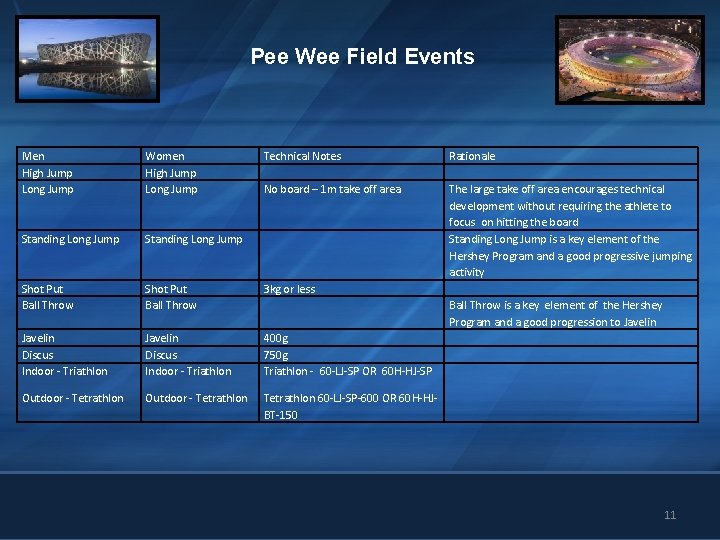
Pee Wee Field Events Men High Jump Long Jump Women High Jump Long Jump Technical Notes Rationale No board – 1 m take off area The large take off area encourages technical development without requiring the athlete to focus on hitting the board Standing Long Jump is a key element of the Hershey Program and a good progressive jumping activity Standing Long Jump Shot Put Ball Throw 3 kg or less Javelin Discus Indoor - Triathlon 400 g 750 g Triathlon - 60 -LJ-SP OR 60 H-HJ-SP Outdoor - Tetrathlon 60 -LJ-SP-600 OR 60 H-HJBT-150 Ball Throw is a key element of the Hershey Program and a good progression to Javelin 11
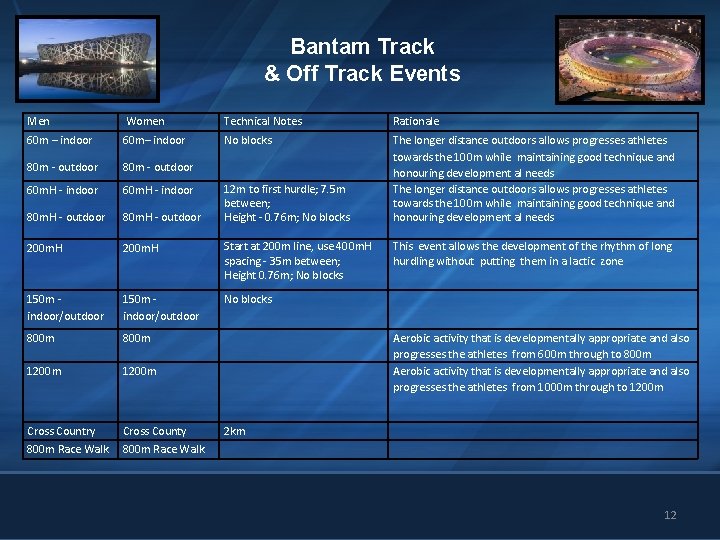
Bantam Track & Off Track Events Men Women Technical Notes Rationale 60 m – indoor 60 m– indoor No blocks 80 m - outdoor 60 m. H - indoor 80 m. H - outdoor The longer distance outdoors allows progresses athletes towards the 100 m while maintaining good technique and honouring development al needs 200 m. H Start at 200 m line, use 400 m. H spacing - 35 m between; Height 0. 76 m; No blocks 150 m indoor/outdoor No blocks 800 m 1200 m Cross Country Cross County 800 m Race Walk 12 m to first hurdle; 7. 5 m between; Height - 0. 76 m; No blocks This event allows the development of the rhythm of long hurdling without putting them in a lactic zone Aerobic activity that is developmentally appropriate and also progresses the athletes from 600 m through to 800 m Aerobic activity that is developmentally appropriate and also progresses the athletes from 1000 m through to 1200 m 2 km 12
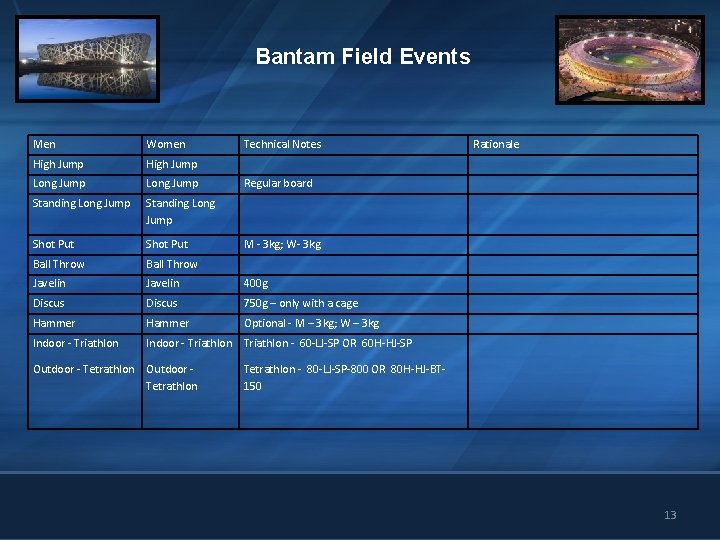
Bantam Field Events Men Women High Jump Long Jump Standing Long Jump Shot Put Ball Throw Javelin 400 g Discus 750 g – only with a cage Hammer Optional - M – 3 kg; W – 3 kg Indoor - Triathlon - 60 -LJ-SP OR 60 H-HJ-SP Outdoor - Tetrathlon Outdoor Tetrathlon Technical Notes Rationale Regular board M - 3 kg; W- 3 kg Tetrathlon - 80 -LJ-SP-800 OR 80 H-HJ-BT 150 13
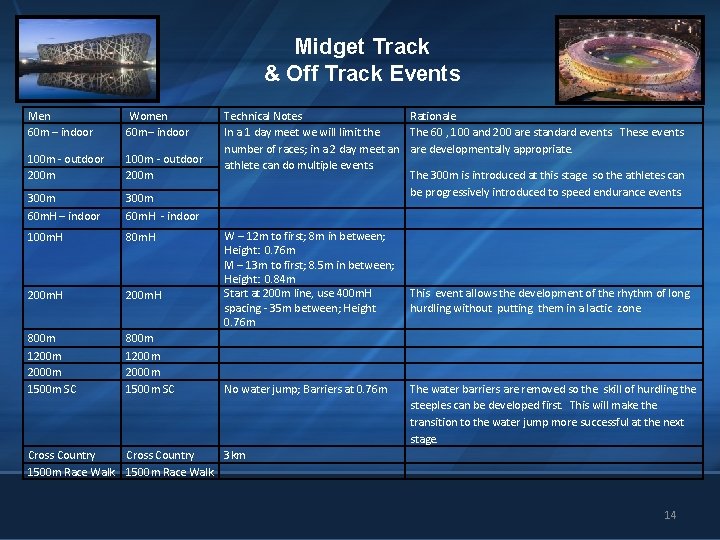
Midget Track & Off Track Events Men 60 m – indoor Women 60 m– indoor 100 m - outdoor 200 m 300 m 60 m. H – indoor 300 m 60 m. H - indoor 100 m. H 80 m. H 200 m. H 800 m 1200 m 2000 m 1500 m SC Technical Notes Rationale In a 1 day meet we will limit the The 60 , 100 and 200 are standard events. These events number of races; in a 2 day meet an are developmentally appropriate. athlete can do multiple events. The 300 m is introduced at this stage so the athletes can be progressively introduced to speed endurance events. W – 12 m to first; 8 m in between; Height: 0. 76 m M – 13 m to first; 8. 5 m in between; Height: 0. 84 m Start at 200 m line, use 400 m. H spacing - 35 m between; Height 0. 76 m No water jump; Barriers at 0. 76 m This event allows the development of the rhythm of long hurdling without putting them in a lactic zone The water barriers are removed so the skill of hurdling the steeples can be developed first. This will make the transition to the water jump more successful at the next stage. Cross Country 3 km 1500 m Race Walk 14
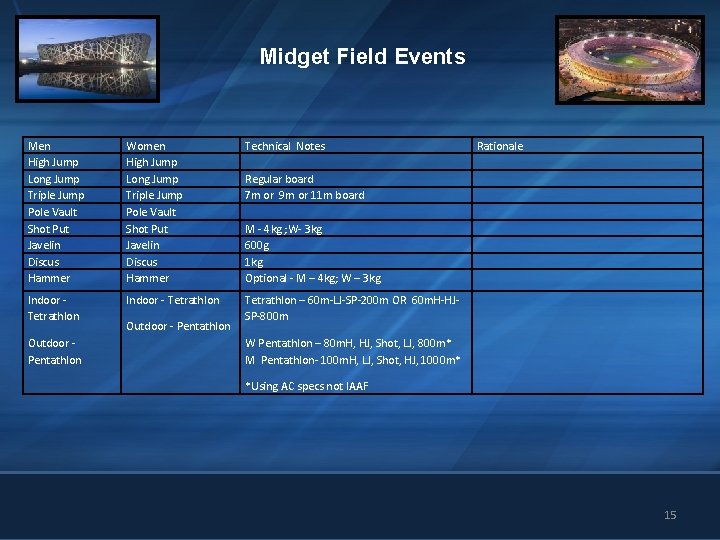
Midget Field Events Men High Jump Long Jump Triple Jump Pole Vault Shot Put Javelin Discus Hammer Women High Jump Long Jump Triple Jump Pole Vault Shot Put Javelin Discus Hammer Technical Notes Indoor Tetrathlon Indoor - Tetrathlon – 60 m-LJ-SP-200 m OR 60 m. H-HJSP-800 m Outdoor Pentathlon Outdoor - Pentathlon Rationale Regular board 7 m or 9 m or 11 m board M - 4 kg ; W- 3 kg 600 g 1 kg Optional - M – 4 kg; W – 3 kg W Pentathlon – 80 m. H, HJ, Shot, LJ, 800 m* M Pentathlon- 100 m. H, LJ, Shot, HJ, 1000 m* *Using AC specs not IAAF 15
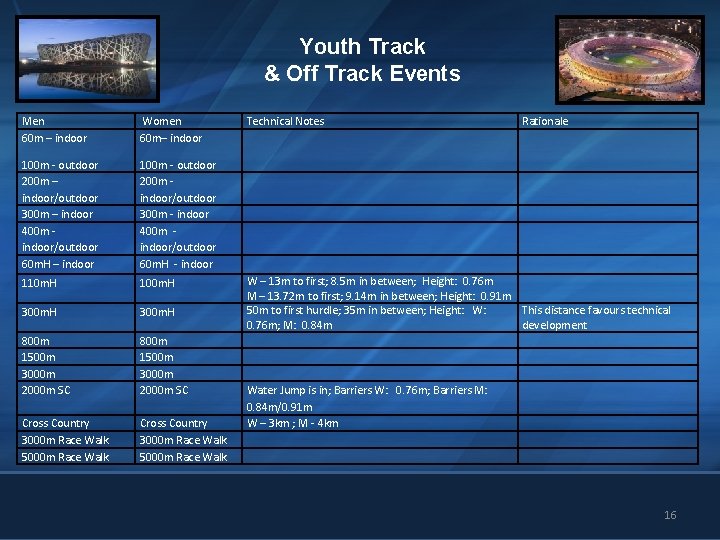
Youth Track & Off Track Events Men 60 m – indoor Women 60 m– indoor 100 m - outdoor 200 m – indoor/outdoor 300 m – indoor 400 m indoor/outdoor 60 m. H – indoor 100 m - outdoor 200 m indoor/outdoor 300 m - indoor 400 m indoor/outdoor 60 m. H - indoor 110 m. H 100 m. H 300 m. H 800 m 1500 m 3000 m 2000 m SC Cross Country 3000 m Race Walk 5000 m Race Walk Technical Notes Rationale W – 13 m to first; 8. 5 m in between; Height: 0. 76 m M – 13. 72 m to first; 9. 14 m in between; Height: 0. 91 m 50 m to first hurdle; 35 m in between; Height: W: This distance favours technical 0. 76 m; M: 0. 84 m development Water Jump is in; Barriers W: 0. 76 m; Barriers M: 0. 84 m/0. 91 m W – 3 km ; M - 4 km 16
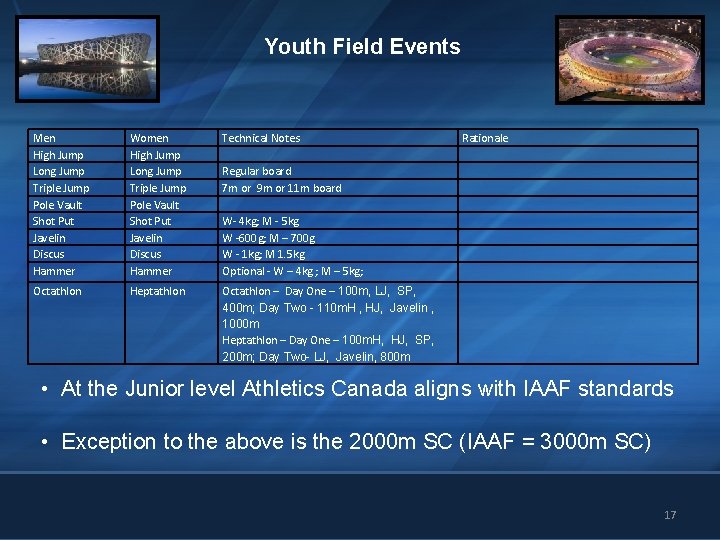
Youth Field Events Men High Jump Long Jump Triple Jump Pole Vault Shot Put Javelin Discus Hammer Women High Jump Long Jump Triple Jump Pole Vault Shot Put Javelin Discus Hammer Technical Notes Octathlon Heptathlon Octathlon – Day One – 100 m, LJ, SP, 400 m; Day Two - 110 m. H , HJ, Javelin , 1000 m Heptathlon – Day One – 100 m. H, HJ, SP, 200 m; Day Two- LJ, Javelin, 800 m Rationale Regular board 7 m or 9 m or 11 m board W- 4 kg; M - 5 kg W -600 g; M – 700 g W - 1 kg; M 1. 5 kg Optional - W – 4 kg ; M – 5 kg; • At the Junior level Athletics Canada aligns with IAAF standards • Exception to the above is the 2000 m SC (IAAF = 3000 m SC) 17
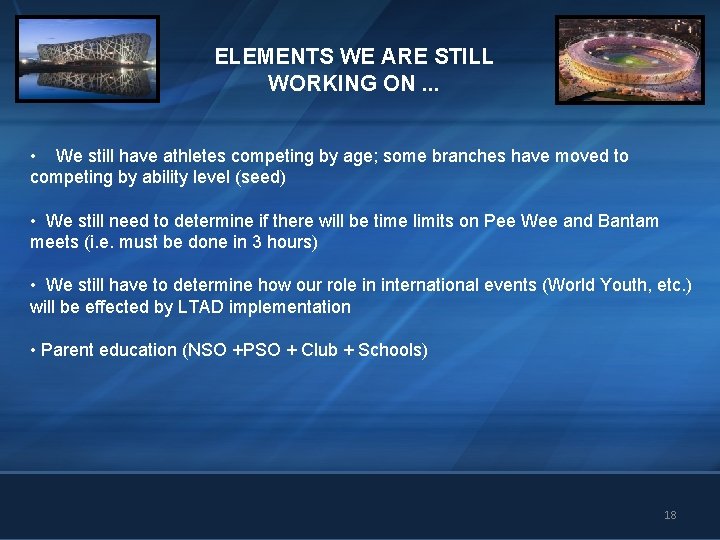
ELEMENTS WE ARE STILL WORKING ON. . . • We still have athletes competing by age; some branches have moved to competing by ability level (seed) • We still need to determine if there will be time limits on Pee Wee and Bantam meets (i. e. must be done in 3 hours) • We still have to determine how our role in international events (World Youth, etc. ) will be effected by LTAD implementation • Parent education (NSO +PSO + Club + Schools) 18
WHY IS THIS SIGNIFICANT? • Athletics Canada event structure now based on athlete development • For the first time events, implement weights and hurdle heights and distances are the same nationwide in each age group • The phased in approach will allow coaches, athletes, parents and officials to adapt to the changes slowly • The long term impact on our sport will be significant 19