
ATHENS INFORMATION TECHNOLOGY www ait edu gr Issues
- Slides: 27
ATHENS INFORMATION TECHNOLOGY www. ait. edu. gr “Issues and Challenges in Physical-Layer Aware Optically Switched Network Design and Operation” Yvan Pointurier, Siamak Azodolmolky, Marianna Angelou and Ioannis Tomkos {yvan, sazo, mang, itom}@ait. edu. gr http: //www. ait. edu. gr September 15 -19, 2009 – Pisa, Italy Session: “Impairment Aware and Reconfigurable Optical Networks” We. II 3 -1 16 Sep'09 Int. Conf. on Photonics in Switching 2009 1
Outline • • • www. ait. edu. gr Introduction Motivations Issues and design challenges DICONET framework Impairment aware lightpath establishment Conclusions 16 Sep'09 Int. Conf. on Photonics in Switching 2009 2
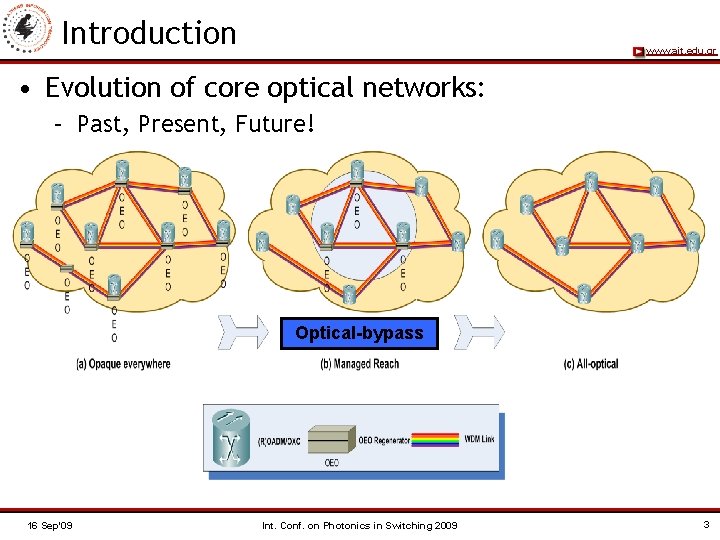
Introduction www. ait. edu. gr • Evolution of core optical networks: – Past, Present, Future! Optical-bypass 16 Sep'09 Int. Conf. on Photonics in Switching 2009 3
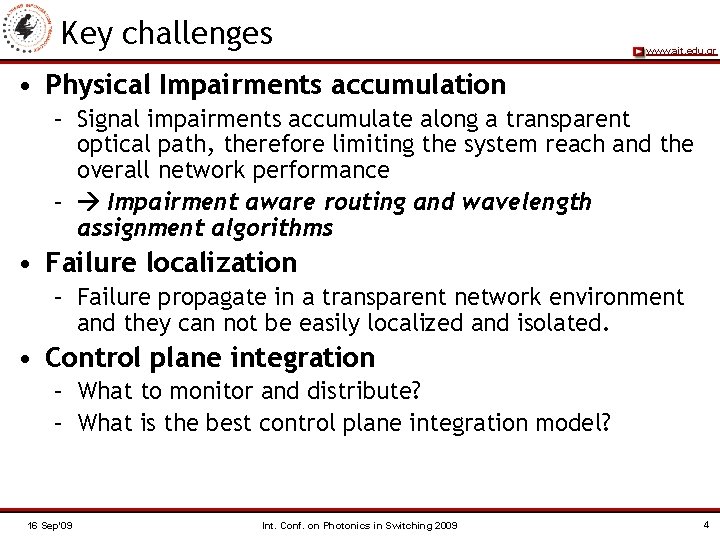
Key challenges www. ait. edu. gr • Physical Impairments accumulation – Signal impairments accumulate along a transparent optical path, therefore limiting the system reach and the overall network performance – Impairment aware routing and wavelength assignment algorithms • Failure localization – Failure propagate in a transparent network environment and they can not be easily localized and isolated. • Control plane integration – What to monitor and distribute? – What is the best control plane integration model? 16 Sep'09 Int. Conf. on Photonics in Switching 2009 4
Toward Future Core Optical Networks www. ait. edu. gr • The network evolution aims at: – Improved cost economics (less costly electronics) • Cost savings of a transparent solution over an opaque network design of up to 50% could be achieved – Source: M. Gunkel, et. al. “A Cost Model for WDM Layer”, Photonics in Switching Conference, 2006. – Reduced investment and operations Efforts (CAPEX, OPEX) – Scalability (bit rate independence) – Suitability to future services (e. g. Grid computing) • The main drivers for network architecture migration: – High bandwidth and end-to-end Qo. S guaranteed services – Dynamic (on demand) technology-independent service provisioning 16 Sep'09 Int. Conf. on Photonics in Switching 2009 5
DICONET framework (1/2) www. ait. edu. gr • Cross-layer optimization – Physical layer impairment monitoring/management – Impairment Aware Lightpath Routing (a. k. a. IA-RWA) • The main Idea: – The development of a dynamic network planning/operation tool residing in the core network nodes that incorporates real-time measurements of optical layer performance into IA-RWA algorithms and is integrated into a unified control plane. http: //www. diconet. eu 16 Sep'09 Int. Conf. on Photonics in Switching 2009 6
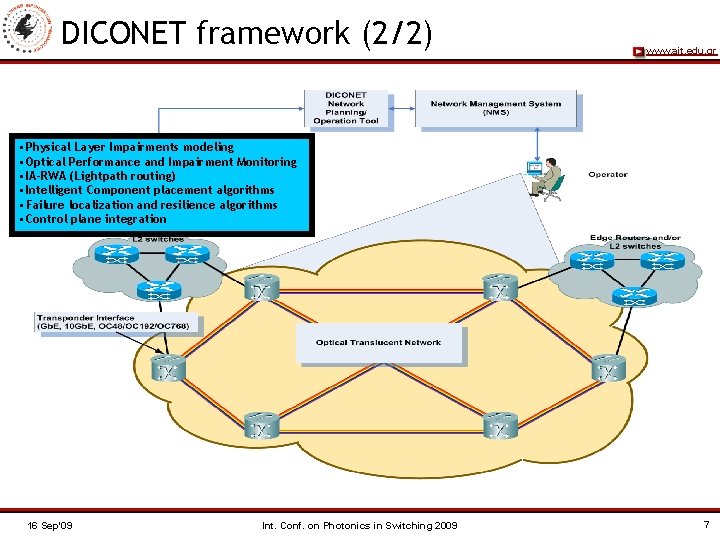
DICONET framework (2/2) www. ait. edu. gr • Physical Layer Impairments modeling • Optical Performance and Impairment Monitoring • IA-RWA (Lightpath routing) • Intelligent Component placement algorithms • Failure localization and resilience algorithms • Control plane integration 16 Sep'09 Int. Conf. on Photonics in Switching 2009 7
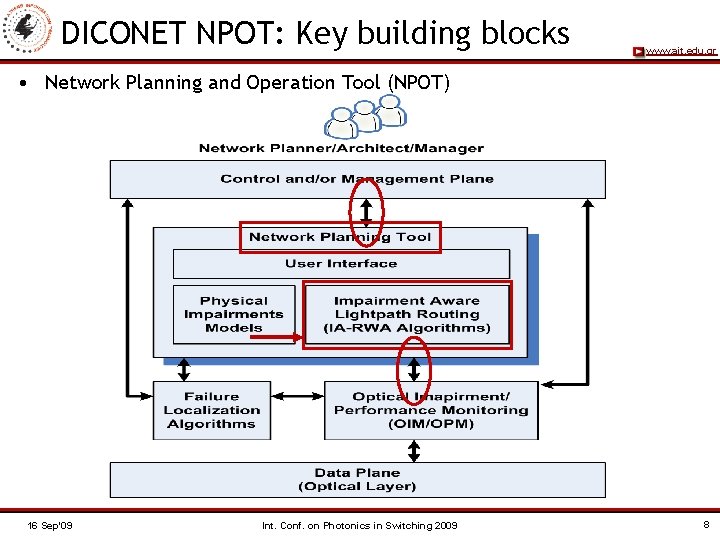
DICONET NPOT: Key building blocks www. ait. edu. gr • Network Planning and Operation Tool (NPOT) 16 Sep'09 Int. Conf. on Photonics in Switching 2009 8
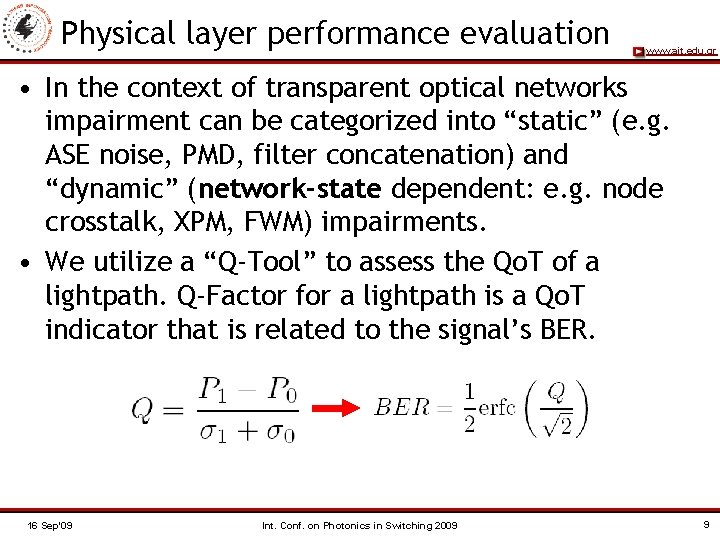
Physical layer performance evaluation www. ait. edu. gr • In the context of transparent optical networks impairment can be categorized into “static” (e. g. ASE noise, PMD, filter concatenation) and “dynamic” (network-state dependent: e. g. node crosstalk, XPM, FWM) impairments. • We utilize a “Q-Tool” to assess the Qo. T of a lightpath. Q-Factor for a lightpath is a Qo. T indicator that is related to the signal’s BER. 16 Sep'09 Int. Conf. on Photonics in Switching 2009 9
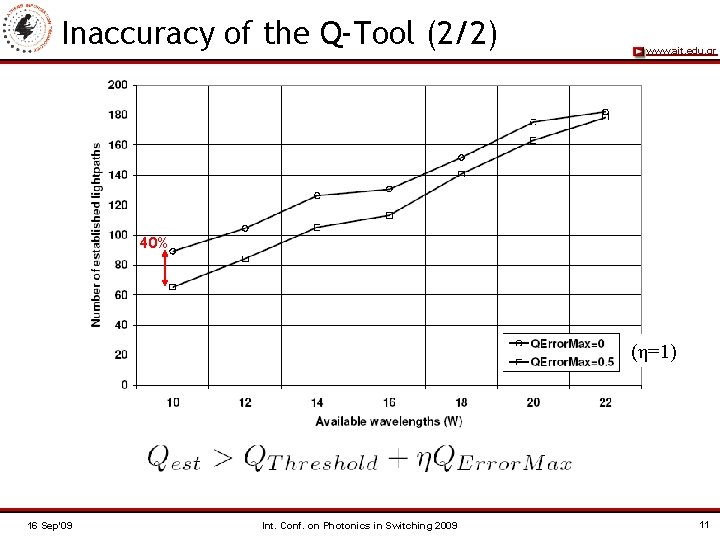
Inaccuracy of the Q-Tool (1/2) www. ait. edu. gr • Practical Qo. T estimators (including our Q-Tool) is a combination of analytical models and/or interpolations of measurements and simulations. • Practical Qo. T estimators should be fast in order to support quick lightpath establishment. • Inaccuracy of Q-Tool – Imperfect physical models (by nature) – Optimization for speed • Incorrect Qo. T estimation has a direct impact on lightpath establishment – Q overestimate accept LP with inadequate Qo. T – Q underestimate block LP with adequate Qo. T 16 Sep'09 Int. Conf. on Photonics in Switching 2009 10
Inaccuracy of the Q-Tool (2/2) www. ait. edu. gr 40% (η=1) 16 Sep'09 Int. Conf. on Photonics in Switching 2009 11
Online “Rahyab” (1/4) www. ait. edu. gr • The main idea behind online Rahyab algorithm is to design a multi-constraint IA-RWA algorithm that considers Qo. T inaccuracy through optical monitor availability information in routing decisions, in order to alleviate the inaccuracy of the Qo. T estimator (i. e. Q-Tool). • “Rahyab” building blocks – Multi-Constraint Path (MCP) computation framework • Link cost vector and Single Mixed Metric Mapping – Online “Rahyab” flowchart 16 Sep'09 Int. Conf. on Photonics in Switching 2009 12
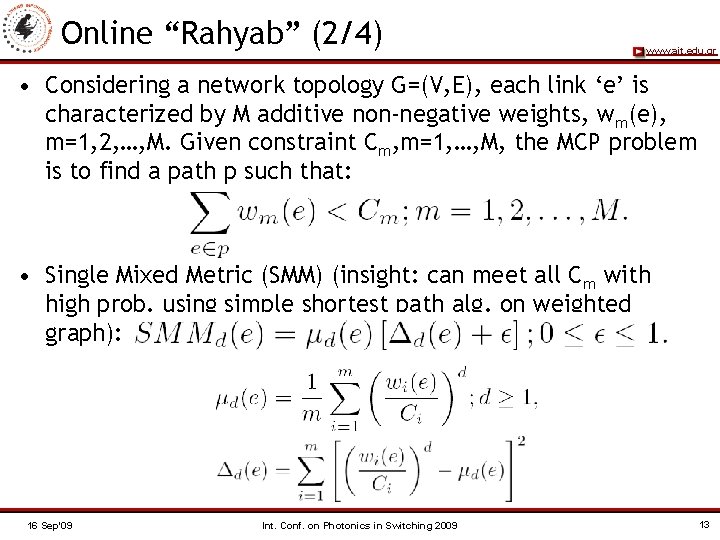
Online “Rahyab” (2/4) www. ait. edu. gr • Considering a network topology G=(V, E), each link ‘e’ is characterized by M additive non-negative weights, wm(e), m=1, 2, …, M. Given constraint Cm, m=1, …, M, the MCP problem is to find a path p such that: • Single Mixed Metric (SMM) (insight: can meet all Cm with high prob. using simple shortest path alg. on weighted graph): 16 Sep'09 Int. Conf. on Photonics in Switching 2009 13
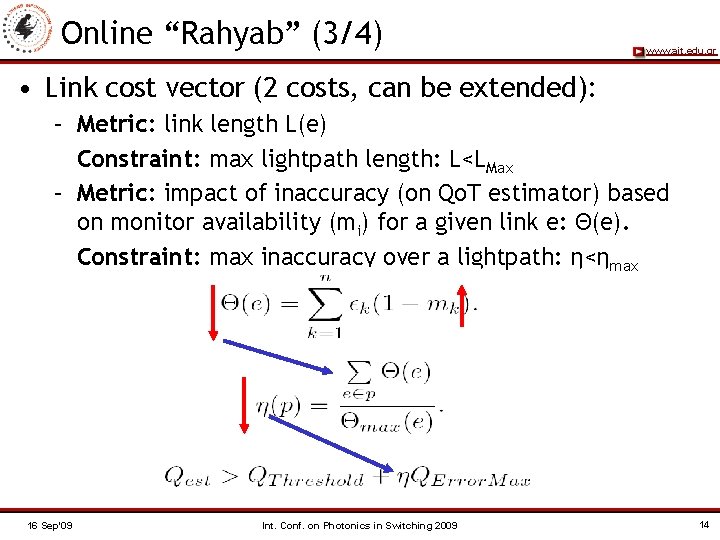
Online “Rahyab” (3/4) www. ait. edu. gr • Link cost vector (2 costs, can be extended): – Metric: link length L(e) Constraint: max lightpath length: L<LMax – Metric: impact of inaccuracy (on Qo. T estimator) based on monitor availability (mi) for a given link e: Θ(e). Constraint: max inaccuracy over a lightpath: η<ηmax 16 Sep'09 Int. Conf. on Photonics in Switching 2009 14
Flow diagram of Rahyab 16 Sep'09 Int. Conf. on Photonics in Switching 2009 www. ait. edu. gr 16
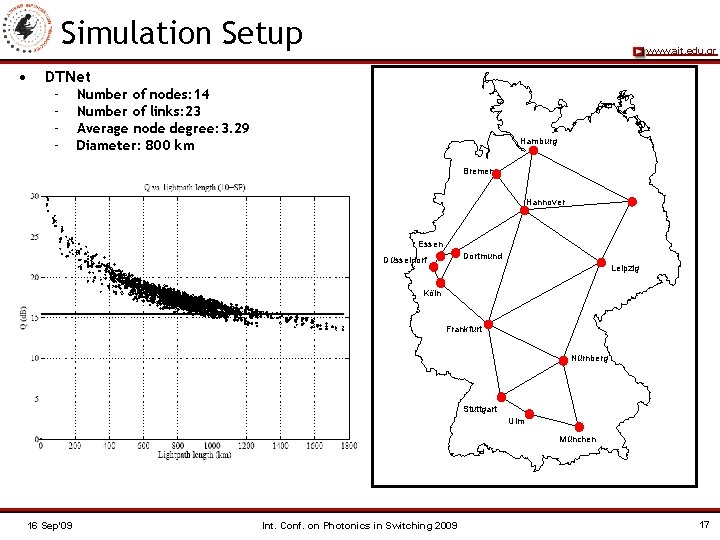
Simulation Setup • www. ait. edu. gr DTNet – – Number of nodes: 14 Number of links: 23 Average node degree: 3. 29 Diameter: 800 km Hamburg Bremen Hannover Essen Dortmund Düsseldorf Leipzig Köln Frankfurt Nürnberg Stuttgart Ulm München 16 Sep'09 Int. Conf. on Photonics in Switching 2009 17
Results (1/3) www. ait. edu. gr • Blocking rate vs. load 16 Sep'09 Int. Conf. on Photonics in Switching 2009 18
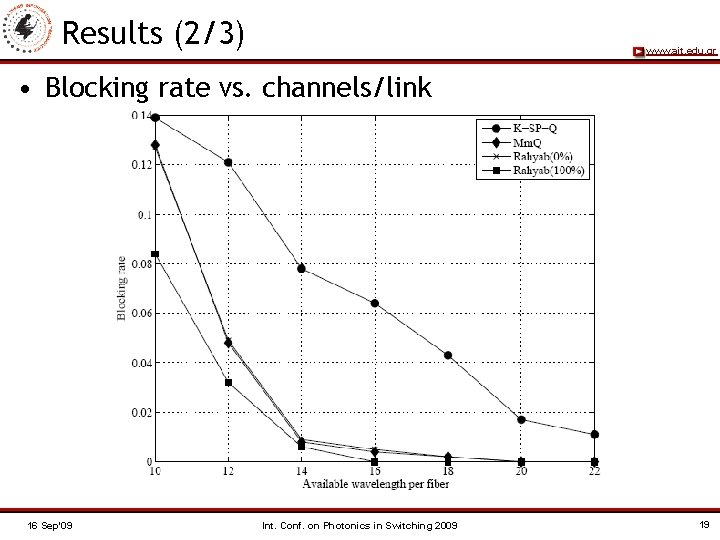
Results (2/3) www. ait. edu. gr • Blocking rate vs. channels/link 16 Sep'09 Int. Conf. on Photonics in Switching 2009 19
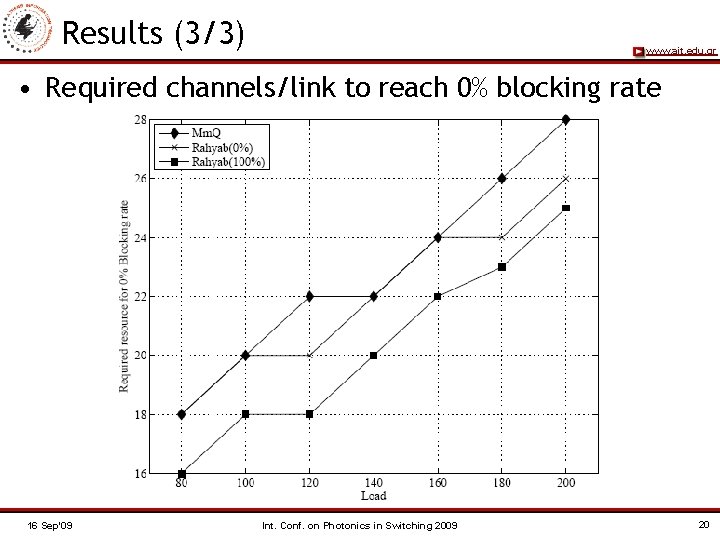
Results (3/3) www. ait. edu. gr • Required channels/link to reach 0% blocking rate 16 Sep'09 Int. Conf. on Photonics in Switching 2009 20
Fast lightpath establishment www. ait. edu. gr • Different approach: incorporate additional (“historic”) probing data to make better Qo. T estimation • Setup: when demand arrives: a) estimate Qo. T using past monitoring data (probes), b) send probe • Problem: wrong Qo. T estimation leads to additional LP establishment attempts, which should be decreased for fast lightpath establishment • Proposed solution: – Perform Qo. T estimation for LPs - use monitoring data of LPs already established – Use “end-to-end” estimation framework (“network kriging”): leverage correlation between LP Qo. T, induced by topology • Lightpaths using common links sustain similar physical effects Work with Nicola Sambo et al. , ICTON 2009 (BONE) 16 Sep'09 Int. Conf. on Photonics in Switching 2009 21
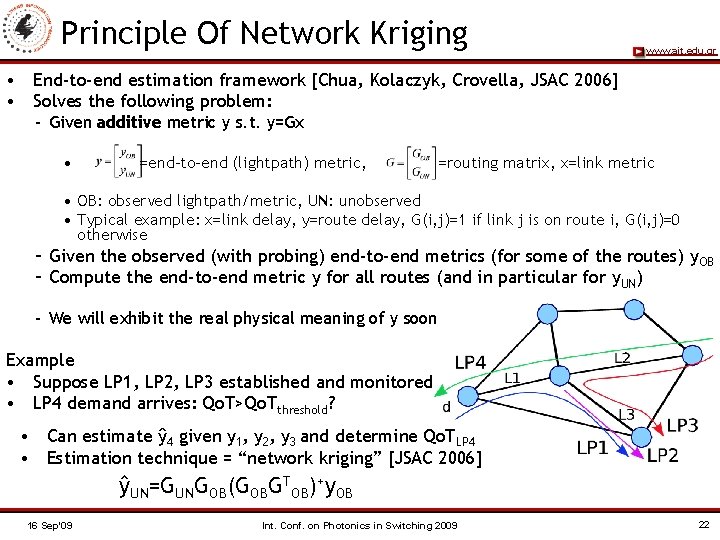
Principle Of Network Kriging www. ait. edu. gr • End-to-end estimation framework [Chua, Kolaczyk, Crovella, JSAC 2006] • Solves the following problem: – Given additive metric y s. t. y=Gx • =end-to-end (lightpath) metric, =routing matrix, x=link metric • OB: observed lightpath/metric, UN: unobserved • Typical example: x=link delay, y=route delay, G(i, j)=1 if link j is on route i, G(i, j)=0 otherwise – Given the observed (with probing) end-to-end metrics (for some of the routes) y. OB – Compute the end-to-end metric y for all routes (and in particular for y. UN) – We will exhibit the real physical meaning of y soon Example • Suppose LP 1, LP 2, LP 3 established and monitored • LP 4 demand arrives: Qo. T>Qo. Tthreshold? • Can estimate ŷ 4 given y 1, y 2, y 3 and determine Qo. TLP 4 • Estimation technique = “network kriging” [JSAC 2006] ŷUN=GUNGOB(GOBGTOB)+y. OB 16 Sep'09 Int. Conf. on Photonics in Switching 2009 22
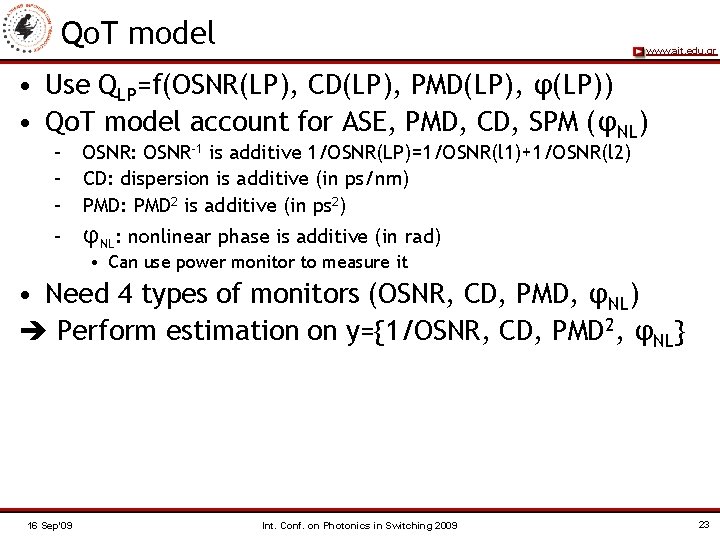
Qo. T model www. ait. edu. gr • Use QLP=f(OSNR(LP), CD(LP), PMD(LP), φ(LP)) • Qo. T model account for ASE, PMD, CD, SPM (φNL) – – – OSNR: OSNR-1 is additive 1/OSNR(LP)=1/OSNR(l 1)+1/OSNR(l 2) CD: dispersion is additive (in ps/nm) PMD: PMD 2 is additive (in ps 2) – φNL: nonlinear phase is additive (in rad) • Can use power monitor to measure it • Need 4 types of monitors (OSNR, CD, PMD, φNL) Perform estimation on y={1/OSNR, CD, PMD 2, φNL} 16 Sep'09 Int. Conf. on Photonics in Switching 2009 23
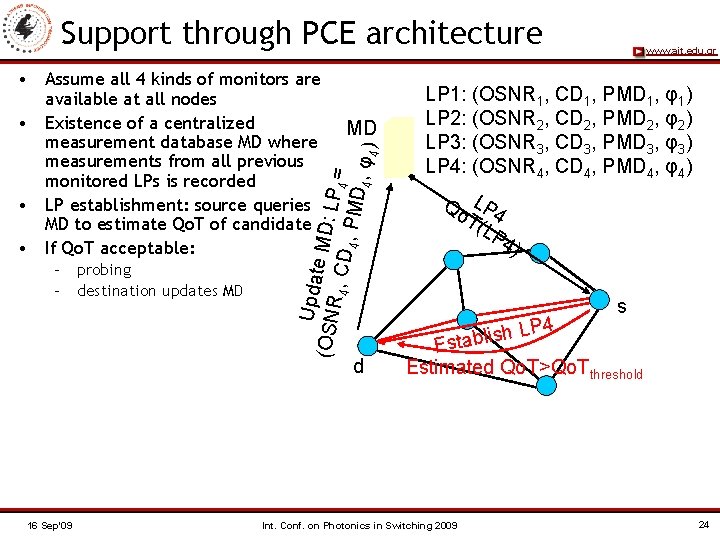
Support through PCE architecture – probing – destination updates MD 4) MD Updat e MD: (OSN LP 4 = R 4 , CD 4 , PMD 4, φ • Assume all 4 kinds of monitors are available at all nodes • Existence of a centralized measurement database MD where measurements from all previous monitored LPs is recorded • LP establishment: source queries MD to estimate Qo. T of candidate • If Qo. T acceptable: d 16 Sep'09 www. ait. edu. gr LP 1: (OSNR 1, CD 1, PMD 1, φ1) LP 2: (OSNR 2, CD 2, PMD 2, φ2) LP 3: (OSNR 3, CD 3, PMD 3, φ3) LP 4: (OSNR 4, CD 4, PMD 4, φ4) Qo LP 4 T( LP 4) s P 4 L h s i l Estab Estimated Qo. T>Qo. Tthreshold Int. Conf. on Photonics in Switching 2009 24
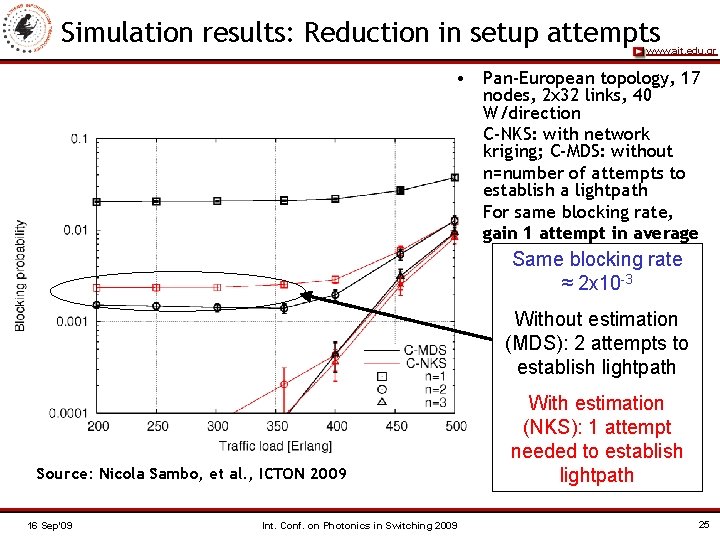
Simulation results: Reduction in setup attempts www. ait. edu. gr • Pan-European topology, 17 nodes, 2 x 32 links, 40 W/direction • C-NKS: with network kriging; C-MDS: without • n=number of attempts to establish a lightpath • For same blocking rate, gain 1 attempt in average Same blocking rate ≈ 2 x 10 -3 Without estimation (MDS): 2 attempts to establish lightpath Source: Nicola Sambo, et al. , ICTON 2009 16 Sep'09 Int. Conf. on Photonics in Switching 2009 With estimation (NKS): 1 attempt needed to establish lightpath 25
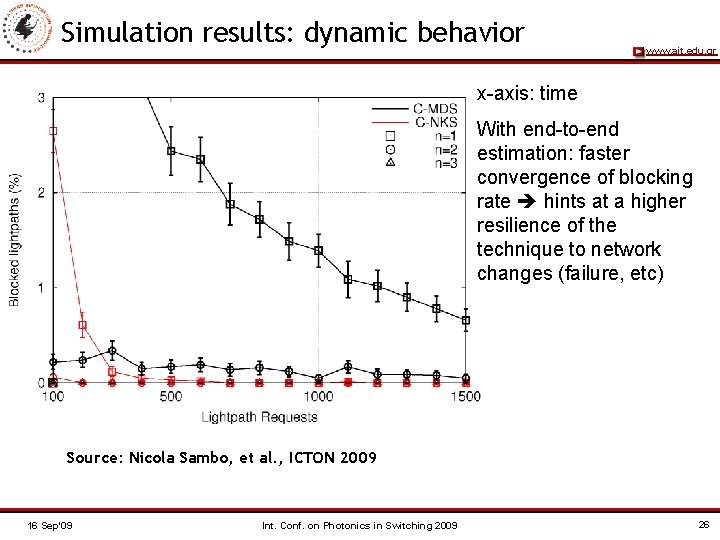
Simulation results: dynamic behavior www. ait. edu. gr x-axis: time With end-to-end estimation: faster convergence of blocking rate hints at a higher resilience of the technique to network changes (failure, etc) Source: Nicola Sambo, et al. , ICTON 2009 16 Sep'09 Int. Conf. on Photonics in Switching 2009 26
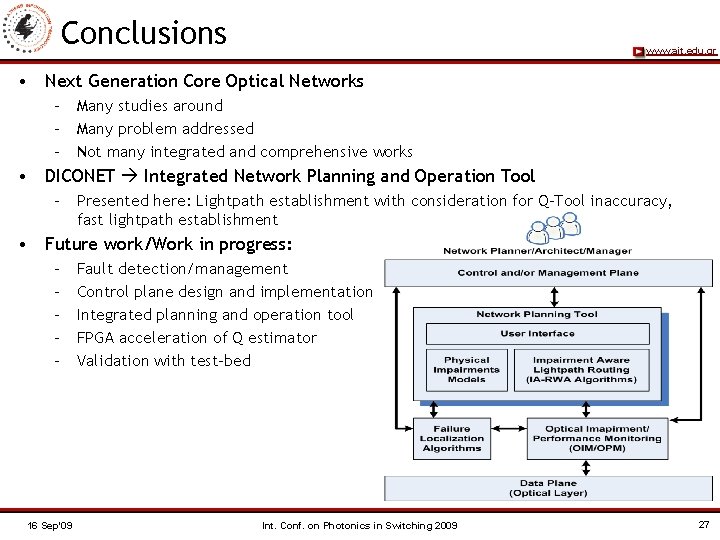
Conclusions www. ait. edu. gr • Next Generation Core Optical Networks – Many studies around – Many problem addressed – Not many integrated and comprehensive works • DICONET Integrated Network Planning and Operation Tool – Presented here: Lightpath establishment with consideration for Q-Tool inaccuracy, fast lightpath establishment • Future work/Work in progress: – – – 16 Sep'09 Fault detection/management Control plane design and implementation Integrated planning and operation tool FPGA acceleration of Q estimator Validation with test-bed Int. Conf. on Photonics in Switching 2009 27
Thank you! www. ait. edu. gr • Question & Answers • Acknowledgements – This work is partially funded by the European Commission (FP 7) Dynamic Impairment Constraint Networking for Transparent Mesh Optical Networks Building the Future Optical Network in Europe http: //www. diconet. eu http: //www. ict-bone. eu 16 Sep'09 Int. Conf. on Photonics in Switching 2009 28