
Athens and Sparta were both Greek city states
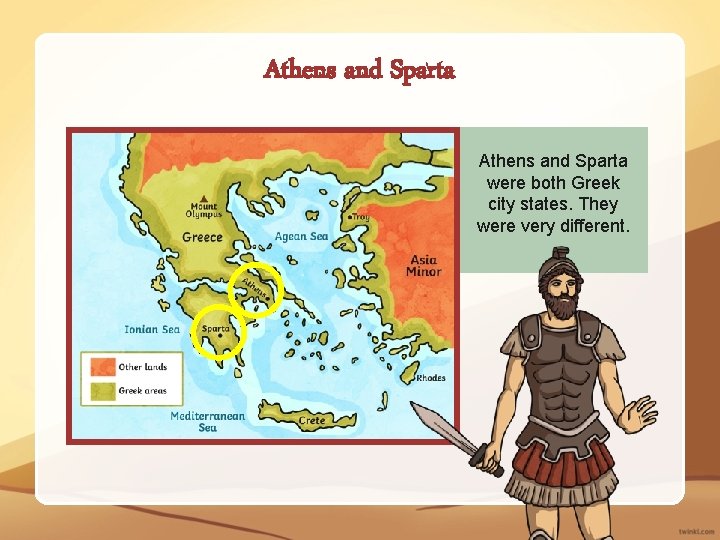
Athens and Sparta were both Greek city states. They were very different.
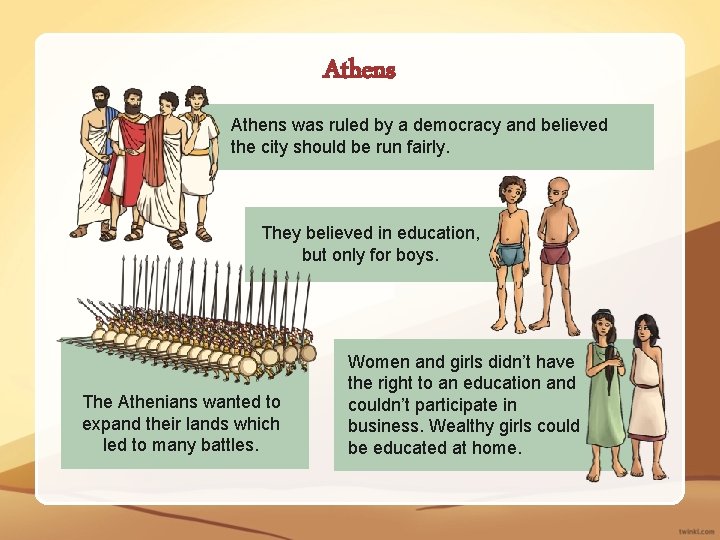
Athens was ruled by a democracy and believed the city should be run fairly. They believed in education, but only for boys. The Athenians wanted to expand their lands which led to many battles. Women and girls didn’t have the right to an education and couldn’t participate in business. Wealthy girls could be educated at home.
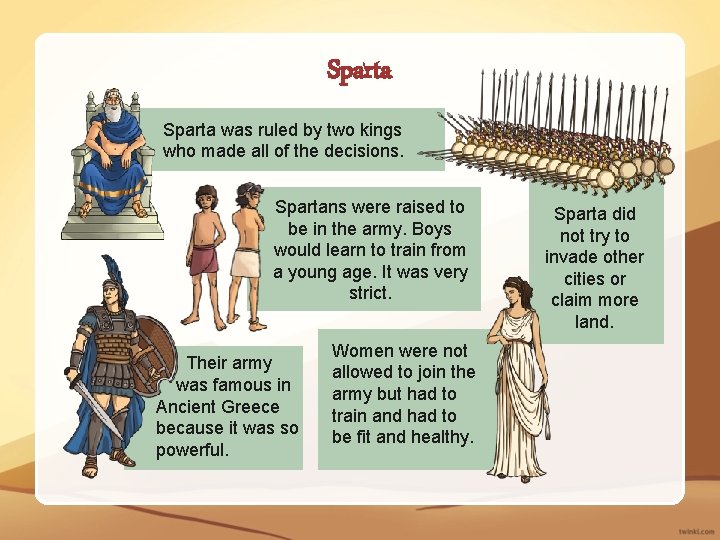
Sparta was ruled by two kings who made all of the decisions. Spartans were raised to be in the army. Boys would learn to train from a young age. It was very strict. Their army was famous in Ancient Greece because it was so powerful. Women were not allowed to join the army but had to train and had to be fit and healthy. Sparta did not try to invade other cities or claim more land.
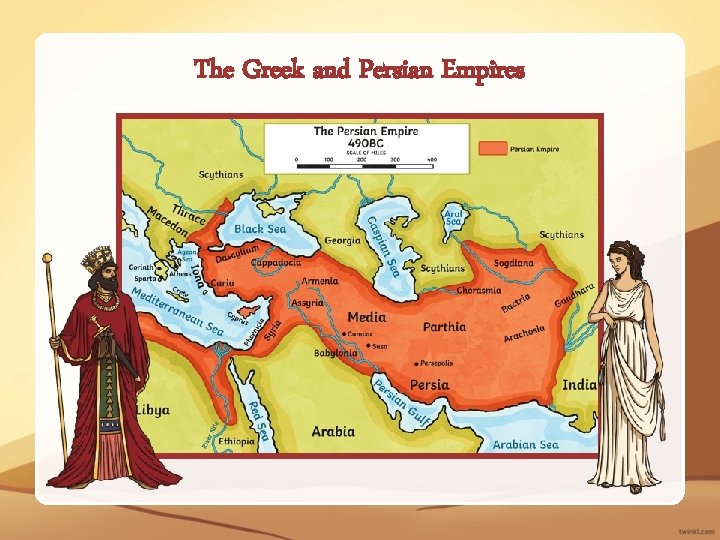
The Greek and Persian Empires
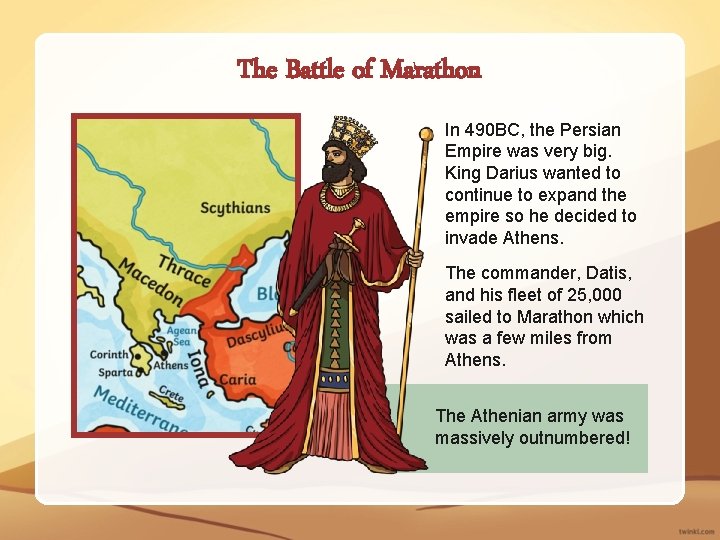
The Battle of Marathon In 490 BC, the Persian Empire was very big. King Darius wanted to continue to expand the empire so he decided to invade Athens. The commander, Datis, and his fleet of 25, 000 sailed to Marathon which was a few miles from Athens. The Athenian army was massively outnumbered!
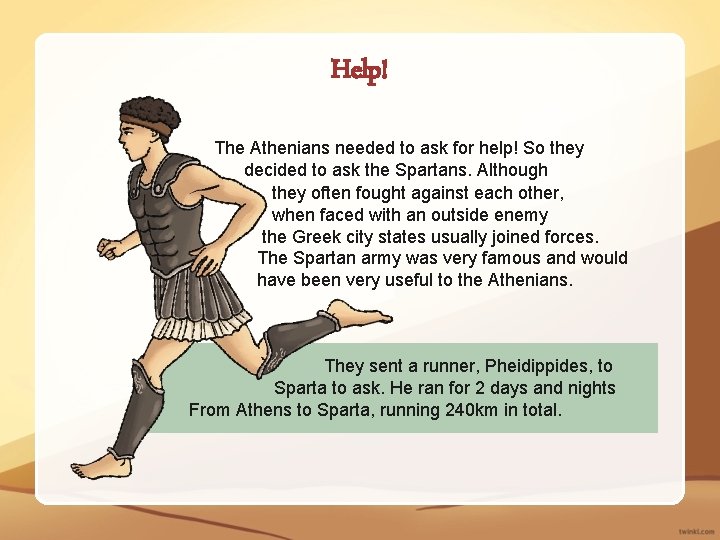
Help! The Athenians needed to ask for help! So they decided to ask the Spartans. Although they often fought against each other, when faced with an outside enemy the Greek city states usually joined forces. The Spartan army was very famous and would have been very useful to the Athenians. They sent a runner, Pheidippides, to Sparta to ask. He ran for 2 days and nights From Athens to Sparta, running 240 km in total.
Help! The Spartans were celebrating a festival and so said they would help, only once the festival was over. Pheidippides then ran back to Athens with the news that they would need to wait! Activity Role play the conversation between the Athenians and the Spartans. Why didn’t the Spartans help? How do the Athenians feel about the Spartans’ reason for not helping?

Let Battle Commence! The Athenian army, led by General Miltiades, tried to wait for the Spartan army but they knew they would have to fight on their own. He had to come up with a plan. Heavily outnumbered, Miltiades decided on a risky battle formation. He knew Datis would put his strongest fighters in the middle so Miltiades put his strongest hoplites (soldiers) on the edge, or the flanks. He also knew the Persians had archers, so instructed his men to charge quickly towards the enemy. Phalanx formation
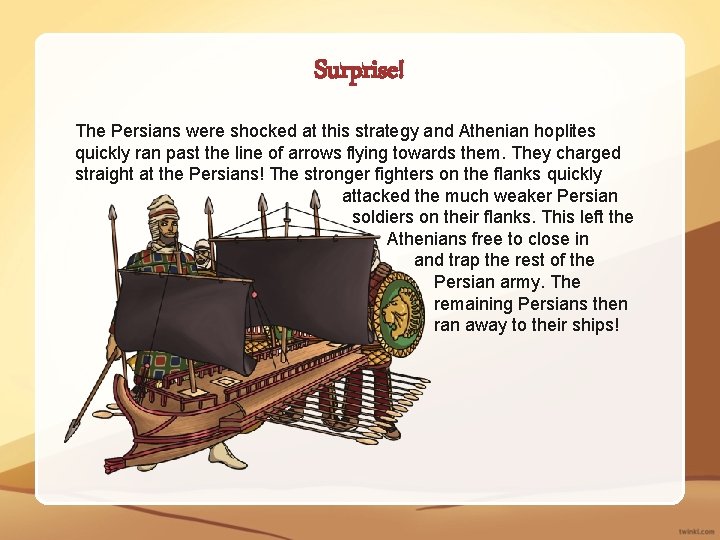
Surprise! The Persians were shocked at this strategy and Athenian hoplites quickly ran past the line of arrows flying towards them. They charged straight at the Persians! The stronger fighters on the flanks quickly attacked the much weaker Persian soldiers on their flanks. This left the Athenians free to close in and trap the rest of the Persian army. The remaining Persians then ran away to their ships!
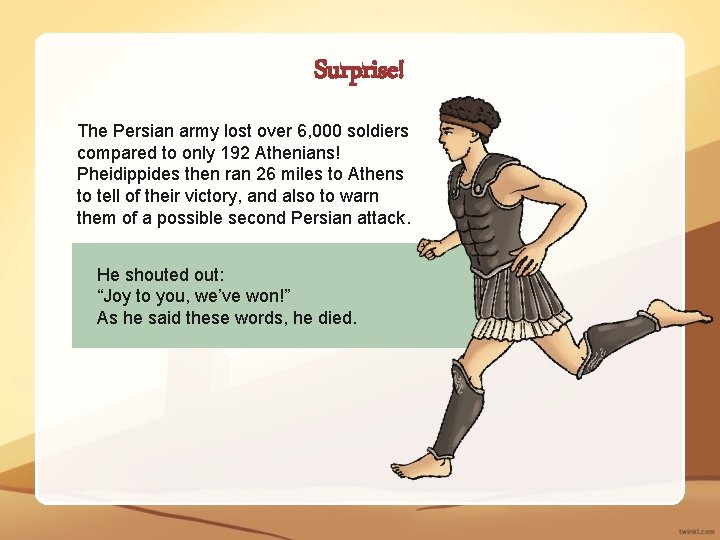
Surprise! The Persian army lost over 6, 000 soldiers compared to only 192 Athenians! Pheidippides then ran 26 miles to Athens to tell of their victory, and also to warn them of a possible second Persian attack. He shouted out: “Joy to you, we’ve won!” As he said these words, he died.
- Slides: 12