
Atheism Agnosticism Humanism THE BIBLE AND DENIAL OF
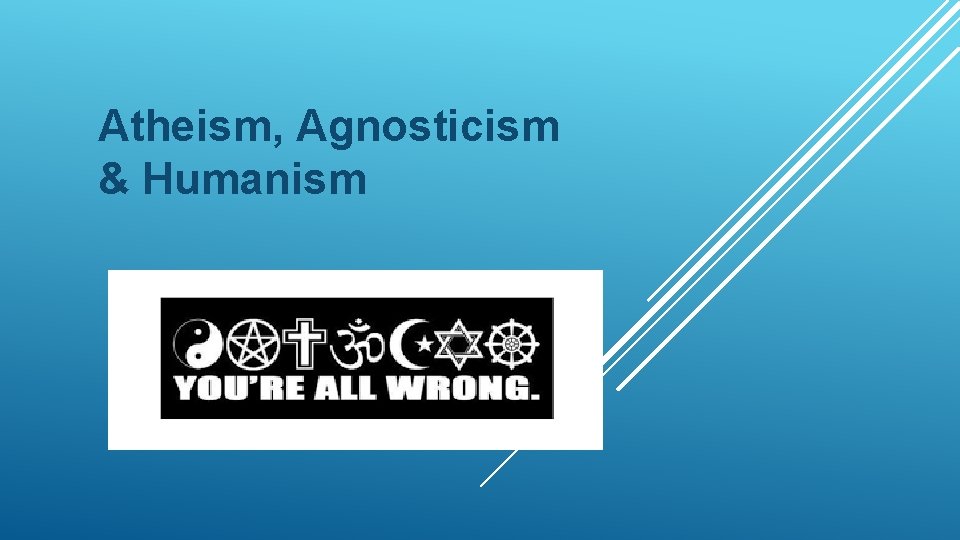
Atheism, Agnosticism & Humanism

THE BIBLE AND DENIAL OF GOD Ø Ø In the pride of his face the wicked does not seek him; all his thoughts are, “There is no God. ” Psalm 10: 4 The fool says in his heart, “There is no God. ” They are corrupt, doing abominable iniquity; there is none who does good. Psalm 53: 1
DEFINITIONS v An atheist is a person who believes that there is no God v An agnostic believes that it is not possible to know whether God exists or not v. A humanist is a person that believes people’s spiritual and emotional needs can be satisfied without following a god or religion Cambridge Dictionary v Worldview - the overall perspective from which one sees and interprets the world. A collection of beliefs about life and the universe held by an individual or a group. https: //www. yourdictionary. com/worldview
ORIGINS – THE ENLIGHTENMENT v The Enlightenment has been defined in many different ways, but at its broadest was a philosophical, intellectual and cultural movement of the seventeenth and eighteenth centuries. It stressed reason, logic, criticism, and freedom of thought over dogma, blind faith, and superstition. https: //www. thoughtco. com/a-beginners-guide-to-theenlightenment-1221925 v The ways of thinking arising from the Enlightenment are dominant in Western science, arts and morality and these ideas are spreading across most nations and cultures – especially in scientific enquiry
EFFECT OF THE ENLIGHTENMENT v The ideas of atheism, agnosticism and humanism as they exist today come largely from the Enlightenment v. A major effect of the Enlightenment has been the growth of the rejection of revelation as a means to understand the universe and as guidance on morality v This means the Bible is often viewed at best as a possible source of some insights and at worst of no value and by some is viewed as harmful to the well being of people
IMPLICATIONS FOR WORLDVIEWS v Atheists have no place for God in their worldview about the universe or for moral views about how we should live v Agnostics hold a worldview that ideas about God to understand the universe or to develop moral views have no sound basis and therefore provide no clear guidance on how we can understand the universe or how we should live v Humanists have a worldview that regards any references to God in our understanding of moral questions as at best a waste of time and at worse likely to be harmful – most Humanists are either Atheists or Agnostics
WORLDVIEW OF MILITANT ATHEISTS v For such people things are explainable only by material causes – such people believe Ø That scientific enquiry leads to understanding not only about the universe but also about why people behave as they do and how this can be changed Ø All explanations are based on material causes – ie there are no spiritual (non-material) factors at work in the universe and in human motivations and behaviour – the possibility of nonmaterial factors as causes is ruled out by assumption Ø All solutions to the problems we face involve changing material conditions - including moral problems
INFLUENCERS OF WORLDVIEWS v Most people do not think in any depth about their worldview - indeed most people probably do not know that they have a worldview and that this view effects how they behave and how they react to the things of life v Many influencers (people that influence worldviews) in politics, science, arts, education and the media are committed atheists or agnostics and humanists - although many are not militant v These influencers have a strong effect on the worldviews adopted by many people
QUASI ATHEISTS v It is possible that a large percentage of people in the UK today are quasi atheists as they have (without thinking about it) adopted large parts of the worldview of atheists v Many of these people may think that they do believe in God or gods but in practice they adopt much of the worldviews of atheists v Many of our friends, relatives and colleagues may well be quasi atheists
HOW MIGHT WE SHARE THE GOSPEL TO ATHEISTS? v Be polite – if atheists aggressively attack our faith we should not retaliate by being aggressive towards them – Proverbs 15: 1 v Remember that they cannot understand the things of God because they are spiritually dead – Eph 2: 1 -5 they need to be made alive by God to be able to understand the gospel v Pray for them with compassion for their plight and with a strong desire for God to act in their lives to allow them to hear the gospel – Romans 10: 1 v The witness of our lives is often as important or may be even more important than what we say - John 13: 34 -35
HOW MIGHT WE SHARE THE GOSPEL TO ATHEISTS? v Challenge people that God has given people ample evidence that he exists and that he is a moral being – Romans 1: 19 -21 and that consequences of rejecting God are terrible – Romans 1: 22 -25 v Never give the impression by what we say and do that we think we are morally superior to them - always emphasize that anything we do that is good is because of the grace of God - 1 Cor 15: 9 -10
HOW MIGHT WE SHARE THE GOSPEL TO ATHEISTS? v Ask people to consider the emptiness of a life without God - Ecclesiastes 1: 2 -3 v Avoid getting into debates in which you are out of your depth - ask advice from those that you think might be able to help you v There are some very good web sites on Christian Apologetics that provide well thought out and reasoned case for the trustworthiness of the Bible and for some of the big moral issues that we face
HOW MIGHT WE SHARE THE GOSPEL TO ATHEISTS? v Remember simple questions are often a good way to prompt people to think about the views they hold - ask atheists (especially quasi atheists) simple questions – Ø Where does your worldview come from? Ø How do you know that your views on the universe morality etc are correct? Ø If most people (especially people you regard as being important) say something is right does this always mean that it is right?
DISCUSSION QUESTIONS v How might we use the 7 th to the 10 th commandments to highlight to Humanists that compliance with God’s moral code would bring about societies based on harmony and peace? v How might we try to get a quasi atheist to question where their worldview comes from? v How might we encourage atheists and agnostics to consider that the revelation of the Bible can provide meaning and purpose to our lives?
- Slides: 15