
ATEX VACUUMS AND ZONES SOURCE OF EXPLOSION SOURCES
- Slides: 13
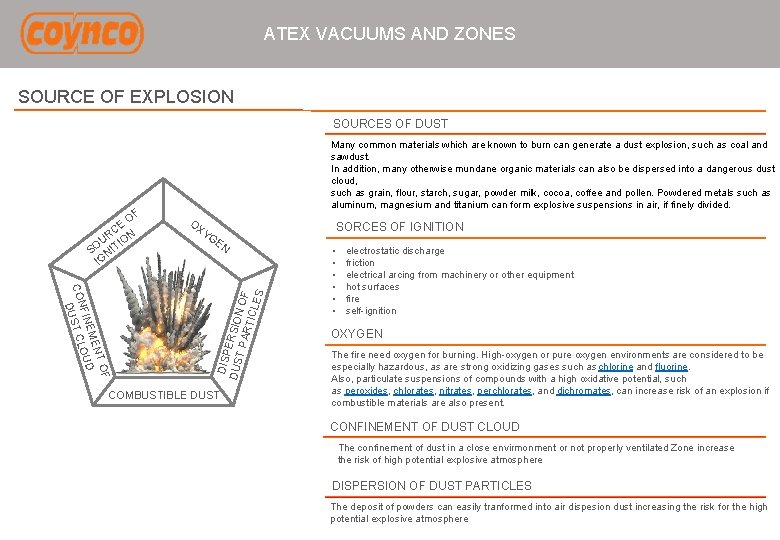
ATEX VACUUMS AND ZONES SOURCE OF EXPLOSION SOURCES OF DUST OX SORCES OF IGNITION YG EN F O NT EME UD FIN O CON UST CL D DISP DUS ERSION T PA RTIC OF LES OF E RC ON U I SO NIT IG Many common materials which are known to burn can generate a dust explosion, such as coal and sawdust. In addition, many otherwise mundane organic materials can also be dispersed into a dangerous dust cloud, such as grain, flour, starch, sugar, powder milk, cocoa, coffee and pollen. Powdered metals such as aluminum, magnesium and titanium can form explosive suspensions in air, if finely divided. COMBUSTIBLE DUST • • • electrostatic discharge friction electrical arcing from machinery or other equipment hot surfaces fire self-ignition OXYGEN The fire need oxygen for burning. High-oxygen or pure oxygen environments are considered to be especially hazardous, as are strong oxidizing gases such as chlorine and fluorine. Also, particulate suspensions of compounds with a high oxidative potential, such as peroxides, chlorates, nitrates, perchlorates, and dichromates, can increase risk of an explosion if combustible materials are also present. CONFINEMENT OF DUST CLOUD The confinement of dust in a close envirmonment or not properly ventilated Zone increase the risk of high potential explosive atmosphere DISPERSION OF DUST PARTICLES The deposit of powders can easily tranformed into air dispesion dust increasing the risk for the high potential explosive atmosphere
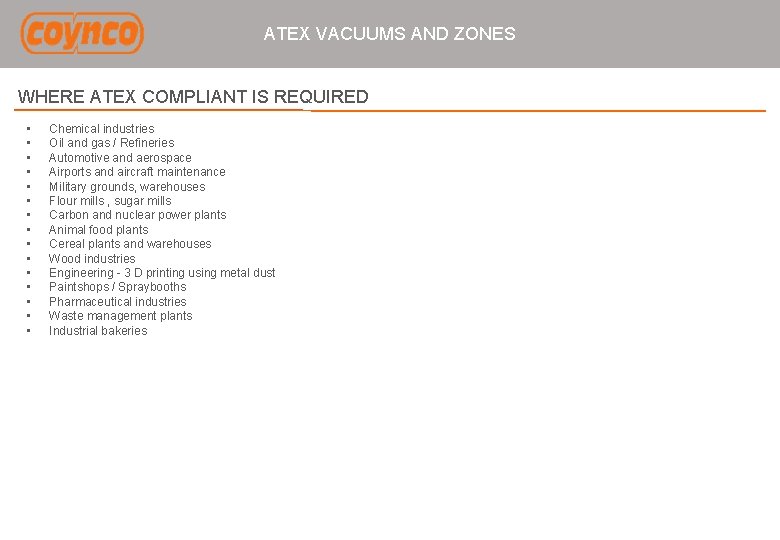
ATEX VACUUMS AND ZONES WHERE ATEX COMPLIANT IS REQUIRED • • • • Chemical industries Oil and gas / Refineries Automotive and aerospace Airports and aircraft maintenance Military grounds, warehouses Flour mills , sugar mills Carbon and nuclear power plants Animal food plants Cereal plants and warehouses Wood industries Engineering - 3 D printing using metal dust Paintshops / Spraybooths Pharmaceutical industries Waste management plants Industrial bakeries
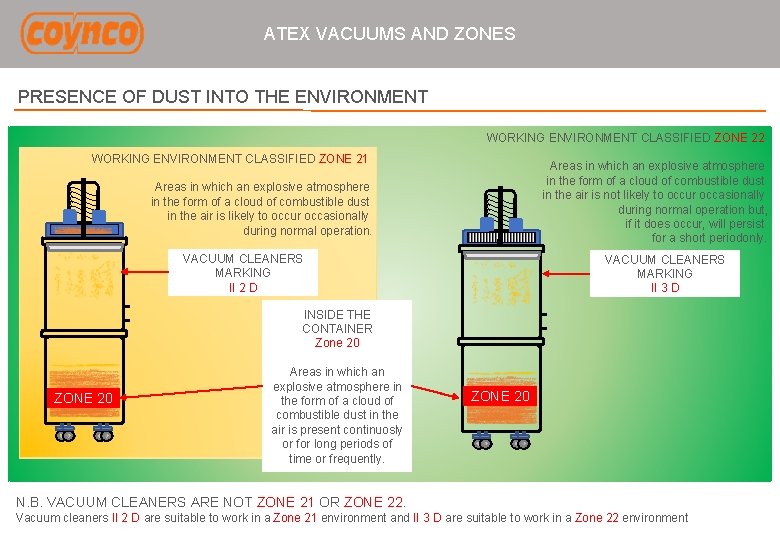
ATEX VACUUMS AND ZONES PRESENCE OF DUST INTO THE ENVIRONMENT WORKING ENVIRONMENT CLASSIFIED ZONE 22 WORKING ENVIRONMENT CLASSIFIED ZONE 21 Areas in which an explosive atmosphere in the form of a cloud of combustible dust in the air is not likely to occur occasionally during normal operation but, if it does occur, will persist for a short periodonly. Areas in which an explosive atmosphere in the form of a cloud of combustible dust in the air is likely to occur occasionally during normal operation. VACUUM CLEANERS MARKING II 2 D VACUUM CLEANERS MARKING II 3 D INSIDE THE CONTAINER Zone 20 ZONE 20 Areas in which an explosive atmosphere in the form of a cloud of combustible dust in the air is present continuosly or for long periods of time or frequently. ZONE 20 N. B. VACUUM CLEANERS ARE NOT ZONE 21 OR ZONE 22. Vacuum cleaners II 2 D are suitable to work in a Zone 21 environment and II 3 D are suitable to work in a Zone 22 environment
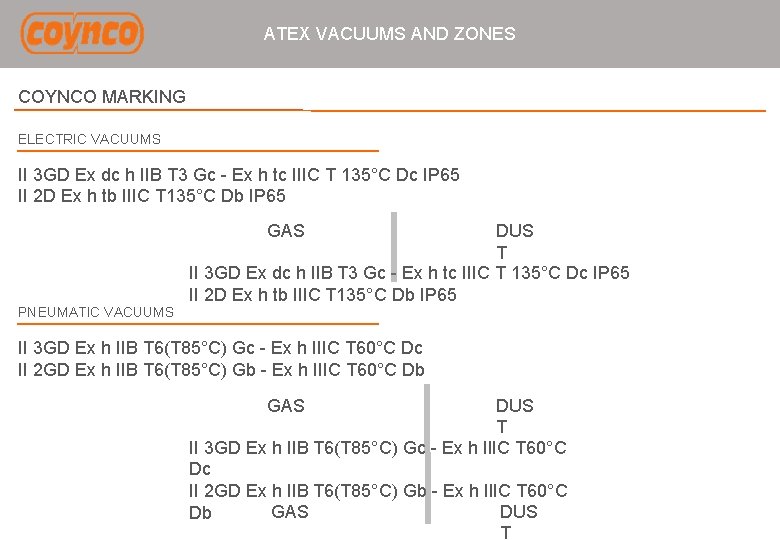
ATEX VACUUMS AND ZONES COYNCO MARKING ELECTRIC VACUUMS II 3 GD Ex dc h IIB T 3 Gc - Ex h tc IIIC T 135°C Dc IP 65 II 2 D Ex h tb IIIC T 135°C Db IP 65 GAS PNEUMATIC VACUUMS DUS T II 3 GD Ex dc h IIB T 3 Gc - Ex h tc IIIC T 135°C Dc IP 65 II 2 D Ex h tb IIIC T 135°C Db IP 65 II 3 GD Ex h IIB T 6(T 85°C) Gc - Ex h IIIC T 60°C Dc II 2 GD Ex h IIB T 6(T 85°C) Gb - Ex h IIIC T 60°C Db GAS DUS T II 3 GD Ex h IIB T 6(T 85°C) Gc - Ex h IIIC T 60°C Dc II 2 GD Ex h IIB T 6(T 85°C) Gb - Ex h IIIC T 60°C GAS DUS Db T
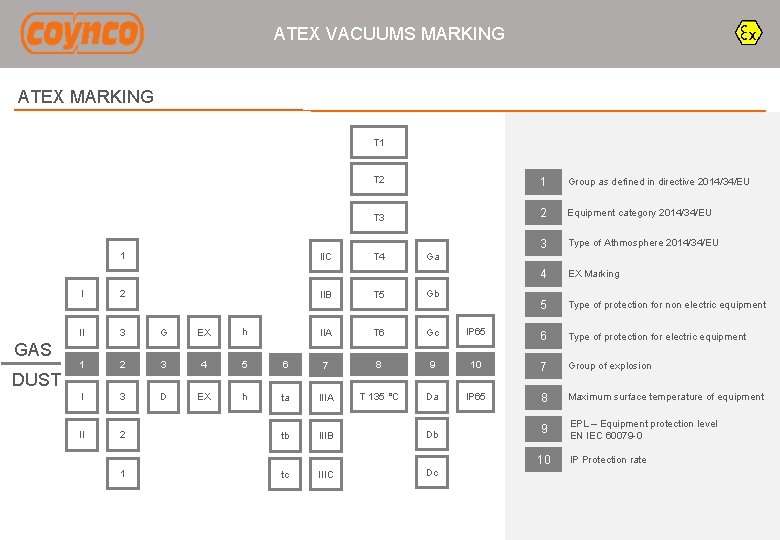
ATEX VACUUMS MARKING ATEX MARKING T 1 1 GAS DUST IIC I 2 II 3 G EX h 1 2 3 4 5 I 3 D EX h II 2 T 2 1 Group as defined in directive 2014/34/EU T 3 2 Equipment category 2014/34/EU 3 Type of Athmosphere 2014/34/EU 4 EX Marking 5 Type of protection for non electric equipment T 4 Ga IIB T 5 Gb IIA T 6 Gc IP 65 6 Type of protection for electric equipment 6 7 8 9 10 7 Group of explosion ta IIIA T 135 °C Da IP 65 8 Maximum surface temperature of equipment tb IIIB 9 EPL – Equipment protection level EN IEC 60079 -0 Db 10 1 tc IIIC Dc IP Protection rate
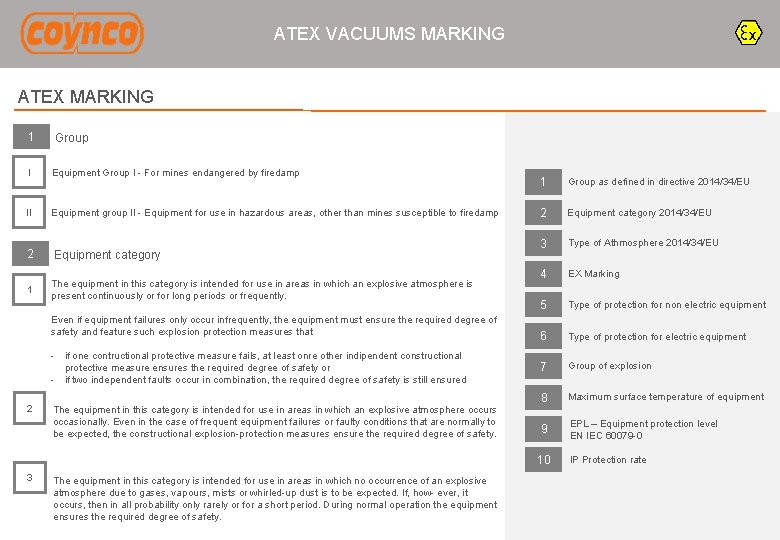
ATEX VACUUMS MARKING ATEX MARKING 1 Group I Equipment Group I - For mines endangered by firedamp II Equipment group II - Equipment for use in hazardous areas, other than mines susceptible to firedamp 2 1 Equipment category The equipment in this category is intended for use in areas in which an explosive atmosphere is present continuously or for long periods or frequently. Even if equipment failures only occur infrequently, the equipment must ensure the required degree of safety and feature such explosion protection measures that - if one contructional protective measure fails, at least onre other indipendent constructional protective measure ensures the required degree of safety or - if two independent faults occur in combination, the required degree of safety is still ensured 2 The equipment in this category is intended for use in areas in which an explosive atmosphere occurs occasionally. Even in the case of frequent equipment failures or faulty conditions that are normally to be expected, the constructional explosion-protection measures ensure the required degree of safety. 1 Group as defined in directive 2014/34/EU 2 Equipment category 2014/34/EU 3 Type of Athmosphere 2014/34/EU 4 EX Marking 5 Type of protection for non electric equipment 6 Type of protection for electric equipment 7 Group of explosion 8 Maximum surface temperature of equipment 9 EPL – Equipment protection level EN IEC 60079 -0 10 3 The equipment in this category is intended for use in areas in which no occurrence of an explosive atmosphere due to gases, vapours, mists or whirled-up dust is to be expected. If, how- ever, it occurs, then in all probability only rarely or for a short period. During normal operation the equipment ensures the required degree of safety. IP Protection rate
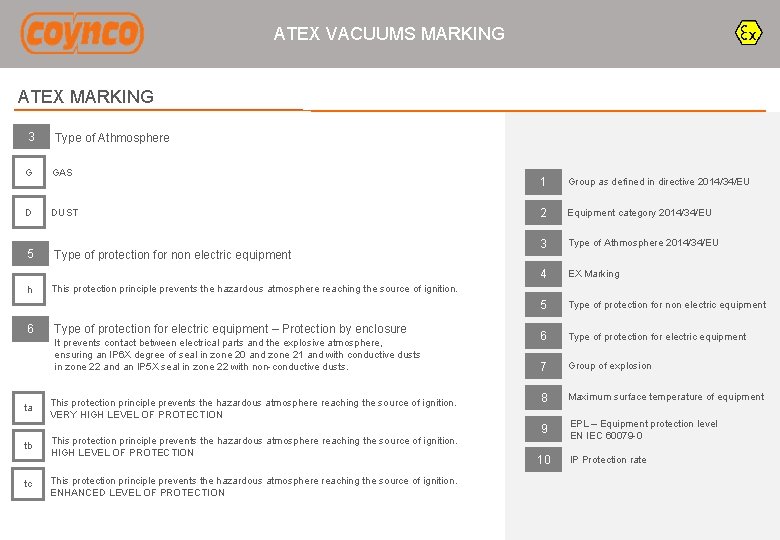
ATEX VACUUMS MARKING ATEX MARKING 3 Type of Athmosphere G GAS D DUST 5 h 6 Type of protection for non electric equipment tb tc Group as defined in directive 2014/34/EU 2 Equipment category 2014/34/EU 3 Type of Athmosphere 2014/34/EU 4 EX Marking 5 Type of protection for non electric equipment 6 Type of protection for electric equipment 7 Group of explosion 8 Maximum surface temperature of equipment 9 EPL – Equipment protection level EN IEC 60079 -0 This protection principle prevents the hazardous atmosphere reaching the source of ignition. Type of protection for electric equipment – Protection by enclosure It prevents contact between electrical parts and the explosive atmosphere, ensuring an IP 6 X degree of seal in zone 20 and zone 21 and with conductive dusts in zone 22 and an IP 5 X seal in zone 22 with non-conductive dusts. ta 1 This protection principle prevents the hazardous atmosphere reaching the source of ignition. VERY HIGH LEVEL OF PROTECTION This protection principle prevents the hazardous atmosphere reaching the source of ignition. ENHANCED LEVEL OF PROTECTION 10 IP Protection rate
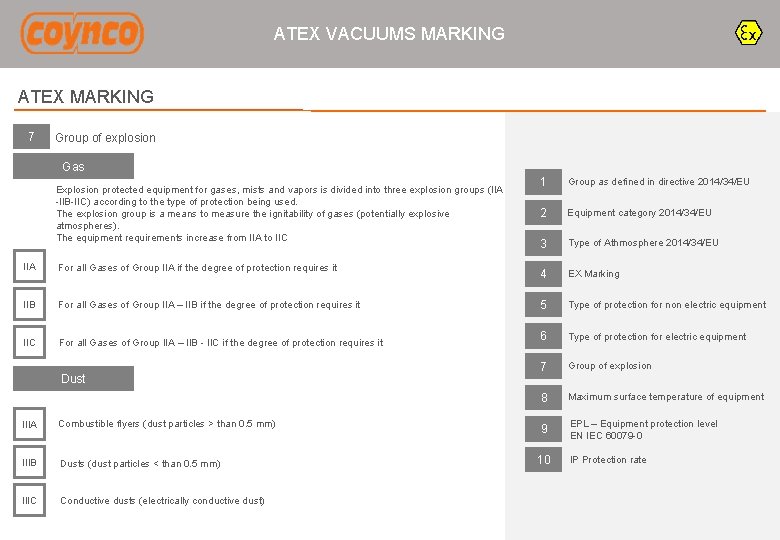
ATEX VACUUMS MARKING ATEX MARKING 7 Group of explosion Gas Explosion protected equipment for gases, mists and vapors is divided into three explosion groups (IIA -IIB-IIC) according to the type of protection being used. The explosion group is a means to measure the ignitability of gases (potentially explosive atmospheres). The equipment requirements increase from IIA to IIC IIA For all Gases of Group IIA if the degree of protection requires it IIB For all Gases of Group IIA – IIB if the degree of protection requires it IIC For all Gases of Group IIA – IIB - IIC if the degree of protection requires it Dust IIIA Combustible flyers (dust particles > than 0. 5 mm) IIIB Dusts (dust particles < than 0. 5 mm) IIIC Conductive dusts (electrically conductive dust) 1 Group as defined in directive 2014/34/EU 2 Equipment category 2014/34/EU 3 Type of Athmosphere 2014/34/EU 4 EX Marking 5 Type of protection for non electric equipment 6 Type of protection for electric equipment 7 Group of explosion 8 Maximum surface temperature of equipment 9 EPL – Equipment protection level EN IEC 60079 -0 10 IP Protection rate
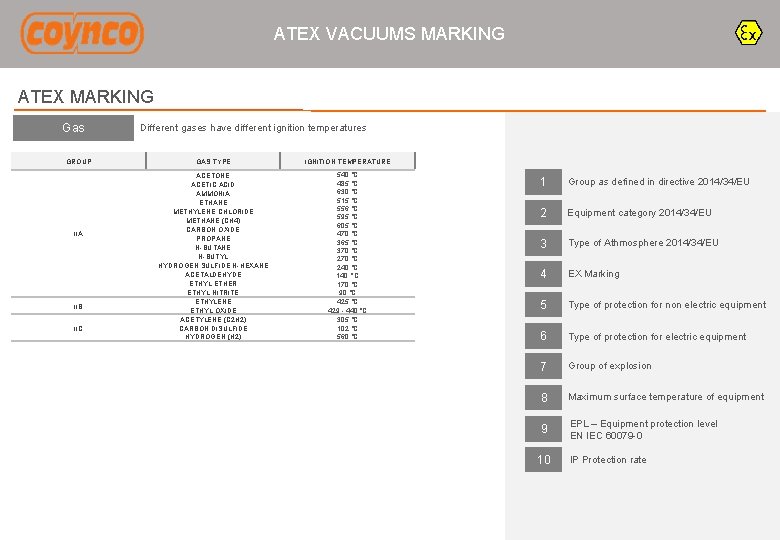
ATEX VACUUMS MARKING ATEX MARKING Gas GROUP IIA IIB IIC Different gases have different ignition temperatures GAS TYPE IGNITION TEMPERATURE ACETONE ACETIC ACID AMMONIA ETHANE METHYLENE CHLORIDE METHANE (CH 4) CARBON OXIDE PROPANE N-BUTYL HYDROGEN SULFIDE N-HEXANE ACETALDEHYDE ETHYL ETHER ETHYL NITRITE ETHYLENE ETHYL OXIDE ACETYLENE (C 2 H 2) CARBON DISULFIDE HYDROGEN (H 2) 540 °C 485 °C 630 °C 515 °C 556 °C 595 °C 605 °C 470 °C 365 °C 370 °C 240 °C 140 ° C 170 °C 90 °C 425 °C 429 - 440 °C 305 °C 102 °C 560 °C 1 Group as defined in directive 2014/34/EU 2 Equipment category 2014/34/EU 3 Type of Athmosphere 2014/34/EU 4 EX Marking 5 Type of protection for non electric equipment 6 Type of protection for electric equipment 7 Group of explosion 8 Maximum surface temperature of equipment 9 EPL – Equipment protection level EN IEC 60079 -0 10 IP Protection rate
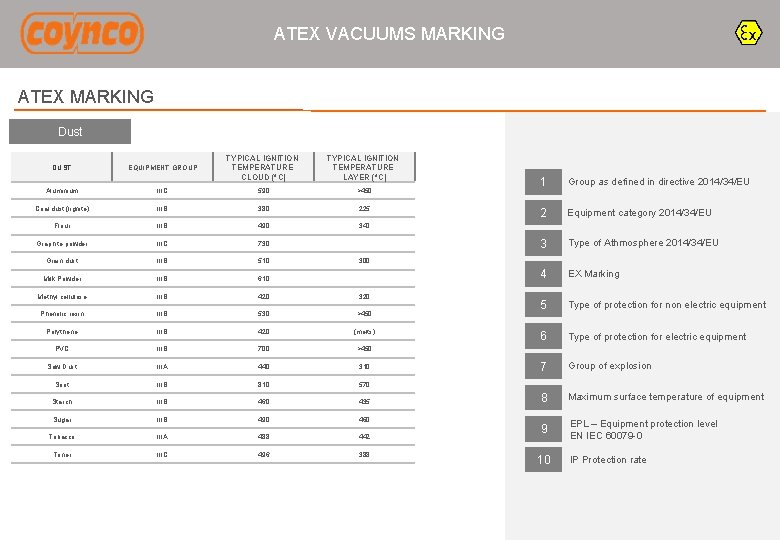
ATEX VACUUMS MARKING ATEX MARKING Dust DUST EQUIPMENT GROUP TYPICAL IGNITION TEMPERATURE CLOUD (°C) TYPICAL IGNITION TEMPERATURE LAYER (°C) Aluminium IIIC 590 >450 Coal dust (lignite) IIIB 380 225 Flour IIIB 490 340 Graphite powder IIIC 730 Grain dust IIIB 510 Milk Powder IIIB 610 Methyl cellulose IIIB 420 320 Phenolic resin IIIB 530 >450 Polythene IIIB 420 (melts) PVC IIIB 700 >450 Saw Dust IIIA 440 310 Soot IIIB 810 570 Starch IIIB 460 435 Sugar IIIB 490 460 Tobacco IIIA 488 442 Toner IIIC 496 388 1 Group as defined in directive 2014/34/EU 2 Equipment category 2014/34/EU 3 Type of Athmosphere 2014/34/EU 4 EX Marking 5 Type of protection for non electric equipment 6 Type of protection for electric equipment 7 Group of explosion 8 Maximum surface temperature of equipment 9 EPL – Equipment protection level EN IEC 60079 -0 300 10 IP Protection rate
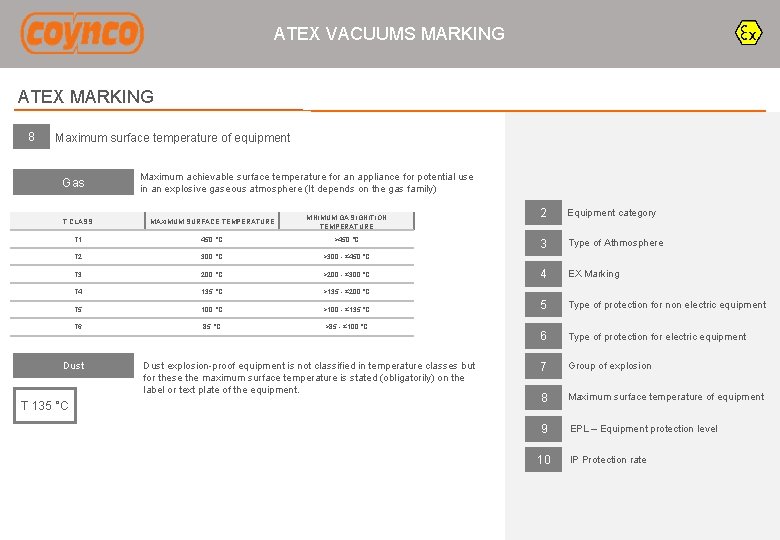
ATEX VACUUMS MARKING ATEX MARKING 8 Maximum surface temperature of equipment Gas Maximum achievable surface temperature for an appliance for potential use in an explosive gaseous atmosphere (It depends on the gas family) T CLASS MAXIMUM SURFACE TEMPERATURE MINIMUM GAS IGNITION TEMPERATURE T 1 450 °C >450 °C T 2 300 °C >300 - ≤ 450 °C T 3 200 °C >200 - ≤ 300 °C T 4 135 °C >135 - ≤ 200 °C T 5 100 °C >100 - ≤ 135 °C T 6 85 °C >85 - ≤ 100 °C Dust T 135 °C Dust explosion-proof equipment is not classified in temperature classes but for these the maximum surface temperature is stated (obligatorily) on the label or text plate of the equipment. 2 Equipment category 3 Type of Athmosphere 4 EX Marking 5 Type of protection for non electric equipment 6 Type of protection for electric equipment 7 Group of explosion 8 Maximum surface temperature of equipment 9 EPL – Equipment protection level 10 IP Protection rate
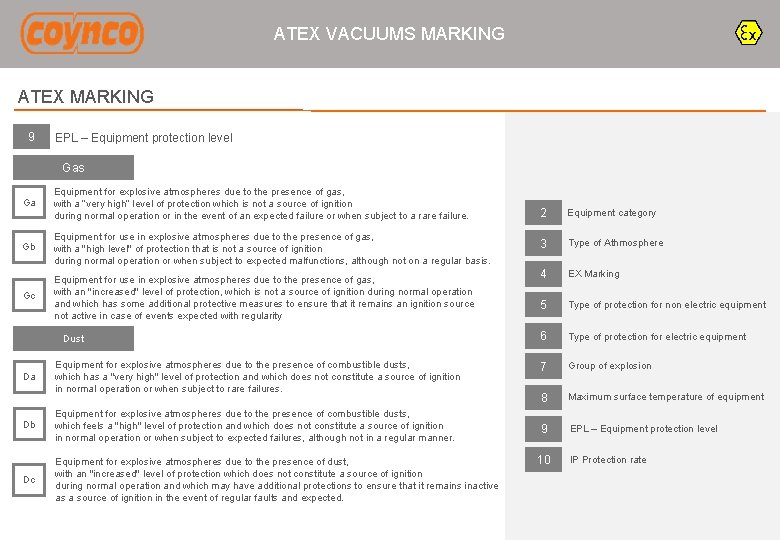
ATEX VACUUMS MARKING ATEX MARKING 9 EPL – Equipment protection level Gas Ga Equipment for explosive atmospheres due to the presence of gas, with a “very high” level of protection which is not a source of ignition during normal operation or in the event of an expected failure or when subject to a rare failure. Gb Equipment for use in explosive atmospheres due to the presence of gas, with a "high level" of protection that is not a source of ignition during normal operation or when subject to expected malfunctions, although not on a regular basis. Gc Equipment for use in explosive atmospheres due to the presence of gas, with an "increased" level of protection, which is not a source of ignition during normal operation and which has some additional protective measures to ensure that it remains an ignition source not active in case of events expected with regularity Dust Da Equipment for explosive atmospheres due to the presence of combustible dusts, which has a "very high" level of protection and which does not constitute a source of ignition in normal operation or when subject to rare failures. Db Equipment for explosive atmospheres due to the presence of combustible dusts, which feels a "high" level of protection and which does not constitute a source of ignition in normal operation or when subject to expected failures, although not in a regular manner. Dc Equipment for explosive atmospheres due to the presence of dust, with an "increased" level of protection which does not constitute a source of ignition during normal operation and which may have additional protections to ensure that it remains inactive as a source of ignition in the event of regular faults and expected. 2 Equipment category 3 Type of Athmosphere 4 EX Marking 5 Type of protection for non electric equipment 6 Type of protection for electric equipment 7 Group of explosion 8 Maximum surface temperature of equipment 9 EPL – Equipment protection level 10 IP Protection rate
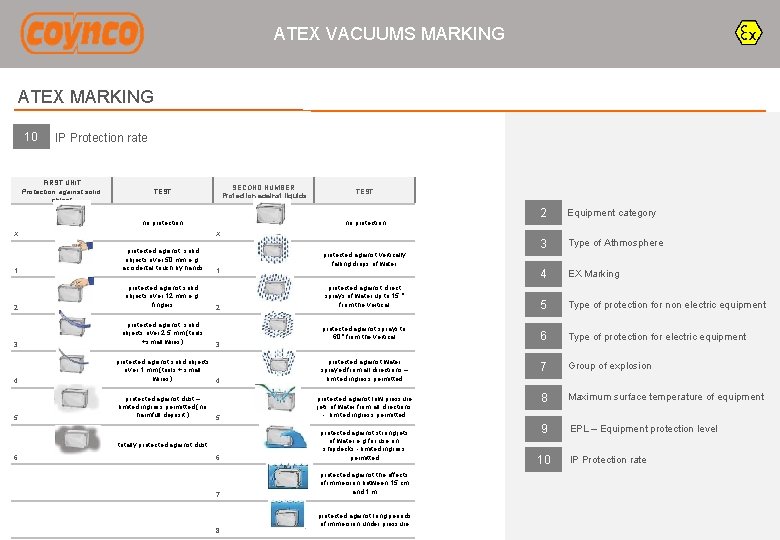
ATEX VACUUMS MARKING ATEX MARKING 10 IP Protection rate FIRST UNIT Protection against solid object SECOND NUMBER Protection against liquids TEST no protection X 1 2 protected against solid objects over 12 mm e. g. fingers 3 protected against solid objects over 2, 5 mm (tools +small wires) 5 no protection X protected against solid objects over 50 mm e. g. accidental touch by hands 4 1 Equipment category 3 Type of Athmosphere protected against vertically falling drops of water 4 EX Marking 5 Type of protection for non electric equipment protected against sprays to 60° from the vertical 6 Type of protection for electric equipment protected against water sprayed from all directions – limited ingress permitted 7 Group of explosion 8 Maximum surface temperature of equipment 5 protected against low pressure jets of water from all directions - limited ingress permitted 9 EPL – Equipment protection level 6 protected against strong jets of water e g for use on shipdecks - limited ingress permitted 7 protected against the affects of immersion between 15 cm and 1 m 2 3 protected against solid objects over 1 mm (tools + small wires) 4 protected against dust – limited ingress permitted (no harmfull deposit. ) 2 protected against direct sprays of water up to 15 ° from the vertical totally protected against dust 6 TEST 8 protected against long periods of immersion under pressure 10 IP Protection rate