
ATELIER DRAWING ARTISTS ARE MADE NOT BORN PACING
ATELIER DRAWING ARTISTS ARE MADE, NOT BORN.
PACING AND CONSIDERATIONS • Usually a 3 -4 day project • 90 min class periods • Fairly expensive but super fun • One day as overview- discuss classical drawing • Second day do plaster casting • Third and fourth day drawing • Any age can do

WHAT IS ATELIER DRAWING? “I have a simple belief that the goal of learning to draw and paint is attainable by anyone who is willing to pursue it. It is as accessible as learning to write or play a musical instrument. There is more than one path a person can follow to be a well-trained artist. What is necessary, however, is a passion for excellence, discipline, and an unflinching desire to pursue truth. ” Juliette Aristides

WHAT IS ATELIER DRAWING? • Atelier drawing is classical studio drawing • Atelier- studio • Learning to draw using Master copies, envelopes, sketching/ sighting shapes and drawing of casts and other still life objects
DRAWING WHAT WE SEE. . . NOT WHAT WE “KNOW” • • Graphing: using graphs to help break down big shapes Envelope drawing: finding main shapes Squinting: seeing main details Sighting: using tools to help with proportions
ENVELOPES • Allows artist to see overall shape • Allows artist to set proportions (how things relate to each other size-wise) • Allows artist to focus attention • View the drawing as a whole before beginning • Prevents artist from using preconceived notions (tree, cloud, apple…)
GRAPHING • Allows big pieces to be broken down into manageable shapes • Allows artist to focus on individual shapes • Once big picture is realized, graphing allows artist to develop detail
SQUINTING • One of the most helpful in drawing skills • Allows light going to retina to be minimized so that basic shapes and outlines are more easily seen • Helpful in determining envelope
SIGHTING • Anything straight can be used as a sight • Useful to get proportions and sizing correct • Using the skewers: demo
SHAPES • Everything in drawing can be broken down into lines and shapes. • Once we get a firm grasp of how to see the shapes, we become better at drawing. • Envelopes- main shape. • Look for repeating shapes and lines. • What is beautiful or interesting about what I’m looking at?
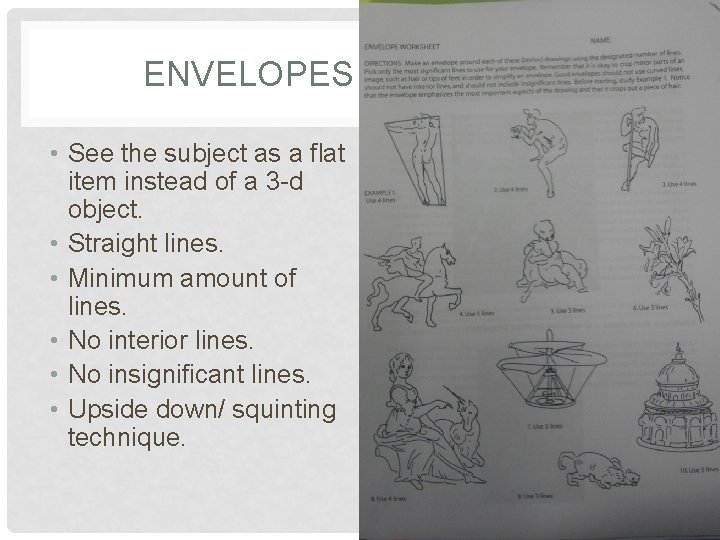
ENVELOPES • See the subject as a flat item instead of a 3 -d object. • Straight lines. • Minimum amount of lines. • No interior lines. • No insignificant lines. • Upside down/ squinting technique.
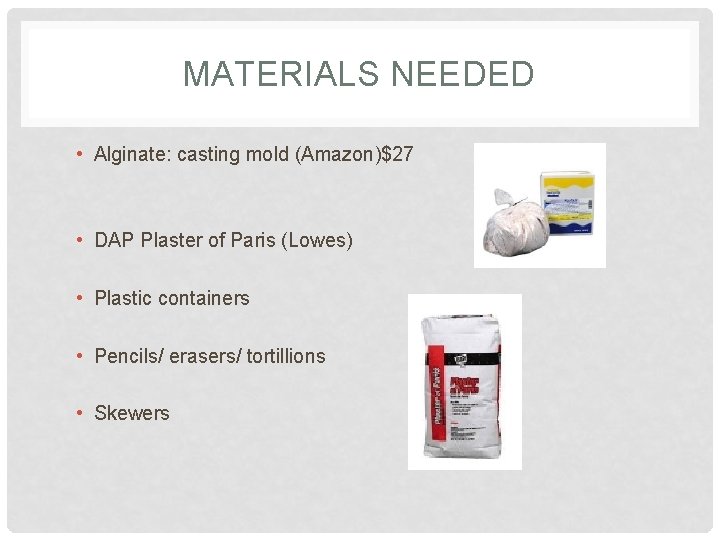
MATERIALS NEEDED • Alginate: casting mold (Amazon)$27 • DAP Plaster of Paris (Lowes) • Plastic containers • Pencils/ erasers/ tortillions • Skewers
CASTING DIRECTIONS • Mix 3 part alginate with 2 -3 part water (easier to add water, start with less than you think you need!) • Should look like watery oatmeal • Place your hand in alginate mixture and let set for 5 -7 min • Hotter the water, quicker the set • Remove hand when you can touch the top and it feels spongy solid
CASTING DIREC’S CONT. • Mix 4 parts plaster to 3 parts water • MAKE SURE YOU MIX ALL THE PLASTER WELL ON SIDES • Pour in alginate mold • Let sit for 10 min or until cold
CASTING DIREC’S CONT. • Dump whole mold out of plastic container carefully • Don’t squeeze it, plaster could crack! • Start removing alginate in small chunks
TIPS AND TRICKS • Hotter water, faster alginate set • Use x-actos or skewers to help pick off alginate • Use appropriate size containers for your clientele to save supplies! • Big groups- YOU mix! Assembly line it. • Mix alginate in individual containers • One large container= plaster for about 4 kids • GO QUICK!
- Slides: 16