
ATC Future Comms Technology Tuesday 11 January 2022

- Slides: 26
ATC Future Comms Technology Tuesday, 11 January 2022 www. atsc 4. com. au
ATC Future Comms v v Introduction Current State of Controller Comms v v v Networking ATSC 4 Developments v v v 2 Serial Network Interface – Full TCPIP Stack Modem Interfaces (4 G, ADSL, Fibre) Amendment 3 Changes www. atsc 4. com. au
ATC Future Comms v ATSC 4 Developments v v v 3 SNMP Support (Solar. Winds) Site Region Server (SRS) Ready Syslog Server Ready Blue Tooth Data Collection Ready Ethernet - Fibre (NBN) Ready RMS Amendment 3 interfaces www. atsc 4. com. au
ATC Future Comms v Why discuss comms for controllers? v Current PSTN network being obsoleted (Dec 17) v Benefits for Road Authorities? v Avoid vendor lock in v Open Standards – support for web browser configuration, file storage etc 4 www. atsc 4. com. au
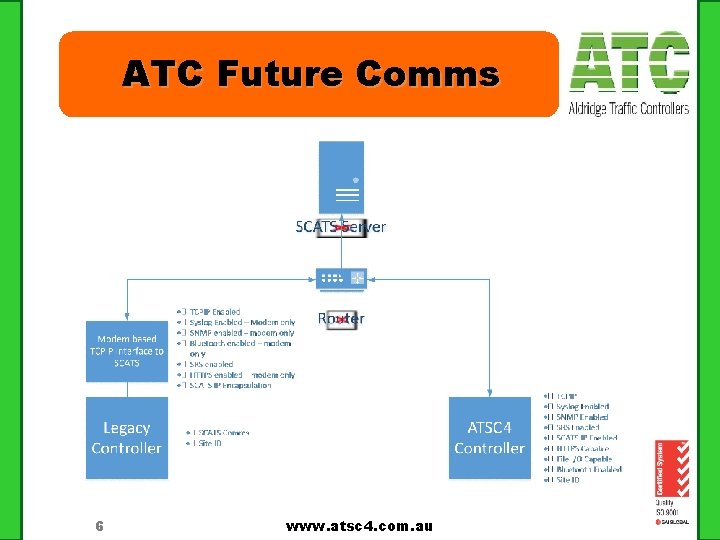
ATC Future Comms v To interface serial comms to SCATS over network the SCATS IP protocol was developed. v Essentially, it allows a legacy comms port to be connected over a IP network. 5 www. atsc 4. com. au
ATC Future Comms 6 www. atsc 4. com. au
ATC Future Comms v The interface device is pretending to be a networked node v Not an architecturally clean solution – it is simply band-aiding the root problem of the Traffic Signal Controller not having a TCPIP stack implemented. v What happens when RMS Amendment 3 comes into force – this problem gets worse !! 7 www. atsc 4. com. au
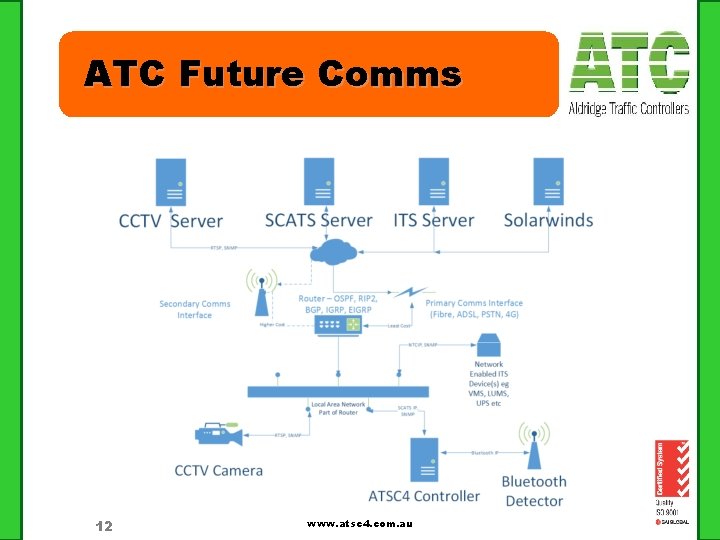
ATC Future Comms v Road Authorities can implement a fault tolerant network for some or all of its ITS devices. v An Ethernet interface allows Road Authorities to add fault tolerant network routing if needed but not essential (VMWare NSX). v Fault Tolerant Routing is available from any device vendor – it is not a telco bespoke solution! 8 www. atsc 4. com. au
ATC Future Comms v The ATSC 4 can interface directly to network protocols. v It can implement secure web server, respond to network monitoring tools (Solarwinds, Tivoli). v It can scale up if more data originates from within intersection (C-ITS, Detector Data, New Sensors etc) 9 www. atsc 4. com. au
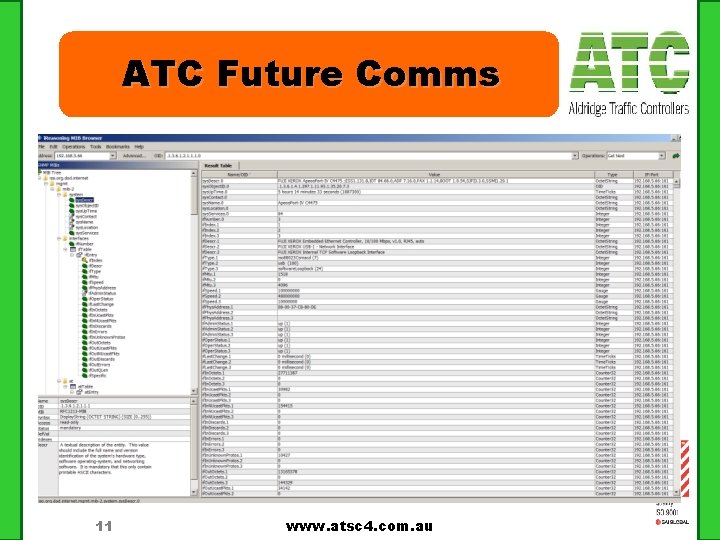
ATC Future Comms v SNMP – the ATSC 4 can serve SCATS and Solarwinds at the same time. v The Syslog Server is an open standard used in UNIX systems – it is not a modem specific solution v The ATSC 4 provides a RICH set of data STRAIGHT FROM THE CONTROLLER. Not a modem specific set of messages 10 www. atsc 4. com. au
ATC Future Comms 11 www. atsc 4. com. au
ATC Future Comms 12 www. atsc 4. com. au
ATC Future Comms v The ATSC 4 can be interfaced to current and emerging networks. v Making ITS devices network native will simplify managing such devices. v Road Authorities can seek partners to implement resilient networks. v Many vendors can implement fault tolerance without vendor lock in. 13 www. atsc 4. com. au
ATC Future Comms v By using open standards protocols Road Authorities can leverage networked ITS devices. v Reduced implementation costs. v When NBN is rolled out, ATSC 4 will plug directly into Network Interface Device (NID) 14 www. atsc 4. com. au
ATC Future Comms v NBN Packet Priority – time sensitive data such as CCTV, telephony, SCATS etc. v NBN Fault Tolerance – multi-WAN v http: //www. nbnco. com. au/sell-nbn-services/products -services-pricing/nbn-co-ethernet-bitstreamservice. html 15 www. atsc 4. com. au
ATC Future Comms v Routers are workhorse of network v Routers handle ATSC 4, CCTV, Detectors, VMS, LUMS with or without priority v Redundancy of comms is NOT due to service providers but network design 16 www. atsc 4. com. au
ATC Future Comms v Networked ITS Assets will eliminate legacy protocols & devices in time v Wider choice of ITS Products to Road Authorities by adopting open standards protocols v Telecommunications has gone completely IP at the back-end 17 www. atsc 4. com. au
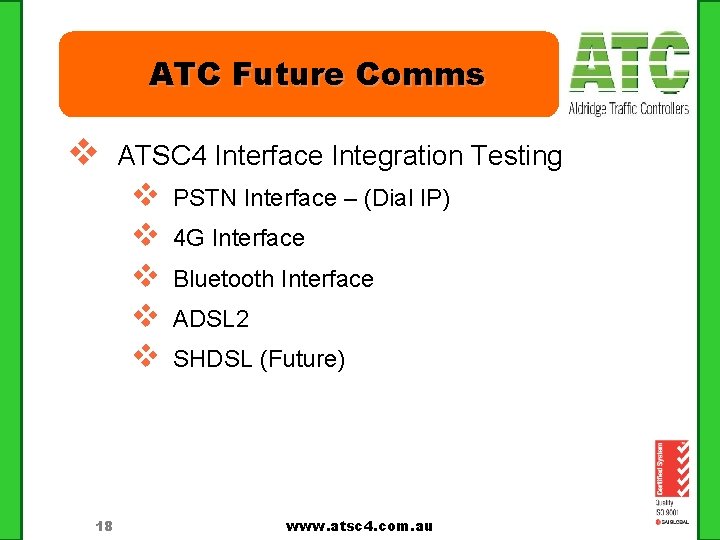
ATC Future Comms v ATSC 4 Interface Integration Testing v v v 18 PSTN Interface – (Dial IP) 4 G Interface Bluetooth Interface ADSL 2 SHDSL (Future) www. atsc 4. com. au
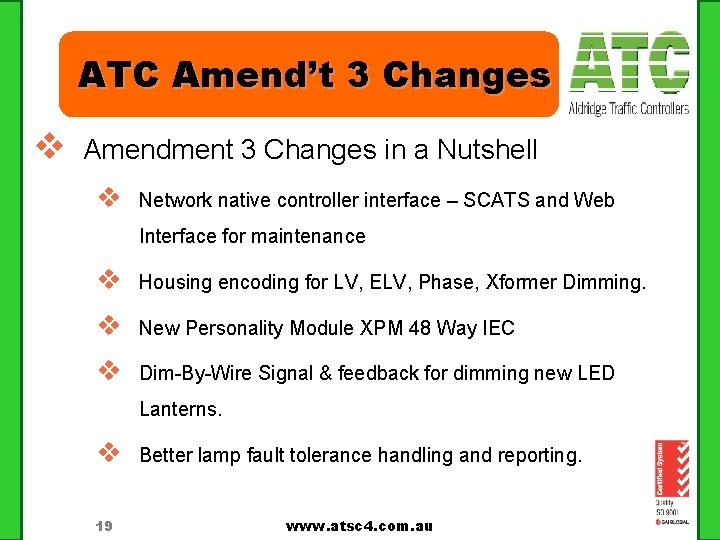
ATC Amend’t 3 Changes v Amendment 3 Changes in a Nutshell v Network native controller interface – SCATS and Web Interface for maintenance v Housing encoding for LV, ELV, Phase, Xformer Dimming. v New Personality Module XPM 48 Way IEC v Dim-By-Wire Signal & feedback for dimming new LED Lanterns. v 19 Better lamp fault tolerance handling and reporting. www. atsc 4. com. au
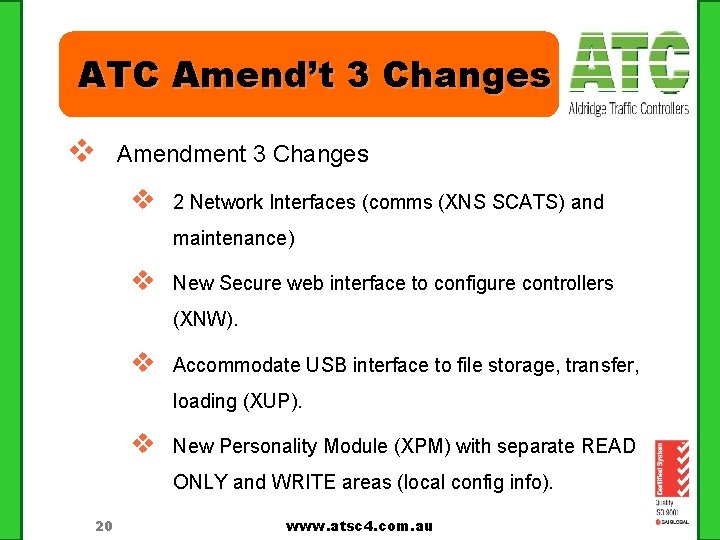
ATC Amend’t 3 Changes v Amendment 3 Changes v 2 Network Interfaces (comms (XNS SCATS) and maintenance) v New Secure web interface to configure controllers (XNW). v Accommodate USB interface to file storage, transfer, loading (XUP). v New Personality Module (XPM) with separate READ ONLY and WRITE areas (local config info). 20 www. atsc 4. com. au
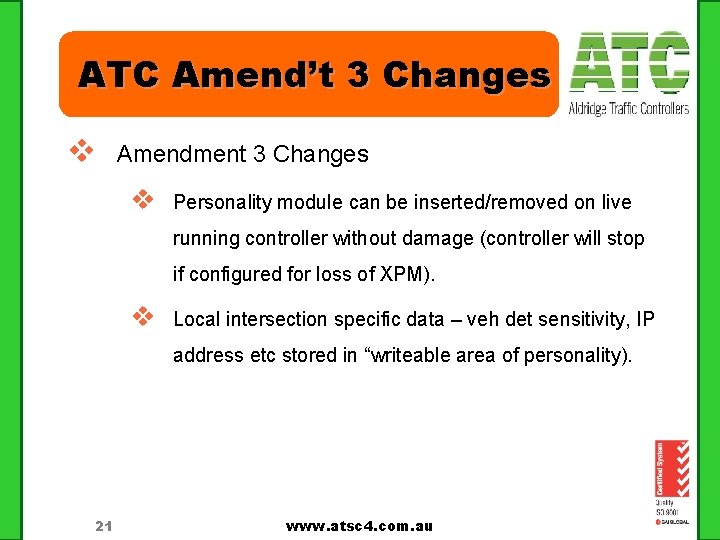
ATC Amend’t 3 Changes v Amendment 3 Changes v Personality module can be inserted/removed on live running controller without damage (controller will stop if configured for loss of XPM). v Local intersection specific data – veh det sensitivity, IP address etc stored in “writeable area of personality). 21 www. atsc 4. com. au
ATC Amend’t 3 Changes v Amendment 3 Changes v PSTN modem interface (XRJ) – line to internal modem (ATSC 4 has this). v Signal Group Voltage suppressing circuits now mandatory – ATSC 4 always had them. v Site ID now provides configuration data for operating voltage & type (LV or ELV etc) – controller housing characteristic. 22 www. atsc 4. com. au
ATC Amend’t 3 Changes v Amendment 3 Changes v 16 types of housing are configurable – by setting of diodes in Site ID and connected via ZHC. v Phase or Amplitude dimming encoded v LV (240 v) and ELV (42 v) encoded v Additional CB for CCTV to be included. v Flash Change Over relays have a test button and flash suppression capability. v 23 Generator Input Circuit mandatory www. atsc 4. com. au
ATC Amend’t 3 Changes v Amendment 3 Changes v Dim-By-Wire – two control signals 15 v from Site ID to command LED lanterns to dim internally (not dim from the signal group output) via ZDC. v Single feedback wire for dim-by-wire into controller 8 v. v Front panel indicators Red = Dimmed, Green = Undimmed. 24 www. atsc 4. com. au
ATC Amend’t 3 Changes v Amendment 3 Changes v Ethernet ports to be MDI/MDX compatible – you can use straight or cross over Ethernet cable to ATSC 4. v Secure web browser interface to supervise operation of controller and is the NEW HHT. v The controller communicates via secure network protocols. 25 www. atsc 4. com. au
ATC Amend’t 3 Changes v Amendment 3 Changes v Better lamp fault monitoring with varying lamp fault tolerance based on signal group loads. v In dimming mode, the algorithm shall use different lamp fault wattage values to avoid false faults. 26 www. atsc 4. com. au