
Ataxia focusing on inherited ataxia Presented by Vidyaningtyas
Ataxia focusing on “inherited ataxia” Presented by: Vidyaningtyas BA, MD Yanuarita T, MD Widagdo S, MD
Ataxia – at glance �Inability to make smooth, accurate and coordinated movements, usually due to a disorder of the cerebellum and / or sensory pathways in the posterior column of the spinal cord.
Ataxia – at glance �Inability to make smooth, accurate and coordinated movements, usually due to a disorder of the cerebellum and / or sensory pathways in the posterior column of the spinal cord. Types: �Cerebellar ataxia �Sensory ataxia �Vestibular ataxia
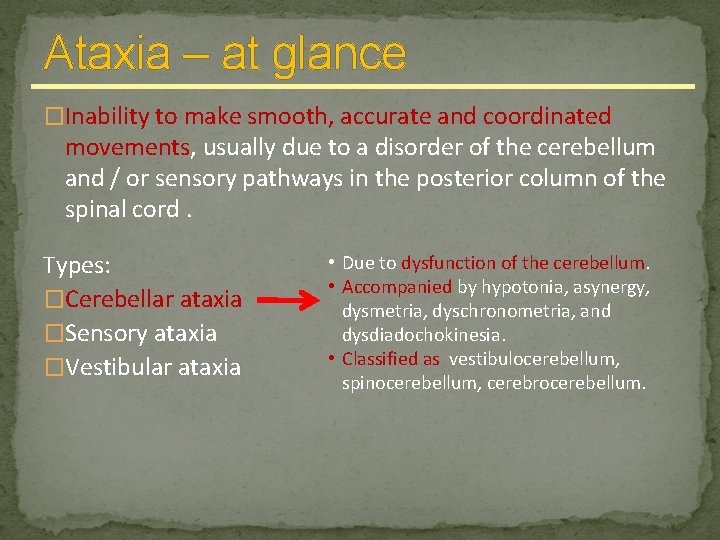
Ataxia – at glance �Inability to make smooth, accurate and coordinated movements, usually due to a disorder of the cerebellum and / or sensory pathways in the posterior column of the spinal cord. Types: �Cerebellar ataxia �Sensory ataxia �Vestibular ataxia • Due to dysfunction of the cerebellum. • Accompanied by hypotonia, asynergy, dysmetria, dyschronometria, and dysdiadochokinesia. • Classified as vestibulocerebellum, spinocerebellum, cerebrocerebellum.
Ataxia – at glance �Inability to make smooth, accurate and coordinated movements, usually due to a disorder of the cerebellum and / or sensory pathways in the posterior column of the spinal cord. Types: �Cerebellar ataxia �Sensory ataxia �Vestibular ataxia • Due to dysfunction of the cerebellum. • Accompanied by hypotonia, asynergy, dysmetria, dyschronometria, and dysdiadochokinesia. • Classified as vestibulocerebellum, spinocerebellum, cerebrocerebellum.
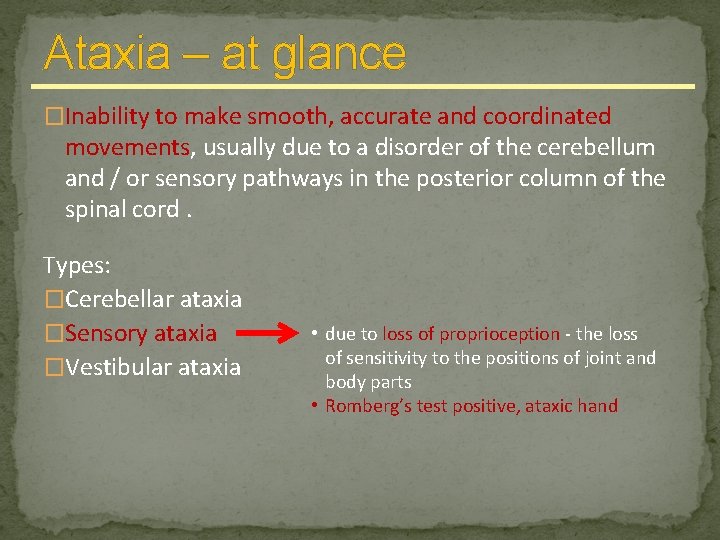
Ataxia – at glance �Inability to make smooth, accurate and coordinated movements, usually due to a disorder of the cerebellum and / or sensory pathways in the posterior column of the spinal cord. Types: �Cerebellar ataxia �Sensory ataxia �Vestibular ataxia • due to loss of proprioception - the loss of sensitivity to the positions of joint and body parts • Romberg’s test positive, ataxic hand
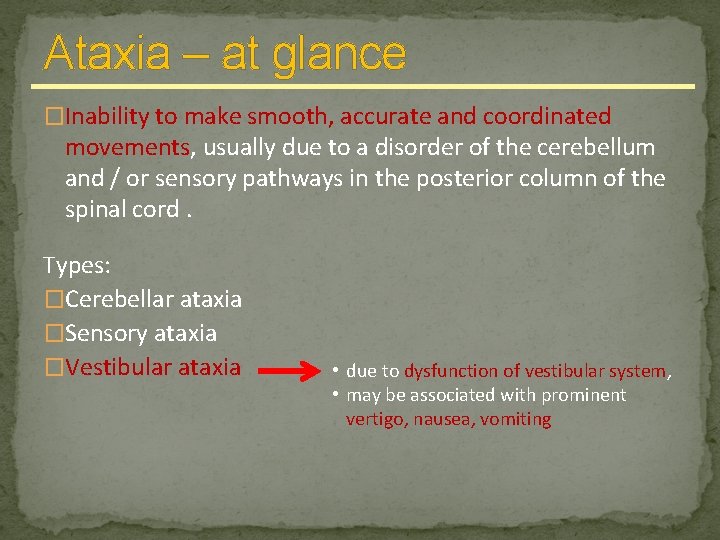
Ataxia – at glance �Inability to make smooth, accurate and coordinated movements, usually due to a disorder of the cerebellum and / or sensory pathways in the posterior column of the spinal cord. Types: �Cerebellar ataxia �Sensory ataxia �Vestibular ataxia • due to dysfunction of vestibular system, • may be associated with prominent vertigo, nausea, vomiting
Ataxia – at glance Ataxia Symmetrical Acute Chronic Inherited ataxia Asymmetrical Acute Chronic
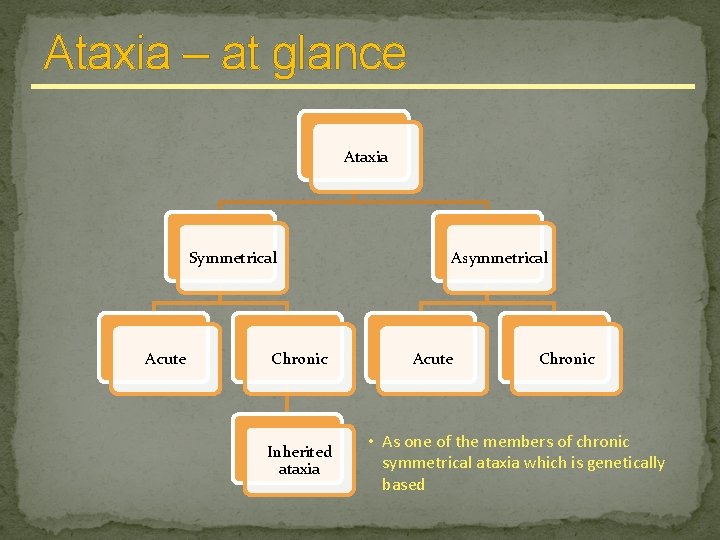
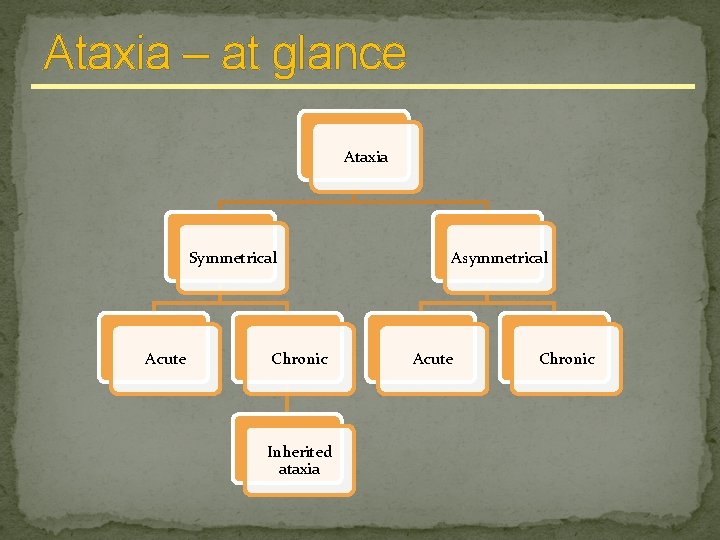
Ataxia – at glance Ataxia Symmetrical Acute Chronic Inherited ataxia Asymmetrical Acute Chronic • As one of the members of chronic symmetrical ataxia which is genetically based
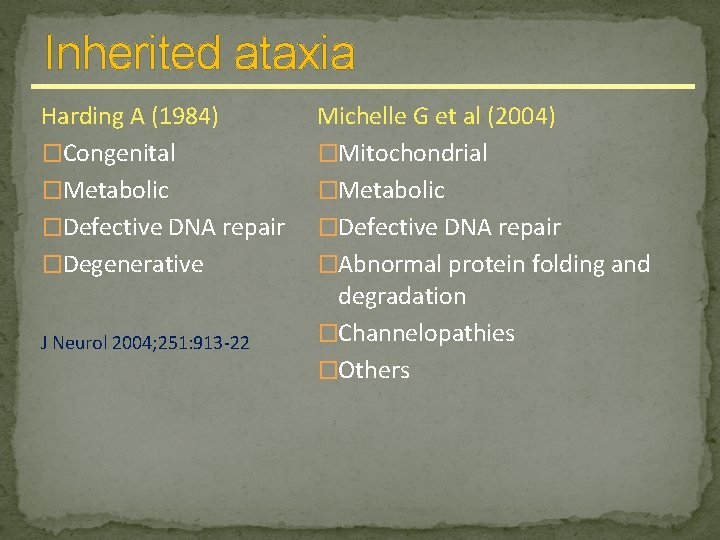
Inherited ataxia Harding A (1984) �Congenital �Metabolic �Defective DNA repair �Degenerative J Neurol 2004; 251: 913 -22 Michelle G et al (2004) �Mitochondrial �Metabolic �Defective DNA repair �Abnormal protein folding and degradation �Channelopathies �Others
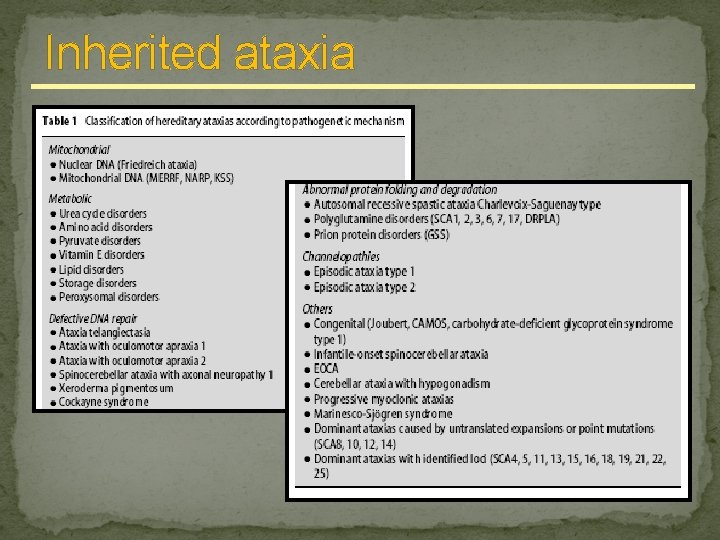
Inherited ataxia
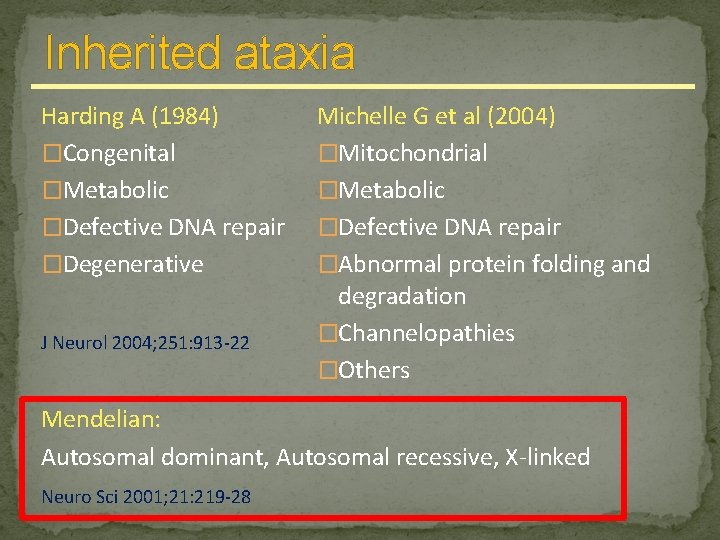
Inherited ataxia Harding A (1984) �Congenital �Metabolic �Defective DNA repair �Degenerative J Neurol 2004; 251: 913 -22 Michelle G et al (2004) �Mitochondrial �Metabolic �Defective DNA repair �Abnormal protein folding and degradation �Channelopathies �Others Mendelian: Autosomal dominant, Autosomal recessive, X-linked Neuro Sci 2001; 21: 219 -28
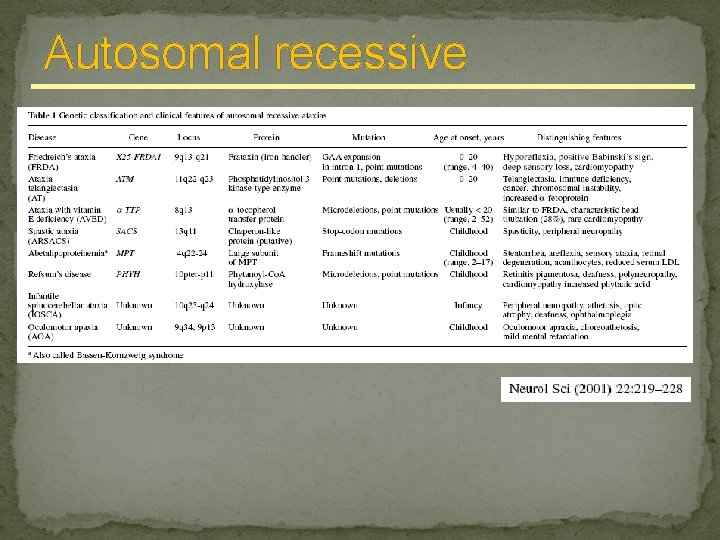
Autosomal recessive
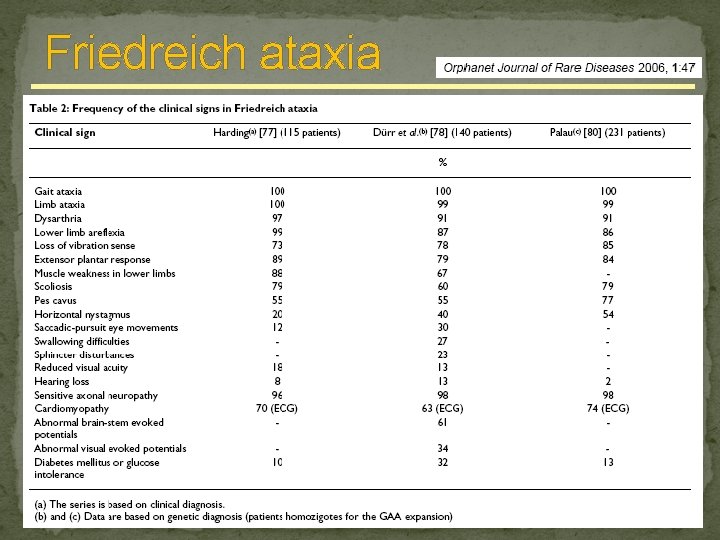
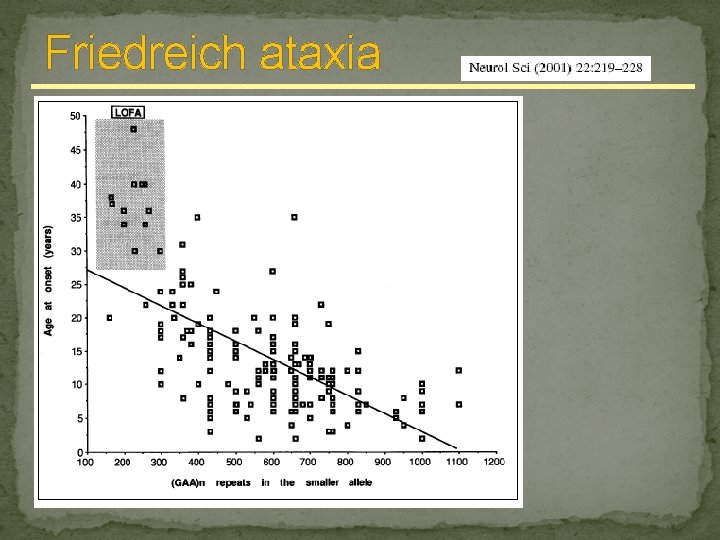
Friedreich ataxia �Commonest form among early onset autosomal recessive ataxia in Europe �Defect at 9 q 13 -q 21. 1 98% abnormally expanded GAA in 1 st intron decreased frataxin expression J Neurol 2004; 251: 913 -22
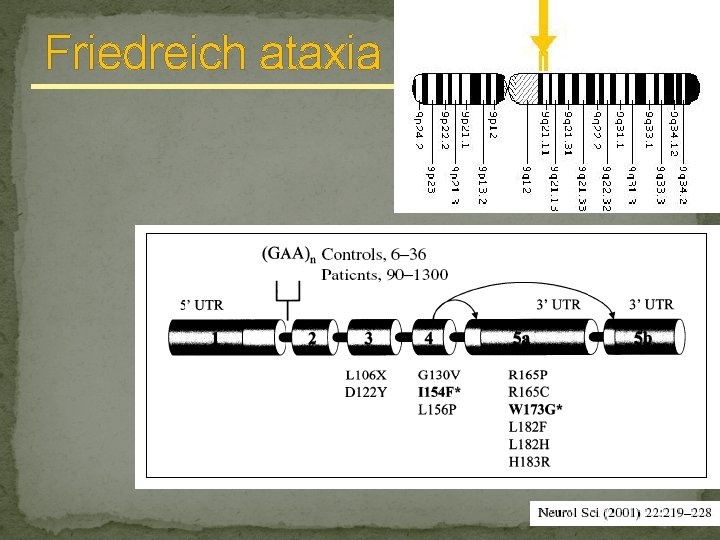
Friedreich ataxia
Friedreich ataxia �Commonest form among early onset autosomal recessive ataxia in Europe �Defect at 9 q 13 -q 21. 1 98% abnormally expanded GAA in 1 st intron decreased frataxin expression �Paternal transmission shows contraction �Clinical manifestation: progressive gait and limb ataxia, dysarthria, absent tendon reflexes, babinski signs, decreased vibration sense, sensory axonal peripheral neuropathy, cardiac hypertrophy, diabetes. J Neurol 2004; 251: 913 -22
Friedreich ataxia
Friedreich ataxia
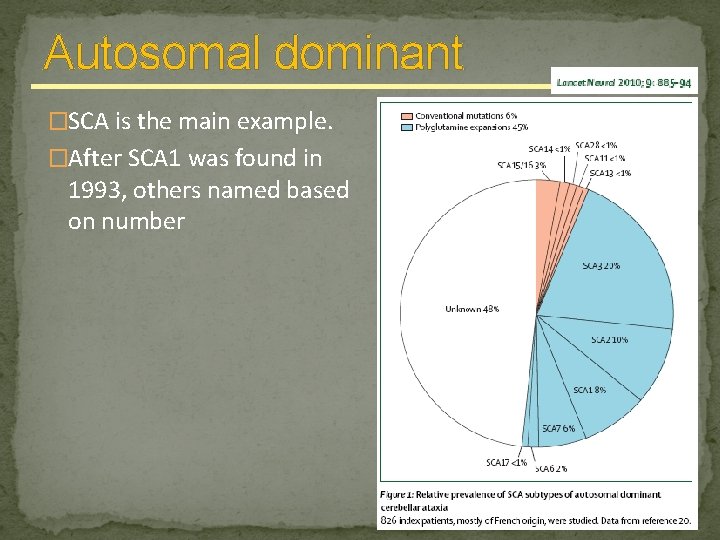
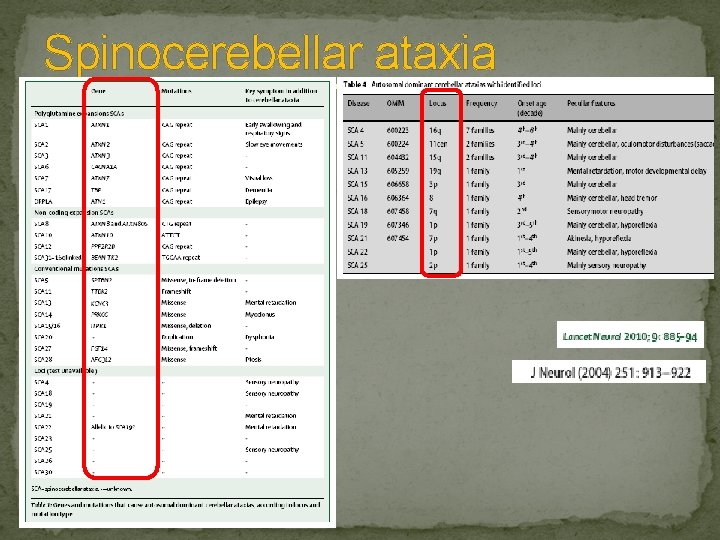
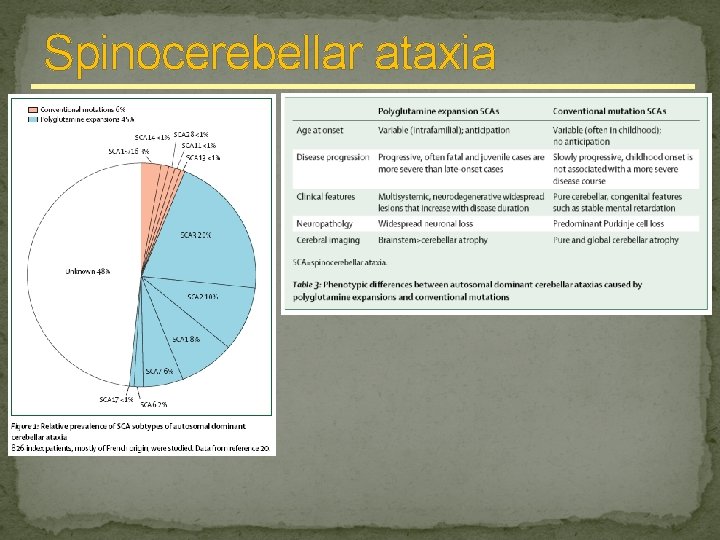
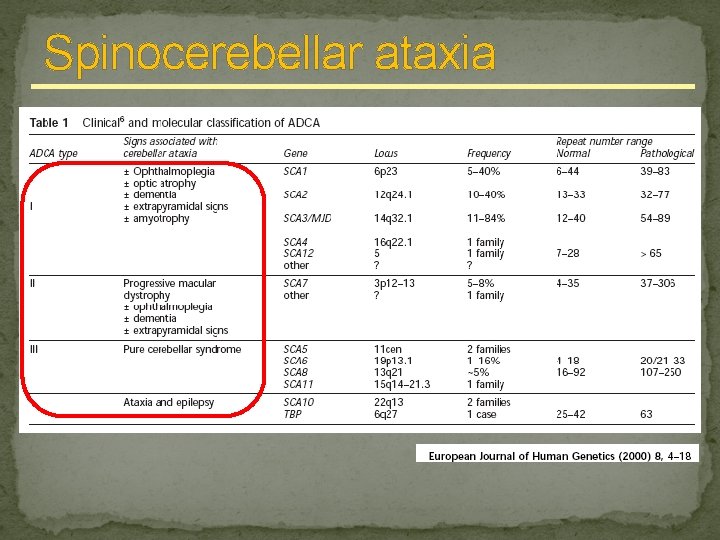
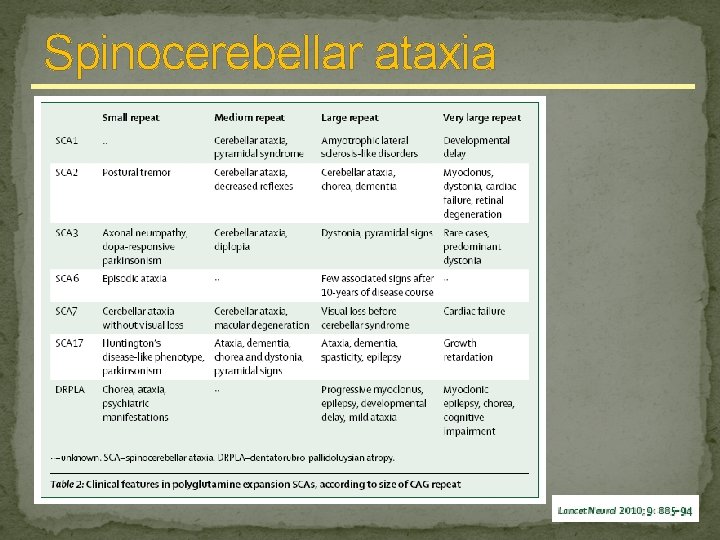
Autosomal dominant �SCA is the main example. �After SCA 1 was found in 1993, others named based on number
Spinocerebellar ataxia
Spinocerebellar ataxia
Spinocerebellar ataxia
Spinocerebellar ataxia
Spinocerebellar ataxia
X-linked (metabolic example) �Deficiency of urea cycle enzyme deficiency of ornithine transcarbamylase as the most common hyperammonemia. �Lethal in male �Female: no symptoms – profound neurological impairment �Clinical manifestation: irritability, episodic vomiting, ataxia, dysarthria, lethargy, coma, developmental delay, mental retardation, seizure. �Treatment: low protein diet, arginine.
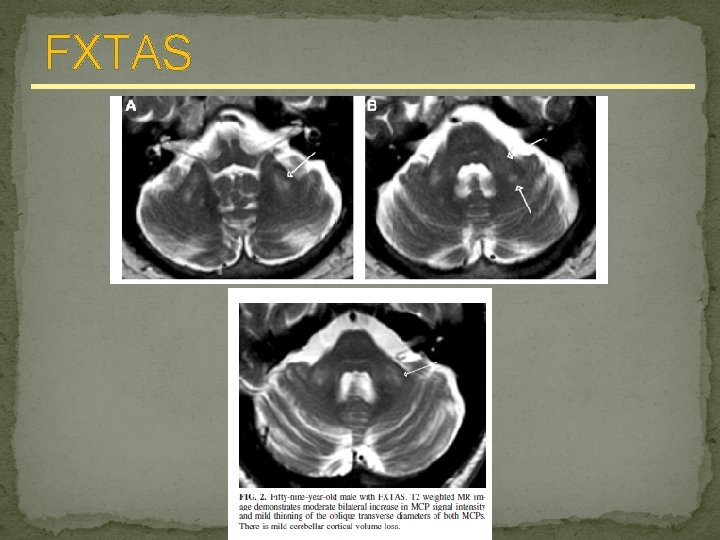
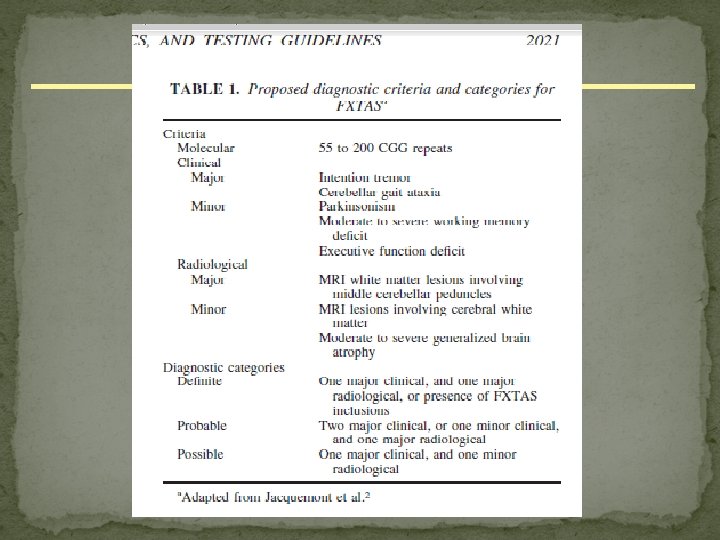
X-linked (FXTAS) � Fragile X-associated tremor/ataxia syndrome (FXTAS) is characterized by tremor and cerebellar gait ataxia. � caused by moderate expansions of a CGG trinucleotide in FMR 1 gene � The pathogenic mechanism is related to overexpression and toxicity of the FMR 1 m. RNA � Clinical manifestation: intention tremor, cerebellar gait and limb ataxia, parkinsonism, decreased reflexes, orthostatic hypotension, impotence, progressive loss of bowel and bladder control. � The pathological hallmark of FXTAS is the presence of intranuclear inclusions in neurons and astrocytes throughout the brain increased T 2 signal intensity in white matter of the MCP � Treatment: low protei n diet, arginine.
FXTAS
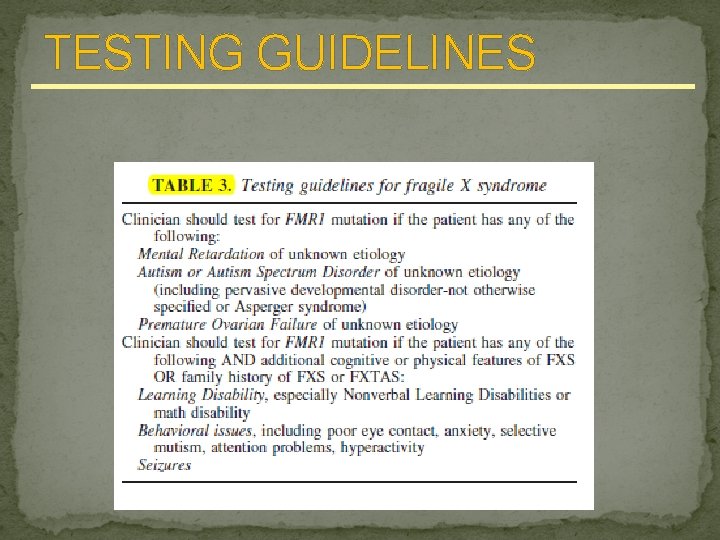
TESTING GUIDELINES
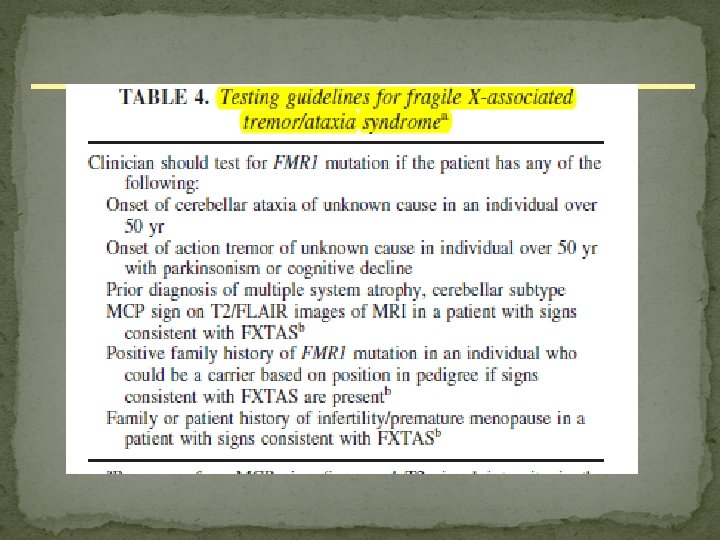
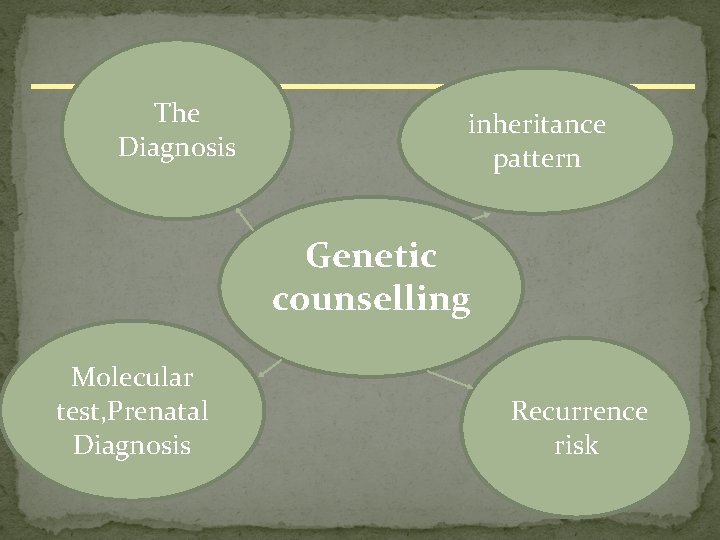
The Diagnosis inheritance pattern Genetic counselling Molecular test, Prenatal Diagnosis Recurrence risk

Thank You
- Slides: 32