
at the front of the classroom are stacks
- Slides: 32
at the front of the classroom are stacks of red , blue, yellow, green orange Please take one card of each color as you enter the classroom.
Astronomy, A 100 Section 26782 Monday & Wednesday 2: 30 - 3: 45 p. m. Swain West Room 119
Overview Ø introductory course in astronomy Ø emphasis on our own Solar System Ø intended for non-science majors Ø no college-level prerequisites Ø mathematics: high-school algebra is assumed. Math content – simple but not ignored
This will be an interactive class, prepare to participate!!!
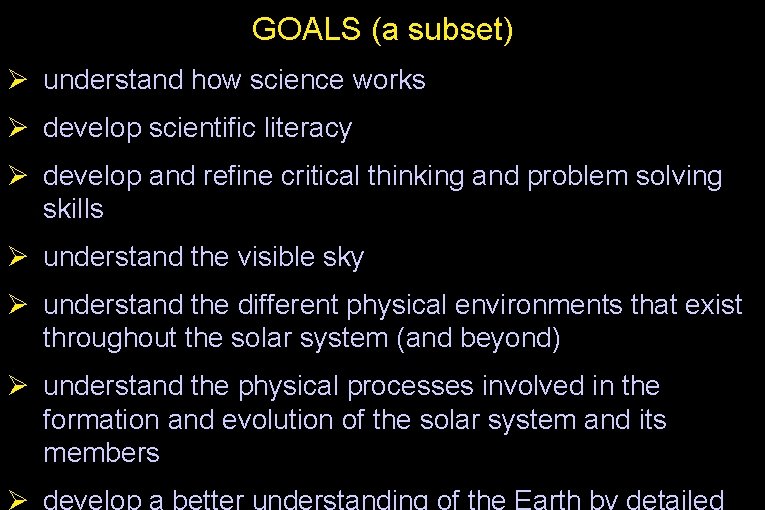
GOALS (a subset) Ø understand how science works Ø develop scientific literacy Ø develop and refine critical thinking and problem solving skills Ø understand the visible sky Ø understand the different physical environments that exist throughout the solar system (and beyond) Ø understand the physical processes involved in the formation and evolution of the solar system and its members Ø develop a better understanding of the Earth by detailed
Class web page: www. astro. indiana. edu/~classweb/a 100 s 26782 Homework assignments, announcements, reading assignments, etc. Consult this site on a regular basis.
Instructor: Dr. Tom Steiman-Cameron (a. k. a. , Dr. Dash) Email: tomsc@astro. indiana. edu Phone: 855 -2400 / 855 -6912 (AST Dept. office) Office: Swain West, Room 414 Office Hours: 1: 00 – 2: 00 am Mondays 10: 30 - 11: 30 pm Wednesdays or by appointment
Associate Instructor: Justin Mason Email: jrmason@indiana. edu Phone: 855 -6928 Office: Swain West, Room 417 Office Hours: 11: 00 – 12: 30 Tuesdays 2: 30 – 4: 00 pm Thursdays or by appointment
FEEDBACK Critical for class! Colored sheets of paper, please keep!
Each class session will include: 1) multiple mini-lectures 2) peer instruction activities. The class will be divided into numerous groups that will participate in collaborative learning exercises tied to the mini-lectures.
Text Book The Cosmic Perspective: The Solar System 6 th Edition Bennett, Donahue, Schneider, & Voit
It is important that you read the assigned work prior to attending class and participate in group activities. If you are having difficulty, please use scheduled office hours or make an appointment with myself or the A. I.
Grades … I hate grading!
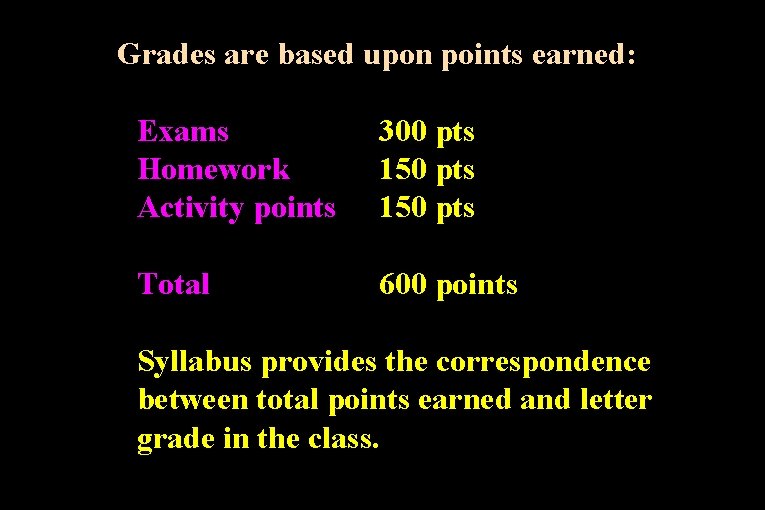
Grades are based upon points earned: Exams Homework Activity points 300 pts 150 pts Total 600 points Syllabus provides the correspondence between total points earned and letter grade in the class.
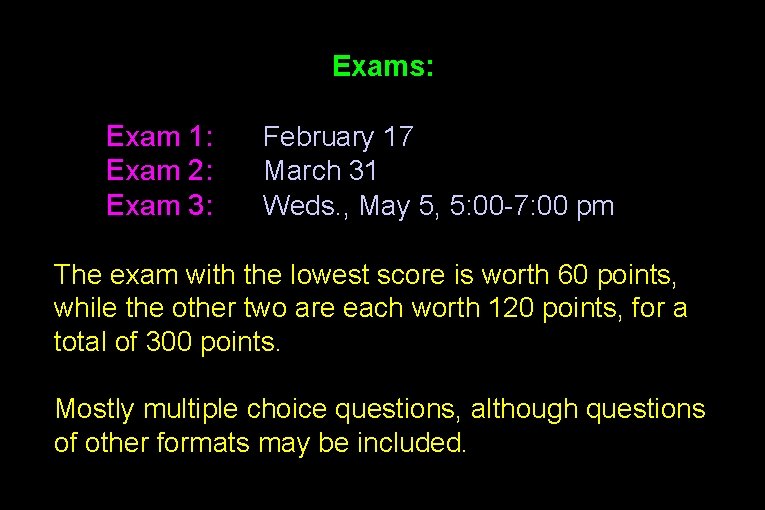
Exams: Exam 1: Exam 2: Exam 3: February 17 March 31 Weds. , May 5, 5: 00 -7: 00 pm The exam with the lowest score is worth 60 points, while the other two are each worth 120 points, for a total of 300 points. Mostly multiple choice questions, although questions of other formats may be included.
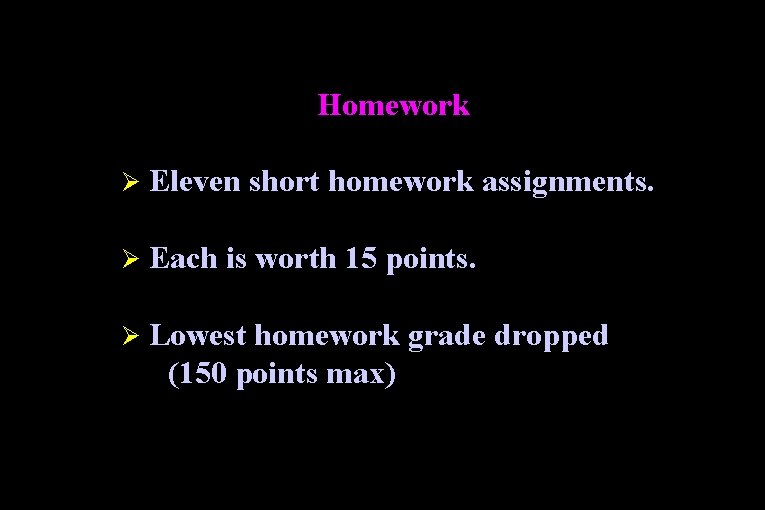
Homework Ø Eleven short homework assignments. Ø Each is worth 15 points. Ø Lowest homework grade dropped (150 points max)
Activity Points There will be a number of in-class and out-of-class exercises for which you can earn “activity points”. The purpose is to encourage active participation in the learning process. Up to 150 activity points can be counted towards the final grade (more than 200 points available throughout the semester)
Assignment for next class: 1. Read Chapter 1 2. Visit class website 3. Read the syllabus 4. Attach (glue/paste/tape/weld) a white sheet of paper to the back of each colored sheet of paper
Some rules (I REALLY hate rules!!)
Classroom etiquette (common courtesy) Ø Move conversations out of classroom Ø Cell phones off Ø Ipods off Ø Headphones off Ø No-surfing Also, no sitting on the floor in the back of the classroom or on the steps.
Academic Honesty Ø Except when told otherwise, be solely responsible for your work. No exceptions!
Most important issue - HAVE FUN!! ENJOY THE PROCESS!!!
We will commonly start each class by looking at the Astronomy Picture of the Day (APOD) http: //antwrp. gsfc. nasa. gov/apod/
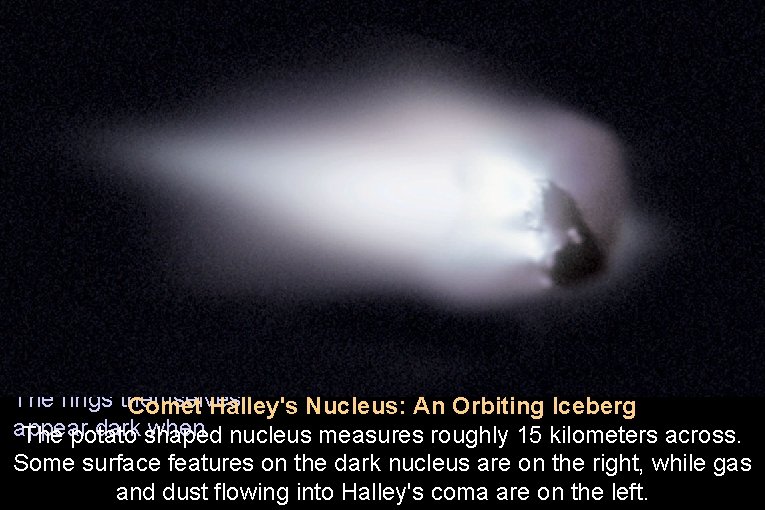
The Cassini spacecraft now orbiting Saturn recently drifted in giant planet's shadow for about 12 hours and looked back toward the eclipsed Sun. Here the night side of Saturn is seen to be partly lit by light reflected from its own majestic ring system. The rings themselves Comet Halley's Nucleus: An Orbiting Iceberg appear dark shaped when nucleus measures roughly 15 kilometers across. The potato Some surface features on the dark nucleus are on the right, while gas and dust flowing into Halley's coma are on the left.
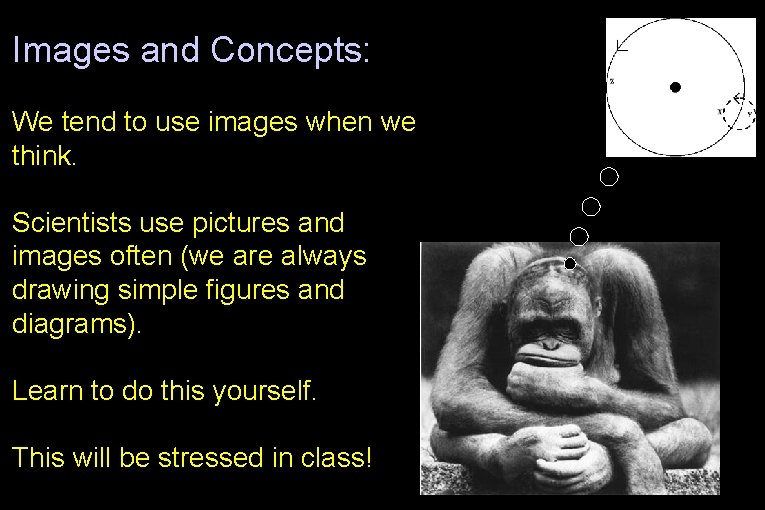
Images and Concepts: We tend to use images when we think. Scientists use pictures and images often (we are always drawing simple figures and diagrams). Learn to do this yourself. This will be stressed in class!
Thinking, not memorizing! Ø A primary goal of class Science is a process, not a set of facts! Ø
Astronomy is a physical SCIENCE. In order to make progress in understanding astronomy, we need to understand science: what is it and how does it work?
There are many definitions of science. They all have in common the view that science encompasses those human endeavors that seek to understand how nature works. The aspect of nature being studied, e. g. , the physical world, the biological world, human society and interactions, provides the pronoun we place before science: e. g. , physical science, biological science, social science.
Why are you taking this class? Why does the University consider it important for non-science majors to take a course in the physical sciences?
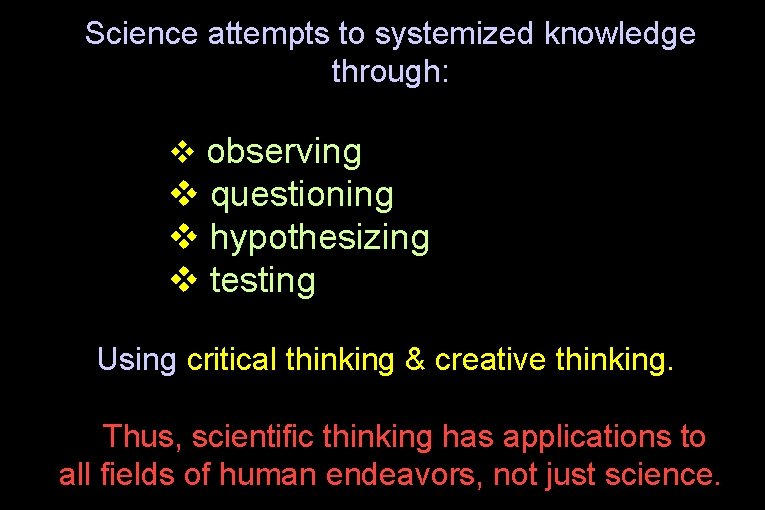
Science attempts to systemized knowledge through: v observing v questioning v hypothesizing v testing Using critical thinking & creative thinking. Thus, scientific thinking has applications to all fields of human endeavors, not just science.
Our goal is to teach you to be creative, critical thinkers that question authority, not to groom you to take exams!
Over the next few weeks, you will hopefully… 1. learn to question everything! 2. become aware that your thinking is guided by assumptions and prejudices you have acquired through your life experiences! 3. be creative, but critical, in your thinking!