
AT 737 Satellite Orbits and Navigation 2 AT
AT 737 Satellite Orbits and Navigation 2 AT 737 Satellite Orbits and Navigation
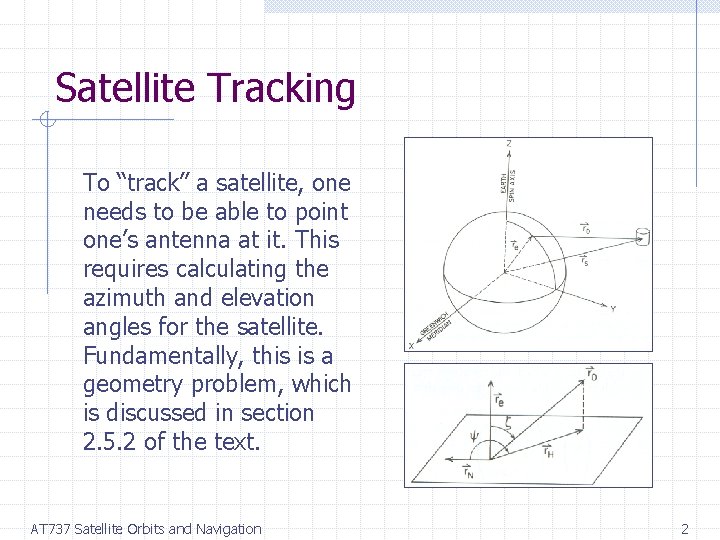
Satellite Tracking To “track” a satellite, one needs to be able to point one’s antenna at it. This requires calculating the azimuth and elevation angles for the satellite. Fundamentally, this is a geometry problem, which is discussed in section 2. 5. 2 of the text. AT 737 Satellite Orbits and Navigation 2
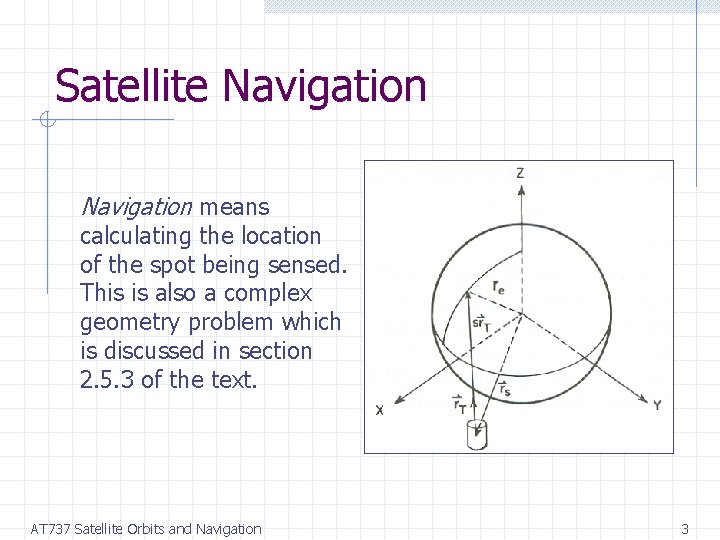
Satellite Navigation means calculating the location of the spot being sensed. This is also a complex geometry problem which is discussed in section 2. 5. 3 of the text. AT 737 Satellite Orbits and Navigation 3
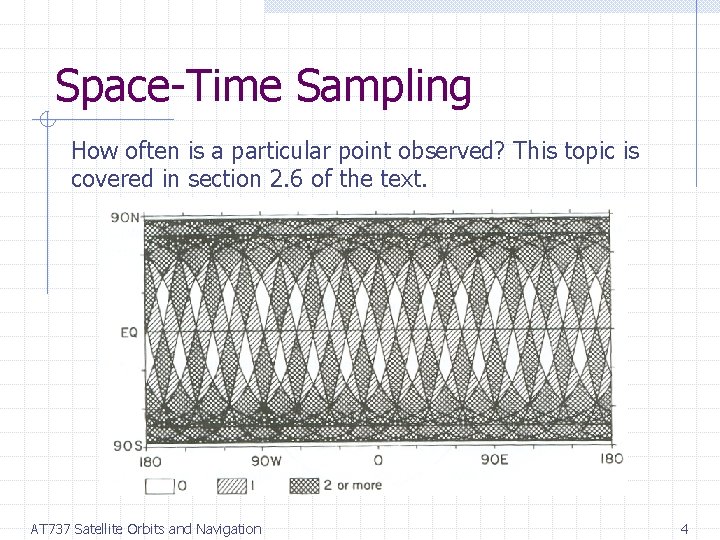
Space-Time Sampling How often is a particular point observed? This topic is covered in section 2. 6 of the text. AT 737 Satellite Orbits and Navigation 4
Met. Sat Orbits Geostationary Sunsynchronous LEO Molniya Formations Constellations AT 737 Satellite Orbits and Navigation 5
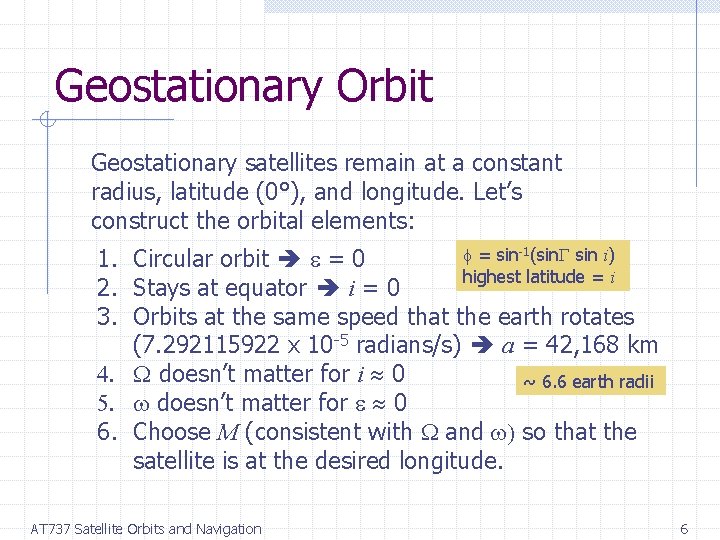
Geostationary Orbit Geostationary satellites remain at a constant radius, latitude (0°), and longitude. Let’s construct the orbital elements: = sin-1(sin i) 1. Circular orbit e = 0 highest latitude = i 2. Stays at equator i = 0 3. Orbits at the same speed that the earth rotates (7. 292115922 x 10 -5 radians/s) a = 42, 168 km 4. W doesn’t matter for i 0 ~ 6. 6 earth radii 5. w doesn’t matter for e 0 6. Choose M (consistent with W and w) so that the satellite is at the desired longitude. AT 737 Satellite Orbits and Navigation 6
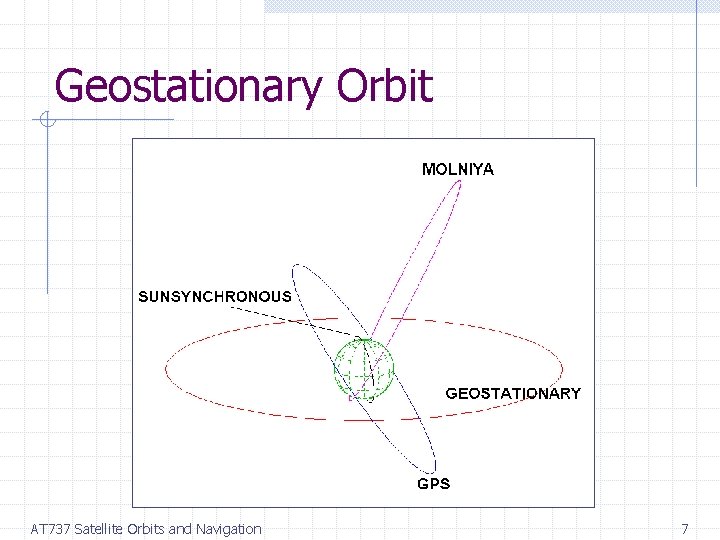
Geostationary Orbit AT 737 Satellite Orbits and Navigation 7
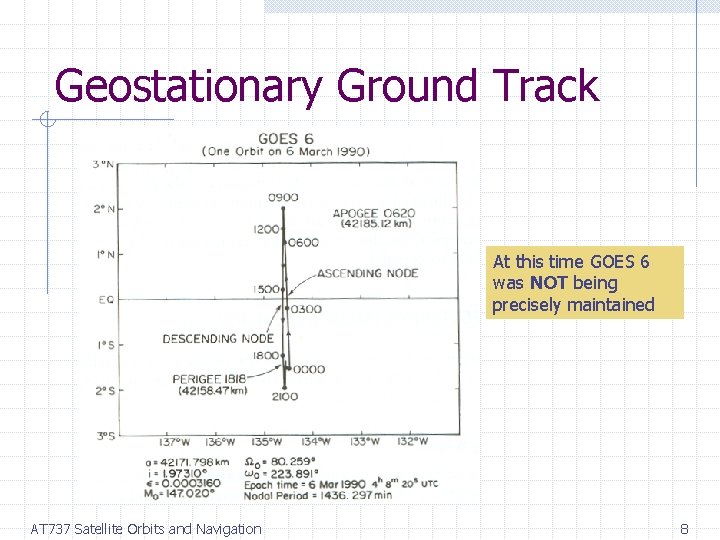
Geostationary Ground Track At this time GOES 6 was NOT being precisely maintained AT 737 Satellite Orbits and Navigation 8
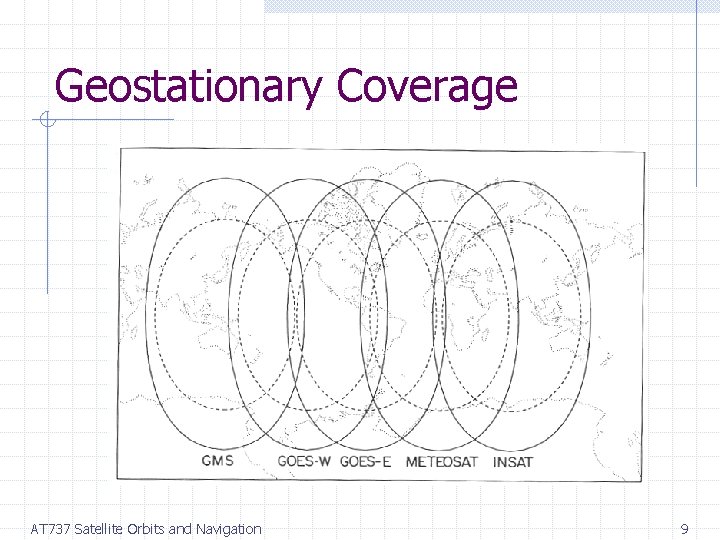
Geostationary Coverage AT 737 Satellite Orbits and Navigation 9
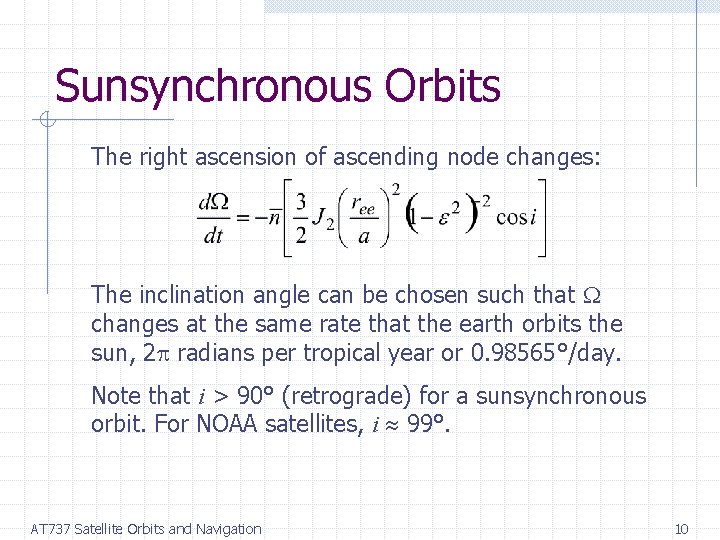
Sunsynchronous Orbits The right ascension of ascending node changes: The inclination angle can be chosen such that W changes at the same rate that the earth orbits the sun, 2 p radians per tropical year or 0. 98565°/day. Note that i > 90° (retrograde) for a sunsynchronous orbit. For NOAA satellites, i 99°. AT 737 Satellite Orbits and Navigation 10
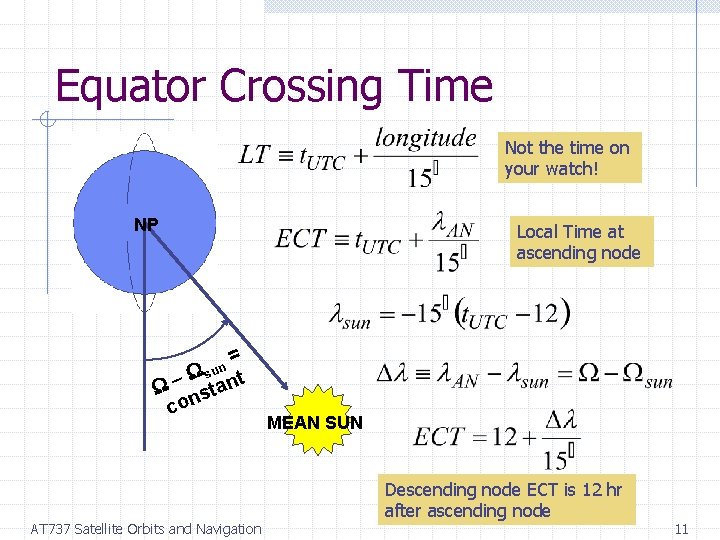
Equator Crossing Time Not the time on your watch! NP Local Time at ascending node = t tan W sun W– s con AT 737 Satellite Orbits and Navigation MEAN SUN Descending node ECT is 12 hr after ascending node 11
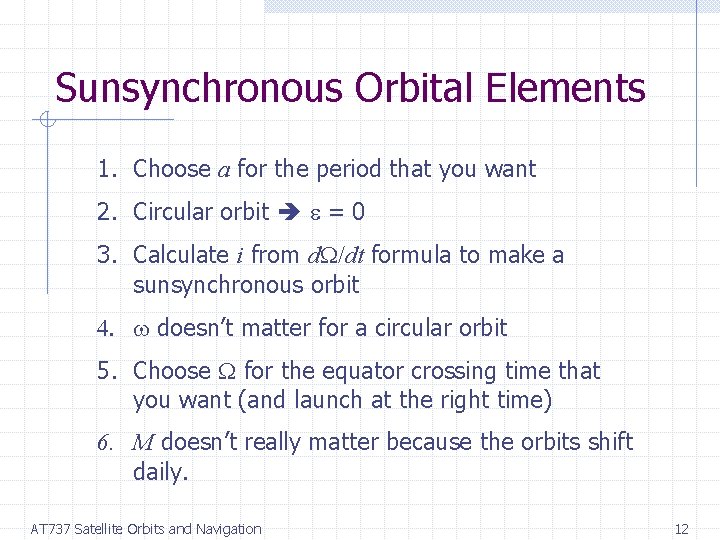
Sunsynchronous Orbital Elements 1. Choose a for the period that you want 2. Circular orbit e = 0 3. Calculate i from d. W/dt formula to make a sunsynchronous orbit 4. w doesn’t matter for a circular orbit 5. Choose W for the equator crossing time that you want (and launch at the right time) 6. M doesn’t really matter because the orbits shift daily. AT 737 Satellite Orbits and Navigation 12
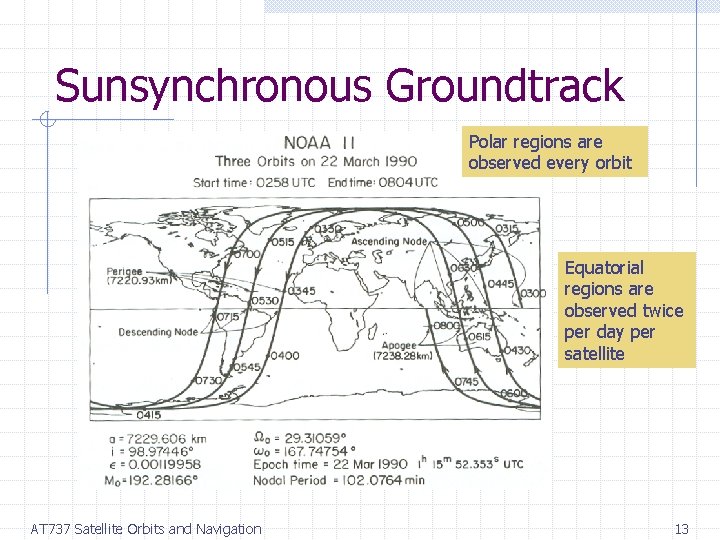
Sunsynchronous Groundtrack Polar regions are observed every orbit Equatorial regions are observed twice per day per satellite AT 737 Satellite Orbits and Navigation 13
Low Earth Orbit (LEO) Any satellite in approximately circular orbit with semimajor axis less than, say, 1500 km is said to be in Low Earth Orbit. Sunsynchronous satellites are in low earth orbit, but many nonsunsynchronous satellites are also in orbit. Perhaps the most important aspect of nonsynchronous LEOs is that they sample all local times, which can be important for climate and other applications. AT 737 Satellite Orbits and Navigation 14

Mid-Earth Orbit (MEO) 1. Semimajor axis >LEO and <GEO 2. The Global Positioning System (GPS) is a good example a = 26559 ± 5 km (4. 2 earth radii) i = 55° ± 1° e=0 AT 737 Satellite Orbits and Navigation 15
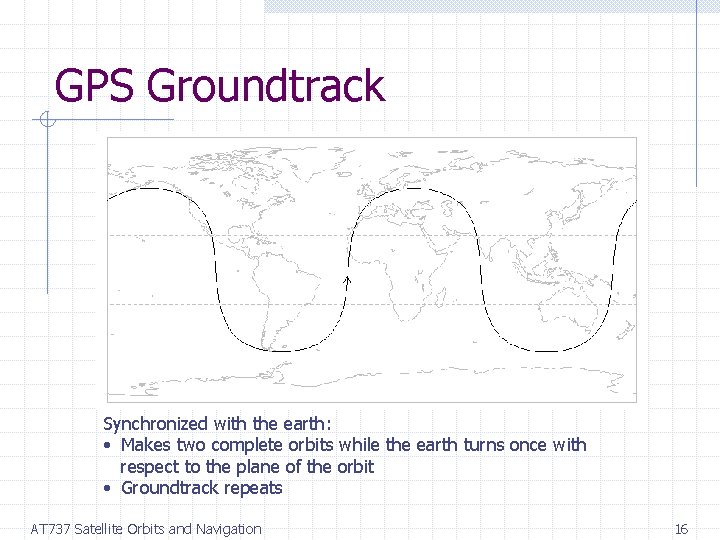
GPS Groundtrack Synchronized with the earth: • Makes two complete orbits while the earth turns once with respect to the plane of the orbit • Groundtrack repeats AT 737 Satellite Orbits and Navigation 16
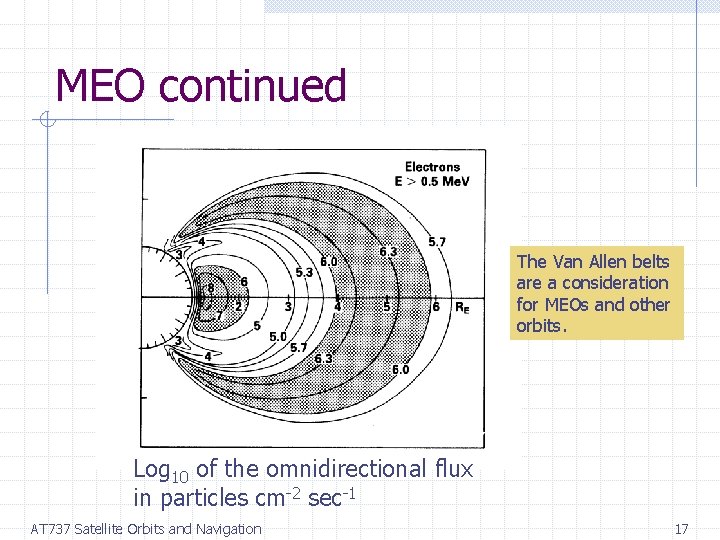
MEO continued The Van Allen belts are a consideration for MEOs and other orbits. Log 10 of the omnidirectional flux in particles cm-2 sec-1 AT 737 Satellite Orbits and Navigation 17
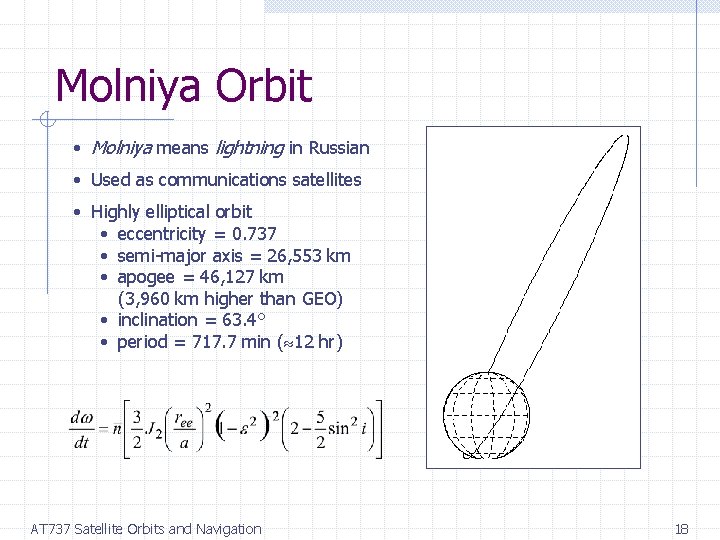
Molniya Orbit • Molniya means lightning in Russian • Used as communications satellites • Highly elliptical orbit • eccentricity = 0. 737 • semi-major axis = 26, 553 km • apogee = 46, 127 km (3, 960 km higher than GEO) • inclination = 63. 4° • period = 717. 7 min ( 12 hr) AT 737 Satellite Orbits and Navigation 18
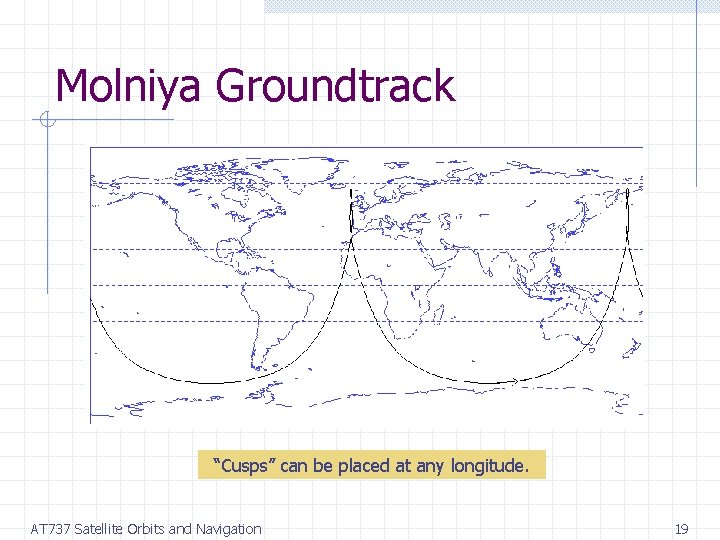
Molniya Groundtrack “Cusps” can be placed at any longitude. AT 737 Satellite Orbits and Navigation 19
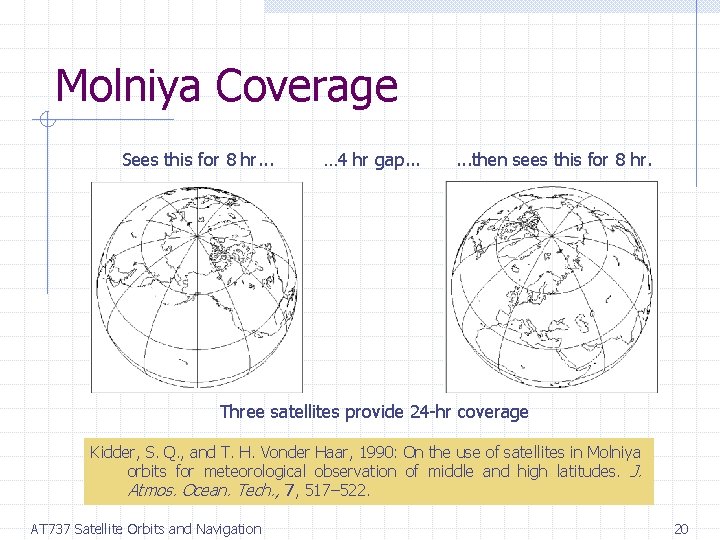
Molniya Coverage Sees this for 8 hr. . . … 4 hr gap. . . then sees this for 8 hr. Three satellites provide 24 -hr coverage Kidder, S. Q. , and T. H. Vonder Haar, 1990: On the use of satellites in Molniya orbits for meteorological observation of middle and high latitudes. J. Atmos. Ocean. Tech. , 7, 517– 522. AT 737 Satellite Orbits and Navigation 20
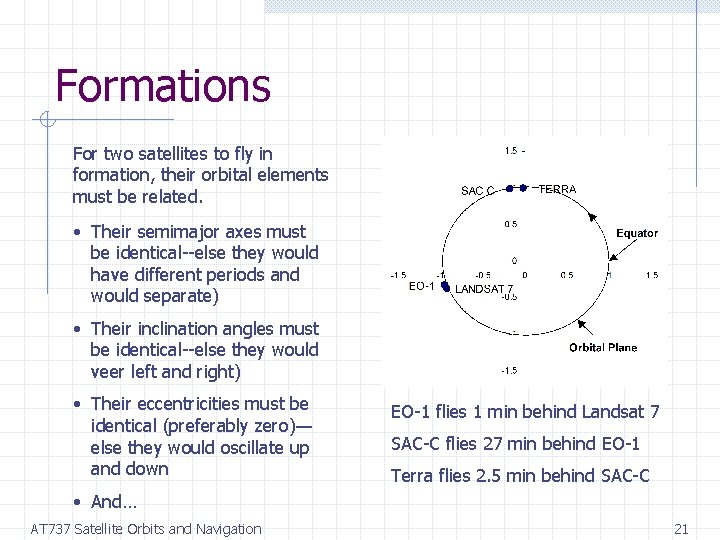
Formations For two satellites to fly in formation, their orbital elements must be related. • Their semimajor axes must be identical--else they would have different periods and would separate) • Their inclination angles must be identical--else they would veer left and right) • Their eccentricities must be identical (preferably zero)— else they would oscillate up and down EO-1 flies 1 min behind Landsat 7 SAC-C flies 27 min behind EO-1 Terra flies 2. 5 min behind SAC-C • And… AT 737 Satellite Orbits and Navigation 21
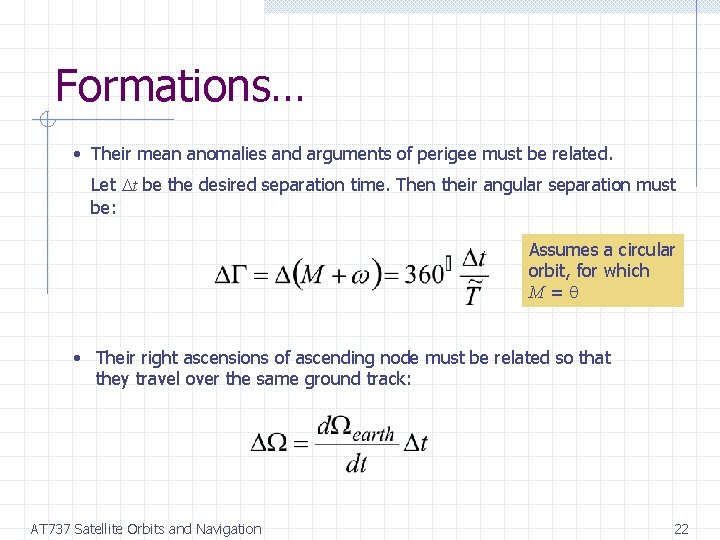
Formations… • Their mean anomalies and arguments of perigee must be related. Let Dt be the desired separation time. Then their angular separation must be: Assumes a circular orbit, for which M= • Their right ascensions of ascending node must be related so that they travel over the same ground track: AT 737 Satellite Orbits and Navigation 22
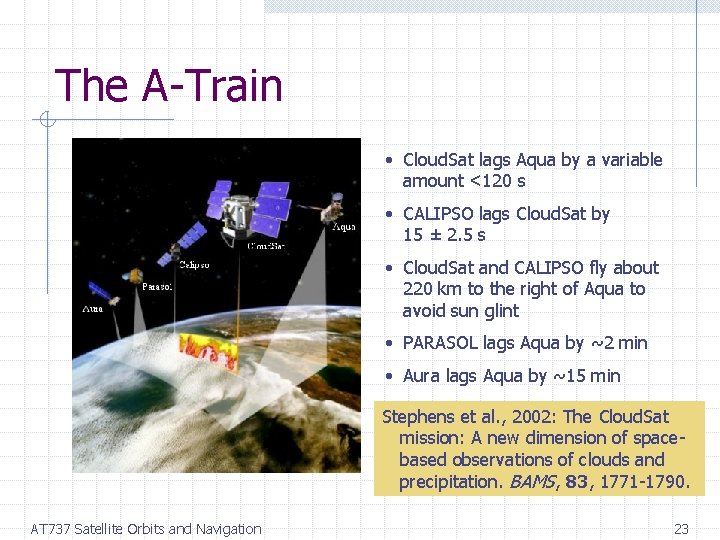
The A-Train • Cloud. Sat lags Aqua by a variable amount <120 s • CALIPSO lags Cloud. Sat by 15 ± 2. 5 s • Cloud. Sat and CALIPSO fly about 220 km to the right of Aqua to avoid sun glint • PARASOL lags Aqua by ~2 min • Aura lags Aqua by ~15 min Stephens et al. , 2002: The Cloud. Sat mission: A new dimension of spacebased observations of clouds and precipitation. BAMS, 83, 1771 -1790. AT 737 Satellite Orbits and Navigation 23
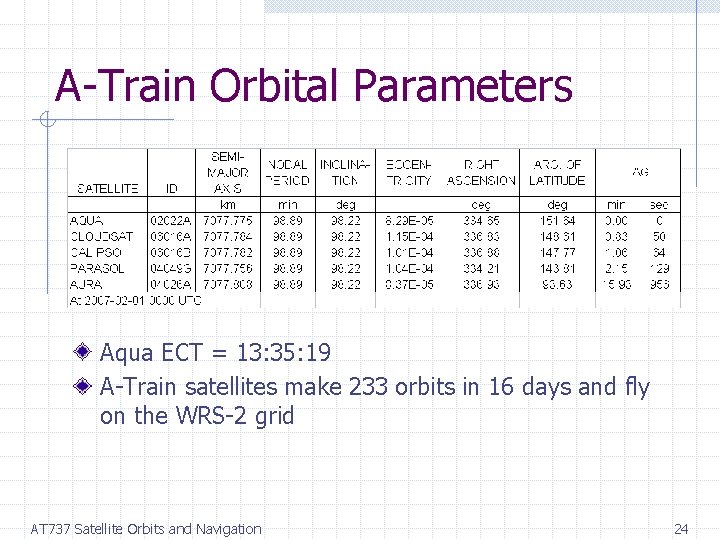
A-Train Orbital Parameters Aqua ECT = 13: 35: 19 A-Train satellites make 233 orbits in 16 days and fly on the WRS-2 grid AT 737 Satellite Orbits and Navigation 24
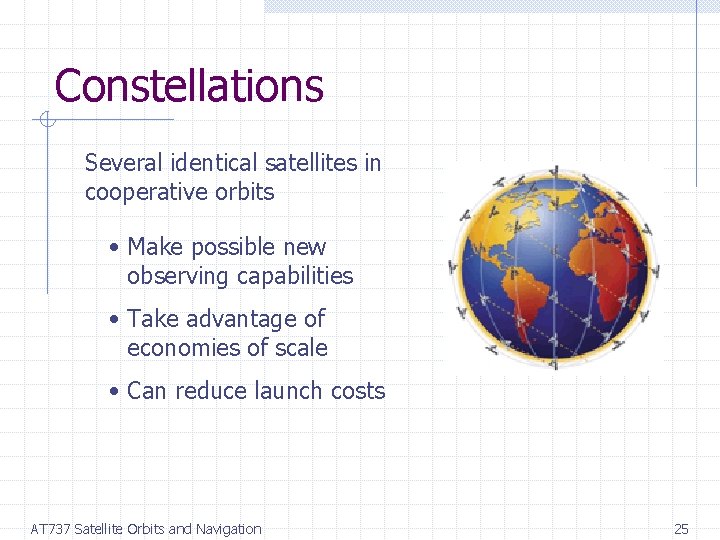
Constellations Several identical satellites in cooperative orbits • Make possible new observing capabilities • Take advantage of economies of scale • Can reduce launch costs AT 737 Satellite Orbits and Navigation 25
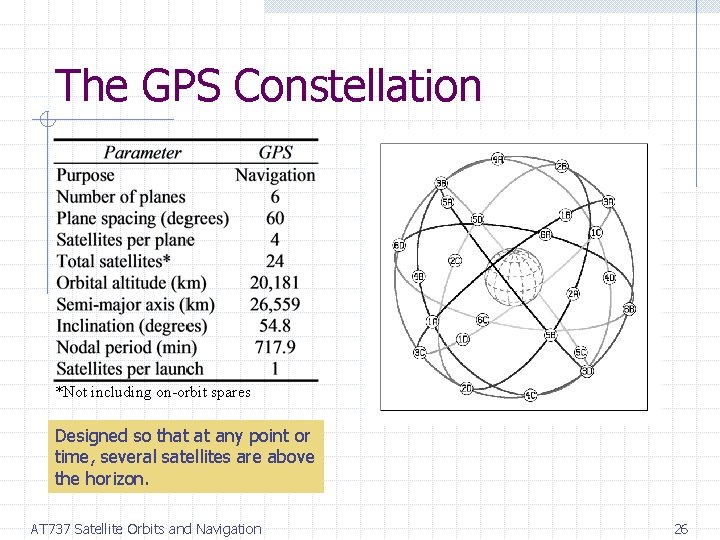
The GPS Constellation *Not including on-orbit spares Designed so that at any point or time, several satellites are above the horizon. AT 737 Satellite Orbits and Navigation 26
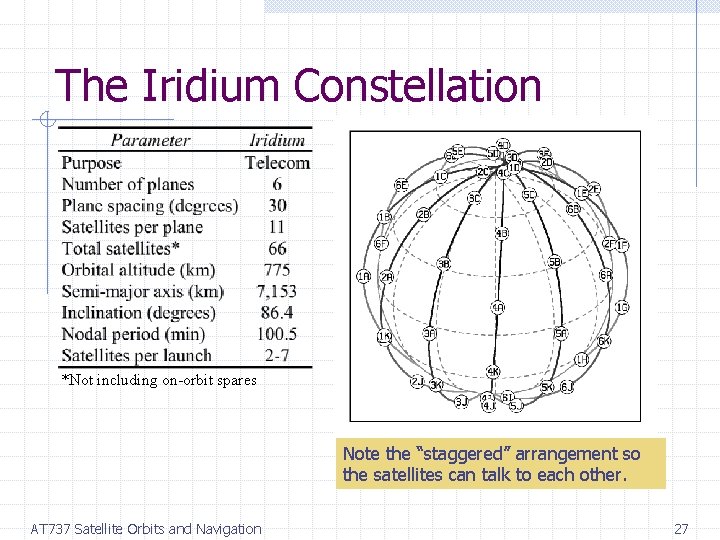
The Iridium Constellation *Not including on-orbit spares Note the “staggered” arrangement so the satellites can talk to each other. AT 737 Satellite Orbits and Navigation 27
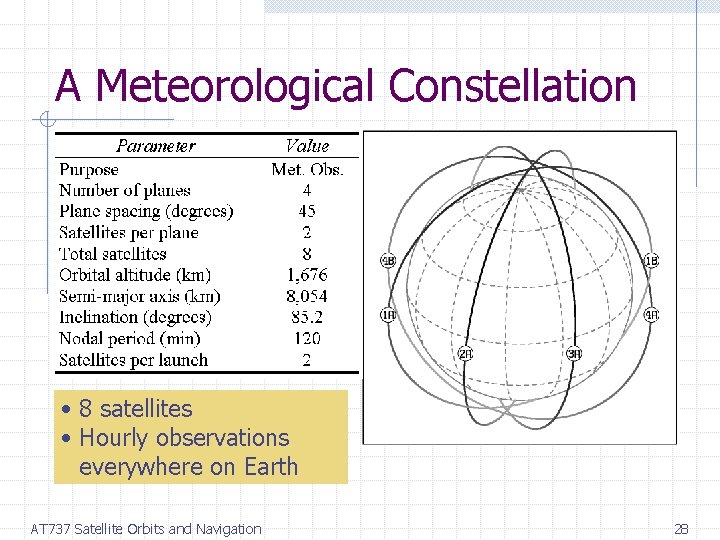
A Meteorological Constellation • 8 satellites • Hourly observations everywhere on Earth AT 737 Satellite Orbits and Navigation 28
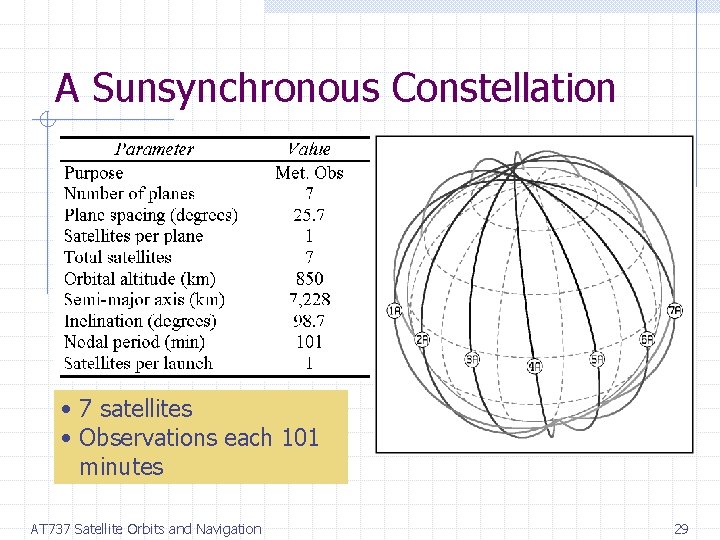
A Sunsynchronous Constellation • 7 satellites • Observations each 101 minutes AT 737 Satellite Orbits and Navigation 29
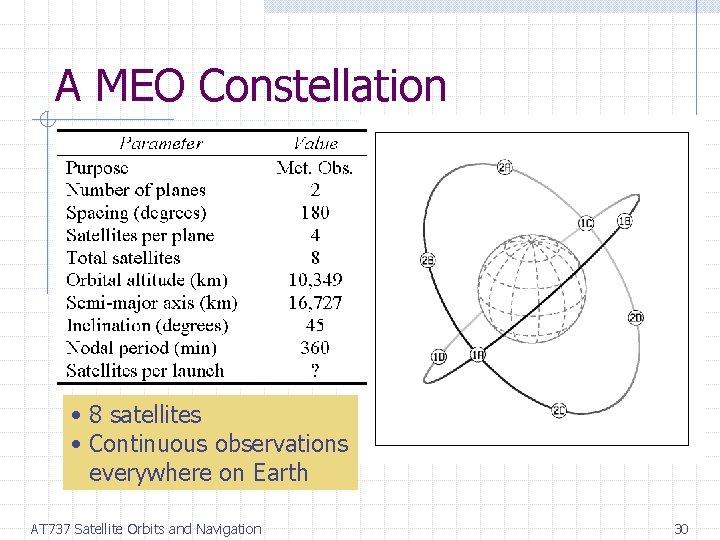
A MEO Constellation • 8 satellites • Continuous observations everywhere on Earth AT 737 Satellite Orbits and Navigation 30
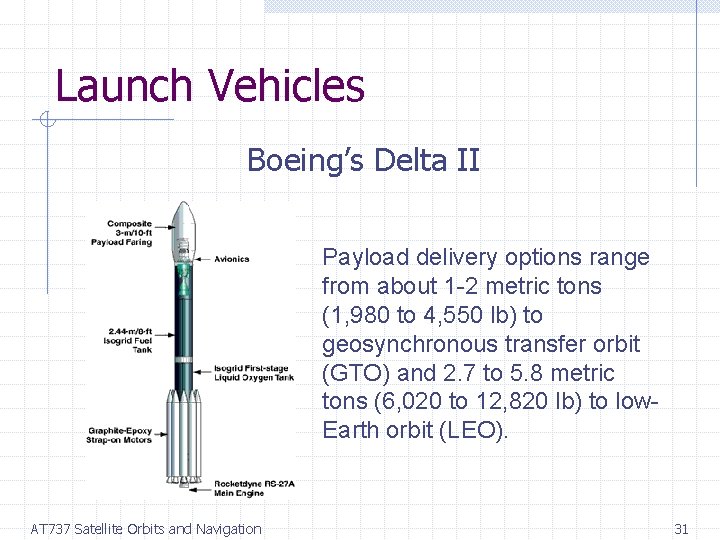
Launch Vehicles Boeing’s Delta II Payload delivery options range from about 1 -2 metric tons (1, 980 to 4, 550 lb) to geosynchronous transfer orbit (GTO) and 2. 7 to 5. 8 metric tons (6, 020 to 12, 820 lb) to low. Earth orbit (LEO). AT 737 Satellite Orbits and Navigation 31
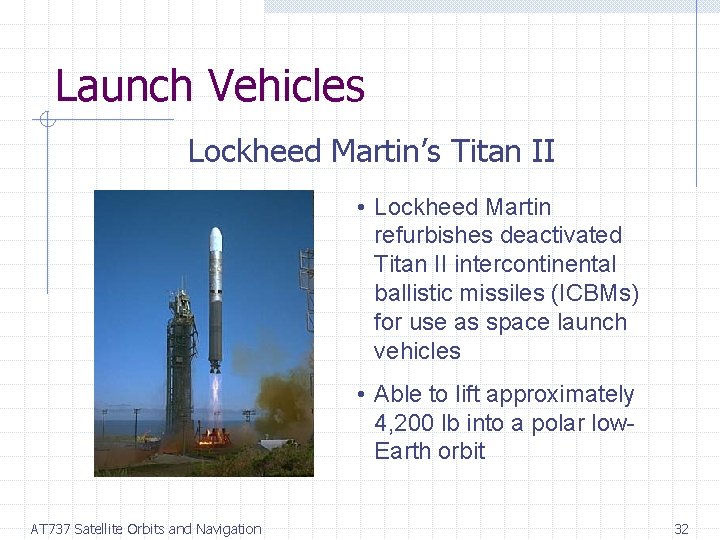
Launch Vehicles Lockheed Martin’s Titan II • Lockheed Martin refurbishes deactivated Titan II intercontinental ballistic missiles (ICBMs) for use as space launch vehicles • Able to lift approximately 4, 200 lb into a polar low. Earth orbit AT 737 Satellite Orbits and Navigation 32
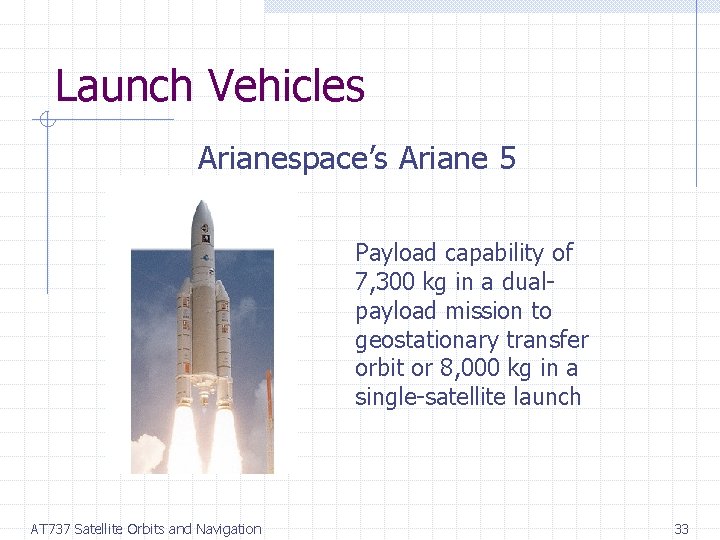
Launch Vehicles Arianespace’s Ariane 5 Payload capability of 7, 300 kg in a dualpayload mission to geostationary transfer orbit or 8, 000 kg in a single-satellite launch AT 737 Satellite Orbits and Navigation 33
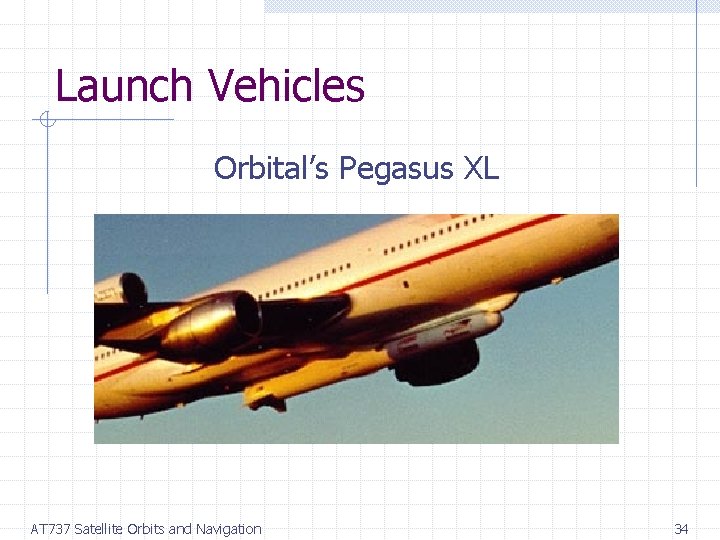
Launch Vehicles Orbital’s Pegasus XL AT 737 Satellite Orbits and Navigation 34
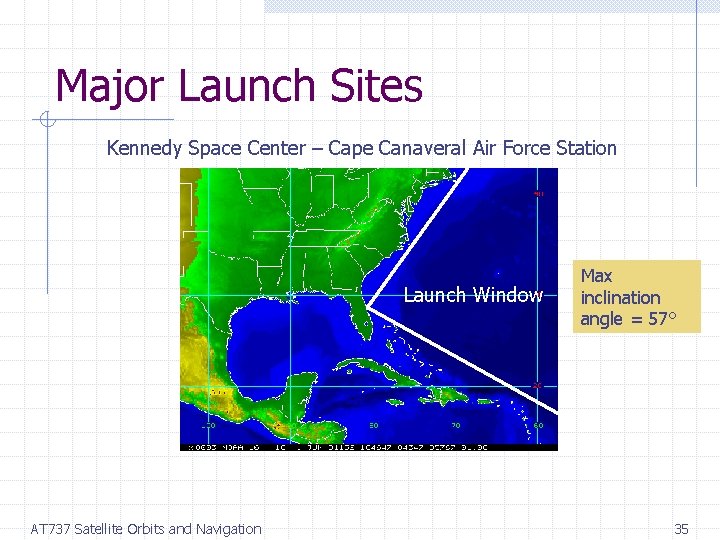
Major Launch Sites Kennedy Space Center – Cape Canaveral Air Force Station Launch Window AT 737 Satellite Orbits and Navigation Max inclination angle = 57° 35
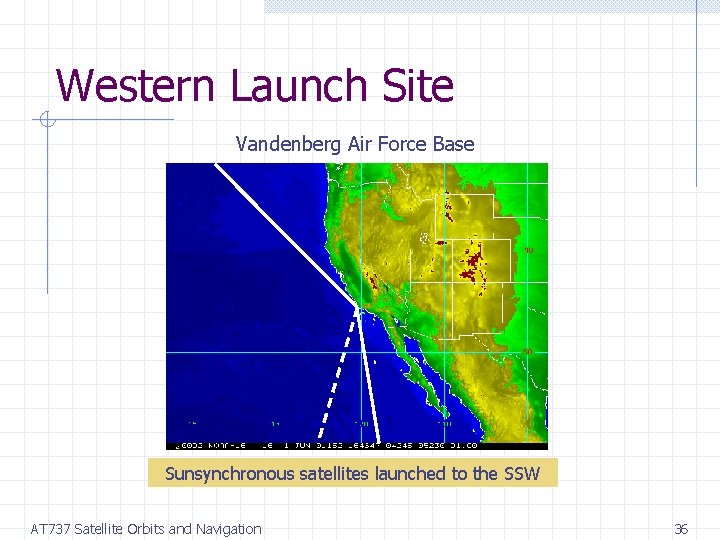
Western Launch Site Vandenberg Air Force Base Sunsynchronous satellites launched to the SSW AT 737 Satellite Orbits and Navigation 36
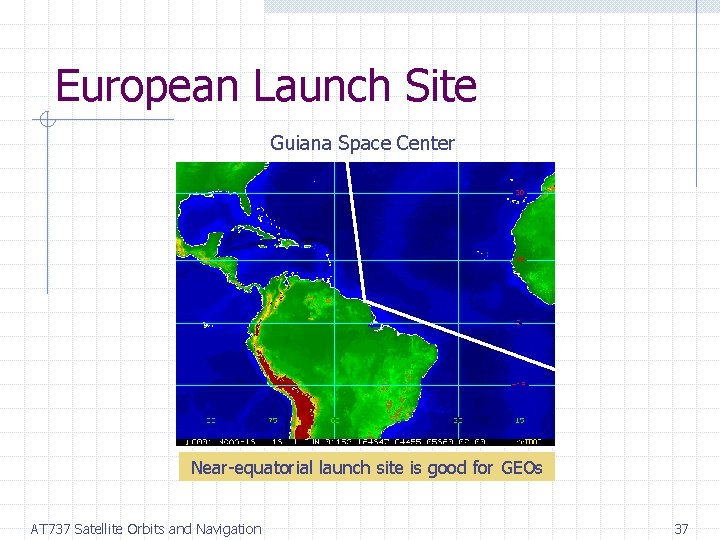
European Launch Site Guiana Space Center Near-equatorial launch site is good for GEOs AT 737 Satellite Orbits and Navigation 37
Launch Schedules Vandenberg AFB http: //www. spacearchive. info/vafbsked. htm Kennedy Space Center http: //www. nasa. gov/centers/kennedy/missions/schedule. html Guiana Space Center http: //www. arianespace. com/site/launchstatus/status_sub_index. html General Launch Schedule http: //www. satelliteonthenet. co. uk/launch. html AT 737 Satellite Orbits and Navigation 38
- Slides: 38