
Asynchronous Transfer Mode ATM Networks Andreas Prodromou 1
- Slides: 22
Asynchronous Transfer Mode (ATM) Networks Andreas Prodromou 1 HMY 654 - Advanced Computer Networks
The Network § § Cell-switching and multiplexing technology Combines the benefits of: § § Circuit switching (Virtual Circuits): § Guaranteed capacity and constant transmission delay Packet switching: § Flexibility and efficiency Can be used for high-speed LANs, voice and video data Utilizes fixed length cells to carry information 2 HMY 654 - Advanced Computer Networks
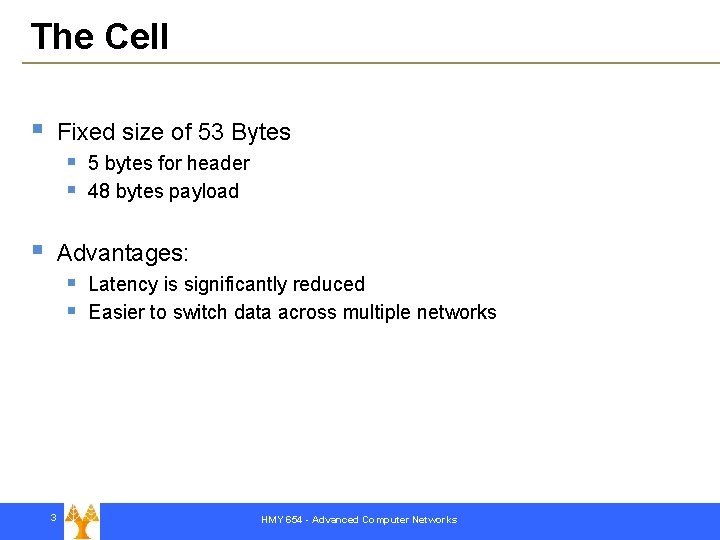
The Cell § Fixed size of 53 Bytes § § § 5 bytes for header 48 bytes payload Advantages: § § 3 Latency is significantly reduced Easier to switch data across multiple networks HMY 654 - Advanced Computer Networks
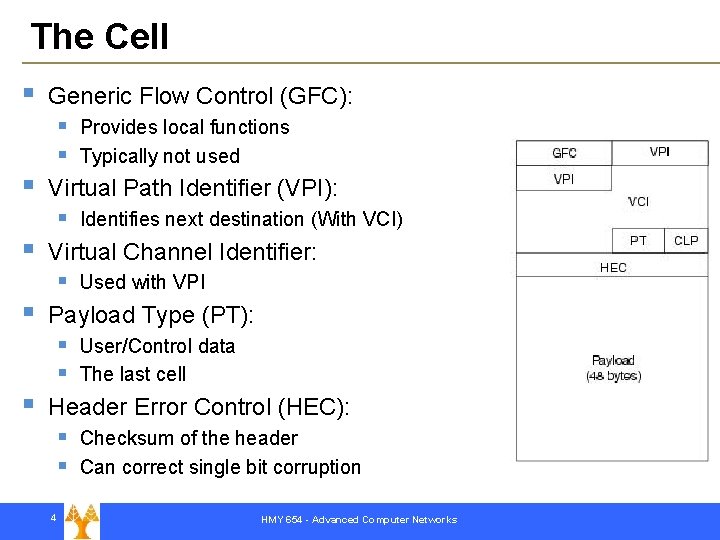
The Cell § Generic Flow Control (GFC): § § § Virtual Path Identifier (VPI): § § Used with VPI Payload Type (PT): § § § Identifies next destination (With VCI) Virtual Channel Identifier: § § Provides local functions Typically not used User/Control data The last cell Header Error Control (HEC): § § 4 Checksum of the header Can correct single bit corruption HMY 654 - Advanced Computer Networks
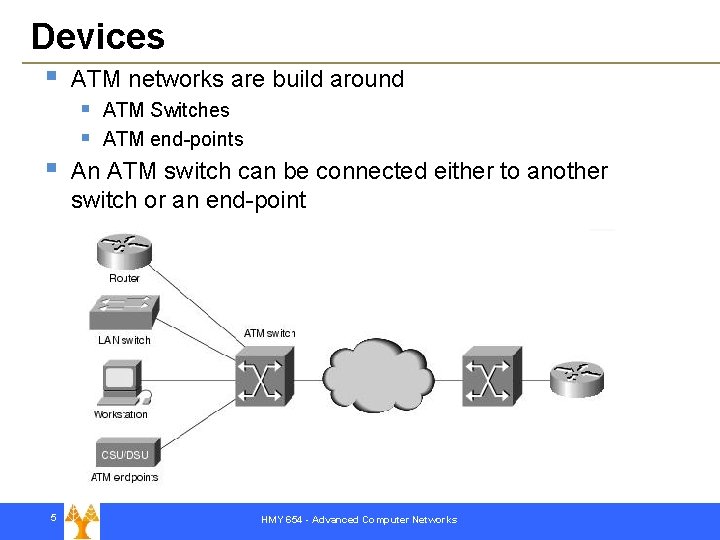
Devices § ATM networks are build around § § § 5 ATM Switches ATM end-points An ATM switch can be connected either to another switch or an end-point HMY 654 - Advanced Computer Networks
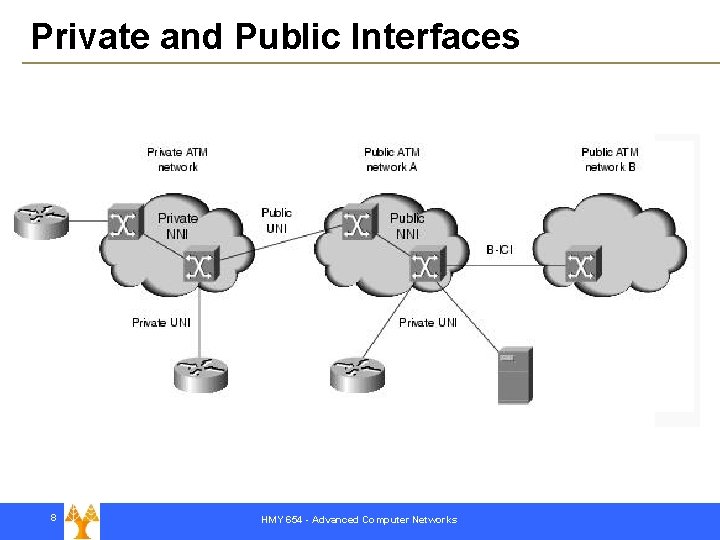
Switches and Interfaces § ATM switch supports two types of interfaces § § User-Network Interface (UNI) § Connects ATM end-point to a switch Network-Network Interface (NNI) § Connects two switches § UNI and NNI can be divided in private and public § Third type: Broadband Inter-Carrier Interface (BICI) § 6 Connects two public switches from different service providers HMY 654 - Advanced Computer Networks
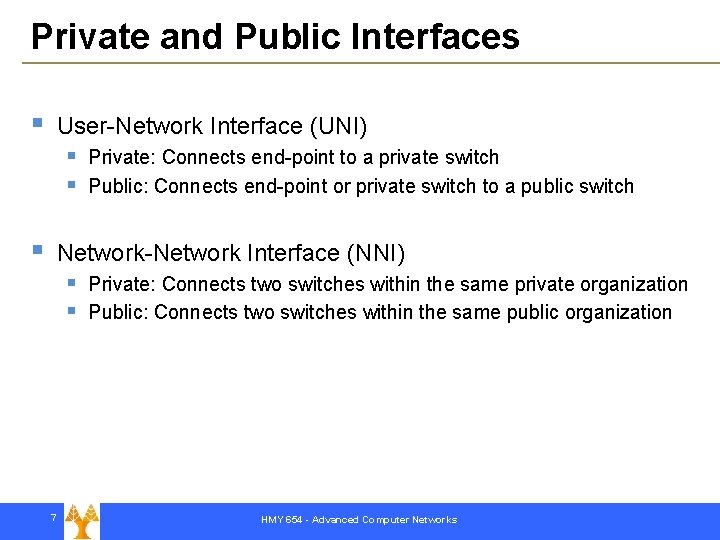
Private and Public Interfaces § User-Network Interface (UNI) § § § Private: Connects end-point to a private switch Public: Connects end-point or private switch to a public switch Network-Network Interface (NNI) § § 7 Private: Connects two switches within the same private organization Public: Connects two switches within the same public organization HMY 654 - Advanced Computer Networks
Private and Public Interfaces 8 HMY 654 - Advanced Computer Networks
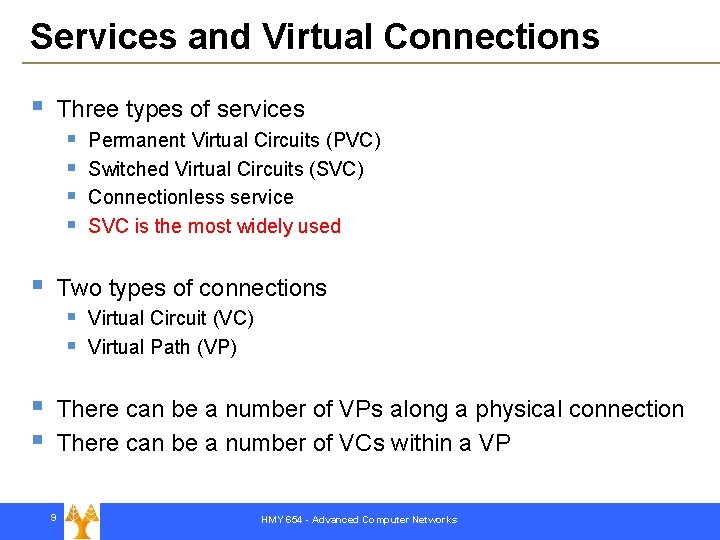
Services and Virtual Connections § Three types of services § § § Two types of connections § § Permanent Virtual Circuits (PVC) Switched Virtual Circuits (SVC) Connectionless service SVC is the most widely used Virtual Circuit (VC) Virtual Path (VP) There can be a number of VPs along a physical connection There can be a number of VCs within a VP 9 HMY 654 - Advanced Computer Networks
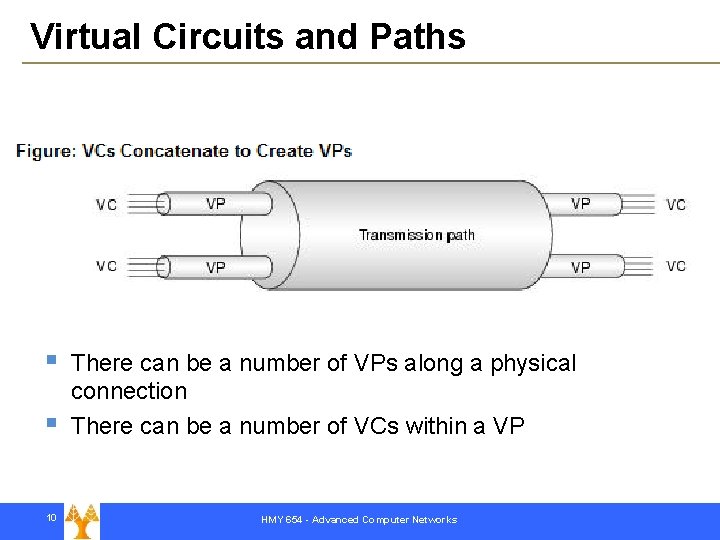
Virtual Circuits and Paths § § 10 There can be a number of VPs along a physical connection There can be a number of VCs within a VP HMY 654 - Advanced Computer Networks
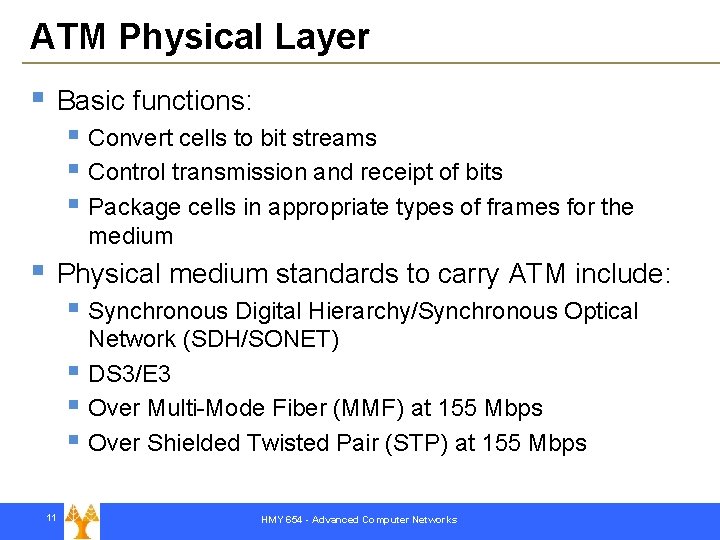
ATM Physical Layer § Basic functions: § Convert cells to bit streams § Control transmission and receipt of bits § Package cells in appropriate types of frames for the medium § Physical medium standards to carry ATM include: § Synchronous Digital Hierarchy/Synchronous Optical § § § 11 Network (SDH/SONET) DS 3/E 3 Over Multi-Mode Fiber (MMF) at 155 Mbps Over Shielded Twisted Pair (STP) at 155 Mbps HMY 654 - Advanced Computer Networks
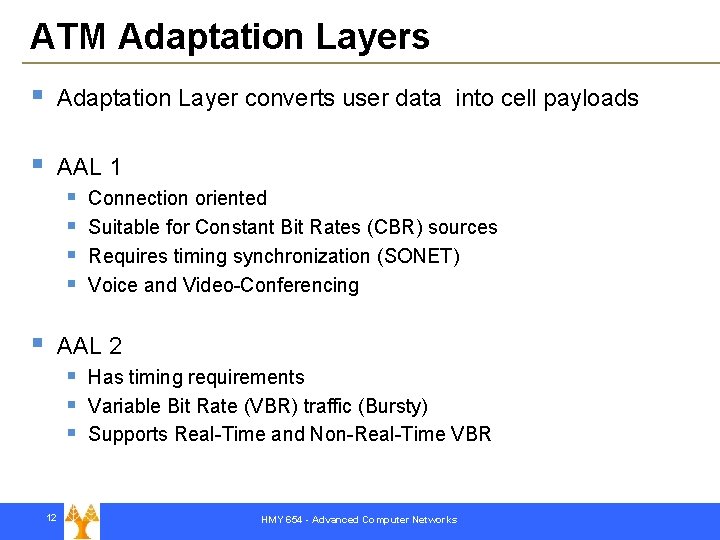
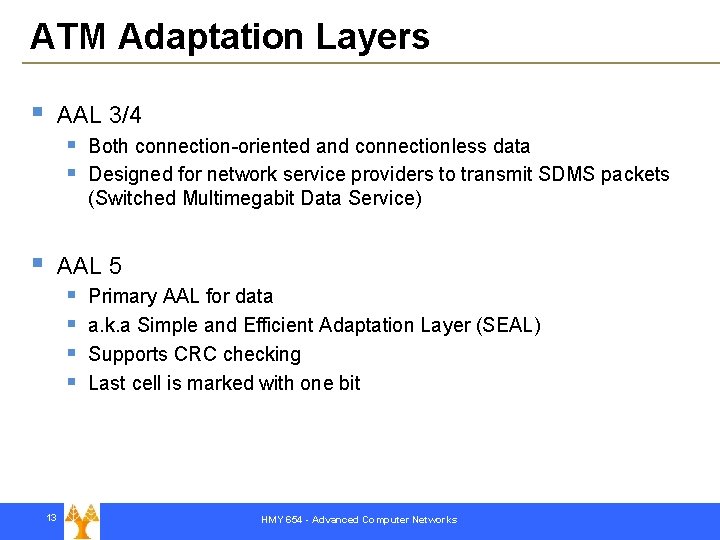
ATM Adaptation Layers § Adaptation Layer converts user data into cell payloads § AAL 1 § § § Connection oriented Suitable for Constant Bit Rates (CBR) sources Requires timing synchronization (SONET) Voice and Video-Conferencing AAL 2 § § § 12 Has timing requirements Variable Bit Rate (VBR) traffic (Bursty) Supports Real-Time and Non-Real-Time VBR HMY 654 - Advanced Computer Networks
ATM Adaptation Layers § AAL 3/4 § § § Both connection-oriented and connectionless data Designed for network service providers to transmit SDMS packets (Switched Multimegabit Data Service) AAL 5 § § 13 Primary AAL for data a. k. a Simple and Efficient Adaptation Layer (SEAL) Supports CRC checking Last cell is marked with one bit HMY 654 - Advanced Computer Networks
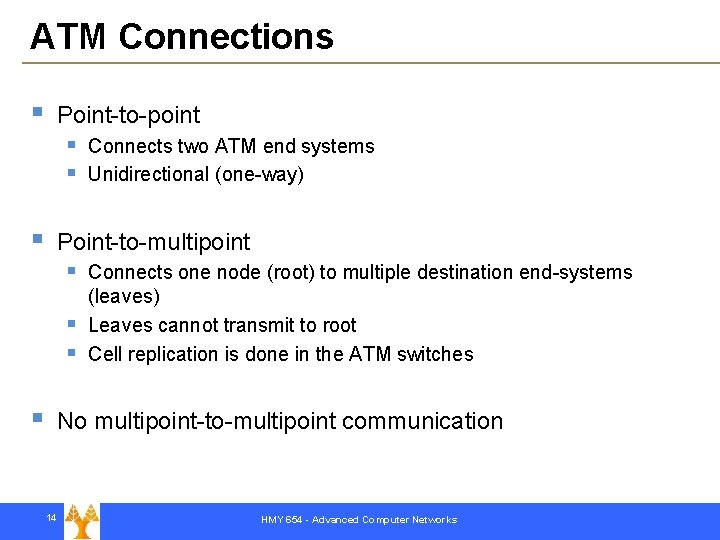
ATM Connections § Point-to-point § § § Point-to-multipoint § § Connects two ATM end systems Unidirectional (one-way) Connects one node (root) to multiple destination end-systems (leaves) Leaves cannot transmit to root Cell replication is done in the ATM switches No multipoint-to-multipoint communication 14 HMY 654 - Advanced Computer Networks
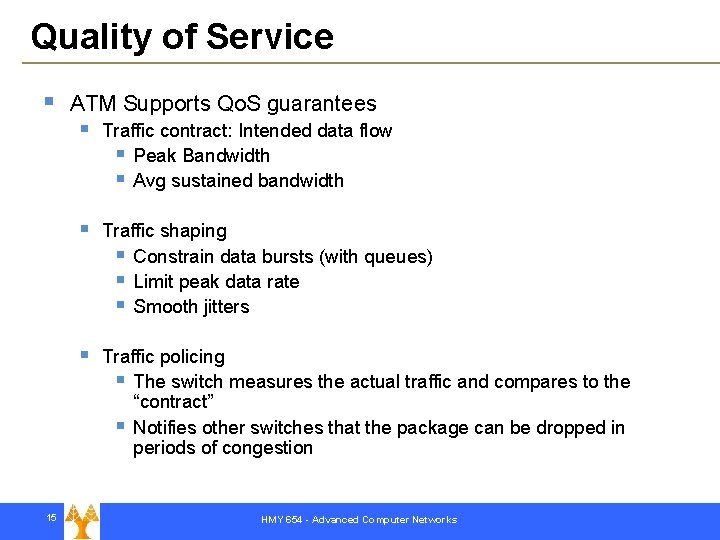
Quality of Service § 15 ATM Supports Qo. S guarantees § Traffic contract: Intended data flow § Peak Bandwidth § Avg sustained bandwidth § Traffic shaping § Constrain data bursts (with queues) § Limit peak data rate § Smooth jitters § Traffic policing § The switch measures the actual traffic and compares to the “contract” § Notifies other switches that the package can be dropped in periods of congestion HMY 654 - Advanced Computer Networks
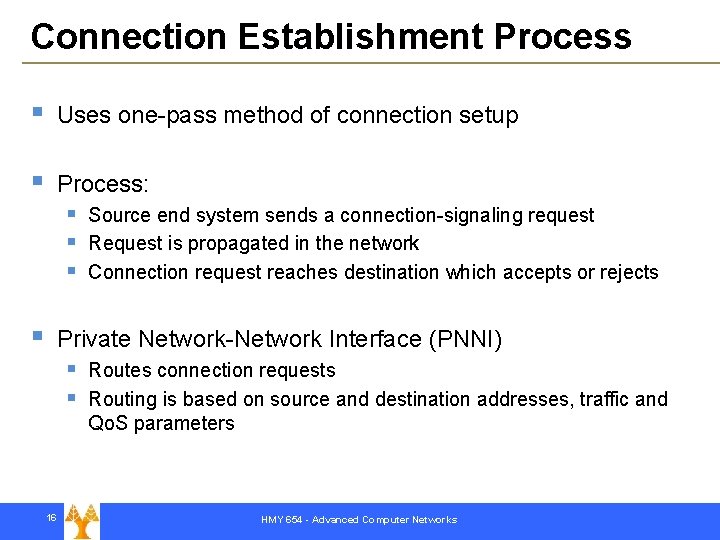
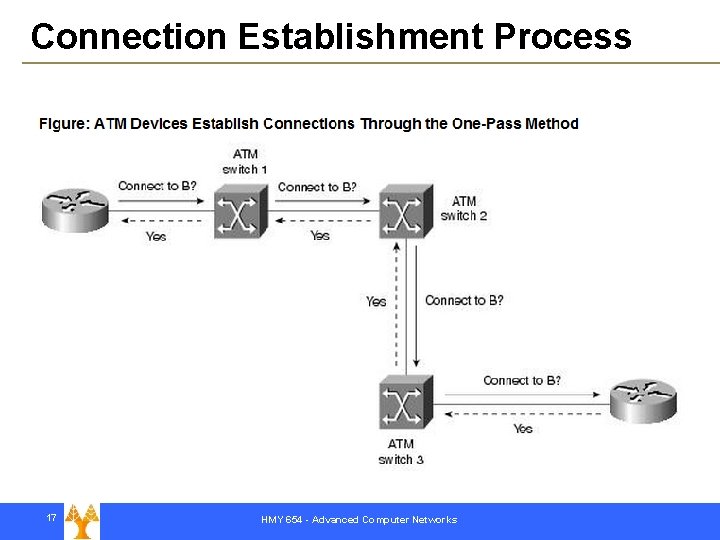
Connection Establishment Process § Uses one-pass method of connection setup § Process: § § Source end system sends a connection-signaling request Request is propagated in the network Connection request reaches destination which accepts or rejects Private Network-Network Interface (PNNI) § § 16 Routes connection requests Routing is based on source and destination addresses, traffic and Qo. S parameters HMY 654 - Advanced Computer Networks
Connection Establishment Process 17 HMY 654 - Advanced Computer Networks
Private Network-Network Interface (PNNI) § Services § § ATM topology discovery Call establishment § Enables the switches to automatically discover the topology and characteristics of the links § On significant events PNNI announces it to other switches 18 HMY 654 - Advanced Computer Networks
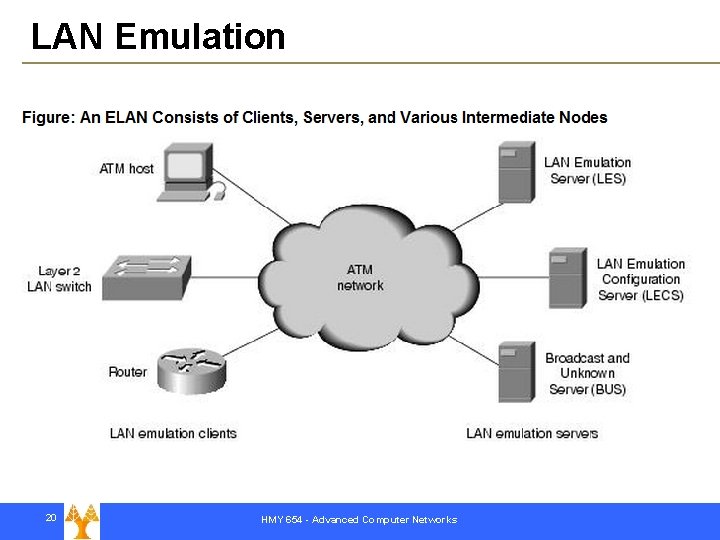
LAN Emulation § Standard defined by the ATM forum § Emulates a LAN on top of ATM network § § IEEE 802. 3 Ethernet IEEE 802. 5 Token Ring LAN Fast Ethernet (100 Base. T) and 802. 12 (100 VG-Any. LAN) can be mapped unchanged (same packet formats) Lane Components § § 19 LAN Emulation Client (LAC) LES Broadcast and Unknown Server (BUS) LAN Emulation Configuration Server (LECS) HMY 654 - Advanced Computer Networks
LAN Emulation 20 HMY 654 - Advanced Computer Networks
Thank you Questions? 21 HMY 654 - Advanced Computer Networks
References § § http: //docwiki. cisco. com/wiki/Asynchronous_Transfer_Mode _Switching Introduction to Asynchronous Transfer Mode (ATM), N. Ganesan 22 HMY 654 - Advanced Computer Networks