
Asynchronous Transfer Mode ATM ATM 1 An Overview


- Slides: 39
Asynchronous Transfer Mode (ATM) ATM - 1
An Overview of ATM v A technology for multiplexing fixed-length cells from a variety of sources to a variety of remote locations. v Capable of moving data at a wide range of speeds, but aimed at very high speed (100 -1000 Mb/s). v Capable of handling data from a variety of media (e. g. voice, video, and data) using a single interface. v ATM is a connection-oriented protocol. v Connections can be switched or permanent. v Signalling procedures are used to set up switched calls. v Certain quality of service (Qo. S) is guaranteed for each connection. Qo. S parameters may include as cell loss rate, max. /avg. cell delay, delay jitter, cell error rate, cell misinsertion rate, etc. v QOS is negotiated at connection setup. ATM - 2
An Overview of ATM v ATM operates on a best effort basis; cells with errors, or that encounter congestion, are silently dropped. v Two types of connections: point-to-point and multipoint. v Service Carried in Fixed Length Cells (53 octets). q 5 Octets Header q 48 Octets Payload ATM - 3
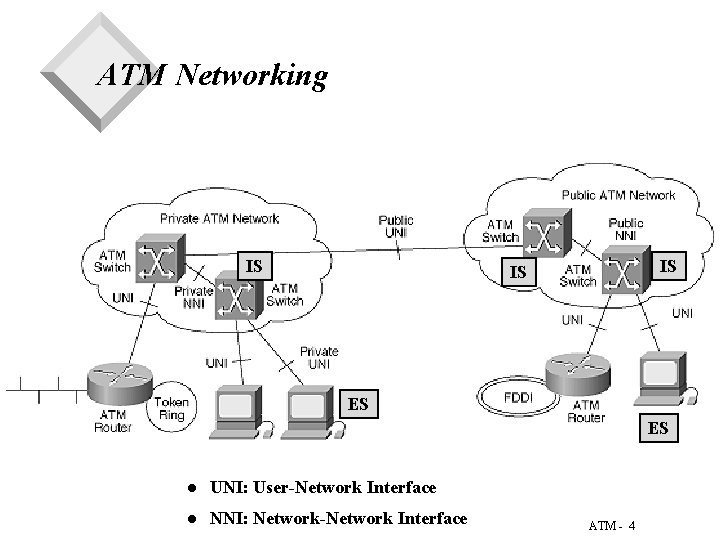
ATM Networking IS IS IS ES ES l UNI: User-Network Interface l NNI: Network-Network Interface ATM - 4
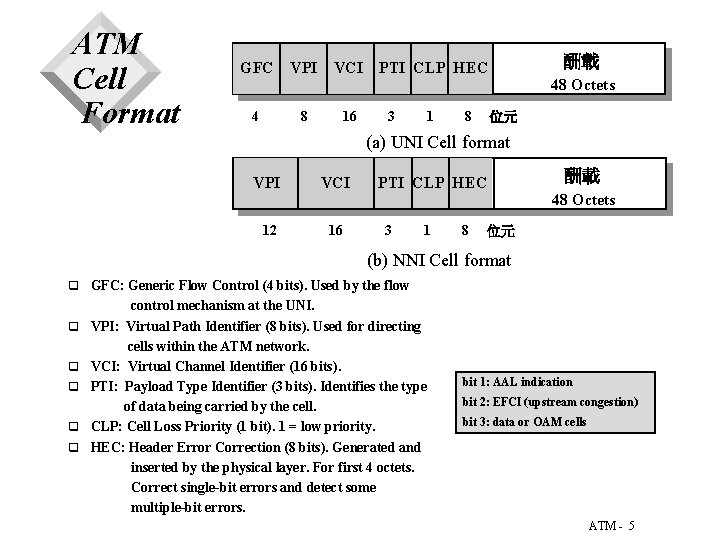
ATM Cell Format GFC VPI 4 8 VCI 16 酬載 PTI CLP HEC 3 1 8 48 Octets 位元 (a) UNI Cell format VPI VCI 12 16 PTI CLP HEC 3 1 8 酬載 48 Octets 位元 (b) NNI Cell format q GFC: Generic Flow Control (4 bits). Used by the flow q q q control mechanism at the UNI. VPI: Virtual Path Identifier (8 bits). Used for directing cells within the ATM network. VCI: Virtual Channel Identifier (16 bits). PTI: Payload Type Identifier (3 bits). Identifies the type of data being carried by the cell. CLP: Cell Loss Priority (1 bit). 1 = low priority. HEC: Header Error Correction (8 bits). Generated and inserted by the physical layer. For first 4 octets. Correct single-bit errors and detect some multiple-bit errors. bit 1: AAL indication bit 2: EFCI (upstream congestion) bit 3: data or OAM cells ATM - 5
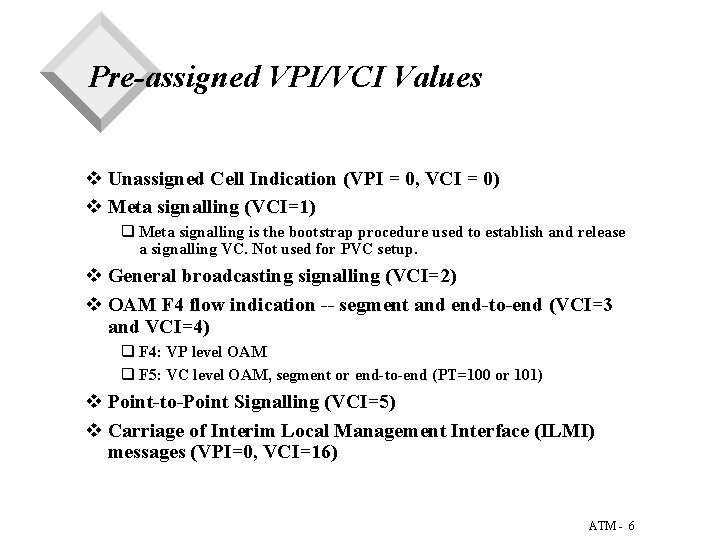
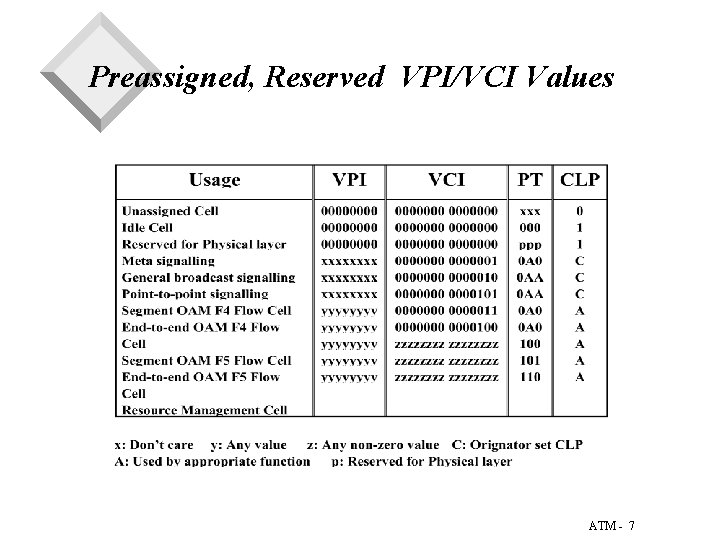
Pre-assigned VPI/VCI Values v Unassigned Cell Indication (VPI = 0, VCI = 0) v Meta signalling (VCI=1) q Meta signalling is the bootstrap procedure used to establish and release a signalling VC. Not used for PVC setup. v General broadcasting signalling (VCI=2) v OAM F 4 flow indication -- segment and end-to-end (VCI=3 and VCI=4) q F 4: VP level OAM q F 5: VC level OAM, segment or end-to-end (PT=100 or 101) v Point-to-Point Signalling (VCI=5) v Carriage of Interim Local Management Interface (ILMI) messages (VPI=0, VCI=16) ATM - 6
Preassigned, Reserved VPI/VCI Values ATM - 7
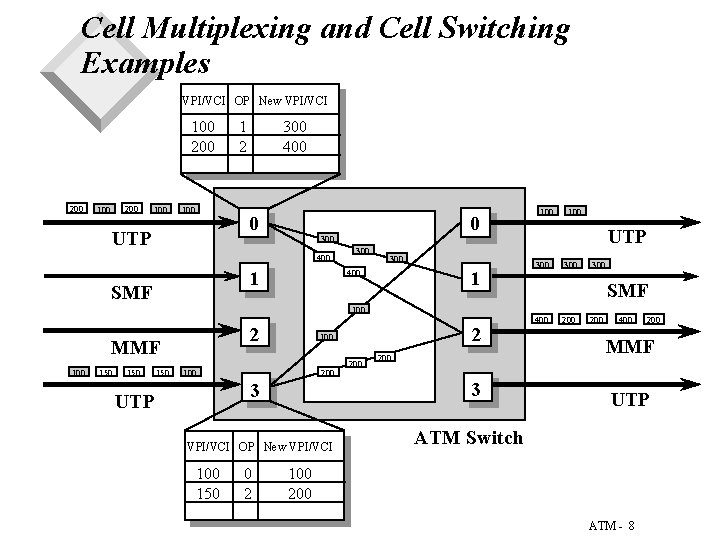
Cell Multiplexing and Cell Switching Examples VPI/VCI OP New VPI/VCI 100 200 200 100 1 2 300 400 0 UTP 400 1 SMF 0 300 300 1 400 100 2 MMF 100 150 150 100 200 VPI/VCI OP New VPI/VCI 100 150 0 2 200 3 3 UTP 2 100 100 UTP 300 300 SMF 400 200 MMF UTP ATM Switch 100 200 ATM - 8
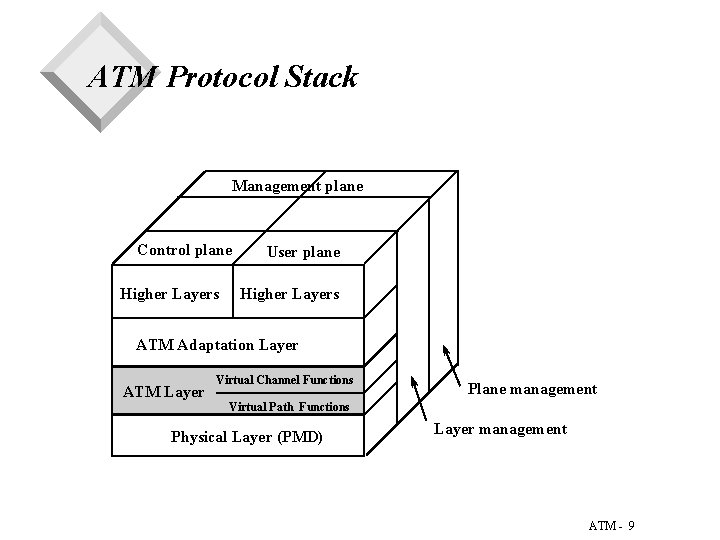
ATM Protocol Stack Management plane Control plane Higher Layers User plane Higher Layers ATM Adaptation Layer ATM Layer Virtual Channel Functions Plane management Virtual Path Functions Physical Layer (PMD) Layer management ATM - 9
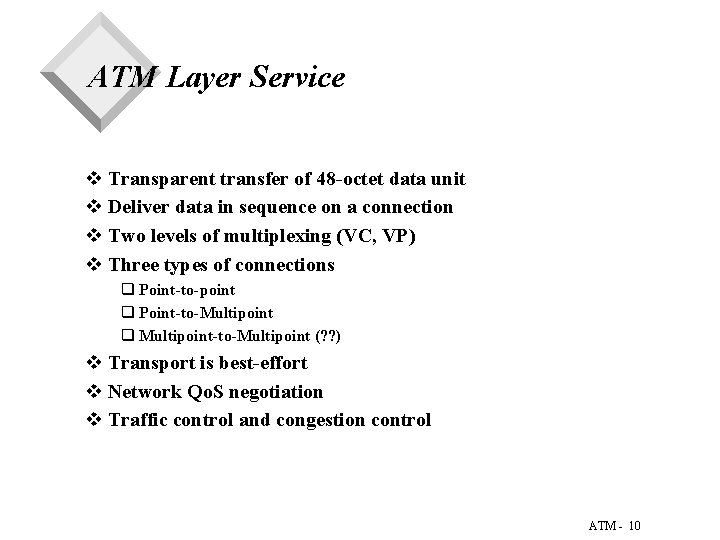
ATM Layer Service v Transparent transfer of 48 -octet data unit v Deliver data in sequence on a connection v Two levels of multiplexing (VC, VP) v Three types of connections q Point-to-point q Point-to-Multipoint q Multipoint-to-Multipoint (? ? ) v Transport is best-effort v Network Qo. S negotiation v Traffic control and congestion control ATM - 10
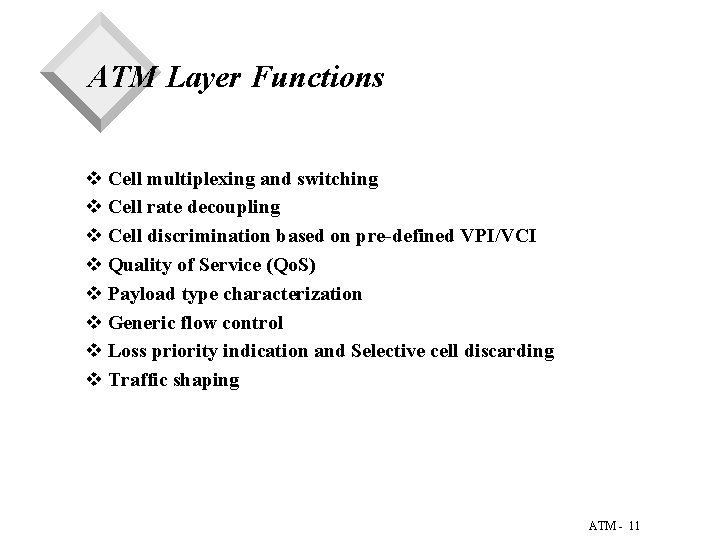
ATM Layer Functions v Cell multiplexing and switching v Cell rate decoupling v Cell discrimination based on pre-defined VPI/VCI v Quality of Service (Qo. S) v Payload type characterization v Generic flow control v Loss priority indication and Selective cell discarding v Traffic shaping ATM - 11
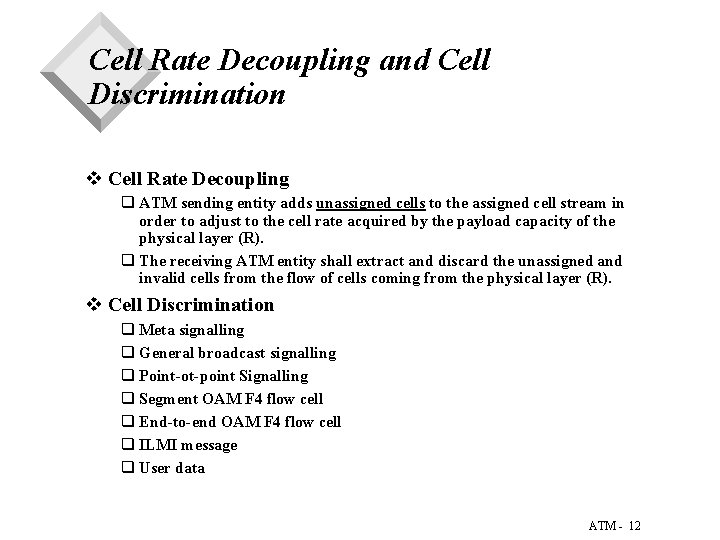
Cell Rate Decoupling and Cell Discrimination v Cell Rate Decoupling q ATM sending entity adds unassigned cells to the assigned cell stream in order to adjust to the cell rate acquired by the payload capacity of the physical layer (R). q The receiving ATM entity shall extract and discard the unassigned and invalid cells from the flow of cells coming from the physical layer (R). v Cell Discrimination q Meta signalling q General broadcast signalling q Point-ot-point Signalling q Segment OAM F 4 flow cell q End-to-end OAM F 4 flow cell q ILMI message q User data ATM - 12
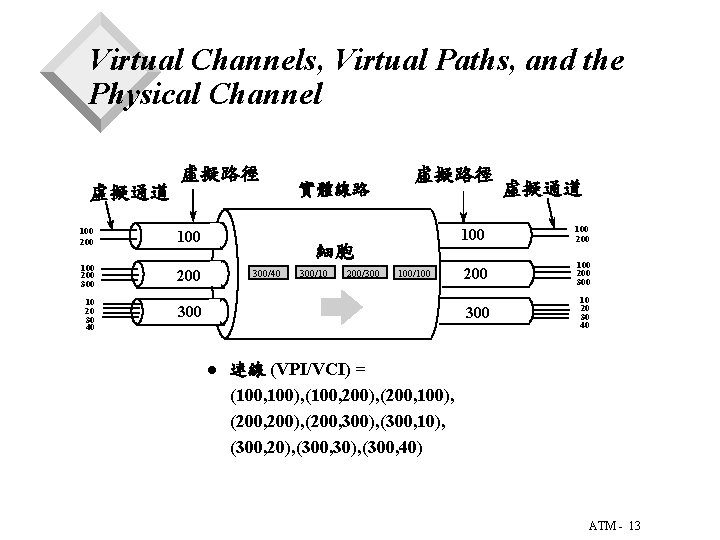
Virtual Channels, Virtual Paths, and the Physical Channel 虛擬通道 虛擬路徑 100 200 300 200 10 20 30 40 實體線路 虛擬路徑 100 細胞 300/40 300/10 200/300 100/100 300 l 虛擬通道 100 200 300 10 20 30 40 連線 (VPI/VCI) = (100, 100), (100, 200), (200, 100), (200, 200), (200, 300), (300, 10), (300, 20), (300, 30), (300, 40) ATM - 13
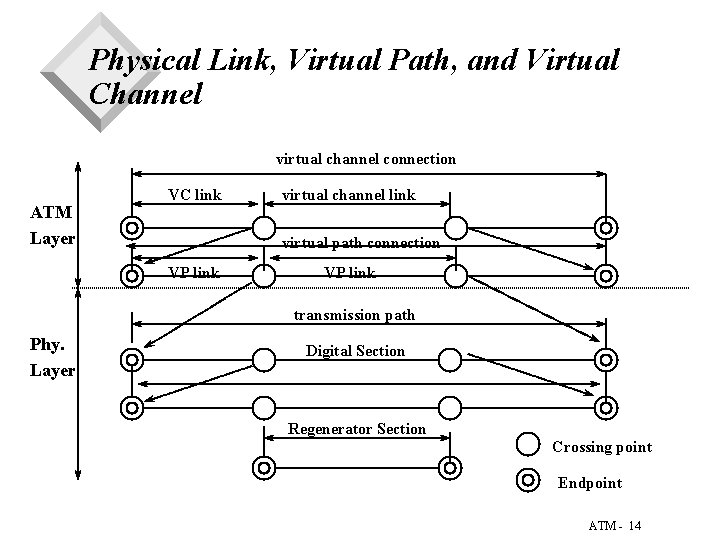
Physical Link, Virtual Path, and Virtual Channel virtual channel connection ATM Layer VC link virtual channel link virtual path connection VP link transmission path Phy. Layer Digital Section Regenerator Section Crossing point Endpoint ATM - 14
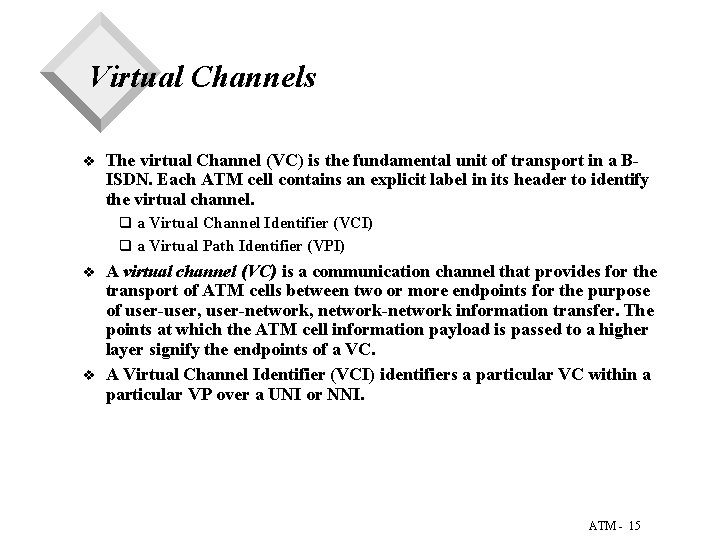
Virtual Channels v The virtual Channel (VC) is the fundamental unit of transport in a BISDN. Each ATM cell contains an explicit label in its header to identify the virtual channel. q a Virtual Channel Identifier (VCI) q a Virtual Path Identifier (VPI) v v A virtual channel (VC) is a communication channel that provides for the transport of ATM cells between two or more endpoints for the purpose of user-user, user-network, network-network information transfer. The points at which the ATM cell information payload is passed to a higher layer signify the endpoints of a VC. A Virtual Channel Identifier (VCI) identifiers a particular VC within a particular VP over a UNI or NNI. ATM - 15
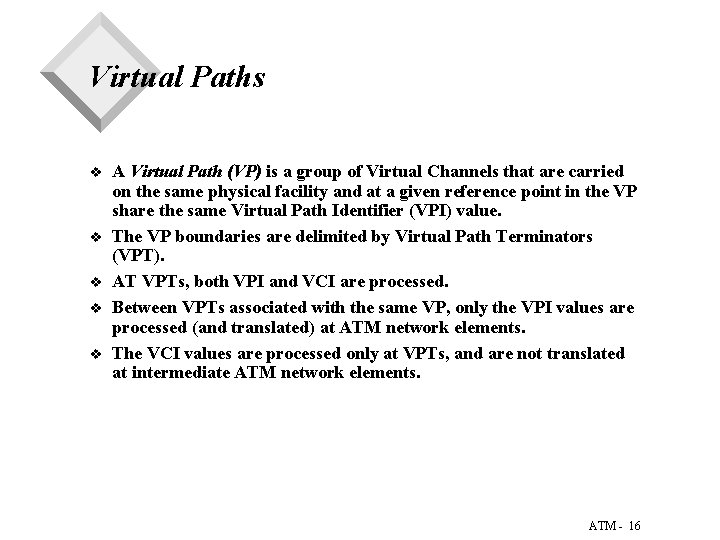
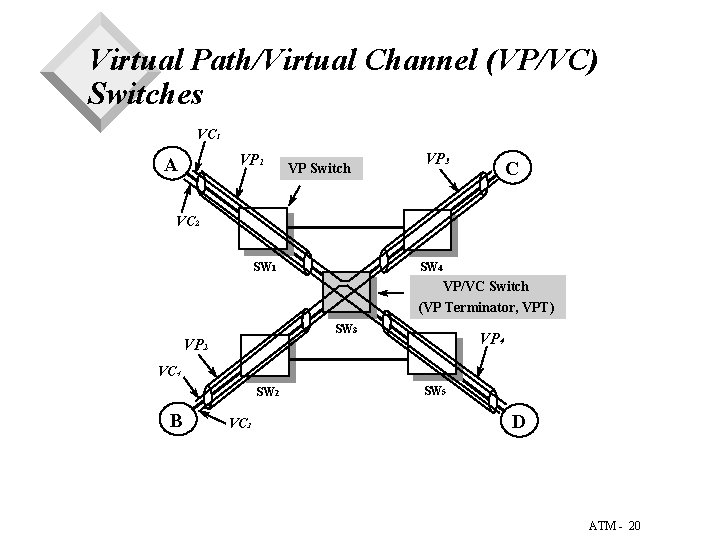
Virtual Paths v v v A Virtual Path (VP) is a group of Virtual Channels that are carried on the same physical facility and at a given reference point in the VP share the same Virtual Path Identifier (VPI) value. The VP boundaries are delimited by Virtual Path Terminators (VPT). AT VPTs, both VPI and VCI are processed. Between VPTs associated with the same VP, only the VPI values are processed (and translated) at ATM network elements. The VCI values are processed only at VPTs, and are not translated at intermediate ATM network elements. ATM - 16
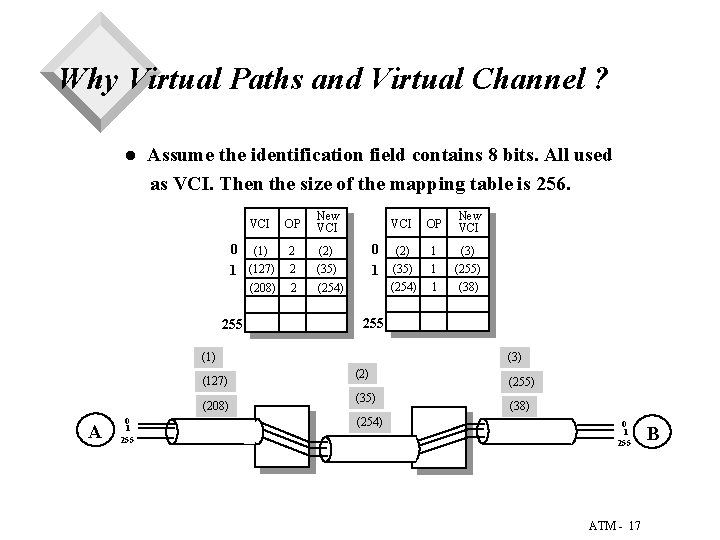
Why Virtual Paths and Virtual Channel ? l Assume the identification field contains 8 bits. All used as VCI. Then the size of the mapping table is 256. OP New VCI 0 (1) 1 (127) 2 2 (2) (35) (208) 2 (254) VCI 255 0 1 (208) A 0 1 255 OP New VCI (2) (35) 1 1 (3) (255) (254) 1 (38) 255 (1) (127) VCI (3) (2) (35) (254) (255) (38) 0 1 255 ATM - 17 B
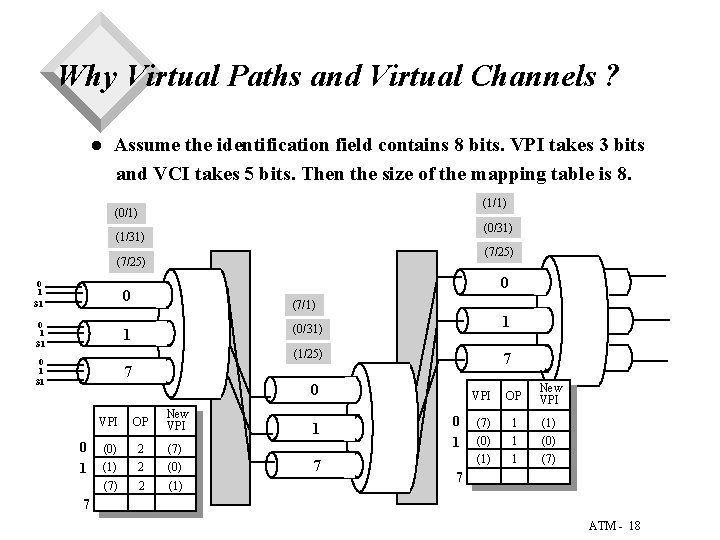
Why Virtual Paths and Virtual Channels ? l Assume the identification field contains 8 bits. VPI takes 3 bits and VCI takes 5 bits. Then the size of the mapping table is 8. (1/1) (0/31) (1/31) (7/25) 0 1 31 0 0 0 1 31 (7/1) 1 (0/31) 1 (1/25) 0 1 31 7 7 0 0 1 VPI OP New VPI 1 (0) (1) 2 2 (7) (0) 7 (7) 2 (1) 0 1 VPI OP New VPI (7) (0) 1 1 (1) (0) (1) 1 (7) 7 7 ATM - 18
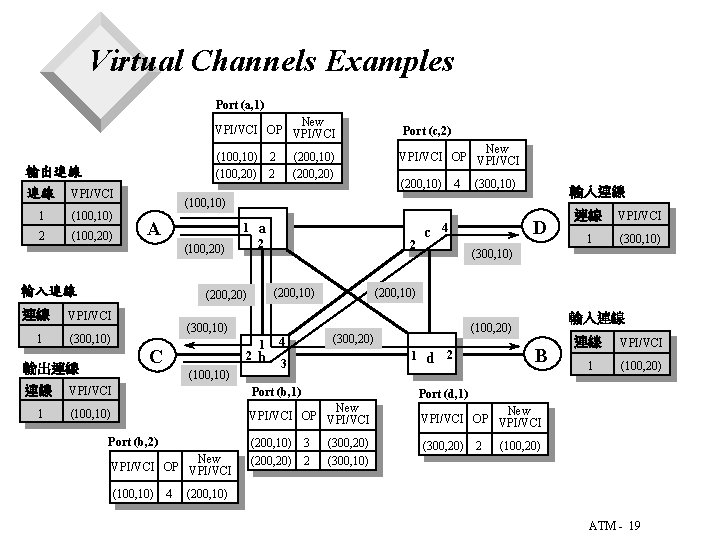
Virtual Channels Examples Port (a, 1) New VPI/VCI OP VPI/VCI (100, 10) 2 (100, 20) 2 輸出連線 連線 VPI/VCI 1 (100, 10) 2 (100, 20) 1 A 2 (100, 20) VPI/VCI 2 4 (300, 10) 輸入連線 2 (100, 10) 1 b 4 c D 4 (300, 20) 1 3 d B 2 Port (b, 1) Port (d, 1) 1 (100, 10) New VPI/VCI OP VPI/VCI (200, 10) 3 (200, 20) 2 (300, 20) (100, 10) 4 1 (300, 10) 輸入連線 (100, 20) VPI/VCI New VPI/VCI OP VPI/VCI (300, 10) 連線 Port (b, 2) 連線 (200, 10) (300, 10) C 輸出連線 (200, 10) a 1 (200, 20) (300, 10) New VPI/VCI OP VPI/VCI (100, 10) 輸入連線 連線 (200, 10) (200, 20) Port (c, 2) (300, 20) (300, 10) 2 連線 VPI/VCI 1 (100, 20) (200, 10) ATM - 19
Virtual Path/Virtual Channel (VP/VC) Switches VC 1 VP 1 A VP Switch VP 3 C VC 2 SW 1 SW 4 VP/VC Switch (VP Terminator, VPT) SW 3 VP 2 VP 4 VC 4 SW 2 B VC 3 SW 5 D ATM - 20
ATM Adaptation Layers (AAL) v AAL Reference Structure v AAL Type 1 Management plane v AAL Type 2 v AAL Type 3/4 User plane v AAL Type 5 Control plane v SAAL Higher Layers ATM Adaptation Layer ATM Layer Plane management Virtual Channel Functions Virtual Path Functions Physical Layer (PMD) Layer management ATM - 21
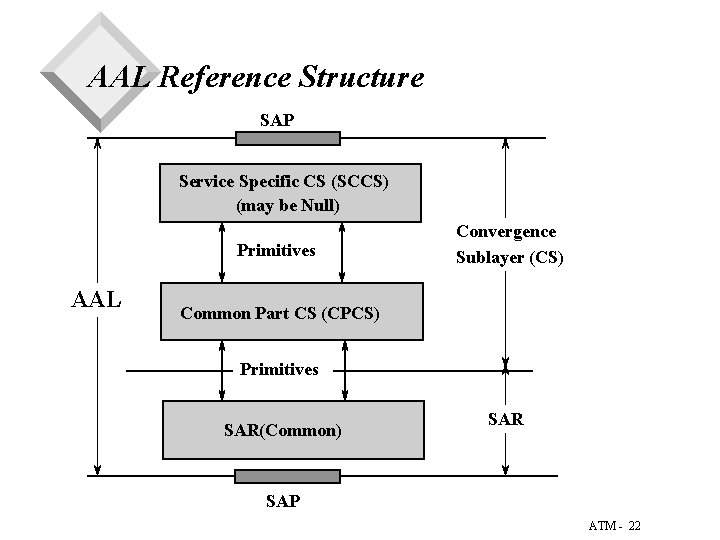
AAL Reference Structure SAP Service Specific CS (SCCS) (may be Null) Primitives AAL Convergence Sublayer (CS) Common Part CS (CPCS) Primitives SAR(Common) SAR SAP ATM - 22
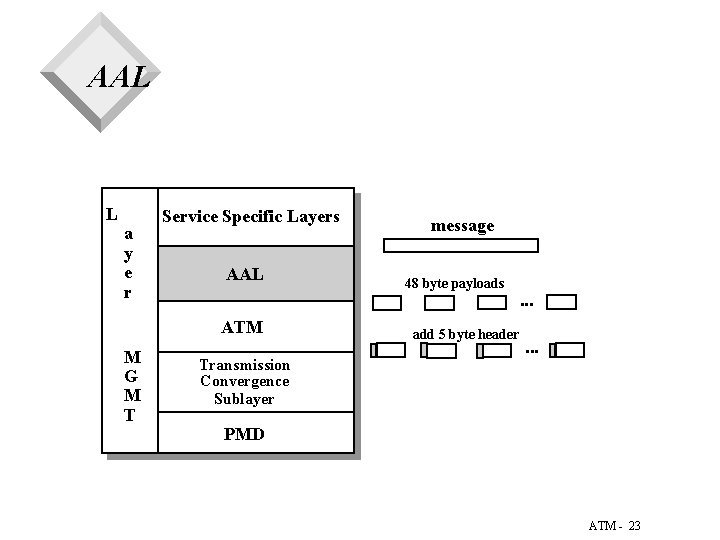
AAL L a y e r Service Specific Layers AAL ATM M G M T Transmission Convergence Sublayer message 48 byte payloads add 5 byte header . . . PMD ATM - 23
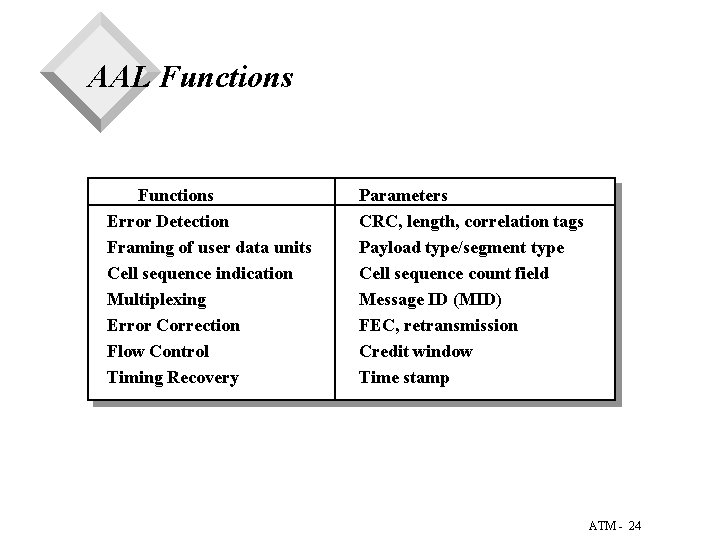
AAL Functions Error Detection Framing of user data units Cell sequence indication Multiplexing Error Correction Flow Control Timing Recovery Parameters CRC, length, correlation tags Payload type/segment type Cell sequence count field Message ID (MID) FEC, retransmission Credit window Time stamp ATM - 24
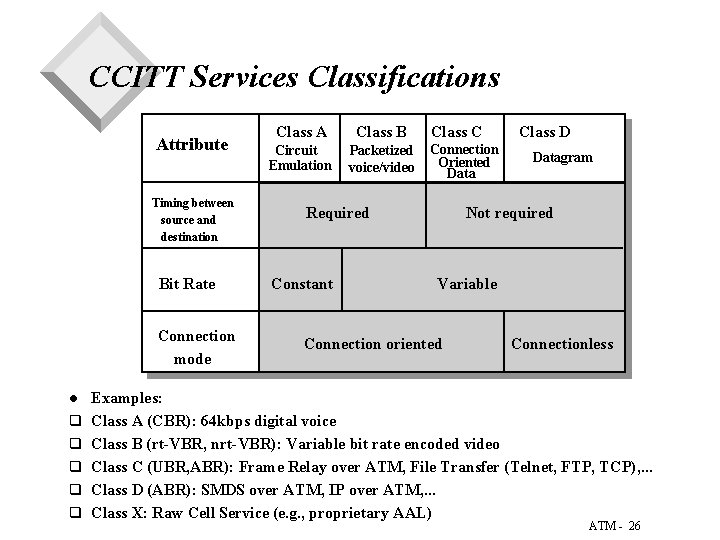
ATM Adaptation Layers (AAL) v In order to carry data units longer than 48 octets in ATM cells, an adaptation layer is needed. v The ATM adaptation layer (AAL) provides for segmentation and reassembly of higher-layer data units and for detection of errors in transmission. v Since the ATM layer simply carries cells without concern for their contents, a number of different AALs can be used across a single ATM interface. v The AAL maps the user, control, or management protocol data units into the information field of the ATM cell and vice versa. v To reflect the spectrum of applications, four service classes have been defined by CCITT. ATM - 25
CCITT Services Classifications Attribute Timing between source and destination Bit Rate Connection mode l q q q Class A Class B Circuit Emulation Packetized voice/video Class C Connection Oriented Data Required Constant Class D Datagram Not required Variable Connection oriented Connectionless Examples: Class A (CBR): 64 kbps digital voice Class B (rt-VBR, nrt-VBR): Variable bit rate encoded video Class C (UBR, ABR): Frame Relay over ATM, File Transfer (Telnet, FTP, TCP), . . . Class D (ABR): SMDS over ATM, IP over ATM, . . . Class X: Raw Cell Service (e. g. , proprietary AAL) ATM - 26
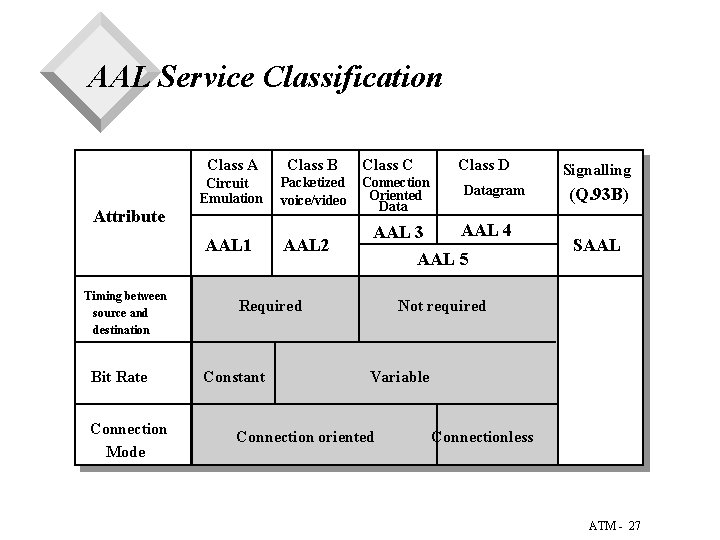
AAL Service Classification Attribute Class A Class B Circuit Emulation Packetized voice/video AAL 1 Timing between source and destination Bit Rate Connection Mode AAL 2 Class C Connection Oriented Data AAL 3 Datagram AAL 4 AAL 5 Required Constant Class D Signalling (Q. 93 B) SAAL Not required Variable Connection oriented Connectionless ATM - 27
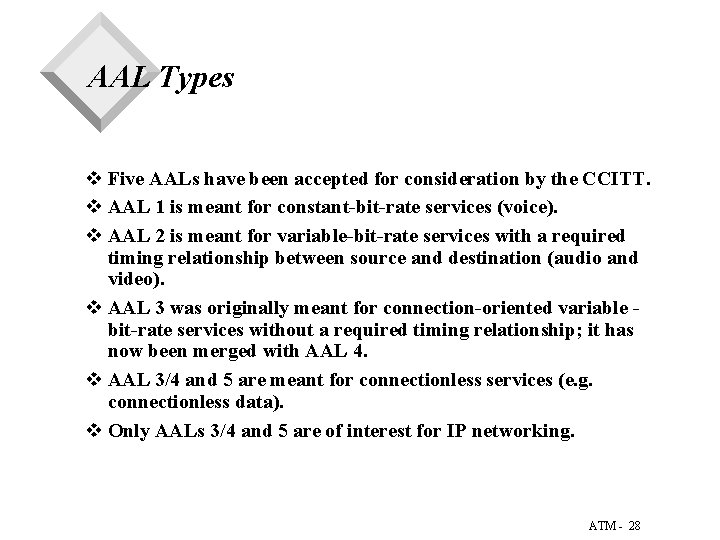
AAL Types v Five AALs have been accepted for consideration by the CCITT. v AAL 1 is meant for constant-bit-rate services (voice). v AAL 2 is meant for variable-bit-rate services with a required timing relationship between source and destination (audio and video). v AAL 3 was originally meant for connection-oriented variable bit-rate services without a required timing relationship; it has now been merged with AAL 4. v AAL 3/4 and 5 are meant for connectionless services (e. g. connectionless data). v Only AALs 3/4 and 5 are of interest for IP networking. ATM - 28
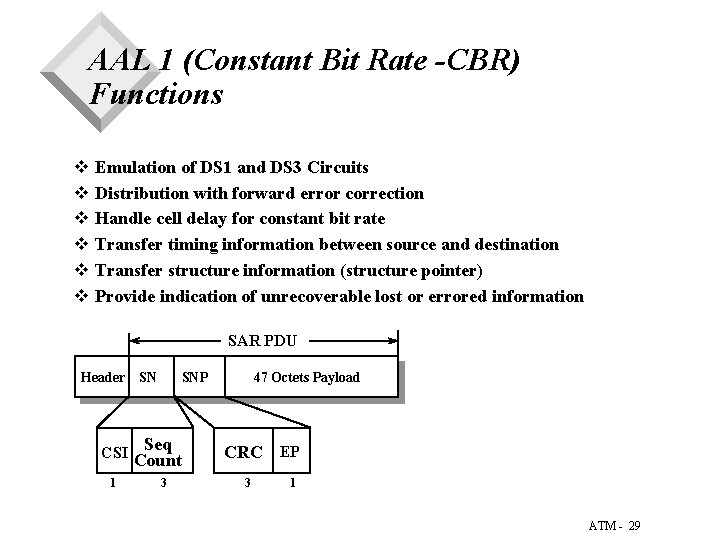
AAL 1 (Constant Bit Rate -CBR) Functions v v v Emulation of DS 1 and DS 3 Circuits Distribution with forward error correction Handle cell delay for constant bit rate Transfer timing information between source and destination Transfer structure information (structure pointer) Provide indication of unrecoverable lost or errored information SAR PDU Header CSI 1 SN SNP Seq Count 3 47 Octets Payload CRC EP 3 1 ATM - 29
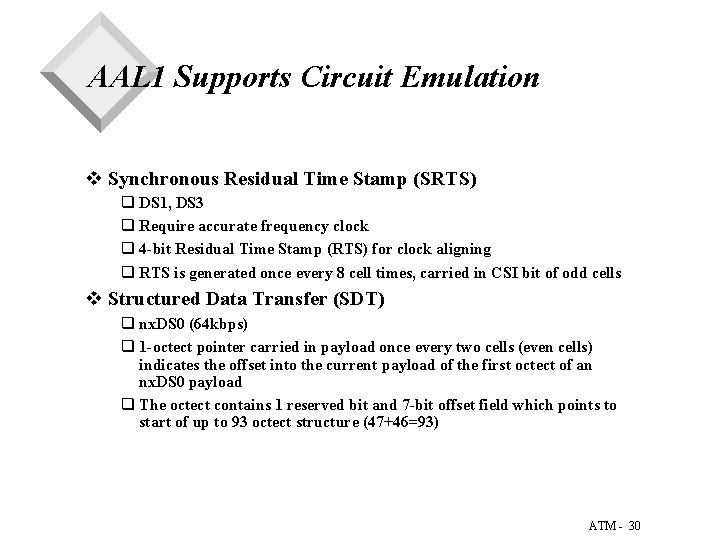
AAL 1 Supports Circuit Emulation v Synchronous Residual Time Stamp (SRTS) q DS 1, DS 3 q Require accurate frequency clock q 4 -bit Residual Time Stamp (RTS) for clock aligning q RTS is generated once every 8 cell times, carried in CSI bit of odd cells v Structured Data Transfer (SDT) q nx. DS 0 (64 kbps) q 1 -octect pointer carried in payload once every two cells (even cells) indicates the offset into the current payload of the first octect of an nx. DS 0 payload q The octect contains 1 reserved bit and 7 -bit offset field which points to start of up to 93 octect structure (47+46=93) ATM - 30
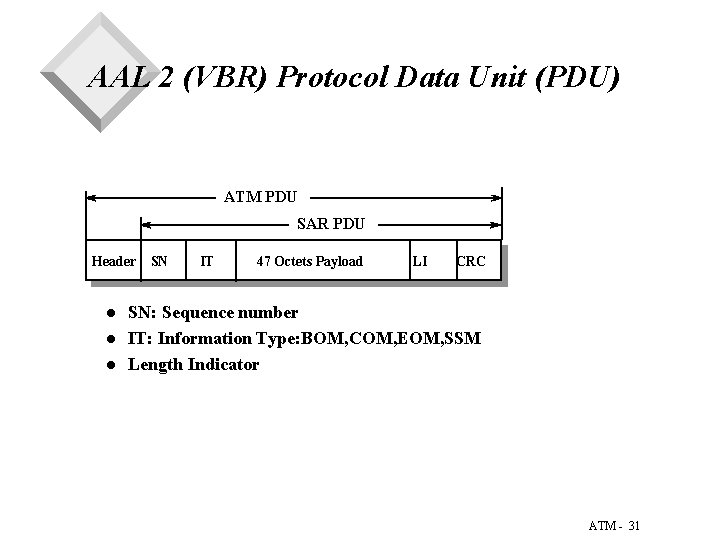
AAL 2 (VBR) Protocol Data Unit (PDU) ATM PDU SAR PDU Header l l l SN IT 47 Octets Payload LI CRC SN: Sequence number IT: Information Type: BOM, COM, EOM, SSM Length Indicator ATM - 31
AAL 3/4 v The variable bit rate (VBR) adaptation layer, defined in CCITT recommendation I. 363, is defined for services (e. g. data) that require bursty bandwidth. v Comprises two sublayers: q the convergence sublayer (CS) q the segmentation and reassembly sublayer (SAR) ATM - 32
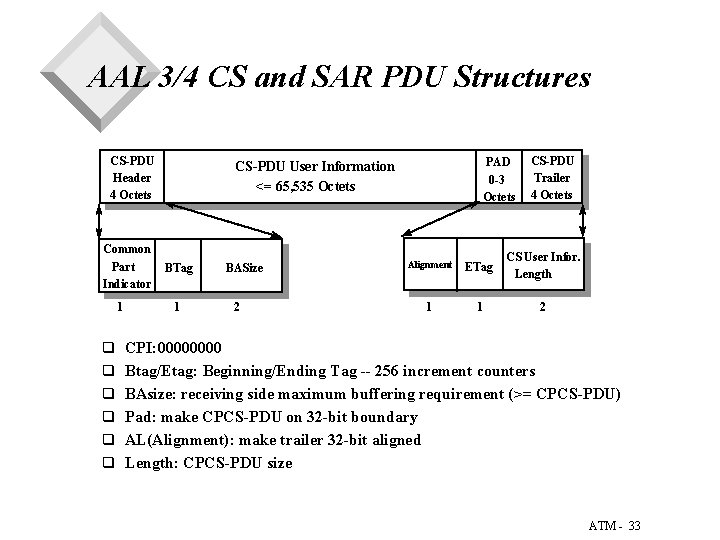
AAL 3/4 CS and SAR PDU Structures CS-PDU Header 4 Octets Common Part Indicator 1 PAD 0 -3 Octets CS-PDU User Information <= 65, 535 Octets BTag 1 BASize CS-PDU Trailer 4 Octets Alignment ETag CS User Infor. Length 1 1 2 2 q CPI: 0000 q Btag/Etag: Beginning/Ending Tag -- 256 increment counters q BAsize: receiving side maximum buffering requirement (>= CPCS-PDU) q Pad: make CPCS-PDU on 32 -bit boundary q AL(Alignment): make trailer 32 -bit aligned q Length: CPCS-PDU size ATM - 33
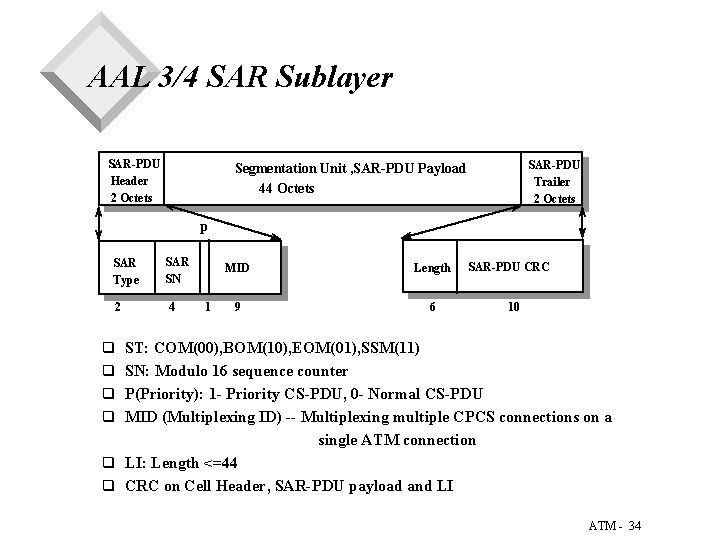
AAL 3/4 SAR Sublayer SAR-PDU Header 2 Octets SAR-PDU Trailer 2 Octets Segmentation Unit , SAR-PDU Payload 44 Octets p SAR Type SAR SN 2 4 1 MID Length 9 6 SAR-PDU CRC 10 q ST: COM(00), BOM(10), EOM(01), SSM(11) q SN: Modulo 16 sequence counter q P(Priority): 1 - Priority CS-PDU, 0 - Normal CS-PDU q MID (Multiplexing ID) -- Multiplexing multiple CPCS connections on a single ATM connection q LI: Length <=44 q CRC on Cell Header, SAR-PDU payload and LI ATM - 34
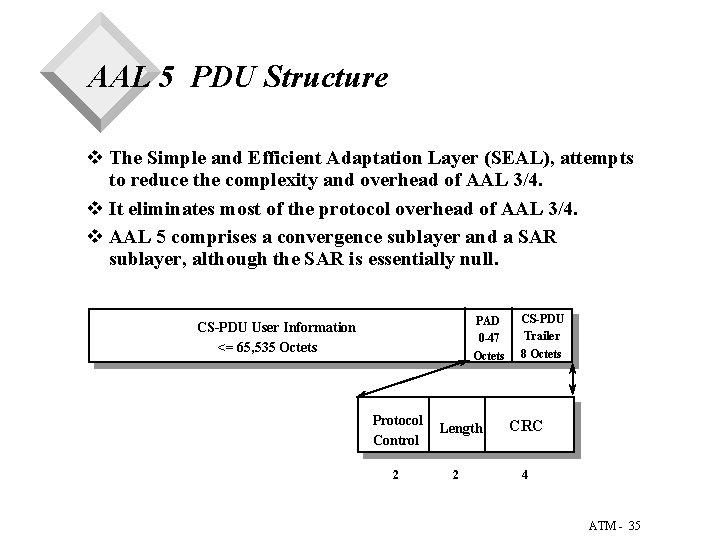
AAL 5 PDU Structure v The Simple and Efficient Adaptation Layer (SEAL), attempts to reduce the complexity and overhead of AAL 3/4. v It eliminates most of the protocol overhead of AAL 3/4. v AAL 5 comprises a convergence sublayer and a SAR sublayer, although the SAR is essentially null. PAD 0 -47 Octets CS-PDU User Information <= 65, 535 Octets Protocol Control 2 Length 2 CS-PDU Trailer 8 Octets CRC 4 ATM - 35
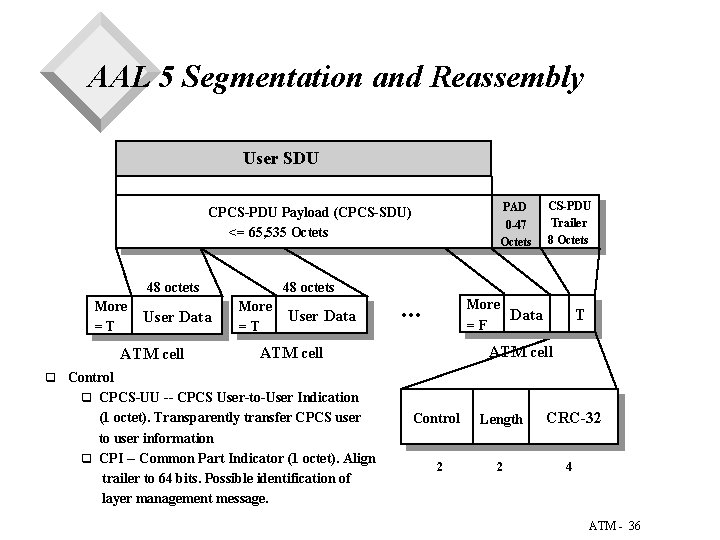
AAL 5 Segmentation and Reassembly User SDU PAD 0 -47 Octets CPCS-PDU Payload (CPCS-SDU) <= 65, 535 Octets 48 octets More =T User Data ATM cell More =T User Data . . . CS-PDU Trailer 8 Octets More Data =F T ATM cell q Control q CPCS-UU -- CPCS User-to-User Indication (1 octet). Transparently transfer CPCS user to user information q CPI -- Common Part Indicator (1 octet). Align trailer to 64 bits. Possible identification of layer management message. Control Length 2 2 CRC-32 4 ATM - 36
AAL 5 v When a network node has a user datagram to transmit, it first converts it to a CS-PDU by adding the pad (if necessary) and trailer. v Then it breaks the CS-PDU into 48 -octet SAR-PDUs and transmits each in an ATM cell on the same virtual channel. v Since there is no AAL 5 SAR header, an end-of-frame indication in the ATM cell header is required: SDU type of 1 (binary value 0 X 1) in the PTI field. v The receiver simply concatenates cells as they are received, watching for the end-of-frame indication. v The higher layer is responsible for ignoring PDUs with CRC errors. v Some applications may discard PDUs with errors; others may choose to use them. ATM - 37
SAAL Structure Primitives Service Specific Coordination Function (SSCF) Service Specific Convergence Sublayer Common Part Service Specific Connection Oriented Peer-to-Peer Protocol (SSCOP) Peer-to-Peer Message Common Part AAL Peer-to-Peer Protocol (CP-AAL) Peer-to-Peer Message Primitives ATM - 38
SAAL Reside between Q. 93 B and ATM Layer. v SAAL is used to provide reliable transport of Q. 93 B messages between peer Q. 93 B entities. v SAAL CP-AAL uses AAL 5 Common Part Protocol. v SSCOP can be used for any reliable service. v SSCF maps primitives from MTP 3 to the required SSCOP signals and vice versa, and v flow control v maintains link status v reports to layer management when a link is released v ATM - 39