
Asynchronous Transfer Mode ATM and Qo S CSIT



- Slides: 25
Asynchronous Transfer Mode (ATM) and Qo. S CSIT 560 by M. Hamdi 1
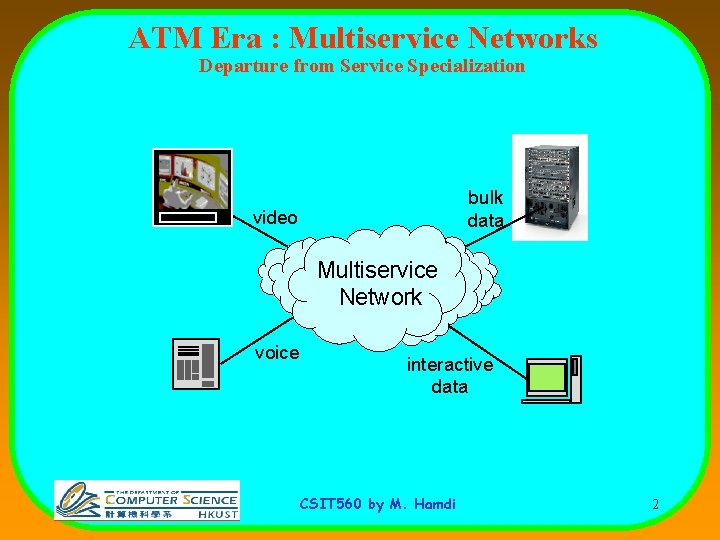
ATM Era : Multiservice Networks Departure from Service Specialization bulk data video Multiservice Network voice interactive data CSIT 560 by M. Hamdi 2
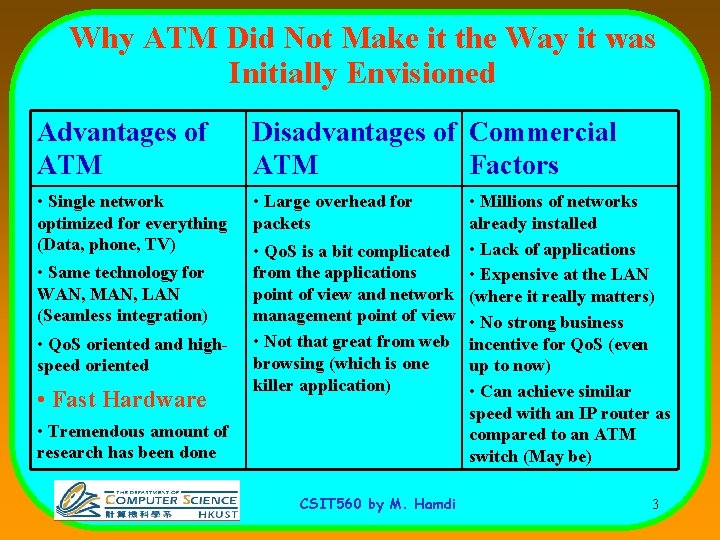
Why ATM Did Not Make it the Way it was Initially Envisioned Advantages of ATM Disadvantages of Commercial ATM Factors • Single network optimized for everything (Data, phone, TV) • Large overhead for packets • Same technology for WAN, MAN, LAN (Seamless integration) • Qo. S oriented and highspeed oriented • Fast Hardware • Tremendous amount of research has been done • Millions of networks already installed • Qo. S is a bit complicated • Lack of applications from the applications • Expensive at the LAN point of view and network (where it really matters) management point of view • No strong business • Not that great from web incentive for Qo. S (even browsing (which is one up to now) killer application) • Can achieve similar speed with an IP router as compared to an ATM switch (May be) CSIT 560 by M. Hamdi 3
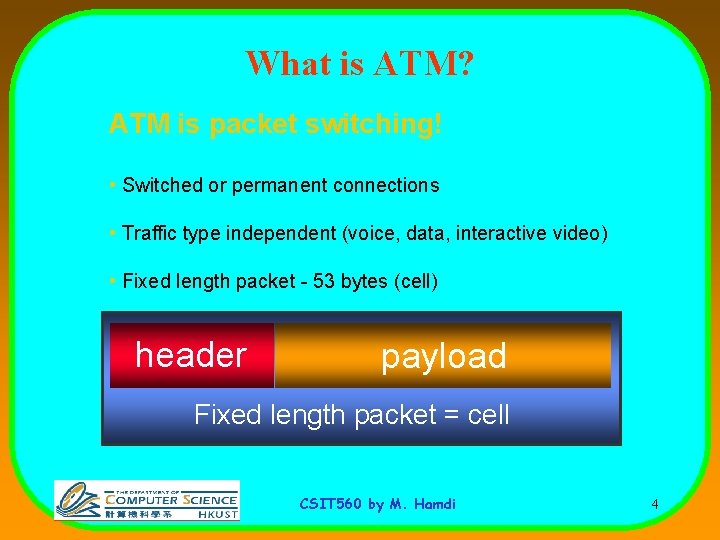
What is ATM? ATM is packet switching! • Switched or permanent connections • Traffic type independent (voice, data, interactive video) • Fixed length packet - 53 bytes (cell) header payload Fixed length packet = cell CSIT 560 by M. Hamdi 4
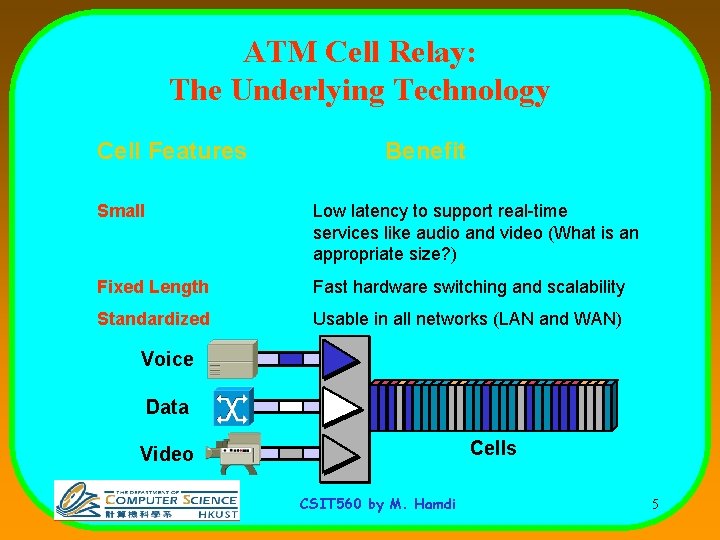
ATM Cell Relay: The Underlying Technology Cell Features Benefit Small Low latency to support real-time services like audio and video (What is an appropriate size? ) Fixed Length Fast hardware switching and scalability Standardized Usable in all networks (LAN and WAN) Voice Data Cells Video CSIT 560 by M. Hamdi 5
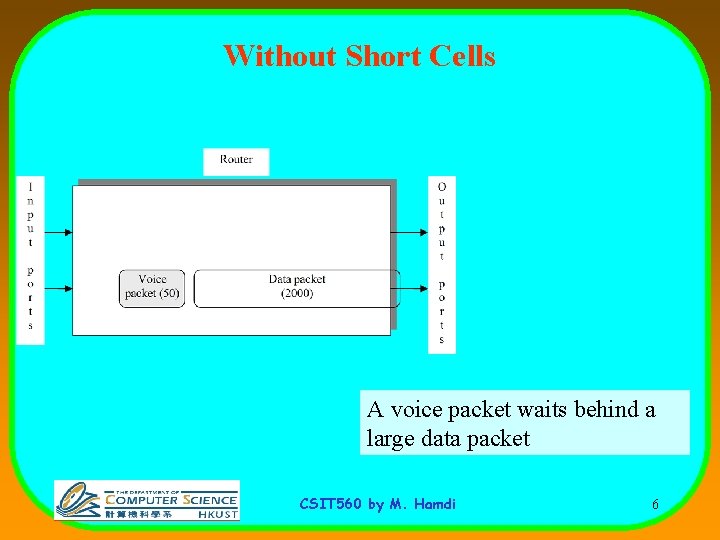
Without Short Cells A voice packet waits behind a large data packet CSIT 560 by M. Hamdi 6
With Short Cells • Voice packet can go immediately after data packet #1 • Waiting for voice is reduced significantly CSIT 560 by M. Hamdi 7
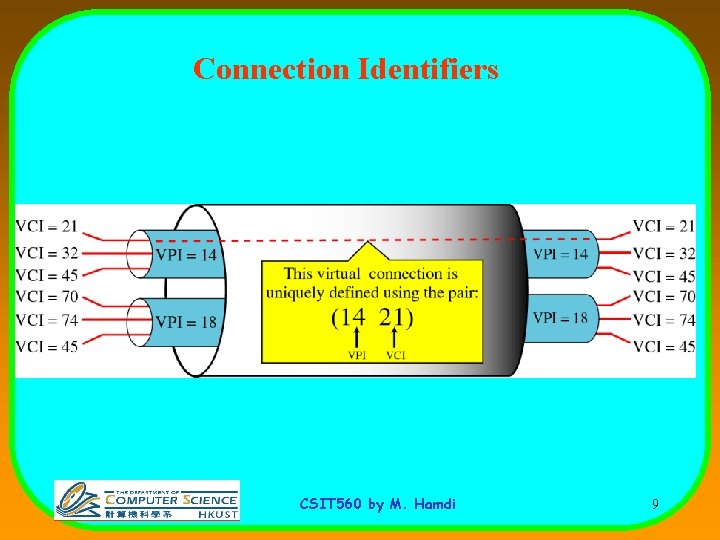
Virtual Paths & Virtual Channels A Virtual Path (VP) describes the semi-permanent route between two end points. l A Virtual Channel (VC) describes a cell transmission channel inside a virtual path l VCs VP Physical Transmission Link VP VCs • Unique on a link-by-link basis • Virtual channels are contained within virtual paths • Interpreted at each switch to: • determine output link • determine outgoing VPI/VCI • Two-level structure: • allows “trunking” of virtual channels as one virtual path • virtual path can be switched • both used to route cells through network CSIT 560 by M. Hamdi 8
Connection Identifiers CSIT 560 by M. Hamdi 9
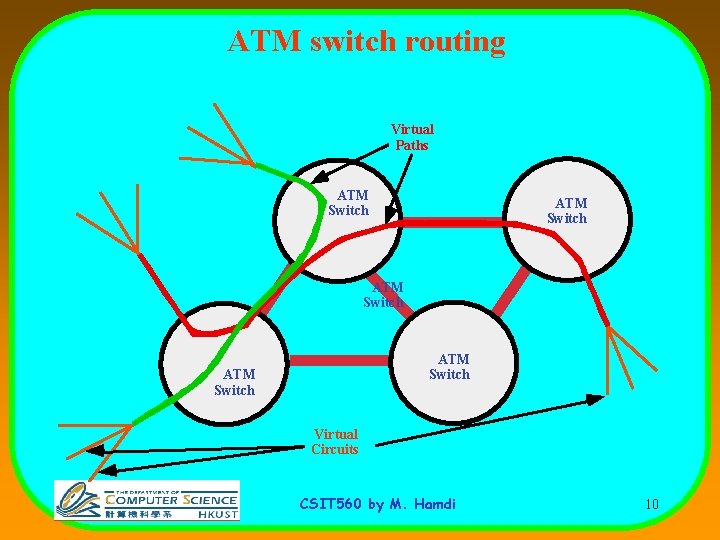
ATM switch routing Virtual Paths ATM Switch ATM Switch Virtual Circuits CSIT 560 by M. Hamdi 10
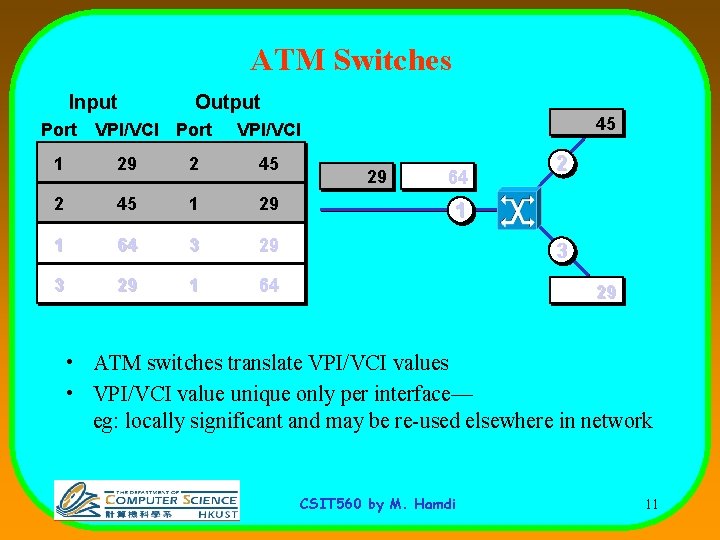
ATM Switches Input Output Port VPI/VCI Port 45 VPI/VCI 1 29 2 45 1 29 1 64 3 29 1 64 29 64 2 1 3 29 • ATM switches translate VPI/VCI values • VPI/VCI value unique only per interface— eg: locally significant and may be re-used elsewhere in network CSIT 560 by M. Hamdi 11
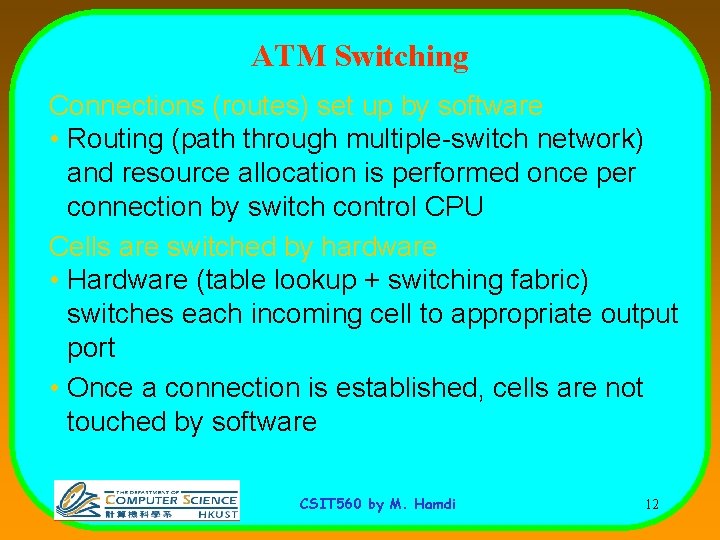
ATM Switching Connections (routes) set up by software • Routing (path through multiple-switch network) and resource allocation is performed once per connection by switch control CPU Cells are switched by hardware • Hardware (table lookup + switching fabric) switches each incoming cell to appropriate output port • Once a connection is established, cells are not touched by software CSIT 560 by M. Hamdi 12
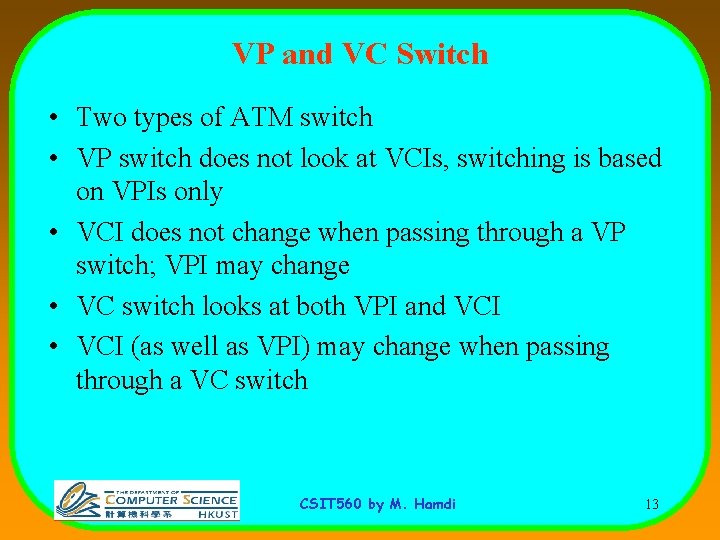
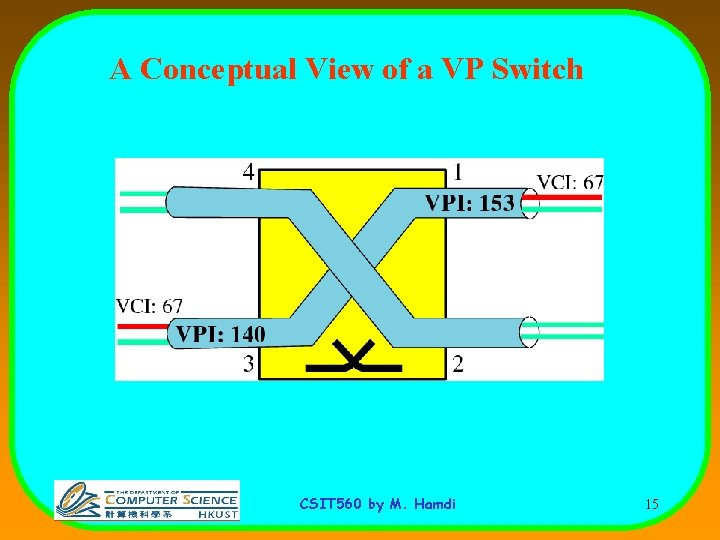
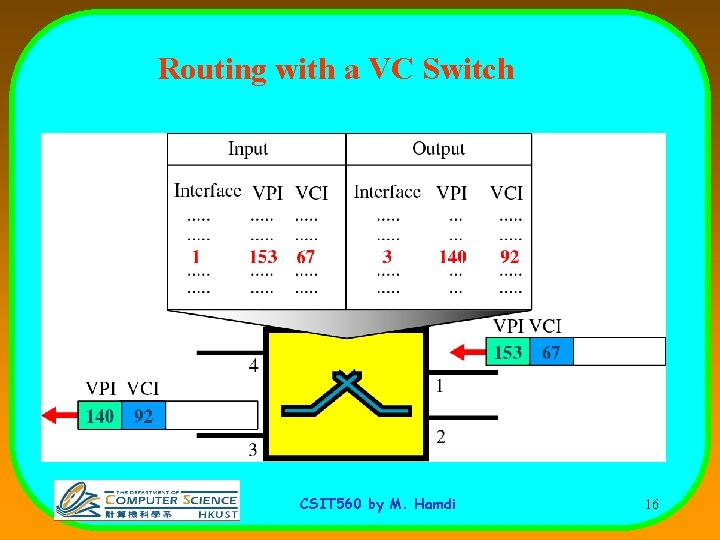
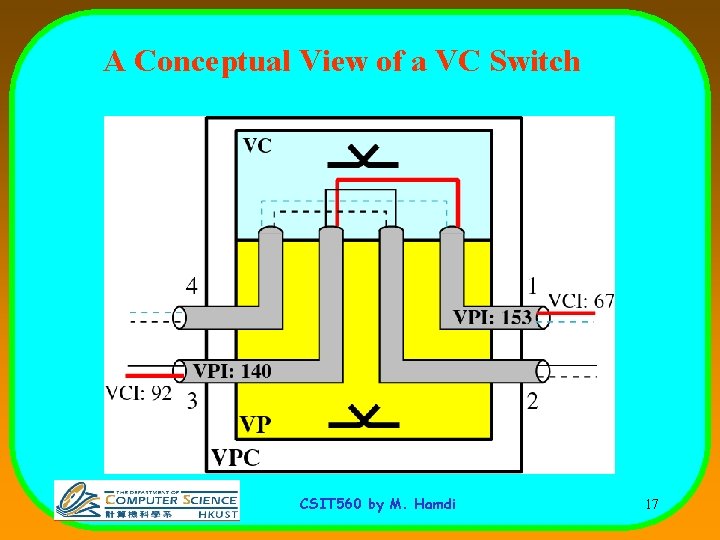
VP and VC Switch • Two types of ATM switch • VP switch does not look at VCIs, switching is based on VPIs only • VCI does not change when passing through a VP switch; VPI may change • VC switch looks at both VPI and VCI • VCI (as well as VPI) may change when passing through a VC switch CSIT 560 by M. Hamdi 13
Routing with a VP Switch CSIT 560 by M. Hamdi 14
A Conceptual View of a VP Switch CSIT 560 by M. Hamdi 15
Routing with a VC Switch CSIT 560 by M. Hamdi 16
A Conceptual View of a VC Switch CSIT 560 by M. Hamdi 17
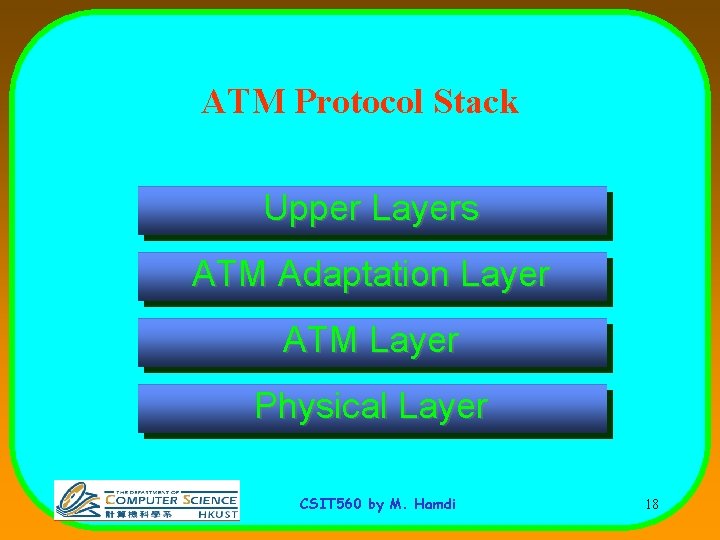
ATM Protocol Stack Upper Layers ATM Adaptation Layer ATM Layer Physical Layer CSIT 560 by M. Hamdi 18
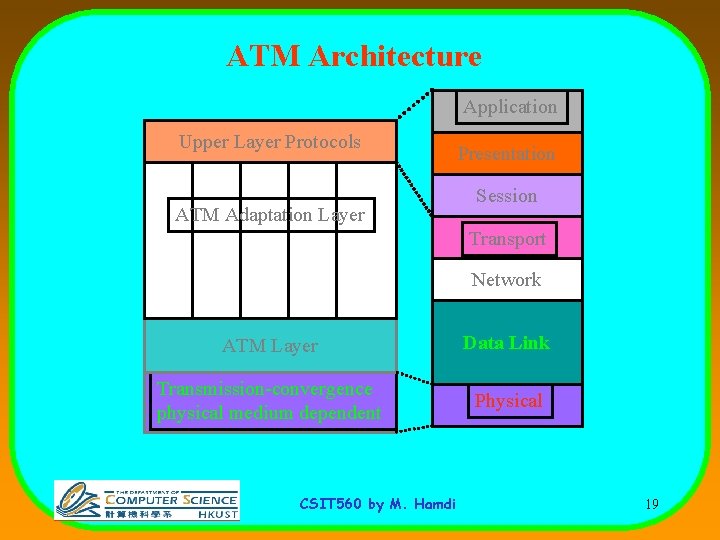
ATM Architecture Application Upper Layer Protocols ATM Adaptation Layer Presentation Session Transport Network ATM Layer Data Link Transmission-convergence physical medium dependent Physical CSIT 560 by M. Hamdi 19
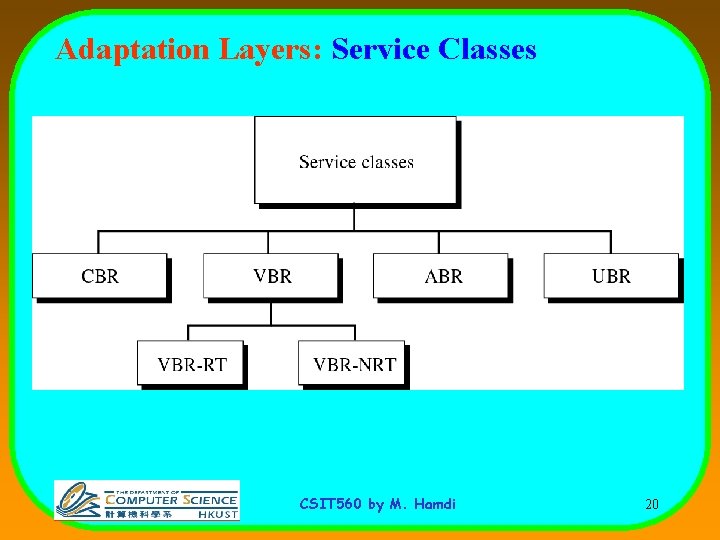
Adaptation Layers: Service Classes CSIT 560 by M. Hamdi 20
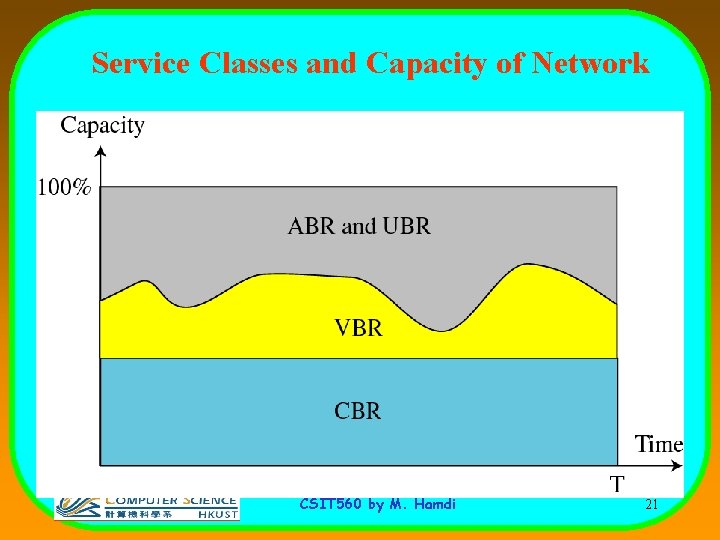
Service Classes and Capacity of Network CSIT 560 by M. Hamdi 21
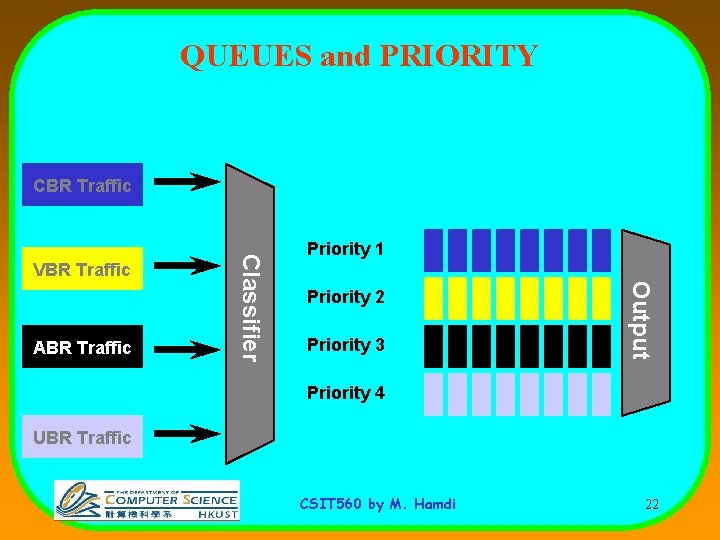
QUEUES and PRIORITY CBR Traffic Priority 2 Priority 3 Output ABR Traffic Classifier VBR Traffic Priority 1 Priority 4 UBR Traffic CSIT 560 by M. Hamdi 22
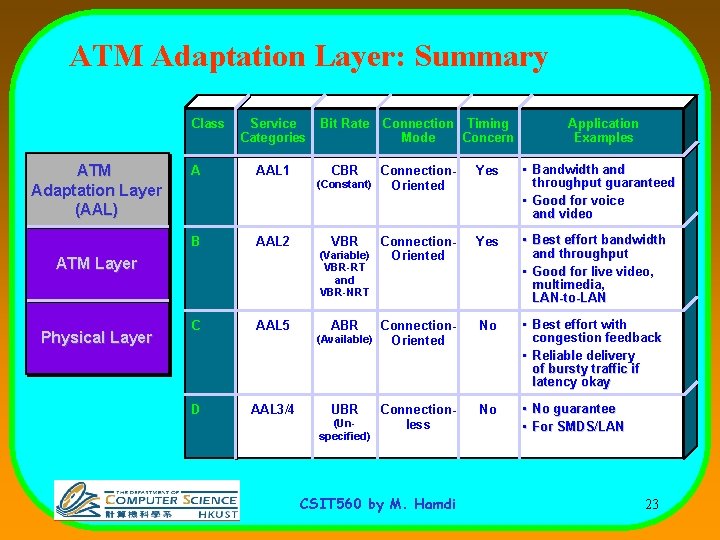
ATM Adaptation Layer: Summary Class ATM Adaptation Layer (AAL) A Service Categories AAL 1 CBR (Constant) B AAL 2 VBR (Variable) VBR-RT and VBR-NRT ATM Layer Physical Layer Bit Rate C AAL 5 ABR (Available) D AAL 3/4 UBR (Unspecified) Connection Timing Mode Concern Application Examples Connection. Oriented Yes • Bandwidth and throughput guaranteed • Good for voice and video Connection. Oriented Yes • Best effort bandwidth and throughput • Good for live video, multimedia, LAN-to-LAN Connection. Oriented No • Best effort with congestion feedback • Reliable delivery of bursty traffic if latency okay Connectionless No • No guarantee • For SMDS/LAN CSIT 560 by M. Hamdi 23
QUALITY OF SERVICE – Max CDT, Mean CTD, CDV, CLR, CER, SECBR, CMR CSIT 560 by M. Hamdi 24
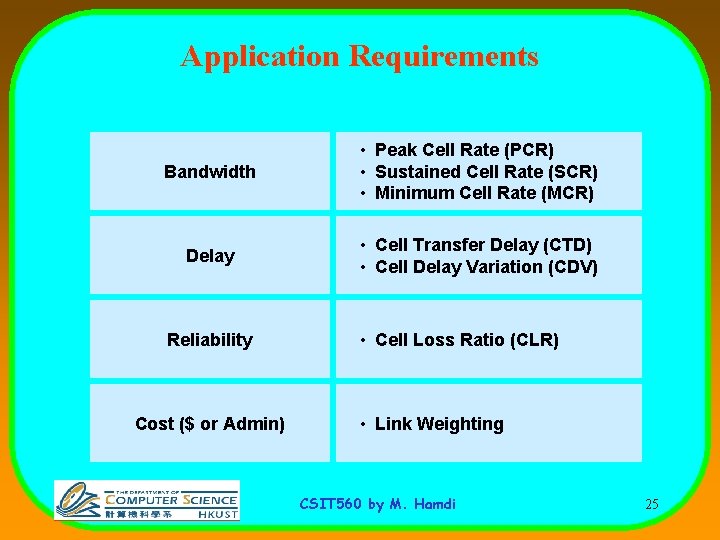
Application Requirements Bandwidth • Peak Cell Rate (PCR) • Sustained Cell Rate (SCR) • Minimum Cell Rate (MCR) Delay • Cell Transfer Delay (CTD) • Cell Delay Variation (CDV) Reliability Cost ($ or Admin) • Cell Loss Ratio (CLR) • Link Weighting CSIT 560 by M. Hamdi 25