
Asymptotic Notation V S ABBIRAMY Asst Professor Department
Asymptotic Notation, V S ABBIRAMY Asst. Professor Department of Computer Science 07 December 2020 Comp 122, Spring 2004
Asymptotic Complexity • Running time of an algorithm as a function of input size n for large n. • Expressed using only the highest-order term in the expression for the exact running time. – Instead of exact running time, say (n 2). • Describes behavior of function in the limit. • Written using Asymptotic Notation. Comp 122
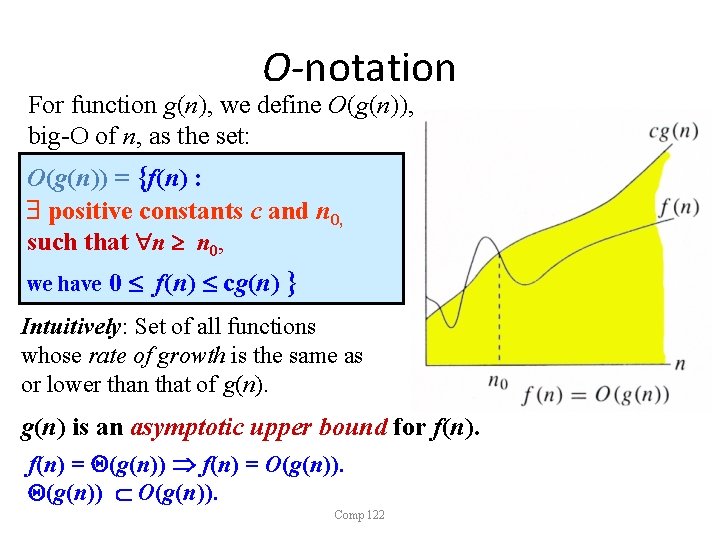
O-notation For function g(n), we define O(g(n)), big-O of n, as the set: O(g(n)) = {f(n) : positive constants c and n 0, such that n n 0, we have 0 f(n) cg(n) } Intuitively: Set of all functions whose rate of growth is the same as or lower than that of g(n) is an asymptotic upper bound for f(n) = (g(n)) f(n) = O(g(n)). (g(n)) O(g(n)). Comp 122
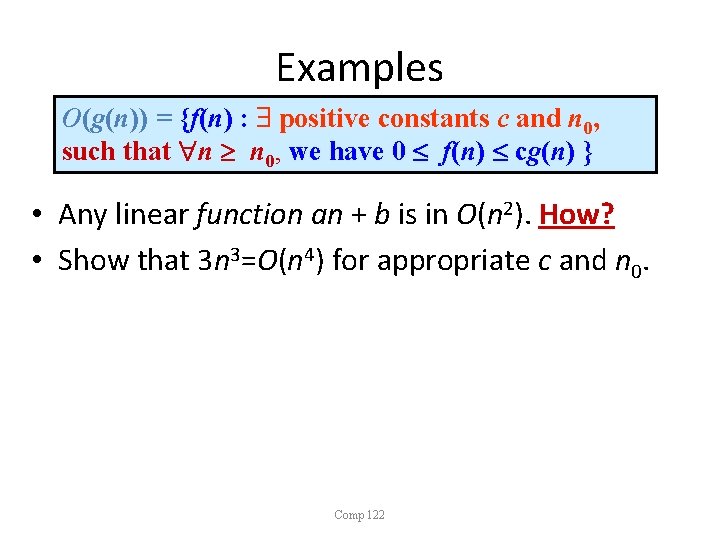
Examples O(g(n)) = {f(n) : positive constants c and n 0, such that n n 0, we have 0 f(n) cg(n) } • Any linear function an + b is in O(n 2). How? • Show that 3 n 3=O(n 4) for appropriate c and n 0. Comp 122
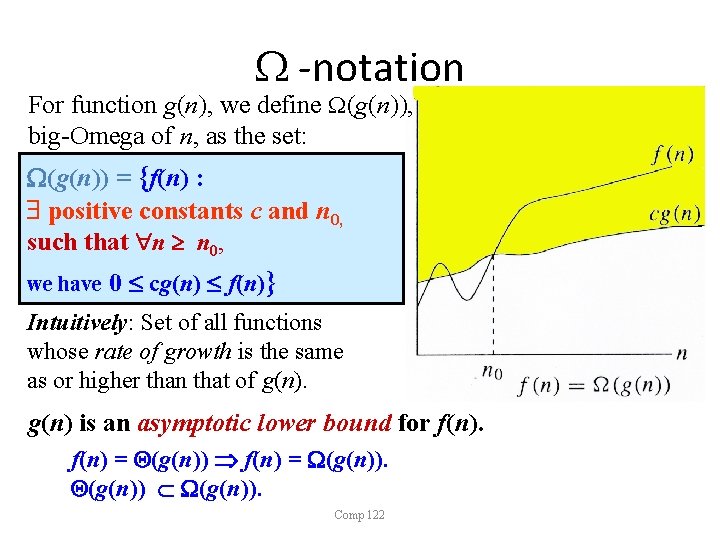
-notation For function g(n), we define (g(n)), big-Omega of n, as the set: (g(n)) = {f(n) : positive constants c and n 0, such that n n 0, we have 0 cg(n) f(n)} Intuitively: Set of all functions whose rate of growth is the same as or higher than that of g(n) is an asymptotic lower bound for f(n) = (g(n)). Comp 122
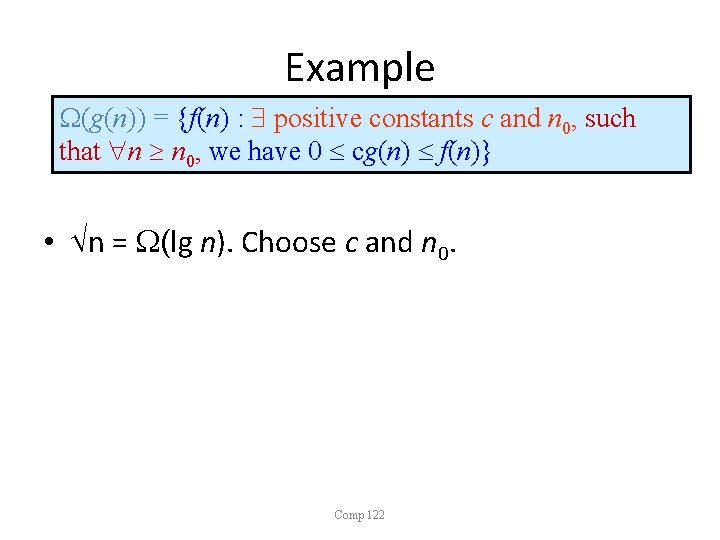
Example (g(n)) = {f(n) : positive constants c and n 0, such that n n 0, we have 0 cg(n) f(n)} • n = (lg n). Choose c and n 0. Comp 122
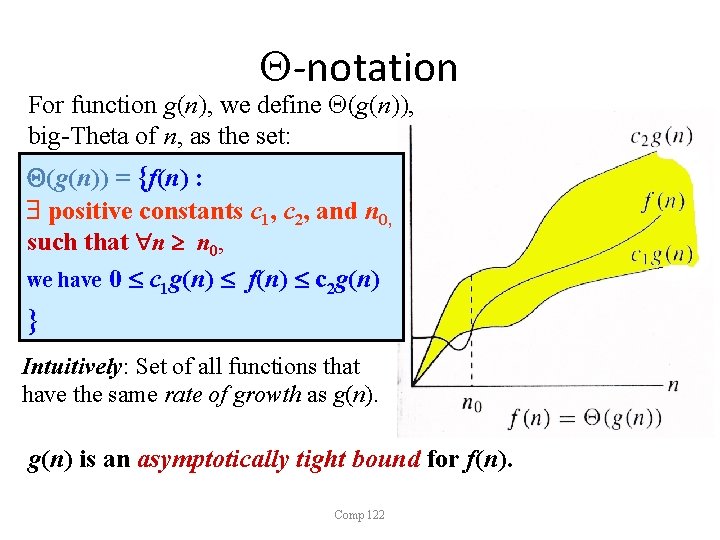
-notation For function g(n), we define (g(n)), big-Theta of n, as the set: (g(n)) = {f(n) : positive constants c 1, c 2, and n 0, such that n n 0, we have 0 c 1 g(n) f(n) c 2 g(n) } Intuitively: Set of all functions that have the same rate of growth as g(n) is an asymptotically tight bound for f(n). Comp 122
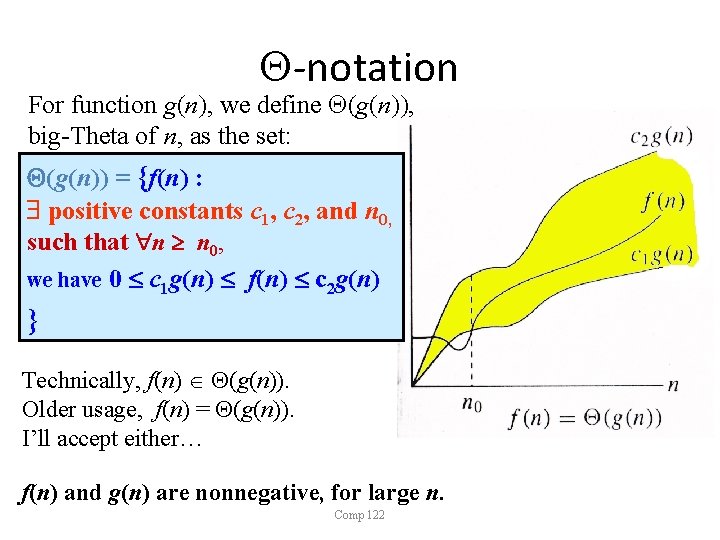
-notation For function g(n), we define (g(n)), big-Theta of n, as the set: (g(n)) = {f(n) : positive constants c 1, c 2, and n 0, such that n n 0, we have 0 c 1 g(n) f(n) c 2 g(n) } Technically, f(n) (g(n)). Older usage, f(n) = (g(n)). I’ll accept either… f(n) and g(n) are nonnegative, for large n. Comp 122
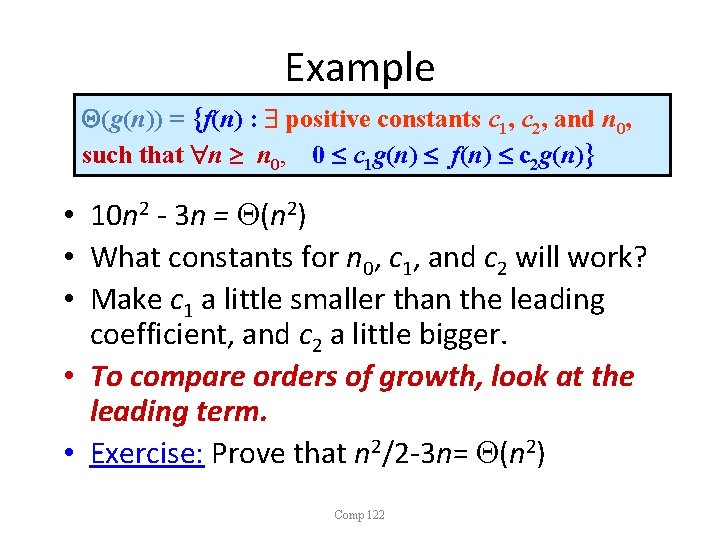
Example (g(n)) = {f(n) : positive constants c 1, c 2, and n 0, such that n n 0, 0 c 1 g(n) f(n) c 2 g(n)} • 10 n 2 - 3 n = (n 2) • What constants for n 0, c 1, and c 2 will work? • Make c 1 a little smaller than the leading coefficient, and c 2 a little bigger. • To compare orders of growth, look at the leading term. • Exercise: Prove that n 2/2 -3 n= (n 2) Comp 122
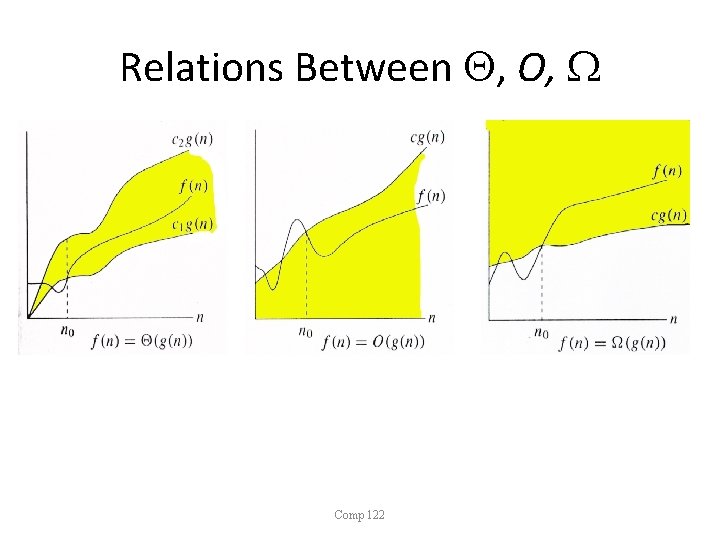
Relations Between , O, Comp 122

Relations Between , , O Theorem : For any two functions g(n) and f(n), f(n) = (g(n)) iff f(n) = O(g(n)) and f(n) = (g(n)). • I. e. , (g(n)) = O(g(n)) Ç (g(n)) • In practice, asymptotically tight bounds are obtained from asymptotic upper and lower bounds. Comp 122

Running Times • “Running time is O(f(n))” Worst case is O(f(n)) • O(f(n)) bound on the worst-case running time O(f(n)) bound on the running time of every input. • (f(n)) bound on the worst-case running time (f(n)) bound on the running time of every input. • “Running time is (f(n))” Best case is (f(n)) • Can still say “Worst-case running time is (f(n))” – Means worst-case running time is given by some unspecified function g(n) (f(n)). Comp 122
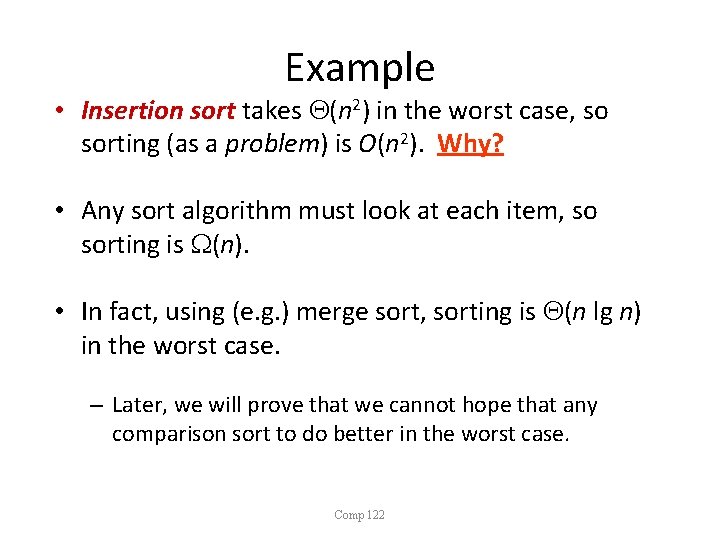
Example • Insertion sort takes (n 2) in the worst case, so sorting (as a problem) is O(n 2). Why? • Any sort algorithm must look at each item, so sorting is (n). • In fact, using (e. g. ) merge sort, sorting is (n lg n) in the worst case. – Later, we will prove that we cannot hope that any comparison sort to do better in the worst case. Comp 122
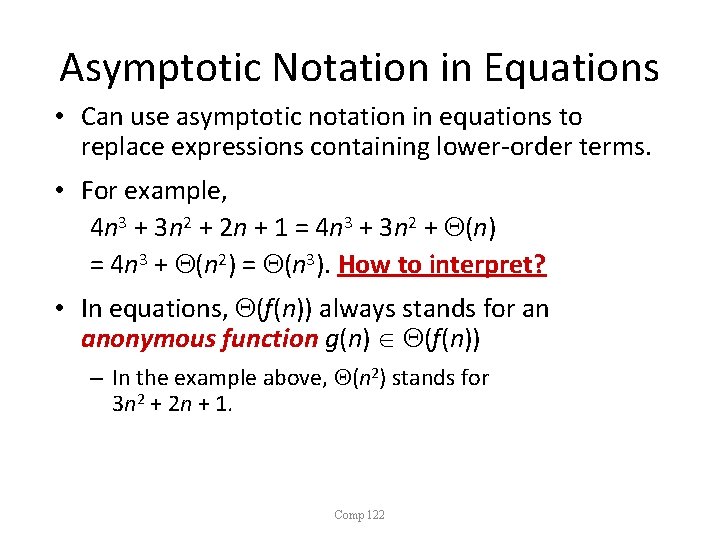
Asymptotic Notation in Equations • Can use asymptotic notation in equations to replace expressions containing lower-order terms. • For example, 4 n 3 + 3 n 2 + 2 n + 1 = 4 n 3 + 3 n 2 + (n) = 4 n 3 + (n 2) = (n 3). How to interpret? • In equations, (f(n)) always stands for an anonymous function g(n) (f(n)) – In the example above, (n 2) stands for 3 n 2 + 2 n + 1. Comp 122

o-notation For a given function g(n), the set little-o: o(g(n)) = {f(n): c > 0, n 0 > 0 such that n n 0, we have 0 f(n) < cg(n)}. f(n) becomes insignificant relative to g(n) as n approaches infinity: lim [f(n) / g(n)] = 0 n g(n) is an upper bound for f(n) that is not asymptotically tight. Observe the difference in this definition from previous ones. Why? Comp 122
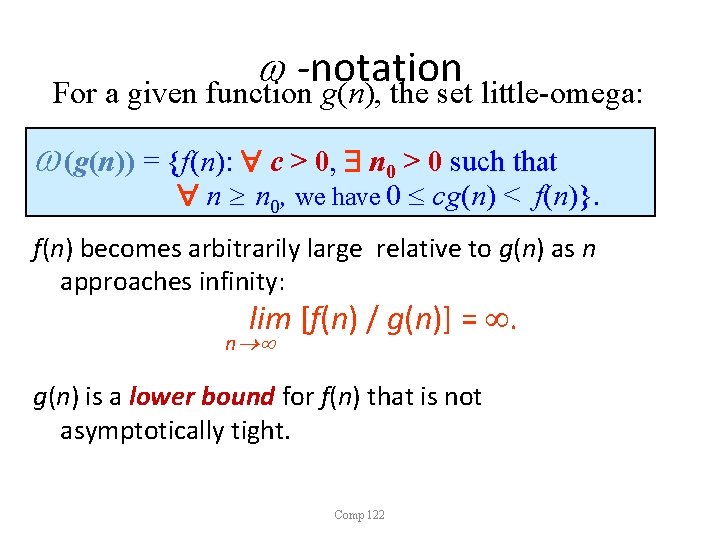
w -notation For a given function g(n), the set little-omega: w(g(n)) = {f(n): c > 0, n 0 > 0 such that n n 0, we have 0 cg(n) < f(n)}. f(n) becomes arbitrarily large relative to g(n) as n approaches infinity: lim [f(n) / g(n)] = . n g(n) is a lower bound for f(n) that is not asymptotically tight. Comp 122
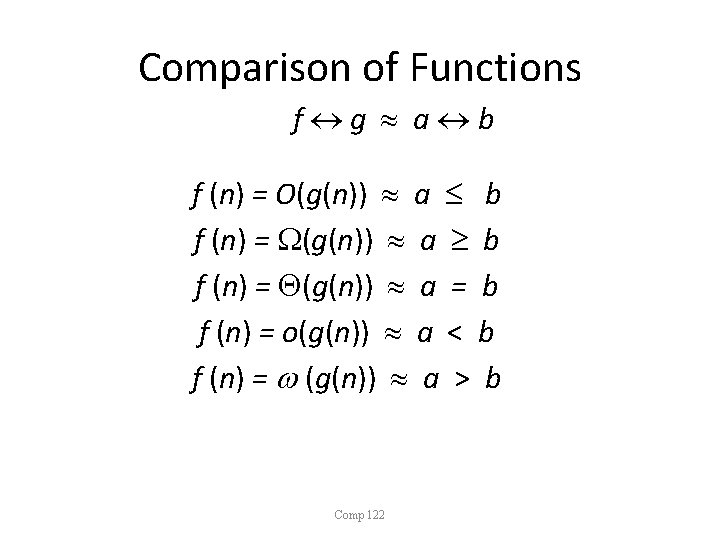
Comparison of Functions f g a b f (n) = O(g(n)) a b f (n) = (g(n)) a = b f (n) = o(g(n)) a < b f (n) = w (g(n)) a > b Comp 122
- Slides: 17