
Asymmetrical Digital Subscriber Line ADSL Asymmetrical Digital Subscriber
Asymmetrical Digital Subscriber Line (ADSL)
Asymmetrical Digital Subscriber Line n n n n Background n motivation for developing ADSL n historical development DSL end-to-end environment and reference model Line environment - characteristics of local loop (LL) Why conventional modems don’t work so well in LL? Modem technology in ADSL flavors: ISDN (!), HDSL, ADSL, VDSL. . . Standards interfaces terminals standards rx-tx channel services 2
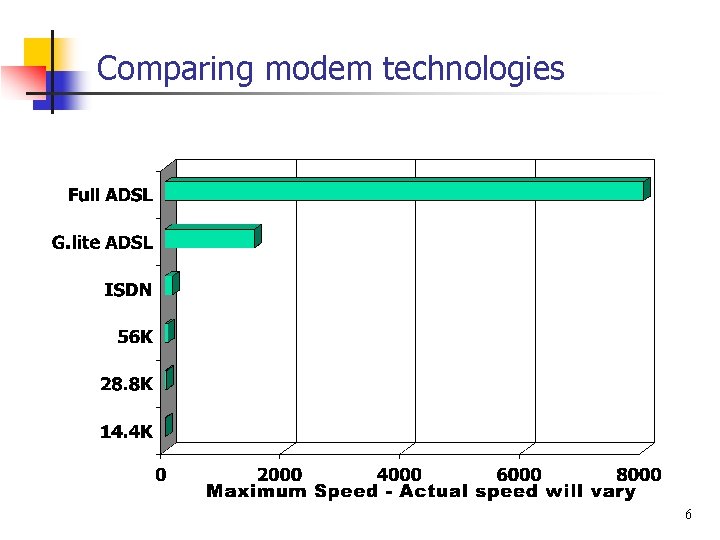
Motivation for developing ADSL n n n Need for high-speed Internet access - also telephone modem speeds have peaked and cable modems have turned out DSL means methods to transmit high speed data to local loop by using unshielded 2 -wire twisted pairs DSL allows rates varying from 160 kb/s up 50 Mb/s on down link (DL) depending on technology used! In the most popular commercial ADSL 512 kbit/s upstream and 2048 kb/s downstream Different operation modes developed to serve symmetric and asymmetric traffic requirements and different rates (STM and ATM supported by ADSL) 3
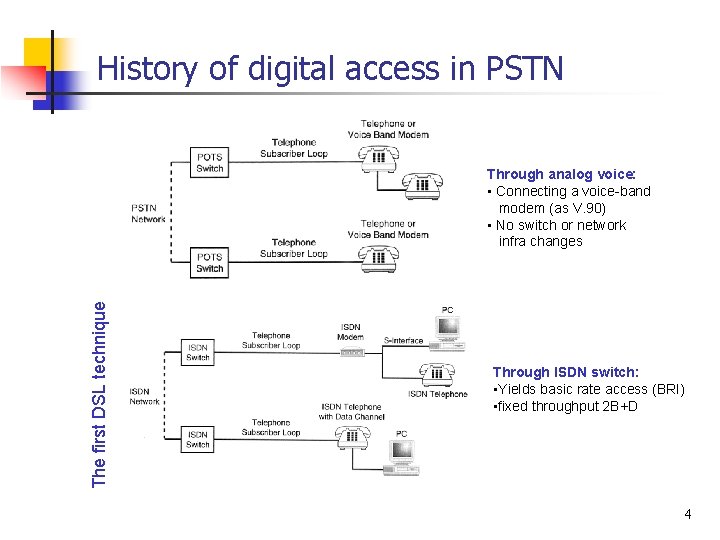
History of digital access in PSTN The first DSL technique Through analog voice: • Connecting a voice-band modem (as V. 90) • No switch or network infra changes Through ISDN switch: • Yields basic rate access (BRI) • fixed throughput 2 B+D 4
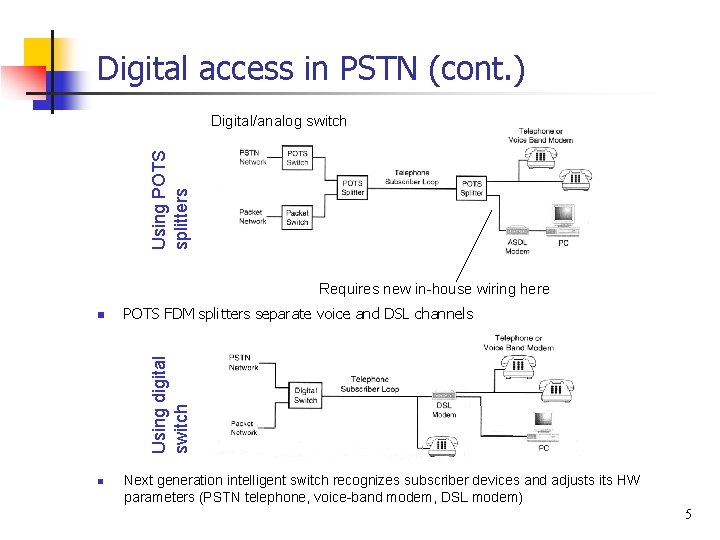
Digital access in PSTN (cont. ) Using POTS splitters Digital/analog switch Requires new in-house wiring here POTS FDM splitters separate voice and DSL channels Using digital switch n n Next generation intelligent switch recognizes subscriber devices and adjusts its HW parameters (PSTN telephone, voice-band modem, DSL modem) 5
Comparing modem technologies 6
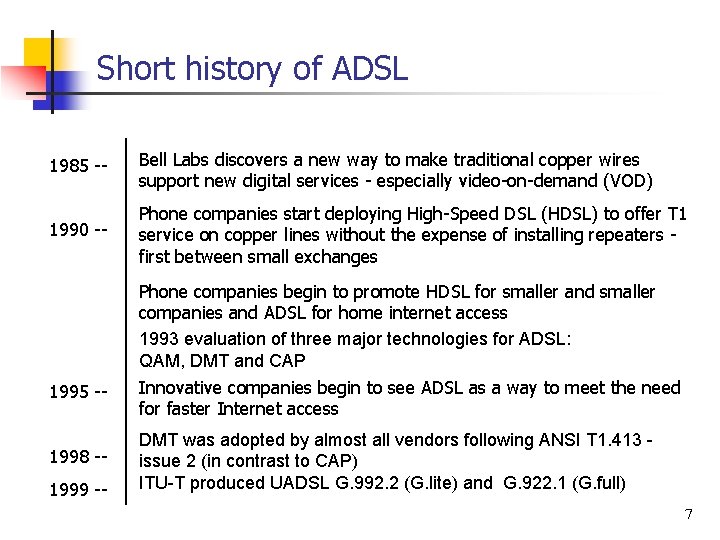
Short history of ADSL 1985 -- Bell Labs discovers a new way to make traditional copper wires support new digital services - especially video-on-demand (VOD) 1990 -- Phone companies start deploying High-Speed DSL (HDSL) to offer T 1 service on copper lines without the expense of installing repeaters first between small exchanges 1995 -1998 -1999 -- Phone companies begin to promote HDSL for smaller and smaller companies and ADSL for home internet access 1993 evaluation of three major technologies for ADSL: QAM, DMT and CAP Innovative companies begin to see ADSL as a way to meet the need for faster Internet access DMT was adopted by almost all vendors following ANSI T 1. 413 issue 2 (in contrast to CAP) ITU-T produced UADSL G. 992. 2 (G. lite) and G. 922. 1 (G. full) 7
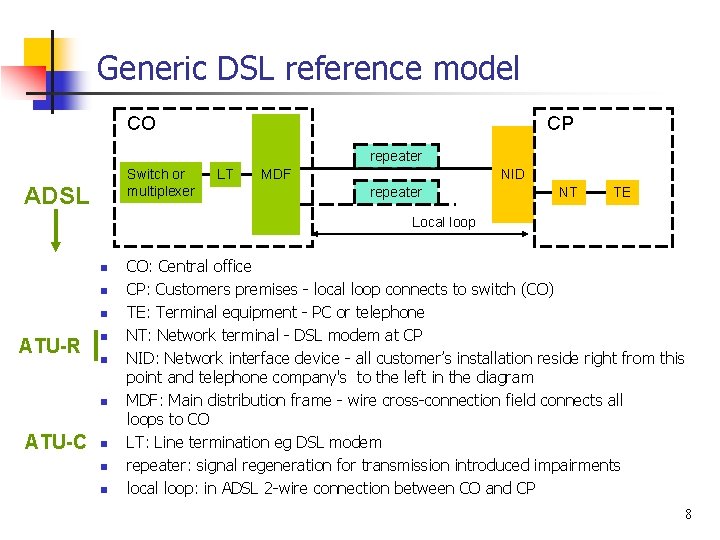
Generic DSL reference model CO CP repeater Switch or multiplexer ADSL LT MDF NID repeater NT TE Local loop n n n ATU-R n n n ATU-C n n n CO: Central office CP: Customers premises - local loop connects to switch (CO) TE: Terminal equipment - PC or telephone NT: Network terminal - DSL modem at CP NID: Network interface device - all customer’s installation reside right from this point and telephone company's to the left in the diagram MDF: Main distribution frame - wire cross-connection field connects all loops to CO LT: Line termination eg DSL modem repeater: signal regeneration for transmission introduced impairments local loop: in ADSL 2 -wire connection between CO and CP 8
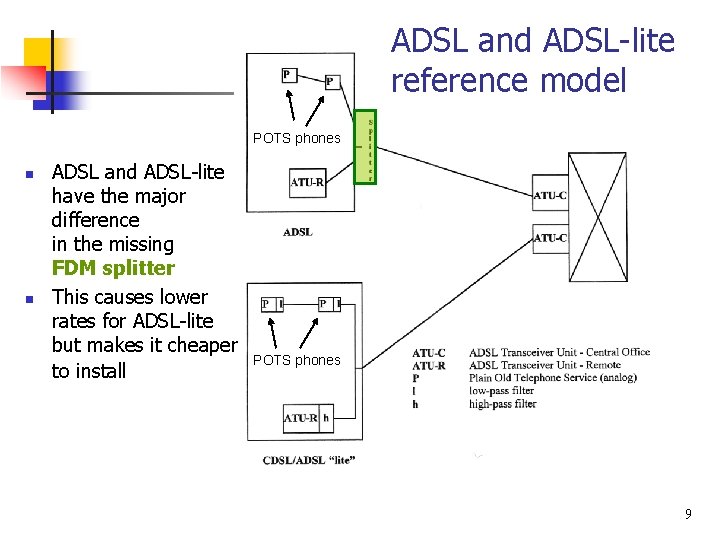
ADSL and ADSL-lite reference model POTS phones n n ADSL and ADSL-lite have the major difference in the missing FDM splitter This causes lower rates for ADSL-lite but makes it cheaper to install POTS phones 9
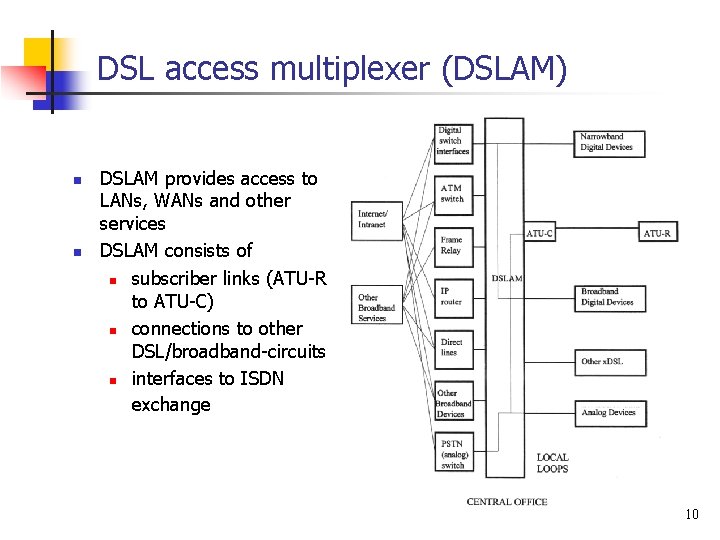
DSL access multiplexer (DSLAM) n n DSLAM provides access to LANs, WANs and other services DSLAM consists of n subscriber links (ATU-R to ATU-C) n connections to other DSL/broadband-circuits n interfaces to ISDN exchange 10
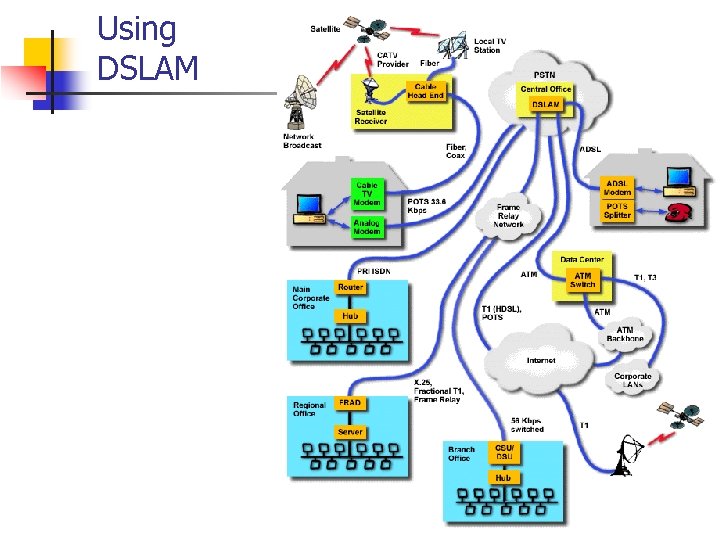
Using DSLAM 11
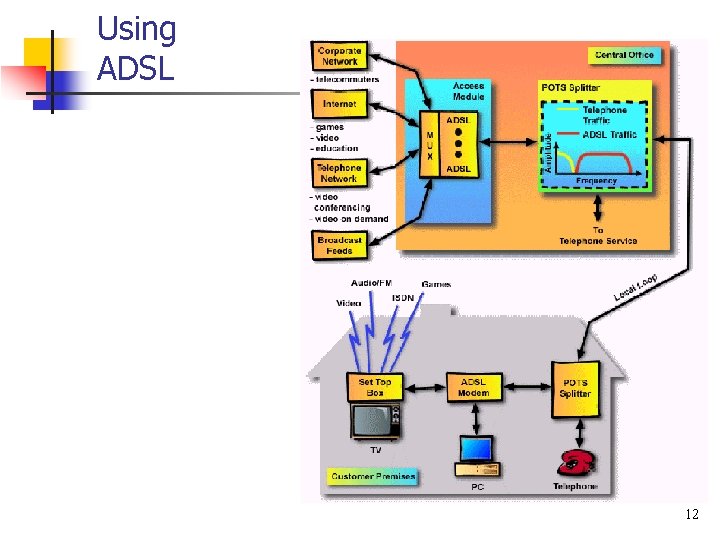
Using ADSL 12
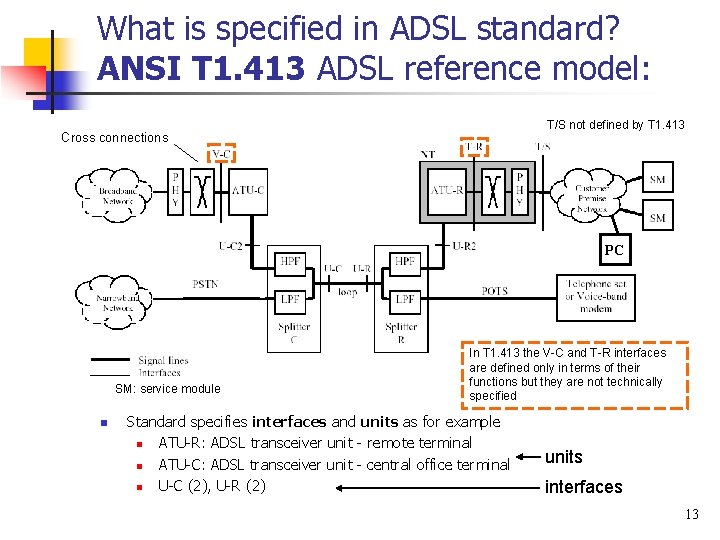
What is specified in ADSL standard? ANSI T 1. 413 ADSL reference model: T/S not defined by T 1. 413 Cross connections PC SM: service module n In T 1. 413 the V-C and T-R interfaces are defined only in terms of their functions but they are not technically specified Standard specifies interfaces and units as for example n ATU-R: ADSL transceiver unit - remote terminal n ATU-C: ADSL transceiver unit - central office terminal n U-C (2), U-R (2) units interfaces 13
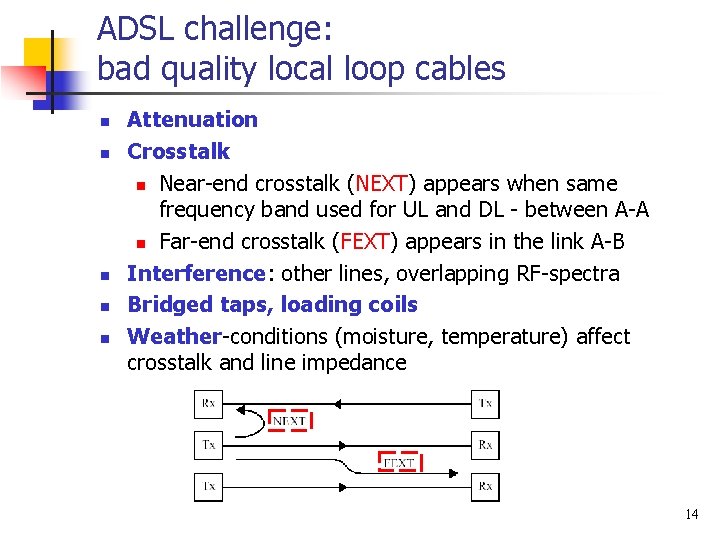
ADSL challenge: bad quality local loop cables n n n Attenuation Crosstalk n Near-end crosstalk (NEXT) appears when same frequency band used for UL and DL - between A-A n Far-end crosstalk (FEXT) appears in the link A-B Interference: other lines, overlapping RF-spectra Bridged taps, loading coils Weather-conditions (moisture, temperature) affect crosstalk and line impedance 14
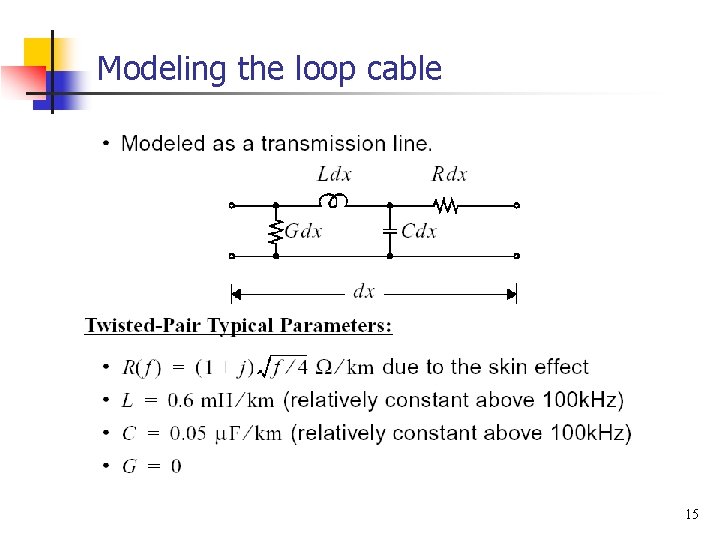
Modeling the loop cable 15
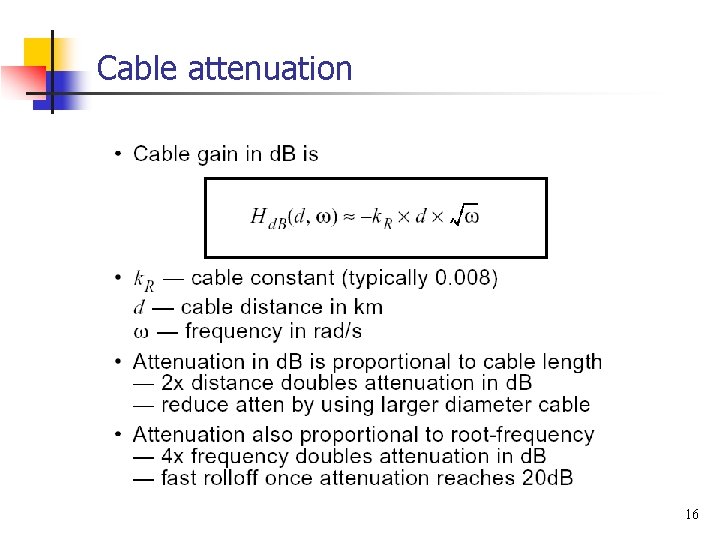
Cable attenuation 16
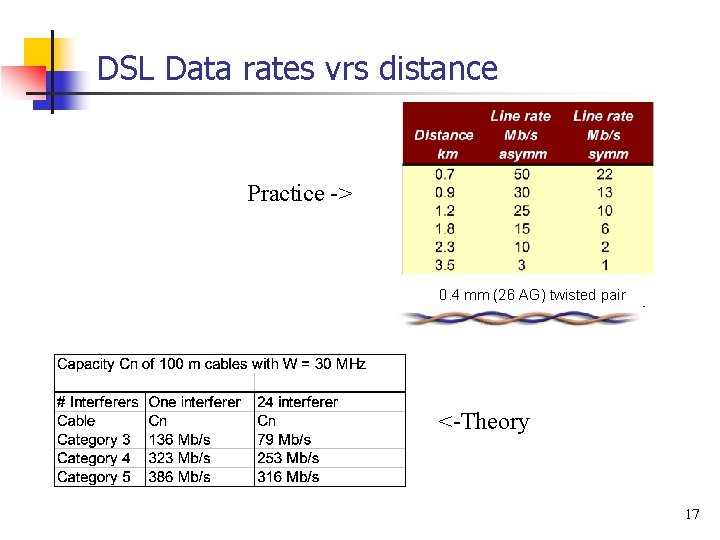
DSL Data rates vrs distance Practice -> 0. 4 mm (26 AG) twisted pair <-Theory 17
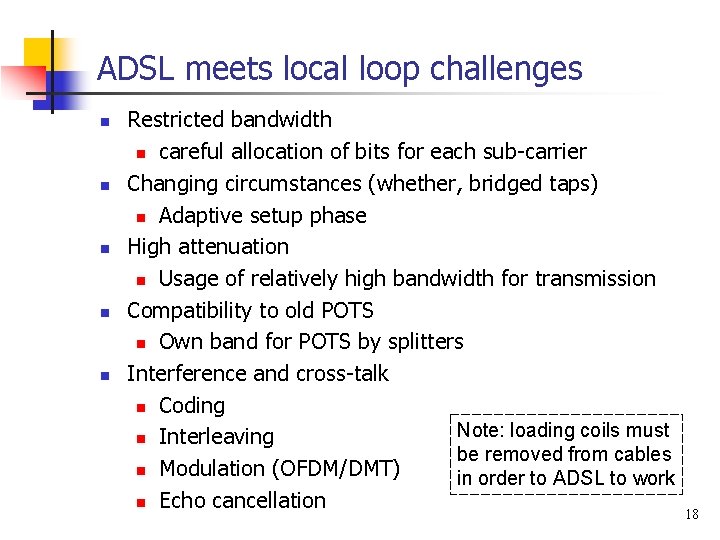
ADSL meets local loop challenges n n n Restricted bandwidth n careful allocation of bits for each sub-carrier Changing circumstances (whether, bridged taps) n Adaptive setup phase High attenuation n Usage of relatively high bandwidth for transmission Compatibility to old POTS n Own band for POTS by splitters Interference and cross-talk n Coding Note: loading coils must n Interleaving be removed from cables n Modulation (OFDM/DMT) in order to ADSL to work n Echo cancellation 18
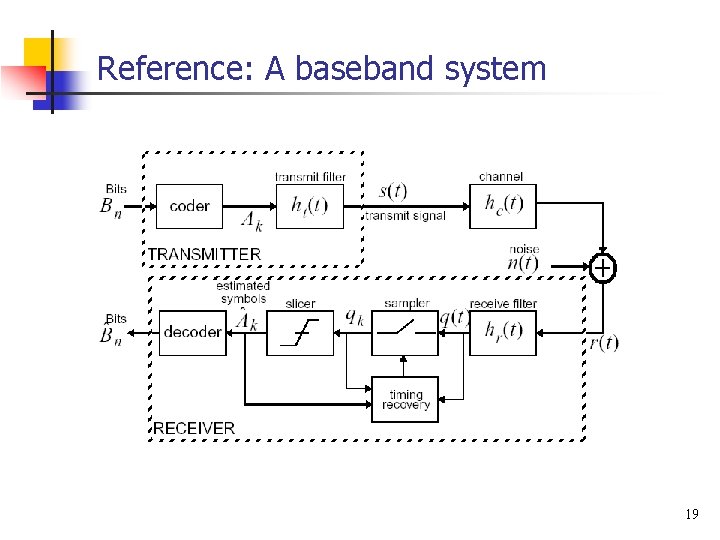
Reference: A baseband system 19
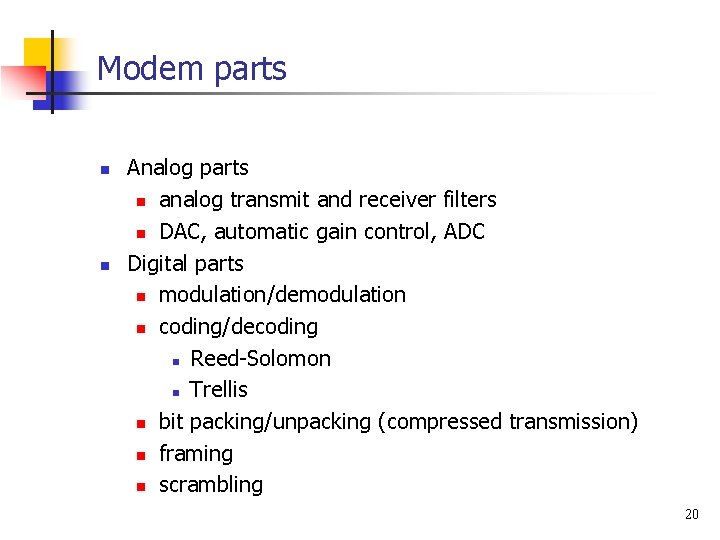
Modem parts n n Analog parts n analog transmit and receiver filters n DAC, automatic gain control, ADC Digital parts n modulation/demodulation n coding/decoding n Reed-Solomon n Trellis n bit packing/unpacking (compressed transmission) n framing n scrambling 20
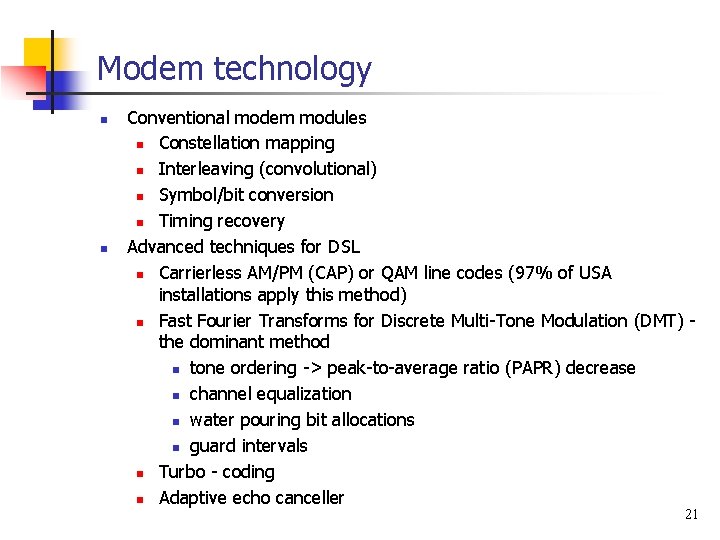
Modem technology n n Conventional modem modules n Constellation mapping n Interleaving (convolutional) n Symbol/bit conversion n Timing recovery Advanced techniques for DSL n Carrierless AM/PM (CAP) or QAM line codes (97% of USA installations apply this method) n Fast Fourier Transforms for Discrete Multi-Tone Modulation (DMT) the dominant method n tone ordering -> peak-to-average ratio (PAPR) decrease n channel equalization n water pouring bit allocations n guard intervals n Turbo - coding n Adaptive echo canceller 21
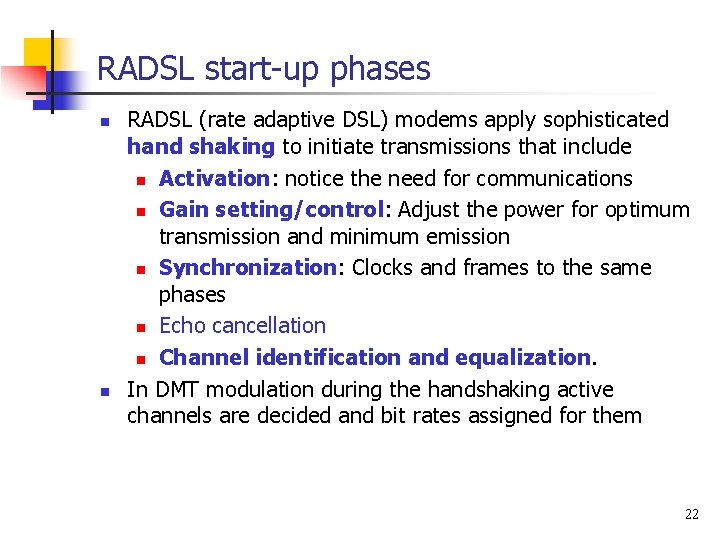
RADSL start-up phases n n RADSL (rate adaptive DSL) modems apply sophisticated hand shaking to initiate transmissions that include n Activation: notice the need for communications n Gain setting/control: Adjust the power for optimum transmission and minimum emission n Synchronization: Clocks and frames to the same phases n Echo cancellation n Channel identification and equalization. In DMT modulation during the handshaking active channels are decided and bit rates assigned for them 22
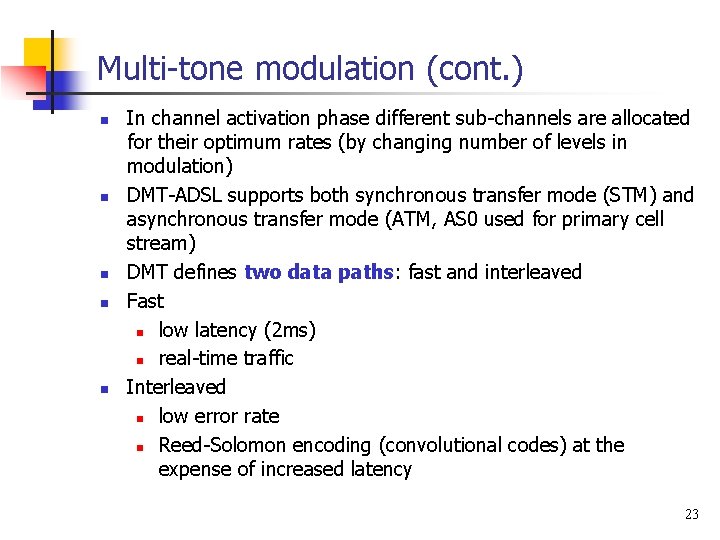
Multi-tone modulation (cont. ) n n n In channel activation phase different sub-channels are allocated for their optimum rates (by changing number of levels in modulation) DMT-ADSL supports both synchronous transfer mode (STM) and asynchronous transfer mode (ATM, AS 0 used for primary cell stream) DMT defines two data paths: fast and interleaved Fast n low latency (2 ms) n real-time traffic Interleaved n low error rate n Reed-Solomon encoding (convolutional codes) at the expense of increased latency 23
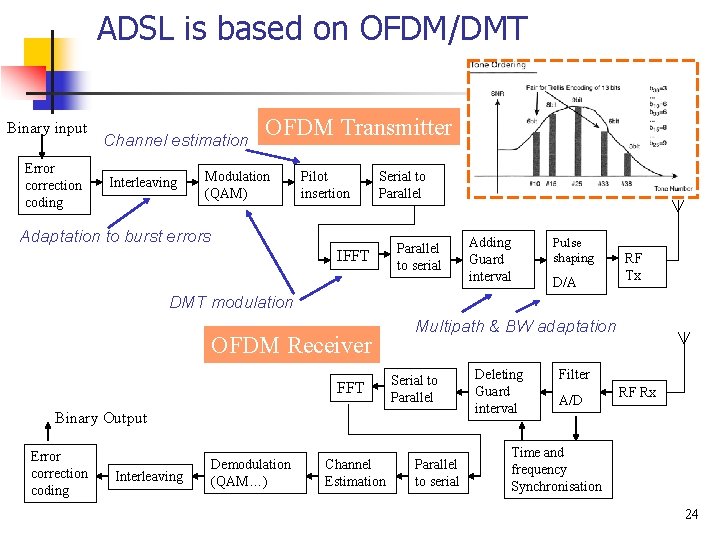
ADSL is based on OFDM/DMT Binary input Error correction coding Channel estimation Interleaving OFDM Transmitter Modulation (QAM) Pilot insertion Serial to Parallel Adaptation to burst errors IFFT Parallel to serial Adding Guard interval Pulse shaping D/A RF Tx DMT modulation OFDM Receiver FFT Multipath & BW adaptation Serial to Parallel Binary Output Error correction coding Interleaving Demodulation (QAM…) Channel Estimation Parallel to serial Deleting Guard interval Filter A/D RF Rx Time and frequency Synchronisation 24
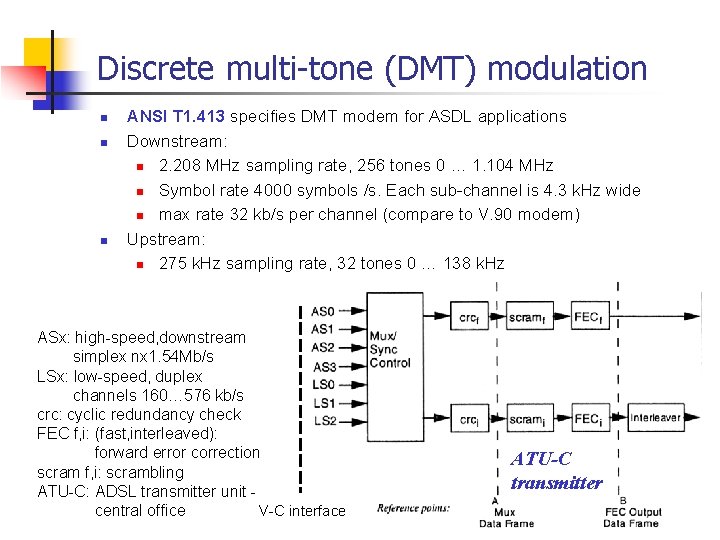
Discrete multi-tone (DMT) modulation n ANSI T 1. 413 specifies DMT modem for ASDL applications Downstream: n 2. 208 MHz sampling rate, 256 tones 0 … 1. 104 MHz n Symbol rate 4000 symbols /s. Each sub-channel is 4. 3 k. Hz wide n max rate 32 kb/s per channel (compare to V. 90 modem) Upstream: n 275 k. Hz sampling rate, 32 tones 0 … 138 k. Hz ASx: high-speed, downstream simplex nx 1. 54 Mb/s LSx: low-speed, duplex channels 160… 576 kb/s crc: cyclic redundancy check FEC f, i: (fast, interleaved): forward error correction scram f, i: scrambling ATU-C: ADSL transmitter unit central office V-C interface ATU-C transmitter 25
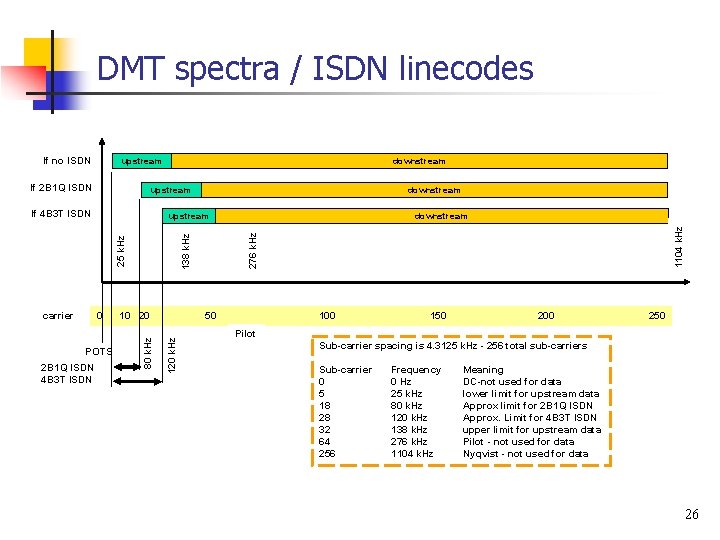
DMT spectra / ISDN linecodes If no ISDN upstream If 2 B 1 Q ISDN downstream upstream If 4 B 3 T ISDN upstream 2 B 1 Q ISDN 4 B 3 T ISDN 50 120 k. Hz POTS 10 20 80 k. Hz 0 1104 k. Hz downstream 276 k. Hz 138 k. Hz 25 k. Hz carrier downstream 100 150 200 250 Pilot Sub-carrier spacing is 4. 3125 k. Hz - 256 total sub-carriers Sub-carrier 0 5 18 28 32 64 256 Frequency 0 Hz 25 k. Hz 80 k. Hz 120 k. Hz 138 k. Hz 276 k. Hz 1104 k. Hz Meaning DC-not used for data lower limit for upstream data Approx limit for 2 B 1 Q ISDN Approx. Limit for 4 B 3 T ISDN upper limit for upstream data Pilot - not used for data Nyqvist - not used for data 26
ADSL system total data rate n n Total data rate=Net data rate + System overheads The net data rate is transmitted in the ADSL bearer channels ADSL system overheads n an ADSL embedded operations channel, eoc n an ADSL overhead control channel, aoc n crc check bytes n fixed indicator bits for O&M* n Reed-Solomon FEC redundancy bytes These data streams are organized into ADSL frames and super-frames for the downstream and upstream data O&M: error detection, corrected errors, loss of signal, remote defects. . . 27
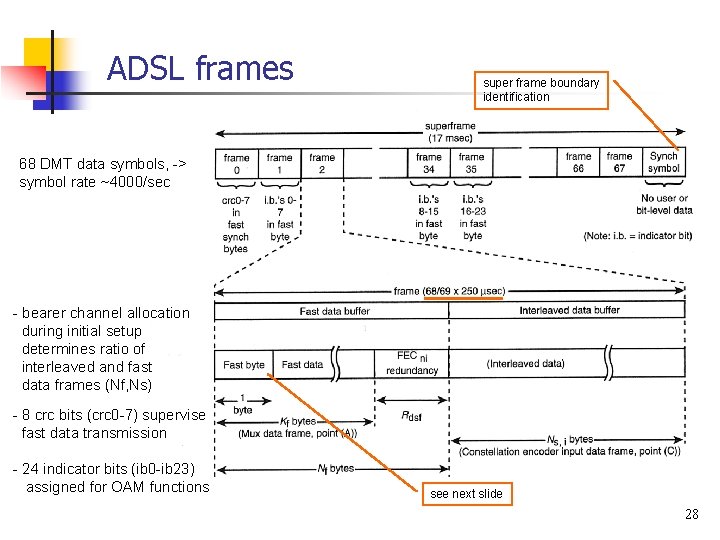
ADSL frames super frame boundary identification 68 DMT data symbols, -> symbol rate ~4000/sec - bearer channel allocation during initial setup determines ratio of interleaved and fast data frames (Nf, Ns) - 8 crc bits (crc 0 -7) supervise fast data transmission - 24 indicator bits (ib 0 -ib 23) assigned for OAM functions see next slide 28
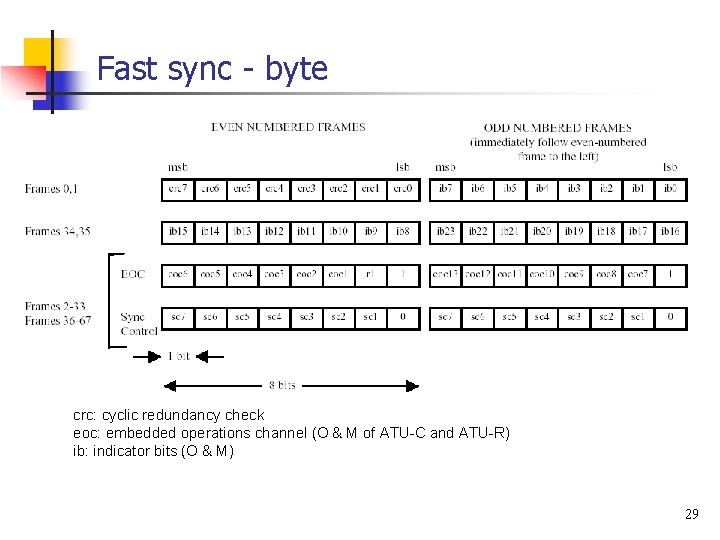
Fast sync - byte crc: cyclic redundancy check eoc: embedded operations channel (O & M of ATU-C and ATU-R) ib: indicator bits (O & M) 29
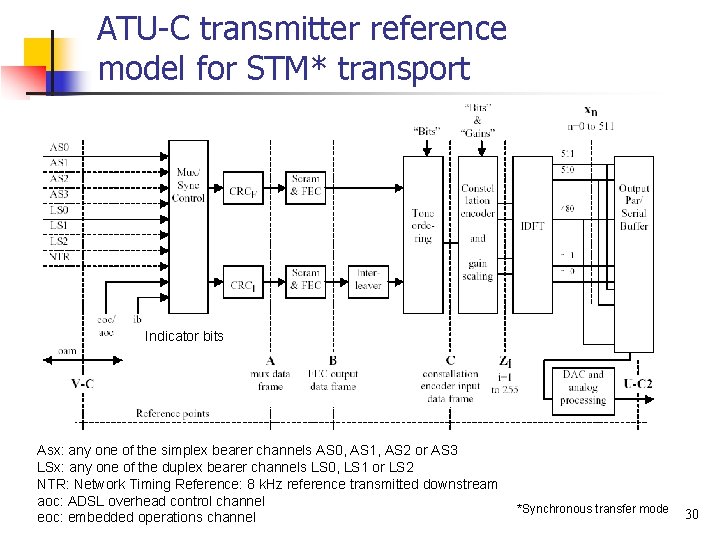
ATU-C transmitter reference model for STM* transport Indicator bits Asx: any one of the simplex bearer channels AS 0, AS 1, AS 2 or AS 3 LSx: any one of the duplex bearer channels LS 0, LS 1 or LS 2 NTR: Network Timing Reference: 8 k. Hz reference transmitted downstream aoc: ADSL overhead control channel eoc: embedded operations channel *Synchronous transfer mode 30
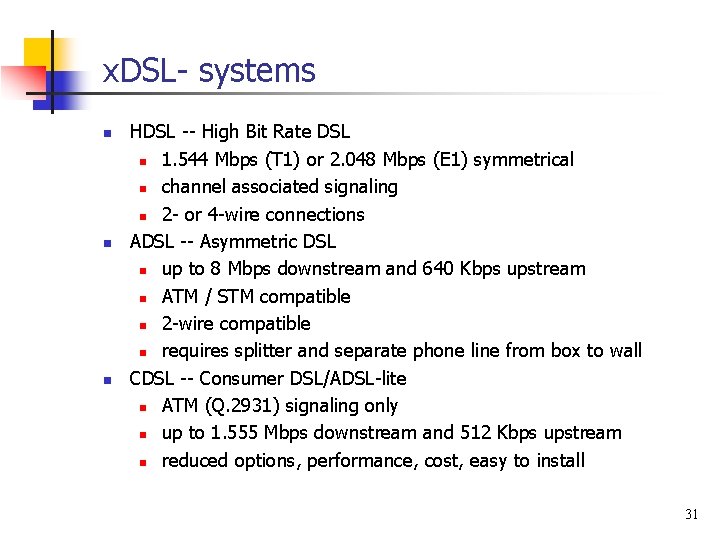
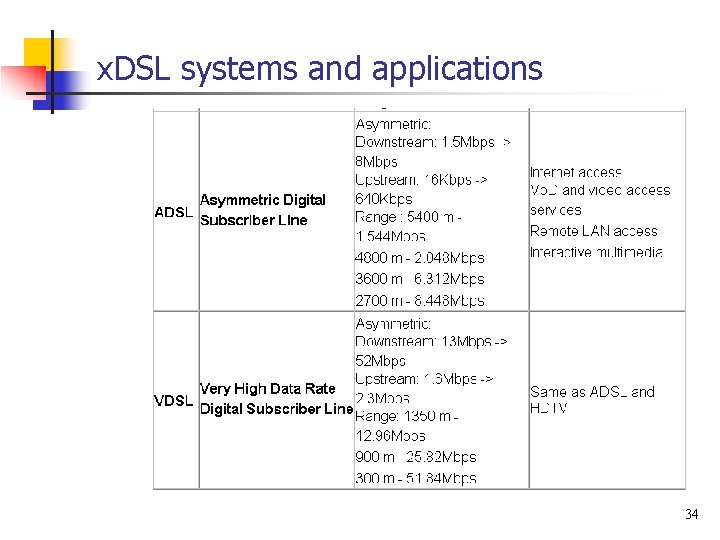
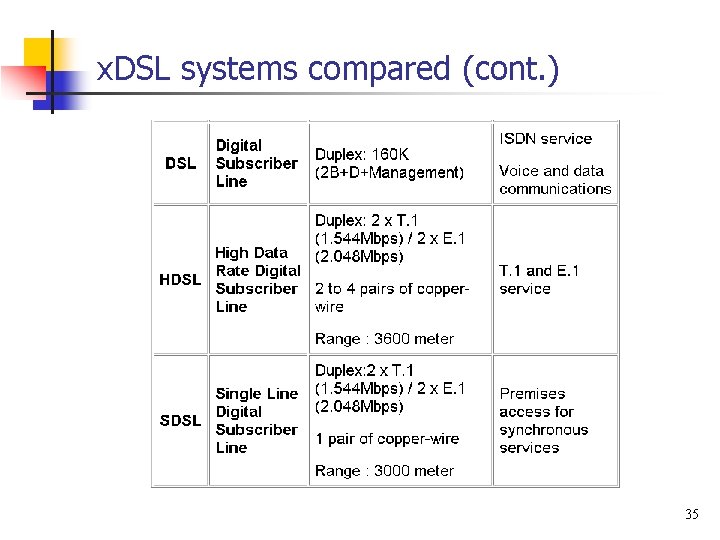
x. DSL- systems n n n HDSL -- High Bit Rate DSL n 1. 544 Mbps (T 1) or 2. 048 Mbps (E 1) symmetrical n channel associated signaling n 2 - or 4 -wire connections ADSL -- Asymmetric DSL n up to 8 Mbps downstream and 640 Kbps upstream n ATM / STM compatible n 2 -wire compatible n requires splitter and separate phone line from box to wall CDSL -- Consumer DSL/ADSL-lite n ATM (Q. 2931) signaling only n up to 1. 555 Mbps downstream and 512 Kbps upstream n reduced options, performance, cost, easy to install 31
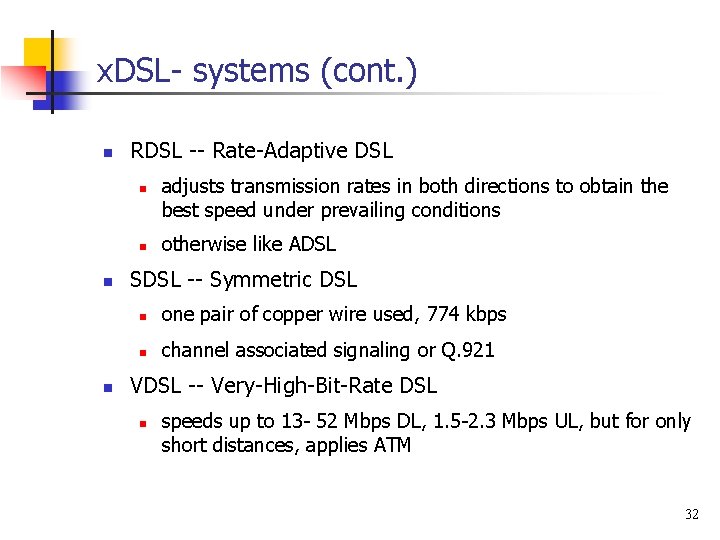
x. DSL- systems (cont. ) n RDSL -- Rate-Adaptive DSL n n adjusts transmission rates in both directions to obtain the best speed under prevailing conditions otherwise like ADSL SDSL -- Symmetric DSL n one pair of copper wire used, 774 kbps n channel associated signaling or Q. 921 VDSL -- Very-High-Bit-Rate DSL n speeds up to 13 - 52 Mbps DL, 1. 5 -2. 3 Mbps UL, but for only short distances, applies ATM 32
x. DSL systems (cont. ) n BRI ISDN (DSL) n uses existing ISDN equipment, but in 'always on' mode instead of as a dial-up service. Yields 2 B+D up to 128 kbps + 16 kbps or X. 25 with 160 kbps n signaling Q. 921/Q. 931 n designed for speech networks V. 90 n 56 kbps DL, 33. 6 kbps UL n signaling analog n for speech network n n 33
x. DSL systems and applications 8 34
x. DSL systems compared (cont. ) 35
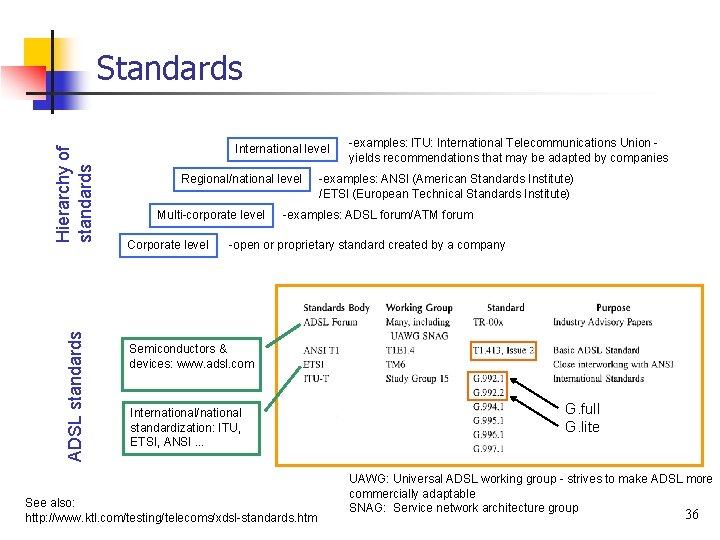
ADSL standards Hierarchy of standards Standards International level Regional/national level Multi-corporate level Corporate level -examples: ITU: International Telecommunications Union yields recommendations that may be adapted by companies -examples: ANSI (American Standards Institute) /ETSI (European Technical Standards Institute) -examples: ADSL forum/ATM forum -open or proprietary standard created by a company Semiconductors & devices: www. adsl. com International/national standardization: ITU, ETSI, ANSI. . . See also: http: //www. ktl. com/testing/telecoms/xdsl-standards. htm G. full G. lite UAWG: Universal ADSL working group - strives to make ADSL more commercially adaptable SNAG: Service network architecture group 36
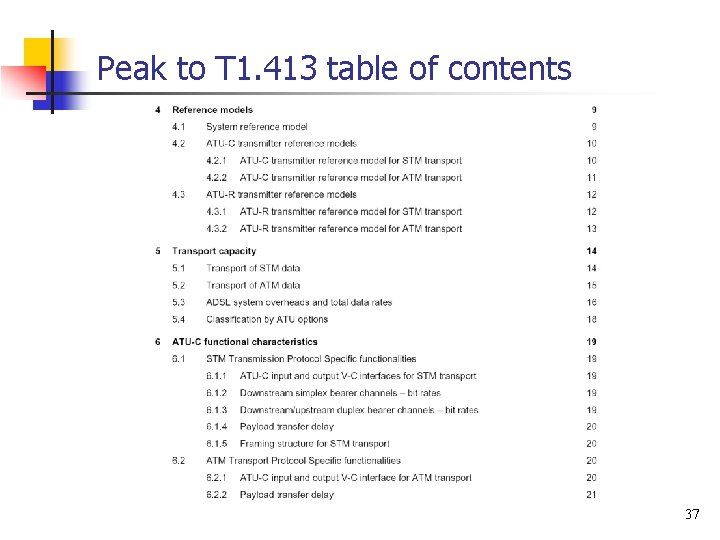
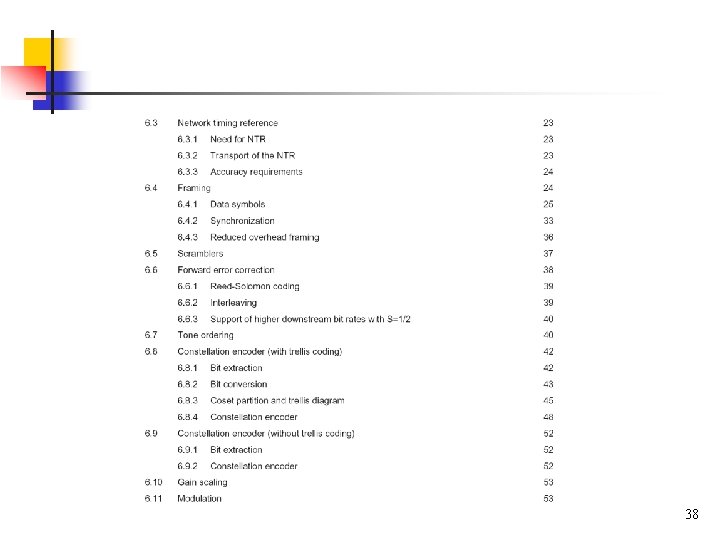
Peak to T 1. 413 table of contents 37
38
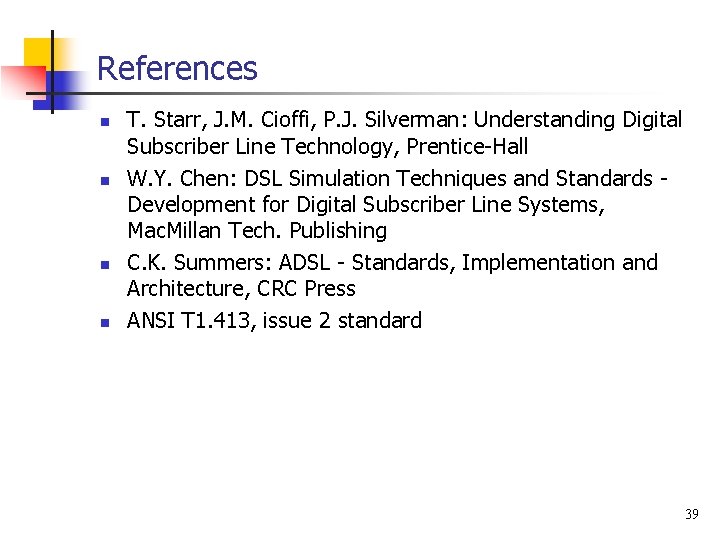
References n n T. Starr, J. M. Cioffi, P. J. Silverman: Understanding Digital Subscriber Line Technology, Prentice-Hall W. Y. Chen: DSL Simulation Techniques and Standards Development for Digital Subscriber Line Systems, Mac. Millan Tech. Publishing C. K. Summers: ADSL - Standards, Implementation and Architecture, CRC Press ANSI T 1. 413, issue 2 standard 39
- Slides: 39