
Aswath Damodaran VALUATION FOUR LESSONS TO TAKE AWAY








- Slides: 55
Aswath Damodaran VALUATION: FOUR LESSONS TO TAKE AWAY! July 2015 Aswath Damodaran 1
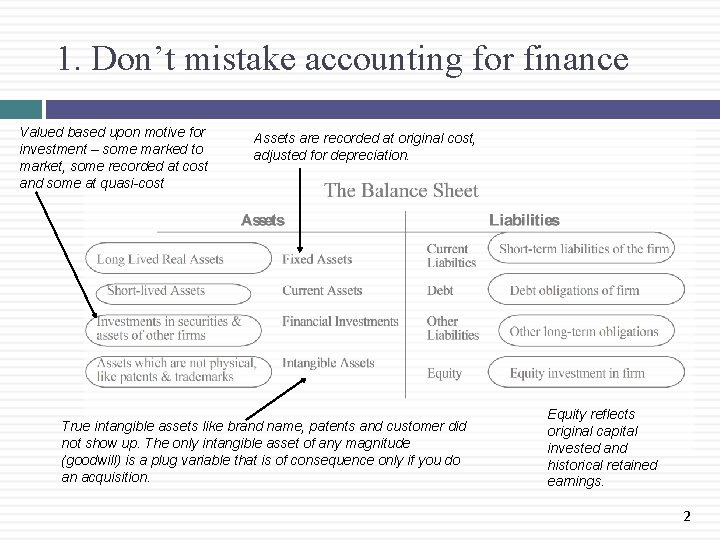
1. Don’t mistake accounting for finance Valued based upon motive for investment – some marked to market, some recorded at cost and some at quasi-cost Assets are recorded at original cost, adjusted for depreciation. True intangible assets like brand name, patents and customer did not show up. The only intangible asset of any magnitude (goodwill) is a plug variable that is of consequence only if you do an acquisition. Equity reflects original capital invested and historical retained earnings. 2
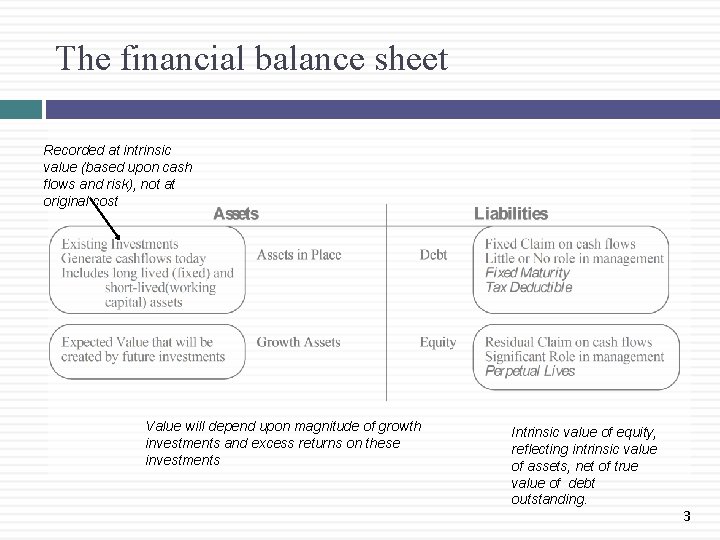
The financial balance sheet Recorded at intrinsic value (based upon cash flows and risk), not at original cost Value will depend upon magnitude of growth investments and excess returns on these investments Intrinsic value of equity, reflecting intrinsic value of assets, net of true value of debt outstanding. 3
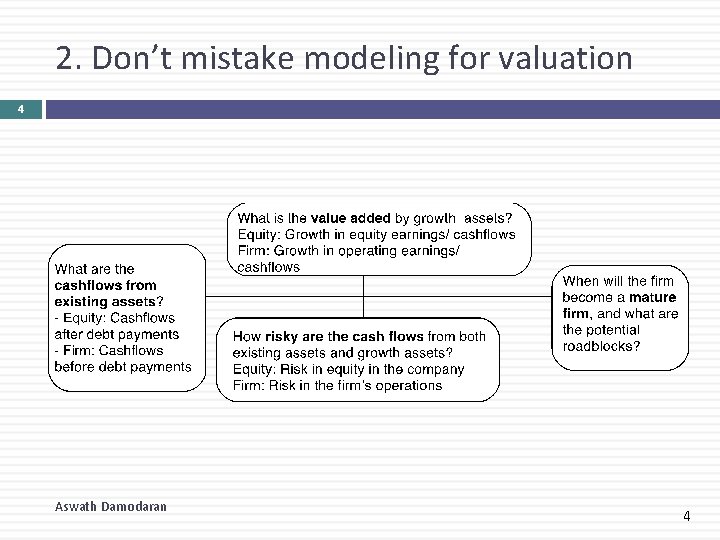
2. Don’t mistake modeling for valuation 4 Aswath Damodaran 4
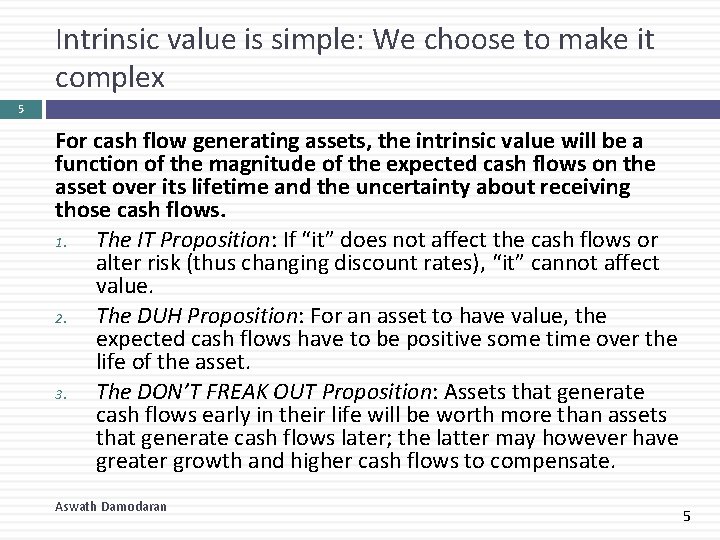
Intrinsic value is simple: We choose to make it complex 5 For cash flow generating assets, the intrinsic value will be a function of the magnitude of the expected cash flows on the asset over its lifetime and the uncertainty about receiving those cash flows. 1. The IT Proposition: If “it” does not affect the cash flows or alter risk (thus changing discount rates), “it” cannot affect value. 2. The DUH Proposition: For an asset to have value, the expected cash flows have to be positive some time over the life of the asset. 3. The DON’T FREAK OUT Proposition: Assets that generate cash flows early in their life will be worth more than assets that generate cash flows later; the latter may however have greater growth and higher cash flows to compensate. Aswath Damodaran 5
DCF as a tool for intrinsic valuation 6 Aswath Damodaran 6
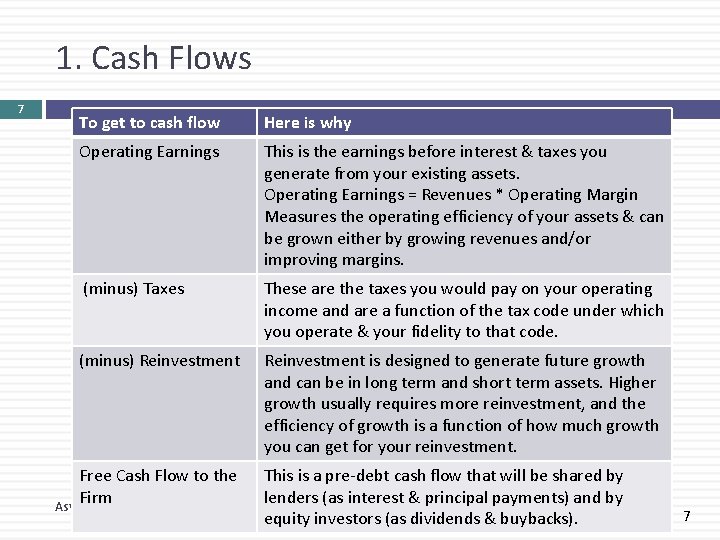
1. Cash Flows 7 To get to cash flow Here is why Operating Earnings This is the earnings before interest & taxes you generate from your existing assets. Operating Earnings = Revenues * Operating Margin Measures the operating efficiency of your assets & can be grown either by growing revenues and/or improving margins. (minus) Taxes These are the taxes you would pay on your operating income and are a function of the tax code under which you operate & your fidelity to that code. (minus) Reinvestment is designed to generate future growth and can be in long term and short term assets. Higher growth usually requires more reinvestment, and the efficiency of growth is a function of how much growth you can get for your reinvestment. Free Cash Flow to the Firm Aswath Damodaran This is a pre-debt cash flow that will be shared by lenders (as interest & principal payments) and by equity investors (as dividends & buybacks). 7
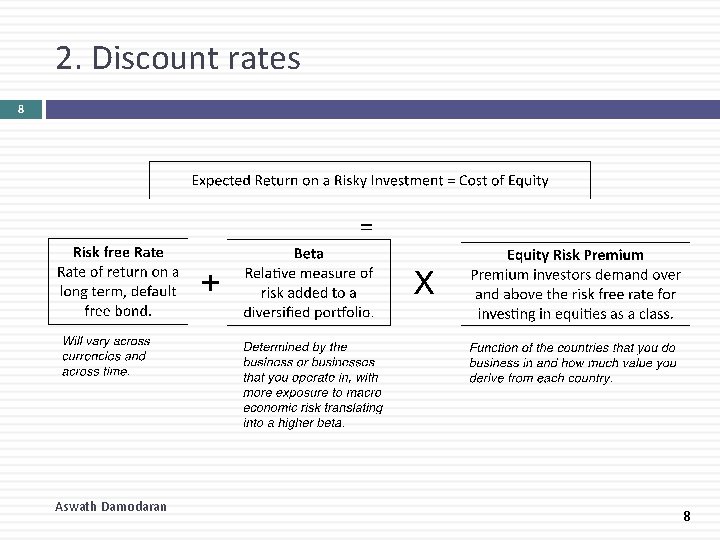
2. Discount rates 8 Aswath Damodaran 8
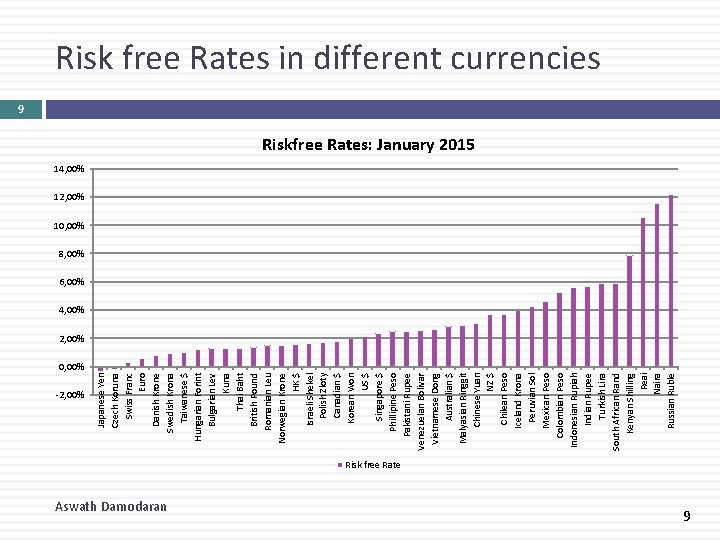
-2, 00% Japanese Yen Czech Koruna Swiss Franc Euro Danish Krone Swedish Krona Taiwanese $ Hungarian Forint Bulgarian Lev Kuna Thai Baht British Pound Romanian Leu Norwegian Krone HK $ Israeli Shekel Polish Zloty Canadian $ Korean Won US $ Singapore $ Phillipine Peso Pakistani Rupee Venezuelan Bolivar Vietnamese Dong Australian $ Malyasian Ringgit Chinese Yuan NZ $ Chilean Peso Iceland Krona Peruvian Sol Mexican Peso Colombian Peso Indonesian Rupiah Indian Rupee Turkish Lira South African Rand Kenyan Shilling Reai Naira Russian Ruble Risk free Rates in different currencies 9 Riskfree Rates: January 2015 14, 00% 12, 00% 10, 00% 8, 00% 6, 00% 4, 00% 2, 00% 0, 00% Risk free Rate Aswath Damodaran 9
ERP : Jan 2015 Andorra Austria Belgium Cyprus Denmark Finland France Germany Greece Guernsey Iceland Ireland Isle of Man Canada 5. 75% US 5. 75% North America 5. 75% Argentina Belize Bolivia Brazil Chile Colombia Costa Rica Ecuador El Salvador Guatemala Honduras Mexico Nicaragua Panama Paraguay Peru Suriname Uruguay Venezuela Latin America 8. 15% 2. 40% Italy 5. 75% 0. 00% Jersey 6. 65% 0. 90% Liechtenstein 15. 50% 9. 75% Luxembourg 5. 75% 0. 00% Malta 5. 75% 0. 00% Netherlands 6. 35% 0. 60% Norway 5. 75% 0. 00% Portugal 17. 00% 11. 25% Spain 6. 35% 0. 60% Sweden 9. 05% 3. 30% Switzerland 8. 15% 2. 40% Turkey 6. 35% 0. 60% UK W. Europe 0. 00% 17. 00% 11. 25% 19. 25% 13. 50% 11. 15% 5. 40% 8. 60% 2. 85% 6. 65% 0. 90% 8. 60% 2. 85% 9. 50% 3. 75% 15. 50% 9. 75% 11. 15% 5. 40% 9. 50% 3. 75% 15. 50% 9. 75% 7. 55% 1. 80% 15. 50% 9. 75% 8. 60% 2. 85% 10. 25% 4. 50% 7. 55% 1. 80% 11. 15% 5. 40% 8. 60% 2. 85% 17. 00% 11. 25% 9. 95% 4. 20% Angola Botswana Burkina Faso Cameroon Cape Verde Congo (DR) Congo (Republic) Côte d'Ivoire Egypt Ethiopia Gabon Ghana Kenya Morocco Mozambique Namibia Nigeria Rwanda Senegal South Africa Tunisia Uganda Zambia Africa 8. 60% 6. 35% 5. 75% 7. 55% 5. 75% 9. 50% 8. 60% 5. 75% 9. 05% 6. 35% 6. 88% 10. 25% 7. 03% 15. 50% 14. 00% 15. 50% 11. 15% 12. 50% 17. 00% 12. 50% 11. 15% 14. 00% 12. 50% 9. 50% 12. 50% 9. 05% 11. 15% 14. 00% 12. 50% 8. 60% 11. 15% 12. 50% 11. 73% 2. 85% 0. 60% 0. 00% 1. 80% 0. 00% 3. 75% 2. 85% 0. 00% 3. 30% 0. 60% 1. 13% 4. 50% 1. 28% 9. 75% 8. 25% 9. 75% 5. 40% 6. 75% 11. 25% 6. 75% 5. 40% 8. 25% 6. 75% 3. 75% 6. 75% 3. 30% 5. 40% 8. 25% 6. 75% 2. 85% 5. 40% 6. 75% 5. 98% Albania Armenia Azerbaijan Belarus Bosnia Bulgaria Croatia Czech Repub Estonia Georgia Hungary Kazakhstan Latvia Lithuania Macedonia Moldova 12. 50% 10. 25% 9. 05% 15. 50% 8. 60% 9. 50% 6. 80% 11. 15% 9. 50% 8. 60% 8. 15% 11. 15% 15. 50% Abu Dhabi Bahrain Israel Jordan Kuwait Lebanon Oman Qatar Ras Al Khaimah Saudi Arabia Sharjah UAE Middle East 6. 75% 4. 50% 3. 30% 9. 75% 2. 85% 3. 75% 1. 05% 5. 40% 3. 75% 2. 85% 2. 40% 5. 40% 9. 75% 6. 50% 8. 60% 6. 80% 12. 50% 6. 50% 14. 00% 6. 80% 6. 50% 7. 03% 6. 65% 7. 55% 6. 50% 6. 85% Montenegro Poland Romania Russia Serbia Slovakia Slovenia Ukraine E. Europe 0. 75% 2. 85% 1. 05% 6. 75% 0. 75% 8. 25% 1. 05% 0. 75% 1. 28% 0. 90% 1. 80% 0. 75% 1. 10% Black #: Total ERP Red #: Country risk premium AVG: GDP weighted average 11. 15% 7. 03% 9. 05% 8. 60% 12. 50% 7. 03% 9. 50% 20. 75% 9. 08% 5. 40% 1. 28% 3. 30% 2. 85% 6. 75% 1. 28% 3. 75% 15. 00% 3. 33% Bangladesh Cambodia China Fiji Hong Kong India Indonesia Japan 11. 15% 14. 00% 6. 65% 12. 50% 6. 35% 9. 05% 6. 80% 5. 40% 8. 25% 0. 90% 6. 75% 0. 60% 3. 30% 1. 05% Korea Macao Malaysia Mauritius Mongolia Pakistan Papua New Guinea Philippines Singapore Sri Lanka Taiwan Thailand Vietnam Asia 6. 65% 6. 50% 7. 55% 8. 15% 14. 00% 17. 00% 12. 50% 8. 60% 5. 75% 12. 50% 6. 65% 8. 15% 12. 50% 7. 26% 0. 90% 0. 75% 1. 80% 2. 40% 8. 25% 11. 25% 6. 75% 2. 85% 0. 00% 6. 75% 0. 90% 2. 40% 6. 75% 1. 51% Australia Cook Islands New Zealand Australia & NZ 5. 75% 12. 50% 5. 75% 0. 00% 6. 75% 0. 00%
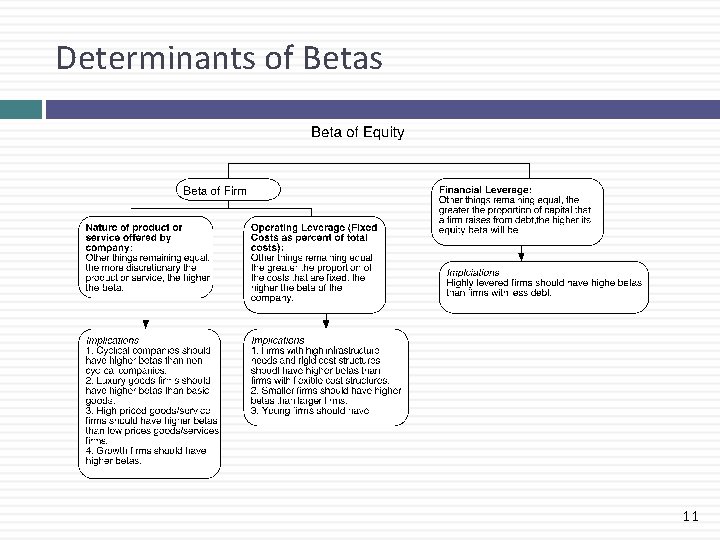
Determinants of Betas 11
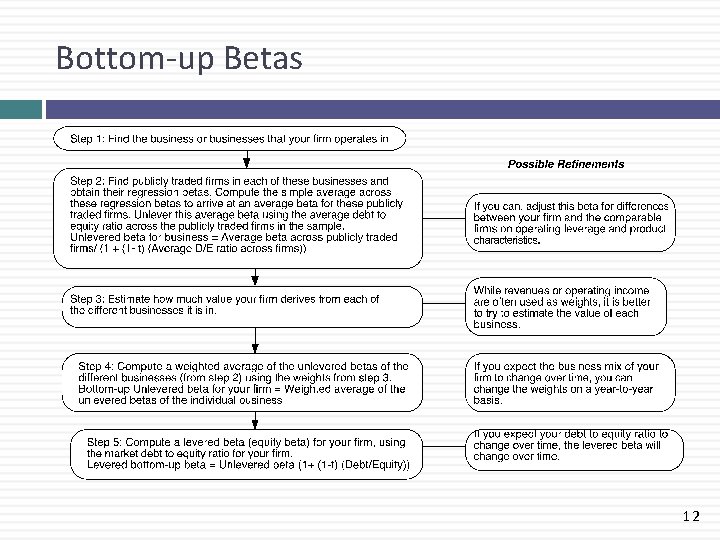
Bottom-up Betas 12
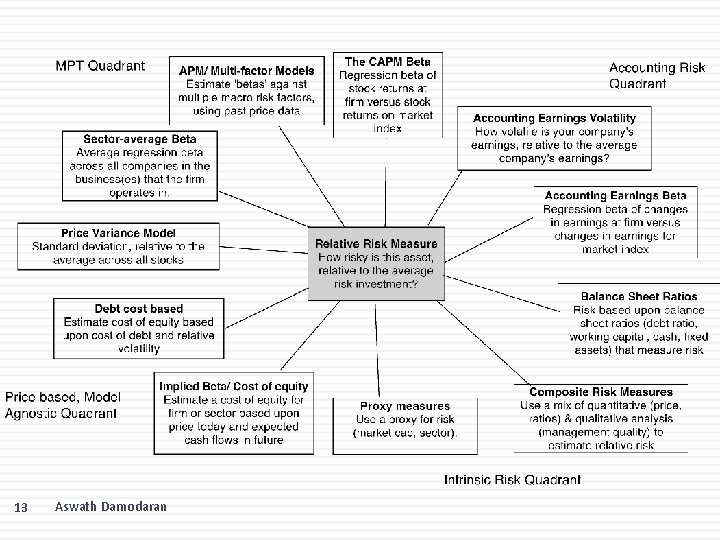
13 Aswath Damodaran
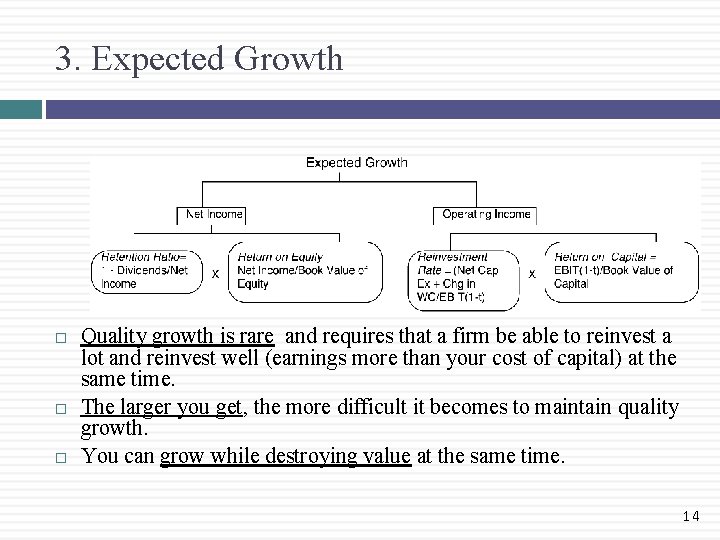
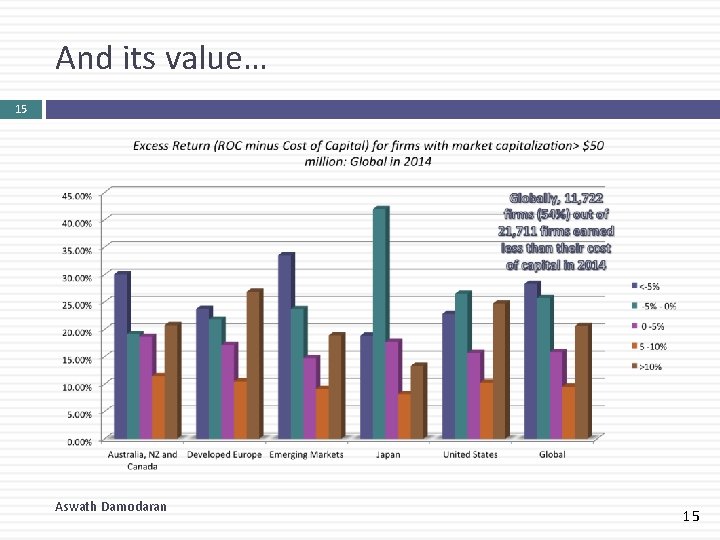
3. Expected Growth Quality growth is rare and requires that a firm be able to reinvest a lot and reinvest well (earnings more than your cost of capital) at the same time. The larger you get, the more difficult it becomes to maintain quality growth. You can grow while destroying value at the same time. 14
And its value… 15 Aswath Damodaran 15
4. The Terminal Value 16 Aswath Damodaran 16
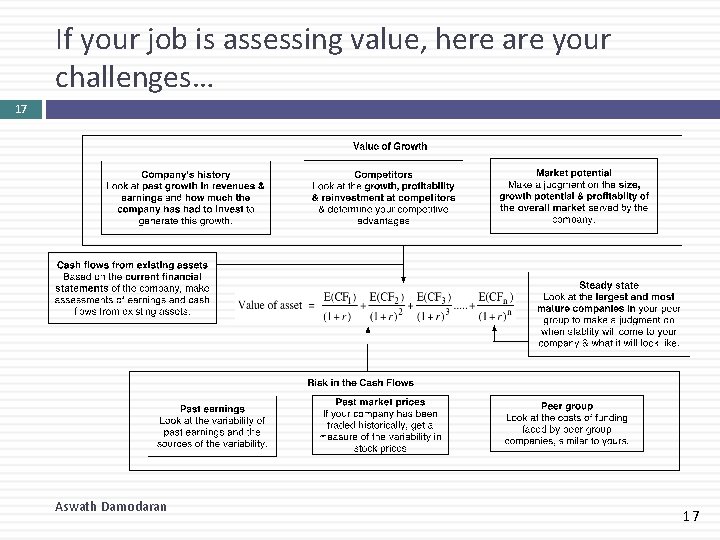
If your job is assessing value, here are your challenges… 17 Aswath Damodaran 17
18 Aswath Damodaran
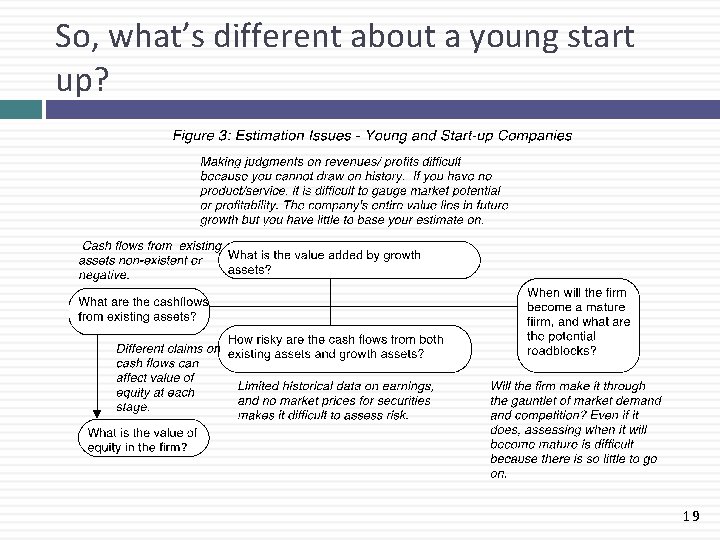
So, what’s different about a young start up? 19
The Dark Side will beckon. . Don’t be tempted. . 20 With young start up companies, you will be told that it is “too difficult” or even “impossible” to value these companies, because there is so little history and so much uncertainty in the future. Instead, you will be asked to come over to the “dark side”, where You will see value metrics that you have never seen before You will hear “macro” stories, justifying value You will be asked to play the momentum game While all of this behavior is understandable, none of it makes the uncertainty go away. You have a choice. You can either hide from uncertainty or face up to it. Aswath Damodaran 20
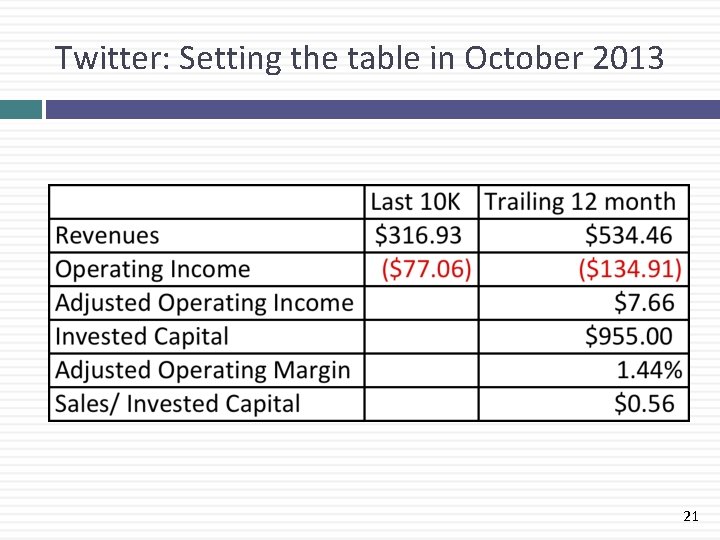
Twitter: Setting the table in October 2013 21
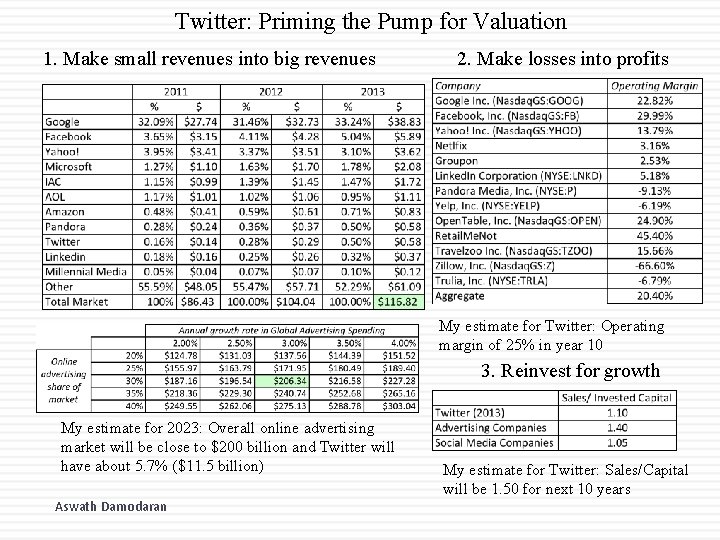
Twitter: Priming the Pump for Valuation 1. Make small revenues into big revenues 2. Make losses into profits My estimate for Twitter: Operating margin of 25% in year 10 3. Reinvest for growth My estimate for 2023: Overall online advertising market will be close to $200 billion and Twitter will have about 5. 7% ($11. 5 billion) Aswath Damodaran My estimate for Twitter: Sales/Capital will be 1. 50 for next 10 years
Sweating the small stuff: Risk and Required Return Risk in the discount rate My estimate for Twitter Cost of Capital: US - Nov ‘ 13 2 500 2 000 1 500 1 000 500 >1 2% % % -1 2 11 -1 1 10 10 % 9 - -9 % 8% -8 % 7% -7 % 6% <6 % 0 Survival Risk My assumption for Twitter 23
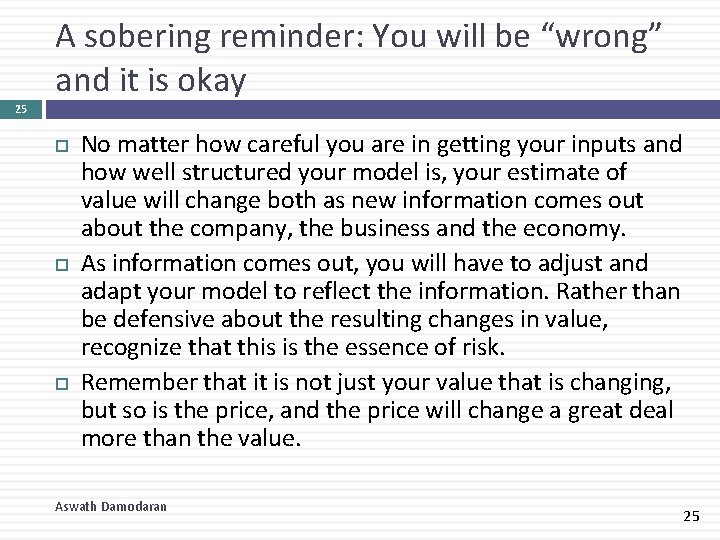
A sobering reminder: You will be “wrong” and it is okay 25 No matter how careful you are in getting your inputs and how well structured your model is, your estimate of value will change both as new information comes out about the company, the business and the economy. As information comes out, you will have to adjust and adapt your model to reflect the information. Rather than be defensive about the resulting changes in value, recognize that this is the essence of risk. Remember that it is not just your value that is changing, but so is the price, and the price will change a great deal more than the value. Aswath Damodaran 25
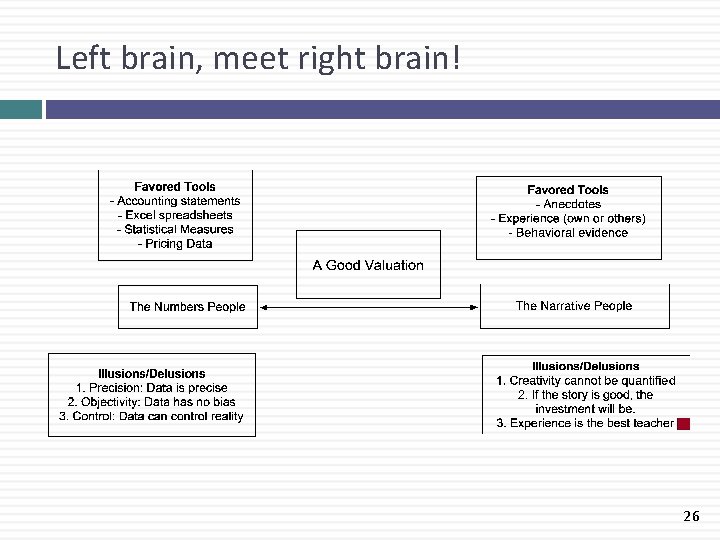
Left brain, meet right brain! 26
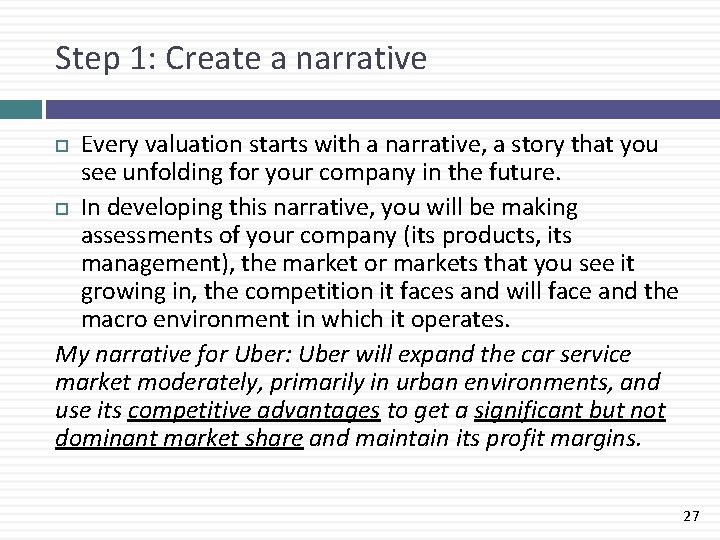
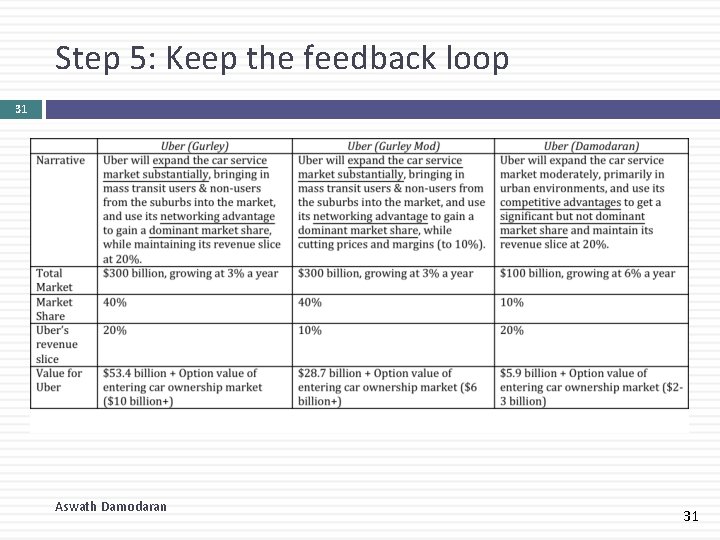
Step 1: Create a narrative Every valuation starts with a narrative, a story that you see unfolding for your company in the future. In developing this narrative, you will be making assessments of your company (its products, its management), the market or markets that you see it growing in, the competition it faces and will face and the macro environment in which it operates. My narrative for Uber: Uber will expand the car service market moderately, primarily in urban environments, and use its competitive advantages to get a significant but not dominant market share and maintain its profit margins. 27
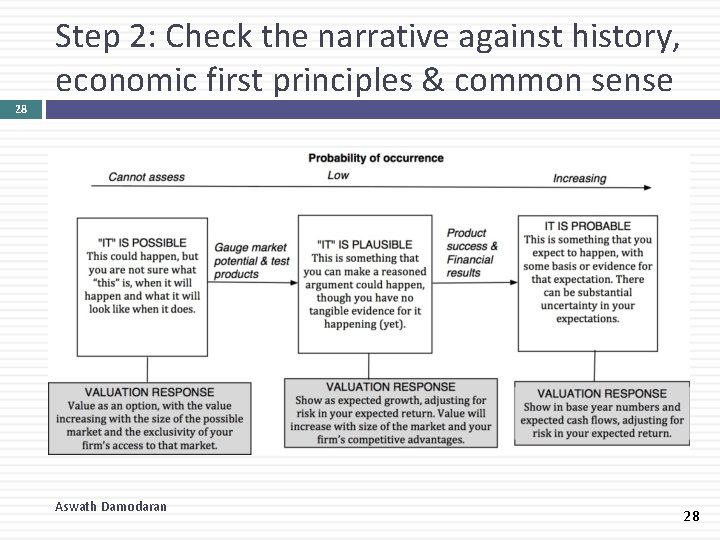
Step 2: Check the narrative against history, economic first principles & common sense 28 Aswath Damodaran 28
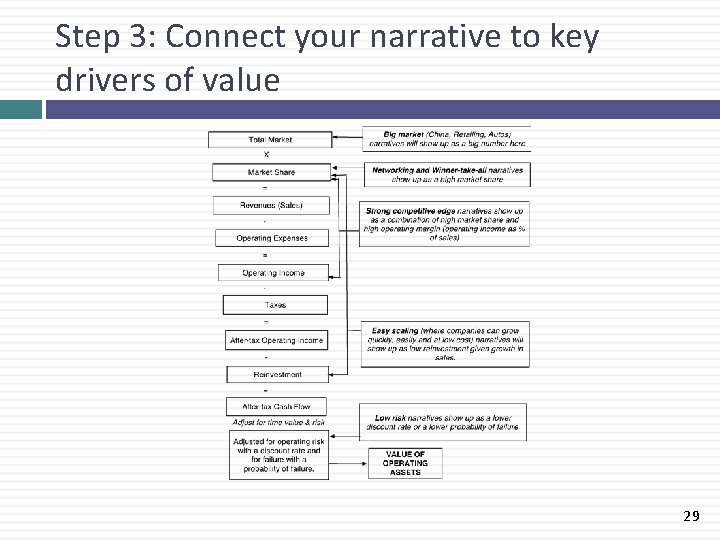
Step 3: Connect your narrative to key drivers of value 29
Step 4: Value the company 30 Aswath Damodaran 30
Step 5: Keep the feedback loop 31 Aswath Damodaran 31
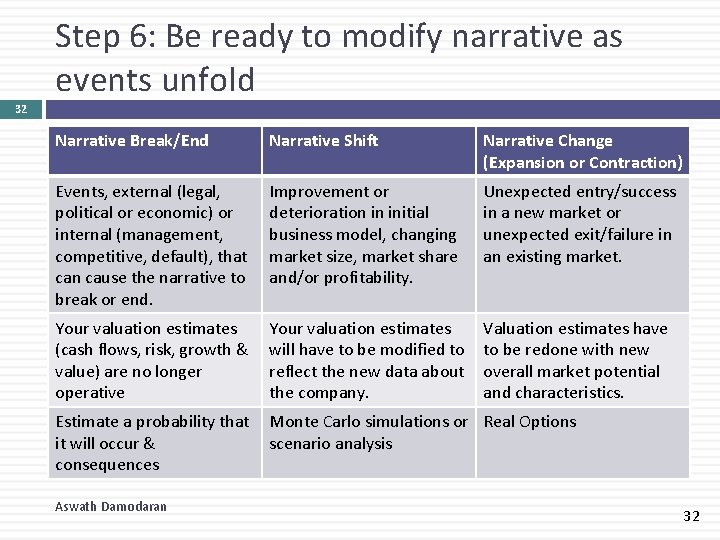
Step 6: Be ready to modify narrative as events unfold 32 Narrative Break/End Narrative Shift Narrative Change (Expansion or Contraction) Events, external (legal, political or economic) or internal (management, competitive, default), that can cause the narrative to break or end. Improvement or deterioration in initial business model, changing market size, market share and/or profitability. Unexpected entry/success in a new market or unexpected exit/failure in an existing market. Your valuation estimates (cash flows, risk, growth & value) are no longer operative Your valuation estimates will have to be modified to reflect the new data about the company. Valuation estimates have to be redone with new overall market potential and characteristics. Estimate a probability that it will occur & consequences Monte Carlo simulations or Real Options scenario analysis Aswath Damodaran 32
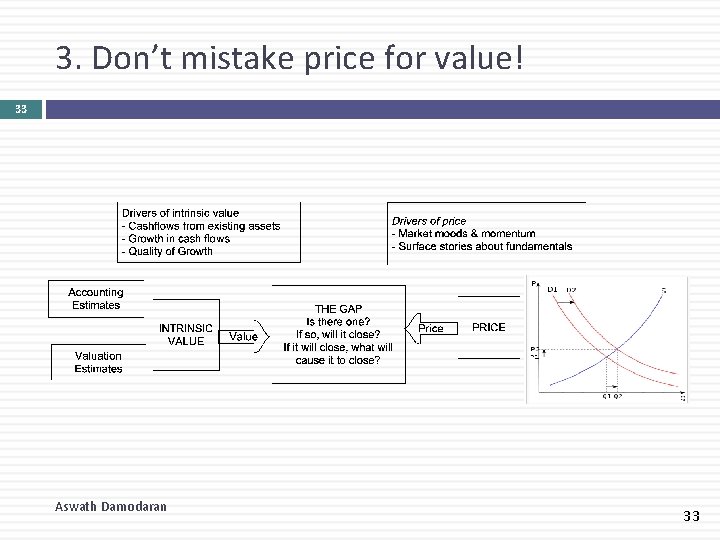
3. Don’t mistake price for value! 33 Aswath Damodaran 33
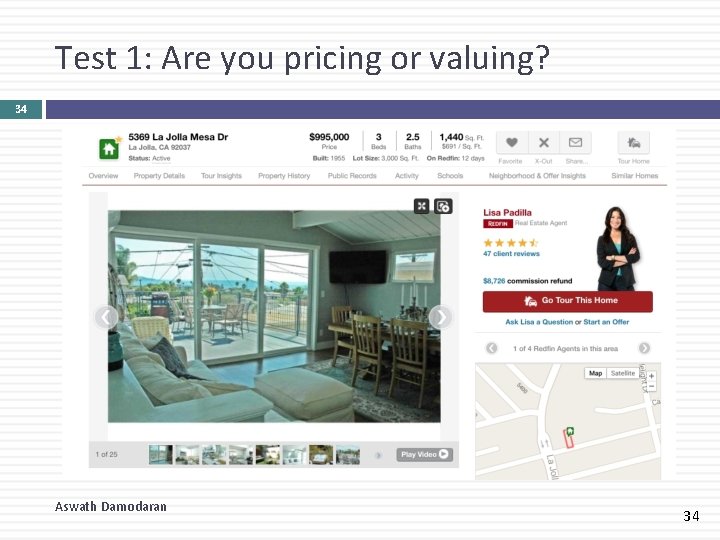
Test 1: Are you pricing or valuing? 34 Aswath Damodaran 34
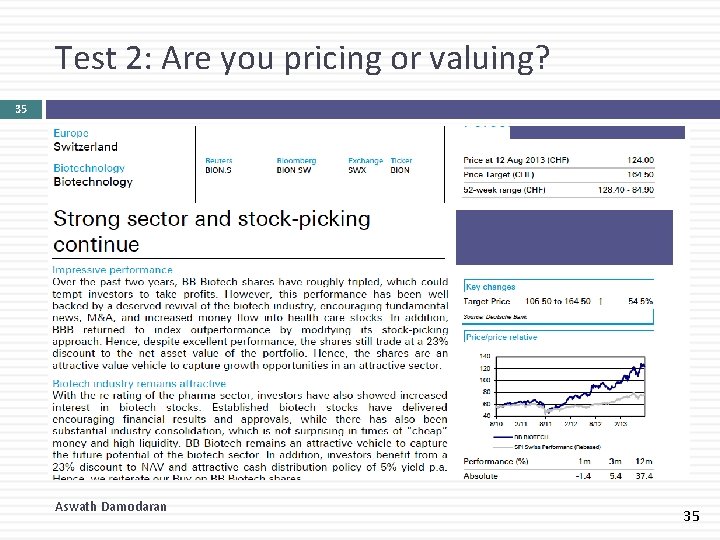
Test 2: Are you pricing or valuing? 35 Aswath Damodaran 35
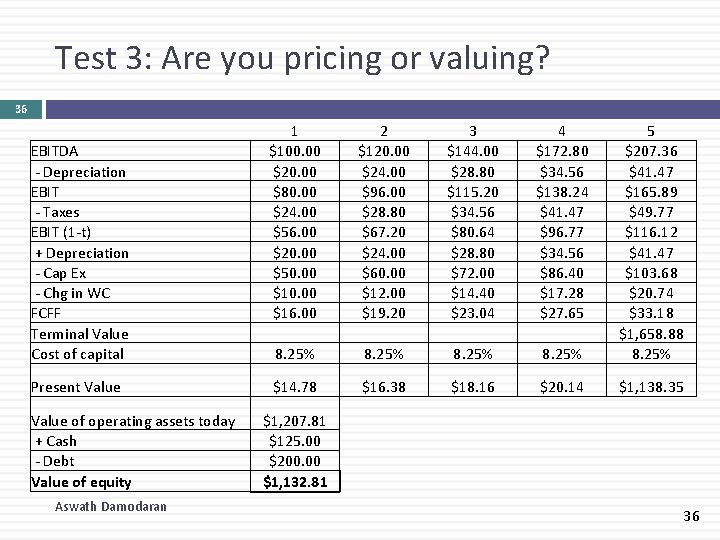
Test 3: Are you pricing or valuing? 36 EBITDA - Depreciation EBIT - Taxes EBIT (1 -t) + Depreciation - Cap Ex - Chg in WC FCFF Terminal Value Cost of capital Present Value of operating assets today + Cash - Debt Value of equity Aswath Damodaran 1 $100. 00 $20. 00 $80. 00 $24. 00 $56. 00 $20. 00 $50. 00 $16. 00 2 $120. 00 $24. 00 $96. 00 $28. 80 $67. 20 $24. 00 $60. 00 $12. 00 $19. 20 3 $144. 00 $28. 80 $115. 20 $34. 56 $80. 64 $28. 80 $72. 00 $14. 40 $23. 04 4 $172. 80 $34. 56 $138. 24 $41. 47 $96. 77 $34. 56 $86. 40 $17. 28 $27. 65 8. 25% 5 $207. 36 $41. 47 $165. 89 $49. 77 $116. 12 $41. 47 $103. 68 $20. 74 $33. 18 $1, 658. 88 8. 25% $14. 78 $16. 38 $18. 16 $20. 14 $1, 138. 35 $1, 207. 81 $125. 00 $200. 00 $1, 132. 81 36
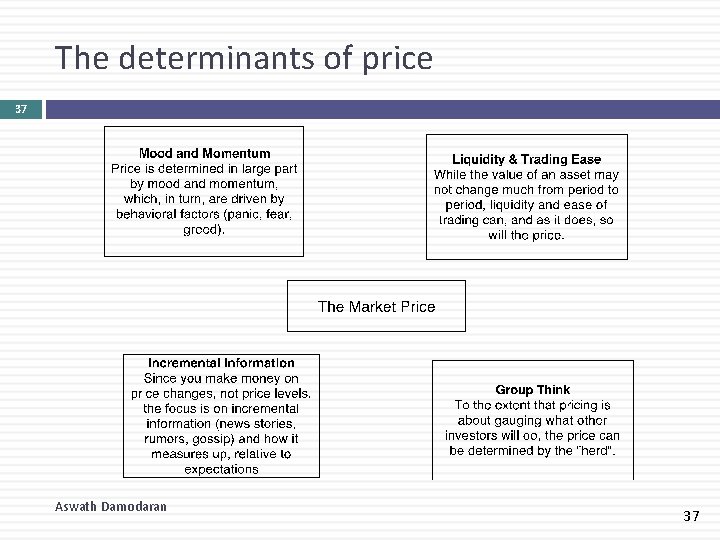
The determinants of price 37 Aswath Damodaran 37
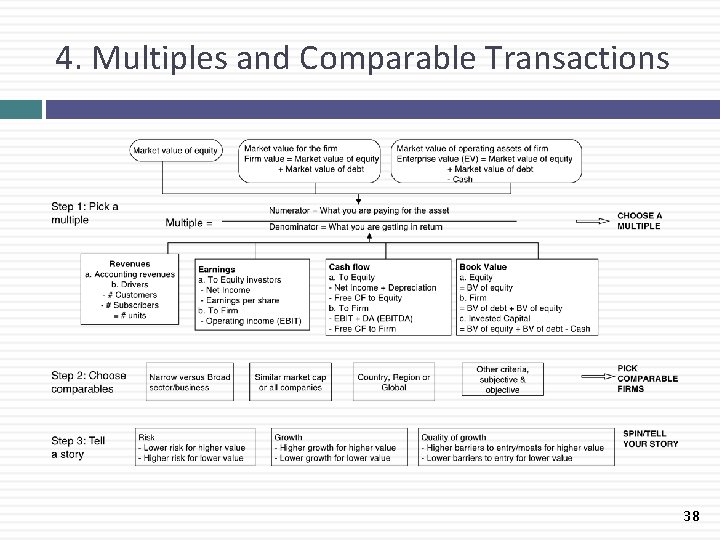
4. Multiples and Comparable Transactions 38
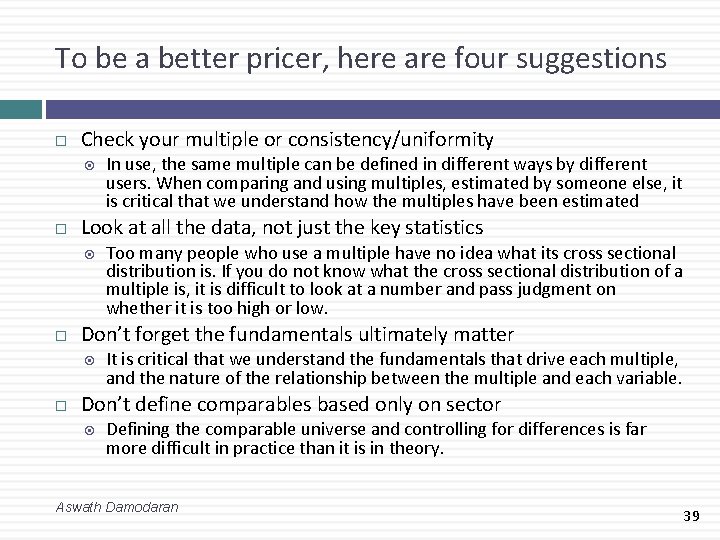
To be a better pricer, here are four suggestions Check your multiple or consistency/uniformity Look at all the data, not just the key statistics Too many people who use a multiple have no idea what its cross sectional distribution is. If you do not know what the cross sectional distribution of a multiple is, it is difficult to look at a number and pass judgment on whether it is too high or low. Don’t forget the fundamentals ultimately matter In use, the same multiple can be defined in different ways by different users. When comparing and using multiples, estimated by someone else, it is critical that we understand how the multiples have been estimated It is critical that we understand the fundamentals that drive each multiple, and the nature of the relationship between the multiple and each variable. Don’t define comparables based only on sector Defining the comparable universe and controlling for differences is far more difficult in practice than it is in theory. Aswath Damodaran 39
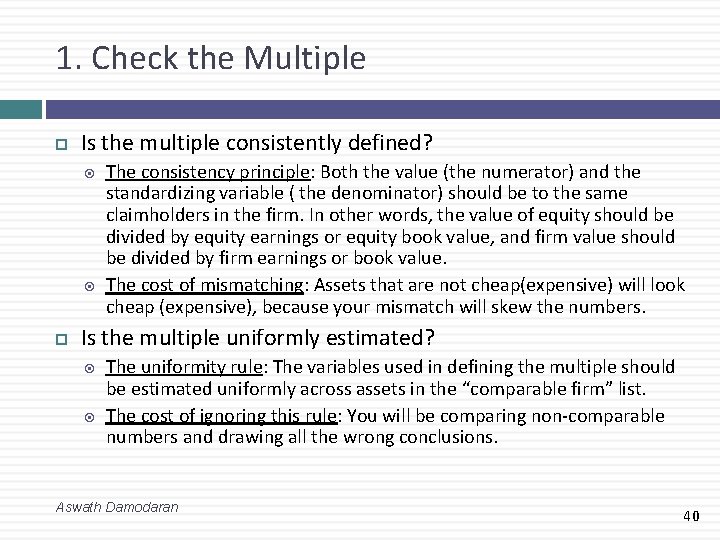
1. Check the Multiple Is the multiple consistently defined? The consistency principle: Both the value (the numerator) and the standardizing variable ( the denominator) should be to the same claimholders in the firm. In other words, the value of equity should be divided by equity earnings or equity book value, and firm value should be divided by firm earnings or book value. The cost of mismatching: Assets that are not cheap(expensive) will look cheap (expensive), because your mismatch will skew the numbers. Is the multiple uniformly estimated? The uniformity rule: The variables used in defining the multiple should be estimated uniformly across assets in the “comparable firm” list. The cost of ignoring this rule: You will be comparing non-comparable numbers and drawing all the wrong conclusions. Aswath Damodaran 40
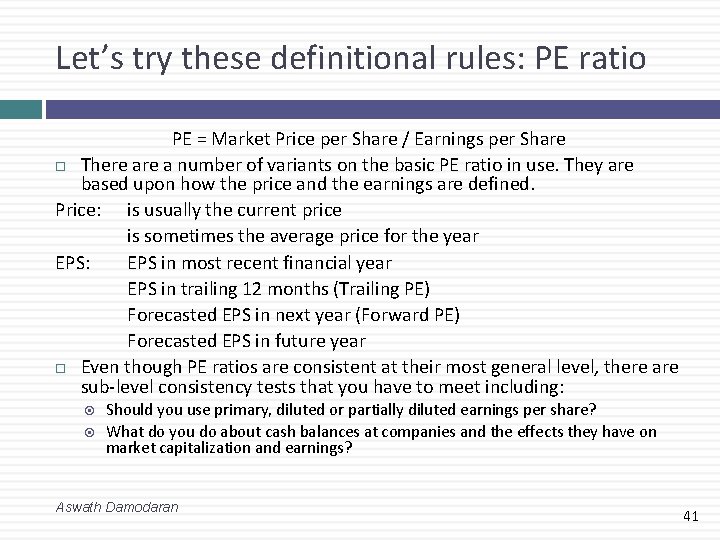
Let’s try these definitional rules: PE ratio PE = Market Price per Share / Earnings per Share There a number of variants on the basic PE ratio in use. They are based upon how the price and the earnings are defined. Price: is usually the current price is sometimes the average price for the year EPS: EPS in most recent financial year EPS in trailing 12 months (Trailing PE) Forecasted EPS in next year (Forward PE) Forecasted EPS in future year Even though PE ratios are consistent at their most general level, there are sub-level consistency tests that you have to meet including: Should you use primary, diluted or partially diluted earnings per share? What do you do about cash balances at companies and the effects they have on market capitalization and earnings? Aswath Damodaran 41
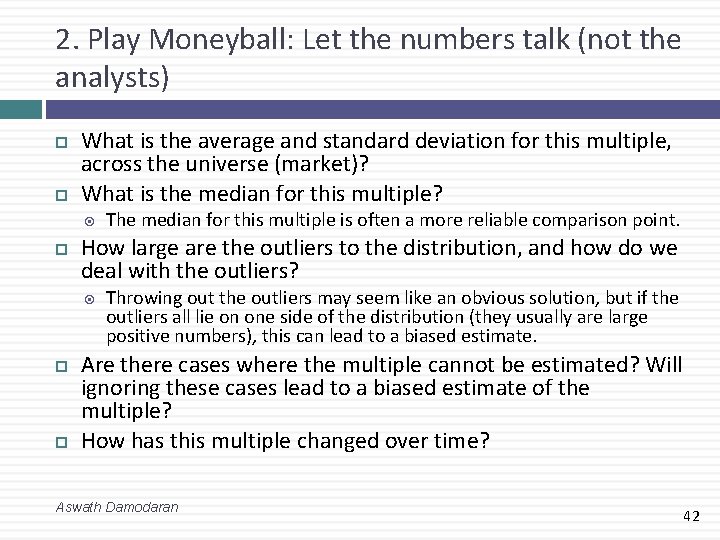
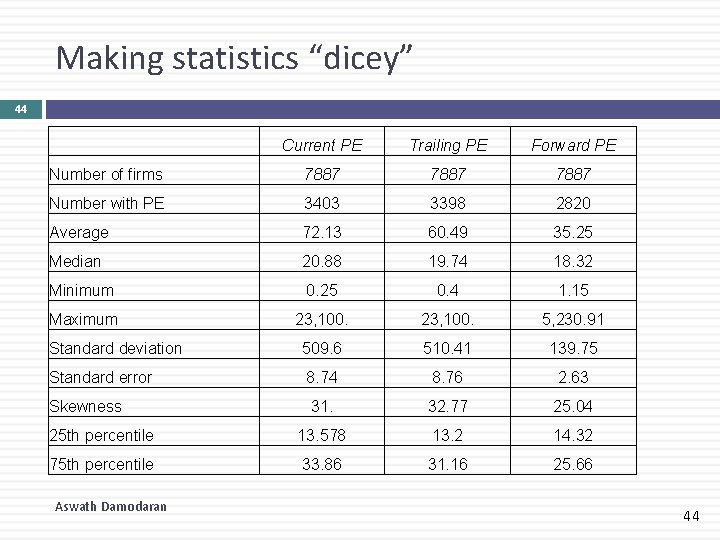
2. Play Moneyball: Let the numbers talk (not the analysts) What is the average and standard deviation for this multiple, across the universe (market)? What is the median for this multiple? How large are the outliers to the distribution, and how do we deal with the outliers? The median for this multiple is often a more reliable comparison point. Throwing out the outliers may seem like an obvious solution, but if the outliers all lie on one side of the distribution (they usually are large positive numbers), this can lead to a biased estimate. Are there cases where the multiple cannot be estimated? Will ignoring these cases lead to a biased estimate of the multiple? How has this multiple changed over time? Aswath Damodaran 42
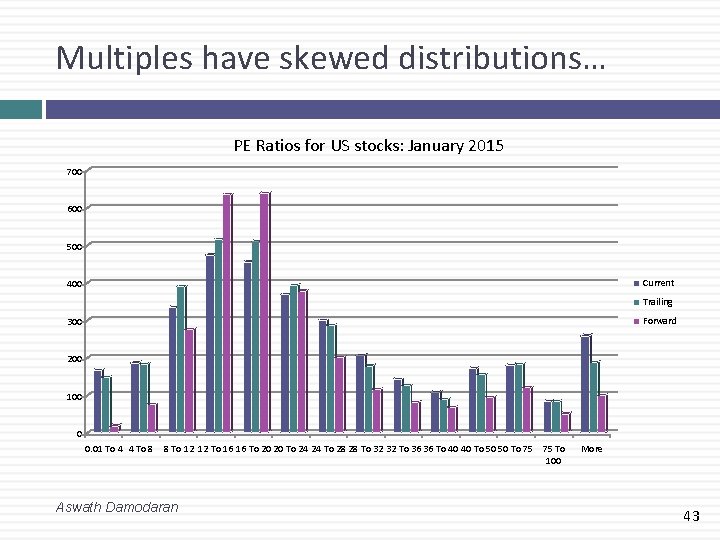
Multiples have skewed distributions… PE Ratios for US stocks: January 2015 700 600 500 Current 400 Trailing Forward 300 200 100 0 0. 01 To 4 4 To 8 8 To 12 12 To 16 16 To 20 20 To 24 24 To 28 28 To 32 32 To 36 36 To 40 40 To 50 50 To 75 75 To 100 Aswath Damodaran More 43
Making statistics “dicey” 44 Current PE Trailing PE Forward PE Number of firms 7887 Number with PE 3403 3398 2820 Average 72. 13 60. 49 35. 25 Median 20. 88 19. 74 18. 32 Minimum 0. 25 0. 4 1. 15 Maximum 23, 100. 5, 230. 91 Standard deviation 509. 6 510. 41 139. 75 Standard error 8. 74 8. 76 2. 63 Skewness 31. 32. 77 25. 04 25 th percentile 13. 578 13. 2 14. 32 75 th percentile 33. 86 31. 16 25. 66 Aswath Damodaran 44
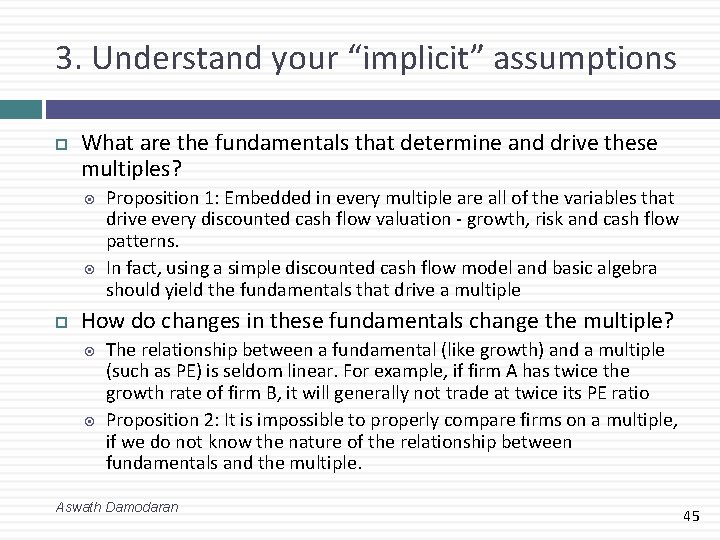
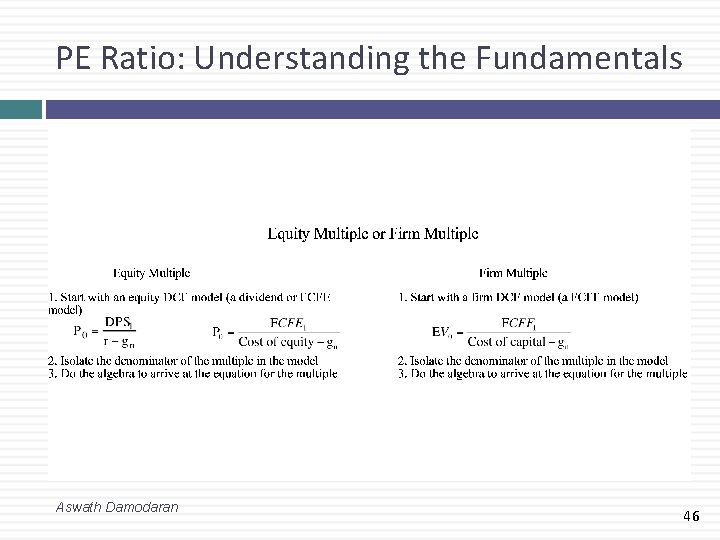
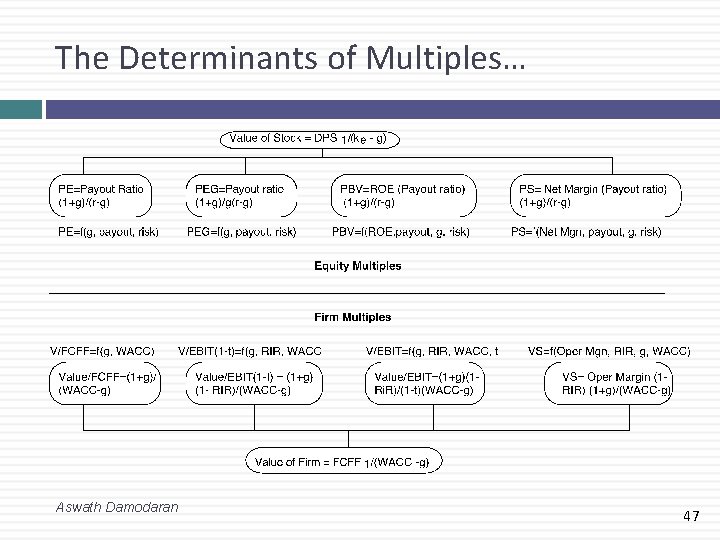
3. Understand your “implicit” assumptions What are the fundamentals that determine and drive these multiples? Proposition 1: Embedded in every multiple are all of the variables that drive every discounted cash flow valuation - growth, risk and cash flow patterns. In fact, using a simple discounted cash flow model and basic algebra should yield the fundamentals that drive a multiple How do changes in these fundamentals change the multiple? The relationship between a fundamental (like growth) and a multiple (such as PE) is seldom linear. For example, if firm A has twice the growth rate of firm B, it will generally not trade at twice its PE ratio Proposition 2: It is impossible to properly compare firms on a multiple, if we do not know the nature of the relationship between fundamentals and the multiple. Aswath Damodaran 45
PE Ratio: Understanding the Fundamentals Aswath Damodaran 46
The Determinants of Multiples… Aswath Damodaran 47
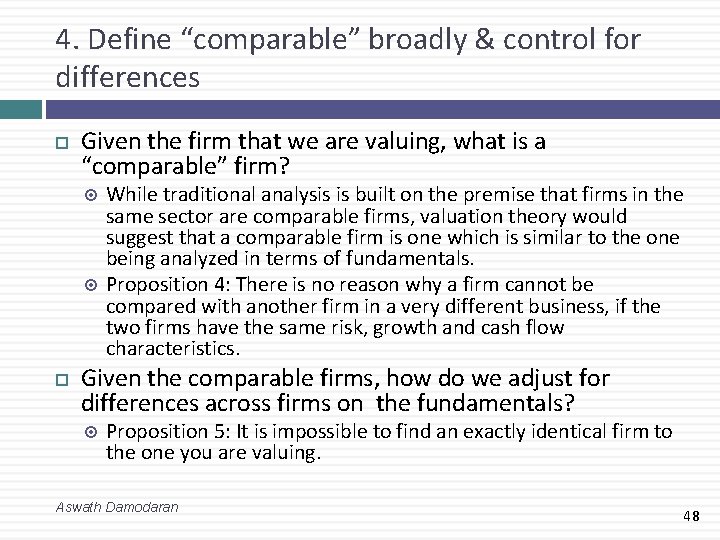
4. Define “comparable” broadly & control for differences Given the firm that we are valuing, what is a “comparable” firm? While traditional analysis is built on the premise that firms in the same sector are comparable firms, valuation theory would suggest that a comparable firm is one which is similar to the one being analyzed in terms of fundamentals. Proposition 4: There is no reason why a firm cannot be compared with another firm in a very different business, if the two firms have the same risk, growth and cash flow characteristics. Given the comparable firms, how do we adjust for differences across firms on the fundamentals? Proposition 5: It is impossible to find an exactly identical firm to the one you are valuing. Aswath Damodaran 48
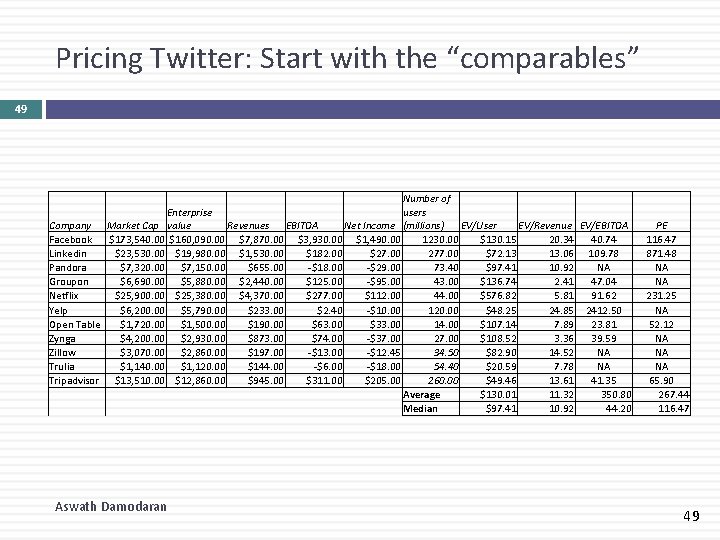
Pricing Twitter: Start with the “comparables” 49 Number of users Enterprise Company Market Cap value Revenues EBITDA Net Income (millions) EV/User EV/Revenue EV/EBITDA Facebook $173, 540. 00 $160, 090. 00 $7, 870. 00 $3, 930. 00 $1, 490. 00 1230. 00 $130. 15 20. 34 40. 74 Linkedin $23, 530. 00 $19, 980. 00 $1, 530. 00 $182. 00 $27. 00 277. 00 $72. 13 13. 06 109. 78 Pandora $7, 320. 00 $7, 150. 00 $655. 00 -$18. 00 -$29. 00 73. 40 $97. 41 10. 92 NA Groupon $6, 690. 00 $5, 880. 00 $2, 440. 00 $125. 00 -$95. 00 43. 00 $136. 74 2. 41 47. 04 Netflix $25, 900. 00 $25, 380. 00 $4, 370. 00 $277. 00 $112. 00 44. 00 $576. 82 5. 81 91. 62 Yelp $6, 200. 00 $5, 790. 00 $233. 00 $2. 40 -$10. 00 120. 00 $48. 25 24. 85 2412. 50 Open Table $1, 720. 00 $1, 500. 00 $190. 00 $63. 00 $33. 00 14. 00 $107. 14 7. 89 23. 81 Zynga $4, 200. 00 $2, 930. 00 $873. 00 $74. 00 -$37. 00 27. 00 $108. 52 3. 36 39. 59 Zillow $3, 070. 00 $2, 860. 00 $197. 00 -$13. 00 -$12. 45 34. 50 $82. 90 14. 52 NA Trulia $1, 140. 00 $1, 120. 00 $144. 00 -$6. 00 -$18. 00 54. 40 $20. 59 7. 78 NA Tripadvisor $13, 510. 00 $12, 860. 00 $945. 00 $311. 00 $205. 00 260. 00 $49. 46 13. 61 41. 35 Average $130. 01 11. 32 350. 80 Median $97. 41 10. 92 44. 20 Aswath Damodaran PE 116. 47 871. 48 NA NA 231. 25 NA 52. 12 NA NA NA 65. 90 267. 44 116. 47 49
Read the tea leaves: See what the market cares about 50 Market Cap Enterprise value Revenues EBITDA Net Income Number of users (millions) 1. Enterprise value 0. 9998 1. Revenues 0. 8933 0. 8966 1. EBITDA 0. 9709 0. 9701 0. 8869 1. Net Income 0. 8978 0. 8971 0. 8466 0. 9716 1. Number of users (millions) 0. 9812 0. 9789 0. 8053 0. 9354 0. 8453 1. Twitter had 240 million users at the time of its IPO. What price would you attach to the company? Aswath Damodaran 50
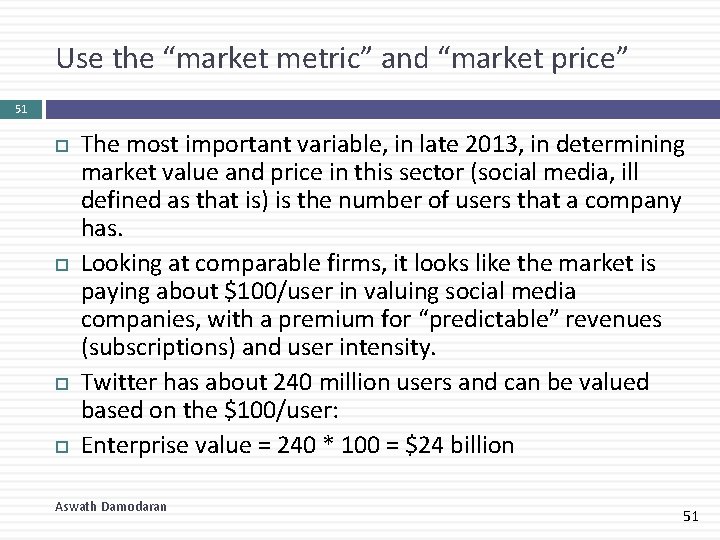
Use the “market metric” and “market price” 51 The most important variable, in late 2013, in determining market value and price in this sector (social media, ill defined as that is) is the number of users that a company has. Looking at comparable firms, it looks like the market is paying about $100/user in valuing social media companies, with a premium for “predictable” revenues (subscriptions) and user intensity. Twitter has about 240 million users and can be valued based on the $100/user: Enterprise value = 240 * 100 = $24 billion Aswath Damodaran 51
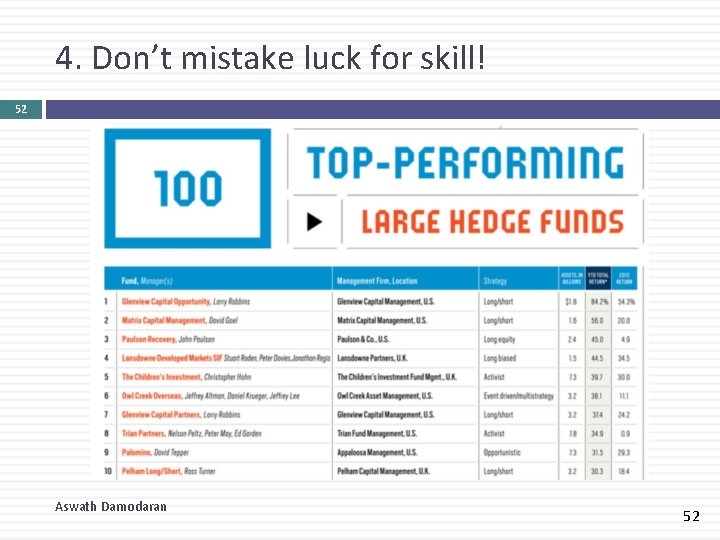
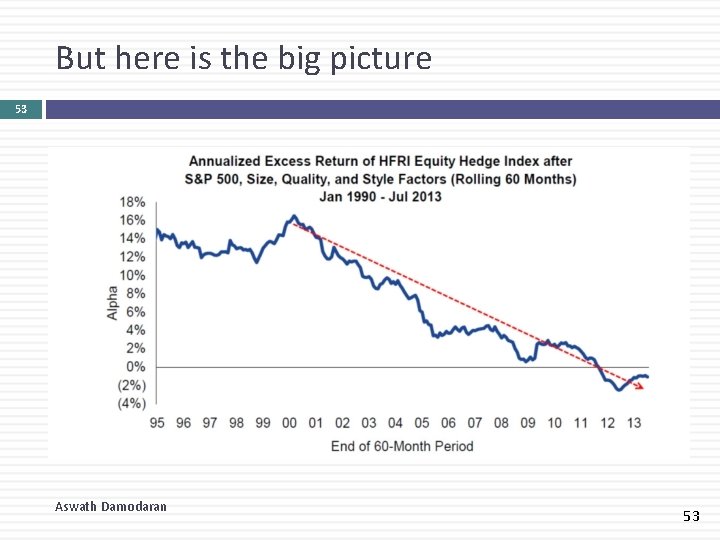
4. Don’t mistake luck for skill! 52 Aswath Damodaran 52
But here is the big picture 53 Aswath Damodaran 53
The Impossible Quest: Searching for “smart” money 54 We are constantly told that there is “smart” money out there, i. e. , investors who have figured out ways to beat the market consistently. Can you name one category of investors that you would list as “smart” money? Can you name individual investors that you would call “smart” money” It is every active investor’s dream to be one of the “smart money” group. What do you need to bring to the game to have a good chance of succeeding? a. b. c. d. e. f. Lots of money to invest Smarts (High IQ, College Pedigree) Information access (Better data, More data, Proprietary data) Information processing (Better models, Bigger computers) Trading platform (High speed trading) Something else (What? ) Aswath Damodaran 54
And the final lesson. . Aswath Damodaran 55