
ASTROPHYSICS Physical properties of star 1 SIZE spherical


- Slides: 23
ASTROPHYSICS
Physical properties of star 1. SIZE spherical depends on mass, temperature, gravity & age Range- 0. 2 R to 220 R, R- solar radius = 6. 96 x 108 m [ calculated using stefan’s law]
Physical properties of star 2. MASS: Range- 0. 1 M to 50 M M – solar mass =1. 99 x 1039 [ Keppler’s iii law]
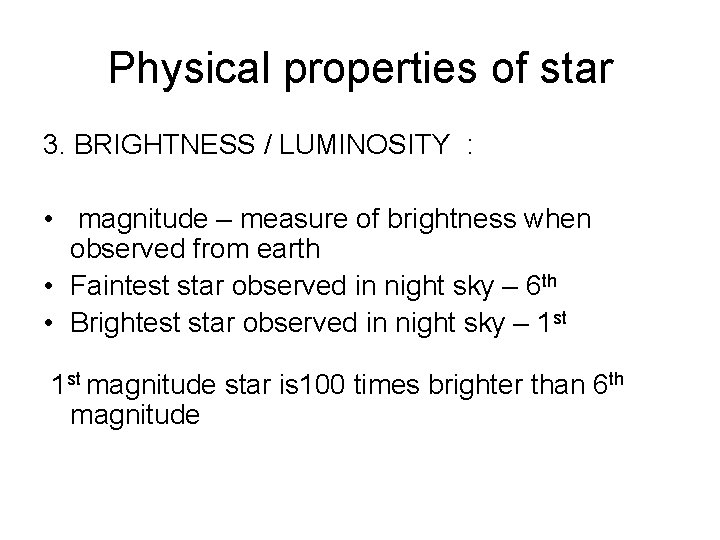
Physical properties of star 3. BRIGHTNESS / LUMINOSITY : • magnitude – measure of brightness when observed from earth • Faintest star observed in night sky – 6 th • Brightest star observed in night sky – 1 st magnitude star is 100 times brighter than 6 th magnitude
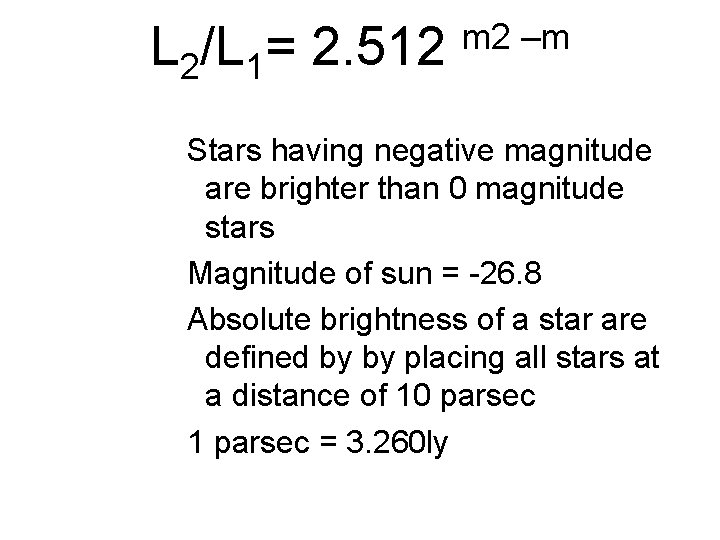
L 2/L 1= 2. 512 m 2 –m Stars having negative magnitude are brighter than 0 magnitude stars Magnitude of sun = -26. 8 Absolute brightness of a star are defined by by placing all stars at a distance of 10 parsec 1 parsec = 3. 260 ly
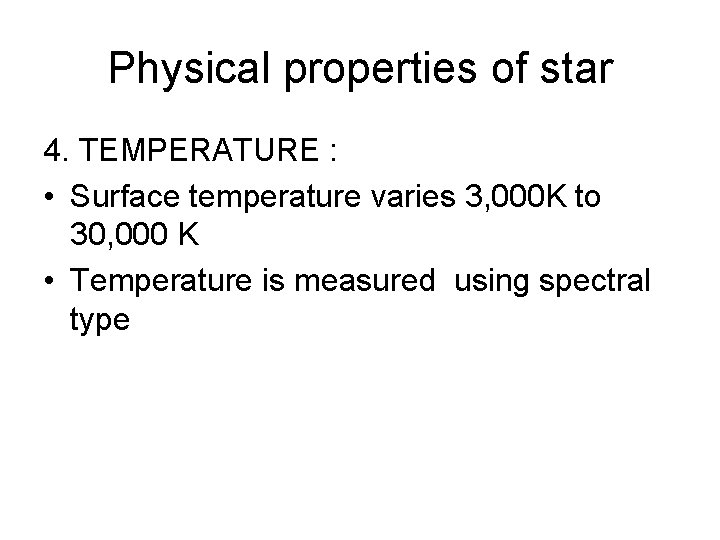
Physical properties of star 4. TEMPERATURE : • Surface temperature varies 3, 000 K to 30, 000 K • Temperature is measured using spectral type
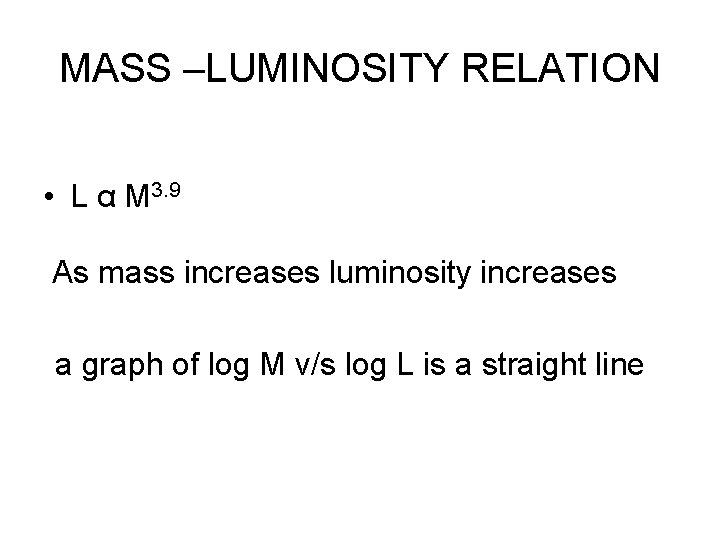
MASS –LUMINOSITY RELATION • L α M 3. 9 As mass increases luminosity increases a graph of log M v/s log L is a straight line
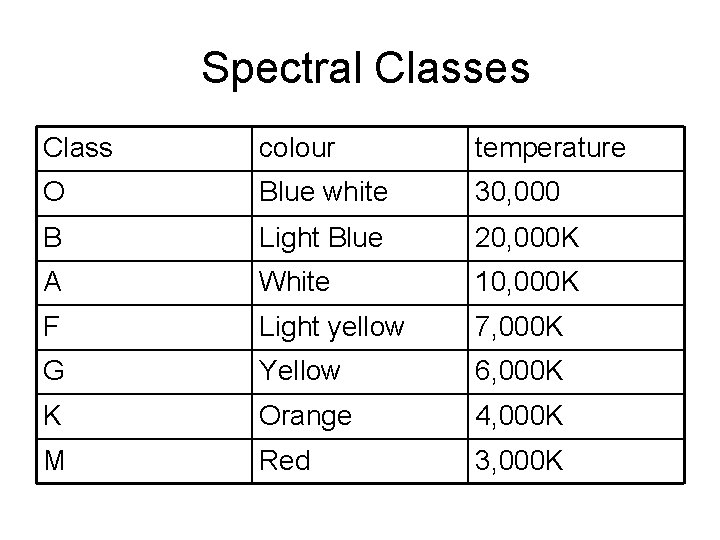
Spectral Classes Class colour temperature O Blue white 30, 000 B Light Blue 20, 000 K A White 10, 000 K F Light yellow 7, 000 K G Yellow 6, 000 K K Orange 4, 000 K M Red 3, 000 K
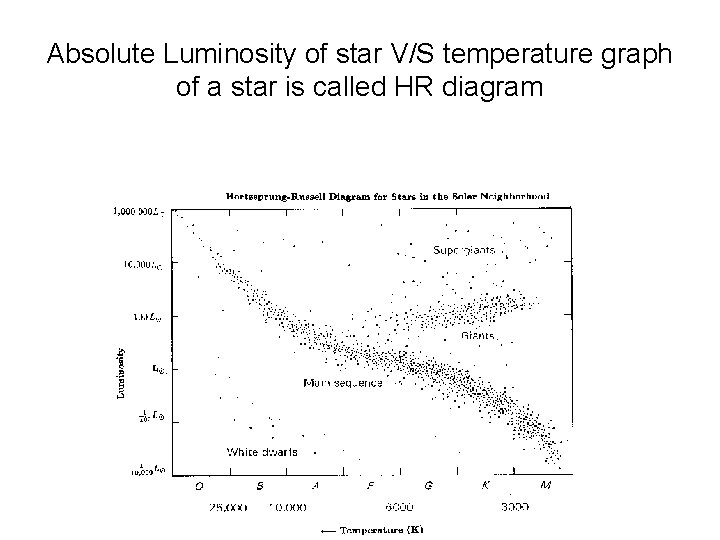
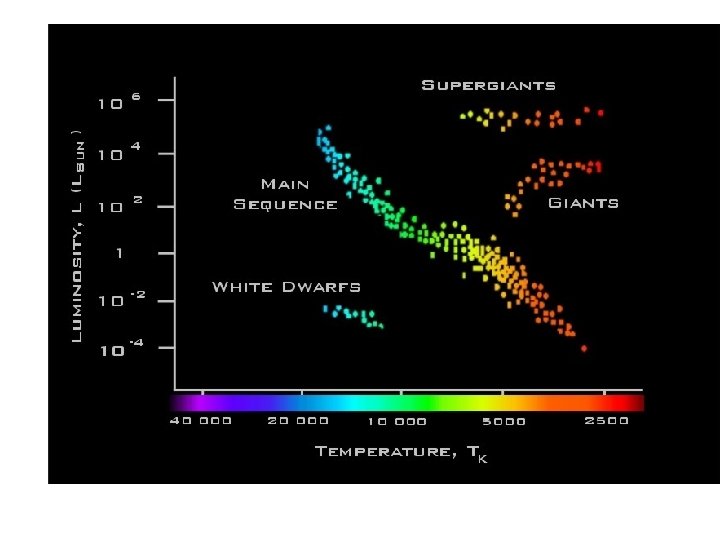
Absolute Luminosity of star V/S temperature graph of a star is called HR diagram
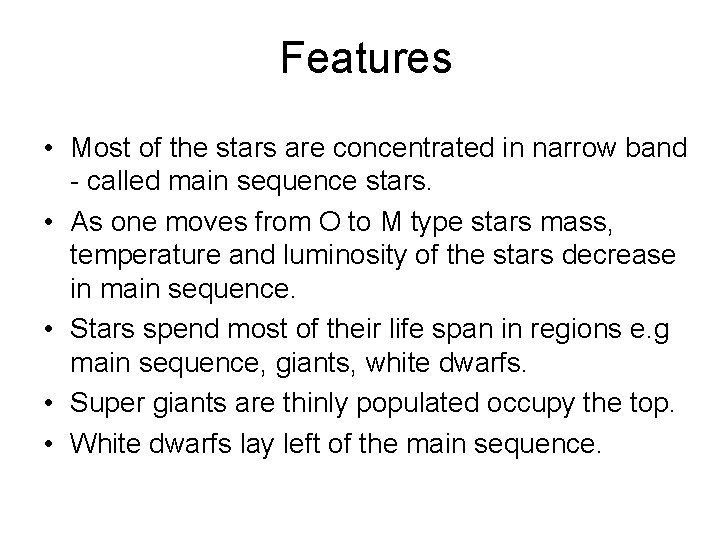
Features • Most of the stars are concentrated in narrow band - called main sequence stars. • As one moves from O to M type stars mass, temperature and luminosity of the stars decrease in main sequence. • Stars spend most of their life span in regions e. g main sequence, giants, white dwarfs. • Super giants are thinly populated occupy the top. • White dwarfs lay left of the main sequence.
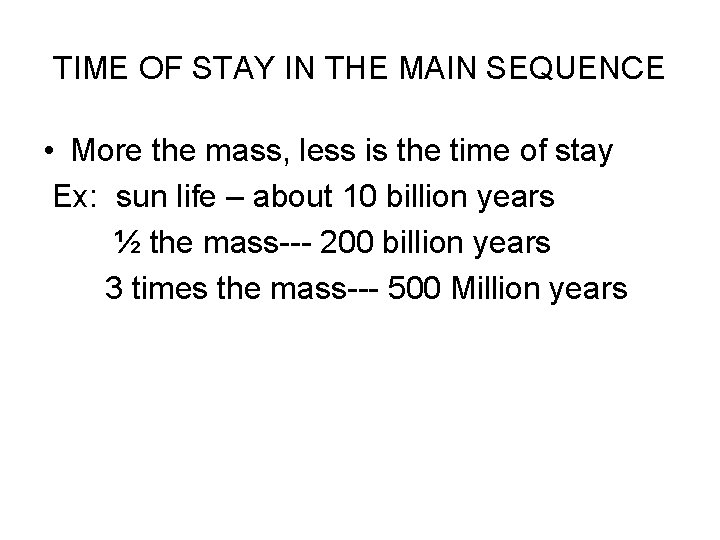
TIME OF STAY IN THE MAIN SEQUENCE • More the mass, less is the time of stay Ex: sun life – about 10 billion years ½ the mass--- 200 billion years 3 times the mass--- 500 Million years
Internal Temperature and Pressure of a Star • Pressure and the temperature are maximum at the stellar core and decrease towards the surface of the star.
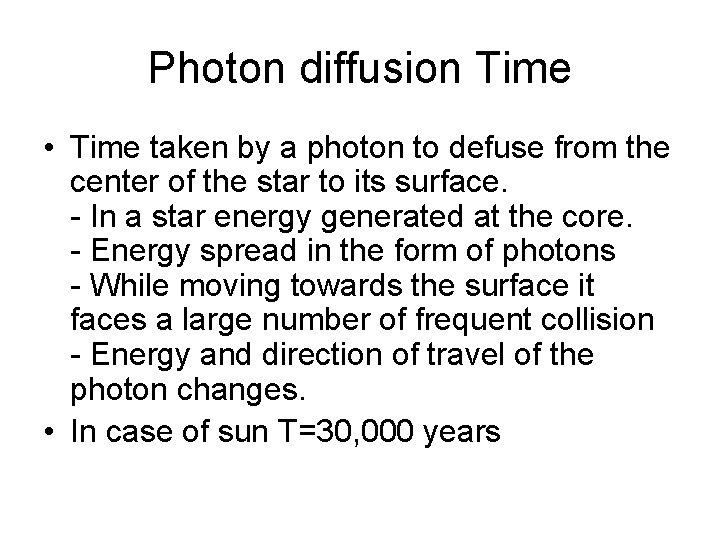
Photon diffusion Time • Time taken by a photon to defuse from the center of the star to its surface. - In a star energy generated at the core. - Energy spread in the form of photons - While moving towards the surface it faces a large number of frequent collision - Energy and direction of travel of the photon changes. • In case of sun T=30, 000 years
Stellar Evolution
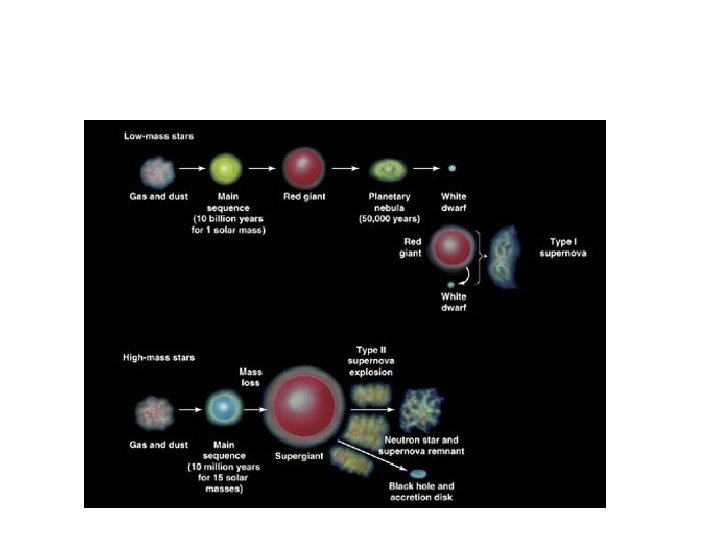
1. Proto star • Large cloud of interstellar dust and gases mostly hydrogen compressed due to gravitational force. • High pressure and temperature are produced. • Nuclear fusion of hydrogen starts. • Gravitational contraction is balanced by outward pressure.
Helium Star • As hydrogen fuel is exhausted, energy generation decreases • - star begins to contract. • Temperature increases and star becomes very hot. • Helium atoms begins to fuse to form carbon.
Red giant • Fusion of helium continues at the centre. • Heat generated at the core expands the outer layer enormously ( 10 to 20 times the size of the sun ) • This cools the outer layer. • So star appears reddish and dim.
White dwarf • After spending millions of years in red giant stage carbon fuses. • Radiation oozes the outer layer of the star. • As a result generation of energy further decreases, star collapses further. • Star sinks and acquire high density and high temperature. • This is the end stage of the star. l
Chandrashekhar limit • If mass of the star at birth < 1. 4 Mo star ends with white dwarf stage. • If mass of the star at the time of its birth > 1. 4 Mo the core of the star collapses further, temperature and pressure increases enormously results in explosion called supernova.
• Debris of supernova has high temperature and pressure that electrons and protons fused into neutron called neutron star. • If the mass of the neutron star > 5 Mo it further collapses under its own gravity. • Any radiation entering this mass can not come out. Which sucks everything like a hole- black hole.
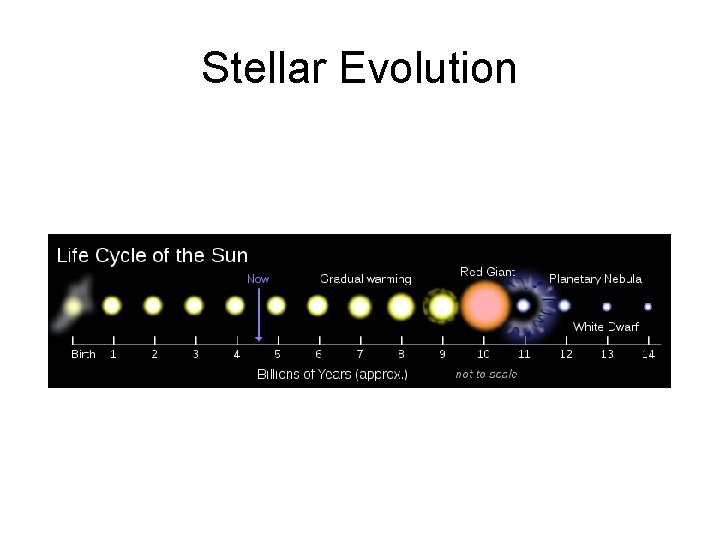
Stellar Evolution