
Astrophysics of Planetary Systems Harvard 18 May 2004
- Slides: 15
“Astrophysics of Planetary Systems” Harvard 18 May 2004 The Nature of Turbulence in Protoplanetary Disks Jeremy Goodman Princeton University jeremy@astro. princeton. edu
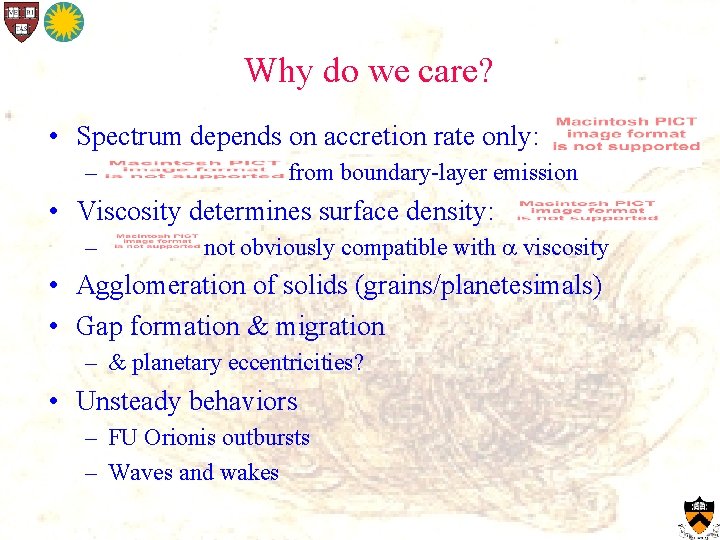
Why do we care? • Spectrum depends on accretion rate only: – from boundary-layer emission • Viscosity determines surface density: – not obviously compatible with viscosity • Agglomeration of solids (grains/planetesimals) • Gap formation & migration – & planetary eccentricities? • Unsteady behaviors – FU Orionis outbursts – Waves and wakes
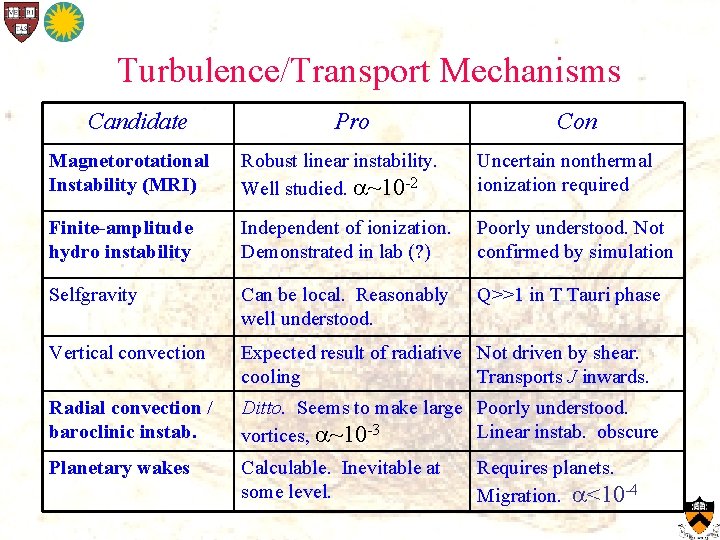
Turbulence/Transport Mechanisms Candidate Pro Con Magnetorotational Instability (MRI) Robust linear instability. Well studied. ~10 -2 Uncertain nonthermal ionization required Finite-amplitude hydro instability Independent of ionization. Demonstrated in lab (? ) Poorly understood. Not confirmed by simulation Selfgravity Can be local. Reasonably well understood. Q>>1 in T Tauri phase Vertical convection Expected result of radiative Not driven by shear. cooling Transports J inwards. Radial convection / baroclinic instab. Ditto. Seems to make large Poorly understood. Linear instab. obscure vortices, ~10 -3 Planetary wakes Calculable. Inevitable at some level. Requires planets. Migration. <10 -4
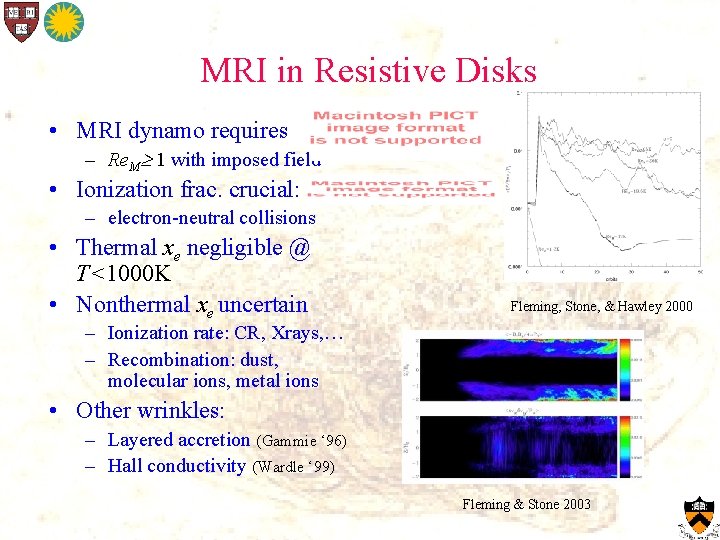
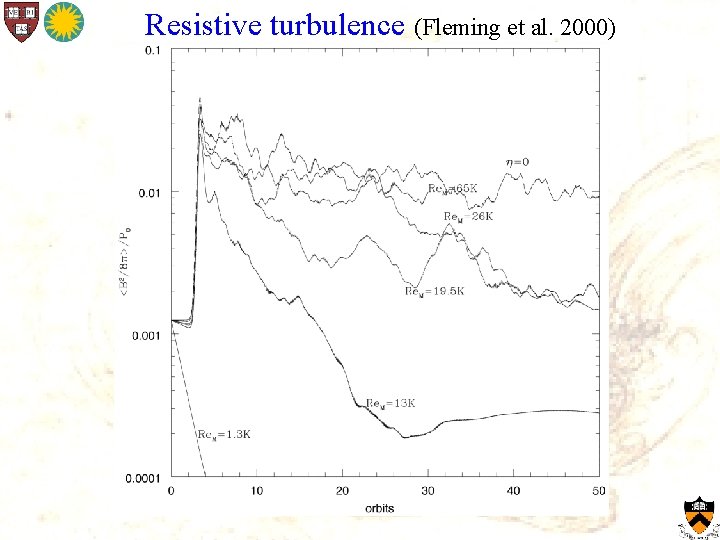
MRI in Resistive Disks • MRI dynamo requires – Re. M 1 with imposed field • Ionization frac. crucial: – electron-neutral collisions • Thermal xe negligible @ T<1000 K • Nonthermal xe uncertain Fleming, Stone, & Hawley 2000 – Ionization rate: CR, Xrays, … – Recombination: dust, molecular ions, metal ions • Other wrinkles: – Layered accretion (Gammie ‘ 96) – Hall conductivity (Wardle ‘ 99) Fleming & Stone 2003
Resistive turbulence (Fleming et al. 2000)
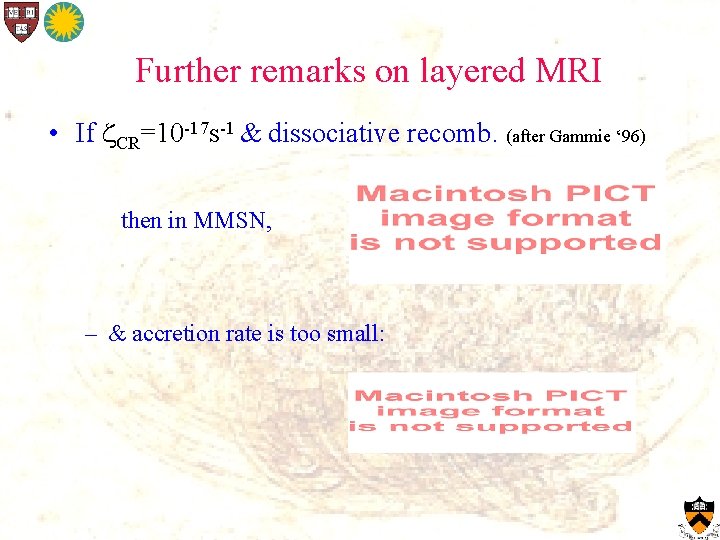
Further remarks on layered MRI • If CR=10 -17 s-1 & dissociative recomb. (after Gammie ‘ 96) then in MMSN, – & accretion rate is too small:
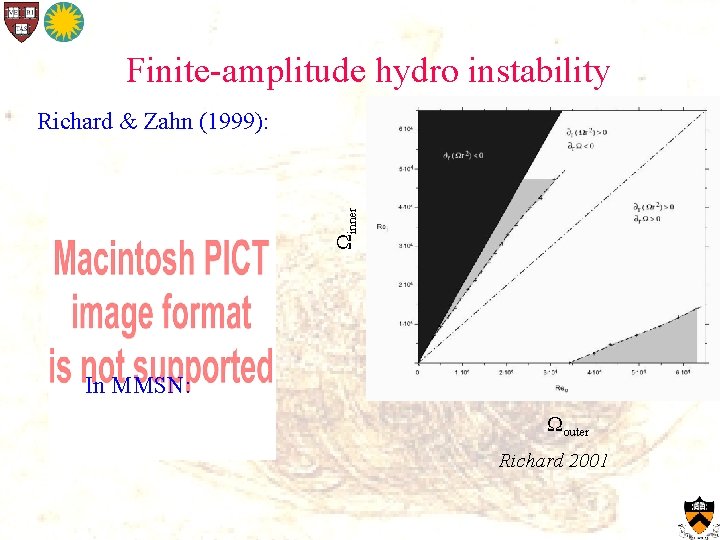
Finite-amplitude hydro instability inner Richard & Zahn (1999): In MMSN: outer Richard 2001
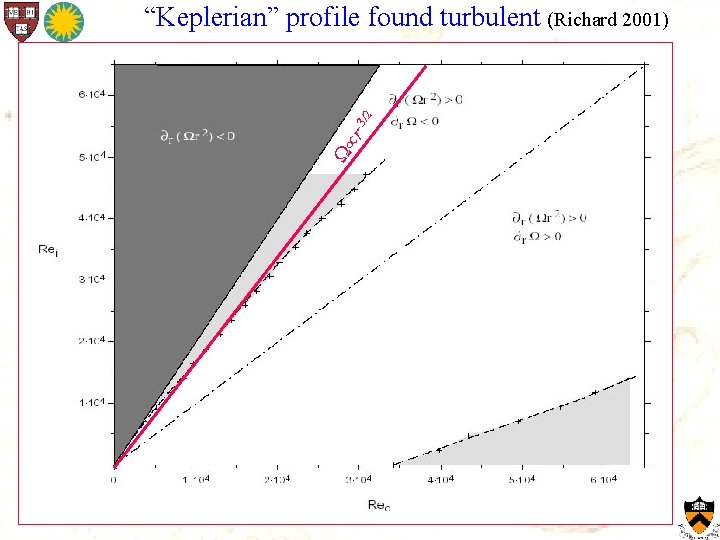
r -3/2 “Keplerian” profile found turbulent (Richard 2001)
Objections to FAHI • Nonlocal: r not H is the lengthscale – H > r >> r in experiments – H << r ≈ r in accretion disks • Also compressible • No local linear instability for – But e. g. pipe flow is also linearly stable • Not found in local (shearing-sheet) simulations – But viscosity is explicitly nonlocal – Resolution or numerical Re may be inadequate • E. g. Longaretti 2002 • Doesn’t explain outbursts (e. g. dwarf novae)
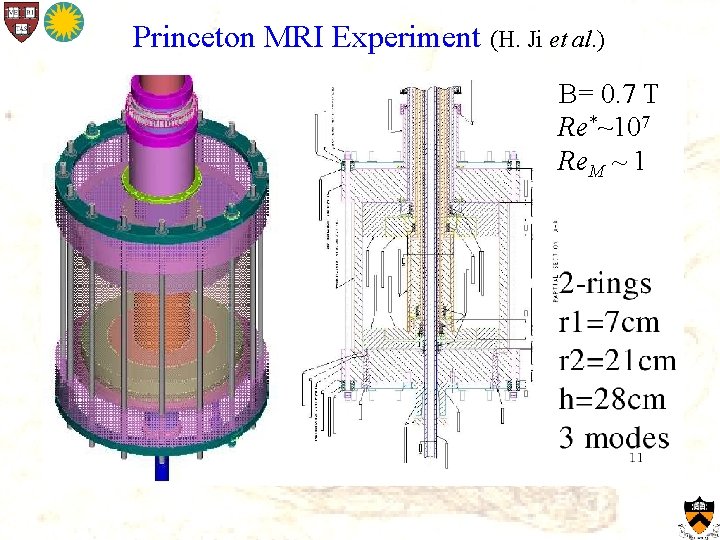
Princeton MRI Experiment (H. Ji et al. ) B= 0. 7 T Re*~107 Re. M ~ 1
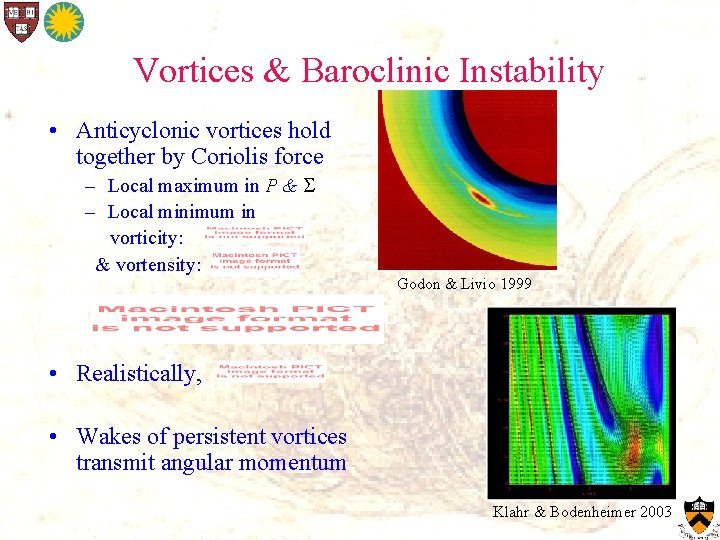
Vortices & Baroclinic Instability • Anticyclonic vortices hold together by Coriolis force – Local maximum in P & – Local minimum in vorticity: & vortensity: Godon & Livio 1999 • Realistically, • Wakes of persistent vortices transmit angular momentum Klahr & Bodenheimer 2003
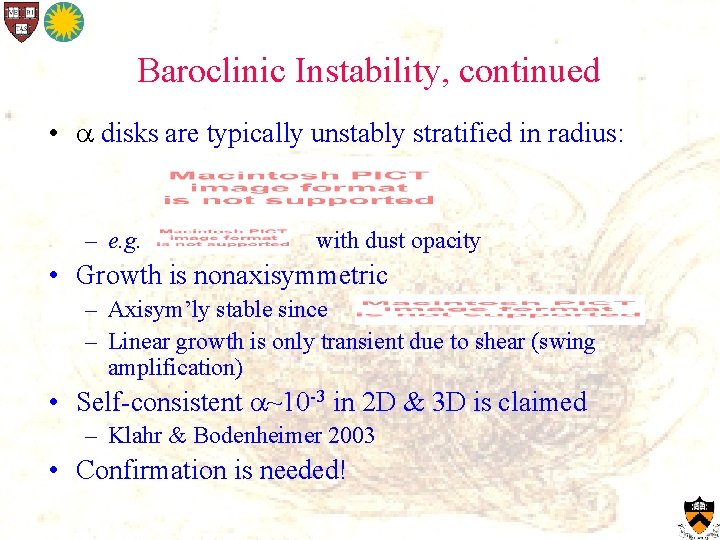
Baroclinic Instability, continued • disks are typically unstably stratified in radius: – e. g. with dust opacity • Growth is nonaxisymmetric – Axisym’ly stable since – Linear growth is only transient due to shear (swing amplification) • Self-consistent ~10 -3 in 2 D & 3 D is claimed – Klahr & Bodenheimer 2003 • Confirmation is needed!
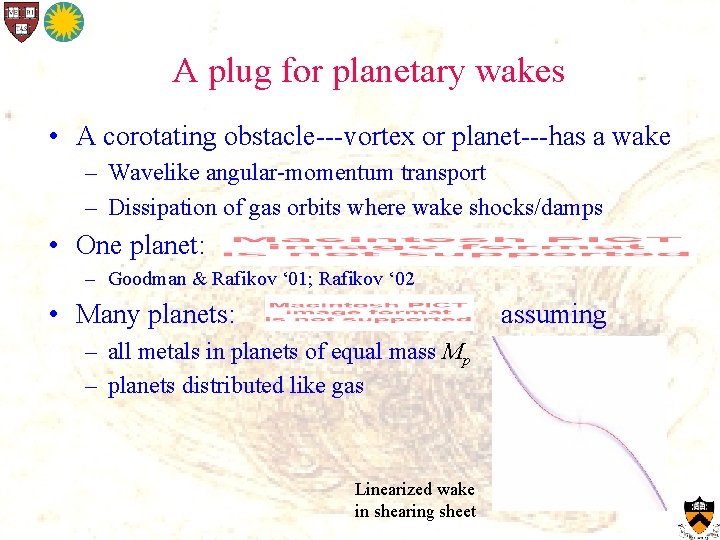
A plug for planetary wakes • A corotating obstacle---vortex or planet---has a wake – Wavelike angular-momentum transport – Dissipation of gas orbits where wake shocks/damps • One planet: – Goodman & Rafikov ‘ 01; Rafikov ‘ 02 • Many planets: assuming – all metals in planets of equal mass Mp – planets distributed like gas Linearized wake in shearing sheet
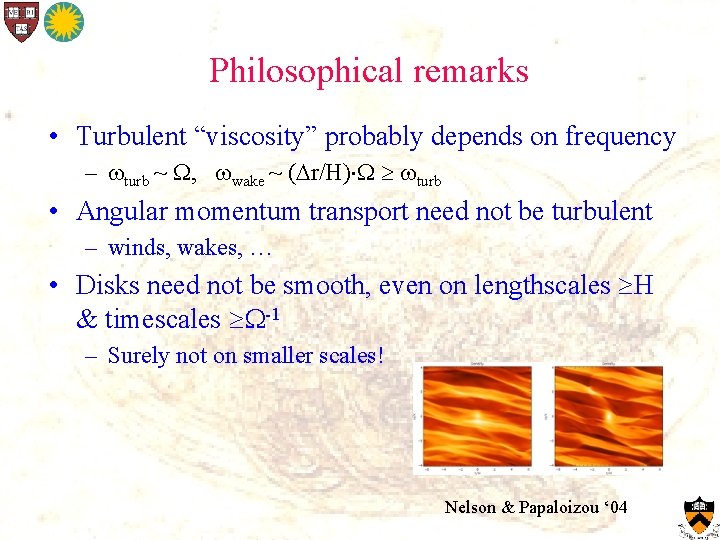
Philosophical remarks • Turbulent “viscosity” probably depends on frequency – turb ~ , wake ~ ( r/H) turb • Angular momentum transport need not be turbulent – winds, wakes, … • Disks need not be smooth, even on lengthscales H & timescales -1 – Surely not on smaller scales! Nelson & Papaloizou ‘ 04
Peroration • MRI is the leading candidate but depends on uncertain microphysics and HE irradiation – ISM theorists needed! • Finite-amplitude instability should be taken seriously – Higher-resolution simulations – Experiments with d(r 2 )/dr > 0 • Baroclinic instability needs to be confirmed – Simulations with independent codes • Investigate T( )