
ASTROPARTICLE PHYSICS LECTURE 2 1 Susan Cartwright University

![M. Ave et al. , [AIRFLY Collab. ], Astropart. Phys. 28 (2007) 41. FLUORESCENCE](https://slidetodoc.com/presentation_image_h2/8154a26559f190bea5ff77fb0c8b09f1/image-7.jpg "M. Ave et al. , [AIRFLY Collab. ], Astropart. Phys. 28 (2007) 41. FLUORESCENCE")
- Slides: 40
ASTROPARTICLE PHYSICS LECTURE 2 1 Susan Cartwright University of Sheffield
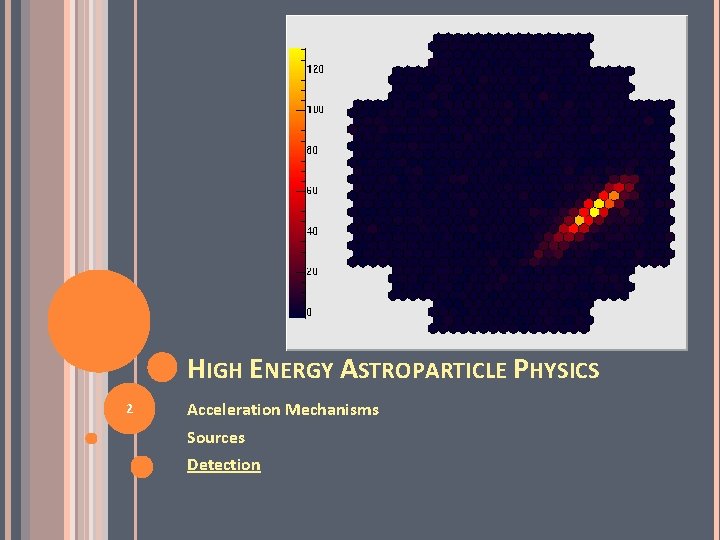
HIGH ENERGY ASTROPARTICLE PHYSICS 2 Acceleration Mechanisms Sources Detection
DETECTION OF HIGH ENERGY ASTROPARTICLES Basic principles � Cosmic rays and high-energy γs shower in the atmosphere detect light emitted or induced by the shower Cherenkov radiation fluorescence detect shower particles that reach the ground much more likely for hadron-induced showers � Neutrinos in general don’t shower detect products of charged-current interactions (e, μ, τ) � Ultra-high-energy neutrinos will shower in matter acoustic detection of shower energy 3
DETECTION OF AIR SHOWERS Cherenkov radiation � emitted by charged particles in the shower travelling at speeds > c/n where n is refractive index forward peaked faint, so requires dark skies relatively low energy threshold works for both hadron and photon cascades—basis of ground-based γ-ray astronomy Nitrogen fluorescence � UV radiation emitted by excited nitrogen molecules isotropic requires dark skies Detection of shower particles on ground � usually using water Cherenkov detectors higher threshold not dependent on sky conditions works better for hadron-induced showers 4
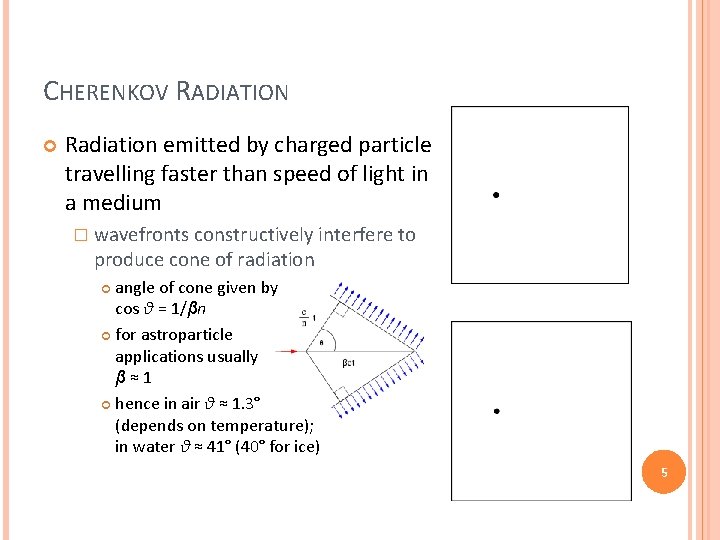
CHERENKOV RADIATION Radiation emitted by charged particle travelling faster than speed of light in a medium � wavefronts constructively interfere to produce cone of radiation angle of cone given by cos θ = 1/βn for astroparticle applications usually β≈1 hence in air θ ≈ 1. 3° (depends on temperature); in water θ ≈ 41° (40° for ice) 5
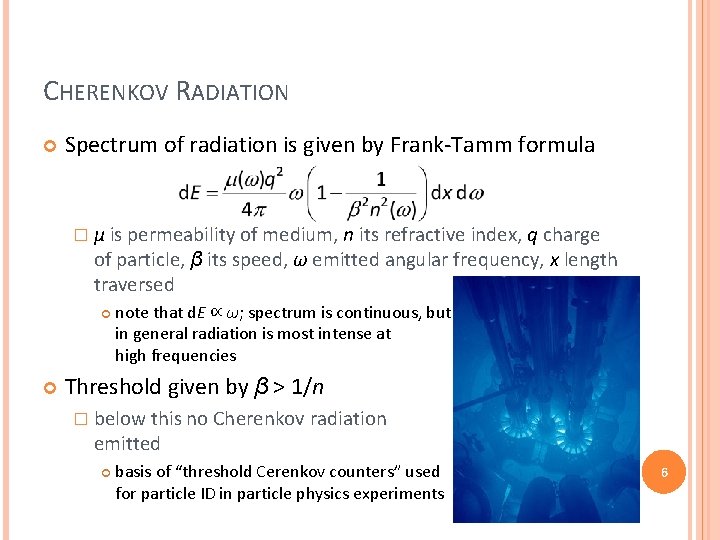
CHERENKOV RADIATION Spectrum of radiation is given by Frank-Tamm formula � μ is permeability of medium, n its refractive index, q charge of particle, β its speed, ω emitted angular frequency, x length traversed note that d. E ∝ ω; spectrum is continuous, but in general radiation is most intense at high frequencies Threshold given by β > 1/n � below this no Cherenkov radiation emitted basis of “threshold Cerenkov counters” used for particle ID in particle physics experiments 6
M. Ave et al. , [AIRFLY Collab. ], Astropart. Phys. 28 (2007) 41. FLUORESCENCE Misnamed! � it’s really scintillation Emitted isotropically � in contrast to Cherenkov Almost independent of primary particle species Fluorescence spectrum excited by 3 Me. V electrons in dry air � exciting particles are mainly e± which are produced by both electromagnetic and hadronic cascades � light produced ∝ energy deposited in atmosphere Emitted light is in discrete lines in near UV � detection requires clear skies and nearly moonless nights 7
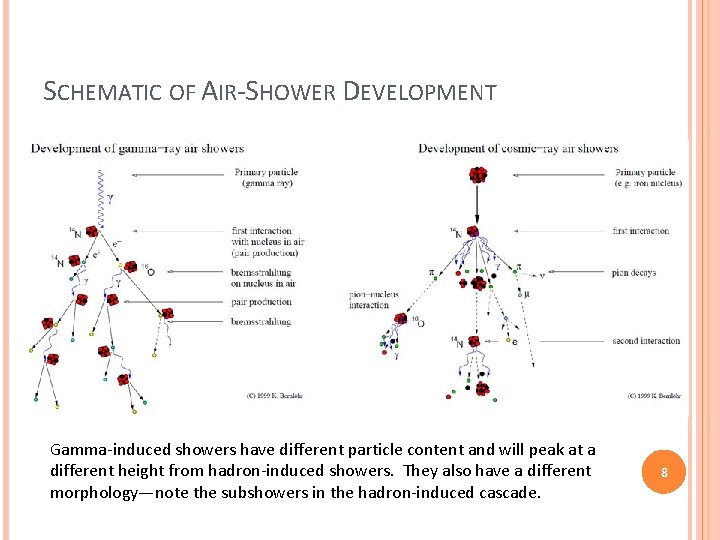
SCHEMATIC OF AIR-SHOWER DEVELOPMENT Gamma-induced showers have different particle content and will peak at a different height from hadron-induced showers. They also have a different morphology—note the subshowers in the hadron-induced cascade. 8
AIR SHOWER ANIMATION http: //astro. uchicago. edu/cosmus/projects/aires Ave, Surendran, Yamamoto, Landsberg, Subba. Rao (animation); Sciutto (AIRES simulation) 9
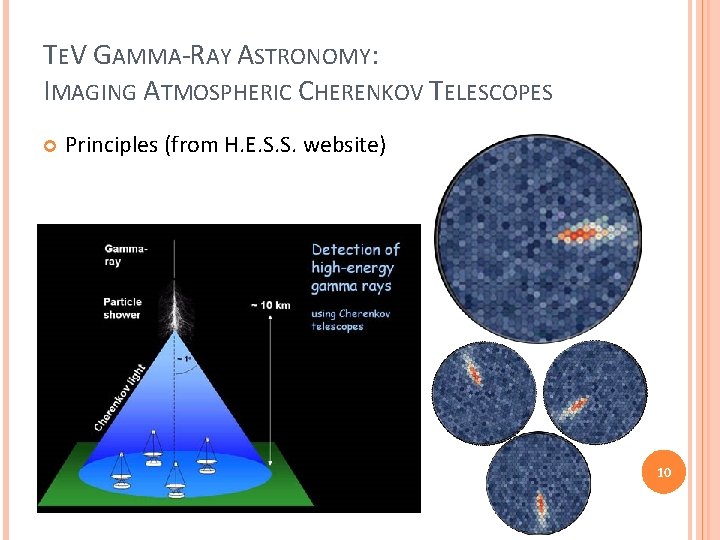
TEV GAMMA-RAY ASTRONOMY: IMAGING ATMOSPHERIC CHERENKOV TELESCOPES Principles (from H. E. S. S. website) 10
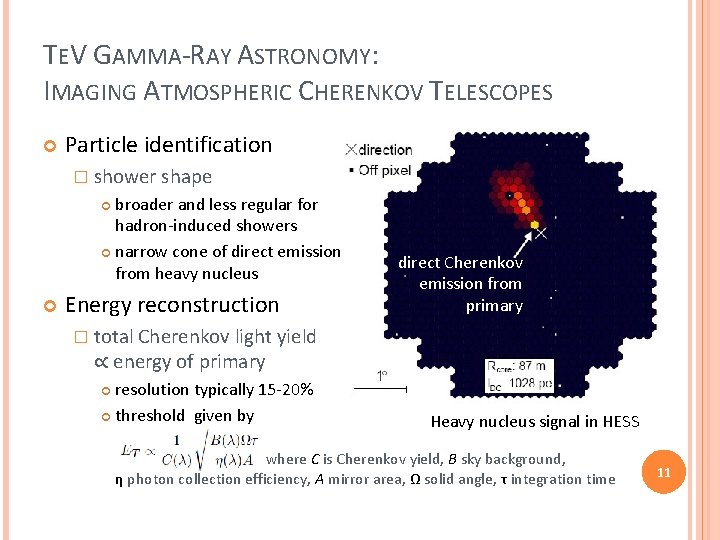
TEV GAMMA-RAY ASTRONOMY: IMAGING ATMOSPHERIC CHERENKOV TELESCOPES Particle identification � shower shape broader and less regular for hadron-induced showers narrow cone of direct emission from heavy nucleus Energy reconstruction direct Cherenkov emission from primary � total Cherenkov light yield ∝ energy of primary resolution typically 15 -20% threshold given by Heavy nucleus signal in HESS where C is Cherenkov yield, B sky background, η photon collection efficiency, A mirror area, Ω solid angle, τ integration time 11
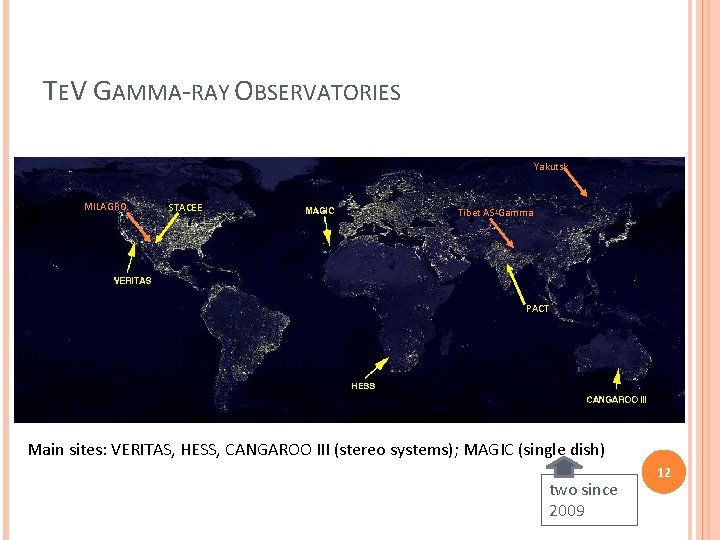
TEV GAMMA-RAY OBSERVATORIES Yakutsk MILAGRO STACEE Tibet AS-Gamma PACT Main sites: VERITAS, HESS, CANGAROO III (stereo systems); MAGIC (single dish) two since 2009 12
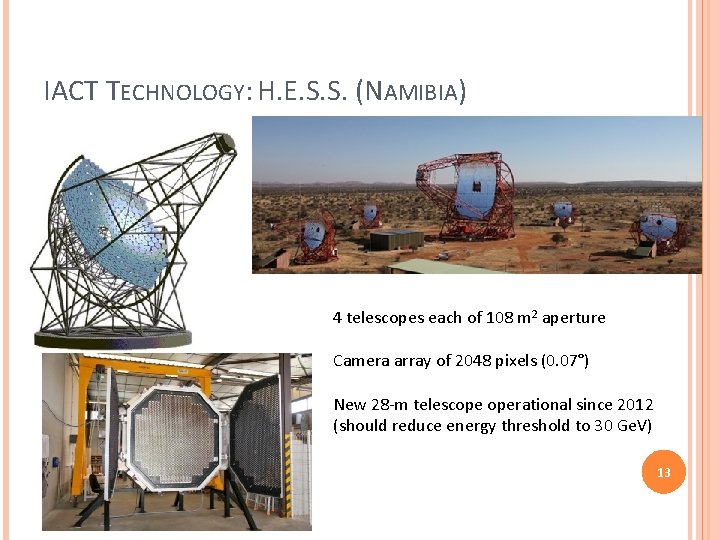
IACT TECHNOLOGY: H. E. S. S. (NAMIBIA) 4 telescopes each of 108 m 2 aperture Camera array of 2048 pixels (0. 07°) New 28 -m telescope operational since 2012 (should reduce energy threshold to 30 Ge. V) 13
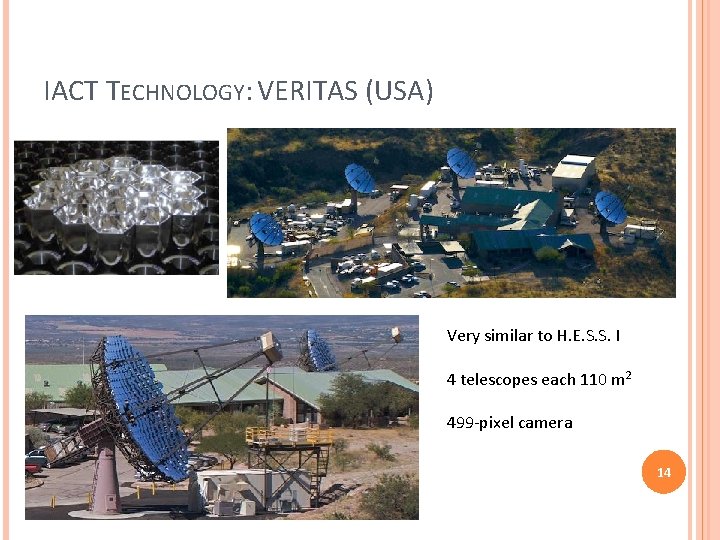
IACT TECHNOLOGY: VERITAS (USA) Very similar to H. E. S. S. I 4 telescopes each 110 m 2 499 -pixel camera 14
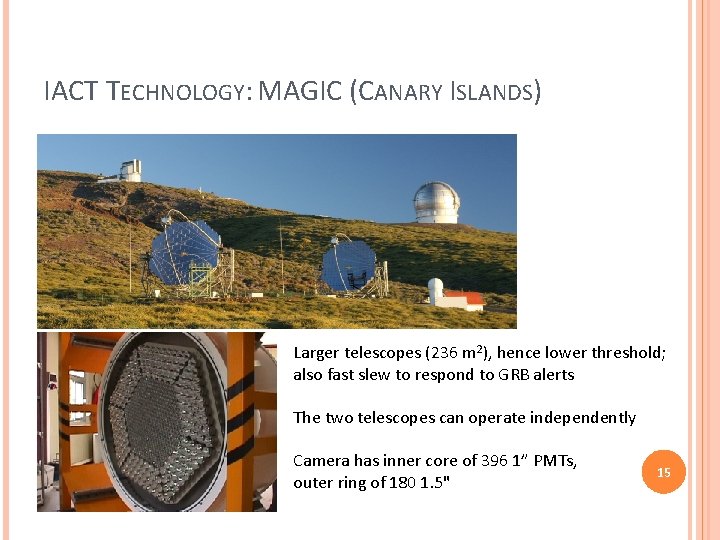
IACT TECHNOLOGY: MAGIC (CANARY ISLANDS) Larger telescopes (236 m 2), hence lower threshold; also fast slew to respond to GRB alerts The two telescopes can operate independently Camera has inner core of 396 1” PMTs, outer ring of 180 1. 5" 15
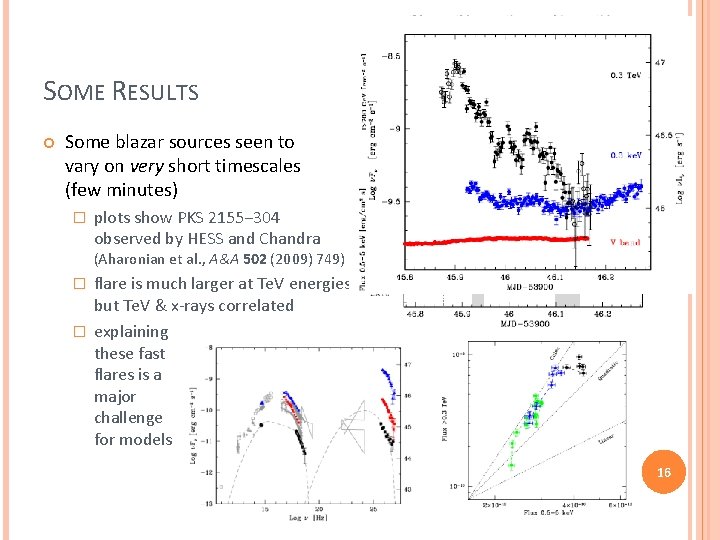
SOME RESULTS Some blazar sources seen to vary on very short timescales (few minutes) � plots show PKS 2155− 304 observed by HESS and Chandra (Aharonian et al. , A&A 502 (2009) 749) flare is much larger at Te. V energies but Te. V & x-rays correlated � explaining these fast flares is a major challenge for models � 16
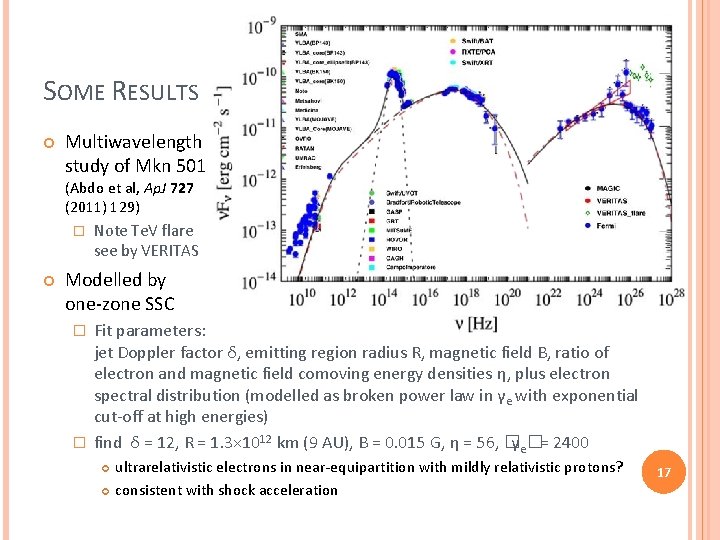
SOME RESULTS Multiwavelength study of Mkn 501 (Abdo et al, Ap. J 727 (2011) 129) � Note Te. V flare see by VERITAS Modelled by one-zone SSC Fit parameters: jet Doppler factor δ, emitting region radius R, magnetic field B, ratio of electron and magnetic field comoving energy densities η, plus electron spectral distribution (modelled as broken power law in γe with exponential cut-off at high energies) � find δ = 12, R = 1. 3× 10¹² km (9 AU), B = 0. 015 G, η = 56, � γe�= 2400 � ultrarelativistic electrons in near-equipartition with mildly relativistic protons? consistent with shock acceleration 17
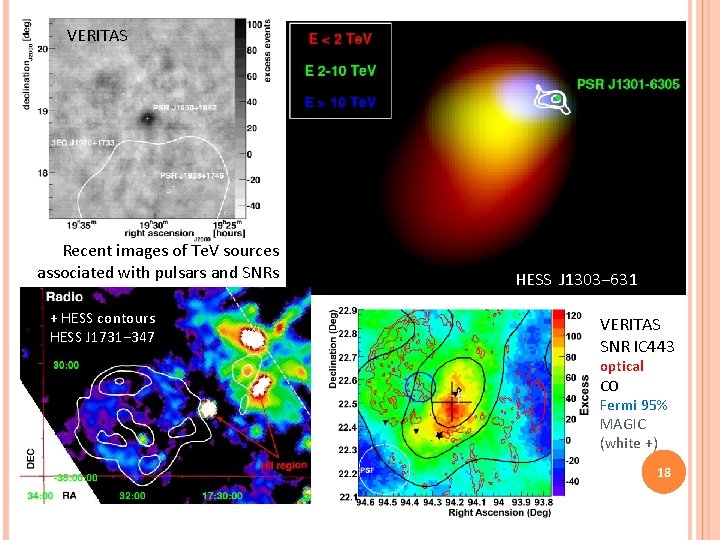
VERITAS SOME RESULTS Recent images of Te. V sources associated with pulsars and SNRs + HESS contours HESS J 1731− 347 HESS J 1303− 631 VERITAS SNR IC 443 optical CO Fermi 95% MAGIC (white +) 18
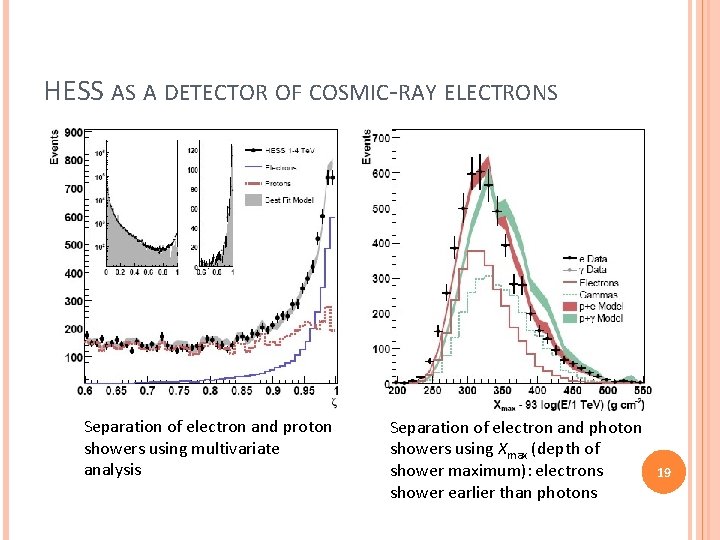
HESS AS A DETECTOR OF COSMIC-RAY ELECTRONS Separation of electron and proton showers using multivariate analysis Separation of electron and photon showers using Xmax (depth of shower maximum): electrons shower earlier than photons 19
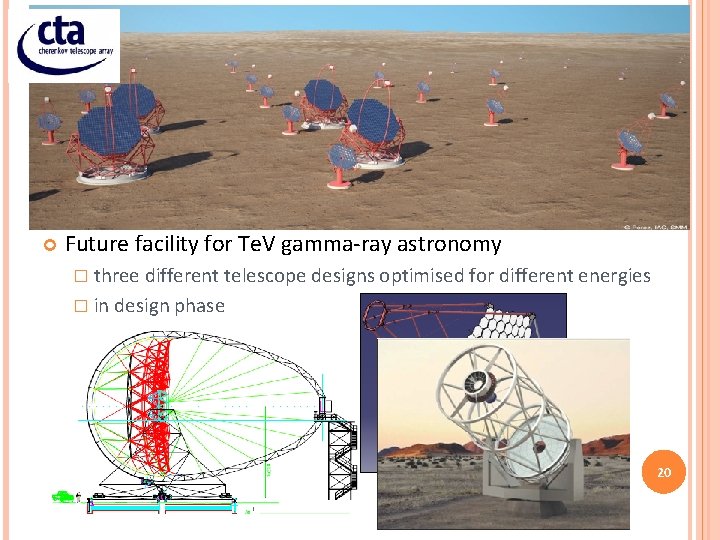
Future facility for Te. V gamma-ray astronomy � three different telescope designs optimised for different energies � in design phase 20
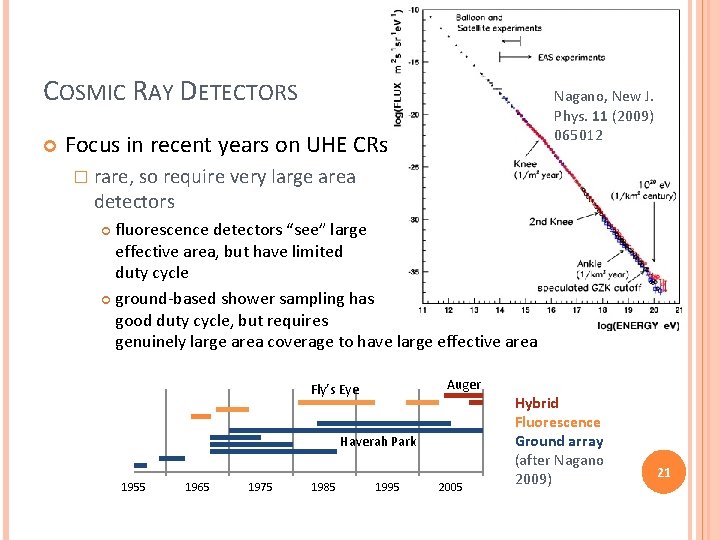
COSMIC RAY DETECTORS Nagano, New J. Phys. 11 (2009) 065012 Focus in recent years on UHE CRs � rare, so require very large area detectors fluorescence detectors “see” large effective area, but have limited duty cycle ground-based shower sampling has good duty cycle, but requires genuinely large area coverage to have large effective area Auger Fly’s Eye Haverah Park 1955 1965 1975 1985 1995 2005 Hybrid Fluorescence Ground array (after Nagano 2009) 21
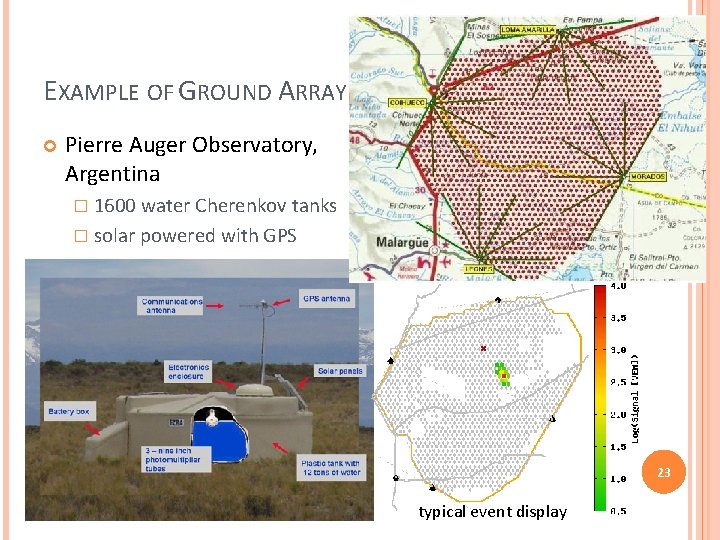
GROUND ARRAY TECHNOLOGY Large area ground arrays consist of multiple small stations whose data are combined to reconstruct the shower � detector technology scintillator (SUGAR, AGASA) or water Cherenkov (Haverah Park, Auger) some detectors (AGASA, Yakutsk) also include underground muon detectors � individual detectors need to be robust and self-contained Energy reconstruction by � conversion from shower size estimated number of electrons, Ne, combined with muons, Nμ, for those experiments with muon detectors � particle density at a given (large) distance from core smaller fluctuations, and less sensitive to primary particle type, than shower core 22
EXAMPLE OF GROUND ARRAY Pierre Auger Observatory, Argentina � 1600 water Cherenkov tanks � solar powered with GPS 23 typical event display
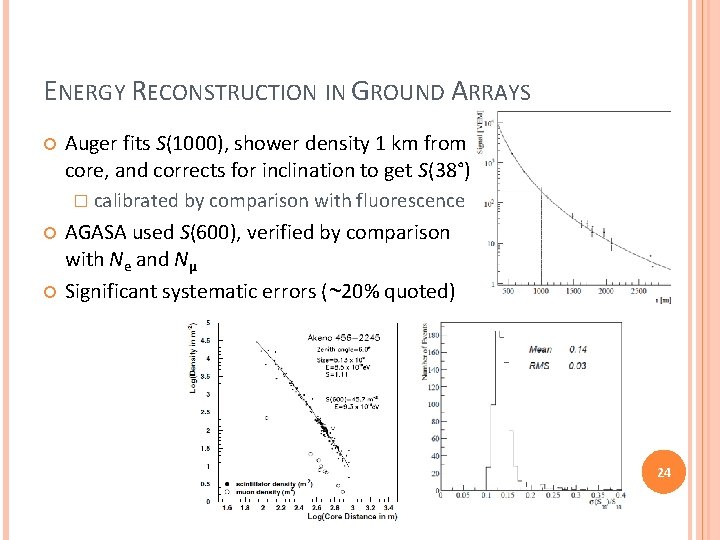
ENERGY RECONSTRUCTION IN GROUND ARRAYS Auger fits S(1000), shower density 1 km from core, and corrects for inclination to get S(38°) � calibrated by comparison with fluorescence AGASA used S(600), verified by comparison with Ne and Nμ Significant systematic errors (~20% quoted) 24
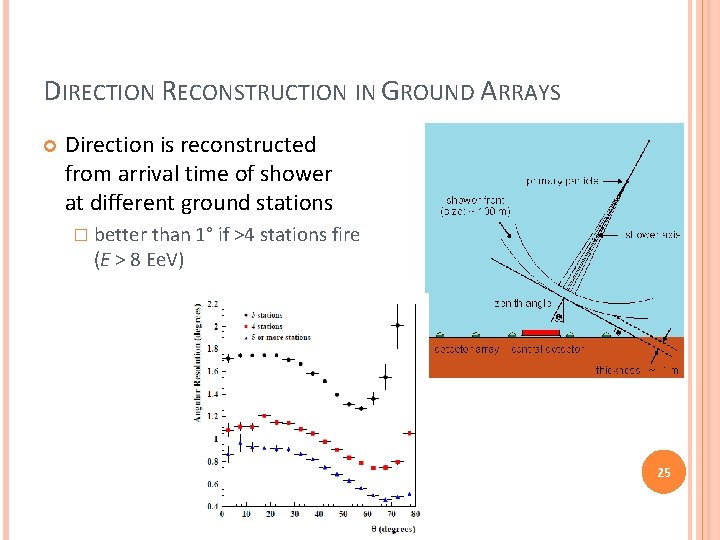
DIRECTION RECONSTRUCTION IN GROUND ARRAYS Direction is reconstructed from arrival time of shower at different ground stations � better than 1° if >4 stations fire (E > 8 Ee. V) 25
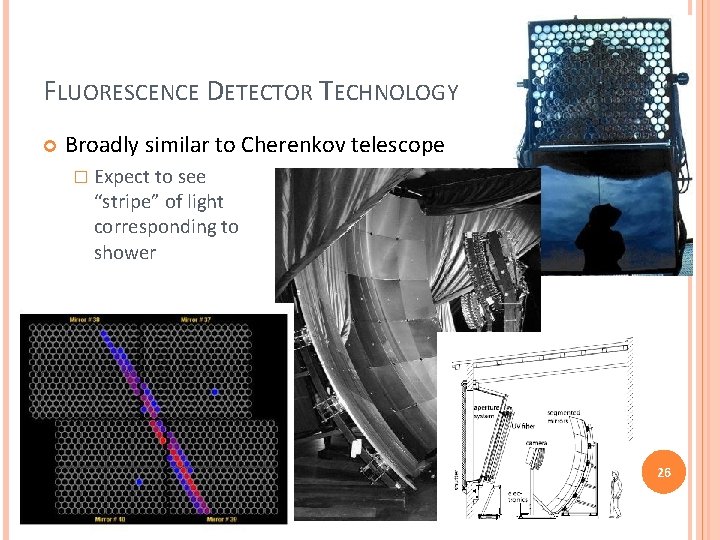
FLUORESCENCE DETECTOR TECHNOLOGY Broadly similar to Cherenkov telescope � Expect to see “stripe” of light corresponding to shower 26
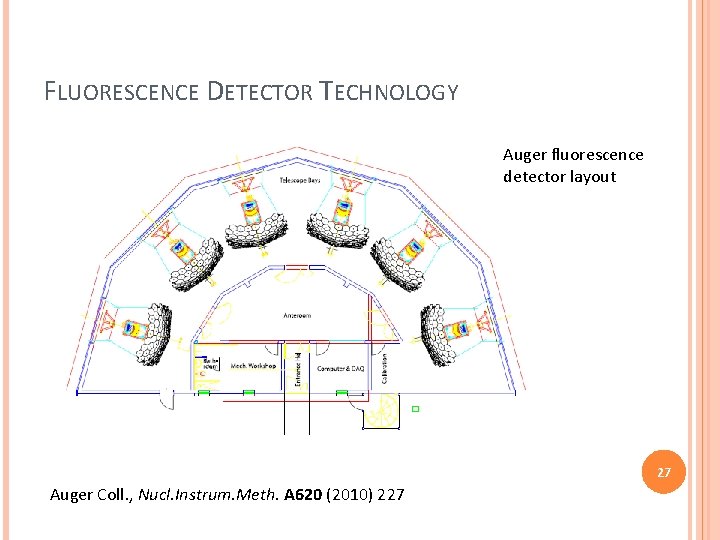
FLUORESCENCE DETECTOR TECHNOLOGY Auger fluorescence detector layout 27 Auger Coll. , Nucl. Instrum. Meth. A 620 (2010) 227
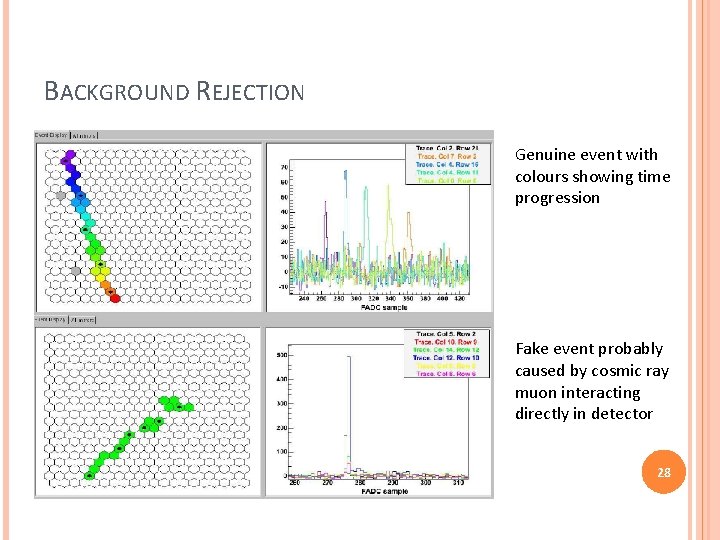
BACKGROUND REJECTION Genuine event with colours showing time progression Fake event probably caused by cosmic ray muon interacting directly in detector 28
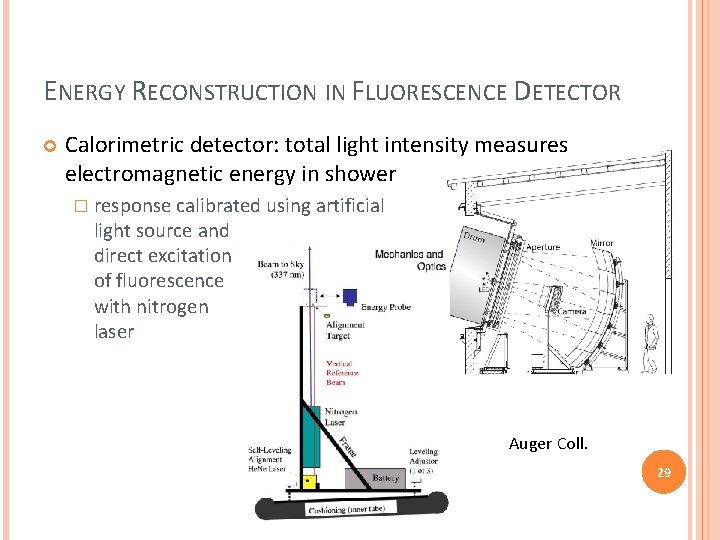
ENERGY RECONSTRUCTION IN FLUORESCENCE DETECTOR Calorimetric detector: total light intensity measures electromagnetic energy in shower � response calibrated using artificial light source and direct excitation of fluorescence with nitrogen laser Auger Coll. 29
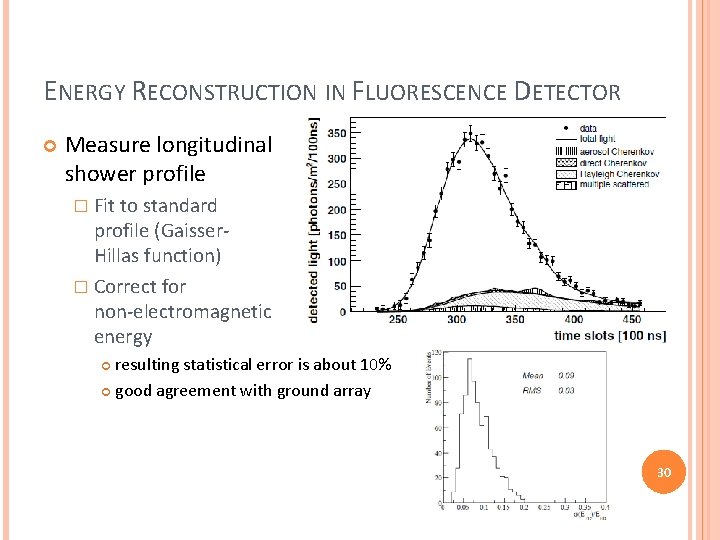
ENERGY RECONSTRUCTION IN FLUORESCENCE DETECTOR Measure longitudinal shower profile � Fit to standard profile (Gaisser. Hillas function) � Correct for non-electromagnetic energy resulting statistical error is about 10% good agreement with ground array 30
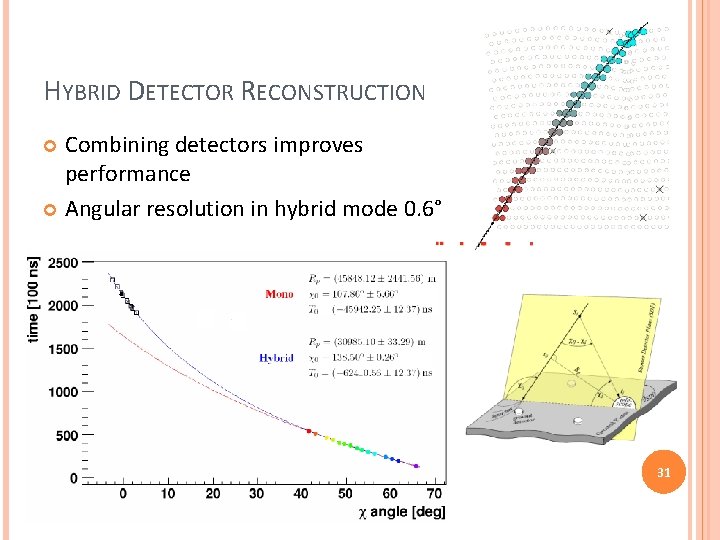
HYBRID DETECTOR RECONSTRUCTION Combining detectors improves performance Angular resolution in hybrid mode 0. 6° 31
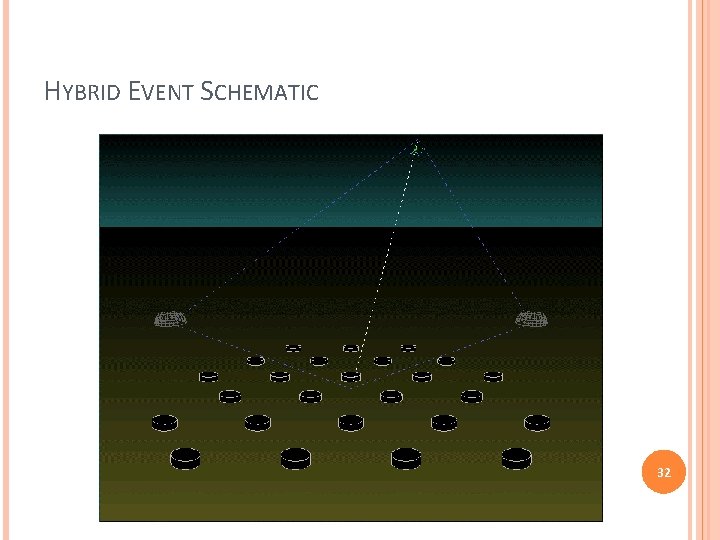
HYBRID EVENT SCHEMATIC 32
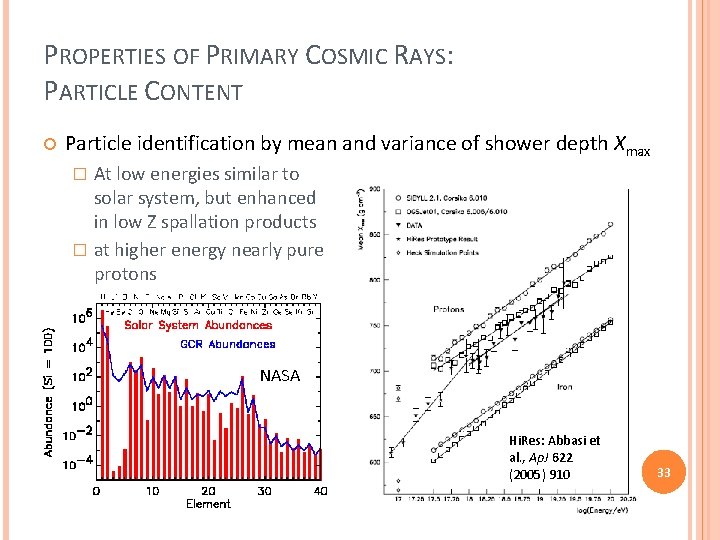
PROPERTIES OF PRIMARY COSMIC RAYS: PARTICLE CONTENT Particle identification by mean and variance of shower depth Xmax At low energies similar to solar system, but enhanced in low Z spallation products � at higher energy nearly pure protons � NASA Hi. Res: Abbasi et al. , Ap. J 622 (2005) 910 33
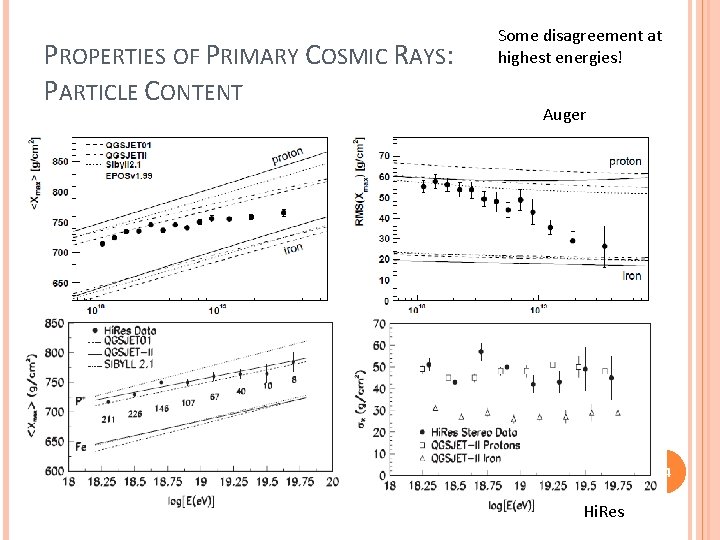
PROPERTIES OF PRIMARY COSMIC RAYS: PARTICLE CONTENT Some disagreement at highest energies! Auger 34 Hi. Res
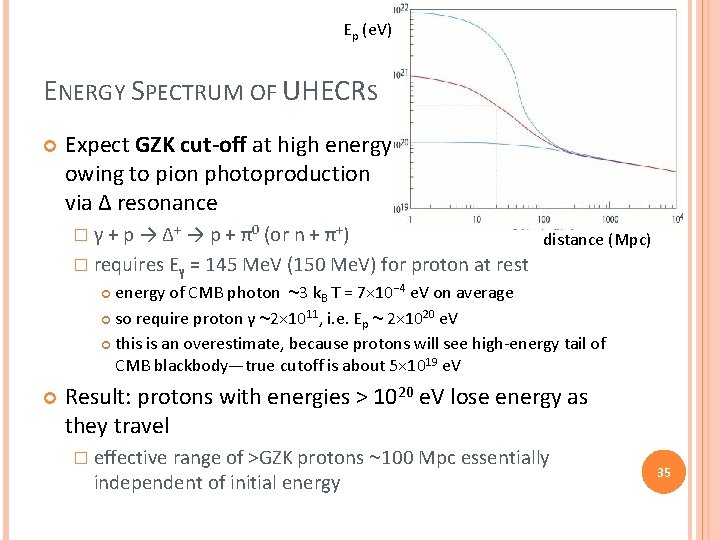
Ep (e. V) ENERGY SPECTRUM OF UHECRS Expect GZK cut-off at high energy owing to pion photoproduction via Δ resonance � γ + p → Δ+ → p + π0 (or n + π+) distance (Mpc) � requires Eγ = 145 Me. V (150 Me. V) for proton at rest energy of CMB photon ~3 k. B T = 7× 10− 4 e. V on average so require proton γ ~2× 10¹¹, i. e. Ep ~ 2× 10²⁰ e. V this is an overestimate, because protons will see high-energy tail of CMB blackbody—true cutoff is about 5× 10¹⁹ e. V Result: protons with energies > 1020 e. V lose energy as they travel � effective range of >GZK protons ~100 Mpc essentially independent of initial energy 35
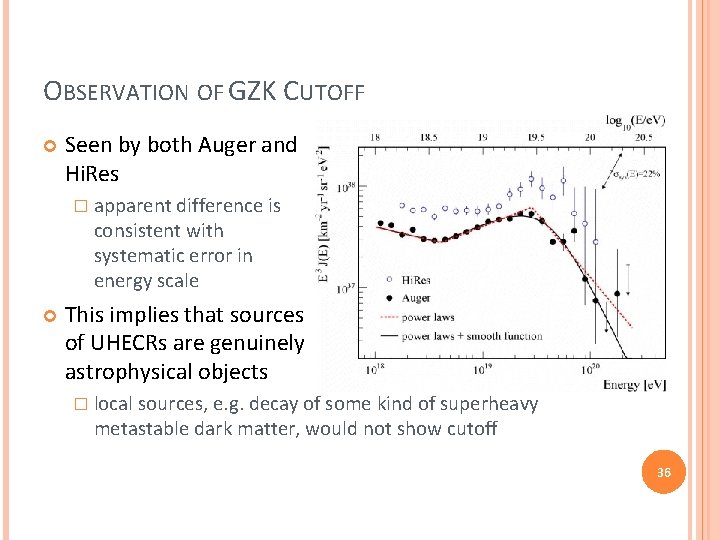
OBSERVATION OF GZK CUTOFF Seen by both Auger and Hi. Res � apparent difference is consistent with systematic error in energy scale This implies that sources of UHECRs are genuinely astrophysical objects � local sources, e. g. decay of some kind of superheavy metastable dark matter, would not show cutoff 36
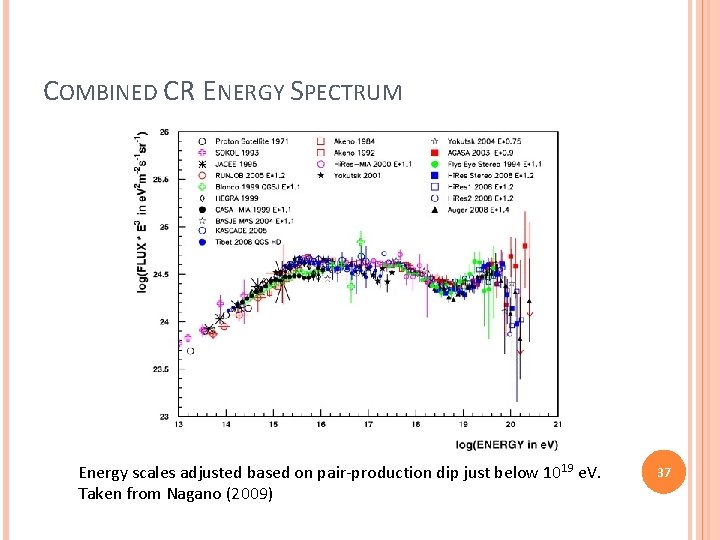
COMBINED CR ENERGY SPECTRUM Energy scales adjusted based on pair-production dip just below 1019 e. V. Taken from Nagano (2009) 37
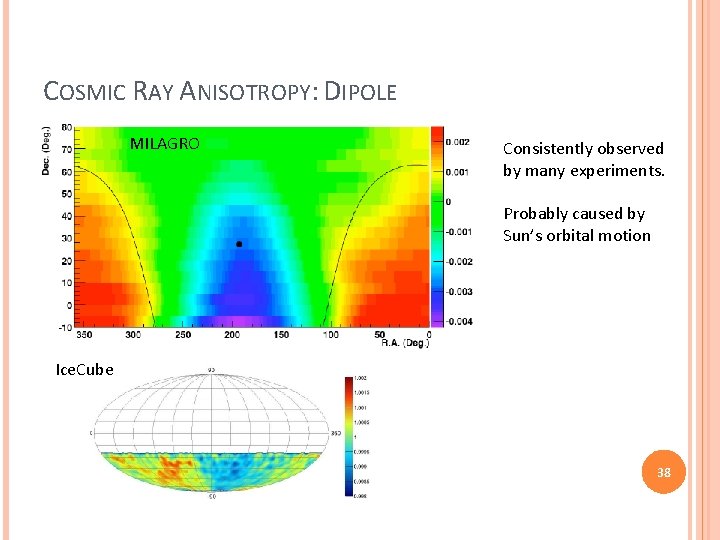
COSMIC RAY ANISOTROPY: DIPOLE MILAGRO Consistently observed by many experiments. Probably caused by Sun’s orbital motion Ice. Cube 38
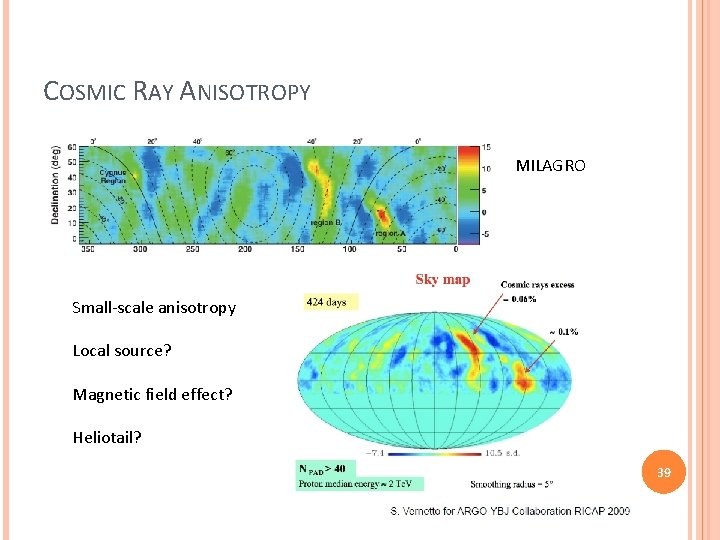
COSMIC RAY ANISOTROPY MILAGRO Small-scale anisotropy Local source? Magnetic field effect? Heliotail? 39
DETECTION OF UHE GAMMAS AND CRS: SUMMARY UHE astroparticles are easier to detect from the ground than from space � large detectors covering large effective areas are not easy to put into orbit Cherenkov, fluorescence and ground-array technologies all well established � each technique has advantages and disadvantages � “hybrid” detectors using multiple techniques are effective Multiwavelength studies of interesting objects provide increasingly good constraints on models � relevant for Te. V γ-rays, not for CRs because of lack of directionality 40