
Astronomy Unit 3 Artificial Satellites Natural Satellites Our
- Slides: 34
Astronomy Unit 3 Artificial Satellites Natural Satellites Our Moon Orbit of our Moon Surface Features of our Moon Origin of our Moon
Artificial Satellites l Vocab Words for Artificial Satellites l Artificial Satellite l Scientific Research Satellite l Weather Satellite l Earth-Observing Satellite l Navigation Satellite l Communication Satellite l Military Satellite
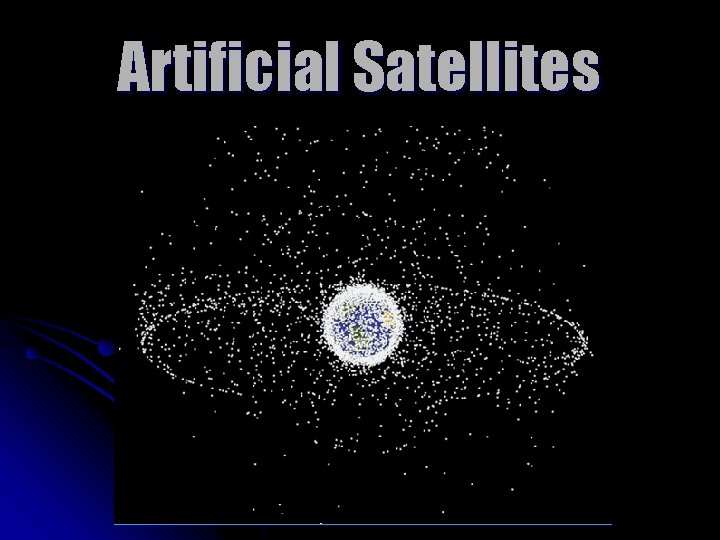
Artificial Satellites l An Artificial Satellite is a man made object put into orbit around another object. l l They remain in orbit by a gravitational force. l l For example, they orbit Earth, other planets, moons, etc. They all take different types of orbits depending upon their purpose. They include different instruments depending upon their purpose. l All include some sort of communication device to communicate with earth and some sort of device to allow it to power itself.
Artificial Satellites
Artificial Satellites l There are 6 types of artificial satellites: l Scientific Research Satellite l Weather Satellite l Earth-Observing Satellite l Navigation Satellite l Communication Satellite l Military Satellite
Artificial Satellites l Scientific Research Satellite l Used to collect data and research other planets and/or moons.
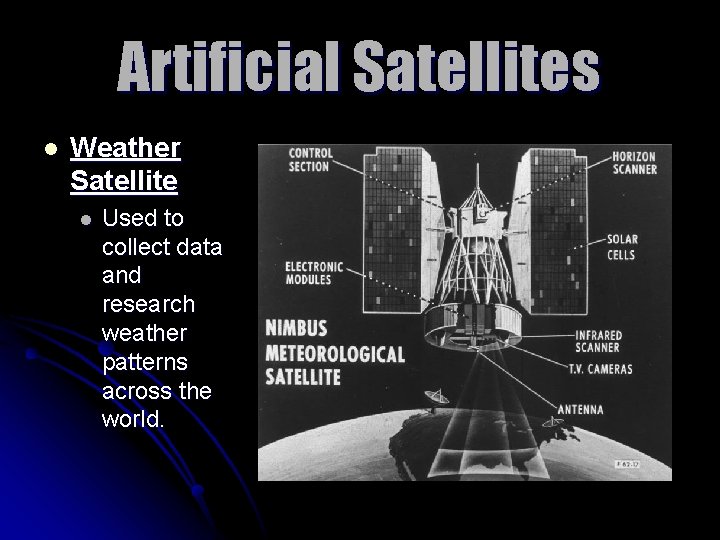
Artificial Satellites l Weather Satellite l Used to collect data and research weather patterns across the world.
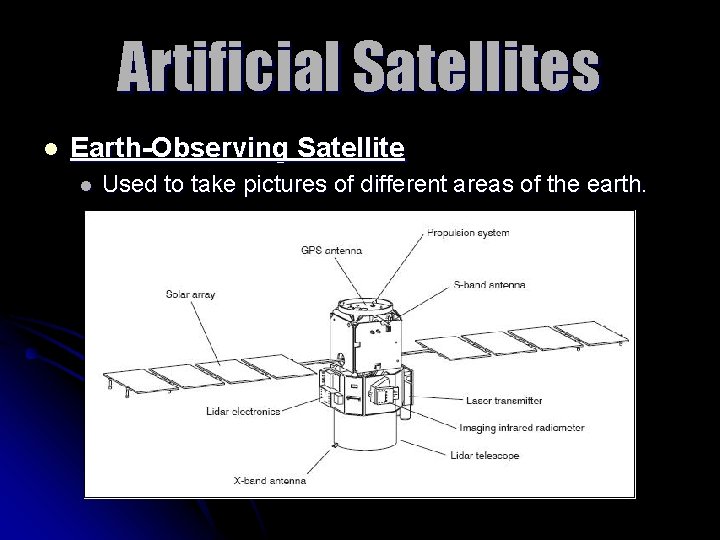
Artificial Satellites l Earth-Observing Satellite l Used to take pictures of different areas of the earth.
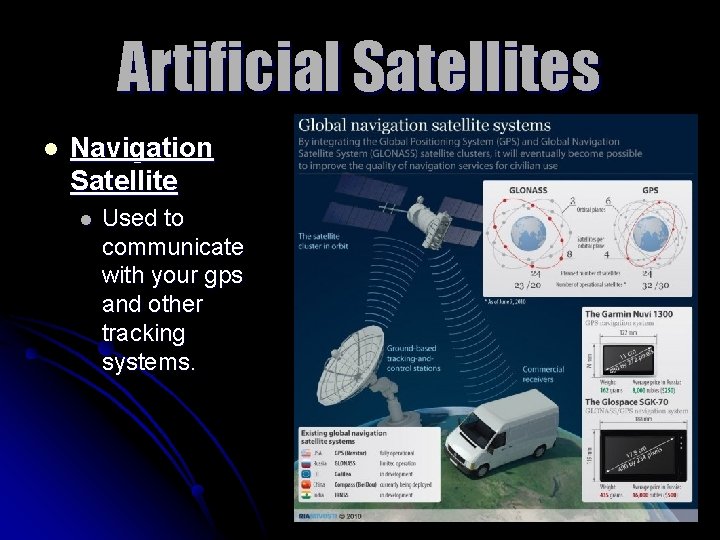
Artificial Satellites l Navigation Satellite l Used to communicate with your gps and other tracking systems.
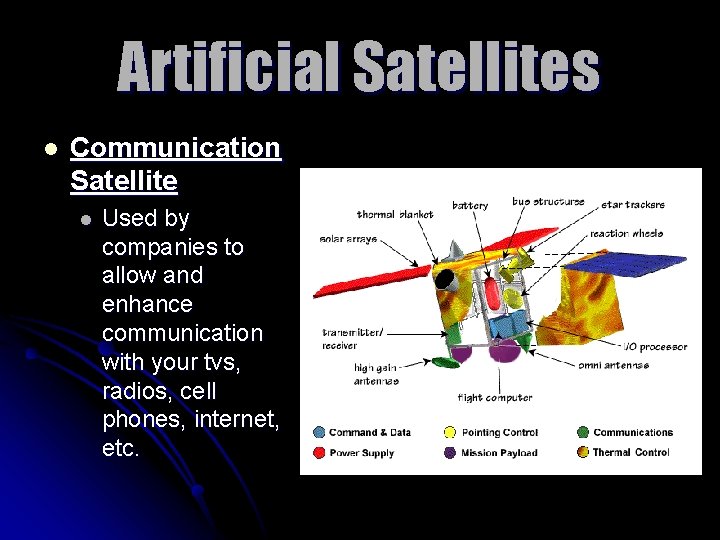
Artificial Satellites l Communication Satellite l Used by companies to allow and enhance communication with your tvs, radios, cell phones, internet, etc.
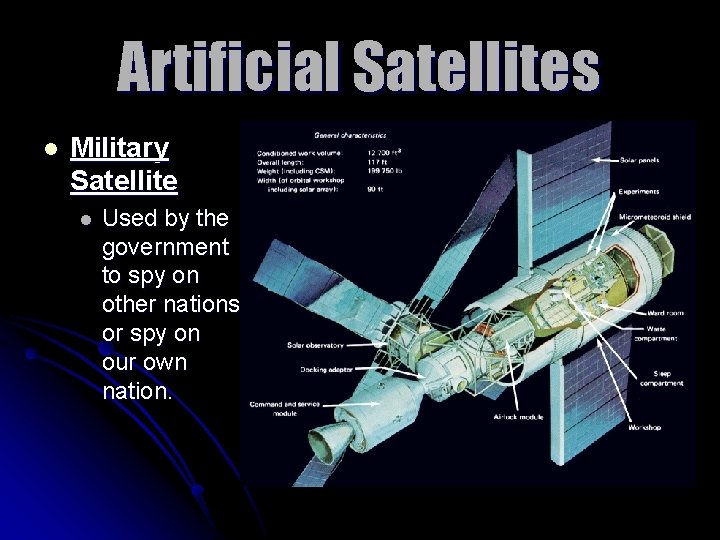
Artificial Satellites l Military Satellite l Used by the government to spy on other nations or spy on our own nation.
Natural Satellites l Vocab Words for Natural Satellites l Natural Satellite
Natural Satellites l A Natural Satellite is an object that is in orbit around another object. It is not manmade! l Examples: l The earth a natural satellite of the sun. l All of the planets, comets, meteoroids, asteroids and dwarf planets are natural satellites of the sun. l The moon is a natural satellite of the earth. l Jupiter has 64 natural satellites. l Natural Satellites orbit due to a gravitational force exerted by its parent object.
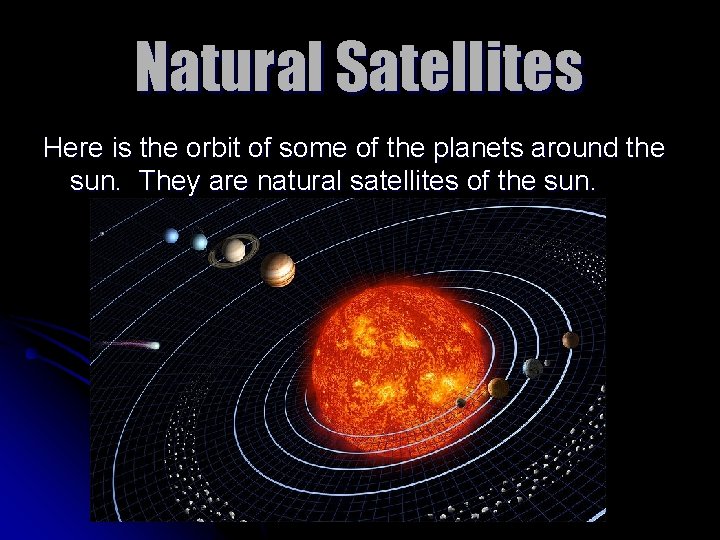
Natural Satellites Here is the orbit of some of the planets around the sun. They are natural satellites of the sun.
Natural Satellites l l Our Moon The Orbit of the Moon l Vocab Words for “The Orbit of the Moon” 1 st Quarter l 3 rd Quarter l New Moon l Full Moon l Waxing l Waning l Synchronous Orbit l Near Side l Far Side l Lunar Eclipse l Solar Eclipse l
Natural Satellites l The Orbit of the Moon l The moon revolves around the earth every 29. 5 days. l The moon rotates around itself every 29. 5 days as well! l This means the moon’s orbit is synchronous l. A Synchronous Orbit is when the period of revolution is equal to the period of rotation. The moon rotates at the same exact pace that is revolves at!
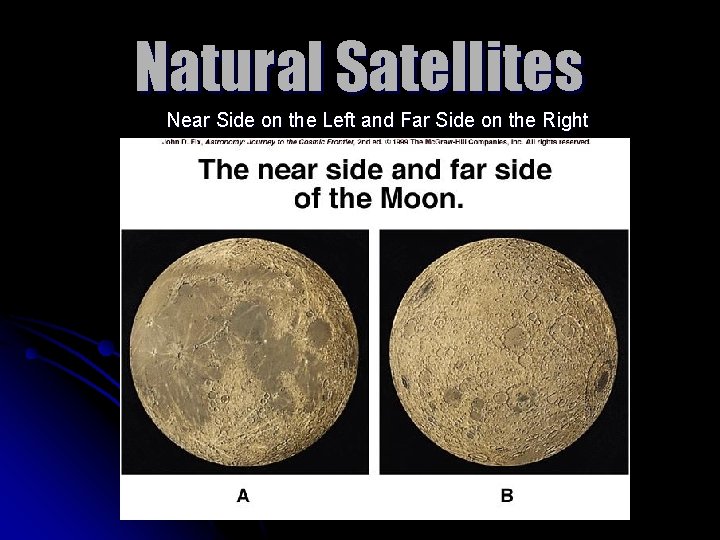
Natural Satellites l The Orbit of the Moon l The Synchronous orbit of the Moon causes the moon to have a Near Side and a Far Side. l The Near Side of the Moon is the side of the moon that ALWAYS faces the earth. l The Far Side of the Moon is the side of the moon that NEVER faces the earth. In 1959 the Russian Mission, Luna 3 (an unmanned space probe) photographed it. This is the first time people saw pictures of the Far Side. l It wasn’t until 1968 that people saw it first hand. Apollo 8 was able to orbit the moon and view the far side. Astronauts Frank Borman, Jim Lovell and William Anders were able to see it. l
Natural Satellites Near Side on the Left and Far Side on the Right
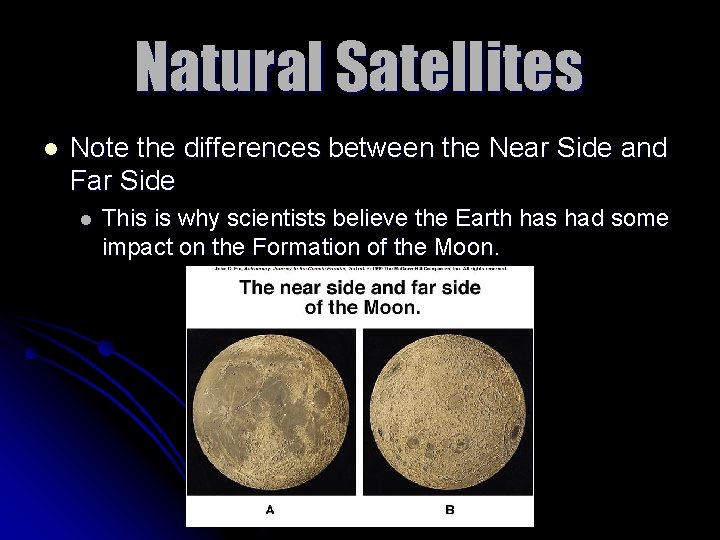
Natural Satellites l Note the differences between the Near Side and Far Side l This is why scientists believe the Earth has had some impact on the Formation of the Moon.
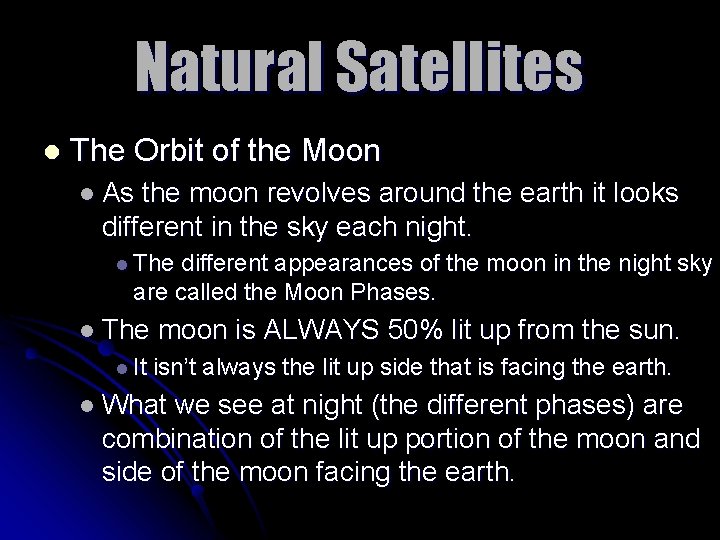
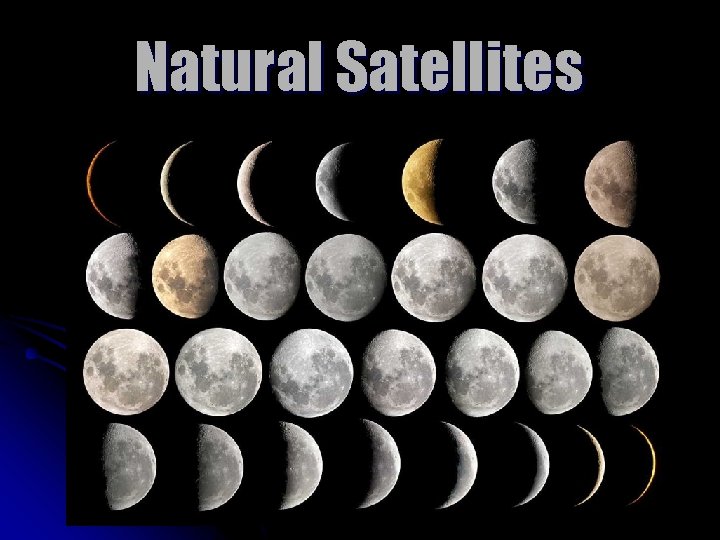
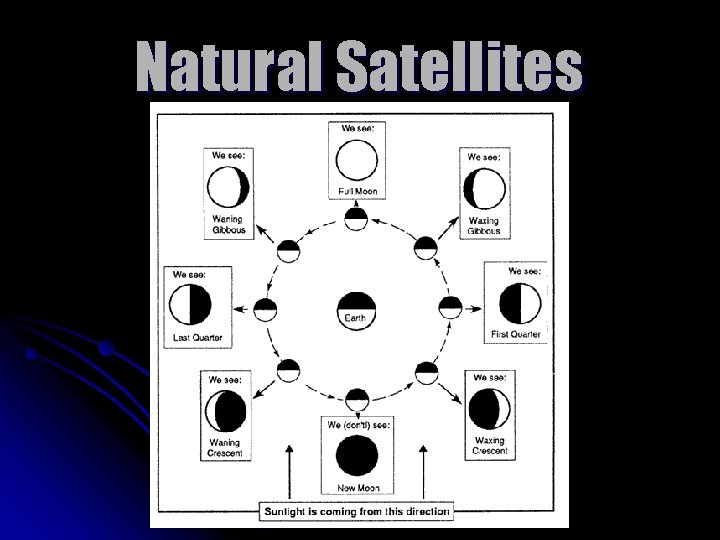
Natural Satellites l The Orbit of the Moon l As the moon revolves around the earth it looks different in the sky each night. l The different appearances of the moon in the night sky are called the Moon Phases. l The l It moon is ALWAYS 50% lit up from the sun. isn’t always the lit up side that is facing the earth. l What we see at night (the different phases) are combination of the lit up portion of the moon and side of the moon facing the earth.
Natural Satellites
Natural Satellites l The Moon goes through 8 distinct phases during each of its revolution. l l l l New Moon Waxing Crescent 1 st Quarter Waxing Gibbous Full Moon Waning Gibbous 3 rd Quarter Waning Crescent
Natural Satellites
Natural Satellites l New Moon is when none of the lit up portion of the moon is facing the earth. l The moon appears completely dark in the night sky from earth. l Full Moon is when all of the lit portion of the moon is facing the earth. l The moon appears completely bright in the night sky from earth.
Natural Satellites l The Waxing phases are the growing phases of the moon. l When the moon goes from new moon to full moon l The Waning phases are the shrinking phases of the moon. l When the moon goes from full moon back down to new moon
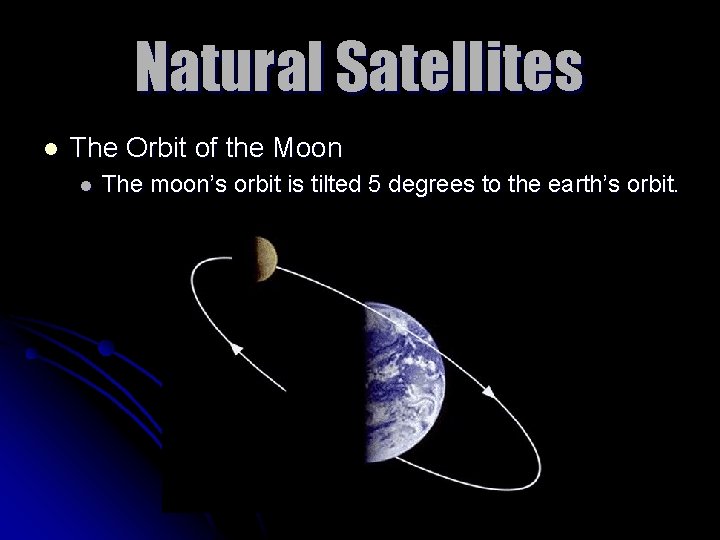
Natural Satellites l The Orbit of the Moon l The moon’s orbit is tilted 5 degrees to the earth’s orbit.
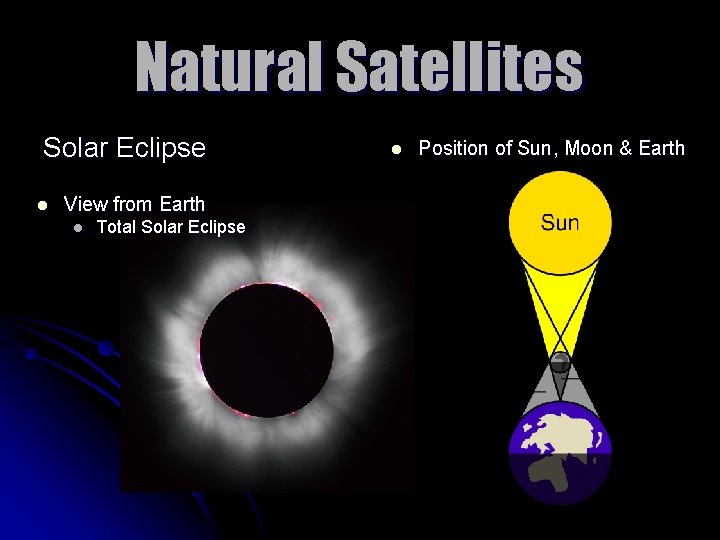
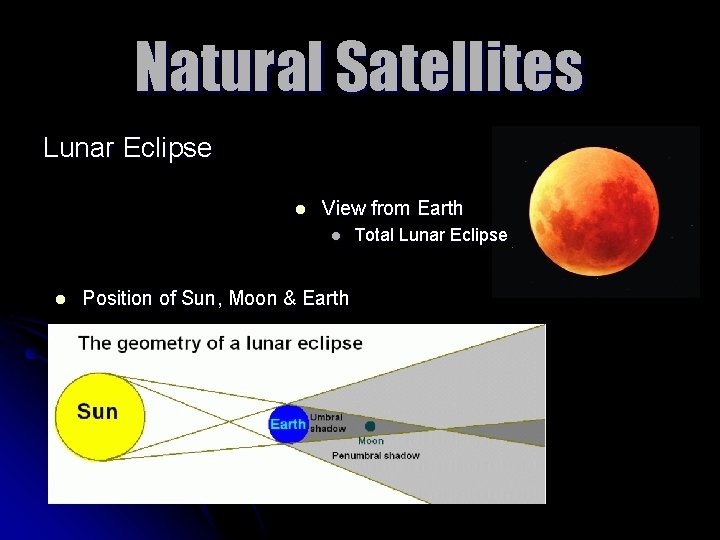
Natural Satellites l The Orbit of the Moon l This tilted orbit means that solar eclipses and lunar eclipses will NOT occur each month. l. A Solar Eclipse is when the moon comes right in between the earth and sun and casts its shadow upon the sun. l The Moon should be New Moon phase at this point. l. A Lunar Eclipse is when Earth falls directly in between the sun and the moon and casts its shadow upon the moon. l The Moon should be in Full Moon phase at this point.
Natural Satellites Solar Eclipse l View from Earth l Total Solar Eclipse l Position of Sun, Moon & Earth
Natural Satellites Lunar Eclipse l View from Earth l l Position of Sun, Moon & Earth Total Lunar Eclipse
Natural Satellites Our Moon l Moon’s Surface Features l l Vocab Words for l Maria l Highland l Crater “Surface Features of our moon”
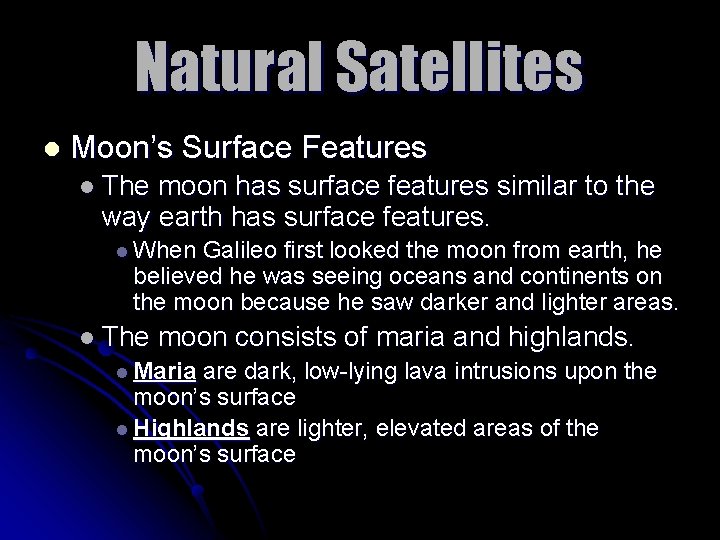
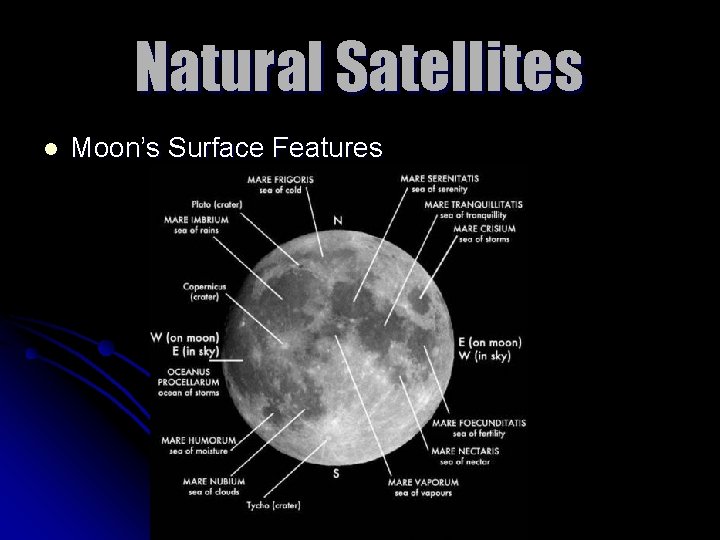
Natural Satellites l Moon’s Surface Features l The moon has surface features similar to the way earth has surface features. l When Galileo first looked the moon from earth, he believed he was seeing oceans and continents on the moon because he saw darker and lighter areas. l The moon consists of maria and highlands. l Maria are dark, low-lying lava intrusions upon the moon’s surface l Highlands are lighter, elevated areas of the moon’s surface
Natural Satellites l Moon’s Surface Features
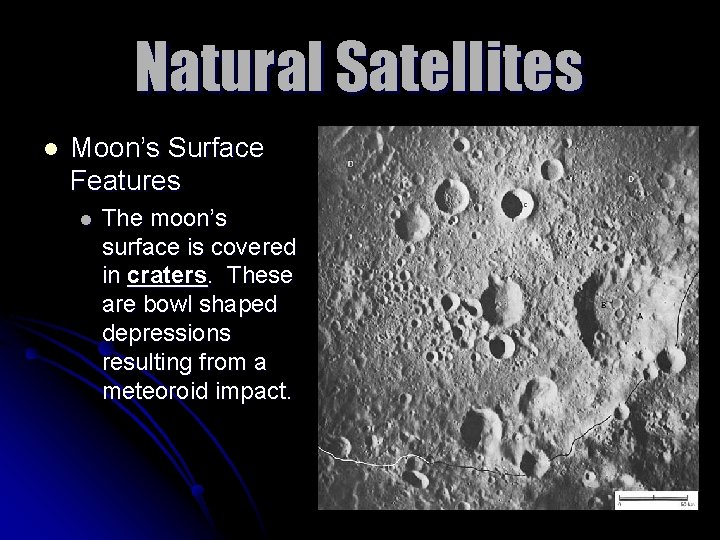
Natural Satellites l Moon’s Surface Features l The moon’s surface is covered in craters. These are bowl shaped depressions resulting from a meteoroid impact.
Natural Satellites l Origin of our Moon l You will read about the different theories on how the moon was formed in your reading booklet. l You will also do a lab that where you will learn about the age of different surface features on the moon.