
Astronomy Toolkit v Magnitudes v Apparent magnitude v
- Slides: 10
Astronomy Toolkit v Magnitudes v Apparent magnitude v Absolute magnitude v The distance equation v Luminosity and intensity v. Units and other basic data v. Logarithms
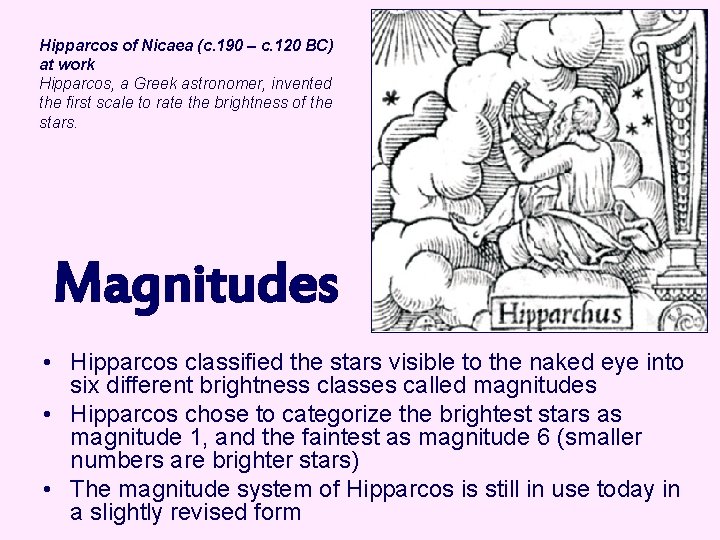
Hipparcos of Nicaea (c. 190 – c. 120 BC) at work Hipparcos, a Greek astronomer, invented the first scale to rate the brightness of the stars. Magnitudes • Hipparcos classified the stars visible to the naked eye into six different brightness classes called magnitudes • Hipparcos chose to categorize the brightest stars as magnitude 1, and the faintest as magnitude 6 (smaller numbers are brighter stars) • The magnitude system of Hipparcos is still in use today in a slightly revised form
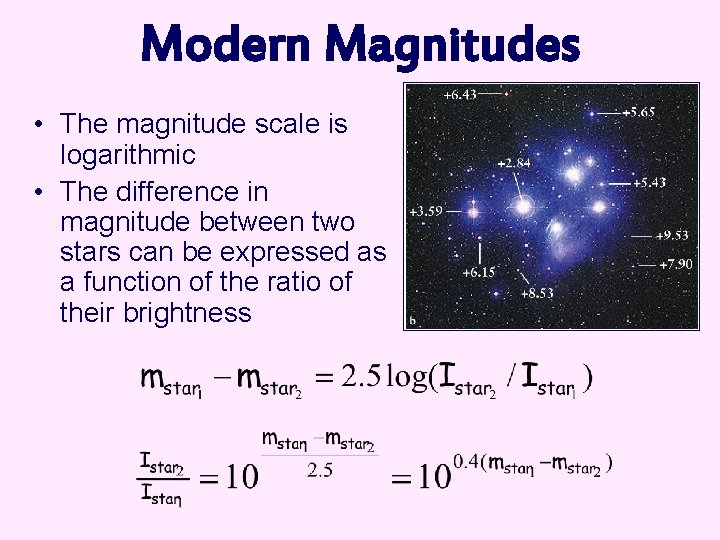
Modern Magnitudes • The magnitude scale is logarithmic • The difference in magnitude between two stars can be expressed as a function of the ratio of their brightness
Apparent Magnitude • Some stars appear bright and others very faint in the sky • The apparent magnitude “m” of a star is a measure of how bright it appears in the sky – Some faint stars are intrinsically bright, but are very distant – Some bright stars are very faint but happen to lie close to us The apparent magnitude of the Sun is -26! • A star’s apparent magnitude tells us little about the star • We need to know stars’ distances from Earth
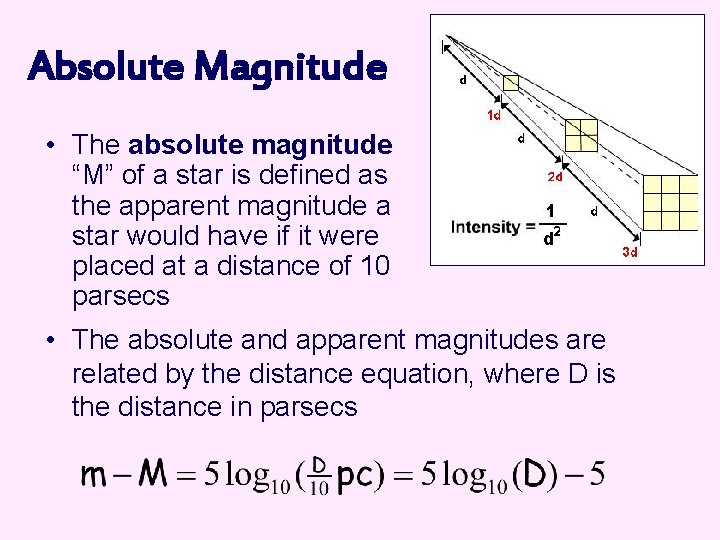
Absolute Magnitude • The absolute magnitude “M” of a star is defined as the apparent magnitude a star would have if it were placed at a distance of 10 parsecs • The absolute and apparent magnitudes are related by the distance equation, where D is the distance in parsecs
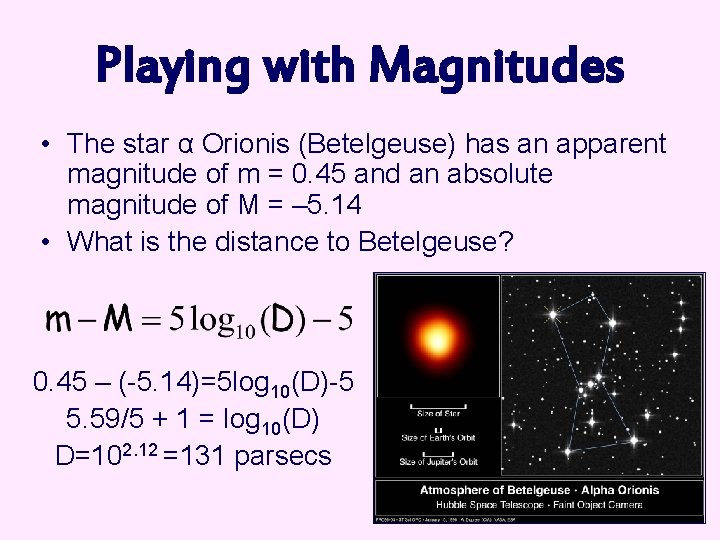
Playing with Magnitudes • The star α Orionis (Betelgeuse) has an apparent magnitude of m = 0. 45 and an absolute magnitude of M = – 5. 14 • What is the distance to Betelgeuse? 0. 45 – (-5. 14)=5 log 10(D)-5 5. 59/5 + 1 = log 10(D) D=102. 12 =131 parsecs
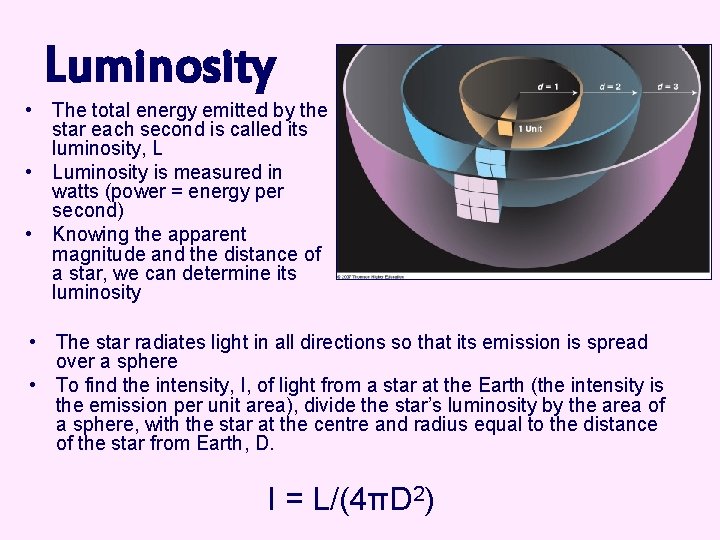
Luminosity • The total energy emitted by the star each second is called its luminosity, L • Luminosity is measured in watts (power = energy per second) • Knowing the apparent magnitude and the distance of a star, we can determine its luminosity • The star radiates light in all directions so that its emission is spread over a sphere • To find the intensity, I, of light from a star at the Earth (the intensity is the emission per unit area), divide the star’s luminosity by the area of a sphere, with the star at the centre and radius equal to the distance of the star from Earth, D. I = L/(4πD 2)
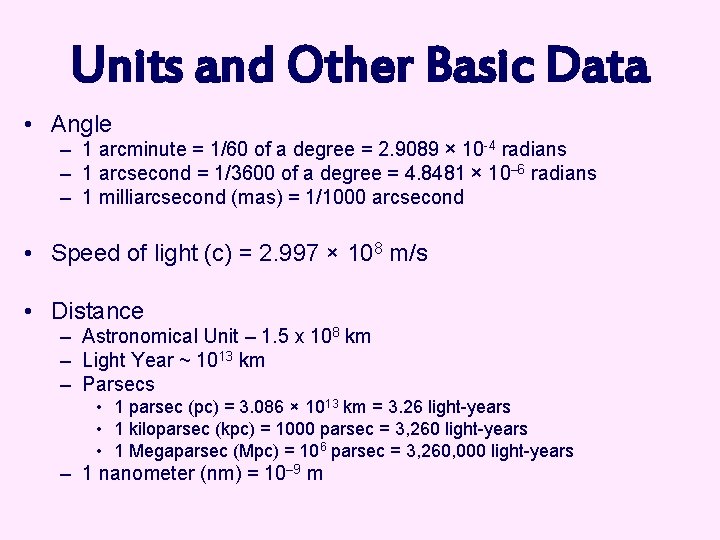
Units and Other Basic Data • Angle – 1 arcminute = 1/60 of a degree = 2. 9089 × 10 -4 radians – 1 arcsecond = 1/3600 of a degree = 4. 8481 × 10– 6 radians – 1 milliarcsecond (mas) = 1/1000 arcsecond • Speed of light (c) = 2. 997 × 108 m/s • Distance – Astronomical Unit – 1. 5 x 10⁸ km – Light Year ~ 1013 km – Parsecs • 1 parsec (pc) = 3. 086 × 1013 km = 3. 26 light-years • 1 kiloparsec (kpc) = 1000 parsec = 3, 260 light-years • 1 Megaparsec (Mpc) = 106 parsec = 3, 260, 000 light-years – 1 nanometer (nm) = 10– 9 m
More Units • Velocity – kilometers per second • Mass – in units of the mass of the Sun 2 x 1030 kg • Luminosity – in units of the solar luminosity 4 x 1026 watts = 4 x 1026 joules sec-1