
Astronomy Timeline How theory develops and changes over
- Slides: 17
Astronomy Timeline How theory develops and changes over time as new technology allows for more accurate observations.
Plato (428 -347 B. C) argued that the sphere and the circle were perfect shapes because of their symmetry The heavens being the creation of the god would have to be “perfect” The heavens were assumed to contain spheres in uniform (constant speed) and perfect, circular motions and earth was the center of motion (Geocentric).
Founded in 283 BC, by 300 B. C. the Library of Alexandria is accepted as the leading center of knowledge, housing more than half a million books (scrolls of parchment or leather and clay tablets). The library of Alexandria held over half a million documents from Assyria, Greece, Persia, Egypt, India and many other nations. Over 100 scholars lived at the Museum full time to perform research, write, lecture or translate and copy documents. http: //ehistory. osu. edu/world/articles/Article. View. cfm? AID=9
Aristarchus Alexandria Egypt 280 BC Suggests the Earth revolves around the Sun(heliocentric). He provides first estimation of Earth-Sun distance.
Eratosthenes Cyrene (now Shahhat, Libya) 240 B. C. He measures the circumference of the earth with surprising accuracy.
140 AD • Ptolemy • Writes the Almagest • Believes that the Earth is the center of the universe • Geocentric theory • Stars are fixed on celestial spheres.
415 A. D. The final destruction of the library of Alexandria, along with the loss of most of the knowledge stored there.
476 - 800 AD Age of Darkness An age of very little intellectual advancements due to fall of Roman empire, barbaric intrusions and warfare.
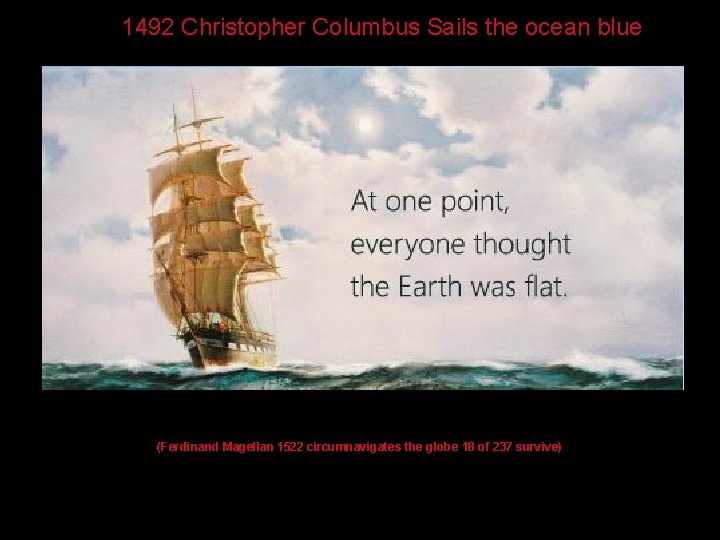
1492 Christopher Columbus Sails the ocean blue (Ferdinand Magellan 1522 circumnavigates the globe 18 of 237 survive)
1543 • Copernicus –Writes De Revolutionibus –Believes the sun to be the center of the universe –Heliocentric theory
1551 • Leonard Digges –Invents theodolite and, from the writings of his son, possibly the telescope
1576 (G is 12) • Thomas Digges –Coments on his father’s st writings (1 telescope? ) –Puts the heliocentric model into stars of infinite space and NOT celestial spheres
1577 (G is 13) Tyco Brahe observes a comet over a year’s time Using Parallax, Tyco proves that stars are NOT fixed on celestial spheres Spends 20 years studying and measuring planetary movements
1600 (G is 36) • Johannes Kepler –Uses Tyco’s data to prove that the planets revolve in elliptical orbits.
1608 (G is a famous professor at university of Pedua 44) Hans Lippershey is officially recorded to have invented the telescope
1609 • Galileo –Invents a new and improved model of Hans’ telescope –Introduces a law of motion called inertia
• Galileo was a remarkable man. • After stating that the Sun was the center of our universe, the church held him under house arrest. He died under house arrest in such great pain from arthritis that even his guards pleaded with their superiors to give them another assignment. Though Galileo recanted his theory and proofs, he continued to study the planets and sun. He died knowing that what he knew to be true was being suppressed and he could do nothing about it. He must have wondered on his death bed, • “How long before they accept the truth? ”