
ASTRONOMY Made by Lucy Darley INTRODUCTION Definition Theory
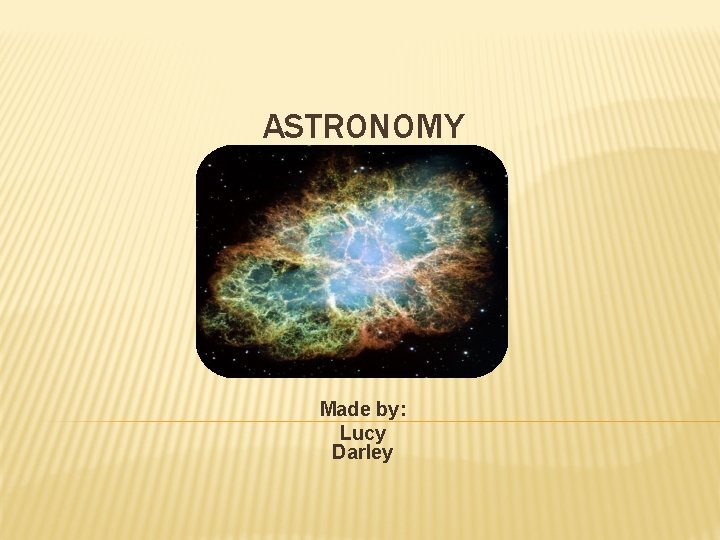
ASTRONOMY Made by: Lucy Darley
INTRODUCTION Definition � Theory: � History � Observing � Celestial objects � � Applications: Celestial navigation � Weather � Prevent collisions � � Questions
DEFINITION � Astronomy is the study of celestial objects: stars, planets, comets, nebulæ, star clusters and galaxies and phenomena, which come from outside the Earth's atmosphere. � It is evolving along with physics, chemistry, meteorology, and motion of celestial objects as well as the formation and development of the universe. � One of the oldest sciences.
HISTORY � Early cultures gathered artefacts that likely had some astronomical purpose: � � � Determine the seasons, calendar Length of the year Understanding of planting seasons � Till 17 th century observation of objects visible to the naked eye. � Invention of telescope developed astronomy into modern science � A heliocentric model of the solar system. � � Nicolaus Copernicus, Galileo Galilei, Johannes Kepler Dutch cartographer Frederik de Wit.
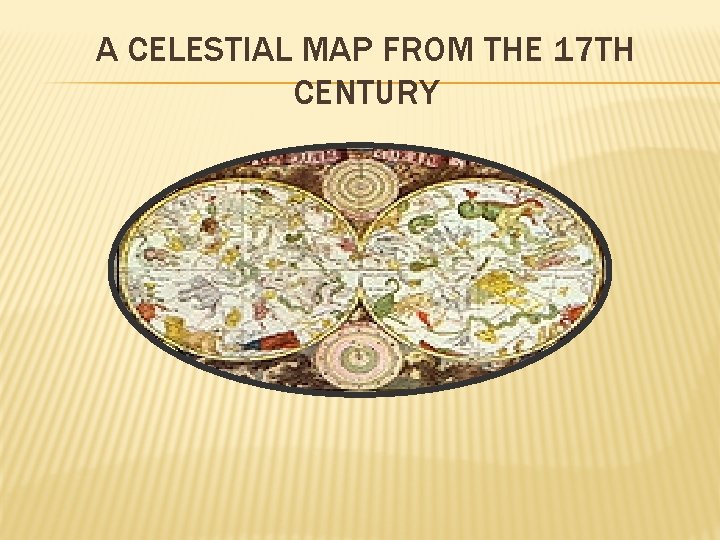
A CELESTIAL MAP FROM THE 17 TH CENTURY
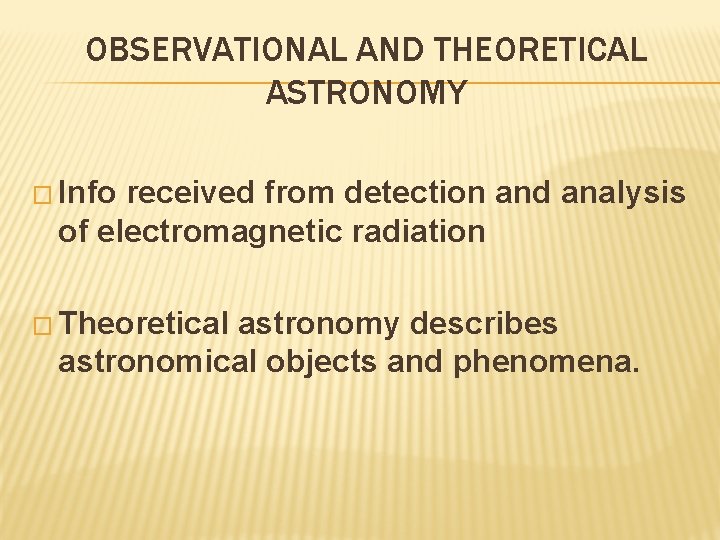
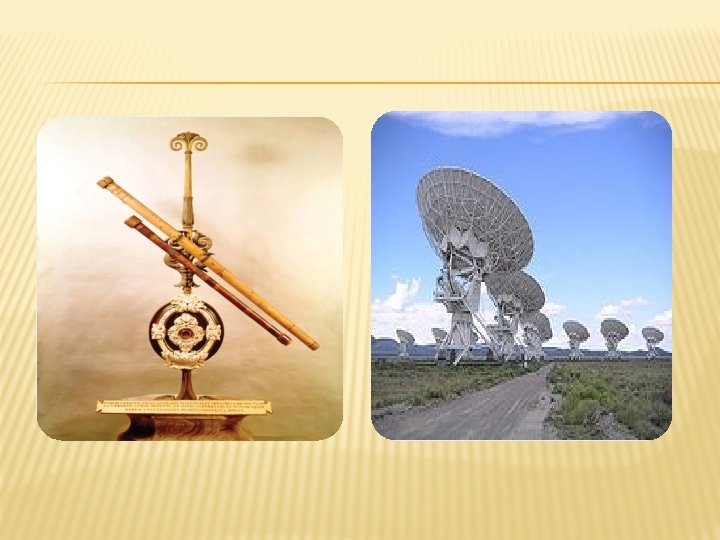
OBSERVATIONAL AND THEORETICAL ASTRONOMY � Info received from detection and analysis of electromagnetic radiation � Theoretical astronomy describes astronomical objects and phenomena.
CELESTIAL OBJECTS � Stars: � � Planets: � � a celestial body orbiting a star rounded by its own gravity Comets: � � a massive ball of plasma held by gravity a solar system body collected of small rocks, ice and sometime with a tail star clusters galaxies: � consists of stars and stellar remnants, gas, dust, and dark matter
APPLICATIONS � Celestial navigation. � � Astronomically: � � � a position fixing technique to enable sailors to know their position on the ocean avoid potential collisions with the Earth measure the scale of the universe Astronomy forecast: � � � Cloud cover Surface pressure Wind speed
QUESTIONS � Please name a few of the celestial objects. � What does the heliocentric theory say about the Sun position in the universe? � Can you name at least one of the creators of this theory? � How is our galaxy called?
- Slides: 10