
Astronomy and the James Webb Space Telescope John
Astronomy and the James Webb Space Telescope John Mather JWST Senior Project Scientist AAAC Oct 13 2011
JWST Science Updates • 4 (original) major themes: first light, galaxy assembly, star & planet formation, evolution of planetary systems • 2011 Conference: Frontier Science Opportunities with the JWST – many new ideas! • Dark energy – Nobel; plans for JWST • Dark matter – mapping it with JWST • Galaxy formation – compare with simulations • Chilly stars (< 300 K) – WISE Y dwarfs • Lonely planets (microlensing) – JWST in clusters
More connections • Herschel: D/H in a comet matches Earth oceans – JWST can find many more • Soummer et al: pulled 3 planets out of HST archives of HR 8799 –JWST too • TESS and Fi. NESSE selected for Explorer studies – finders for JWST • ALMA first light
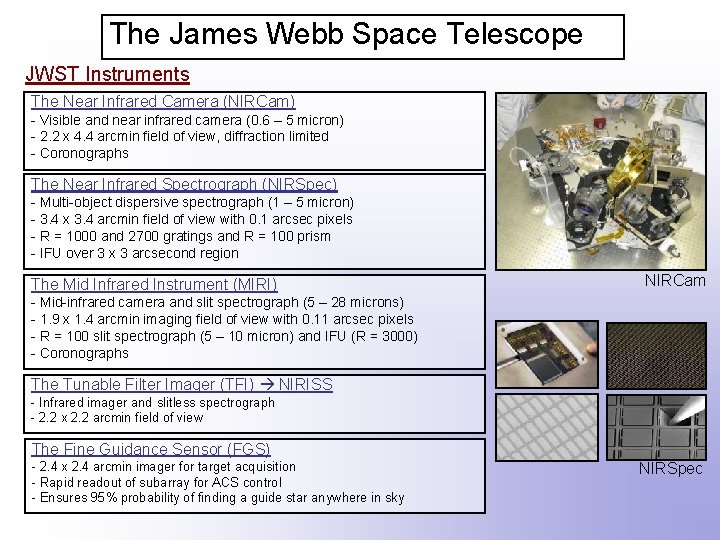
The James Webb Space Telescope JWST Instruments The Near Infrared Camera (NIRCam) - Visible and near infrared camera (0. 6 – 5 micron) - 2. 2 x 4. 4 arcmin field of view, diffraction limited - Coronographs The Near Infrared Spectrograph (NIRSpec) - Multi-object dispersive spectrograph (1 – 5 micron) - 3. 4 x 3. 4 arcmin field of view with 0. 1 arcsec pixels - R = 1000 and 2700 gratings and R = 100 prism - IFU over 3 x 3 arcsecond region The Mid Infrared Instrument (MIRI) NIRCam - Mid-infrared camera and slit spectrograph (5 – 28 microns) - 1. 9 x 1. 4 arcmin imaging field of view with 0. 11 arcsec pixels - R = 100 slit spectrograph (5 – 10 micron) and IFU (R = 3000) - Coronographs The Tunable Filter Imager (TFI) NIRISS - Infrared imager and slitless spectrograph - 2. 2 x 2. 2 arcmin field of view The Fine Guidance Sensor (FGS) - 2. 4 x 2. 4 arcmin imager for target acquisition - Rapid readout of subarray for ACS control - Ensures 95% probability of finding a guide star anywhere in sky NIRSpec
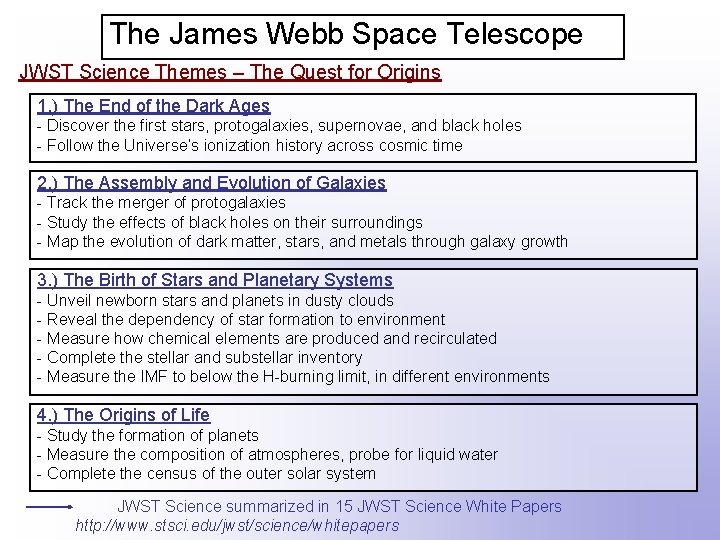
The James Webb Space Telescope JWST Science Themes – The Quest for Origins 1. ) The End of the Dark Ages - Discover the first stars, protogalaxies, supernovae, and black holes - Follow the Universe’s ionization history across cosmic time 2. ) The Assembly and Evolution of Galaxies - Track the merger of protogalaxies - Study the effects of black holes on their surroundings - Map the evolution of dark matter, stars, and metals through galaxy growth 3. ) The Birth of Stars and Planetary Systems - Unveil newborn stars and planets in dusty clouds - Reveal the dependency of star formation to environment - Measure how chemical elements are produced and recirculated - Complete the stellar and substellar inventory - Measure the IMF to below the H-burning limit, in different environments 4. ) The Origins of Life - Study the formation of planets - Measure the composition of atmospheres, probe for liquid water - Complete the census of the outer solar system JWST Science summarized in 15 JWST Science White Papers http: //www. stsci. edu/jwst/science/whitepapers
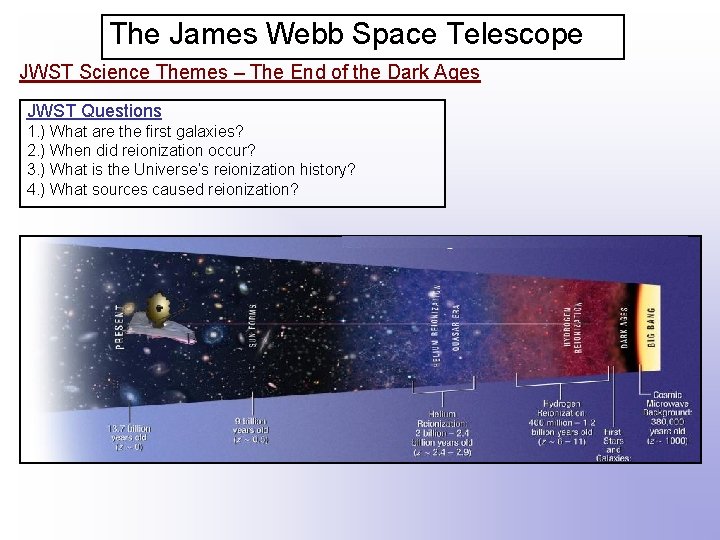
The James Webb Space Telescope JWST Science Themes – The End of the Dark Ages JWST Questions 1. ) What are the first galaxies? 2. ) When did reionization occur? 3. ) What is the Universe’s reionization history? 4. ) What sources caused reionization?
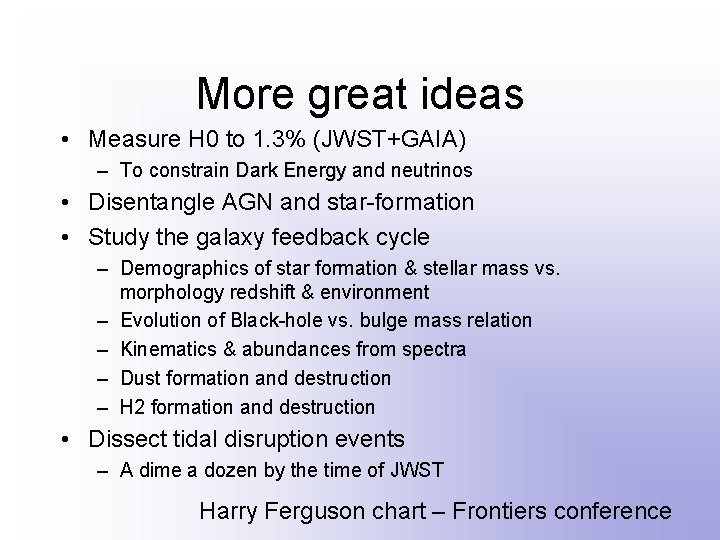
More great ideas • Measure H 0 to 1. 3% (JWST+GAIA) – To constrain Dark Energy and neutrinos • Disentangle AGN and star-formation • Study the galaxy feedback cycle – Demographics of star formation & stellar mass vs. morphology redshift & environment – Evolution of Black-hole vs. bulge mass relation – Kinematics & abundances from spectra – Dust formation and destruction – H 2 formation and destruction • Dissect tidal disruption events – A dime a dozen by the time of JWST Harry Ferguson chart – Frontiers conference

The James Webb Space Telescope Dark Energy and Dark Matter: The acceleration parameter of the Universe 1. ) Leverage multiple techniques to minimize systematic errors. 2. ) wide field surveys will find targets. 3. ) Measure very distant supernovae (standard candles? ) 4. ) SNe rest frame IR light curves – may be better standard candles? 5. ) directly measure effects of dark matter from distorted geometry of distant objects, masses of galaxies and clusters to high-z, rotation curves, etc… 6. ) Map cosmic archeology at high-z (prior to acceleration, formation of clusters). 7. ) Measure Cepheid variables in galaxies with known maser distances. JWST will constrain Dark Energy through exquisite measurements of HO
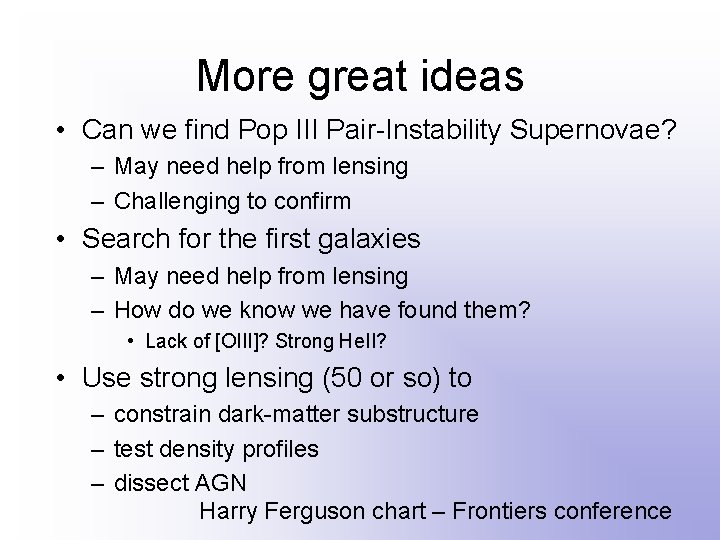
More great ideas • Can we find Pop III Pair-Instability Supernovae? – May need help from lensing – Challenging to confirm • Search for the first galaxies – May need help from lensing – How do we know we have found them? • Lack of [OIII]? Strong He. II? • Use strong lensing (50 or so) to – constrain dark-matter substructure – test density profiles – dissect AGN Harry Ferguson chart – Frontiers conference
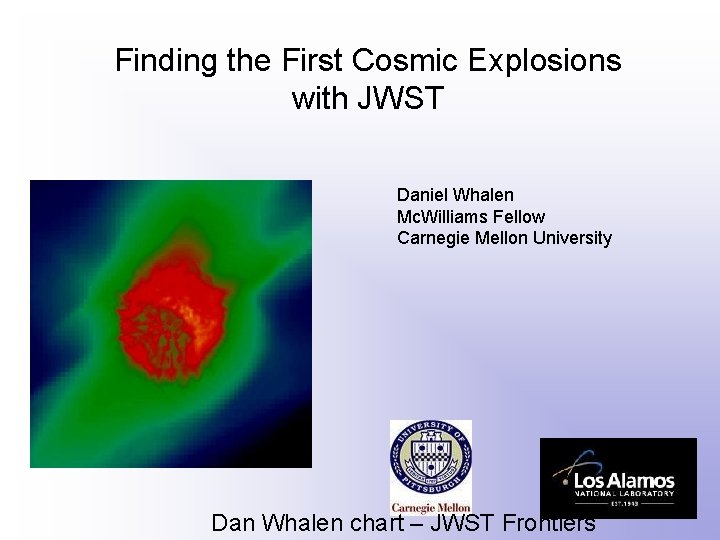
Finding the First Cosmic Explosions with JWST Daniel Whalen Mc. Williams Fellow Carnegie Mellon University Dan Whalen chart – JWST Frontiers
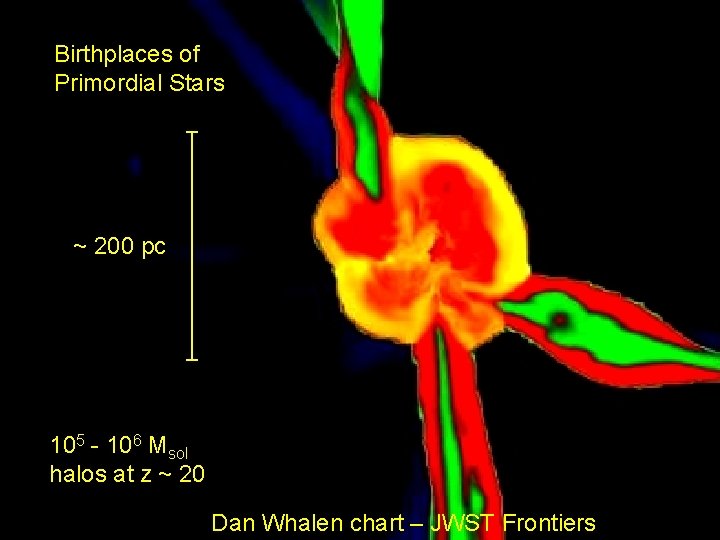
Birthplaces of Primordial Stars ~ 200 pc 105 - 106 Msol halos at z ~ 20 Dan Whalen chart – JWST Frontiers
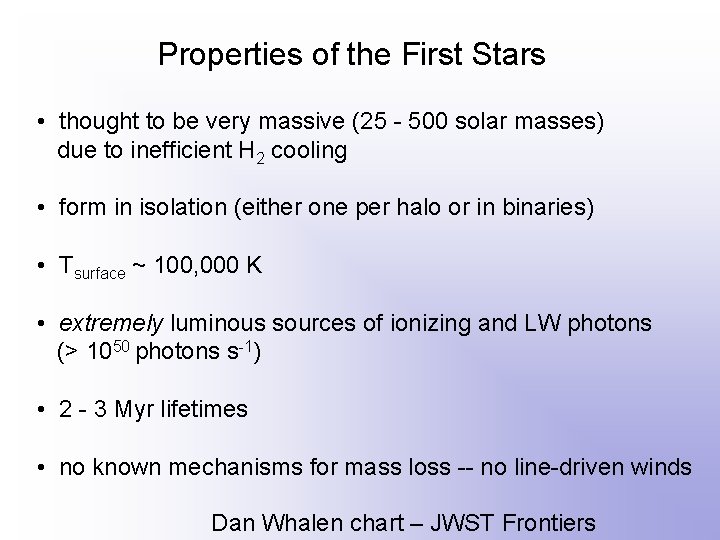
Properties of the First Stars • thought to be very massive (25 - 500 solar masses) due to inefficient H 2 cooling • form in isolation (either one per halo or in binaries) • Tsurface ~ 100, 000 K • extremely luminous sources of ionizing and LW photons (> 1050 photons s-1) • 2 - 3 Myr lifetimes • no known mechanisms for mass loss -- no line-driven winds Dan Whalen chart – JWST Frontiers
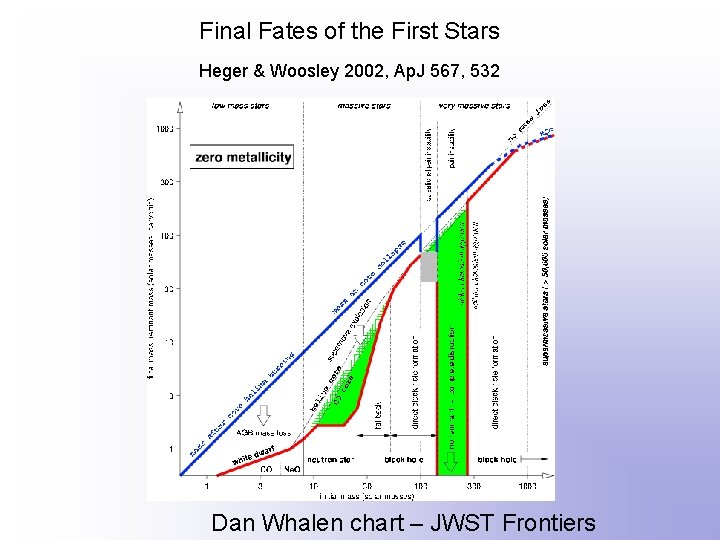
Final Fates of the First Stars Heger & Woosley 2002, Ap. J 567, 532 Dan Whalen chart – JWST Frontiers
Conclusions • PISN will be visible to JWST out to z ~ 10 ; strong lensing may enable their detection out to z ~ 15 (Holz, Whalen & Fryer 2010 Ap. J in prep) • dedicated ground-based followup with 30 -meter class telescopes for primordial SNe spectroscopy • discrimination between Pop III PISN and Pop III CC SNe will be challenging but offers the first direct constraints on the Pop III IMF • complementary detection of Pop III PISN remnants by the SZ effect may be possible (Whalen, Bhattacharya & Holz 2010, Ap. J in prep) Dan Whalen chart – JWST Frontiers

The James Webb Space Telescope JWST Science Themes – The Assembly and Evolution of Galaxies JWST Questions 1. ) Where and when did the hubble sequence form? 2. ) Do hierarchical formation models and global scaling relations explain diverse galaxy morphologies and their cosmic evolution? 3. ) How did the heavy elements form? 4. ) What role do ULIRGs and AGN play in galaxy evolution?
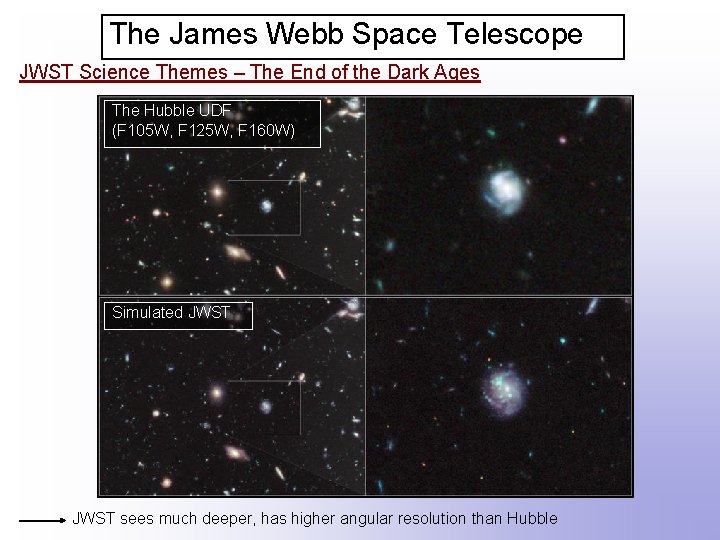
The James Webb Space Telescope JWST Science Themes – The End of the Dark Ages The Hubble UDF (F 105 W, F 125 W, F 160 W) Simulated JWST sees much deeper, has higher angular resolution than Hubble
Outline Three birds: • Is there dark matter substructure? Which comes first: the galaxy or the black hole? Are dark matter density profiles universal? • • • One stone: • Observations of multiply-imaged QSOs • • • MIRI imaging NIRSPEC spectroscopy Tommaso Treu chart – JWST Frontiers
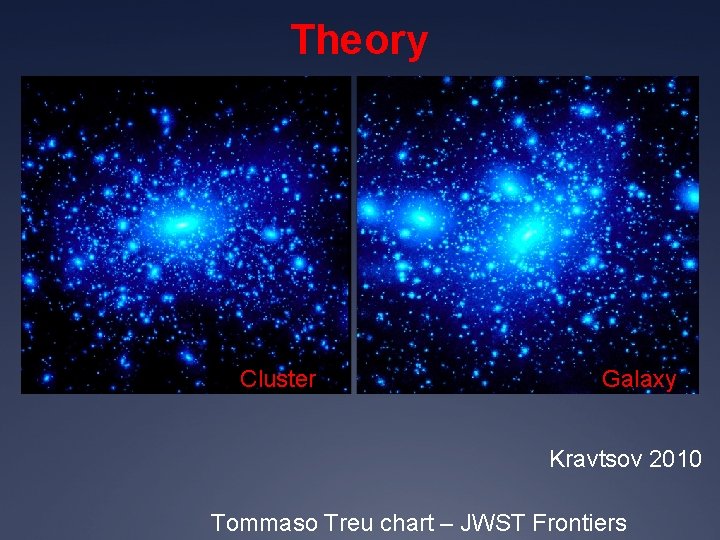
Theory Cluster Galaxy Kravtsov 2010 Tommaso Treu chart – JWST Frontiers
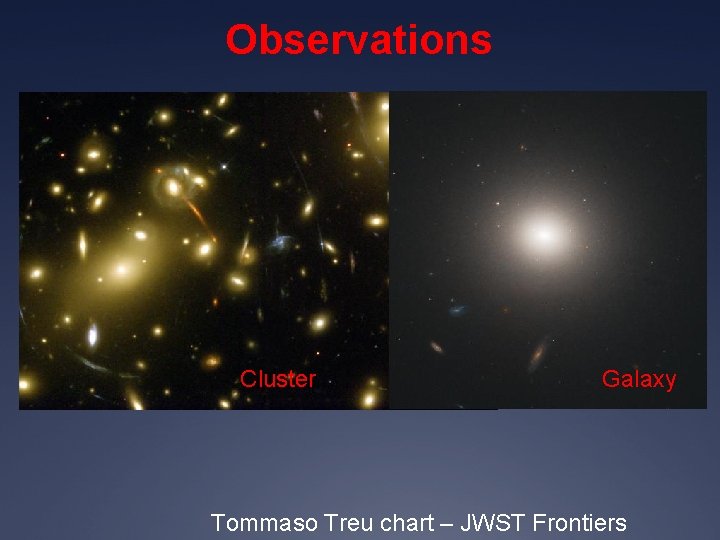
Observations Cluster Galaxy Tommaso Treu chart – JWST Frontiers
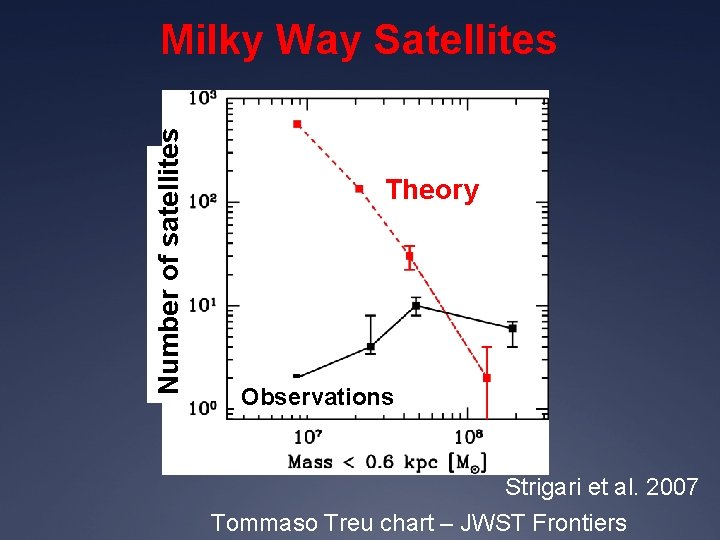
Number of satellites Milky Way Satellites Theory Observations Strigari et al. 2007 Tommaso Treu chart – JWST Frontiers
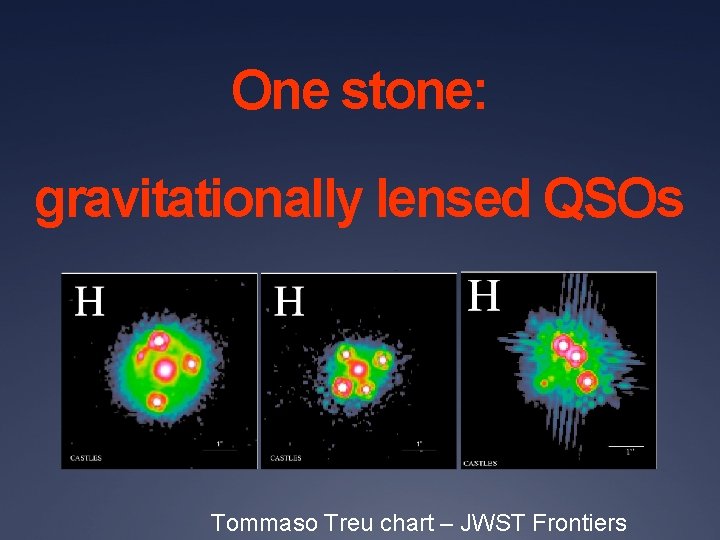
One stone: gravitationally lensed QSOs Tommaso Treu chart – JWST Frontiers
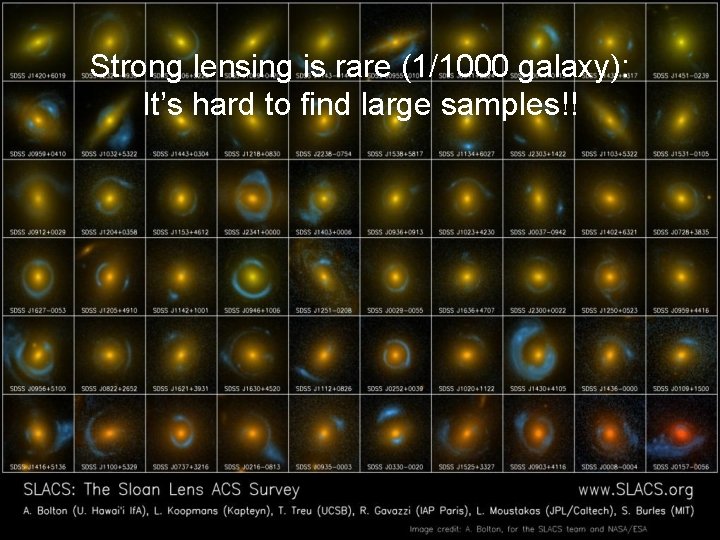
Strong lensing is rare (1/1000 galaxy): It’s hard to find large samples!!
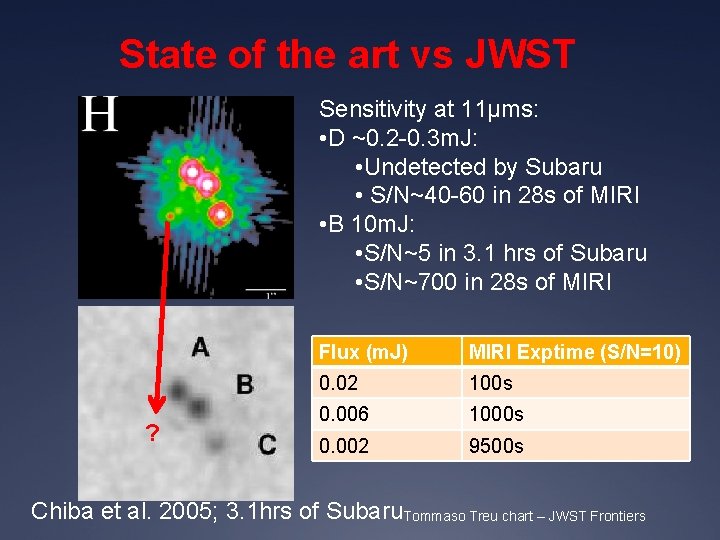
State of the art vs JWST Sensitivity at 11μms: • D ~0. 2 -0. 3 m. J: • Undetected by Subaru • S/N~40 -60 in 28 s of MIRI • B 10 m. J: • S/N~5 in 3. 1 hrs of Subaru • S/N~700 in 28 s of MIRI ? Flux (m. J) MIRI Exptime (S/N=10) 0. 02 100 s 0. 006 1000 s 0. 002 9500 s Chiba et al. 2005; 3. 1 hrs of Subaru. Tommaso Treu chart – JWST Frontiers
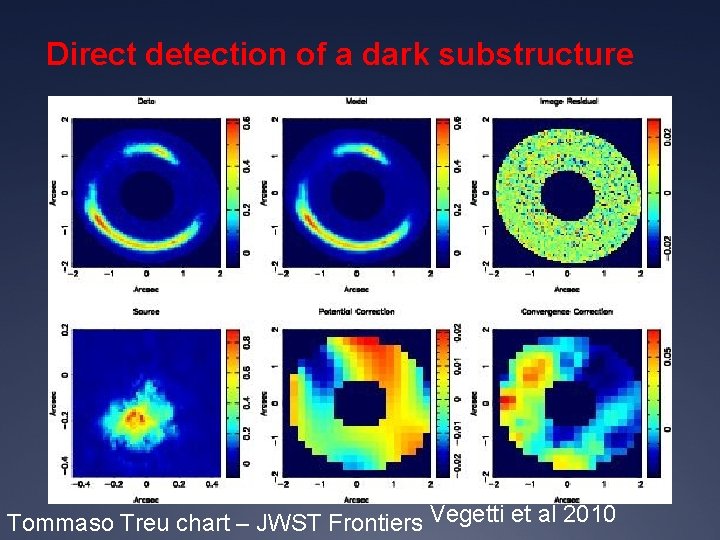
Direct detection of a dark substructure Tommaso Treu chart – JWST Frontiers Vegetti et al 2010
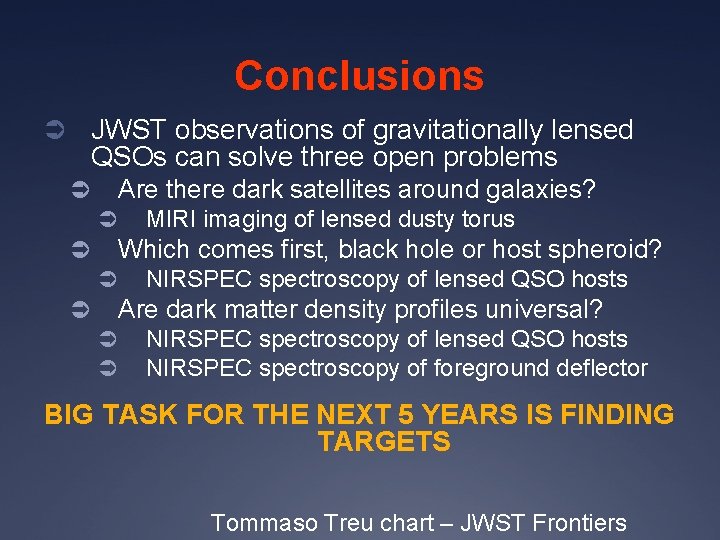
Conclusions Ü JWST observations of gravitationally lensed QSOs can solve three open problems Are there dark satellites around galaxies? Ü Ü MIRI imaging of lensed dusty torus Which comes first, black hole or host spheroid? Ü Ü NIRSPEC spectroscopy of lensed QSO hosts Are dark matter density profiles universal? Ü Ü Ü NIRSPEC spectroscopy of lensed QSO hosts NIRSPEC spectroscopy of foreground deflector BIG TASK FOR THE NEXT 5 YEARS IS FINDING TARGETS Tommaso Treu chart – JWST Frontiers
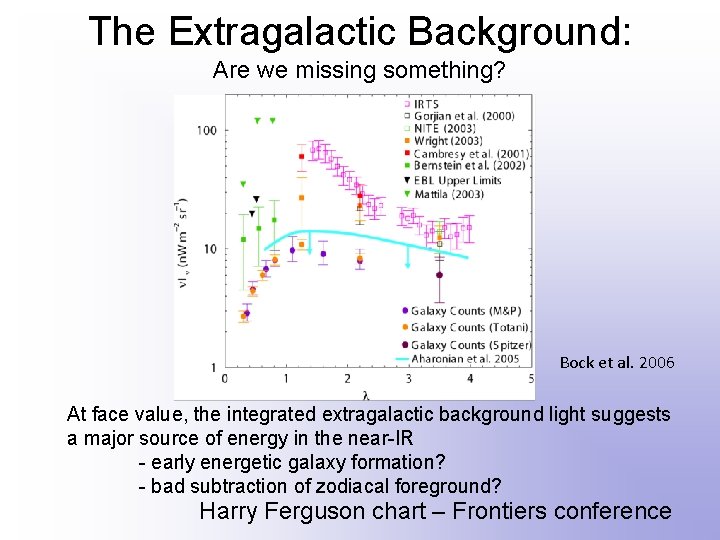
The Extragalactic Background: Are we missing something? Bock et al. 2006 At face value, the integrated extragalactic background light suggests a major source of energy in the near-IR - early energetic galaxy formation? - bad subtraction of zodiacal foreground? Harry Ferguson chart – Frontiers conference
Mid-Infrared Observation of High Redshift Galaxy Evolution Alexandra Pope (UMass Amherst) JWST Workshop – STSc. I Baltimore June 8, 2011
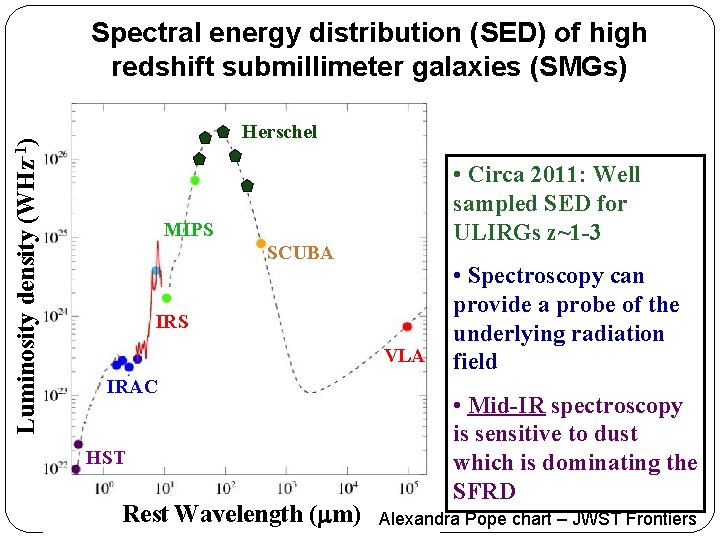
Luminosity density (WHz-1) Spectral energy distribution (SED) of high redshift submillimeter galaxies (SMGs) Herschel • Circa 2011: Well sampled SED for ULIRGs z~1 -3 MIPS SCUBA IRS VLA IRAC HST Rest Wavelength ( m) • Spectroscopy can provide a probe of the underlying radiation field • Mid-IR spectroscopy is sensitive to dust which is dominating the SFRD Alexandra Pope chart – JWST Frontiers
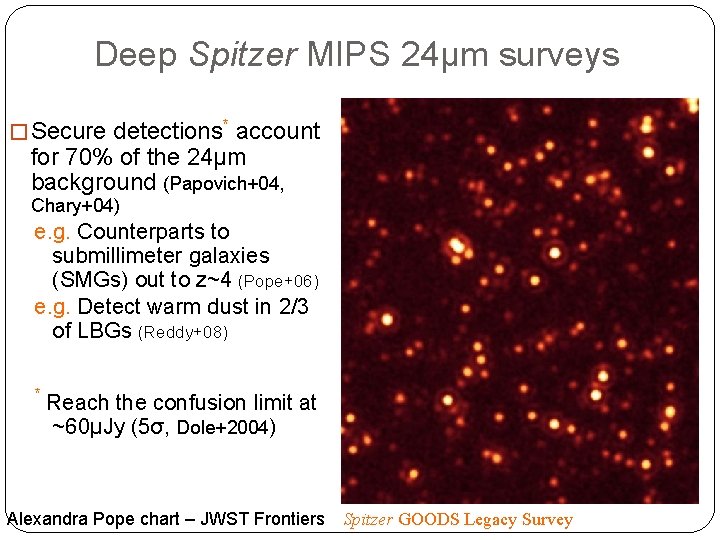
Deep Spitzer MIPS 24μm surveys � Secure detections* account for 70% of the 24μm background (Papovich+04, Chary+04) e. g. Counterparts to submillimeter galaxies (SMGs) out to z~4 (Pope+06) e. g. Detect warm dust in 2/3 of LBGs (Reddy+08) * Reach the confusion limit at ~60μJy (5σ, Dole+2004) Alexandra Pope chart – JWST Frontiers Spitzer GOODS Legacy Survey
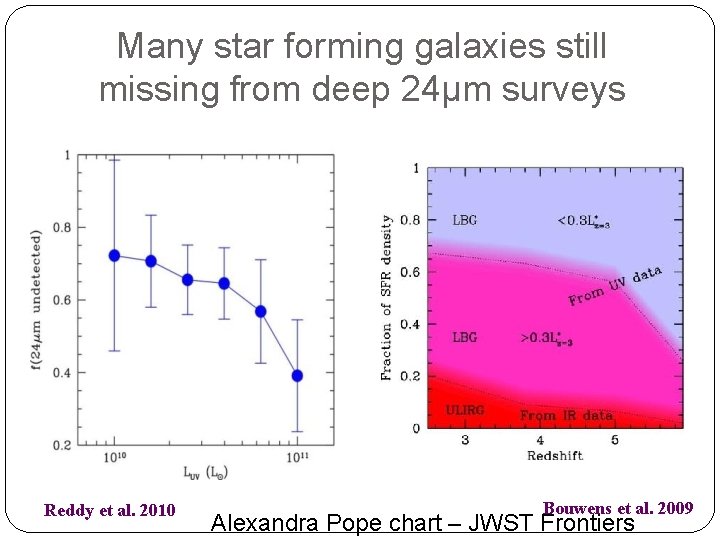
Many star forming galaxies still missing from deep 24μm surveys Reddy et al. 2010 Bouwens et al. 2009 Alexandra Pope chart – JWST Frontiers

JWST/MIRI spectra of z>4 galaxies? �Spitzer/IRS saw PAHs out to z~4 �JWST/MIRI will see the 6. 2μm PAH out to z~3. 5 and the 3. 3μm PAH out to z~7 – track down the earliest dust and learn how it formed 24 hr Spitzer IRS spectrum of the z=4 SMG GN 20 Riechers et al. in preparation Alexandra Pope chart – JWST Frontiers
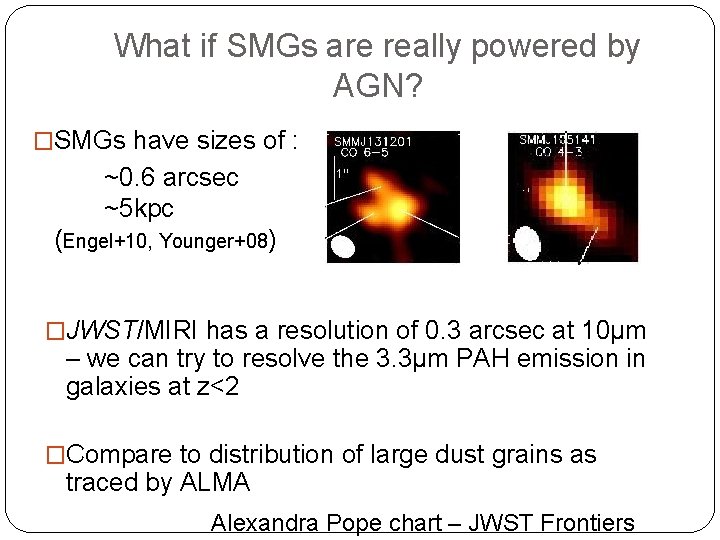
What if SMGs are really powered by AGN? �SMGs have sizes of : ~0. 6 arcsec ~5 kpc (Engel+10, Younger+08) �JWST/MIRI has a resolution of 0. 3 arcsec at 10μm – we can try to resolve the 3. 3μm PAH emission in galaxies at z<2 �Compare to distribution of large dust grains as traced by ALMA Alexandra Pope chart – JWST Frontiers
Synergy with Herschel, ALMA and other (sub)mm facilities � We need to plan JWST program that will complement other capabilities and facilities circa 2017/2018: �Herschel will have provided a statistic samples of high redshift ULIRGs �ALMA will be underway “detecting molecular gas in Milky Way like galaxies out to z~3” – but on smaller targeted samples �Large single dish (sub)mm telescopes (LMT, CCAT) can provide statistical samples of LIRGs – only probing the cold dust Alexandra Pope chart – JWST Frontiers
Summary � We have learnt a lot from Spitzer – this puts us in a great position to plan innovative projects for JWST � Several key areas where still have a lot to learn about dust in high redshift galaxies: � Directly detect dust in the galaxies which dominate the SFRD � Understand the detailed composition of dust at high redshift which constrains the production mechanisms � Relative heating of dust from starbursts and AGN activity � JWST together with ALMA will be a powerful duo for attacking these problems Alexandra Pope chart – JWST Frontiers
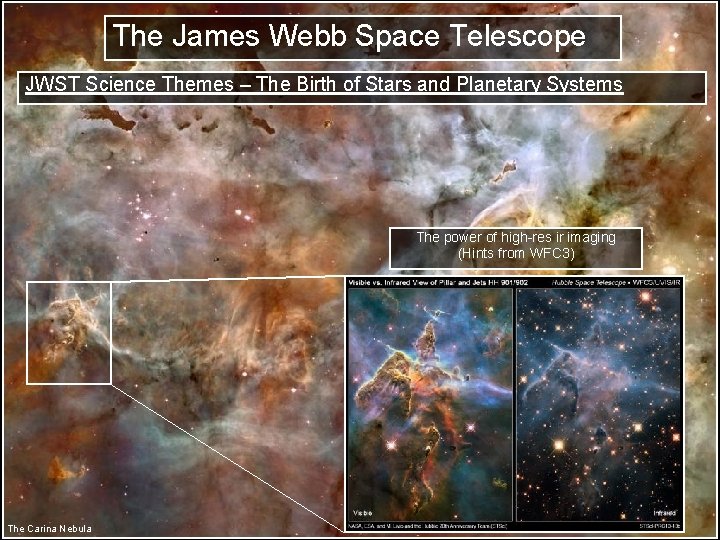
The James Webb Space Telescope JWST Science Themes – The Birth of Stars and Planetary Systems The power of high-res ir imaging (Hints from WFC 3) The Carina Nebula
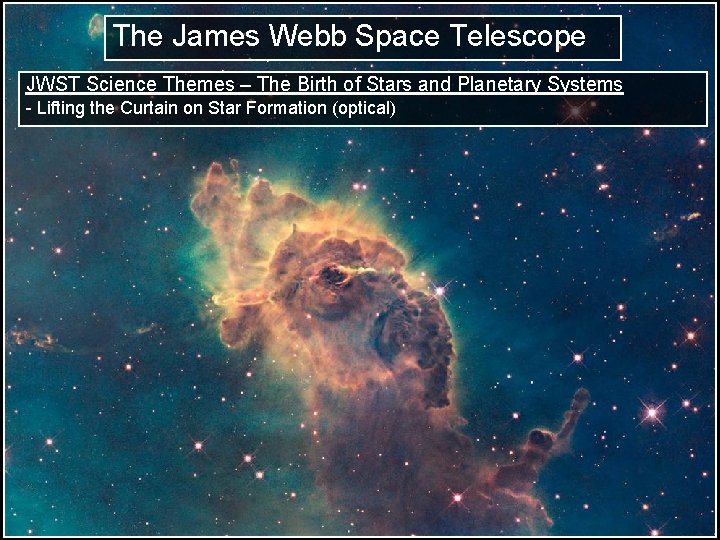
The James Webb Space Telescope JWST Science Themes – The Birth of Stars and Planetary Systems - Lifting the Curtain on Star Formation (optical)

The James Webb Space Telescope JWST Science Themes – The Birth of Stars and Planetary Systems - Lifting the Curtain on Star Formation JWST Questions 1. ) How do clouds collapse and form stars and planets? 2. ) How does environment affect star formation? 3. ) How does feedback from star formation affect environment, and trigger new star formation? 4. ) How are chemical elements produced and recirculated? 5. ) What is the stellar and substellar IMF, to and beyond the H-burning limit? 6. ) How does the IMF depend on environment (age, metallicity, binarity)?
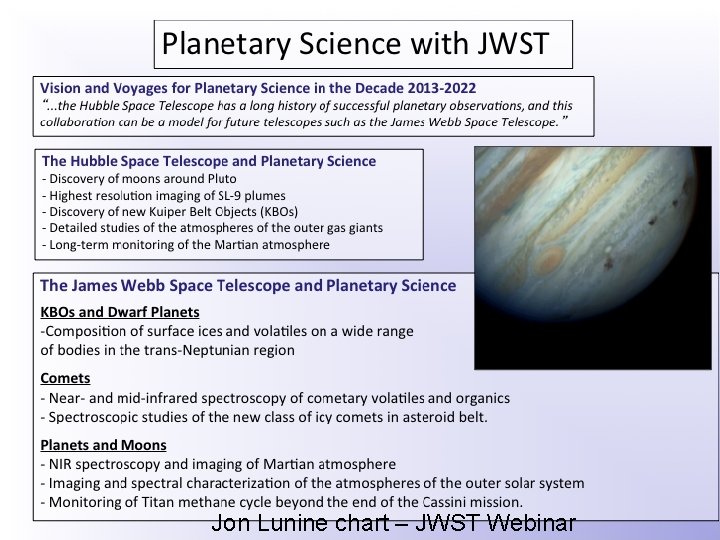
Jon Lunine chart – JWST Webinar
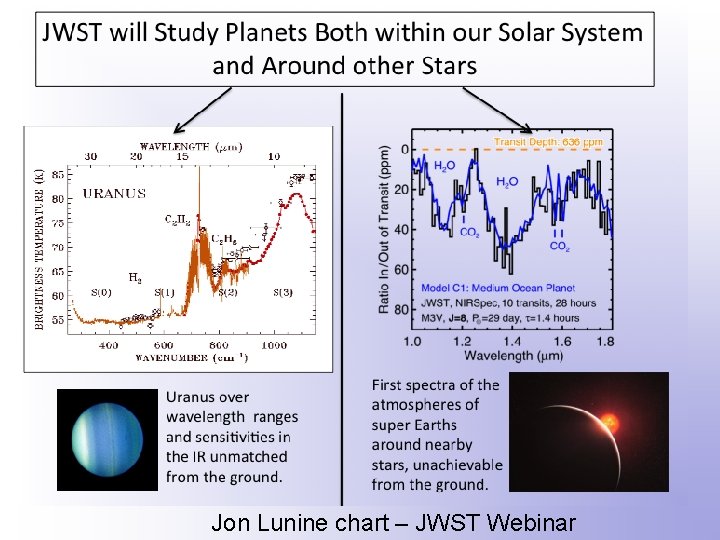
Jon Lunine chart – JWST Webinar
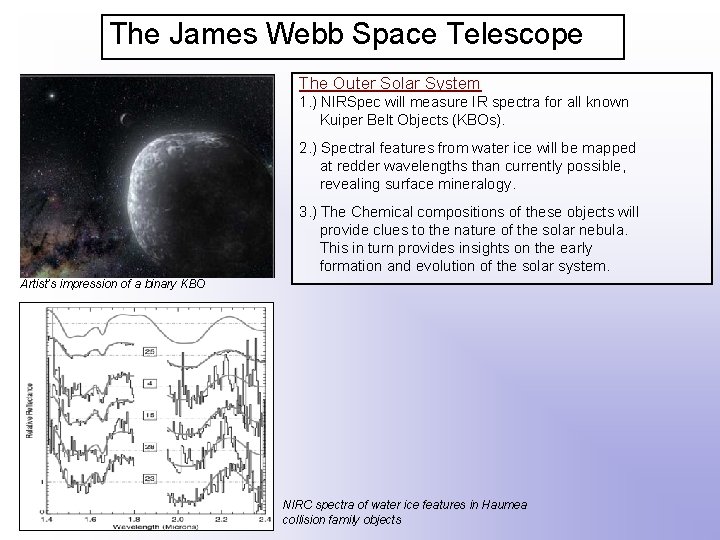
The James Webb Space Telescope The Outer Solar System 1. ) NIRSpec will measure IR spectra for all known Kuiper Belt Objects (KBOs). 2. ) Spectral features from water ice will be mapped at redder wavelengths than currently possible, revealing surface mineralogy. 3. ) The Chemical compositions of these objects will provide clues to the nature of the solar nebula. This in turn provides insights on the early formation and evolution of the solar system. Artist’s impression of a binary KBO NIRC spectra of water ice features in Haumea collision family objects
If JWST launched tomorrow, we have great ideas • What causes the rotational modulation of the spectrum of Uranus? • Why is Neptune’s stratosphere hotter than Uranus’s? • Observe solar systems forming from proto-planetary disks – Gravitational effects – Chemistry and transport of water and organics – Find a molten proto-earth afterglow? • Study known exoplanets – – Orbital constraints Direct imaging Sizes, atmospheres & thermal structure from transits & eclipses Tricky observing strategy decisions – need to prioritize what to do early Harry Ferguson chart – Frontiers conference
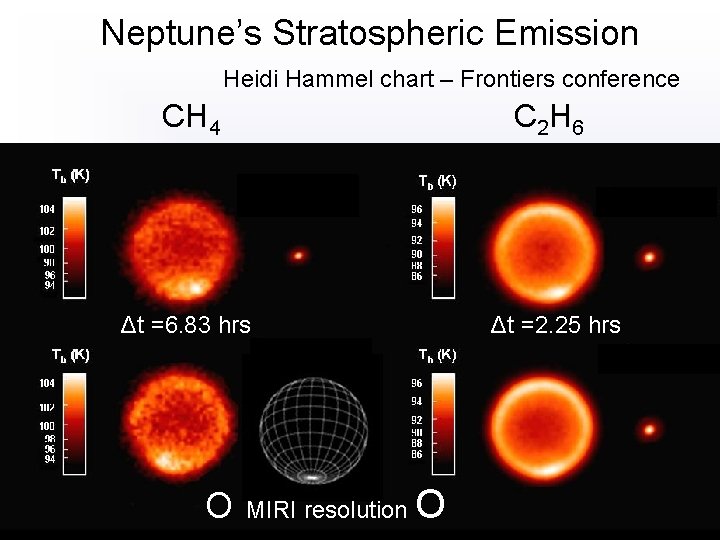
Neptune’s Stratospheric Emission Heidi Hammel chart – Frontiers conference CH 4 C 2 H 6 Δt =6. 83 hrs O MIRI resolution Δt =2. 25 hrs O
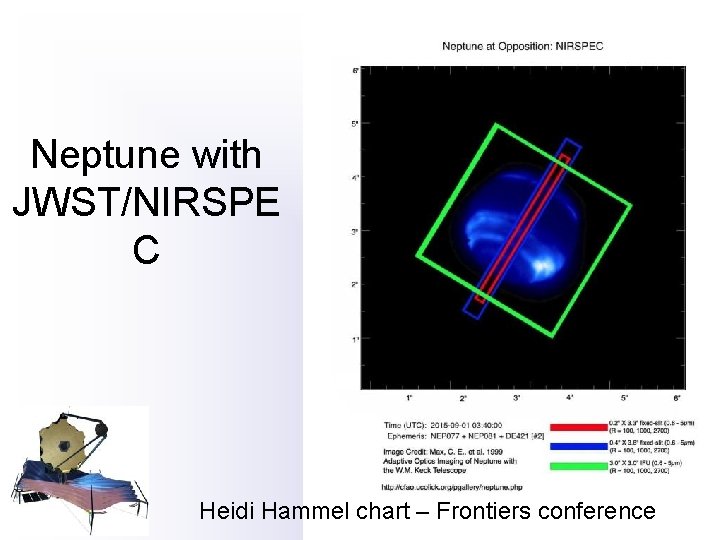
Neptune with JWST/NIRSPE C Heidi Hammel chart – Frontiers conference
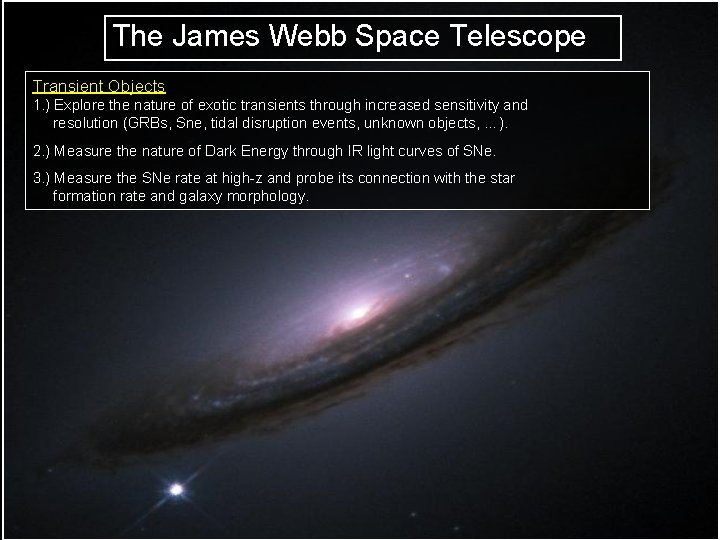
The James Webb Space Telescope Transient Objects 1. ) Explore the nature of exotic transients through increased sensitivity and resolution (GRBs, Sne, tidal disruption events, unknown objects, …). 2. ) Measure the nature of Dark Energy through IR light curves of SNe. 3. ) Measure the SNe rate at high-z and probe its connection with the star formation rate and galaxy morphology.
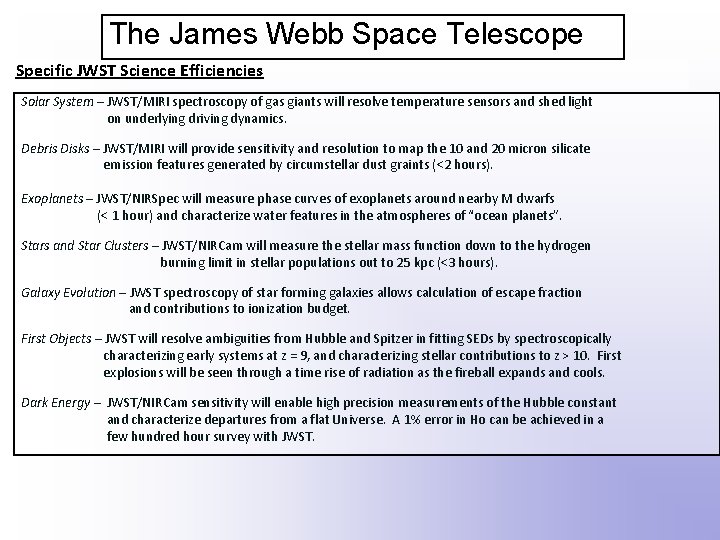
The James Webb Space Telescope Specific JWST Science Efficiencies Solar System – JWST/MIRI spectroscopy of gas giants will resolve temperature sensors and shed light on underlying driving dynamics. Debris Disks – JWST/MIRI will provide sensitivity and resolution to map the 10 and 20 micron silicate emission features generated by circumstellar dust graints (<2 hours). Exoplanets – JWST/NIRSpec will measure phase curves of exoplanets around nearby M dwarfs (< 1 hour) and characterize water features in the atmospheres of “ocean planets”. Stars and Star Clusters – JWST/NIRCam will measure the stellar mass function down to the hydrogen burning limit in stellar populations out to 25 kpc (<3 hours). Galaxy Evolution – JWST spectroscopy of star forming galaxies allows calculation of escape fraction and contributions to ionization budget. First Objects – JWST will resolve ambiguities from Hubble and Spitzer in fitting SEDs by spectroscopically characterizing early systems at z = 9, and characterizing stellar contributions to z > 10. First explosions will be seen through a time rise of radiation as the fireball expands and cools. Dark Energy – JWST/NIRCam sensitivity will enable high precision measurements of the Hubble constant and characterize departures from a flat Universe. A 1% error in Ho can be achieved in a few hundred hour survey with JWST.
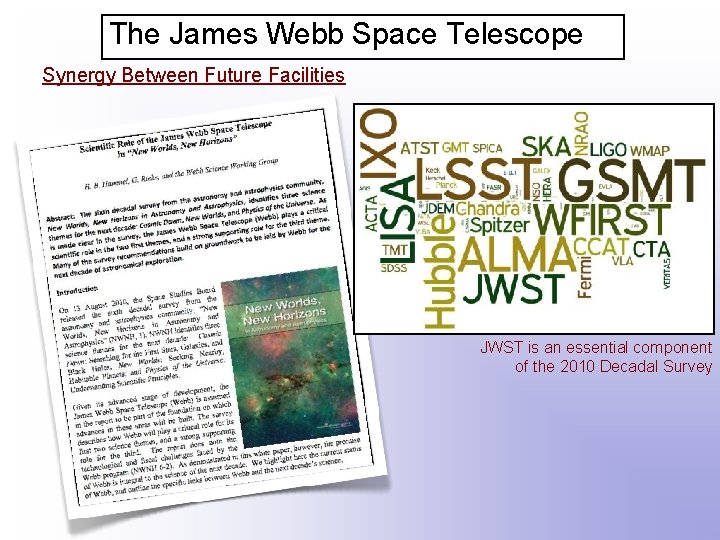
The James Webb Space Telescope Synergy Between Future Facilities JWST is an essential component of the 2010 Decadal Survey
The James Webb Space Telescope Visit JWST at: - The Space Telescope Science Institute (STSc. I): http: //www. stsci. edu/jwst/ - NASA Goddard Space Flight Center (GSFC): http: //www. jwst. nasa. gov/ - European Space Agency (ESA): http: //sci. esa. int/science-e/www/area/index. cfm? fareaid=29 - Canadian Space Agency (CSA): http: //www. asc-csa. gc. ca/eng/satellites/jwst/default. asp - Northrop Grumman: http: //www. as. northropgrumman. com/products/jwst/index. html - JWST Observer Facebook: http: //www. facebook. com/pages/JWST-Observer/103134319723237 - flickr: http: //www. flickr. com/photos/nasawebbtelescope/ -Twitter: @aura. JWST -STSc. I Frontiers Webcast archive: https: //webcast. stsci. edu/webcast/archive. xhtml - JWST Public Website: http: //webbtelescope. org/webb_telescope/ - JWST Public Facebook: http: //www. facebook. com/webbtelescope - Twitter: @NASAWebb. Telescp - Youtube: http: //www. youtube. com/user/NASAWebb. Telescope - Newsletter at STSc. I: https: //blogs. stsci. edu/newsletter/ - Newsletter at GSFC: http: //www. jwst. nasa. gov/newsletters. html
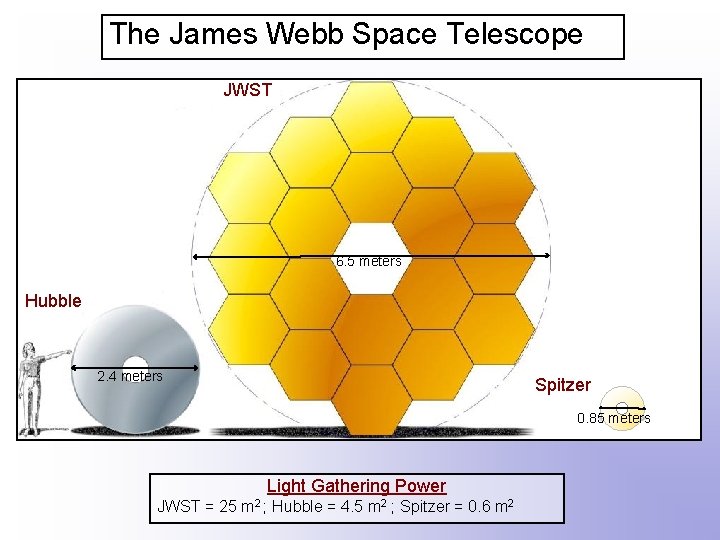
The James Webb Space Telescope JWST 6. 5 meters Hubble 2. 4 meters Spitzer 0. 85 meters Light Gathering Power JWST = 25 m 2 ; Hubble = 4. 5 m 2 ; Spitzer = 0. 6 m 2
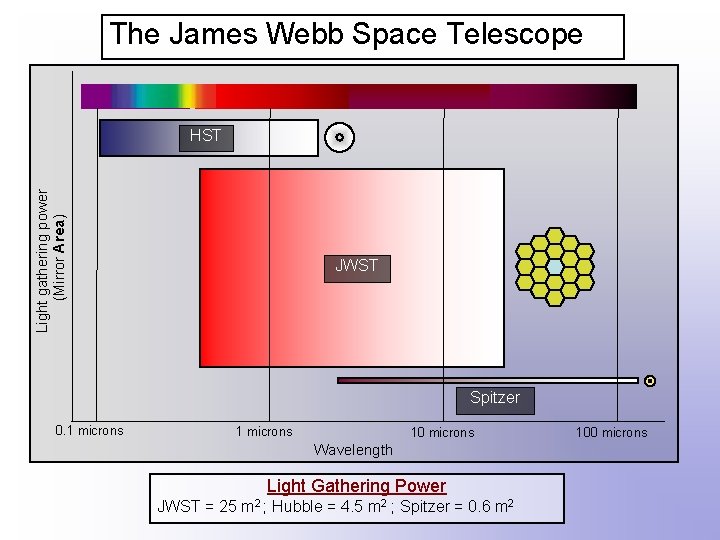
The James Webb Space Telescope Light gathering power (Mirror Area) HST JWST Spitzer 0. 1 microns 10 microns Wavelength Light Gathering Power JWST = 25 m 2 ; Hubble = 4. 5 m 2 ; Spitzer = 0. 6 m 2 100 microns
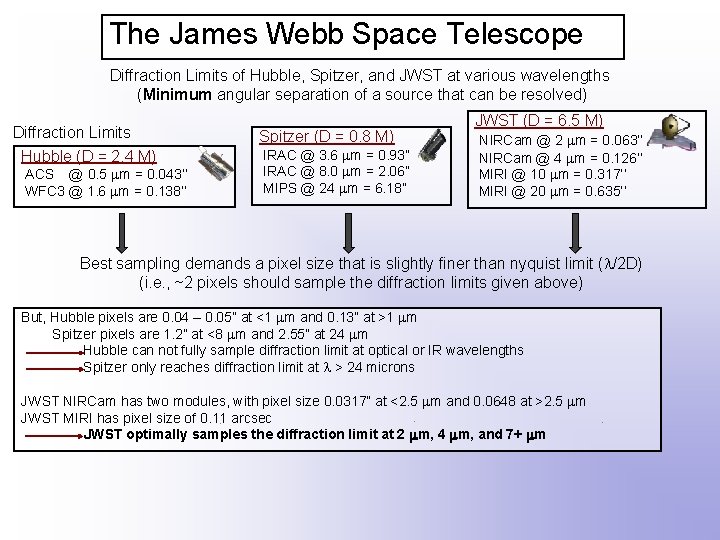
The James Webb Space Telescope Diffraction Limits of Hubble, Spitzer, and JWST at various wavelengths (Minimum angular separation of a source that can be resolved) Diffraction Limits Hubble (D = 2. 4 M) ACS @ 0. 5 mm = 0. 043’’ WFC 3 @ 1. 6 mm = 0. 138’’ Spitzer (D = 0. 8 M) IRAC @ 3. 6 mm = 0. 93” IRAC @ 8. 0 mm = 2. 06” MIPS @ 24 mm = 6. 18” JWST (D = 6. 5 M) NIRCam @ 2 mm = 0. 063’’ NIRCam @ 4 mm = 0. 126’’ MIRI @ 10 mm = 0. 317’’ MIRI @ 20 mm = 0. 635’’ Best sampling demands a pixel size that is slightly finer than nyquist limit (l/2 D) (i. e. , ~2 pixels should sample the diffraction limits given above) But, Hubble pixels are 0. 04 – 0. 05” at <1 mm and 0. 13” at >1 mm Spitzer pixels are 1. 2” at <8 mm and 2. 55” at 24 mm Hubble can not fully sample diffraction limit at optical or IR wavelengths Spitzer only reaches diffraction limit at l > 24 microns JWST NIRCam has two modules, with pixel size 0. 0317” at <2. 5 mm and 0. 0648 at >2. 5 mm JWST MIRI has pixel size of 0. 11 arcsec JWST optimally samples the diffraction limit at 2 m, 4 m, and 7+ m
- Slides: 50