
Astronomical Techniques B Eswar Reddy IIA Bangalore Reference
Astronomical Techniques B. Eswar Reddy IIA, Bangalore Reference: W. M. Smart: Text book on Spherical Astronomy R. M. Green: Spherical Astronomy Kaitchuk, R. H: Astronomical Photometry
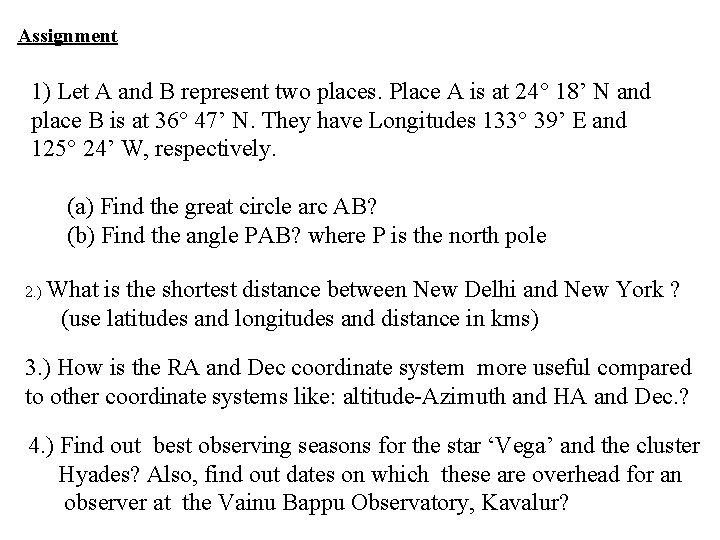
Assignment 1) Let A and B represent two places. Place A is at 24° 18’ N and place B is at 36° 47’ N. They have Longitudes 133° 39’ E and 125° 24’ W, respectively. (a) Find the great circle arc AB? (b) Find the angle PAB? where P is the north pole 2. ) What is the shortest distance between New Delhi and New York ? (use latitudes and longitudes and distance in kms) 3. ) How is the RA and Dec coordinate system more useful compared to other coordinate systems like: altitude-Azimuth and HA and Dec. ? 4. ) Find out best observing seasons for the star ‘Vega’ and the cluster Hyades? Also, find out dates on which these are overhead for an observer at the Vainu Bappu Observatory, Kavalur?
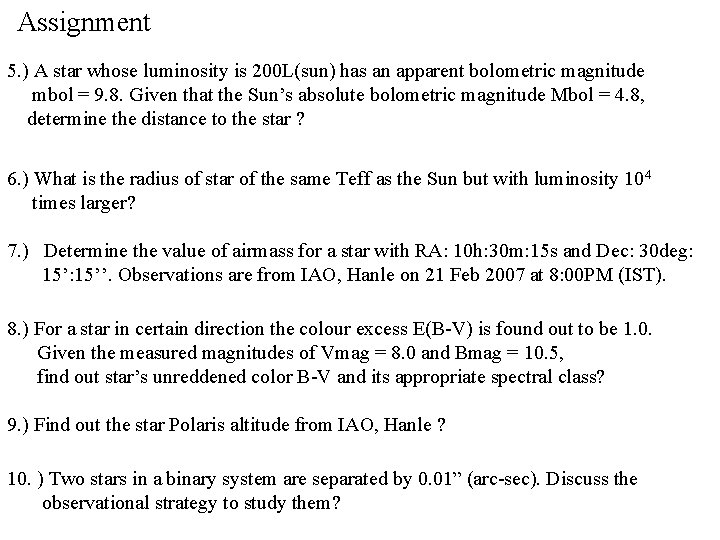
Assignment 5. ) A star whose luminosity is 200 L(sun) has an apparent bolometric magnitude mbol = 9. 8. Given that the Sun’s absolute bolometric magnitude Mbol = 4. 8, determine the distance to the star ? 6. ) What is the radius of star of the same Teff as the Sun but with luminosity 104 times larger? 7. ) Determine the value of airmass for a star with RA: 10 h: 30 m: 15 s and Dec: 30 deg: 15’’. Observations are from IAO, Hanle on 21 Feb 2007 at 8: 00 PM (IST). 8. ) For a star in certain direction the colour excess E(B-V) is found out to be 1. 0. Given the measured magnitudes of Vmag = 8. 0 and Bmag = 10. 5, find out star’s unreddened color B-V and its appropriate spectral class? 9. ) Find out the star Polaris altitude from IAO, Hanle ? 10. ) Two stars in a binary system are separated by 0. 01” (arc-sec). Discuss the observational strategy to study them?
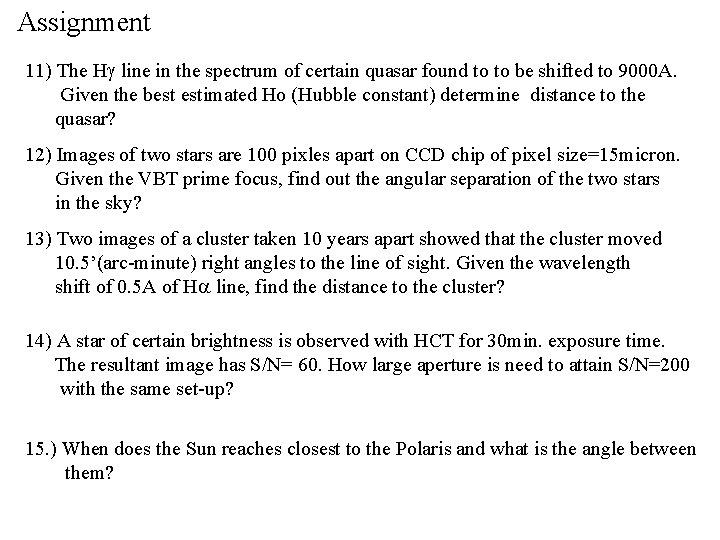
Assignment 11) The H line in the spectrum of certain quasar found to to be shifted to 9000 A. Given the best estimated Ho (Hubble constant) determine distance to the quasar? 12) Images of two stars are 100 pixles apart on CCD chip of pixel size=15 micron. Given the VBT prime focus, find out the angular separation of the two stars in the sky? 13) Two images of a cluster taken 10 years apart showed that the cluster moved 10. 5’(arc-minute) right angles to the line of sight. Given the wavelength shift of 0. 5 A of H line, find the distance to the cluster? 14) A star of certain brightness is observed with HCT for 30 min. exposure time. The resultant image has S/N= 60. How large aperture is need to attain S/N=200 with the same set-up? 15. ) When does the Sun reaches closest to the Polaris and what is the angle between them?
Assignment 16) Stromgren photometry for two stars is given: star 1 ( v=10. 0, b=9. 5 and y=8. 0) and star 2 (v=12. 0, b=10. 5 and y=9. 0). Discuss their relative metallicities? 17. ) What is the field of view for the VBT telescope with the Cassegrain focus? It is fitted with an eye piece of FOV 40° and focal length of 500 cm. 18. ) For a telescope of 50 cm the limiting magnitude (one can see thru the telescope) is 15. To see stars as faint as 26 th magnitude, what sort of telescope aperture one should have? 19. ) The pole star or Polaris has 2000 epoch coordinates RA: 02: 31: 49. 08; DEC: +89: 15: 50. 8. Find out its coordinates for 10000 AD epoch? 20. ) Find out plate scales and angular resolutions for HCT and VBT telescopes?
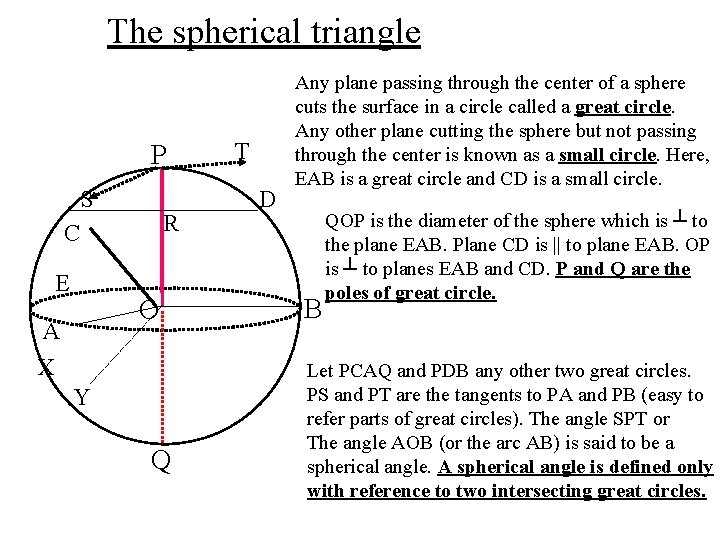
The spherical triangle P S R C E O A X Y Q T D Any plane passing through the center of a sphere cuts the surface in a circle called a great circle. Any other plane cutting the sphere but not passing through the center is known as a small circle. Here, EAB is a great circle and CD is a small circle. B QOP is the diameter of the sphere which is ┴ to the plane EAB. Plane CD is || to plane EAB. OP is ┴ to planes EAB and CD. P and Q are the poles of great circle. Let PCAQ and PDB any other two great circles. PS and PT are the tangents to PA and PB (easy to refer parts of great circles). The angle SPT or The angle AOB (or the arc AB) is said to be a spherical angle. A spherical angle is defined only with reference to two intersecting great circles.
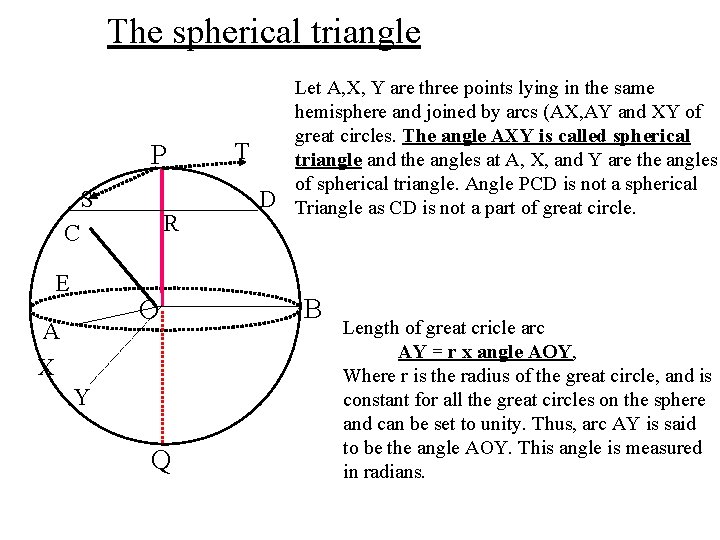
The spherical triangle P S R C E O A X Y Q T D Let A, X, Y are three points lying in the same hemisphere and joined by arcs (AX, AY and XY of great circles. The angle AXY is called spherical triangle and the angles at A, X, and Y are the angles of spherical triangle. Angle PCD is not a spherical Triangle as CD is not a part of great circle. B Length of great cricle arc AY = r x angle AOY, Where r is the radius of the great circle, and is constant for all the great circles on the sphere and can be set to unity. Thus, arc AY is said to be the angle AOY. This angle is measured in radians.
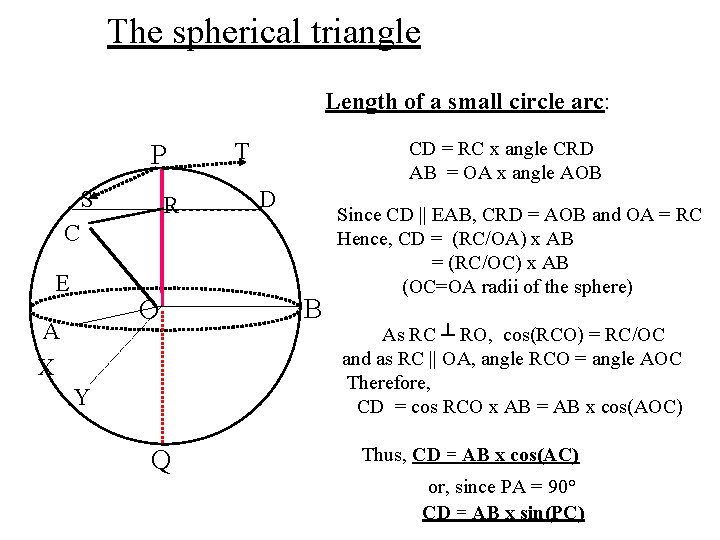
The spherical triangle Length of a small circle arc: P S R CD = RC x angle CRD AB = OA x angle AOB T D C E O A X Y Q B Since CD || EAB, CRD = AOB and OA = RC Hence, CD = (RC/OA) x AB = (RC/OC) x AB (OC=OA radii of the sphere) As RC ┴ RO, cos(RCO) = RC/OC and as RC || OA, angle RCO = angle AOC Therefore, CD = cos RCO x AB = AB x cos(AOC) Thus, CD = AB x cos(AC) or, since PA = 90° CD = AB x sin(PC)
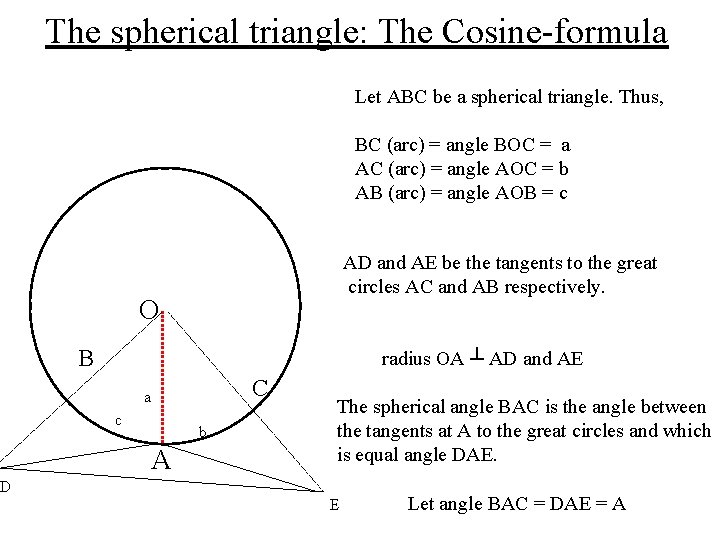
The spherical triangle: The Cosine-formula Let ABC be a spherical triangle. Thus, BC (arc) = angle BOC = a AC (arc) = angle AOC = b AB (arc) = angle AOB = c AD and AE be the tangents to the great circles AC and AB respectively. O B radius OA ┴ AD and AE C a c b A The spherical angle BAC is the angle between the tangents at A to the great circles and which is equal angle DAE. D E Let angle BAC = DAE = A
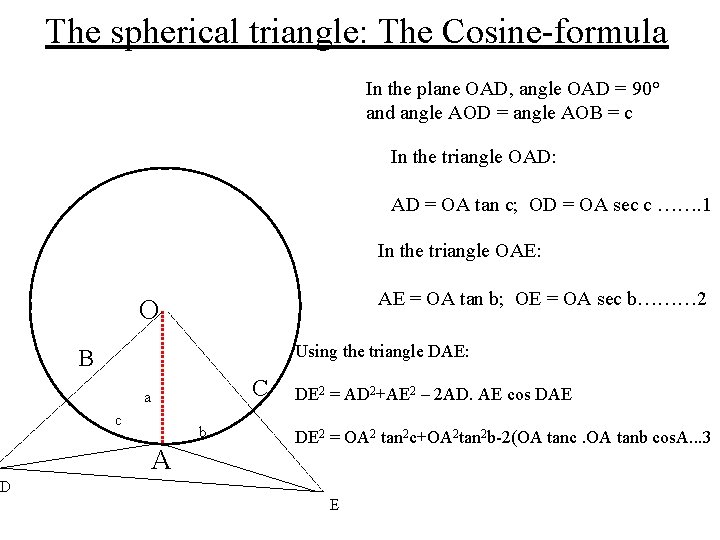
The spherical triangle: The Cosine-formula In the plane OAD, angle OAD = 90° and angle AOD = angle AOB = c In the triangle OAD: AD = OA tan c; OD = OA sec c ……. 1 In the triangle OAE: AE = OA tan b; OE = OA sec b……… 2 O Using the triangle DAE: B C a c b A DE 2 = AD 2+AE 2 – 2 AD. AE cos DAE DE 2 = OA 2 tan 2 c+OA 2 tan 2 b-2(OA tanc. OA tanb cos. A. . . 3 D E
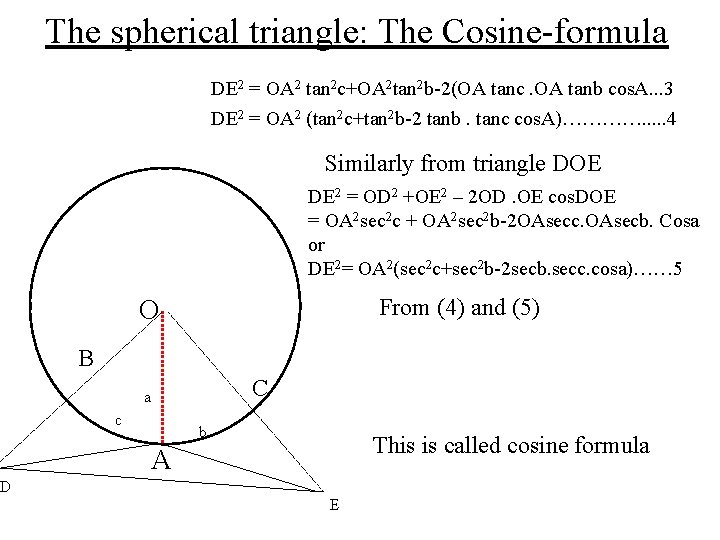
The spherical triangle: The Cosine-formula DE 2 = OA 2 tan 2 c+OA 2 tan 2 b-2(OA tanc. OA tanb cos. A. . . 3 DE 2 = OA 2 (tan 2 c+tan 2 b-2 tanb. tanc cos. A)…………. . . 4 Similarly from triangle DOE DE 2 = OD 2 +OE 2 – 2 OD. OE cos. DOE = OA 2 sec 2 c + OA 2 sec 2 b-2 OAsecc. OAsecb. Cosa or DE 2= OA 2(sec 2 c+sec 2 b-2 secb. secc. cosa)…… 5 From (4) and (5) O B C a c b This is called cosine formula A D E
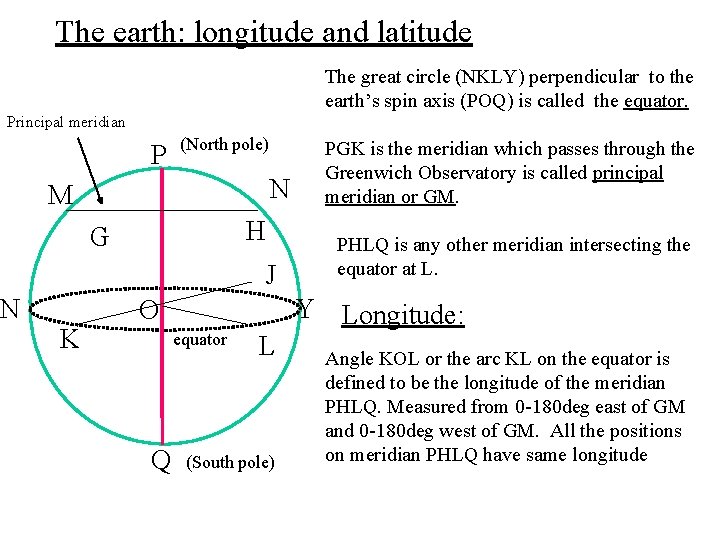
The earth: longitude and latitude The great circle (NKLY) perpendicular to the earth’s spin axis (POQ) is called the equator. Principal meridian N P (North pole) N M H G J K O equator Q L (South pole) PGK is the meridian which passes through the Greenwich Observatory is called principal meridian or GM. PHLQ is any other meridian intersecting the equator at L. Y Longitude: Angle KOL or the arc KL on the equator is defined to be the longitude of the meridian PHLQ. Measured from 0 -180 deg east of GM and 0 -180 deg west of GM. All the positions on meridian PHLQ have same longitude
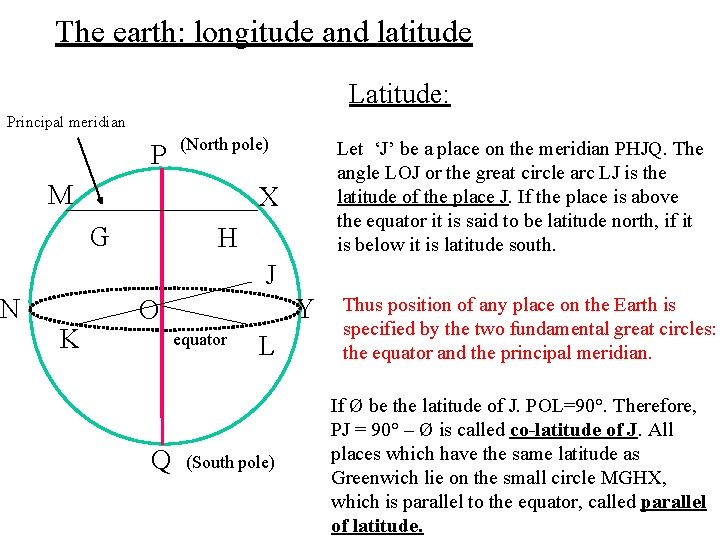
The earth: longitude and latitude Latitude: Principal meridian N P (North pole) M Let ‘J’ be a place on the meridian PHJQ. The angle LOJ or the great circle arc LJ is the latitude of the place J. If the place is above the equator it is said to be latitude north, if it is below it is latitude south. X G H J K Y O equator Q L (South pole) Thus position of any place on the Earth is specified by the two fundamental great circles: the equator and the principal meridian. If Ø be the latitude of J. POL=90°. Therefore, PJ = 90° – Ø is called co-latitude of J. All places which have the same latitude as Greenwich lie on the small circle MGHX, which is parallel to the equator, called parallel of latitude.
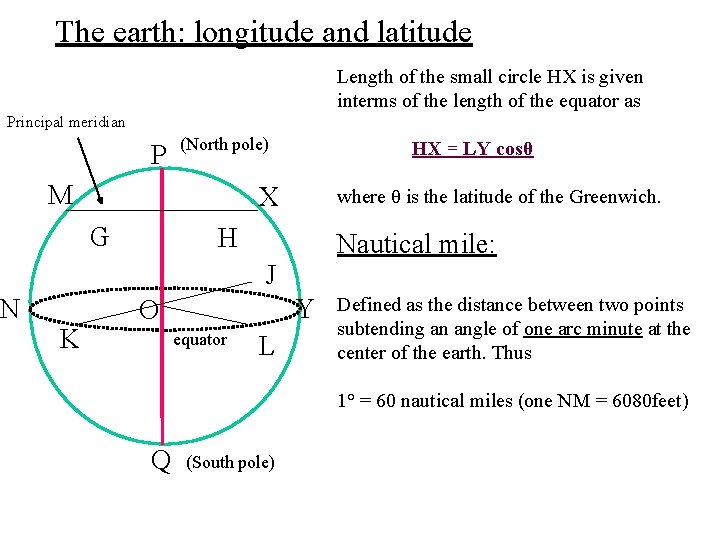
The earth: longitude and latitude Length of the small circle HX is given interms of the length of the equator as Principal meridian N P (North pole) M HX = LY cosθ X G where θ is the latitude of the Greenwich. H Nautical mile: J K Y O equator L Defined as the distance between two points subtending an angle of one arc minute at the center of the earth. Thus 1° = 60 nautical miles (one NM = 6080 feet) Q (South pole)
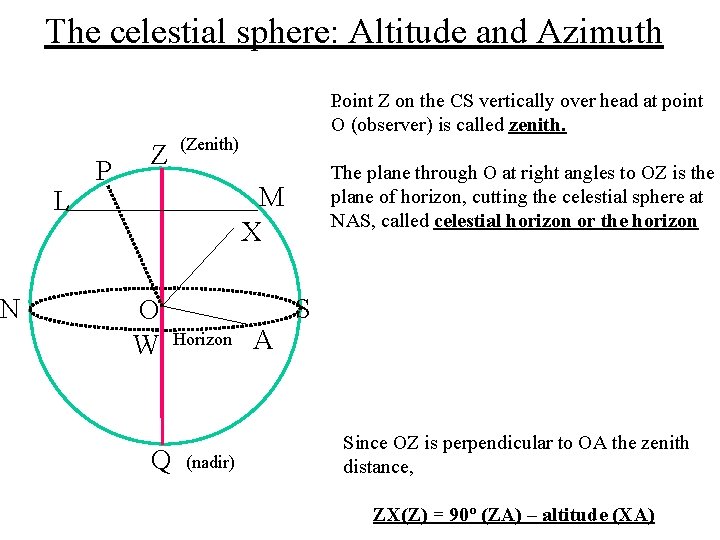
N The celestial sphere: Altitude and Azimuth L P Z . Point Z on the CS vertically over head at point O (observer) is called zenith. (Zenith) The plane through O at right angles to OZ is the plane of horizon, cutting the celestial sphere at NAS, called celestial horizon or the horizon M X O W Q Horizon (nadir) A S Since OZ is perpendicular to OA the zenith distance, ZX(Z) = 90º (ZA) – altitude (XA)
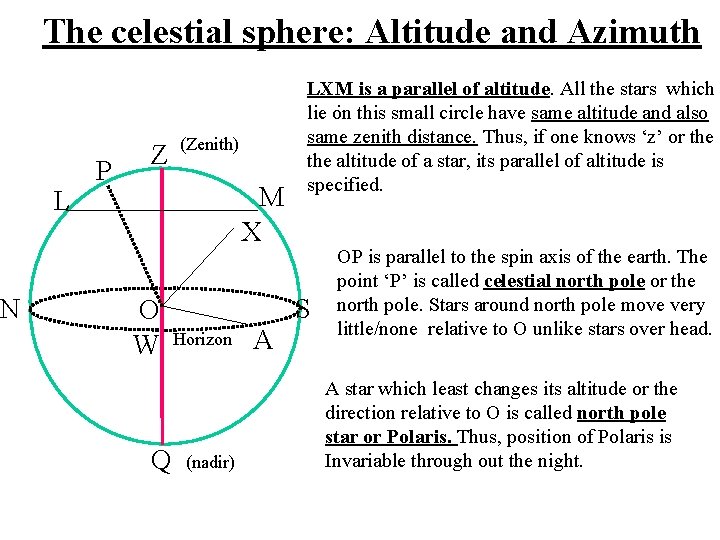
N The celestial sphere: Altitude and Azimuth L P Z (Zenith) M X O W Q Horizon (nadir) A LXM is a parallel of altitude. All the stars which. lie on this small circle have same altitude and also same zenith distance. Thus, if one knows ‘z’ or the altitude of a star, its parallel of altitude is specified. S OP is parallel to the spin axis of the earth. The point ‘P’ is called celestial north pole or the north pole. Stars around north pole move very little/none relative to O unlike stars over head. A star which least changes its altitude or the direction relative to O is called north pole star or Polaris. Thus, position of Polaris is Invariable through out the night.
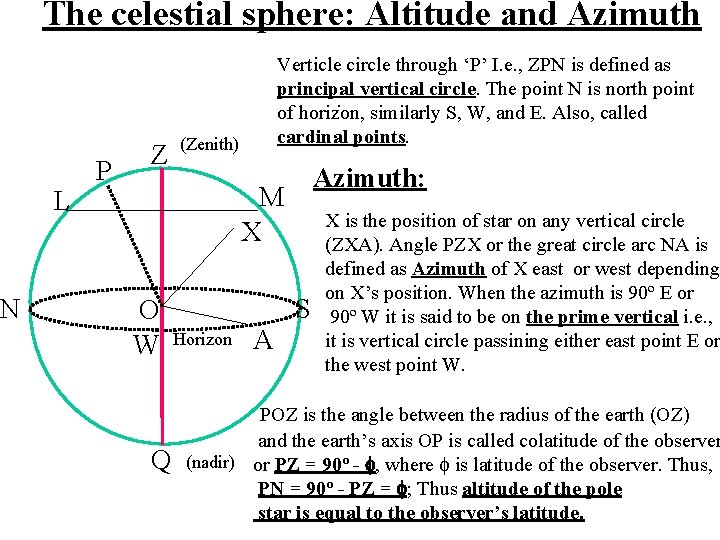
N The celestial sphere: Altitude and Azimuth L P Z Verticle circle through ‘P’ I. e. , ZPN is defined as principal vertical circle. The point N is north point. of horizon, similarly S, W, and E. Also, called cardinal points. (Zenith) Azimuth: M X O W Q Horizon A S X is the position of star on any vertical circle (ZXA). Angle PZX or the great circle arc NA is defined as Azimuth of X east or west depending on X’s position. When the azimuth is 90º E or 90º W it is said to be on the prime vertical i. e. , it is vertical circle passining either east point E or the west point W. POZ is the angle between the radius of the earth (OZ) and the earth’s axis OP is called colatitude of the observer (nadir) or PZ = 90º - , where is latitude of the observer. Thus, PN = 90º - PZ = ; Thus altitude of the pole star is equal to the observer’s latitude.
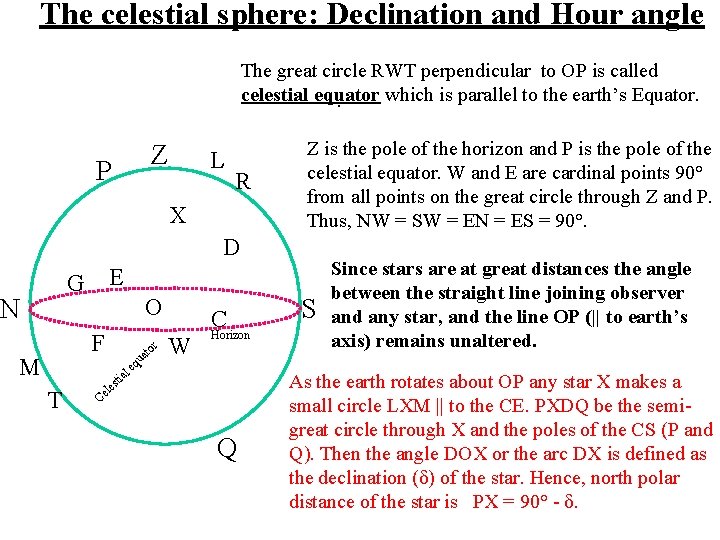
The celestial sphere: Declination and Hour angle The great circle RWT perpendicular to OP is called celestial equator which is parallel to the earth’s Equator. . Z P L R X Z is the pole of the horizon and P is the pole of the celestial equator. W and E are cardinal points 90° from all points on the great circle through Z and P. Thus, NW = SW = EN = ES = 90°. D E G N O F M T r to a sti e el l ua eq C W Horizon C Q S Since stars are at great distances the angle between the straight line joining observer and any star, and the line OP (|| to earth’s axis) remains unaltered. As the earth rotates about OP any star X makes a small circle LXM || to the CE. PXDQ be the semigreat circle through X and the poles of the CS (P and Q). Then the angle DOX or the arc DX is defined as the declination (δ) of the star. Hence, north polar distance of the star is PX = 90° - δ.
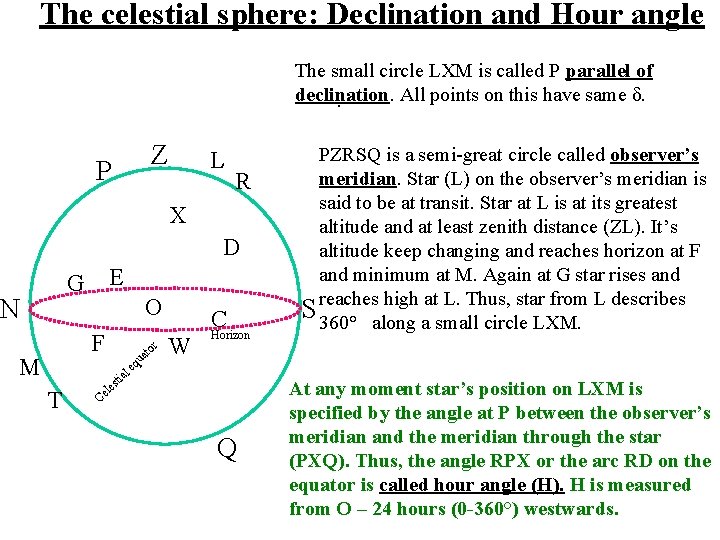
The celestial sphere: Declination and Hour angle The small circle LXM is called P parallel of declination. All points on this have same δ. . Z P L R X D E G N O F M T r to a sti e el l ua eq C W Horizon C Q PZRSQ is a semi-great circle called observer’s meridian. Star (L) on the observer’s meridian is said to be at transit. Star at L is at its greatest altitude and at least zenith distance (ZL). It’s altitude keep changing and reaches horizon at F and minimum at M. Again at G star rises and high at L. Thus, star from L describes S reaches 360° along a small circle LXM. At any moment star’s position on LXM is specified by the angle at P between the observer’s meridian and the meridian through the star (PXQ). Thus, the angle RPX or the arc RD on the equator is called hour angle (H). H is measured from O – 24 hours (0 -360°) westwards.
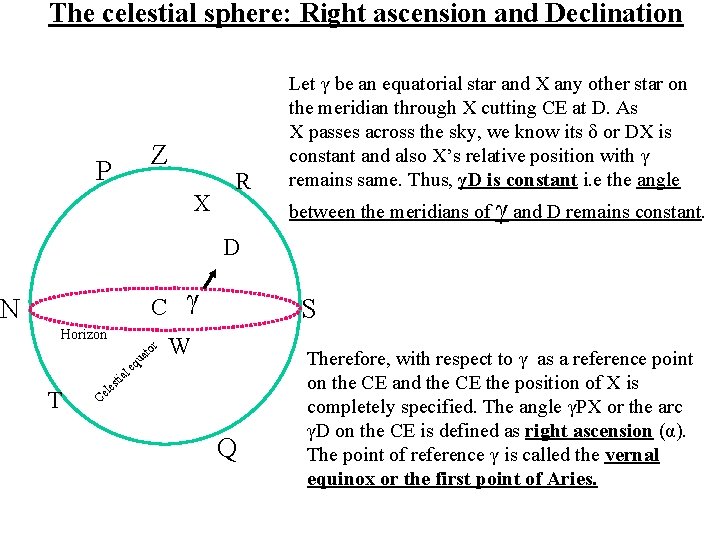
The celestial sphere: Right ascension and Declination Z P X R Let γ be an equatorial star and X any other star on the meridian through X cutting CE at D. As X passes across the sky, we know its δ or DX is constant and also X’s relative position with γ remains same. Thus, γD is constant i. e the angle between the meridians of γ and D remains constant. D C γ N Horizon T Ce or le al sti at qu S W e Q Therefore, with respect to γ as a reference point on the CE and the CE the position of X is completely specified. The angle γPX or the arc γD on the CE is defined as right ascension (α). The point of reference γ is called the vernal equinox or the first point of Aries.
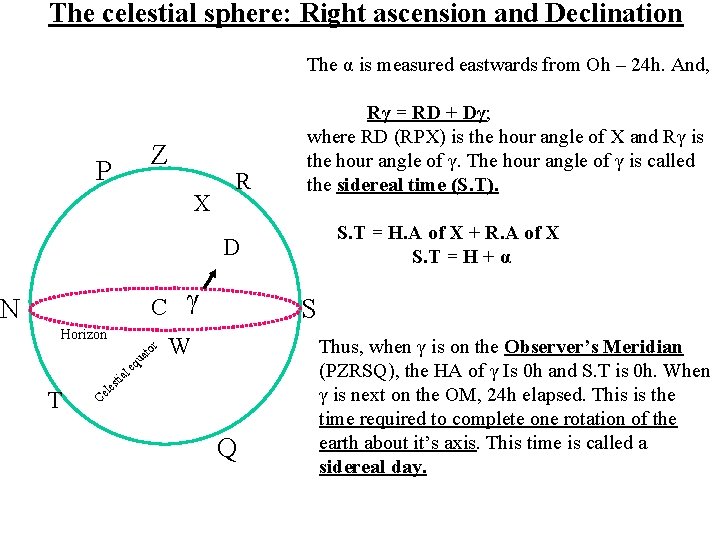
The celestial sphere: Right ascension and Declination The α is measured eastwards from Oh – 24 h. And, Z P X R Rγ = RD + Dγ; where RD (RPX) is the hour angle of X and Rγ is the hour angle of γ. The hour angle of γ is called the sidereal time (S. T). S. T = H. A of X + R. A of X S. T = H + α D C γ N Horizon T Ce or le al sti at qu S W e Q Thus, when γ is on the Observer’s Meridian (PZRSQ), the HA of γ Is 0 h and S. T is 0 h. When γ is next on the OM, 24 h elapsed. This is the time required to complete one rotation of the earth about it’s axis. This time is called a sidereal day.
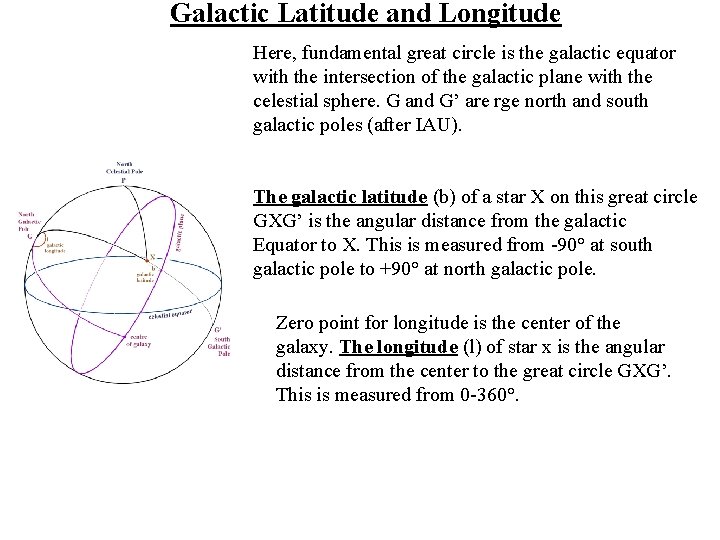
Galactic Latitude and Longitude Here, fundamental great circle is the galactic equator with the intersection of the galactic plane with the celestial sphere. G and G’ are rge north and south galactic poles (after IAU). The galactic latitude (b) of a star X on this great circle GXG’ is the angular distance from the galactic Equator to X. This is measured from -90° at south galactic pole to +90° at north galactic pole. Zero point for longitude is the center of the galaxy. The longitude (l) of star x is the angular distance from the center to the great circle GXG’. This is measured from 0 -360°.

The earth’s orbit: The ecliptic motion P K M X Imagine the earth is at the center of celestial sphere. The Sun appears to make an elliptical Orbit around the earth. The sun makes one complete circuit of the heavens in one year. The plane of the orbit is called the plane of ecliptic. The great circle in which this plane intersects the celestial sphere is called the ecliptic. U C γ T Celestial Y equator ec tic R D lip Q T γR is celestial equator and YγM is the ecliptic. The ecliptic is inclined at an angle of about 23. 5° to the CE. Angle MγR is called the obliquity of the ecliptic.
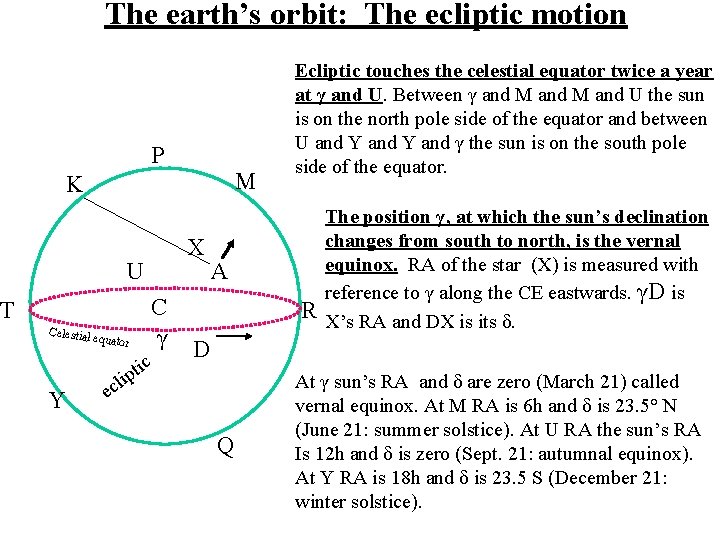
The earth’s orbit: The ecliptic motion P M K X U C γ T Celestial equator tic A R Y The position γ, at which the sun’s declination changes from south to north, is the vernal equinox. RA of the star (X) is measured with reference to γ along the CE eastwards. γD is X’s RA and DX is its δ. D p li ec Ecliptic touches the celestial equator twice a year at γ and U. Between γ and M and U the sun is on the north pole side of the equator and between U and Y and γ the sun is on the south pole side of the equator. Q At γ sun’s RA and δ are zero (March 21) called vernal equinox. At M RA is 6 h and δ is 23. 5° N (June 21: summer solstice). At U RA the sun’s RA Is 12 h and δ is zero (Sept. 21: autumnal equinox). At Y RA is 18 h and δ is 23. 5 S (December 21: winter solstice).
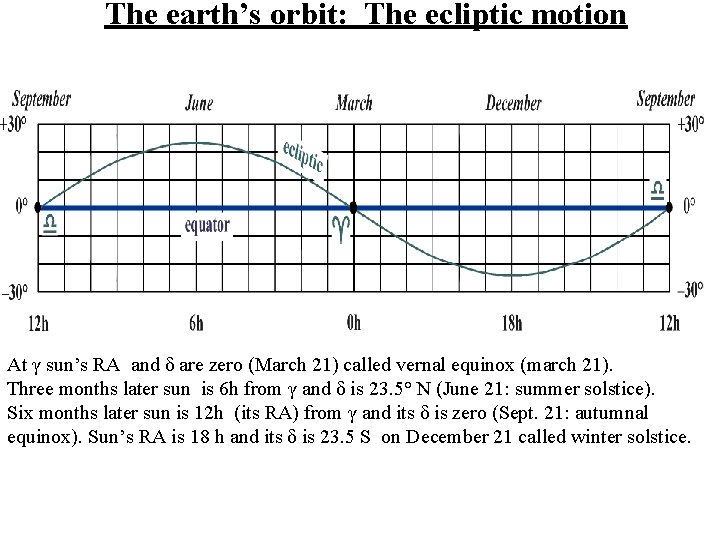
The earth’s orbit: The ecliptic motion At γ sun’s RA and δ are zero (March 21) called vernal equinox (march 21). Three months later sun is 6 h from γ and δ is 23. 5° N (June 21: summer solstice). Six months later sun is 12 h (its RA) from γ and its δ is zero (Sept. 21: autumnal equinox). Sun’s RA is 18 h and its δ is 23. 5 S on December 21 called winter solstice.

Seasons
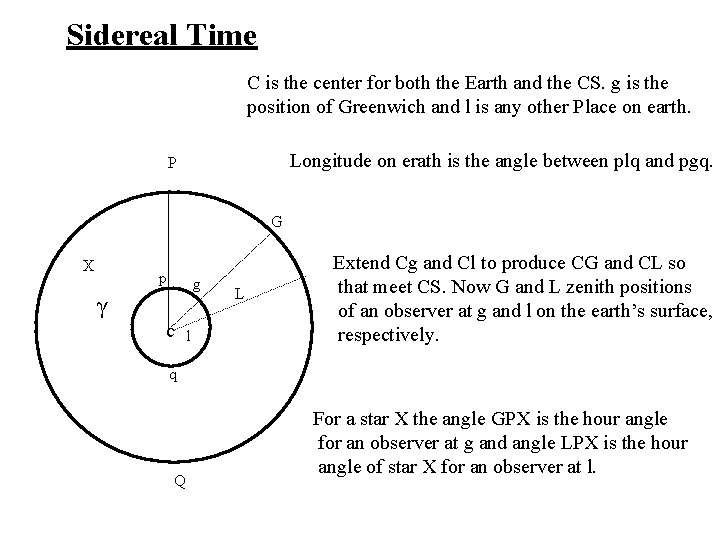
Sidereal Time C is the center for both the Earth and the CS. g is the position of Greenwich and l is any other Place on earth. Longitude on erath is the angle between plq and pgq. P G X p g γ c l L Extend Cg and Cl to produce CG and CL so that meet CS. Now G and L zenith positions of an observer at g and l on the earth’s surface, respectively. q Q For a star X the angle GPX is the hour angle for an observer at g and angle LPX is the hour angle of star X for an observer at l.

Sidereal Time Angle GPX = angle LPX + angle GPL (=angle gpl) H. A of X at g = H. A of X at l + longitude (w) of l P G X p g γ c l q This also holds good for the equinox and the sidereal time is H. A of γ L ST at g = ST at l +- long. of l or Q +ve for east longitudes and –ve for west longitudes
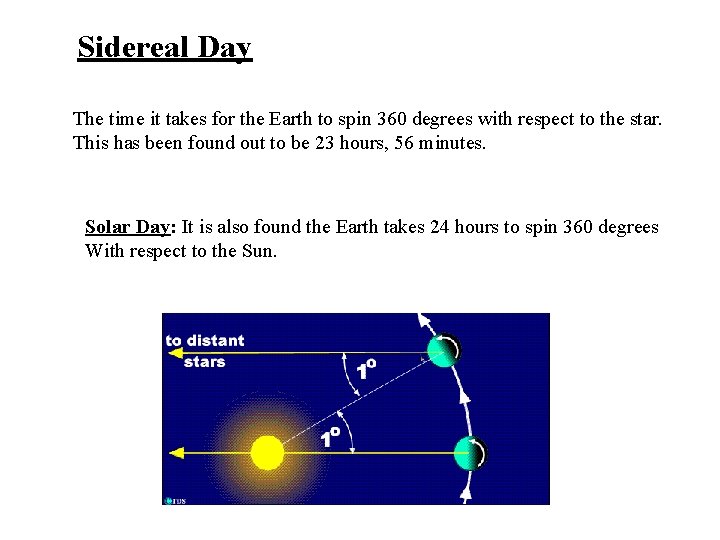
Sidereal Day The time it takes for the Earth to spin 360 degrees with respect to the star. This has been found out to be 23 hours, 56 minutes. Solar Day: It is also found the Earth takes 24 hours to spin 360 degrees With respect to the Sun.
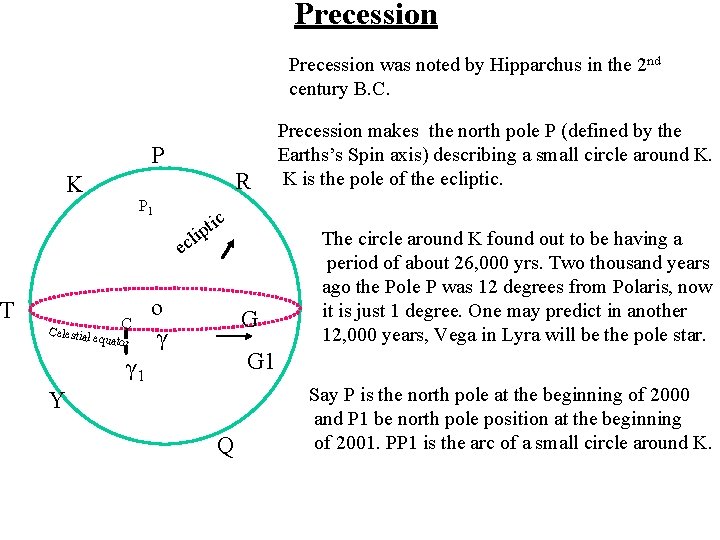
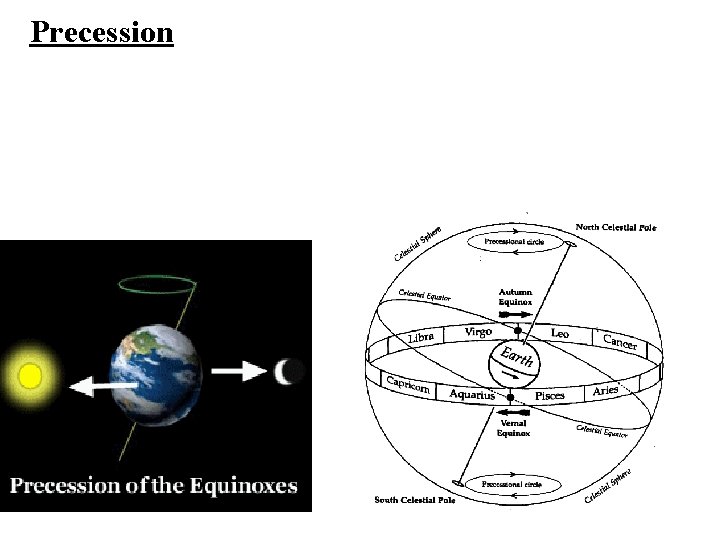
Precession was noted by Hipparchus in the 2 nd century B. C. P K R P 1 c ti p i cl e T Celestial C equator o γ G Precession makes the north pole P (defined by the Earths’s Spin axis) describing a small circle around K. K is the pole of the ecliptic. The circle around K found out to be having a period of about 26, 000 yrs. Two thousand years ago the Pole P was 12 degrees from Polaris, now it is just 1 degree. One may predict in another 12, 000 years, Vega in Lyra will be the pole star. G 1 γ 1 Y Q Say P is the north pole at the beginning of 2000 and P 1 be north pole position at the beginning of 2001. PP 1 is the arc of a small circle around K.
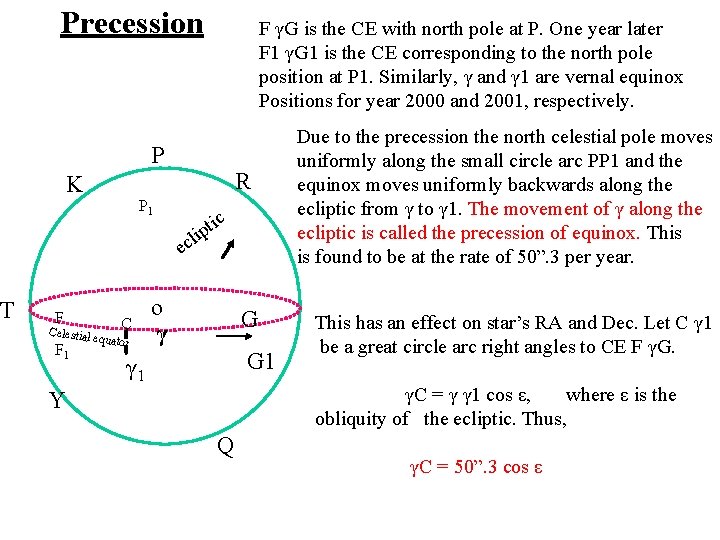
T Precession F γG is the CE with north pole at P. One year later F 1 γG 1 is the CE corresponding to the north pole position at P 1. Similarly, γ and γ 1 are vernal equinox Positions for year 2000 and 2001, respectively. P K R P 1 c ti p i cl e F Celestial F 1 C equator o γ G G 1 γ 1 Due to the precession the north celestial pole moves uniformly along the small circle arc PP 1 and the equinox moves uniformly backwards along the ecliptic from γ to γ 1. The movement of γ along the ecliptic is called the precession of equinox. This is found to be at the rate of 50”. 3 per year. This has an effect on star’s RA and Dec. Let C γ 1 be a great circle arc right angles to CE F γG. γC = γ γ 1 cos ε, where ε is the obliquity of the ecliptic. Thus, Y Q γC = 50”. 3 cos ε
Precession
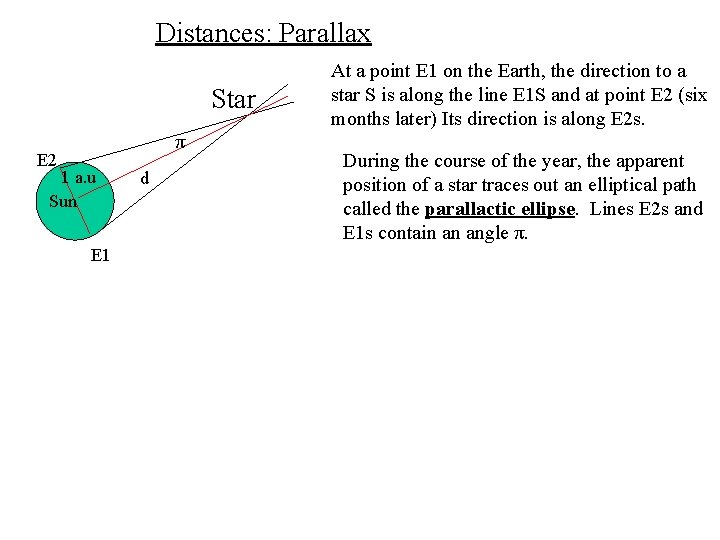
Distances: Parallax Star π E 2 1 a. u Sun E 1 d At a point E 1 on the Earth, the direction to a star S is along the line E 1 S and at point E 2 (six months later) Its direction is along E 2 s. During the course of the year, the apparent position of a star traces out an elliptical path called the parallactic ellipse. Lines E 2 s and E 1 s contain an angle π.
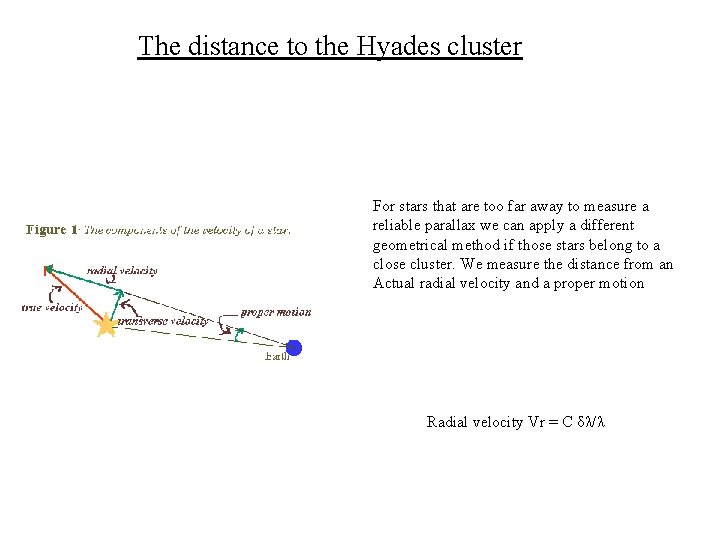
The distance to the Hyades cluster For stars that are too far away to measure a reliable parallax we can apply a different geometrical method if those stars belong to a close cluster. We measure the distance from an Actual radial velocity and a proper motion Radial velocity Vr = C δλ/λ
The distance to the Hyades cluster
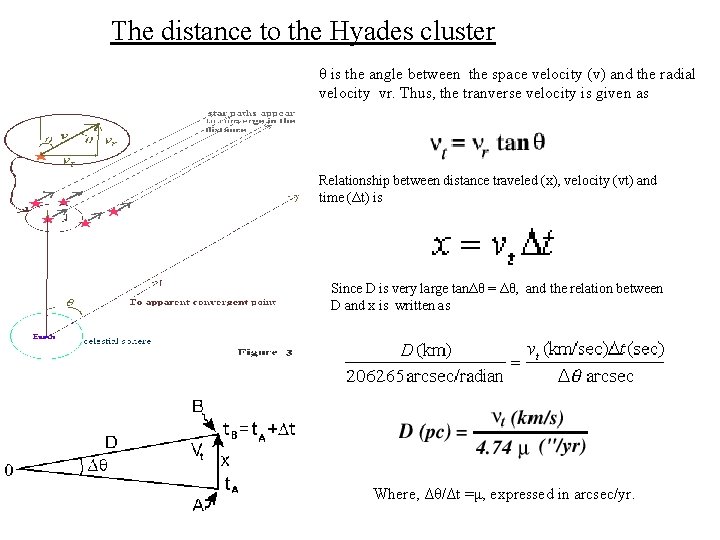
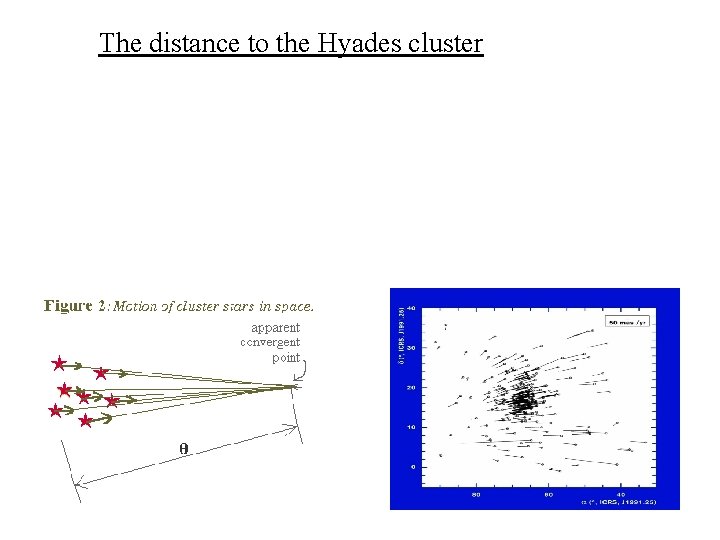
The distance to the Hyades cluster θ is the angle between the space velocity (v) and the radial velocity vr. Thus, the tranverse velocity is given as Relationship between distance traveled (x), velocity (vt) and time (Δt) is Since D is very large tanΔθ = Δθ, and the relation between D and x is written as Where, Δθ/Δt =μ, expressed in arcsec/yr.
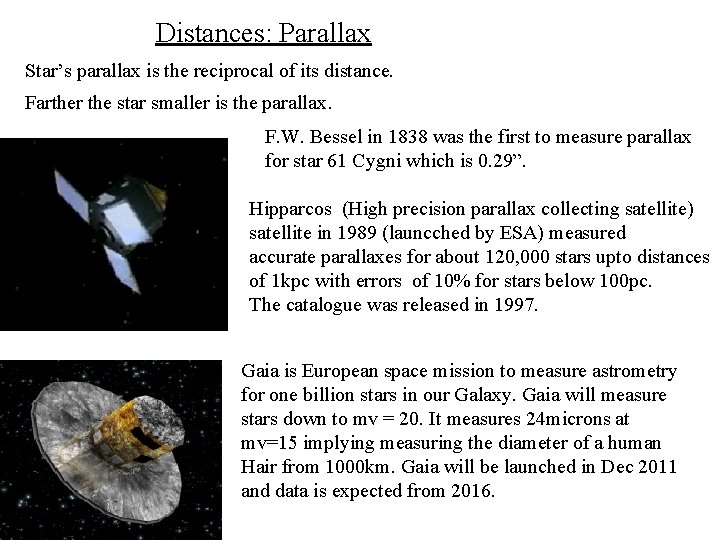
Distances: Parallax Star’s parallax is the reciprocal of its distance. Farther the star smaller is the parallax. F. W. Bessel in 1838 was the first to measure parallax for star 61 Cygni which is 0. 29”. Hipparcos (High precision parallax collecting satellite) satellite in 1989 (launcched by ESA) measured accurate parallaxes for about 120, 000 stars upto distances of 1 kpc with errors of 10% for stars below 100 pc. The catalogue was released in 1997. Gaia is European space mission to measure astrometry for one billion stars in our Galaxy. Gaia will measure stars down to mv = 20. It measures 24 microns at mv=15 implying measuring the diameter of a human Hair from 1000 km. Gaia will be launched in Dec 2011 and data is expected from 2016.
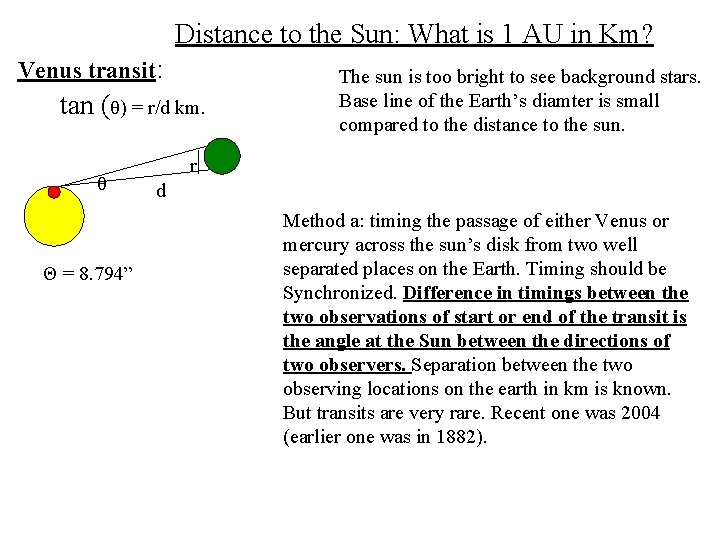
Distance to the Sun: What is 1 AU in Km? Venus transit: tan (θ) = r/d km. θ Θ = 8. 794” The sun is too bright to see background stars. Base line of the Earth’s diamter is small compared to the distance to the sun. r d Method a: timing the passage of either Venus or mercury across the sun’s disk from two well separated places on the Earth. Timing should be Synchronized. Difference in timings between the two observations of start or end of the transit is the angle at the Sun between the directions of two observers. Separation between the two observing locations on the earth in km is known. But transits are very rare. Recent one was 2004 (earlier one was in 1882).
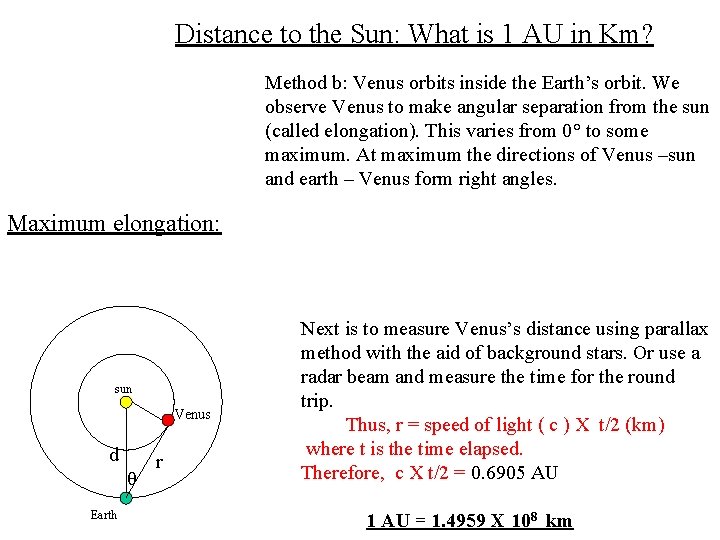
Distance to the Sun: What is 1 AU in Km? Method b: Venus orbits inside the Earth’s orbit. We observe Venus to make angular separation from the sun (called elongation). This varies from 0° to some maximum. At maximum the directions of Venus –sun and earth – Venus form right angles. Maximum elongation: sun Venus d θ Earth r Next is to measure Venus’s distance using parallax method with the aid of background stars. Or use a radar beam and measure the time for the round trip. Thus, r = speed of light ( c ) X t/2 (km) where t is the time elapsed. Therefore, c X t/2 = 0. 6905 AU 1 AU = 1. 4959 X 108 km
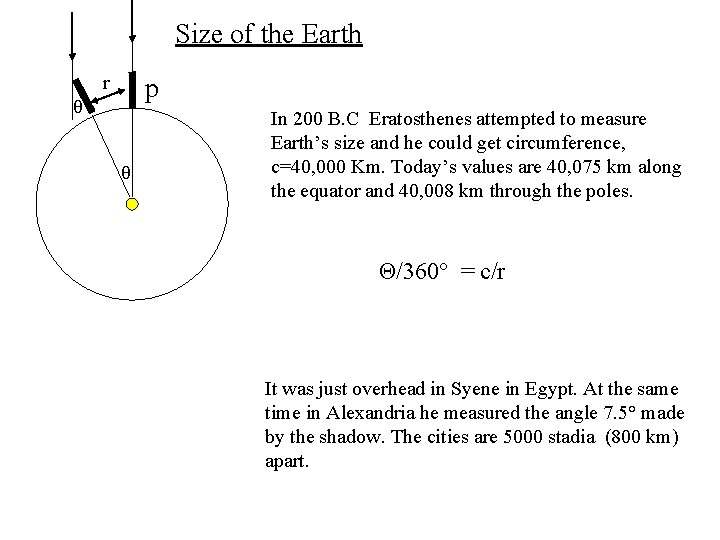
Size of the Earth r p θ θ In 200 B. C Eratosthenes attempted to measure Earth’s size and he could get circumference, c=40, 000 Km. Today’s values are 40, 075 km along the equator and 40, 008 km through the poles. Θ/360° = c/r It was just overhead in Syene in Egypt. At the same time in Alexandria he measured the angle 7. 5° made by the shadow. The cities are 5000 stadia (800 km) apart.
Distance: main sequence method
Supernovae: distance indicators
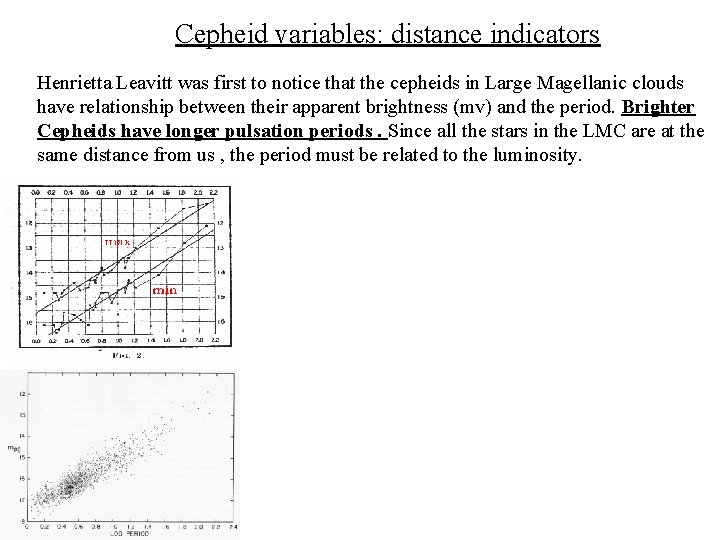
Cepheid variables: distance indicators Henrietta Leavitt was first to notice that the cepheids in Large Magellanic clouds have relationship between their apparent brightness (mv) and the period. Brighter Cepheids have longer pulsation periods. Since all the stars in the LMC are at the same distance from us , the period must be related to the luminosity.
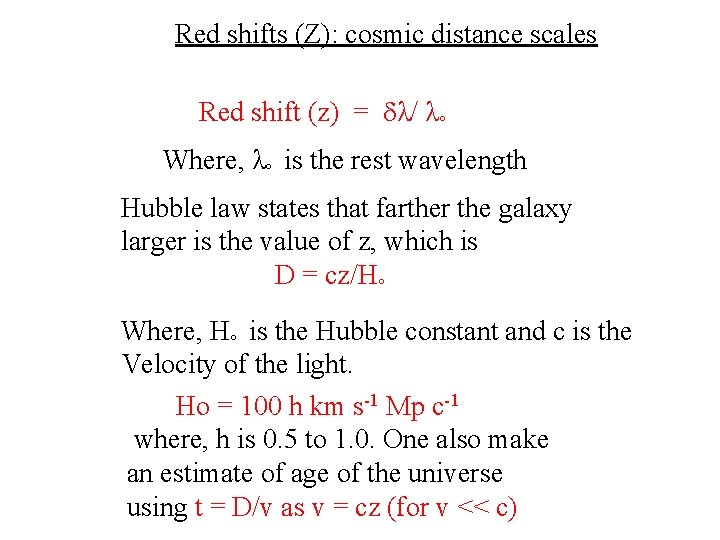
Red shifts (Z): cosmic distance scales Red shift (z) = λ/ λ° Where, λ° is the rest wavelength Hubble law states that farther the galaxy larger is the value of z, which is D = cz/H° Where, H° is the Hubble constant and c is the Velocity of the light. Ho = 100 h km s-1 Mp c-1 where, h is 0. 5 to 1. 0. One also make an estimate of age of the universe using t = D/v as v = cz (for v << c)
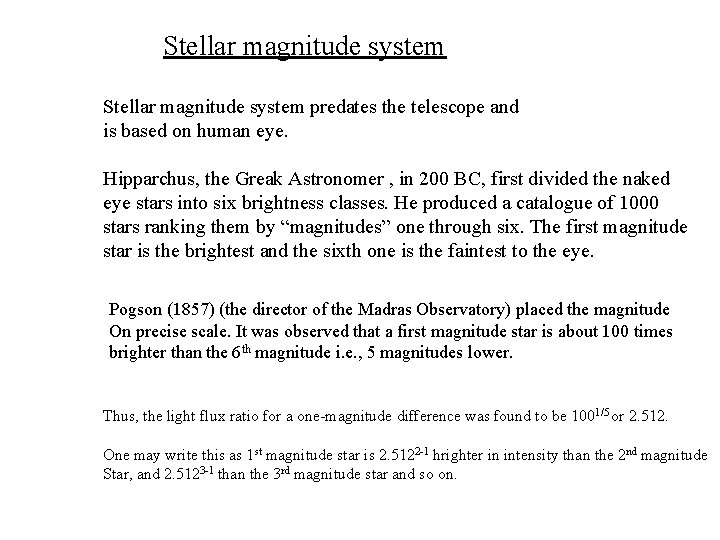
Stellar magnitude system predates the telescope and is based on human eye. Hipparchus, the Greak Astronomer , in 200 BC, first divided the naked eye stars into six brightness classes. He produced a catalogue of 1000 stars ranking them by “magnitudes” one through six. The first magnitude star is the brightest and the sixth one is the faintest to the eye. Pogson (1857) (the director of the Madras Observatory) placed the magnitude On precise scale. It was observed that a first magnitude star is about 100 times brighter than the 6 th magnitude i. e. , 5 magnitudes lower. Thus, the light flux ratio for a one-magnitude difference was found to be 1001/5 or 2. 512. One may write this as 1 st magnitude star is 2. 5122 -1 hrighter in intensity than the 2 nd magnitude Star, and 2. 5123 -1 than the 3 rd magnitude star and so on.
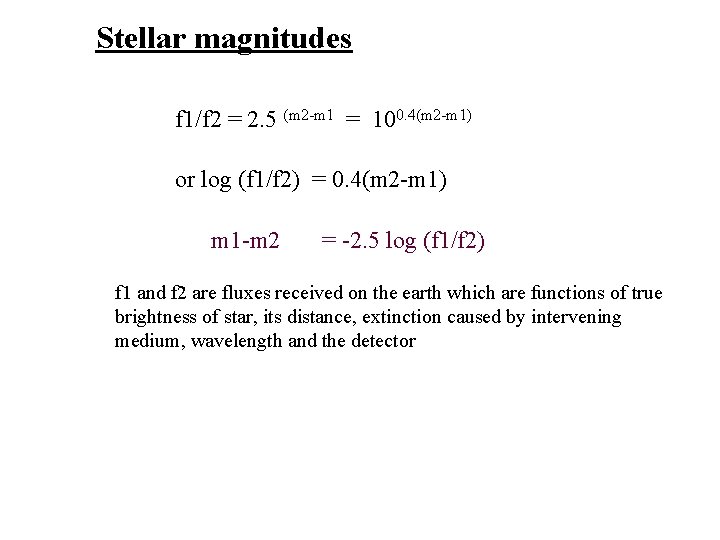
Stellar magnitudes f 1/f 2 = 2. 5 (m 2 -m 1 = 100. 4(m 2 -m 1) or log (f 1/f 2) = 0. 4(m 2 -m 1) m 1 -m 2 = -2. 5 log (f 1/f 2) f 1 and f 2 are fluxes received on the earth which are functions of true brightness of star, its distance, extinction caused by intervening medium, wavelength and the detector
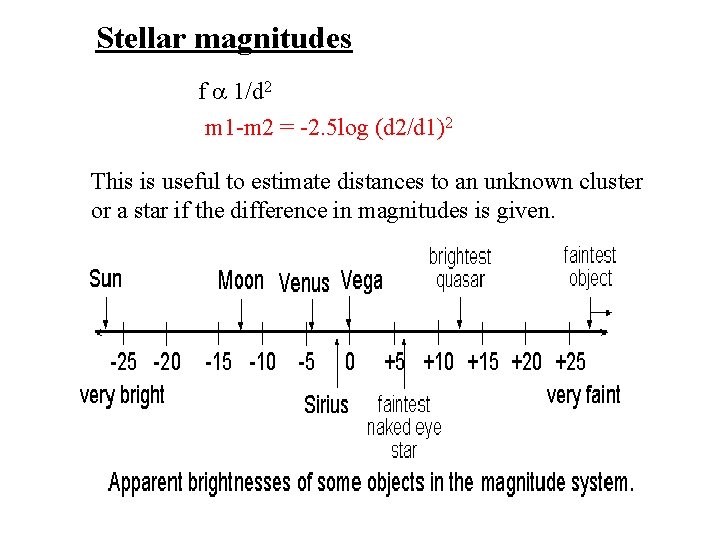
Stellar magnitudes f 1/d 2 m 1 -m 2 = -2. 5 log (d 2/d 1)2 This is useful to estimate distances to an unknown cluster or a star if the difference in magnitudes is given.
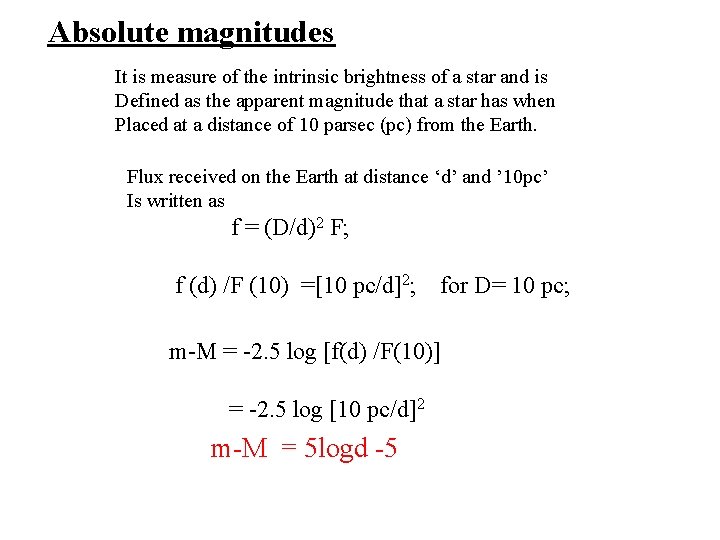
Absolute magnitudes It is measure of the intrinsic brightness of a star and is Defined as the apparent magnitude that a star has when Placed at a distance of 10 parsec (pc) from the Earth. Flux received on the Earth at distance ‘d’ and ’ 10 pc’ Is written as f = (D/d)2 F; f (d) /F (10) =[10 pc/d]2; for D= 10 pc; m-M = -2. 5 log [f(d) /F(10)] = -2. 5 log [10 pc/d]2 m-M = 5 logd -5
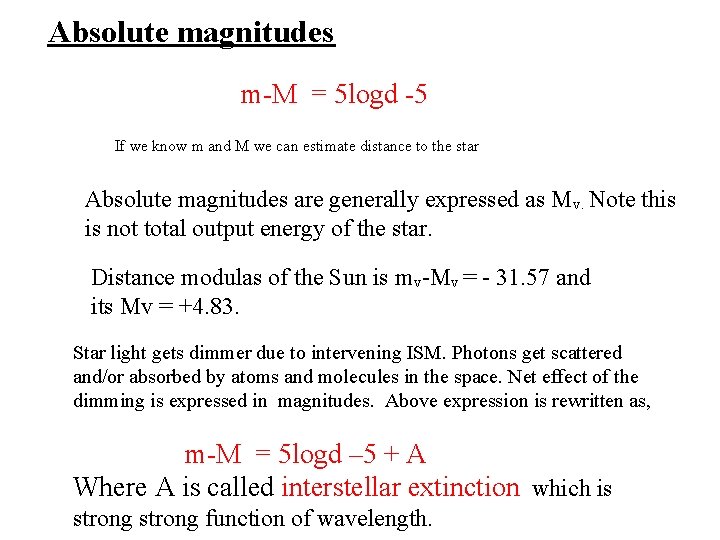
Absolute magnitudes m-M = 5 logd -5 If we know m and M we can estimate distance to the star Absolute magnitudes are generally expressed as Mv. Note this is not total output energy of the star. Distance modulas of the Sun is mv-Mv = - 31. 57 and its Mv = +4. 83. Star light gets dimmer due to intervening ISM. Photons get scattered and/or absorbed by atoms and molecules in the space. Net effect of the dimming is expressed in magnitudes. Above expression is rewritten as, m-M = 5 logd – 5 + A Where A is called interstellar extinction which is strong function of wavelength.
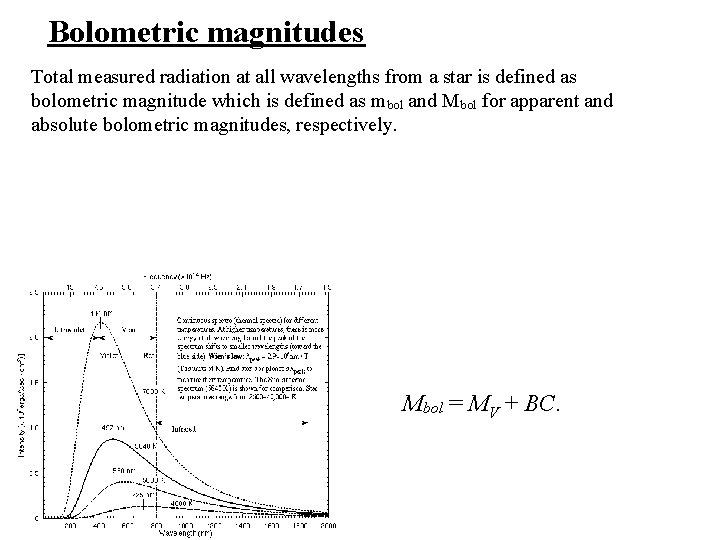
Bolometric magnitudes Total measured radiation at all wavelengths from a star is defined as bolometric magnitude which is defined as mbol and Mbol for apparent and absolute bolometric magnitudes, respectively. Mbol = MV + BC.
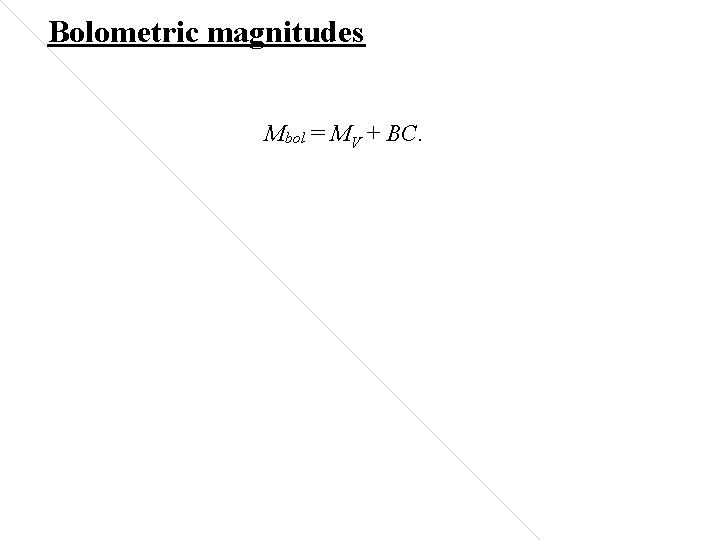
Bolometric magnitudes Mbol = MV + BC.
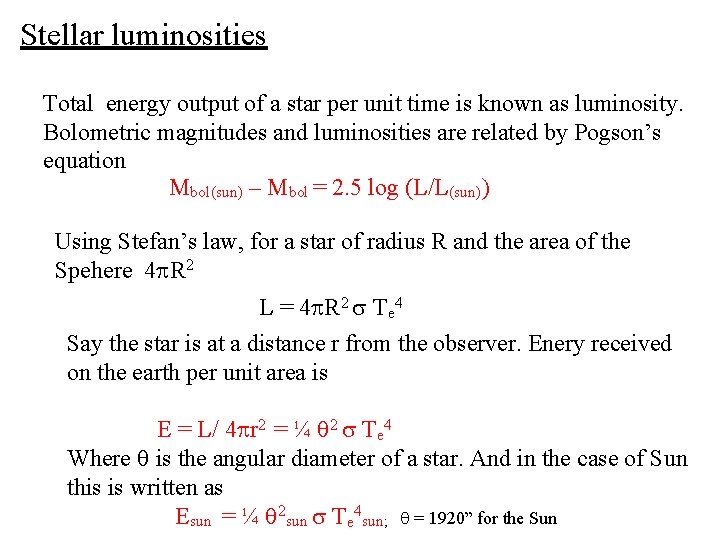
Stellar luminosities Total energy output of a star per unit time is known as luminosity. Bolometric magnitudes and luminosities are related by Pogson’s equation Mbol(sun) – Mbol = 2. 5 log (L/L(sun)) Using Stefan’s law, for a star of radius R and the area of the Spehere 4 R 2 L = 4 R 2 Te 4 Say the star is at a distance r from the observer. Enery received on the earth per unit area is E = L/ 4 r 2 = ¼ 2 Te 4 Where is the angular diameter of a star. And in the case of Sun this is written as Esun = ¼ 2 sun Te 4 sun; = 1920” for the Sun
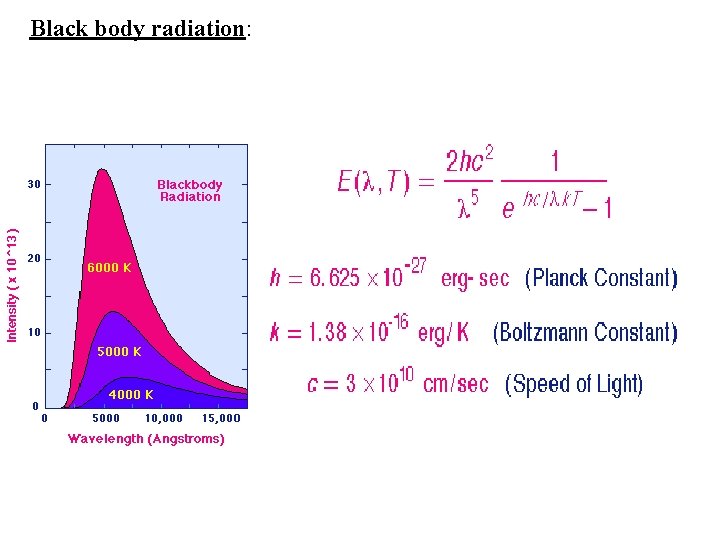
Black body radiation:
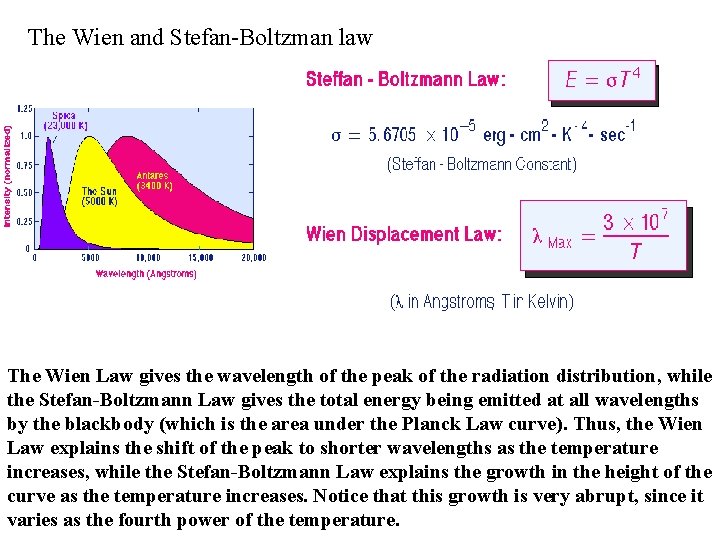
The Wien and Stefan-Boltzman law The Wien Law gives the wavelength of the peak of the radiation distribution, while the Stefan-Boltzmann Law gives the total energy being emitted at all wavelengths by the blackbody (which is the area under the Planck Law curve). Thus, the Wien Law explains the shift of the peak to shorter wavelengths as the temperature increases, while the Stefan-Boltzmann Law explains the growth in the height of the curve as the temperature increases. Notice that this growth is very abrupt, since it varies as the fourth power of the temperature.
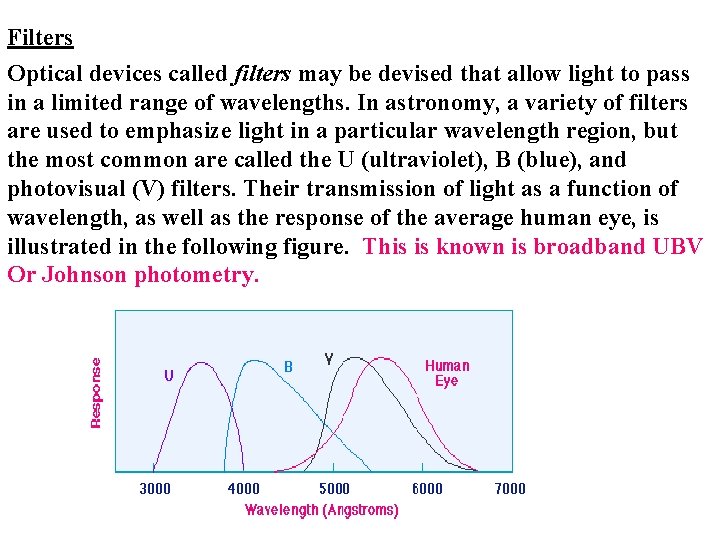
Filters Optical devices called filters may be devised that allow light to pass in a limited range of wavelengths. In astronomy, a variety of filters are used to emphasize light in a particular wavelength region, but the most common are called the U (ultraviolet), B (blue), and photovisual (V) filters. Their transmission of light as a function of wavelength, as well as the response of the average human eye, is illustrated in the following figure. This is known is broadband UBV Or Johnson photometry.
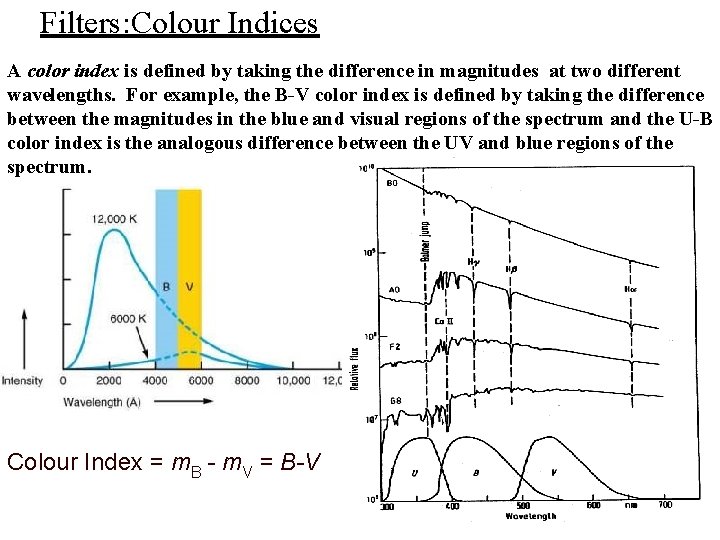
Filters: Colour Indices A color index is defined by taking the difference in magnitudes at two different wavelengths. For example, the B-V color index is defined by taking the difference between the magnitudes in the blue and visual regions of the spectrum and the U-B color index is the analogous difference between the UV and blue regions of the spectrum. Colour Index = m. B - m. V = B-V
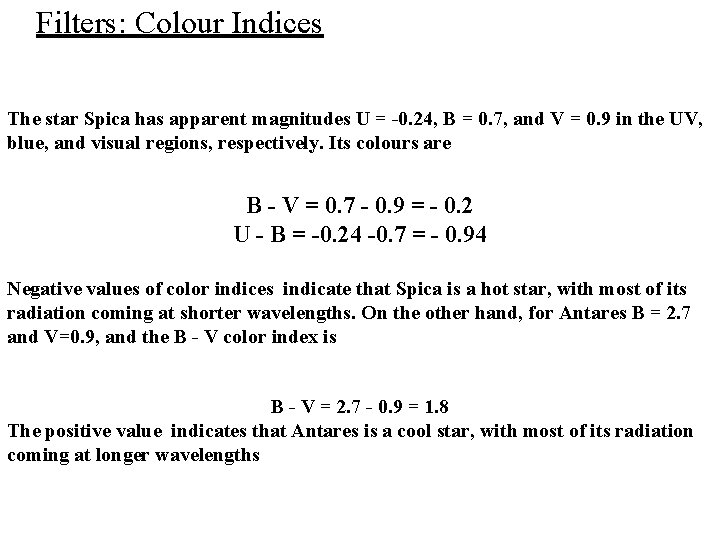
Filters: Colour Indices The star Spica has apparent magnitudes U = -0. 24, B = 0. 7, and V = 0. 9 in the UV, blue, and visual regions, respectively. Its colours are B - V = 0. 7 - 0. 9 = - 0. 2 U - B = -0. 24 -0. 7 = - 0. 94 Negative values of color indices indicate that Spica is a hot star, with most of its radiation coming at shorter wavelengths. On the other hand, for Antares B = 2. 7 and V=0. 9, and the B - V color index is B - V = 2. 7 - 0. 9 = 1. 8 The positive value indicates that Antares is a cool star, with most of its radiation coming at longer wavelengths
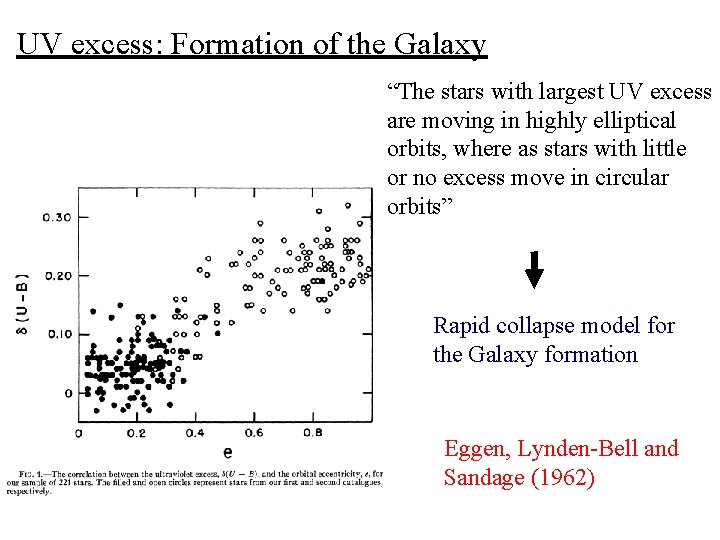
UV excess: Formation of the Galaxy “The stars with largest UV excess are moving in highly elliptical orbits, where as stars with little or no excess move in circular orbits” Rapid collapse model for the Galaxy formation Eggen, Lynden-Bell and Sandage (1962)
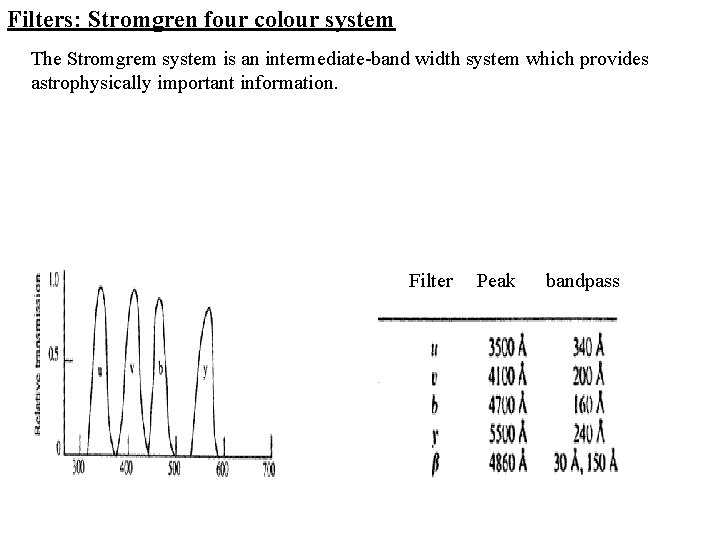
Filters: Stromgren four colour system The Stromgrem system is an intermediate-band width system which provides astrophysically important information. Filter Peak bandpass
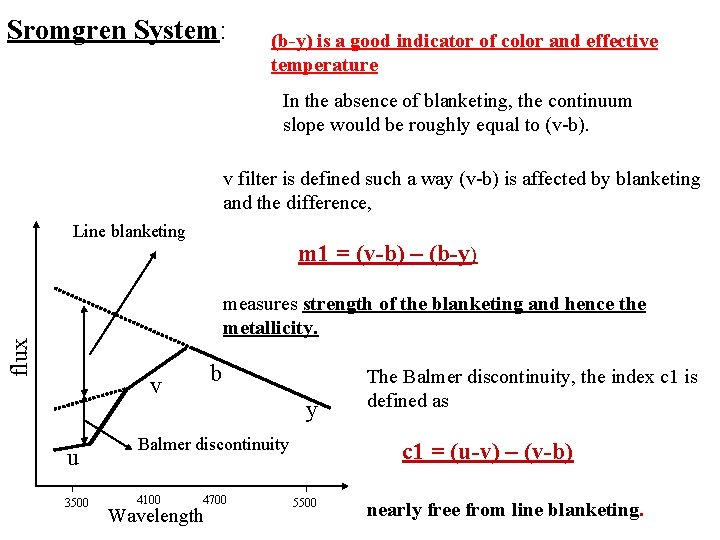
Sromgren System: (b-y) is a good indicator of color and effective temperature In the absence of blanketing, the continuum slope would be roughly equal to (v-b). v filter is defined such a way (v-b) is affected by blanketing and the difference, Line blanketing m 1 = (v-b) – (b-y) flux measures strength of the blanketing and hence the metallicity. b v u 3500 y Balmer discontinuity 4100 4700 Wavelength The Balmer discontinuity, the index c 1 is defined as c 1 = (u-v) – (v-b) 5500 nearly free from line blanketing.
![uvby photometry: large scale Galactic surveys Fig 2. Photometric Teff and [M/H] for a](http://slidetodoc.com/presentation_image_h2/e367ade43741f0d79e853676670969c7/image-61.jpg "uvby photometry: large scale Galactic surveys Fig 2. Photometric Teff and [M/H] for a")
uvby photometry: large scale Galactic surveys Fig 2. Photometric Teff and [M/H] for a sample of 82 stars compared with our (Reddy et al. 2003) spectroscopically derived Teff and [Fe/H] values.
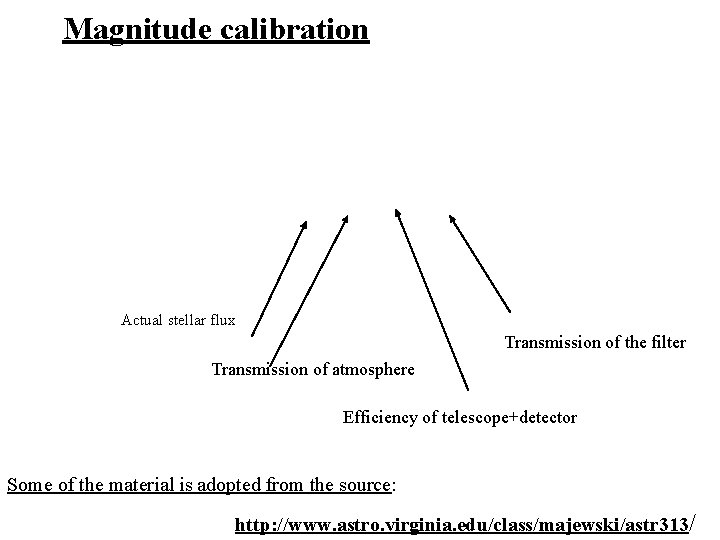
Magnitude calibration Actual stellar flux Transmission of the filter Transmission of atmosphere Efficiency of telescope+detector Some of the material is adopted from the source: http: //www. astro. virginia. edu/class/majewski/astr 313/
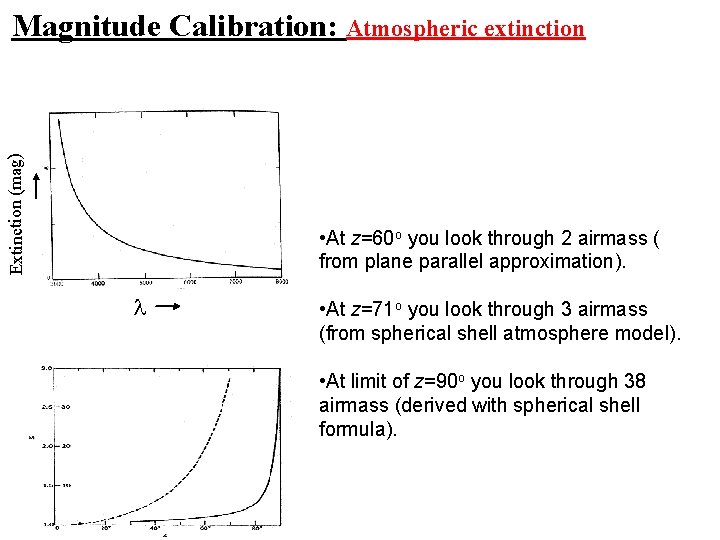
Extinction (mag) Magnitude Calibration: Atmospheric extinction • At z=60 o you look through 2 airmass ( from plane parallel approximation). • At z=71 o you look through 3 airmass (from spherical shell atmosphere model). • At limit of z=90 o you look through 38 airmass (derived with spherical shell formula).
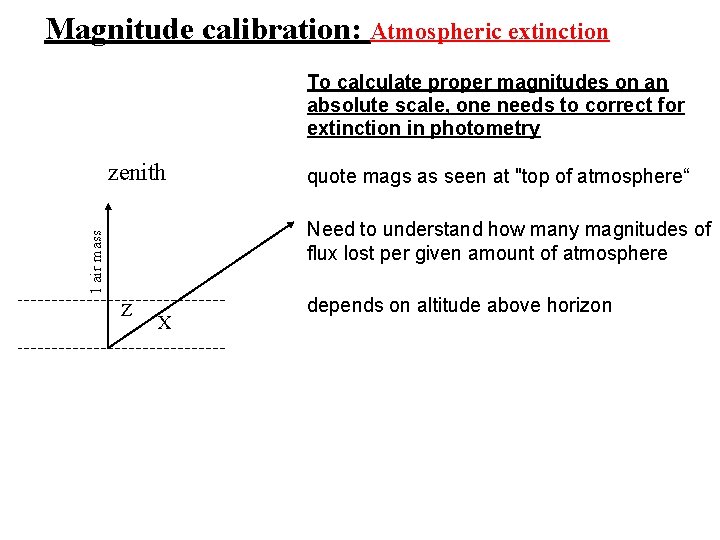
Magnitude calibration: Atmospheric extinction To calculate proper magnitudes on an absolute scale, one needs to correct for extinction in photometry zenith quote mags as seen at "top of atmosphere“ 1 air mass Need to understand how many magnitudes of flux lost per given amount of atmosphere Z X depends on altitude above horizon
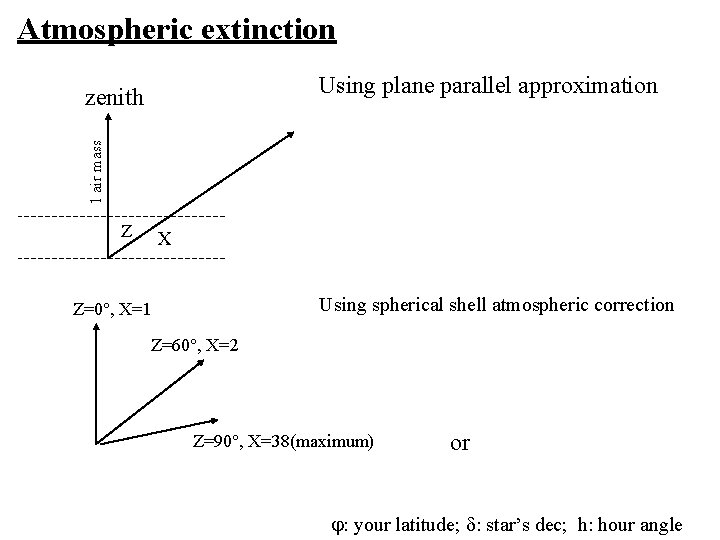
Atmospheric extinction Using plane parallel approximation 1 air mass zenith Z X Using spherical shell atmospheric correction Z=0 , X=1 Z=60 , X=2 Z=90 , X=38(maximum) or : your latitude; : star’s dec; h: hour angle
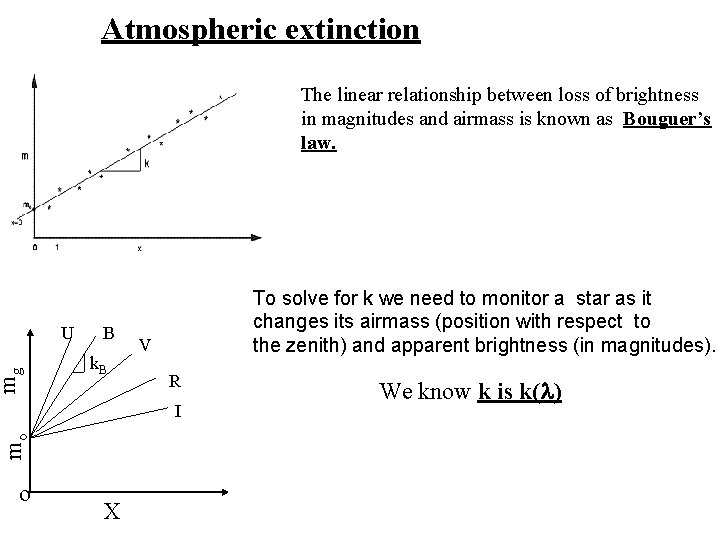
Atmospheric extinction The linear relationship between loss of brightness in magnitudes and airmass is known as Bouguer’s law. mg U B k. B To solve for k we need to monitor a star as it changes its airmass (position with respect to the zenith) and apparent brightness (in magnitudes). V R mo I o X We know k is k( )
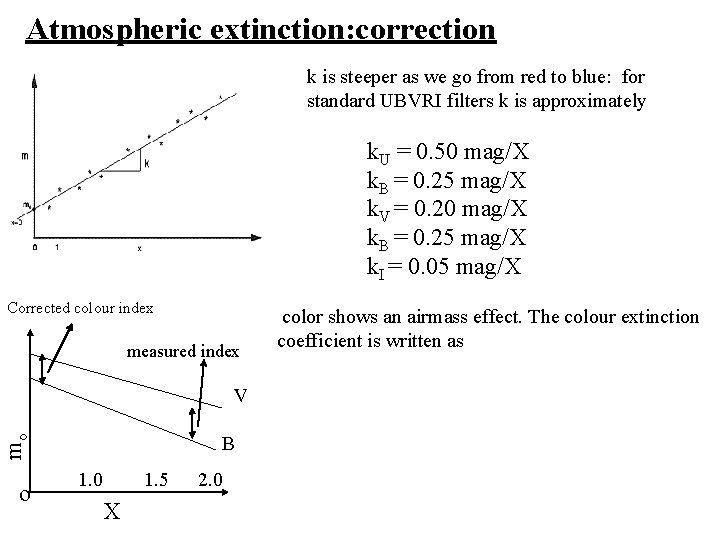
Atmospheric extinction: correction k is steeper as we go from red to blue: for standard UBVRI filters k is approximately k. U = 0. 50 mag/X k. B = 0. 25 mag/X k. V = 0. 20 mag/X k. B = 0. 25 mag/X k. I = 0. 05 mag/X Corrected colour index measured index V mo B o 1. 0 1. 5 X 2. 0 color shows an airmass effect. The colour extinction coefficient is written as
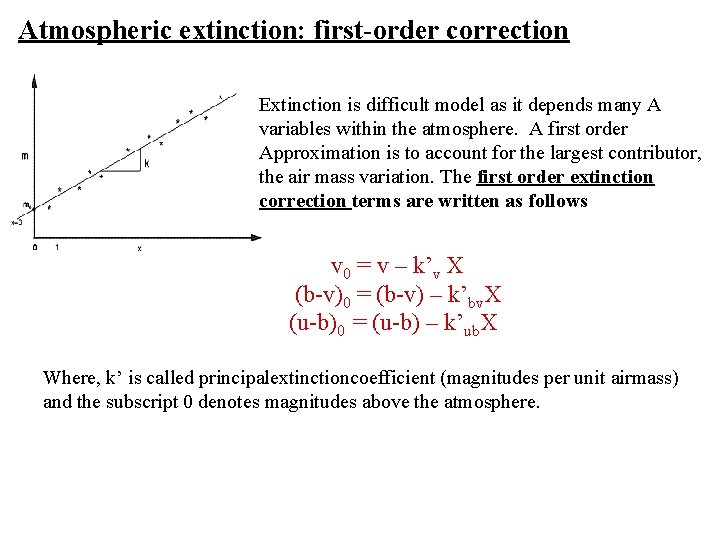
Atmospheric extinction: first-order correction Extinction is difficult model as it depends many A variables within the atmosphere. A first order Approximation is to account for the largest contributor, the air mass variation. The first order extinction correction terms are written as follows v 0 = v – k’v X (b-v)0 = (b-v) – k’bv. X (u-b)0 = (u-b) – k’ub. X Where, k’ is called principalextinctioncoefficient (magnitudes per unit airmass) and the subscript 0 denotes magnitudes above the atmosphere.
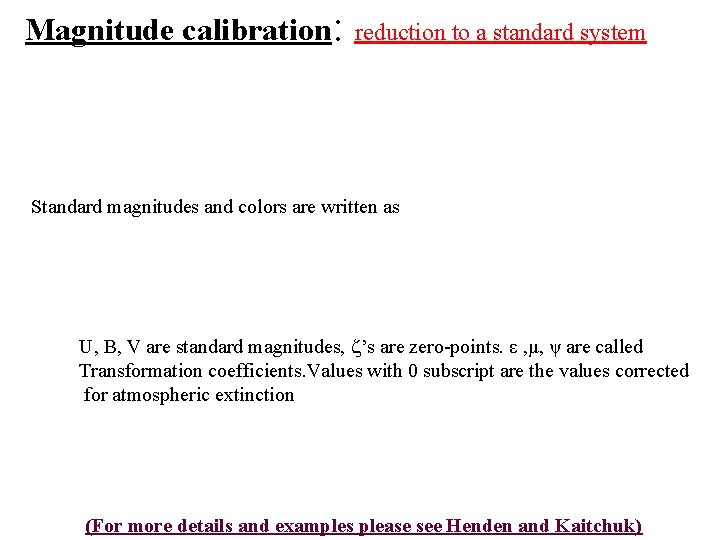
Magnitude calibration: reduction to a standard system Standard magnitudes and colors are written as U, B, V are standard magnitudes, ’s are zero-points. ε , μ, ψ are called Transformation coefficients. Values with 0 subscript are the values corrected for atmospheric extinction (For more details and examples please see Henden and Kaitchuk)
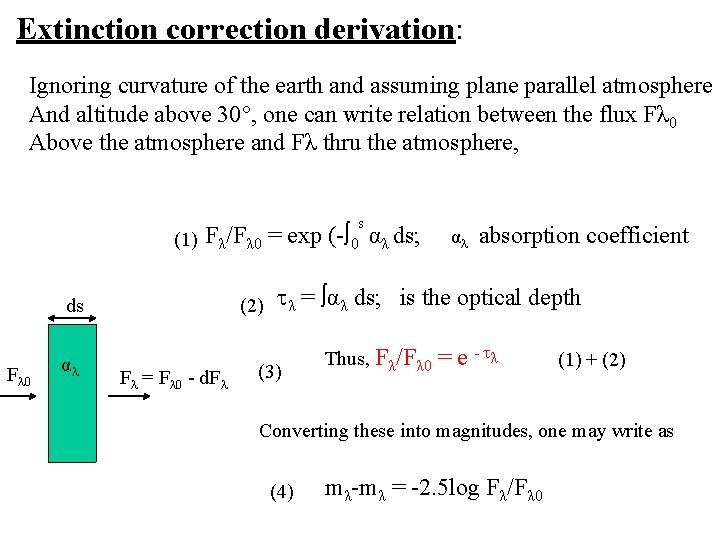
Extinction correction derivation: Ignoring curvature of the earth and assuming plane parallel atmosphere And altitude above 30°, one can write relation between the flux Fλ 0 Above the atmosphere and Fλ thru the atmosphere, s (1) Fλ/Fλ 0 = exp (- 0 αλ ds; ds Fλ 0 αλ (2) Fλ = Fλ 0 - d. Fλ αλ absorption coefficient λ = αλ ds; is the optical depth (3) Thus, Fλ/Fλ 0 = e - λ (1) + (2) Converting these into magnitudes, one may write as (4) mλ-mλ = -2. 5 log Fλ/Fλ 0
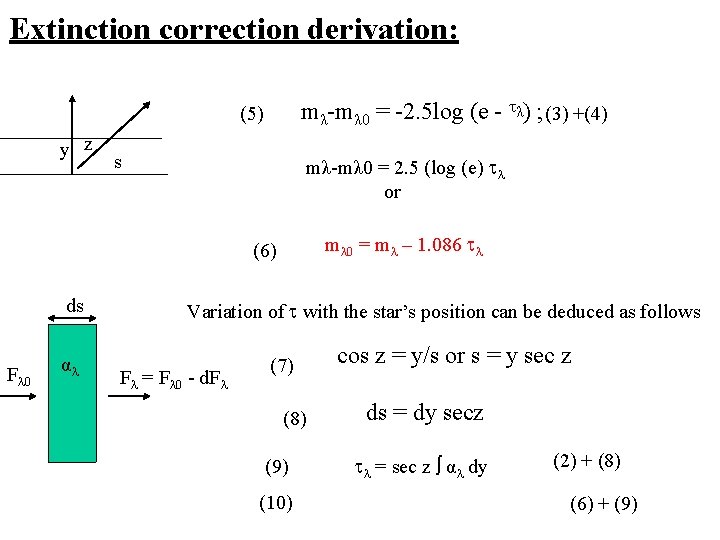
Extinction correction derivation: mλ-mλ 0 = -2. 5 log (e - λ) ; (3) +(4) (5) y z s mλ-mλ 0 = 2. 5 (log (e) λ or mλ 0 = mλ – 1. 086 λ (6) ds Fλ 0 αλ Variation of with the star’s position can be deduced as follows Fλ = Fλ 0 - d. Fλ (7) (8) (9) (10) cos z = y/s or s = y sec z ds = dy secz λ = sec z αλ dy (2) + (8) (6) + (9)
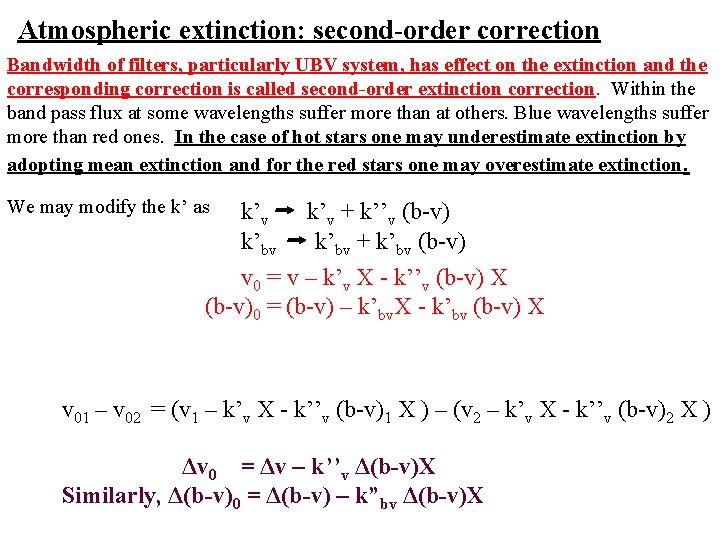
Atmospheric extinction: second-order correction Bandwidth of filters, particularly UBV system, has effect on the extinction and the corresponding correction is called second-order extinction correction. Within the band pass flux at some wavelengths suffer more than at others. Blue wavelengths suffer more than red ones. In the case of hot stars one may underestimate extinction by adopting mean extinction and for the red stars one may overestimate extinction. We may modify the k’ as k’v + k’’v (b-v) k’bv + k’bv (b-v) v 0 = v – k’v X - k’’v (b-v) X (b-v)0 = (b-v) – k’bv. X - k’bv (b-v) X v 01 – v 02 = (v 1 – k’v X - k’’v (b-v)1 X ) – (v 2 – k’v X - k’’v (b-v)2 X ) Δv 0 = Δv – k’’v Δ(b-v)X Similarly, Δ(b-v)0 = Δ(b-v) – k”bv Δ(b-v)X
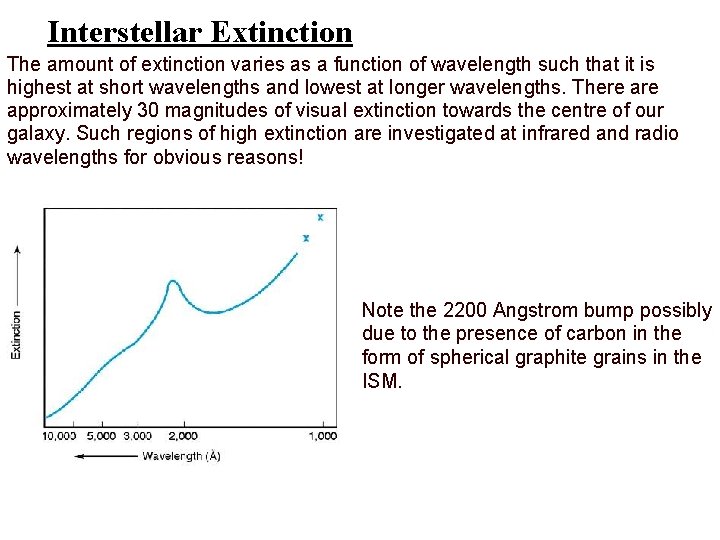
Interstellar Extinction The amount of extinction varies as a function of wavelength such that it is highest at short wavelengths and lowest at longer wavelengths. There approximately 30 magnitudes of visual extinction towards the centre of our galaxy. Such regions of high extinction are investigated at infrared and radio wavelengths for obvious reasons! Note the 2200 Angstrom bump possibly due to the presence of carbon in the form of spherical graphite grains in the ISM.
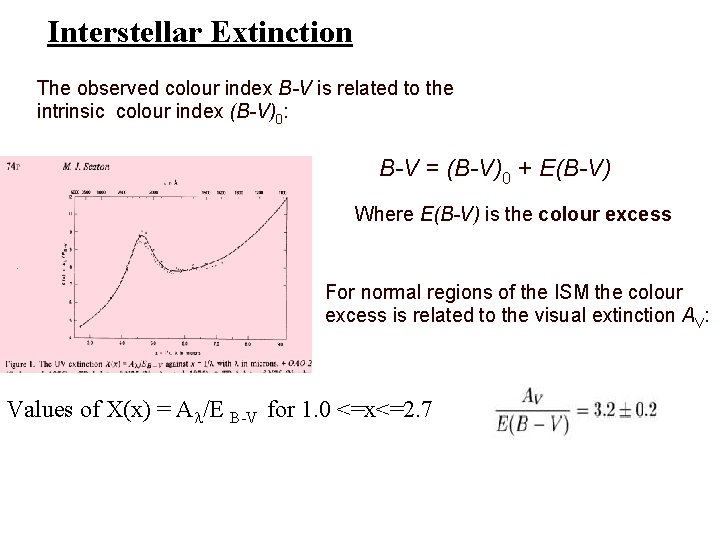
Interstellar Extinction The observed colour index B-V is related to the intrinsic colour index (B-V)0: B-V = (B-V)0 + E(B-V) Where E(B-V) is the colour excess For normal regions of the ISM the colour excess is related to the visual extinction AV: Values of X(x) = A /E B-V for 1. 0 <=x<=2. 7
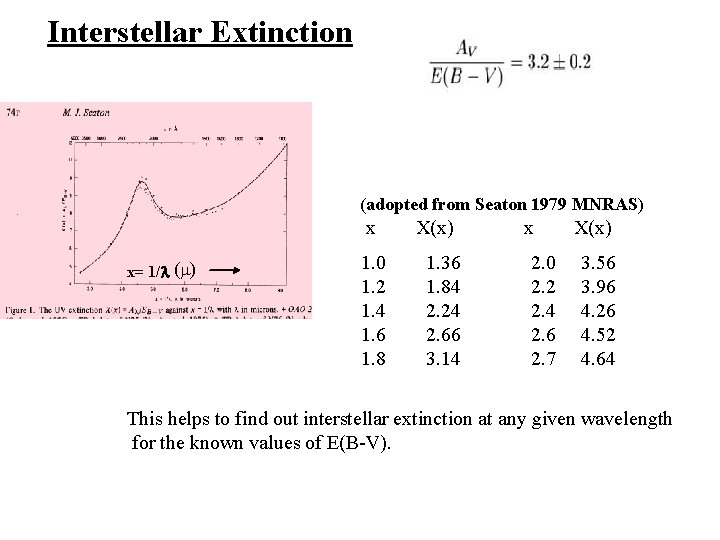
Interstellar Extinction (adopted from Seaton 1979 MNRAS) x x= 1/ ( ) 1. 0 1. 2 1. 4 1. 6 1. 8 X(x) 1. 36 1. 84 2. 24 2. 66 3. 14 x 2. 0 2. 2 2. 4 2. 6 2. 7 X(x) 3. 56 3. 96 4. 26 4. 52 4. 64 This helps to find out interstellar extinction at any given wavelength for the known values of E(B-V).
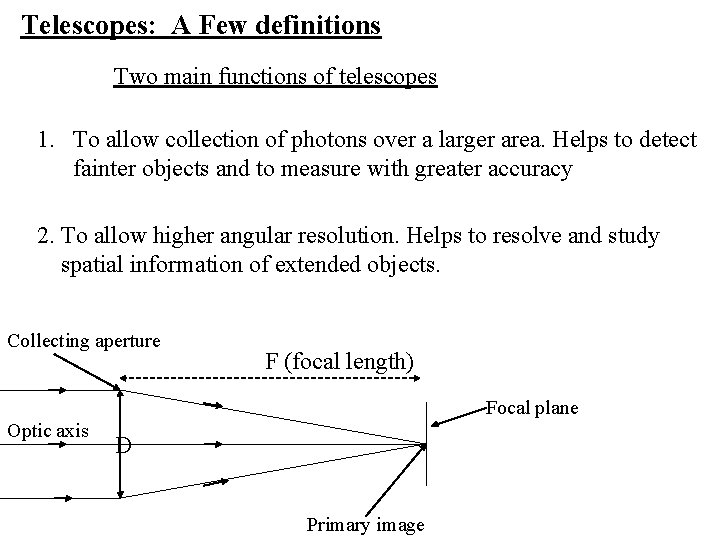
Telescopes: A Few definitions Two main functions of telescopes 1. To allow collection of photons over a larger area. Helps to detect fainter objects and to measure with greater accuracy 2. To allow higher angular resolution. Helps to resolve and study spatial information of extended objects. Collecting aperture F (focal length) Focal plane Optic axis D Primary image
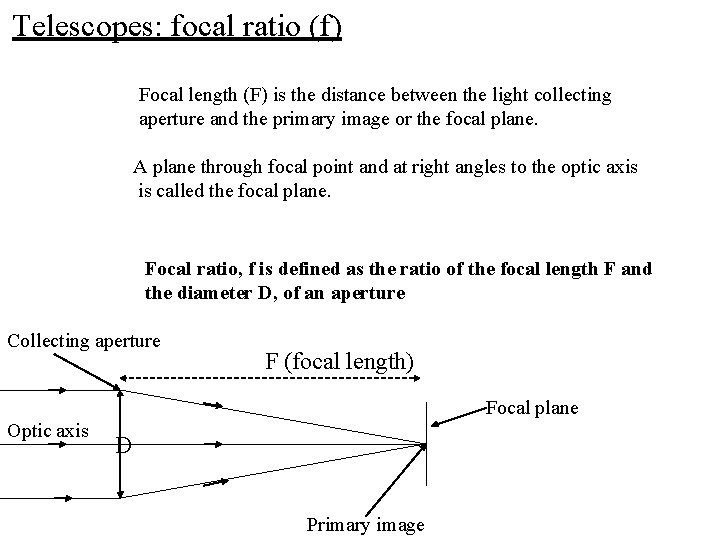
Telescopes: focal ratio (f) Focal length (F) is the distance between the light collecting aperture and the primary image or the focal plane. A plane through focal point and at right angles to the optic axis is called the focal plane. Focal ratio, f is defined as the ratio of the focal length F and the diameter D, of an aperture Collecting aperture F (focal length) Focal plane Optic axis D Primary image
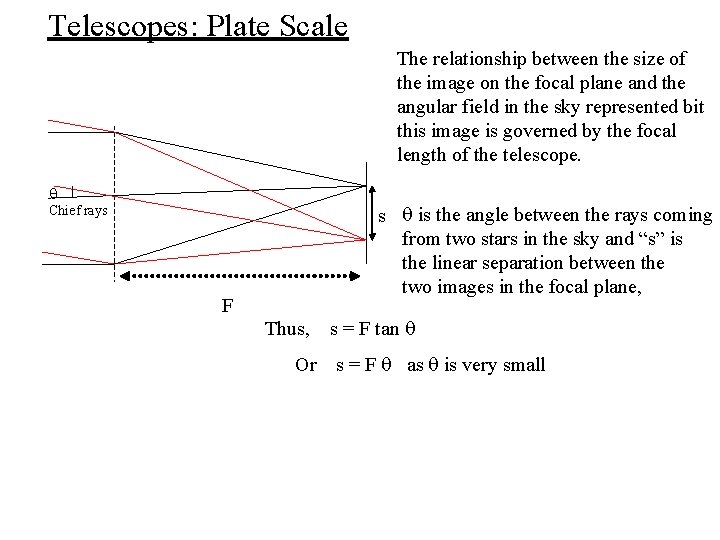
Telescopes: Plate Scale The relationship between the size of the image on the focal plane and the angular field in the sky represented bit this image is governed by the focal length of the telescope. s is the angle between the rays coming from two stars in the sky and “s” is the linear separation between the two images in the focal plane, Chief rays F Thus, Or s = F tan s = F as is very small
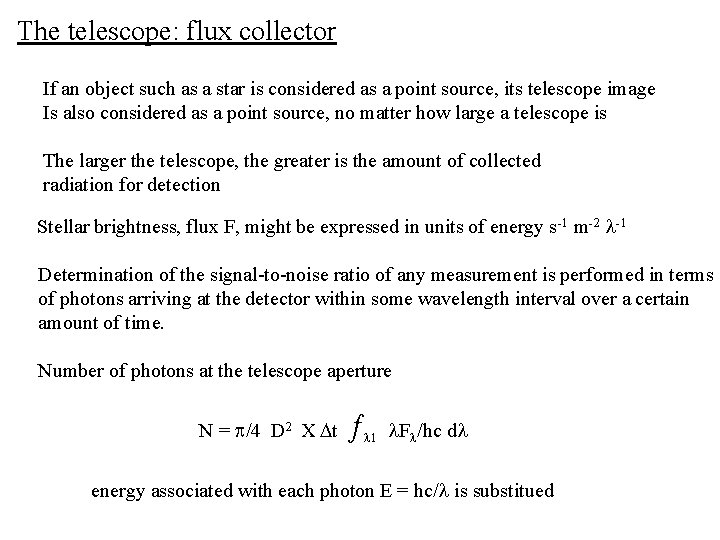
The telescope: flux collector If an object such as a star is considered as a point source, its telescope image Is also considered as a point source, no matter how large a telescope is The larger the telescope, the greater is the amount of collected radiation for detection Stellar brightness, flux F, might be expressed in units of energy s-1 m-2 -1 Determination of the signal-to-noise ratio of any measurement is performed in terms of photons arriving at the detector within some wavelength interval over a certain amount of time. Number of photons at the telescope aperture N = /4 D 2 X t 1 F /hc d energy associated with each photon E = hc/ is substitued
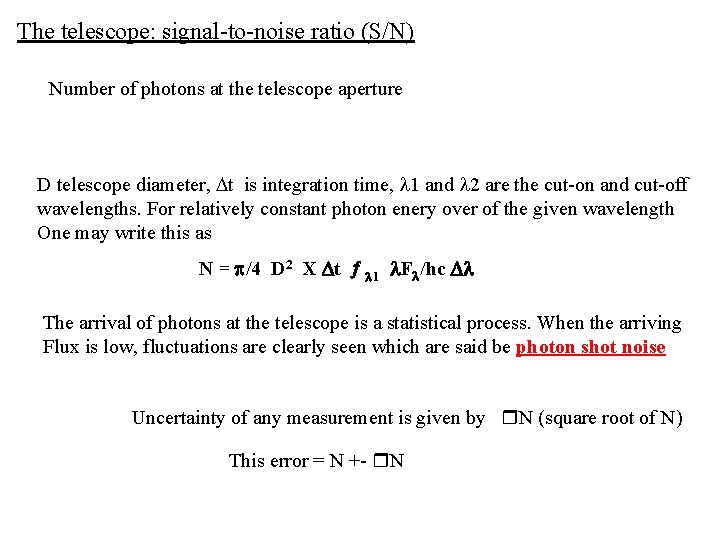
The telescope: signal-to-noise ratio (S/N) Number of photons at the telescope aperture D telescope diameter, t is integration time, 1 and 2 are the cut-on and cut-off wavelengths. For relatively constant photon enery over of the given wavelength One may write this as N = /4 D 2 X t 1 F /hc The arrival of photons at the telescope is a statistical process. When the arriving Flux is low, fluctuations are clearly seen which are said be photon shot noise Uncertainty of any measurement is given by N (square root of N) This error = N +- N
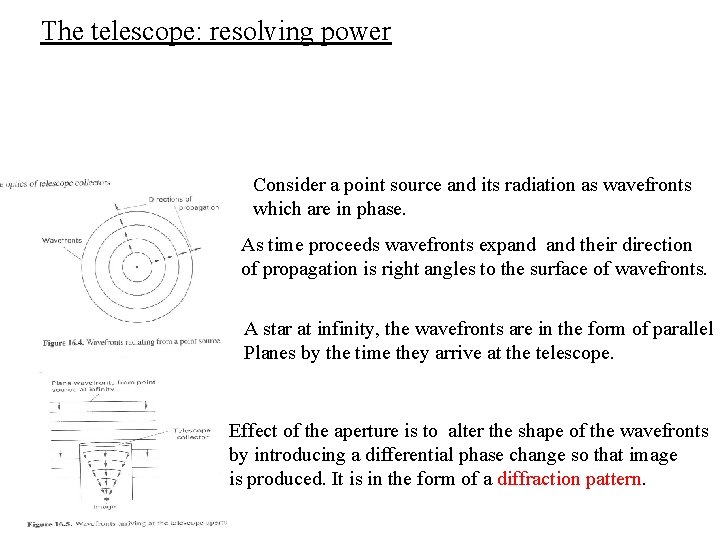
The telescope: resolving power Consider a point source and its radiation as wavefronts which are in phase. As time proceeds wavefronts expand their direction of propagation is right angles to the surface of wavefronts. A star at infinity, the wavefronts are in the form of parallel Planes by the time they arrive at the telescope. Effect of the aperture is to alter the shape of the wavefronts by introducing a differential phase change so that image is produced. It is in the form of a diffraction pattern.
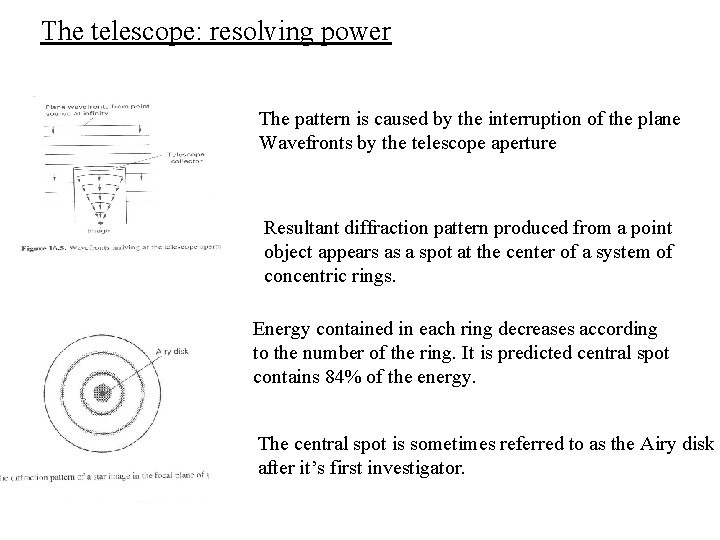
The telescope: resolving power The pattern is caused by the interruption of the plane Wavefronts by the telescope aperture Resultant diffraction pattern produced from a point object appears as a spot at the center of a system of concentric rings. Energy contained in each ring decreases according to the number of the ring. It is predicted central spot contains 84% of the energy. The central spot is sometimes referred to as the Airy disk after it’s first investigator.
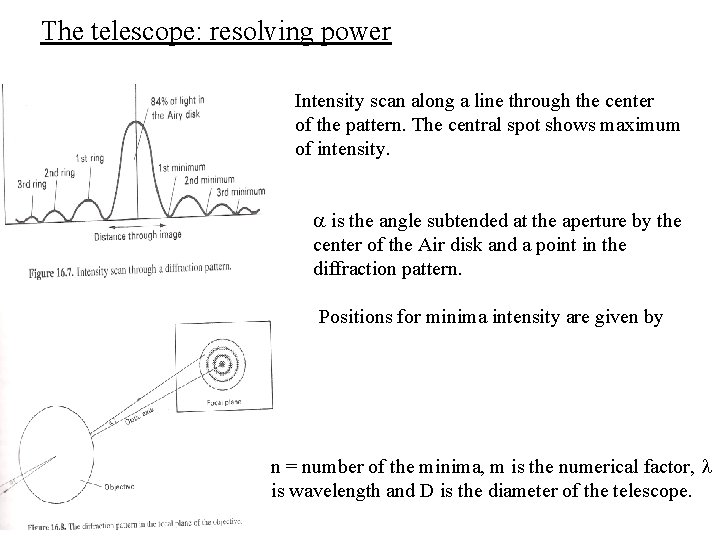
The telescope: resolving power Intensity scan along a line through the center of the pattern. The central spot shows maximum of intensity. is the angle subtended at the aperture by the center of the Air disk and a point in the diffraction pattern. Positions for minima intensity are given by n = number of the minima, m is the numerical factor, is wavelength and D is the diameter of the telescope.
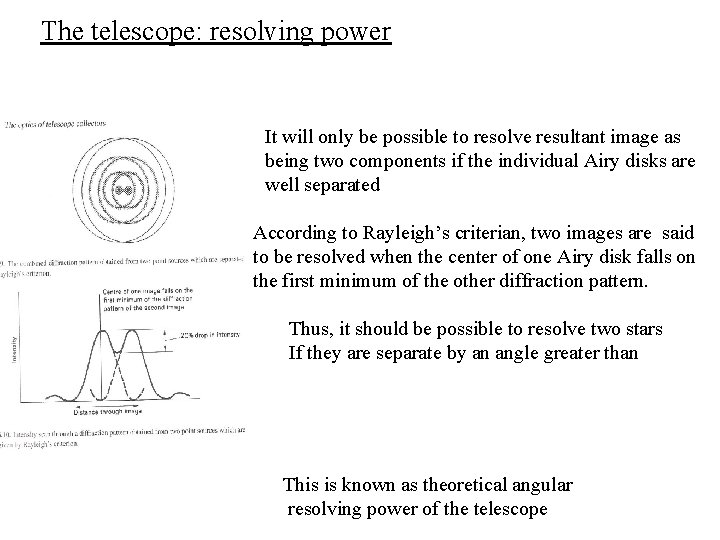
The telescope: resolving power It will only be possible to resolve resultant image as being two components if the individual Airy disks are well separated According to Rayleigh’s criterian, two images are said to be resolved when the center of one Airy disk falls on the first minimum of the other diffraction pattern. Thus, it should be possible to resolve two stars If they are separate by an angle greater than This is known as theoretical angular resolving power of the telescope
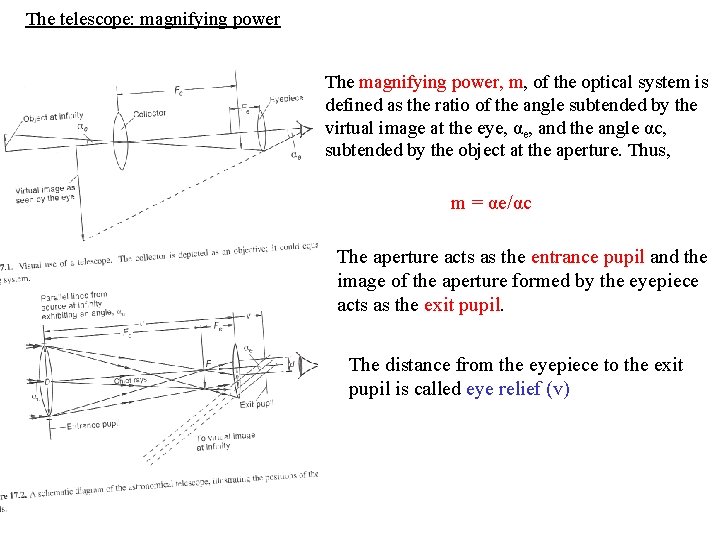
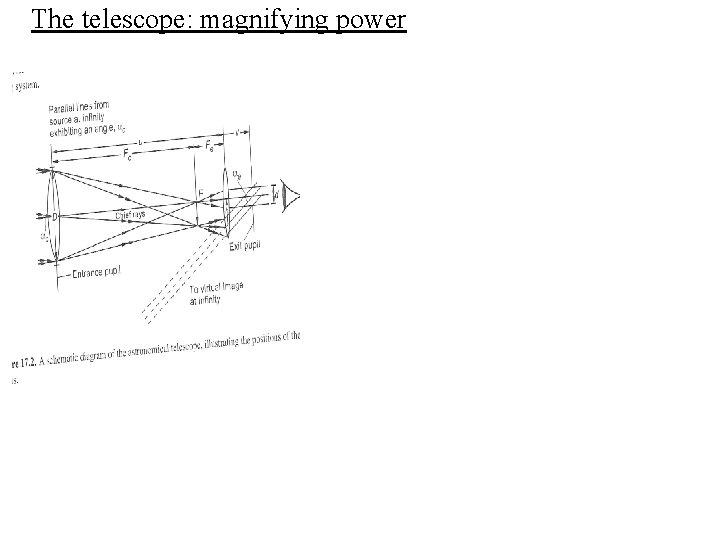
The telescope: magnifying power The magnifying power, m, of the optical system is defined as the ratio of the angle subtended by the virtual image at the eye, αe, and the angle αc, subtended by the object at the aperture. Thus, m = αe/αc The aperture acts as the entrance pupil and the image of the aperture formed by the eyepiece acts as the exit pupil. The distance from the eyepiece to the exit pupil is called eye relief (v)
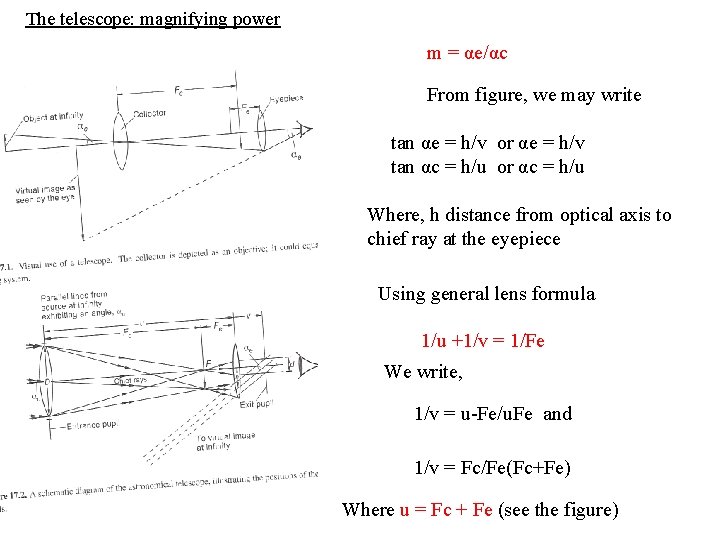
The telescope: magnifying power m = αe/αc From figure, we may write tan αe = h/v or αe = h/v tan αc = h/u or αc = h/u Where, h distance from optical axis to chief ray at the eyepiece Using general lens formula 1/u +1/v = 1/Fe We write, 1/v = u-Fe/u. Fe and 1/v = Fc/Fe(Fc+Fe) Where u = Fc + Fe (see the figure)
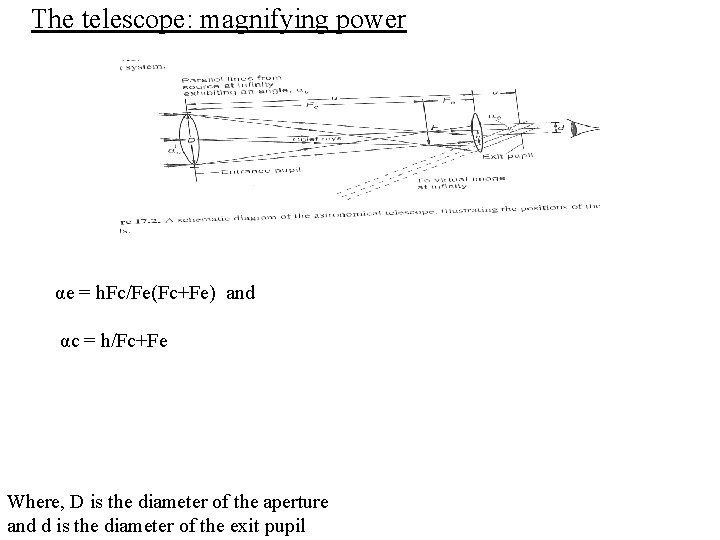
The telescope: magnifying power αe = h. Fc/Fe(Fc+Fe) and αc = h/Fc+Fe Where, D is the diameter of the aperture and d is the diameter of the exit pupil
The telescope: magnifying power
The telescope: field of view (FOV)
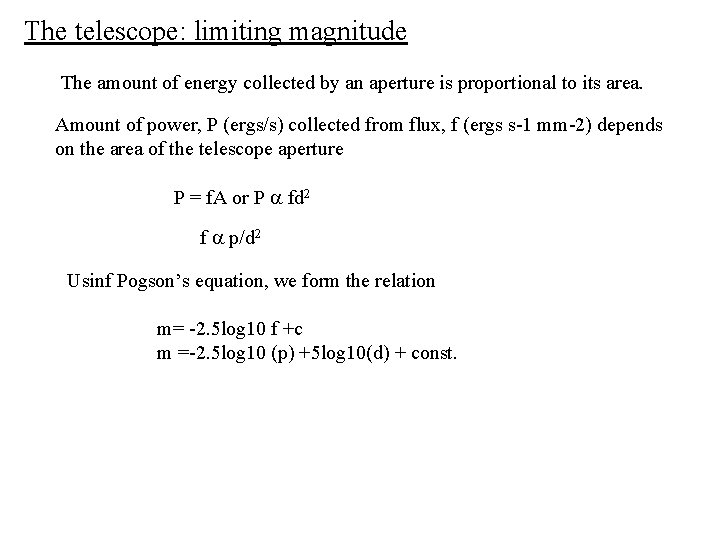
The telescope: limiting magnitude The amount of energy collected by an aperture is proportional to its area. Amount of power, P (ergs/s) collected from flux, f (ergs s-1 mm-2) depends on the area of the telescope aperture P = f. A or P fd 2 f p/d 2 Usinf Pogson’s equation, we form the relation m= -2. 5 log 10 f +c m =-2. 5 log 10 (p) +5 log 10(d) + const.
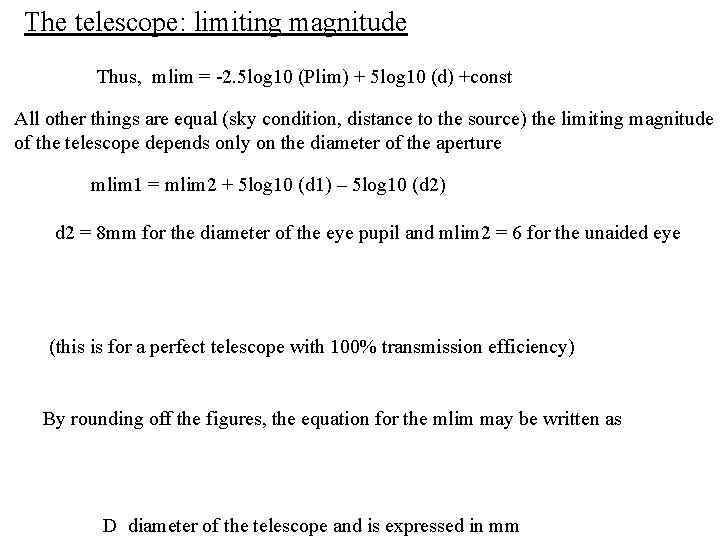
The telescope: limiting magnitude Thus, mlim = -2. 5 log 10 (Plim) + 5 log 10 (d) +const All other things are equal (sky condition, distance to the source) the limiting magnitude of the telescope depends only on the diameter of the aperture mlim 1 = mlim 2 + 5 log 10 (d 1) – 5 log 10 (d 2) d 2 = 8 mm for the diameter of the eye pupil and mlim 2 = 6 for the unaided eye (this is for a perfect telescope with 100% transmission efficiency) By rounding off the figures, the equation for the mlim may be written as D diameter of the telescope and is expressed in mm
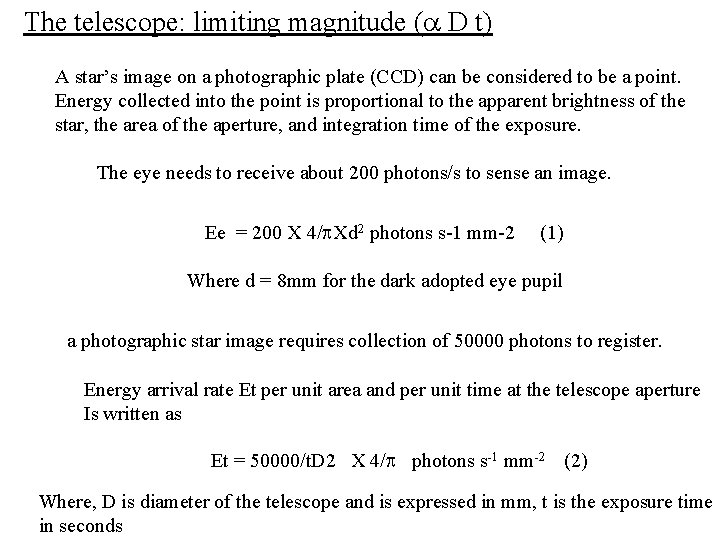
The telescope: limiting magnitude ( D t) A star’s image on a photographic plate (CCD) can be considered to be a point. Energy collected into the point is proportional to the apparent brightness of the star, the area of the aperture, and integration time of the exposure. The eye needs to receive about 200 photons/s to sense an image. Ee = 200 X 4/ Xd 2 photons s-1 mm-2 (1) Where d = 8 mm for the dark adopted eye pupil a photographic star image requires collection of 50000 photons to register. Energy arrival rate Et per unit area and per unit time at the telescope aperture Is written as Et = 50000/t. D 2 X 4/ photons s-1 mm-2 (2) Where, D is diameter of the telescope and is expressed in mm, t is the exposure time in seconds
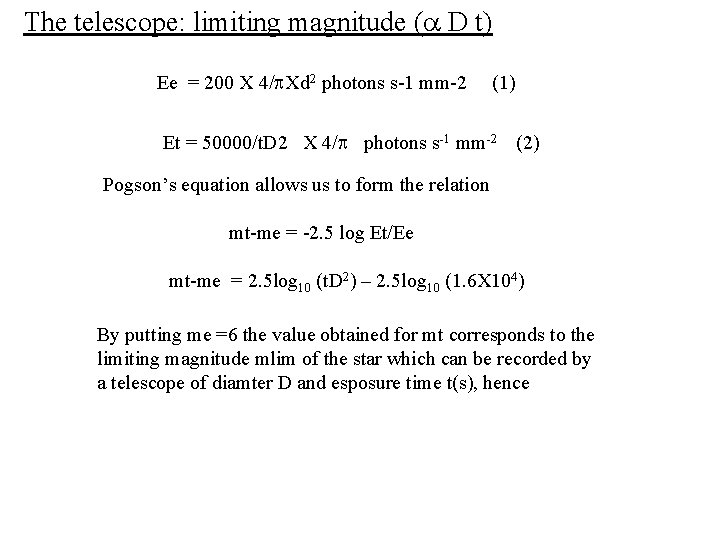
The telescope: limiting magnitude ( D t) Ee = 200 X 4/ Xd 2 photons s-1 mm-2 (1) Et = 50000/t. D 2 X 4/ photons s-1 mm-2 (2) Pogson’s equation allows us to form the relation mt-me = -2. 5 log Et/Ee mt-me = 2. 5 log 10 (t. D 2) – 2. 5 log 10 (1. 6 X 10⁴) By putting me =6 the value obtained for mt corresponds to the limiting magnitude mlim of the star which can be recorded by a telescope of diamter D and esposure time t(s), hence

Telescopes
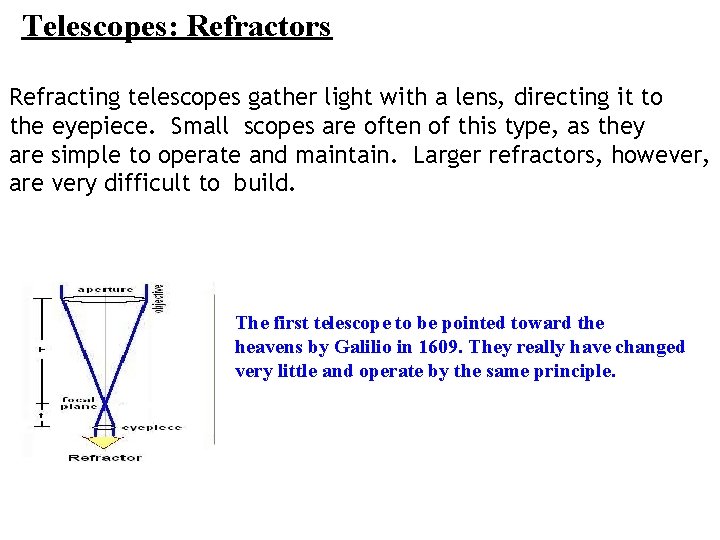
Telescopes: Refractors Refracting telescopes gather light with a lens, directing it to the eyepiece. Small scopes are often of this type, as they are simple to operate and maintain. Larger refractors, however, are very difficult to build. The first telescope to be pointed toward the heavens by Galilio in 1609. They really have changed very little and operate by the same principle.
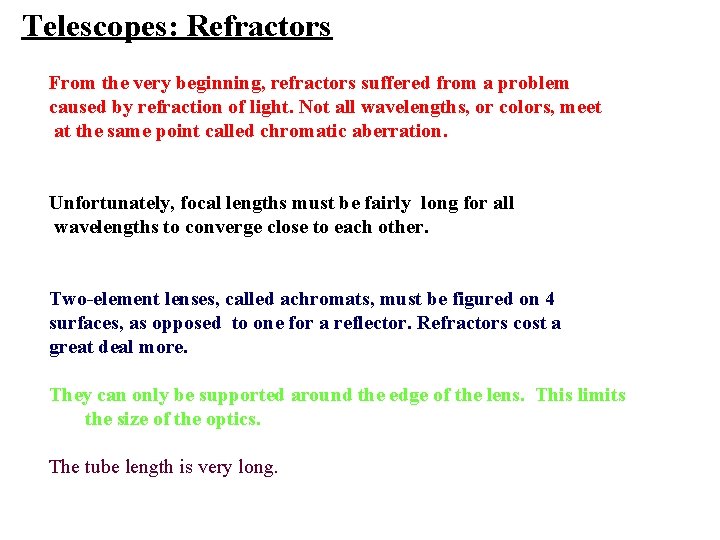
Telescopes: Refractors From the very beginning, refractors suffered from a problem caused by refraction of light. Not all wavelengths, or colors, meet at the same point called chromatic aberration. Unfortunately, focal lengths must be fairly long for all wavelengths to converge close to each other. Two-element lenses, called achromats, must be figured on 4 surfaces, as opposed to one for a reflector. Refractors cost a great deal more. They can only be supported around the edge of the lens. This limits the size of the optics. The tube length is very long.
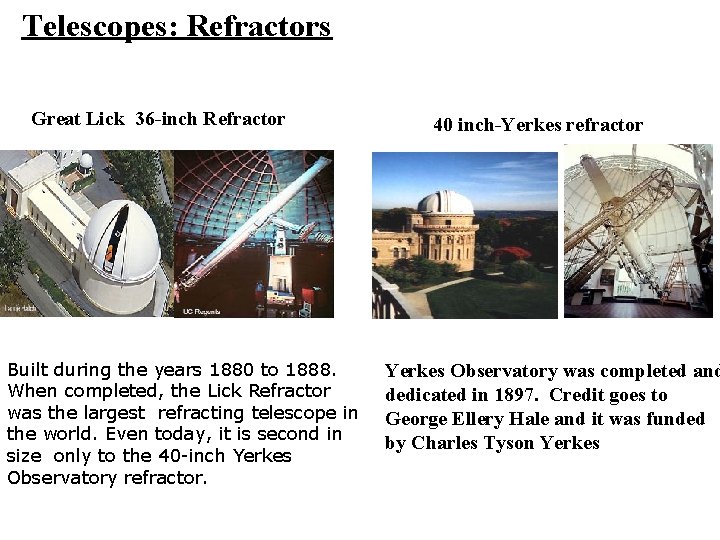
Telescopes: Refractors Great Lick 36 -inch Refractor Built during the years 1880 to 1888. When completed, the Lick Refractor was the largest refracting telescope in the world. Even today, it is second in size only to the 40 -inch Yerkes Observatory refractor. 40 inch-Yerkes refractor Yerkes Observatory was completed and dedicated in 1897. Credit goes to George Ellery Hale and it was funded by Charles Tyson Yerkes
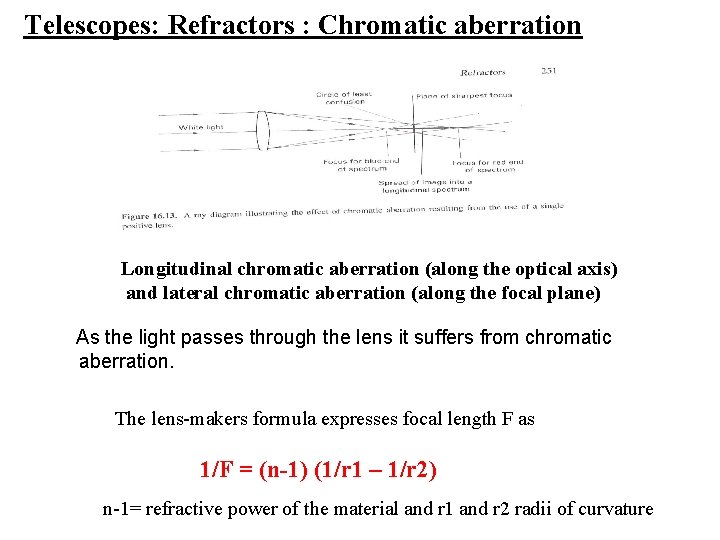
Telescopes: Refractors : Chromatic aberration Longitudinal chromatic aberration (along the optical axis) and lateral chromatic aberration (along the focal plane) As the light passes through the lens it suffers from chromatic aberration. The lens-makers formula expresses focal length F as 1/F = (n-1) (1/r 1 – 1/r 2) n-1= refractive power of the material and r 1 and r 2 radii of curvature
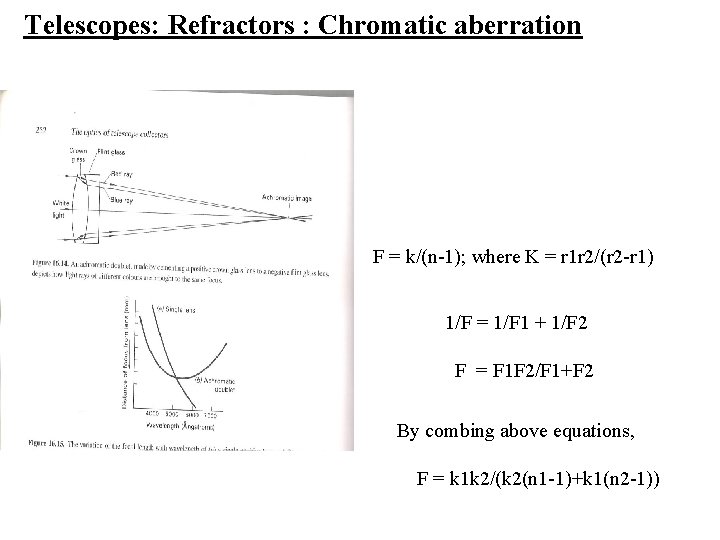
Telescopes: Refractors : Chromatic aberration F = k/(n-1); where K = r 1 r 2/(r 2 -r 1) 1/F = 1/F 1 + 1/F 2 F = F 1 F 2/F 1+F 2 By combing above equations, F = k 1 k 2/(k 2(n 1 -1)+k 1(n 2 -1))
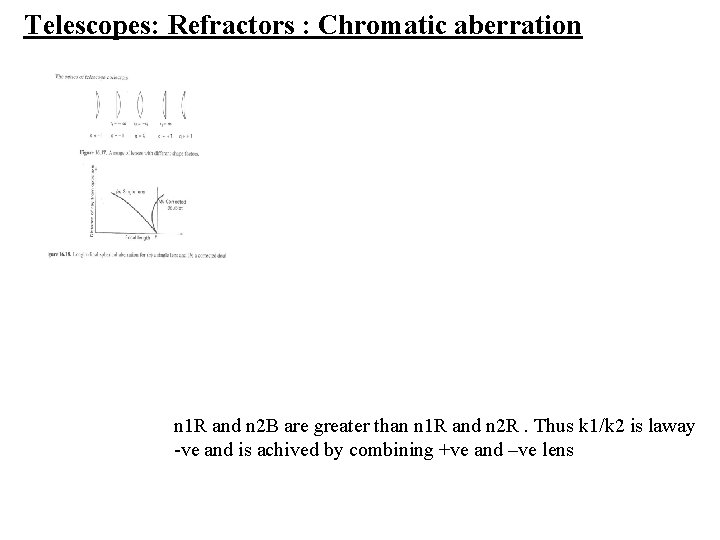
Telescopes: Refractors : Chromatic aberration n 1 R and n 2 B are greater than n 1 R and n 2 R. Thus k 1/k 2 is laway -ve and is achived by combining +ve and –ve lens
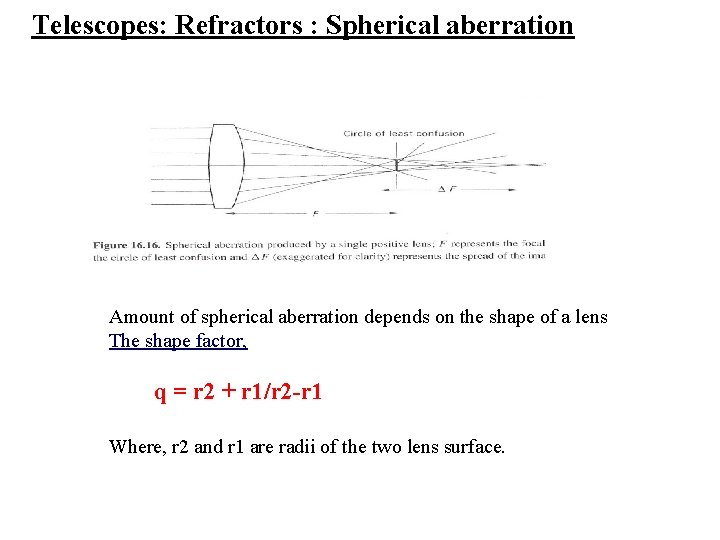
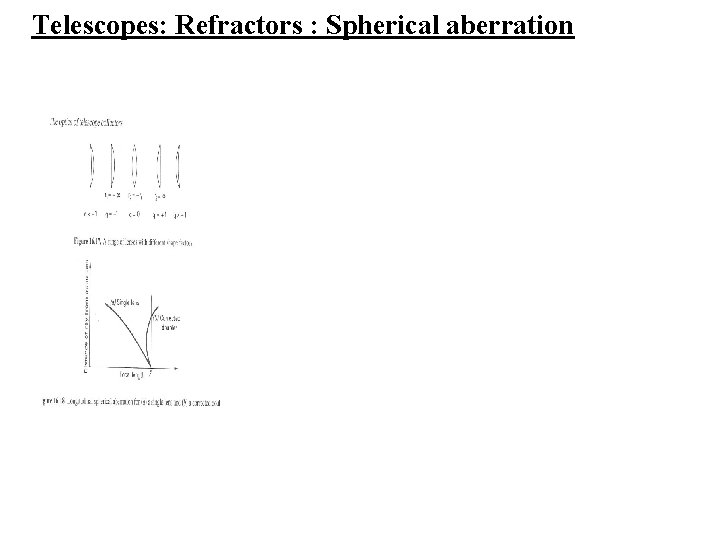
Telescopes: Refractors : Spherical aberration Amount of spherical aberration depends on the shape of a lens The shape factor, q = r 2 + r 1/r 2 -r 1 Where, r 2 and r 1 are radii of the two lens surface.
Telescopes: Refractors : Spherical aberration
Telescopes: Refractors : Coma
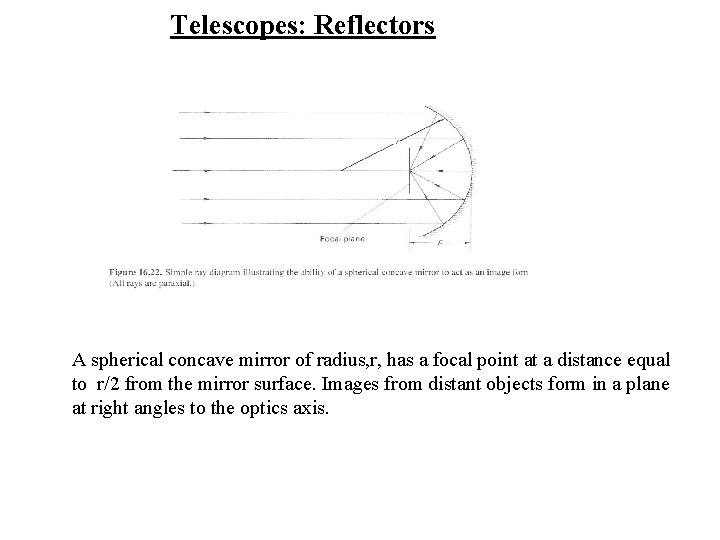
Telescopes: Reflectors A spherical concave mirror of radius, r, has a focal point at a distance equal to r/2 from the mirror surface. Images from distant objects form in a plane at right angles to the optics axis.
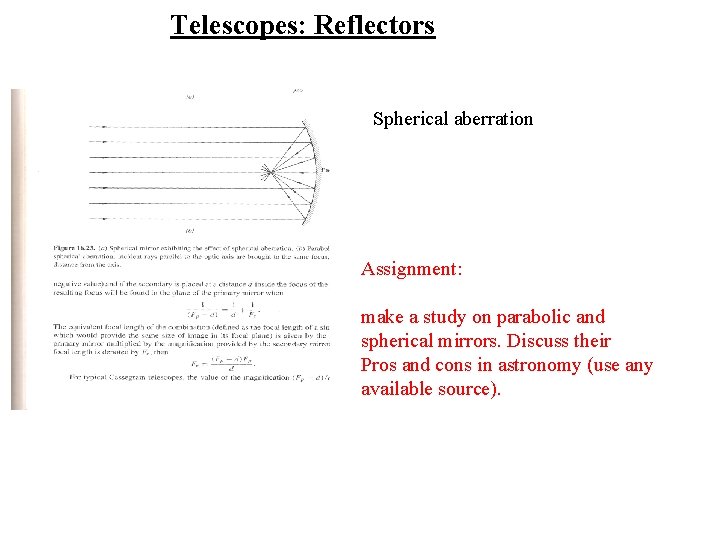
Telescopes: Reflectors Spherical aberration Assignment: make a study on parabolic and spherical mirrors. Discuss their Pros and cons in astronomy (use any available source).
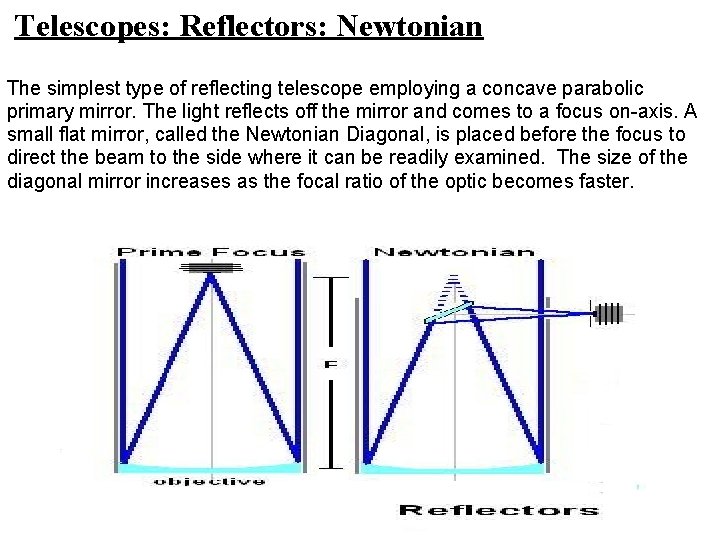
Telescopes: Reflectors: Newtonian The simplest type of reflecting telescope employing a concave parabolic primary mirror. The light reflects off the mirror and comes to a focus on-axis. A small flat mirror, called the Newtonian Diagonal, is placed before the focus to direct the beam to the side where it can be readily examined. The size of the diagonal mirror increases as the focal ratio of the optic becomes faster.
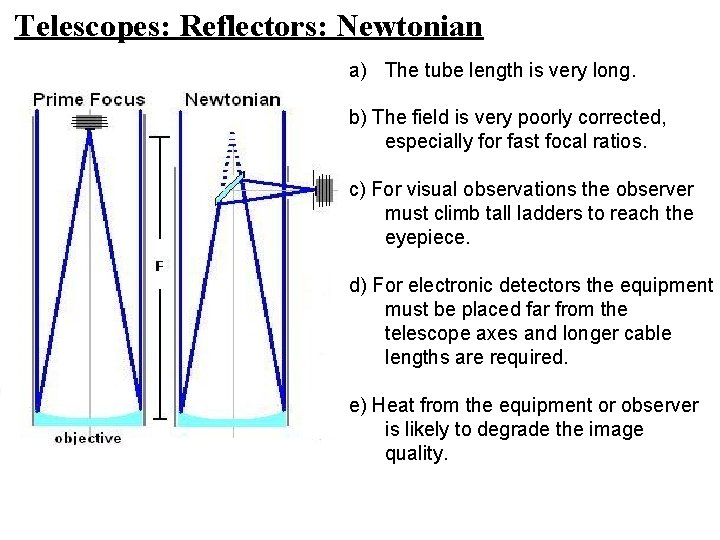
Telescopes: Reflectors: Newtonian a) The tube length is very long. b) The field is very poorly corrected, especially for fast focal ratios. c) For visual observations the observer must climb tall ladders to reach the eyepiece. d) For electronic detectors the equipment must be placed far from the telescope axes and longer cable lengths are required. e) Heat from the equipment or observer is likely to degrade the image quality.
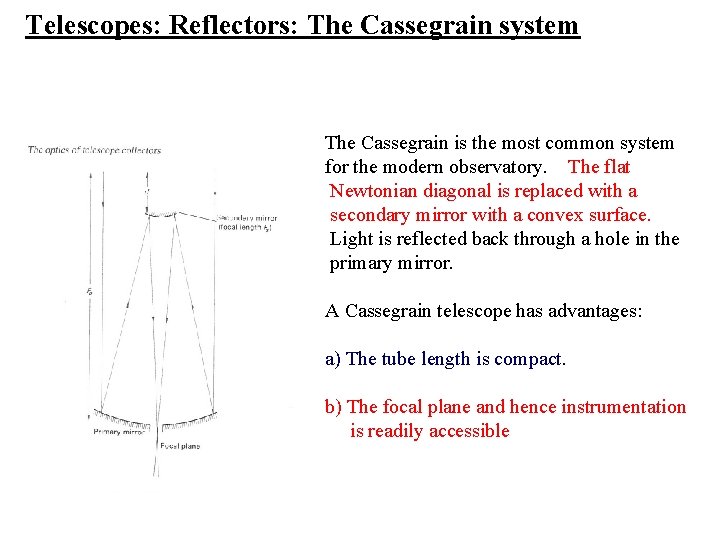
Telescopes: Reflectors: The Cassegrain system The Cassegrain is the most common system for the modern observatory. The flat Newtonian diagonal is replaced with a secondary mirror with a convex surface. Light is reflected back through a hole in the primary mirror. A Cassegrain telescope has advantages: a) The tube length is compact. b) The focal plane and hence instrumentation is readily accessible
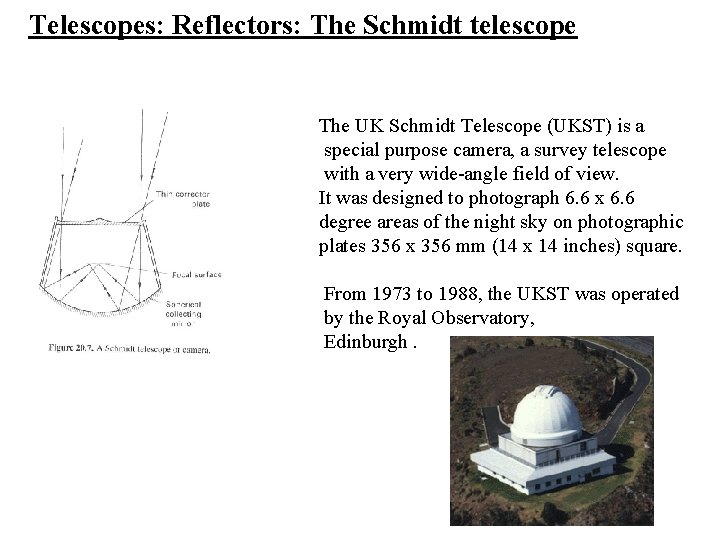
Telescopes: Reflectors: The Schmidt telescope The UK Schmidt Telescope (UKST) is a special purpose camera, a survey telescope with a very wide-angle field of view. It was designed to photograph 6. 6 x 6. 6 degree areas of the night sky on photographic plates 356 x 356 mm (14 x 14 inches) square. From 1973 to 1988, the UKST was operated by the Royal Observatory, Edinburgh.
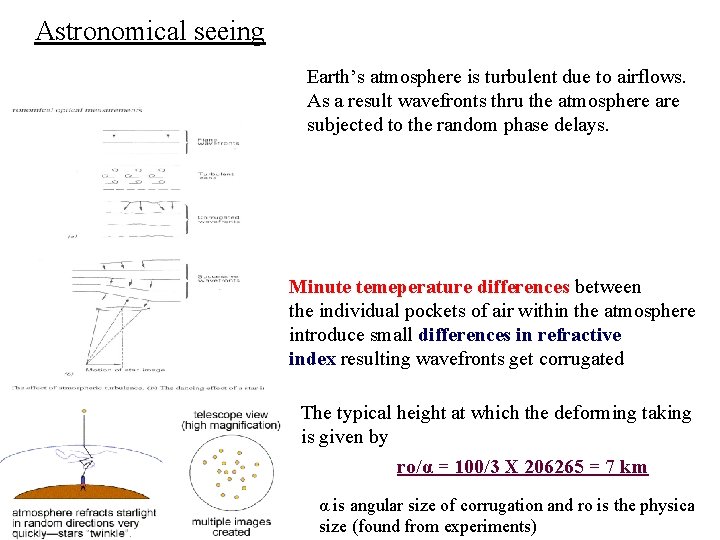
Astronomical seeing Earth’s atmosphere is turbulent due to airflows. As a result wavefronts thru the atmosphere are subjected to the random phase delays. Minute temeperature differences between the individual pockets of air within the atmosphere introduce small differences in refractive index resulting wavefronts get corrugated The typical height at which the deforming taking is given by ro/α = 100/3 X 206265 = 7 km α is angular size of corrugation and ro is the physica size (found from experiments)
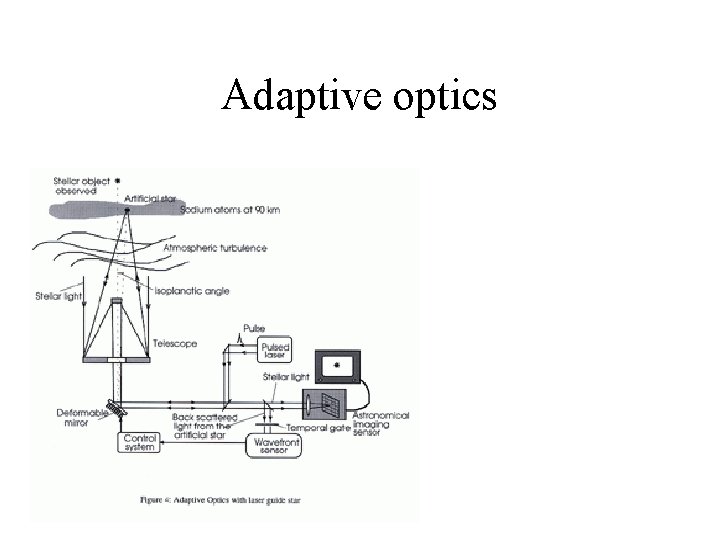
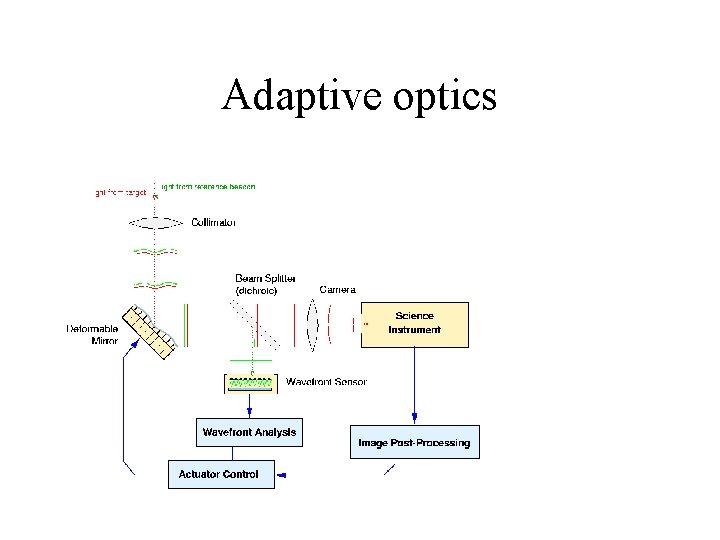
Adaptive optics AO provides a clearer view of the universe by compensating for atmospheric turbulence that causes stars to "twinkle. “ The adaptive optics adjustment is made with a deformable mirror that is almost infinitely adjustable. It changes shape in numerous places hundreds of times per second, compensating for changing atmospheric conditions to focus light precisely. Essentially, when a celestial object is to be observed, a fairly bright star nearby is monitored, and a correction is made for the "twinkle" that is observed. This correction is then applied to the object when it is observed.
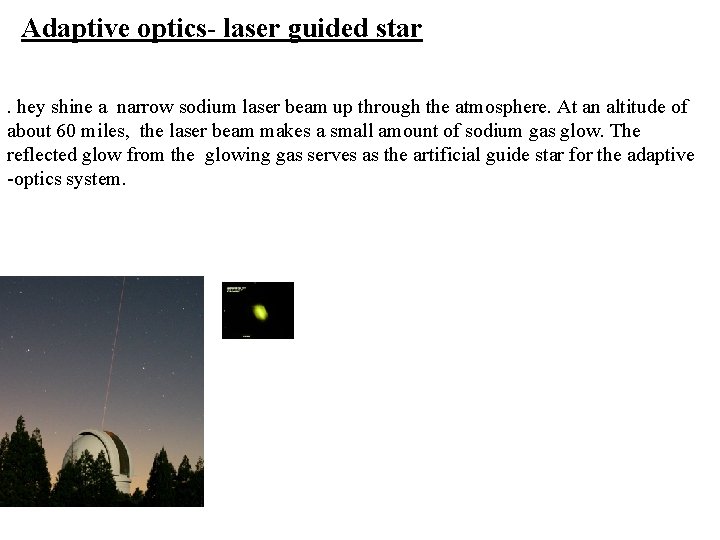
Adaptive optics- laser guided star. hey shine a narrow sodium laser beam up through the atmosphere. At an altitude of about 60 miles, the laser beam makes a small amount of sodium gas glow. The reflected glow from the glowing gas serves as the artificial guide star for the adaptive -optics system.
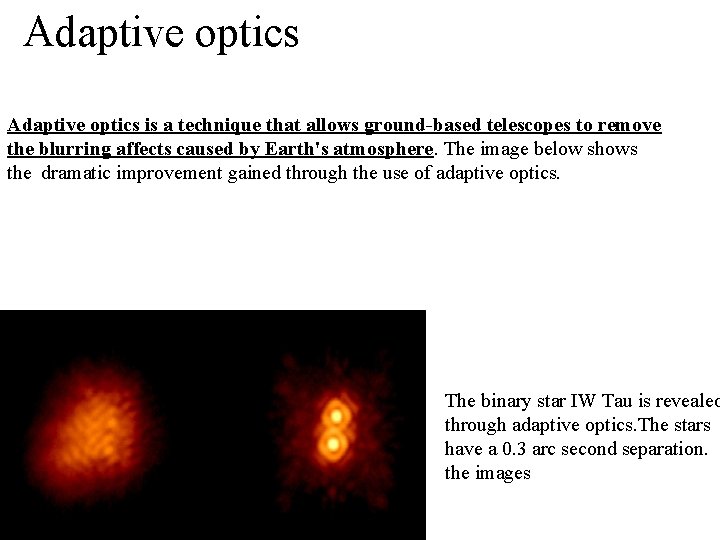
Adaptive optics is a technique that allows ground-based telescopes to remove the blurring affects caused by Earth's atmosphere. The image below shows the dramatic improvement gained through the use of adaptive optics. The binary star IW Tau is revealed through adaptive optics. The stars have a 0. 3 arc second separation. the images
Adaptive optics
Adaptive optics
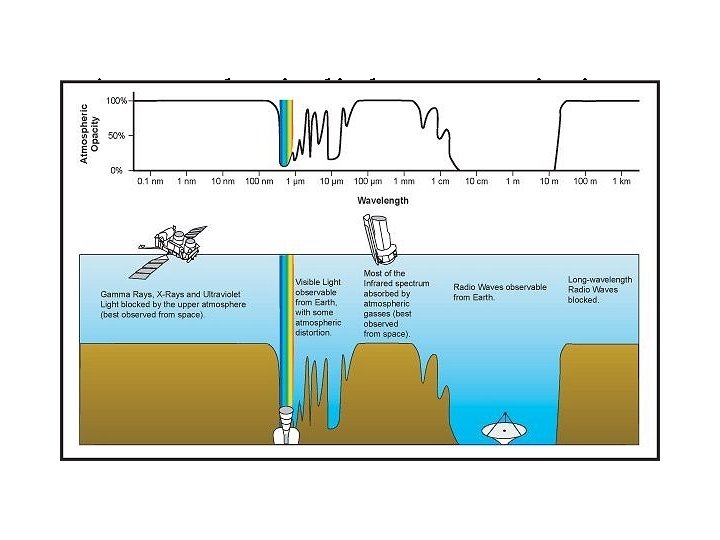
Atmospheric light transmission
Telescopes: Mountings The classical mounting for an astronomical telescope is to have an axis parallel to the Earth's north-south axis, called an equatorial mounting. Another popular mounting is Altazimuth mounting which requires track the star on two axes with varying drive rates. Now that computer controlled drive systems can be made which allow constantly varying drive rates to be used on two axes. .
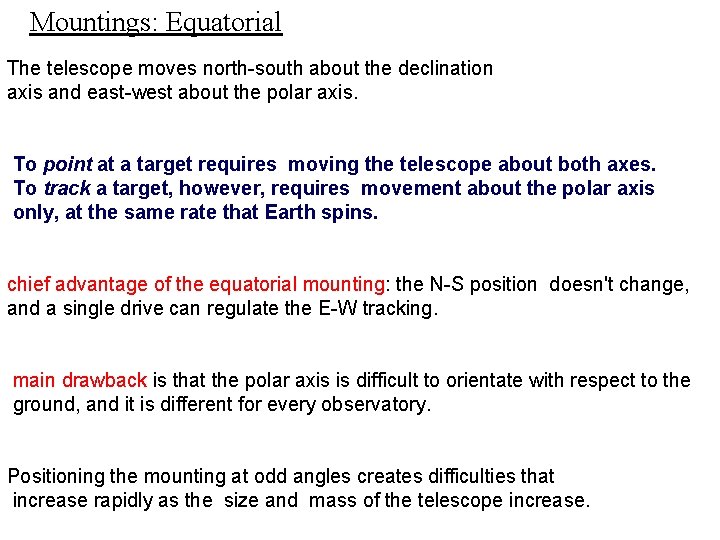
Mountings: Equatorial The telescope moves north-south about the declination axis and east-west about the polar axis. To point at a target requires moving the telescope about both axes. To track a target, however, requires movement about the polar axis only, at the same rate that Earth spins. chief advantage of the equatorial mounting: the N-S position doesn't change, and a single drive can regulate the E-W tracking. main drawback is that the polar axis is difficult to orientate with respect to the ground, and it is different for every observatory. Positioning the mounting at odd angles creates difficulties that increase rapidly as the size and mass of the telescope increase.
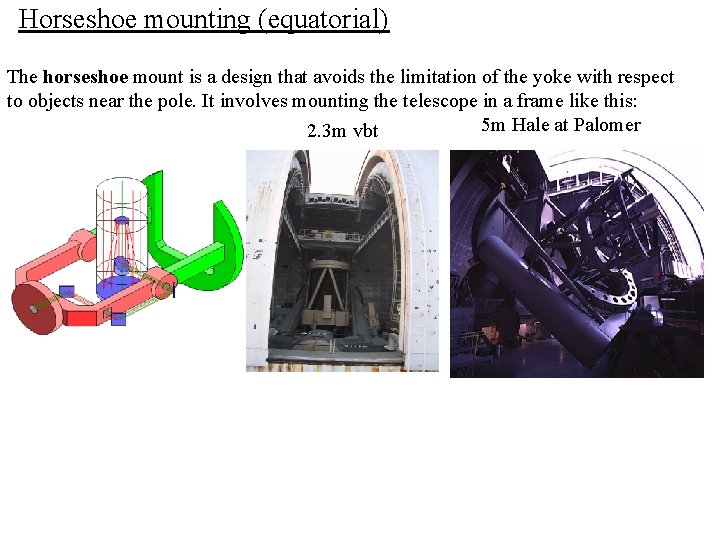
Horseshoe mounting (equatorial) The horseshoe mount is a design that avoids the limitation of the yoke with respect to objects near the pole. It involves mounting the telescope in a frame like this: 5 m Hale at Palomer 2. 3 m vbt
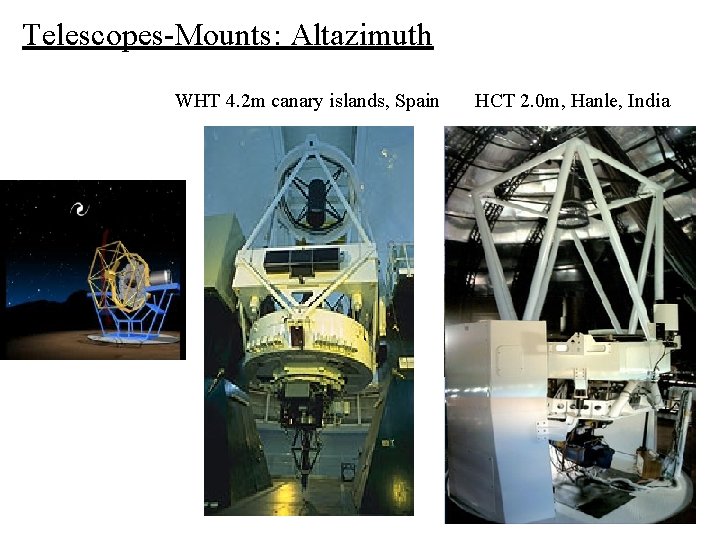
Telescopes-Mounts: Altazimuth WHT 4. 2 m canary islands, Spain HCT 2. 0 m, Hanle, India
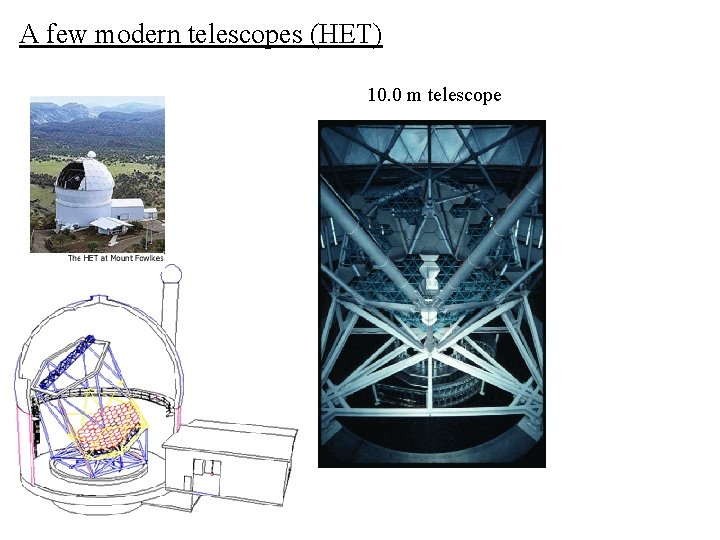
A few modern telescopes (HET) 10. 0 m telescope
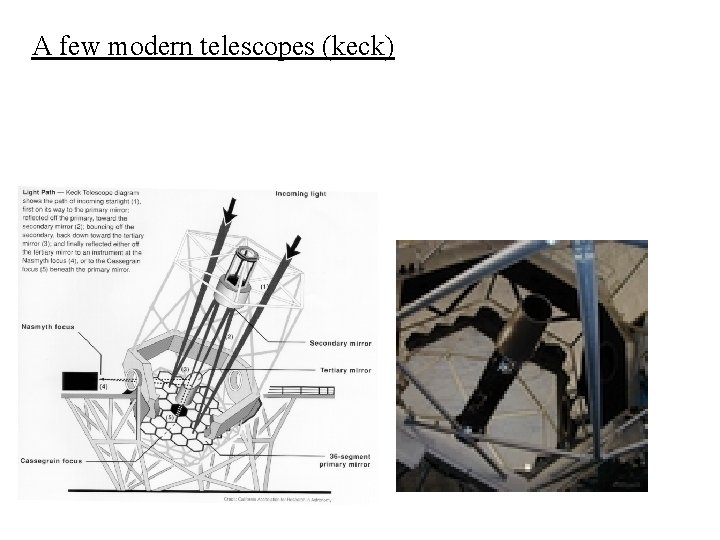
A few modern telescopes (keck)
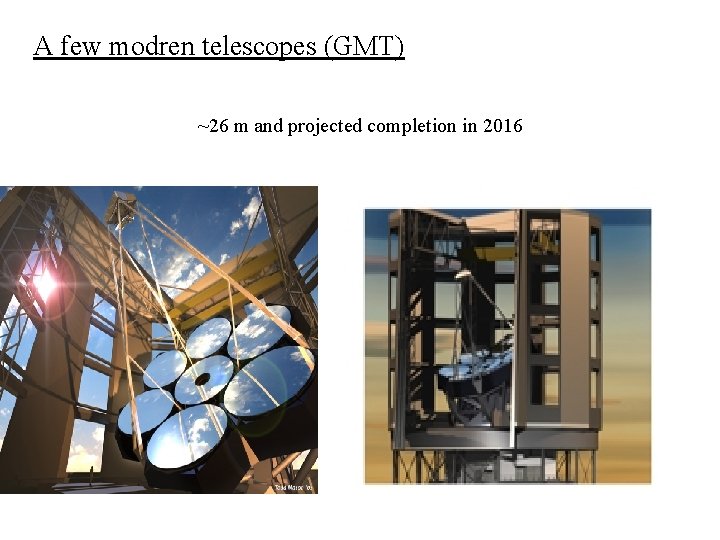
A few modren telescopes (GMT) ~26 m and projected completion in 2016
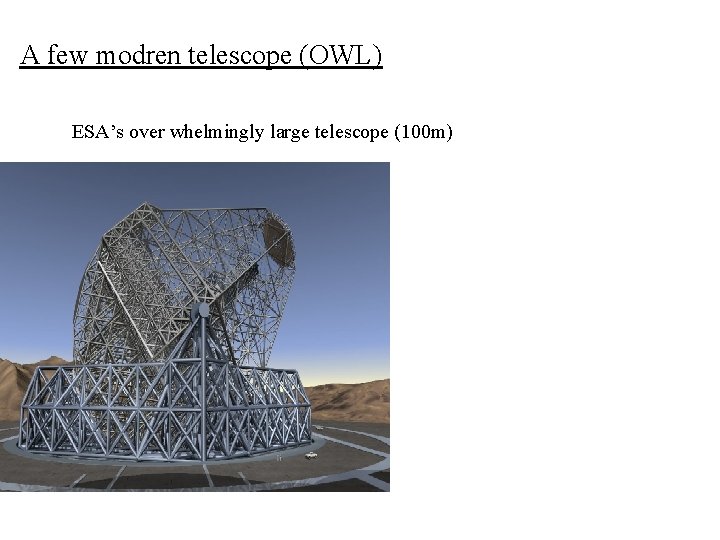
A few modren telescope (OWL) ESA’s over whelmingly large telescope (100 m)
- Slides: 124