
Astrofisica Gamma EGRET AGILE GLAST Astrofisica Gamma Experimental
- Slides: 41
Astrofisica Gamma EGRET AGILE GLAST Astrofisica Gamma
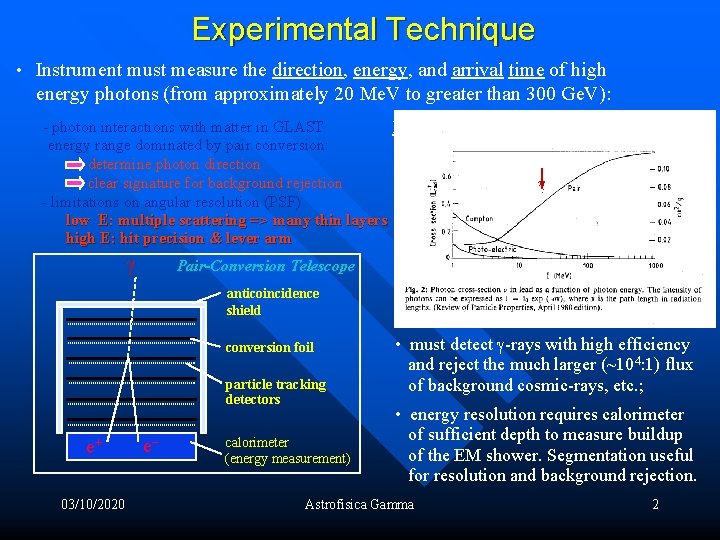
Experimental Technique • Instrument must measure the direction, energy, and arrival time of high energy photons (from approximately 20 Me. V to greater than 300 Ge. V): - photon interactions with matter in GLAST Energy loss mechanisms: energy range dominated by pair conversion: determine photon direction clear signature for background rejection - limitations on angular resolution (PSF) low E: multiple scattering => many thin layers high E: hit precision & lever arm Pair-Conversion Telescope anticoincidence shield conversion foil particle tracking detectors e+ 03/10/2020 e– calorimeter (energy measurement) • must detect -rays with high efficiency and reject the much larger (~104: 1) flux of background cosmic-rays, etc. ; • energy resolution requires calorimeter of sufficient depth to measure buildup of the EM shower. Segmentation useful for resolution and background rejection. Astrofisica Gamma 2
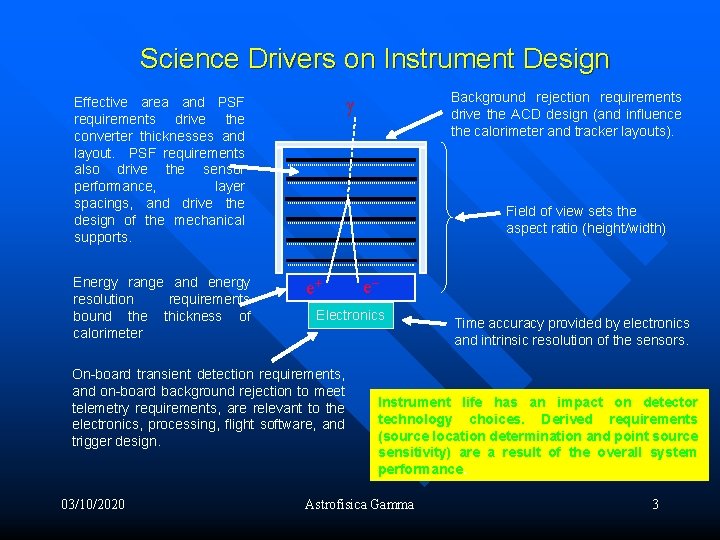
Science Drivers on Instrument Design Energy range and energy resolution requirements bound the thickness of calorimeter Field of view sets the aspect ratio (height/width) e+ e– Electronics On-board transient detection requirements, and on-board background rejection to meet telemetry requirements, are relevant to the electronics, processing, flight software, and trigger design. 03/10/2020 Background rejection requirements drive the ACD design (and influence the calorimeter and tracker layouts). Effective area and PSF requirements drive the converter thicknesses and layout. PSF requirements also drive the sensor performance, layer spacings, and drive the design of the mechanical supports. Time accuracy provided by electronics and intrinsic resolution of the sensors. Instrument life has an impact on detector technology choices. Derived requirements (source location determination and point source sensitivity) are a result of the overall system performance. Astrofisica Gamma 3
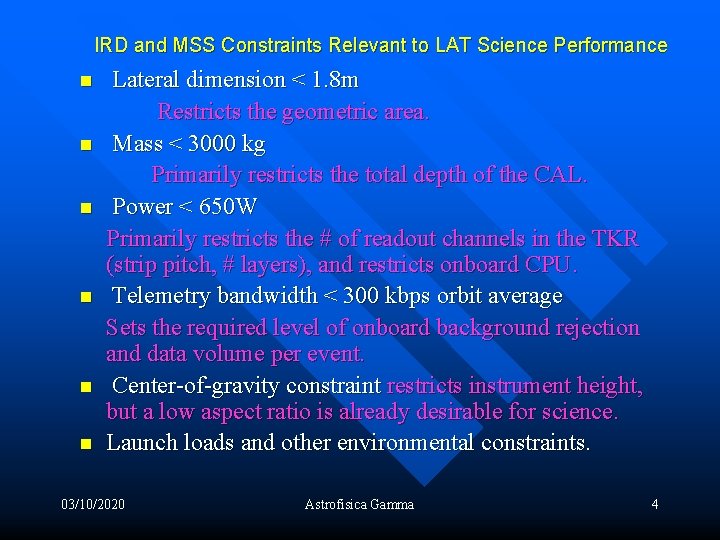
IRD and MSS Constraints Relevant to LAT Science Performance n n n Lateral dimension < 1. 8 m Restricts the geometric area. Mass < 3000 kg Primarily restricts the total depth of the CAL. Power < 650 W Primarily restricts the # of readout channels in the TKR (strip pitch, # layers), and restricts onboard CPU. Telemetry bandwidth < 300 kbps orbit average Sets the required level of onboard background rejection and data volume per event. Center-of-gravity constraint restricts instrument height, but a low aspect ratio is already desirable for science. Launch loads and other environmental constraints. 03/10/2020 Astrofisica Gamma 4
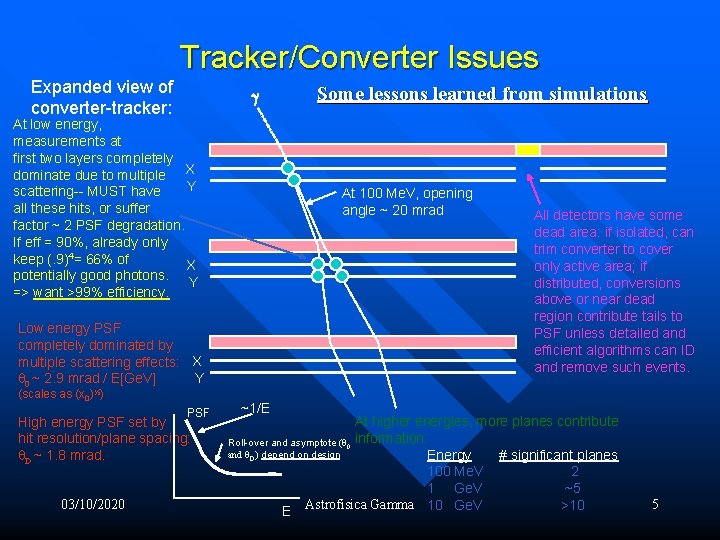
Expanded view of converter-tracker: Tracker/Converter Issues At low energy, measurements at first two layers completely dominate due to multiple X Y scattering-- MUST have all these hits, or suffer factor ~ 2 PSF degradation. If eff = 90%, already only keep (. 9)4= 66% of X potentially good photons. Y => want >99% efficiency. At 100 Me. V, opening angle ~ 20 mrad Low energy PSF completely dominated by multiple scattering effects: X Y q 0 ~ 2. 9 mrad / E[Ge. V] (scales as (x 0)½) PSF High energy PSF set by hit resolution/plane spacing: q. D ~ 1. 8 mrad. 03/10/2020 Some lessons learned from simulations All detectors have some dead area: if isolated, can trim converter to cover only active area; if distributed, conversions above or near dead region contribute tails to PSF unless detailed and efficient algorithms can ID and remove such events. ~1/E At higher energies, more planes contribute Roll-over and asymptote (q 0 information: and q. D) depend on design Energy # significant planes 100 Me. V 2 1 Ge. V ~5 >10 E Astrofisica Gamma 10 Ge. V 5
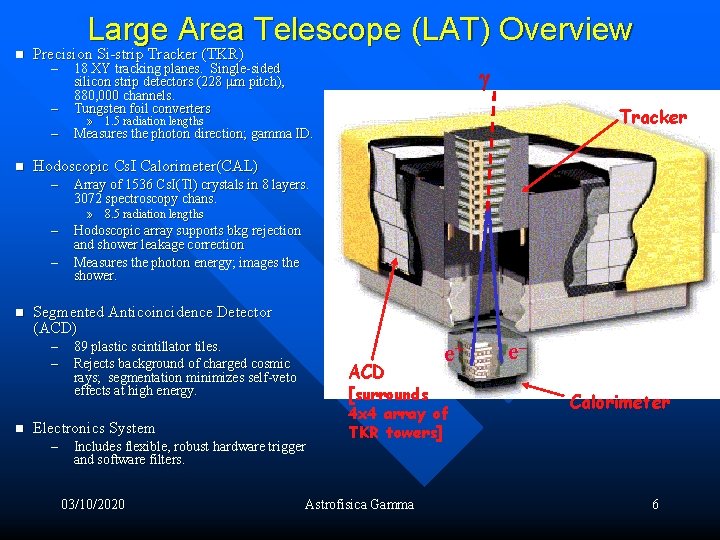
n n Large Area Telescope (LAT) Overview Precision Si-strip Tracker (TKR) – – 18 XY tracking planes. Single-sided silicon strip detectors (228 m pitch), 880, 000 channels. Tungsten foil converters – Measures the photon direction; gamma ID. Tracker » 1. 5 radiation lengths Hodoscopic Cs. I Calorimeter(CAL) – Array of 1536 Cs. I(Tl) crystals in 8 layers. 3072 spectroscopy chans. » 8. 5 radiation lengths – – n Segmented Anticoincidence Detector (ACD) – – n Hodoscopic array supports bkg rejection and shower leakage correction Measures the photon energy; images the shower. 89 plastic scintillator tiles. Rejects background of charged cosmic rays; segmentation minimizes self-veto effects at high energy. ACD [surrounds Electronics System – Includes flexible, robust hardware trigger and software filters. 03/10/2020 e+ 4 x 4 array of TKR towers] Astrofisica Gamma e– Calorimeter 6
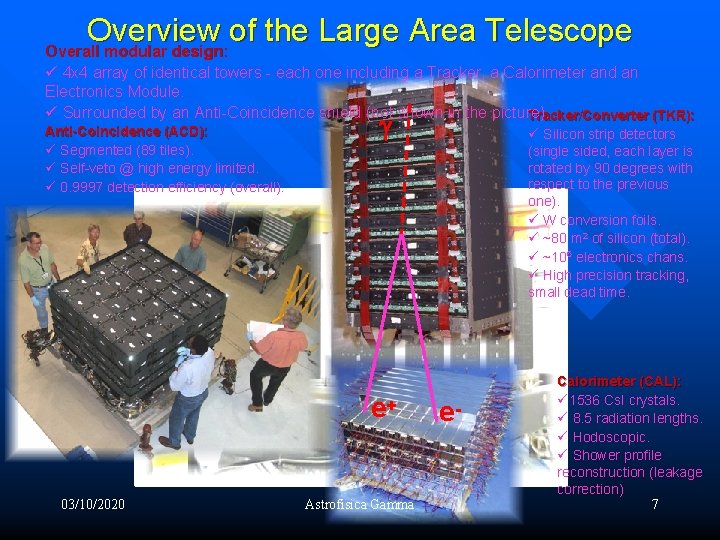
Overview of the Large Area Telescope Overall modular design: ü 4 x 4 array of identical towers - each one including a Tracker, a Calorimeter and an Electronics Module. ü Surrounded by an Anti-Coincidence shield (not shown in the picture). Tracker/Converter (TKR): Anti-Coincidence (ACD): ü Segmented (89 tiles). ü Self-veto @ high energy limited. ü 0. 9997 detection efficiency (overall). e+ 03/10/2020 Astrofisica Gamma ü Silicon strip detectors (single sided, each layer is rotated by 90 degrees with respect to the previous one). ü W conversion foils. ü ~80 m 2 of silicon (total). ü ~106 electronics chans. ü High precision tracking, small dead time. e- Calorimeter (CAL): ü 1536 Cs. I crystals. ü 8. 5 radiation lengths. ü Hodoscopic. ü Shower profile reconstruction (leakage correction) 7
Benefits of Modularity • Construction and Test more manageable, reduce costs and schedule risk. • Early prototyping and performance tests done on detectors that are full-scale relevant to flight. • Aids pattern recognition. • Good match for triggering large-area detector with relatively localized event signatures. Issue: demonstrate that internal dead areas associated with support material and gaps between towers are not a problem. Resolution: Detailed Monte-Carlo model of instrument, combined with beam-test data of prototype hardware, used to validate design performance. 03/10/2020 Astrofisica Gamma 8
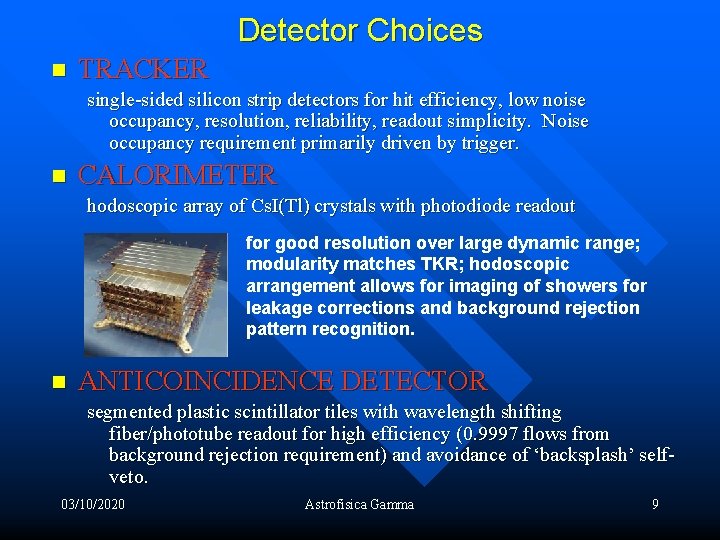
Detector Choices n TRACKER single-sided silicon strip detectors for hit efficiency, low noise occupancy, resolution, reliability, readout simplicity. Noise occupancy requirement primarily driven by trigger. n CALORIMETER hodoscopic array of Cs. I(Tl) crystals with photodiode readout for good resolution over large dynamic range; modularity matches TKR; hodoscopic arrangement allows for imaging of showers for leakage corrections and background rejection pattern recognition. n ANTICOINCIDENCE DETECTOR segmented plastic scintillator tiles with wavelength shifting fiber/phototube readout for high efficiency (0. 9997 flows from background rejection requirement) and avoidance of ‘backsplash’ selfveto. 03/10/2020 Astrofisica Gamma 9
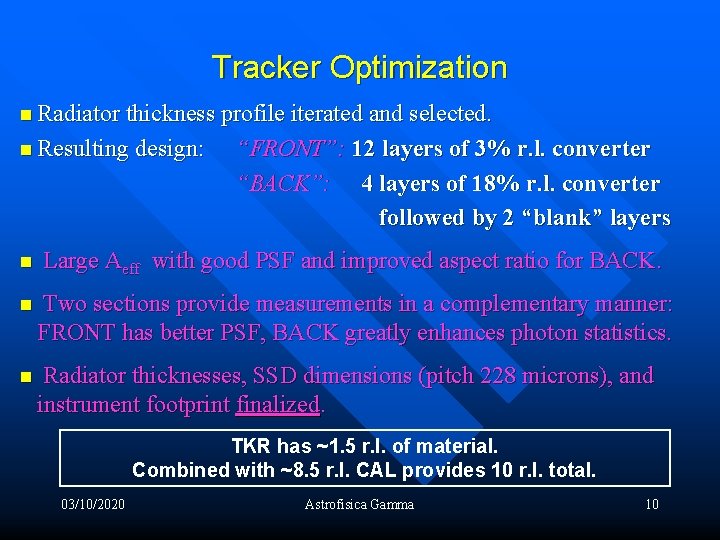
Tracker Optimization n Radiator thickness profile iterated and selected. n Resulting design: “FRONT”: 12 layers of 3% r. l. converter “BACK”: 4 layers of 18% r. l. converter followed by 2 “blank” layers n Large Aeff with good PSF and improved aspect ratio for BACK. n Two sections provide measurements in a complementary manner: FRONT has better PSF, BACK greatly enhances photon statistics. n Radiator thicknesses, SSD dimensions (pitch 228 microns), and instrument footprint finalized. TKR has ~1. 5 r. l. of material. Combined with ~8. 5 r. l. CAL provides 10 r. l. total. 03/10/2020 Astrofisica Gamma 10
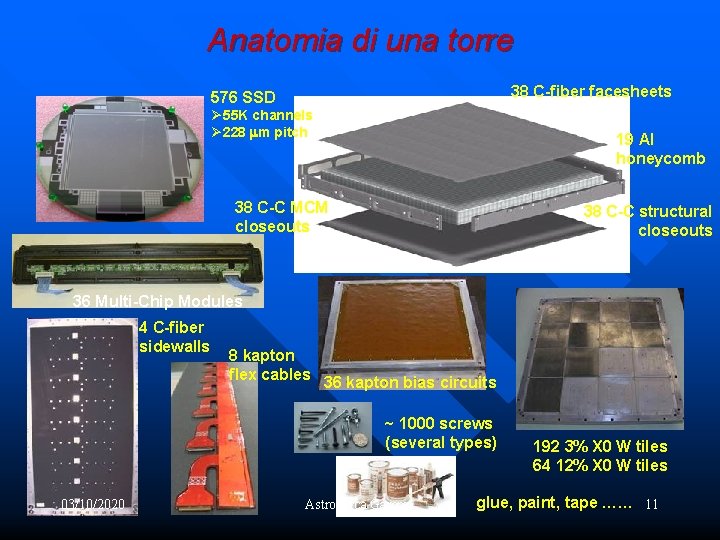
Anatomia di una torre 38 C-fiber facesheets 576 SSD Ø 55 K channels Ø 228 mm pitch 19 Al honeycomb 38 C-C MCM closeouts 38 C-C structural closeouts 36 Multi-Chip Modules 4 C-fiber sidewalls 8 kapton flex cables 36 kapton bias circuits ~ 1000 screws (several types) 03/10/2020 Astrofisica Gamma 192 3% X 0 W tiles 64 12% X 0 W tiles glue, paint, tape …… 11
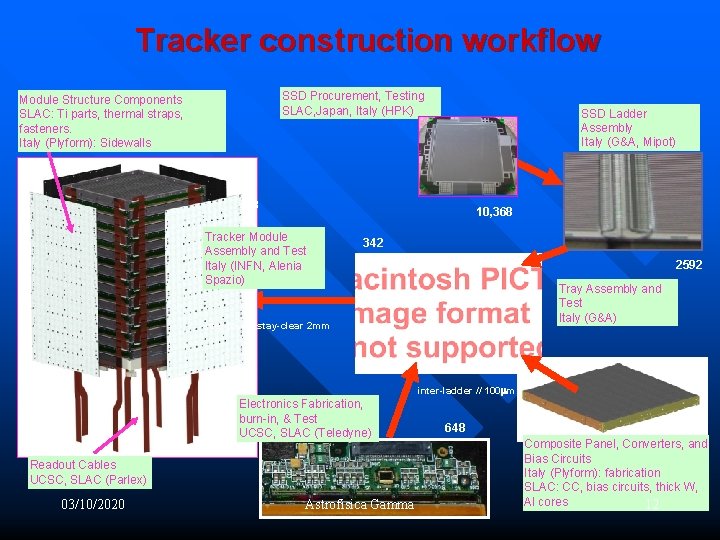
Tracker construction workflow SSD Procurement, Testing SLAC, Japan, Italy (HPK) Module Structure Components SLAC: Ti parts, thermal straps, fasteners. Italy (Plyform): Sidewalls SSD Ladder Assembly Italy (G&A, Mipot) 18 10, 368 Tracker Module Assembly and Test Italy (INFN, Alenia Spazio) 342 2592 Tray Assembly and Test Italy (G&A) inter-tower stay-clear 2 mm 342 inter-ladder // 100 mm Electronics Fabrication, burn-in, & Test UCSC, SLAC (Teledyne) Readout Cables UCSC, SLAC (Parlex) 03/10/2020 Astrofisica Gamma 648 Composite Panel, Converters, and Bias Circuits Italy (Plyform): fabrication SLAC: CC, bias circuits, thick W, Al cores 12
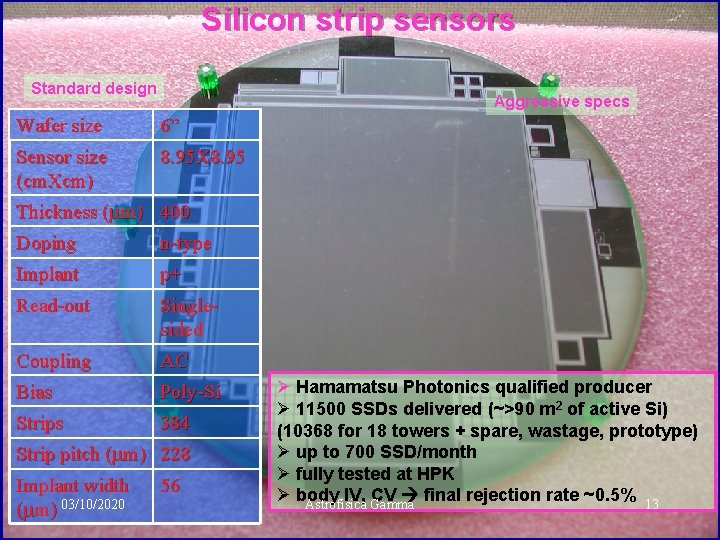
Silicon strip sensors Standard design Aggressive specs Wafer size 6” Sensor size (cm. Xcm) 8. 95 X 8. 95 Thickness ( m) 400 Doping n-type Implant p+ Read-out Singlesided Coupling AC Bias Poly-Si Strips 384 Strip pitch ( m) 228 Implant width ( m) 03/10/2020 56 Ø Hamamatsu Photonics qualified producer Ø 11500 SSDs delivered (~>90 m 2 of active Si) (10368 for 18 towers + spare, wastage, prototype) Ø up to 700 SSD/month Ø fully tested at HPK Ø body IV, CV final rejection rate ~0. 5% 13 Astrofisica Gamma
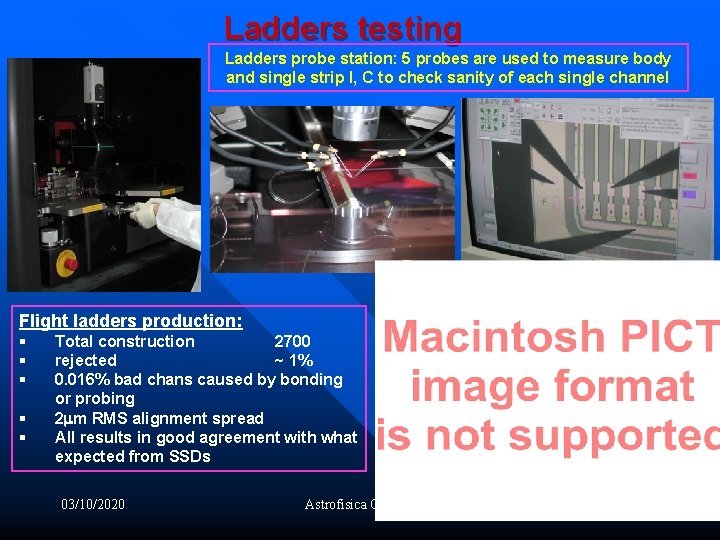
Ladders testing Ladders probe station: 5 probes are used to measure body and single strip I, C to check sanity of each single channel Flight ladders production: § § § Total construction 2700 rejected ~ 1% 0. 016% bad chans caused by bonding or probing 2 mm RMS alignment spread All results in good agreement with what expected from SSDs 03/10/2020 Astrofisica Gamma 14
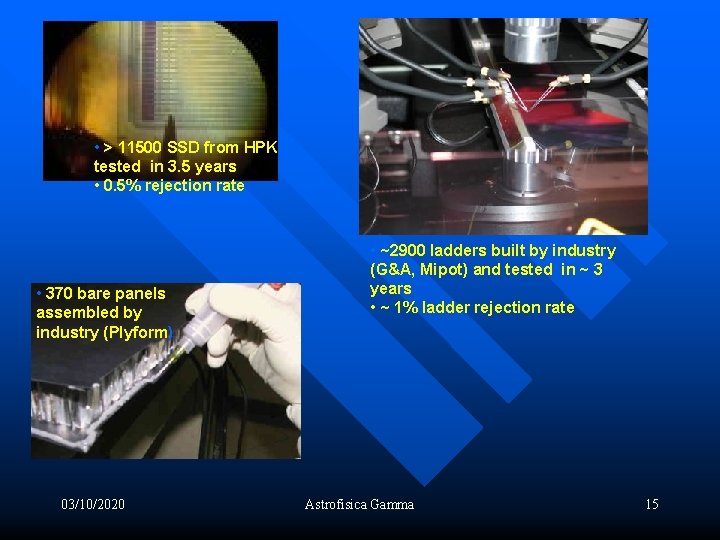
• > 11500 SSD from HPK tested in 3. 5 years • 0. 5% rejection rate • 370 bare panels assembled by industry (Plyform) 03/10/2020 • ~2900 ladders built by industry (G&A, Mipot) and tested in ~ 3 years • ~ 1% ladder rejection rate Astrofisica Gamma 15
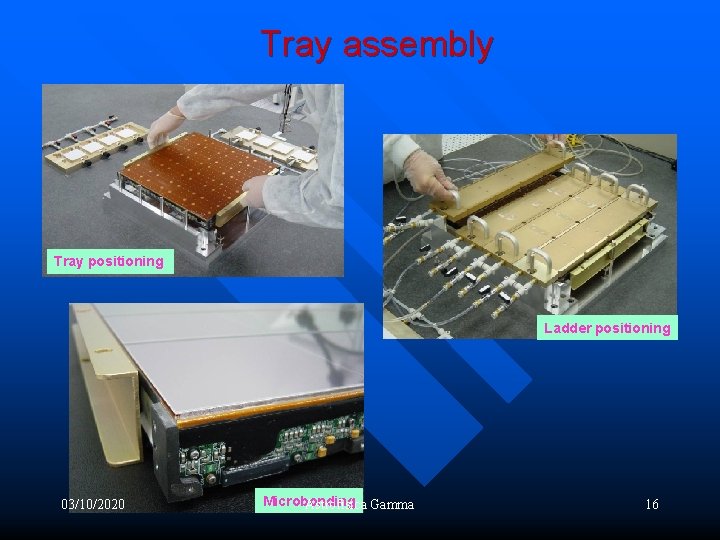
Tray assembly Tray positioning Ladder positioning 03/10/2020 Microbonding Astrofisica Gamma 16
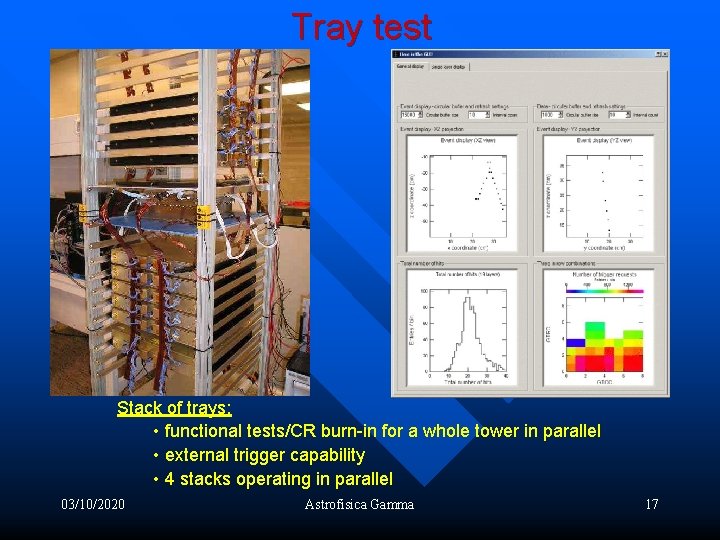
Tray test Stack of trays: • functional tests/CR burn-in for a whole tower in parallel • external trigger capability • 4 stacks operating in parallel 03/10/2020 Astrofisica Gamma 17
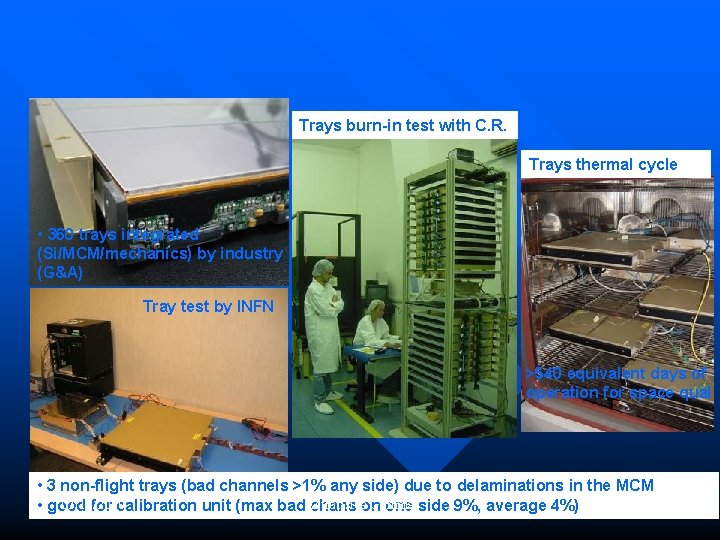
Trays burn-in test with C. R. Trays thermal cycle • 360 trays integrated (Si/MCM/mechanics) by industry (G&A) Tray test by INFN >540 equivalent days of operation for space qual • 3 non-flight trays (bad channels >1% any side) due to delaminations in the MCM 03/10/2020 Gamma 18 • good for calibration unit (max bad. Astrofisica chans on one side 9%, average 4%)
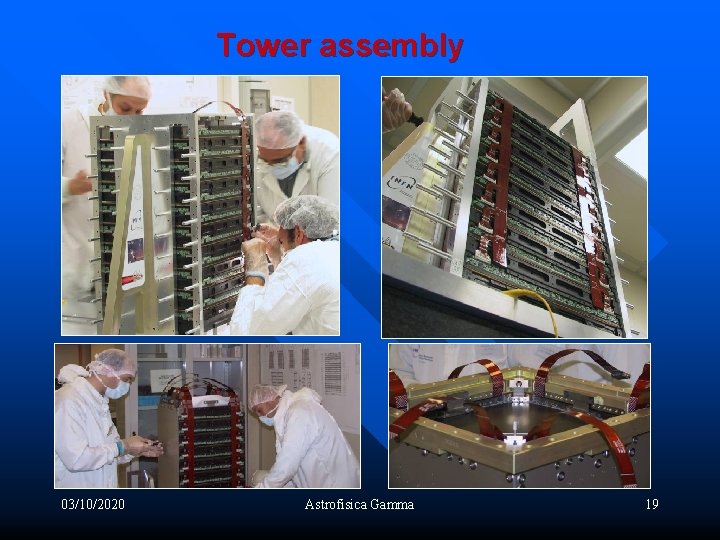
Tower assembly 03/10/2020 Astrofisica Gamma 19
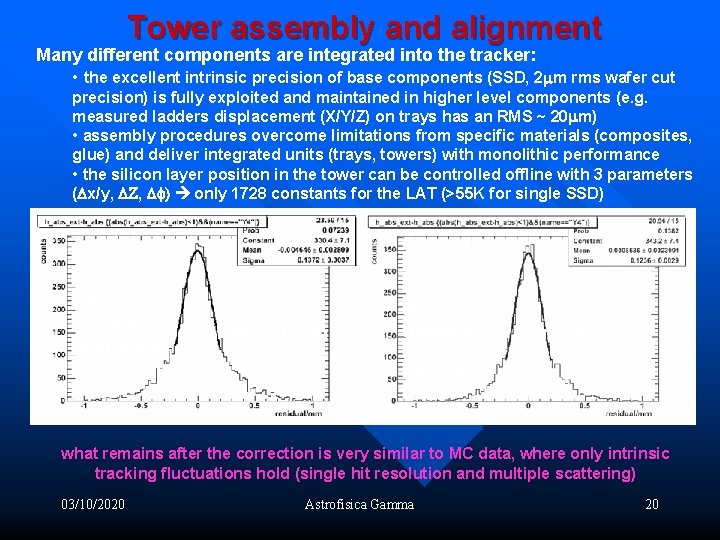
Tower assembly and alignment Many different components are integrated into the tracker: • the excellent intrinsic precision of base components (SSD, 2 mm rms wafer cut precision) is fully exploited and maintained in higher level components (e. g. measured ladders displacement (X/Y/Z) on trays has an RMS ~ 20 mm) • assembly procedures overcome limitations from specific materials (composites, glue) and deliver integrated units (trays, towers) with monolithic performance • the silicon layer position in the tower can be controlled offline with 3 parameters (Dx/y, DZ, Df) only 1728 constants for the LAT (>55 K for single SSD) CR layer residual after offline corrections rms= 137 mm MC layer residual perfect geometry rms= 124 mm what remains after the correction is very similar to MC data, where only intrinsic tracking fluctuations hold (single hit resolution and multiple scattering) 03/10/2020 Astrofisica Gamma 20
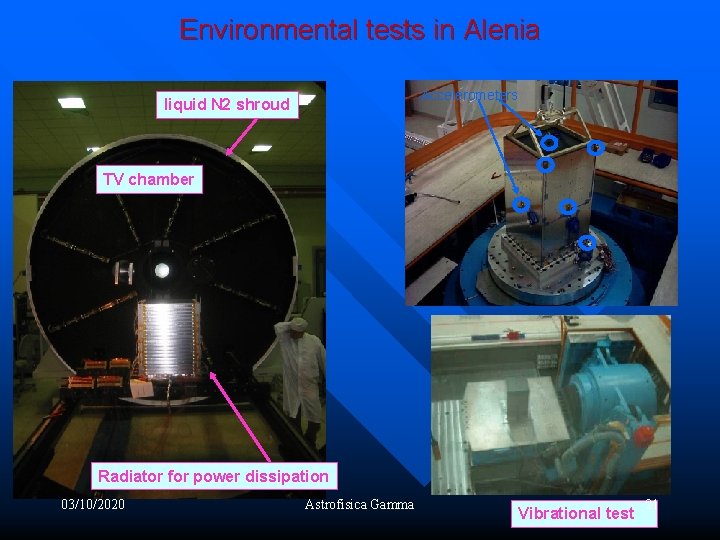
Environmental tests in Alenia Accelerometers liquid N 2 shroud TV chamber Radiator for power dissipation 03/10/2020 Astrofisica Gamma Vibrational test 21
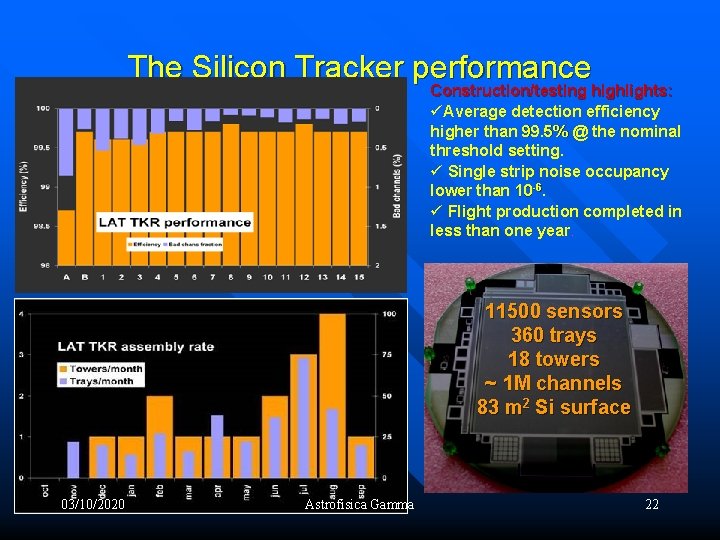
The Silicon Tracker performance Construction/testing highlights: üAverage detection efficiency higher than 99. 5% @ the nominal threshold setting. ü Single strip noise occupancy lower than 10 -6. ü Flight production completed in less than one year. 11500 sensors 360 trays 18 towers ~ 1 M channels 83 m 2 Si surface 03/10/2020 Astrofisica Gamma 22
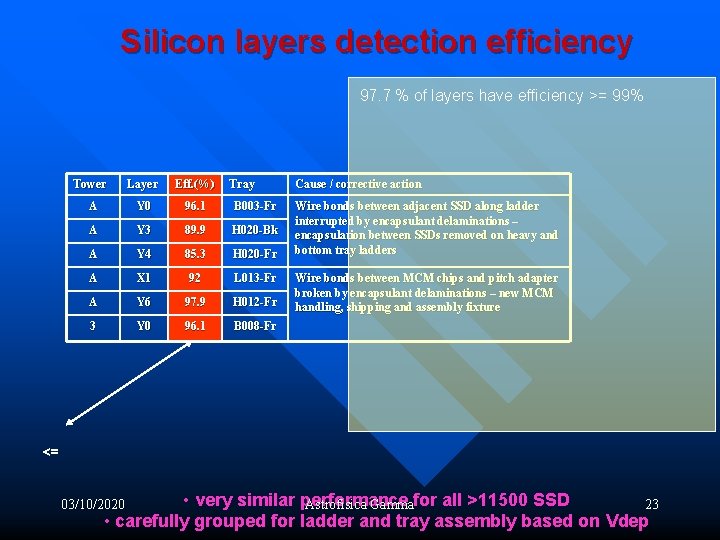
Silicon layers detection efficiency 97. 7 % of layers have efficiency >= 99% Tower Layer Eff. (%) Tray A Y 0 96. 1 B 003 -Fr A Y 3 89. 9 H 020 -Bk A Y 4 85. 3 H 020 -Fr A X 1 92 L 013 -Fr A Y 6 97. 9 H 012 -Fr 3 Y 0 96. 1 B 008 -Fr Cause / corrective action Wire bonds between adjacent SSD along ladder interrupted by encapsulant delaminations – encapsulation between SSDs removed on heavy and bottom tray ladders Wire bonds between MCM chips and pitch adapter broken by encapsulant delaminations – new MCM handling, shipping and assembly fixture <= • very similar performance Astrofisica Gammafor all >11500 SSD 23 • carefully grouped for ladder and tray assembly based on Vdep 03/10/2020
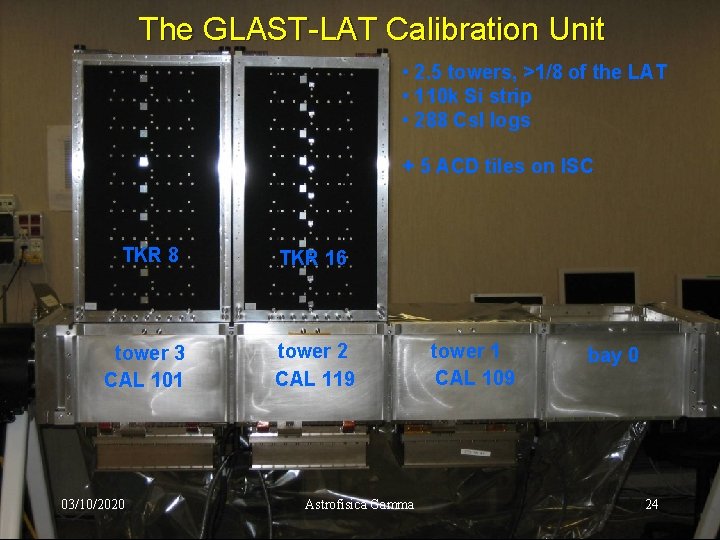
The GLAST-LAT Calibration Unit • 2. 5 towers, >1/8 of the LAT • 110 k Si strip • 288 Cs. I logs + 5 ACD tiles on ISC TKR 8 tower 3 CAL 101 03/10/2020 TKR 16 tower 2 CAL 119 Astrofisica Gamma tower 1 CAL 109 bay 0 24
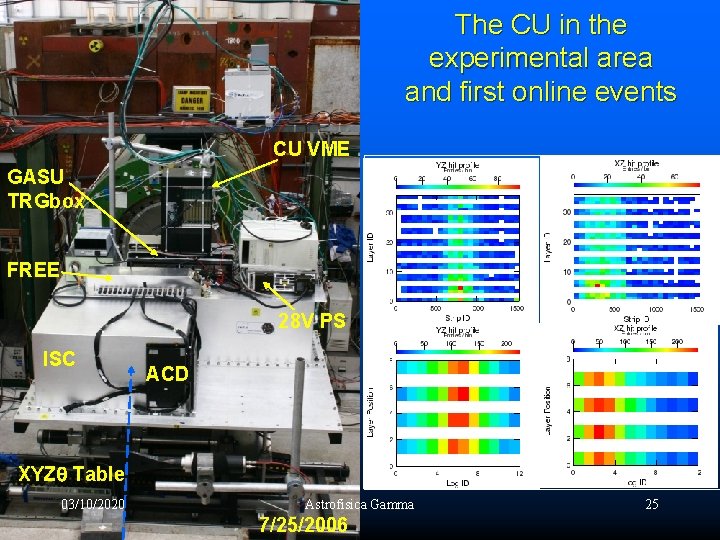
The CU in the experimental area and first online events CU VME GASU TRGbox FREE 28 V PS ISC ACD XYZq Table 03/10/2020 Astrofisica Gamma 7/25/2006 25
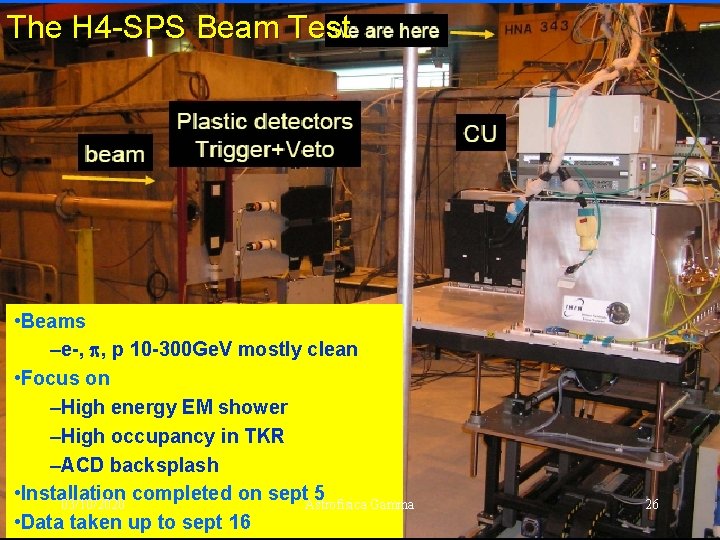
The H 4 -SPS Beam Test • Beams –e-, p, p 10 -300 Ge. V mostly clean • Focus on –High energy EM shower –High occupancy in TKR –ACD backsplash • Installation completed on sept. Astrofisica 5 03/10/2020 Gamma • Data taken up to sept 16 26
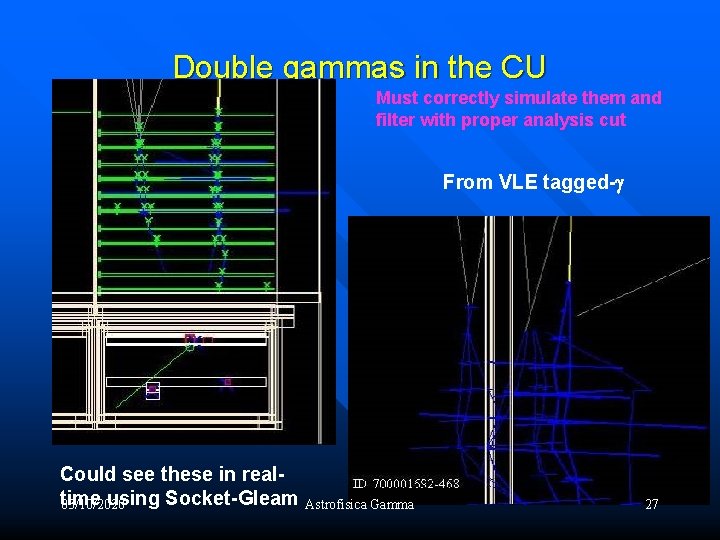
Double gammas in the CU Must correctly simulate them and filter with proper analysis cut From VLE tagged- Could see these in realtime using Socket-Gleam 03/10/2020 Astrofisica Gamma 27
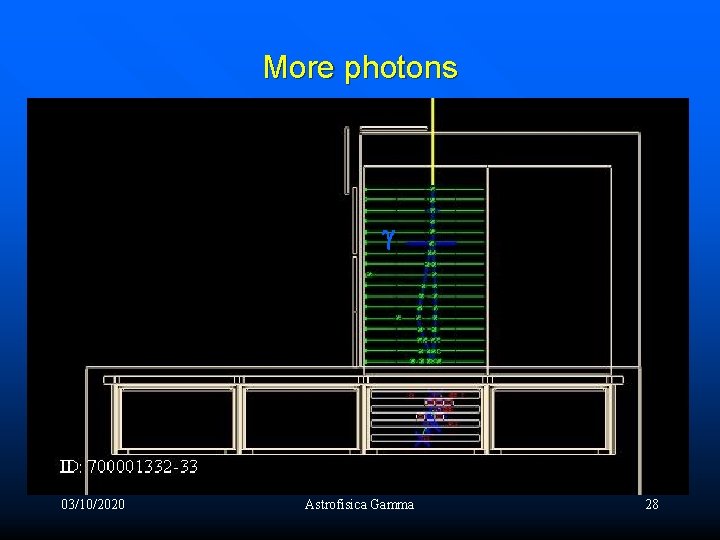
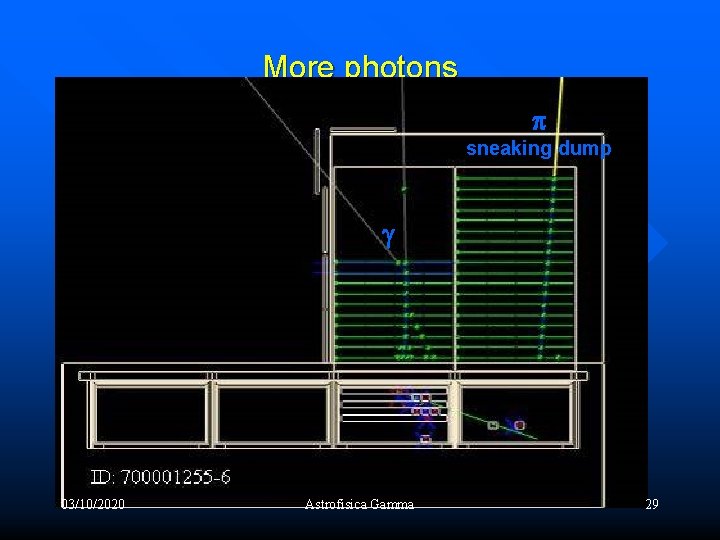
More photons 03/10/2020 Astrofisica Gamma 28
More photons p sneaking dump 03/10/2020 Astrofisica Gamma 29
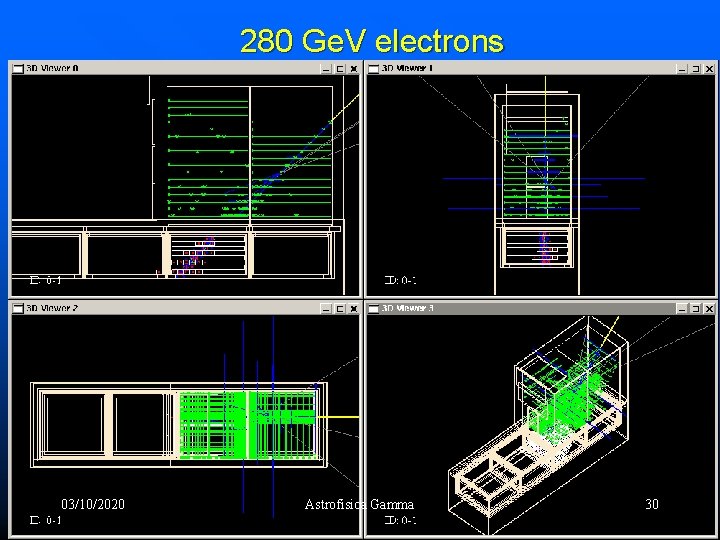
280 Ge. V electrons 03/10/2020 Astrofisica Gamma 30
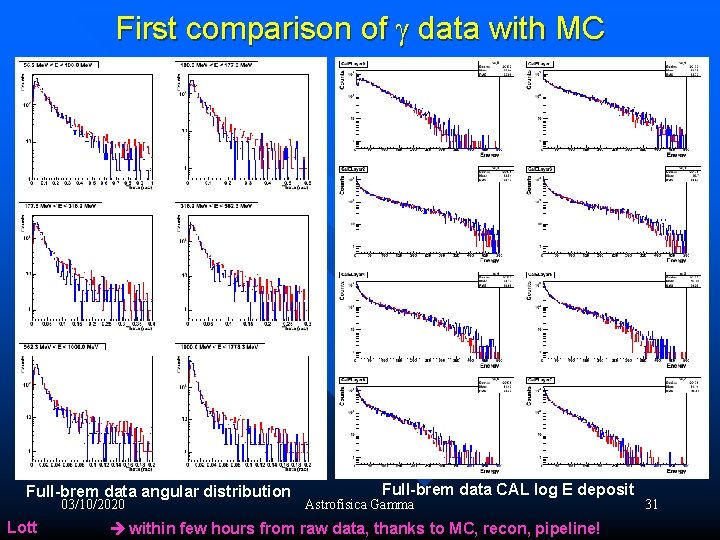
First comparison of data with MC Full-brem data angular distribution 03/10/2020 Lott Full-brem data CAL log E deposit Astrofisica Gamma within few hours from raw data, thanks to MC, recon, pipeline! 31
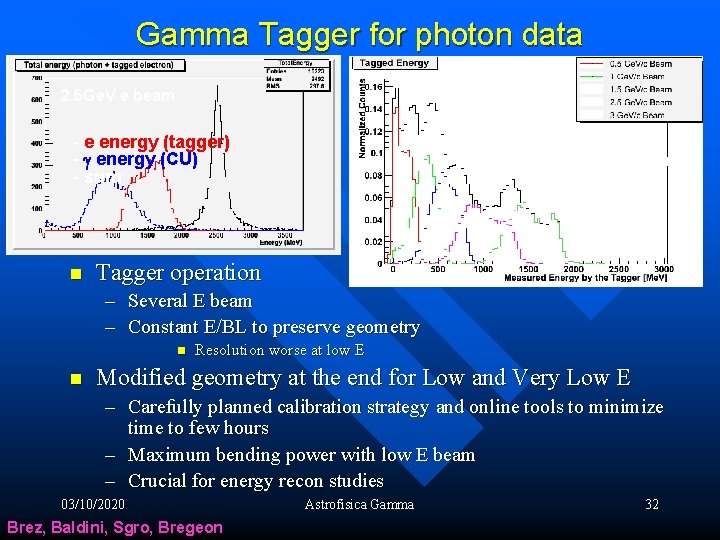
Gamma Tagger for photon data 2. 5 Ge. V e beam - e energy (tagger) - energy (CU) - sum n Tagged spectrum combined Tagger operation – Several E beam – Constant E/BL to preserve geometry n n Resolution worse at low E Modified geometry at the end for Low and Very Low E – Carefully planned calibration strategy and online tools to minimize time to few hours – Maximum bending power with low E beam – Crucial for energy recon studies 03/10/2020 Brez, Baldini, Sgro, Bregeon Astrofisica Gamma 32
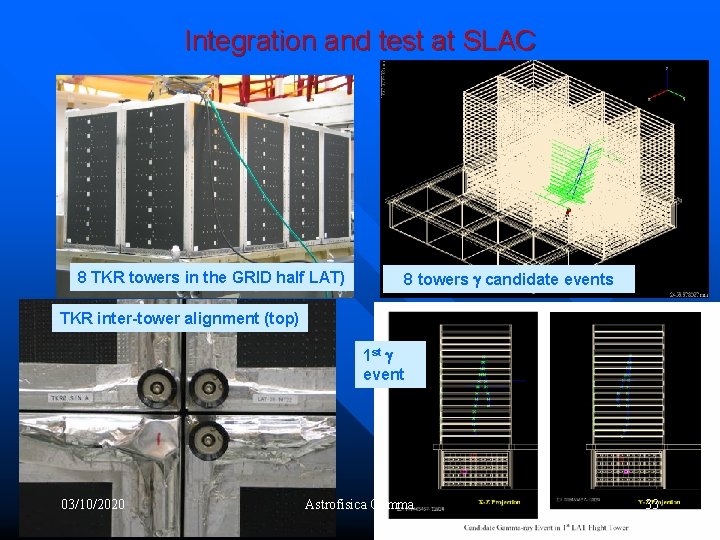
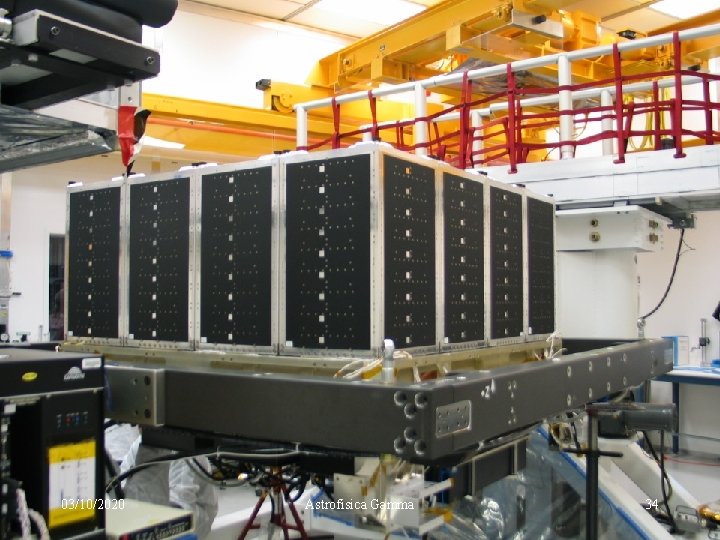
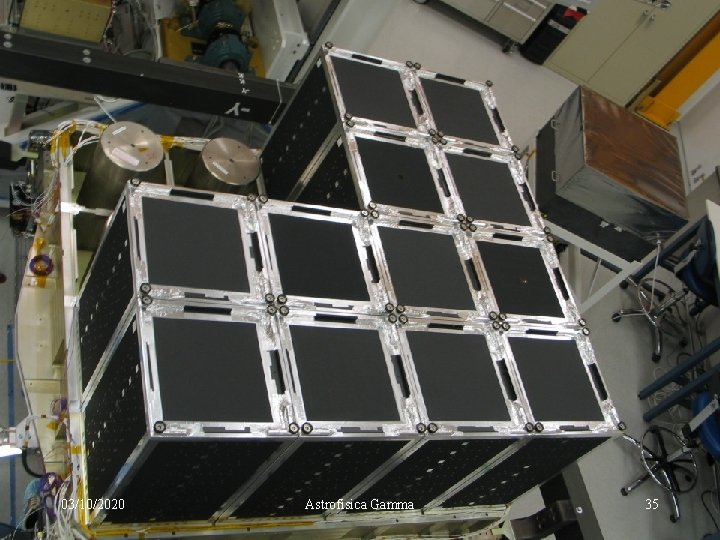
Integration and test at SLAC 8 TKR towers in the GRID half LAT) 8 towers candidate events TKR inter-tower alignment (top) 1 st event 03/10/2020 Astrofisica Gamma 33
03/10/2020 Astrofisica Gamma 34
03/10/2020 Astrofisica Gamma 35
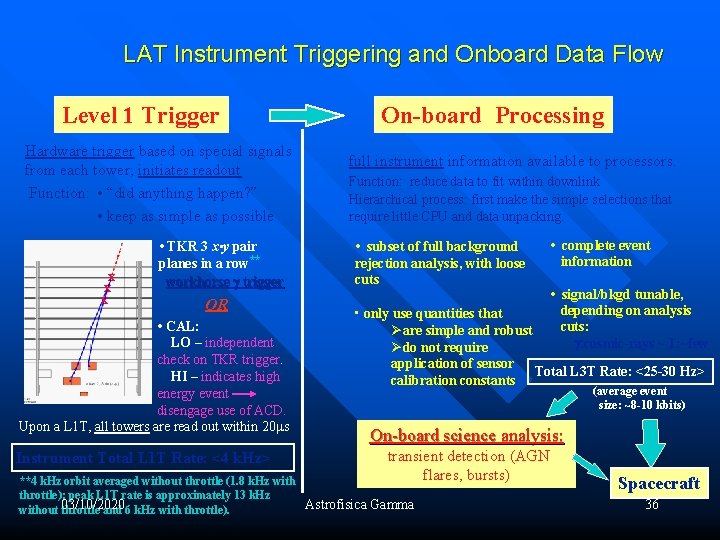
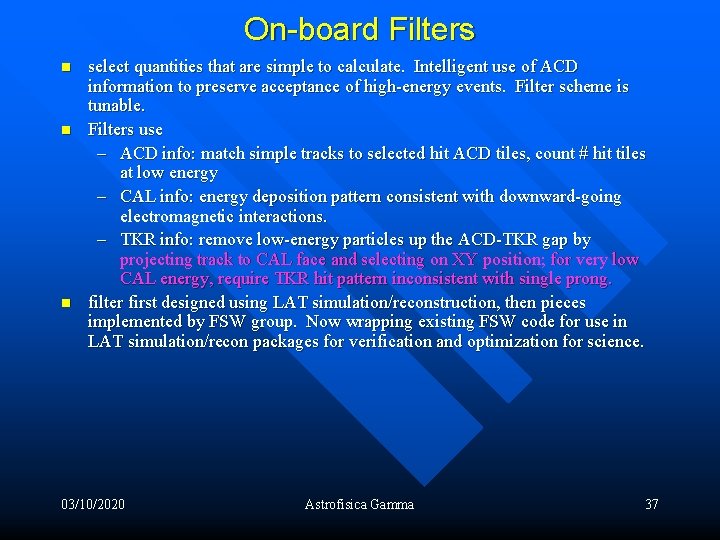
LAT Instrument Triggering and Onboard Data Flow Level 1 Trigger Hardware trigger based on special signals from each tower; initiates readout Function: • “did anything happen? ” • keep as simple as possible x x x • TKR 3 x • y pair planes in a row** workhorse trigger OR • CAL: LO – independent check on TKR trigger. HI – indicates high energy event disengage use of ACD. Upon a L 1 T, all towers are read out within 20 s Instrument Total L 1 T Rate: <4 k. Hz> On-board Processing full instrument information available to processors. Function: reduce data to fit within downlink Hierarchical process: first make the simple selections that require little CPU and data unpacking. • subset of full background rejection analysis, with loose cuts • complete event information • signal/bkgd tunable, depending on analysis cuts: : cosmic-rays ~ 1: ~few • only use quantities that Øare simple and robust Ødo not require application of sensor Total L 3 T Rate: <25 -30 Hz> calibration constants (average event size: ~8 -10 kbits) On-board science analysis: transient detection (AGN flares, bursts) **4 k. Hz orbit averaged without throttle (1. 8 k. Hz with throttle); peak L 1 T rate is approximately 13 k. Hz Astrofisica Gamma without 03/10/2020 throttle and 6 k. Hz with throttle). Spacecraft 36
On-board Filters n n n select quantities that are simple to calculate. Intelligent use of ACD information to preserve acceptance of high-energy events. Filter scheme is tunable. Filters use – ACD info: match simple tracks to selected hit ACD tiles, count # hit tiles at low energy – CAL info: energy deposition pattern consistent with downward-going electromagnetic interactions. – TKR info: remove low-energy particles up the ACD-TKR gap by projecting track to CAL face and selecting on XY position; for very low CAL energy, require TKR hit pattern inconsistent with single prong. filter first designed using LAT simulation/reconstruction, then pieces implemented by FSW group. Now wrapping existing FSW code for use in LAT simulation/recon packages for verification and optimization for science. 03/10/2020 Astrofisica Gamma 37
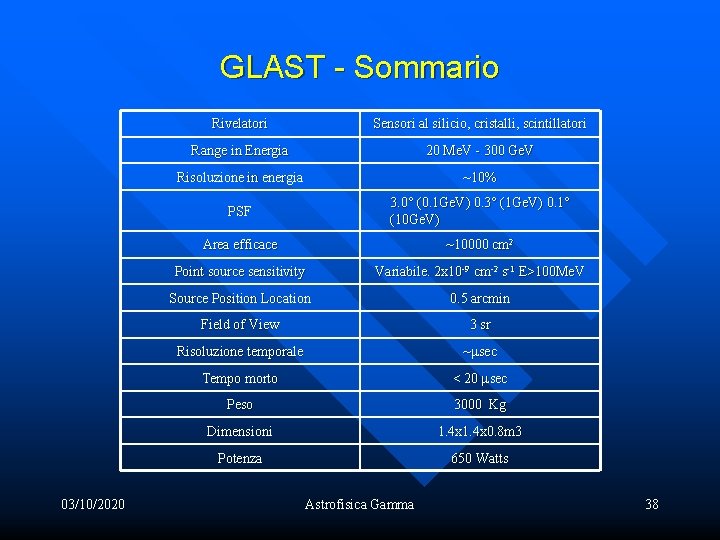
GLAST - Sommario 03/10/2020 Rivelatori Sensori al silicio, cristalli, scintillatori Range in Energia 20 Me. V - 300 Ge. V Risoluzione in energia ~10% PSF 3. 0° (0. 1 Ge. V) 0. 3° (1 Ge. V) 0. 1° (10 Ge. V) Area efficace ~10000 cm 2 Point source sensitivity Variabile. 2 x 10 -9 cm-2 s-1 E>100 Me. V Source Position Location 0. 5 arcmin Field of View 3 sr Risoluzione temporale ~ sec Tempo morto < 20 sec Peso 3000 Kg Dimensioni 1. 4 x 0. 8 m 3 Potenza 650 Watts Astrofisica Gamma 38
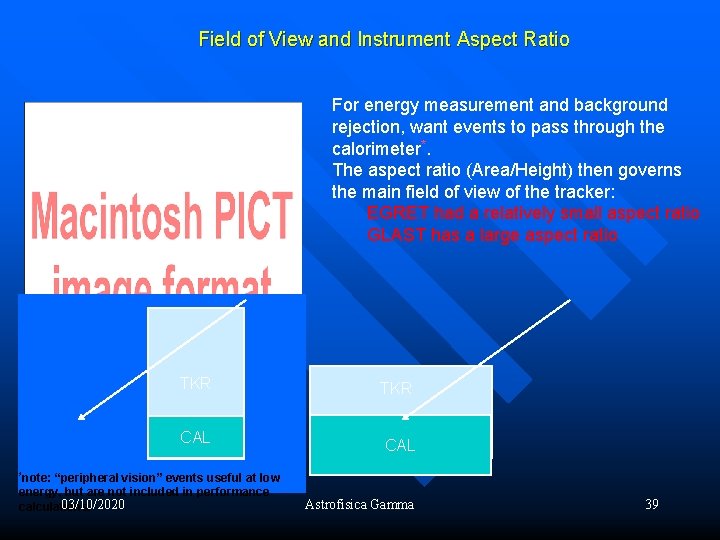
Field of View and Instrument Aspect Ratio For energy measurement and background rejection, want events to pass through the calorimeter*. The aspect ratio (Area/Height) then governs the main field of view of the tracker: EGRET had a relatively small aspect ratio GLAST has a large aspect ratio TKR CAL *note: “peripheral vision” events useful at low energy, but are not included in performance 03/10/2020 calculations. Astrofisica Gamma 39
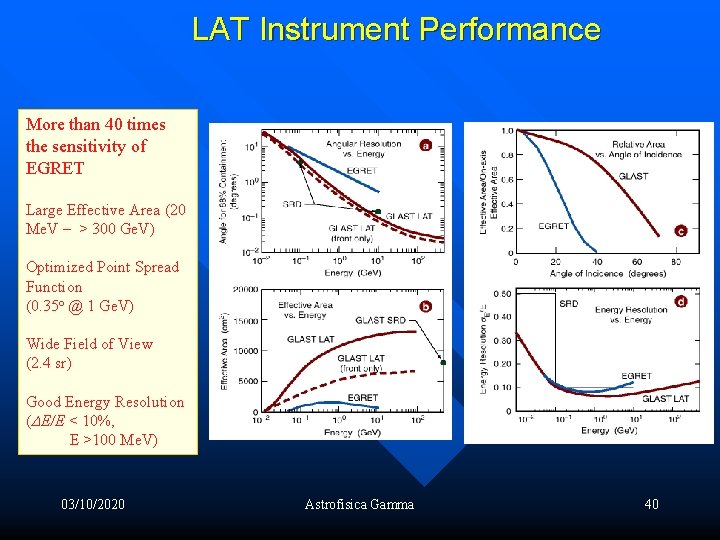
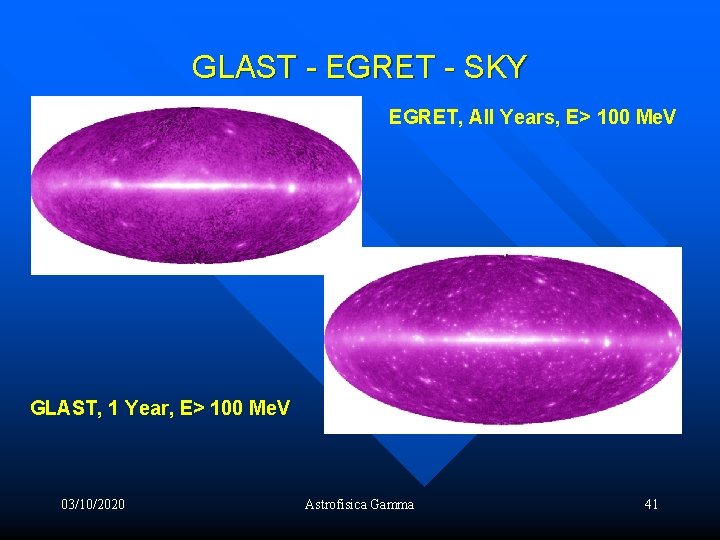
LAT Instrument Performance More than 40 times the sensitivity of EGRET Large Effective Area (20 Me. V – > 300 Ge. V) Optimized Point Spread Function (0. 35 o @ 1 Ge. V) Wide Field of View (2. 4 sr) Good Energy Resolution (DE/E < 10%, E >100 Me. V) 03/10/2020 Astrofisica Gamma 40
GLAST - EGRET - SKY EGRET, All Years, E> 100 Me. V GLAST, 1 Year, E> 100 Me. V 03/10/2020 Astrofisica Gamma 41