
Astro 10 Lecture 10 Stellar Structure and Evolution
- Slides: 57
Astro 10 -Lecture 10: Stellar Structure and Evolution Now that we know the properties of stars, lets talk about how stars work.
Important Dates! • • April 8: Spring Break April 15: Exam #2. Homework #4 due April 16: Chabot field trip. April 22: Project #1 due
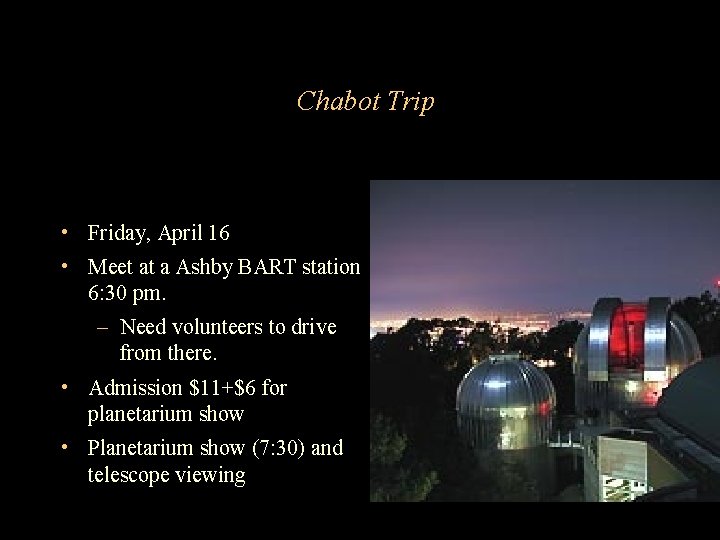
Chabot Trip • Friday, April 16 • Meet at a Ashby BART station 6: 30 pm. – Need volunteers to drive from there. • Admission $11+$6 for planetarium show • Planetarium show (7: 30) and telescope viewing
Star Structure and Formation The Big Picture Stars are big balls of hot gas Stars exist because of gravity They shine because they are hot They continuously generate energy through nuclear fusion They balance gravity with pressure They form because gravity makes interstellar clouds of gas contract They die when they have no more fuel, and gravity takes over
Stellar Structure – MS Stars Main Sequence STARS Gravitational (hydrostatic) equilibrium: Gravity and Pressure balance DEMO Temperature and Pressure related When Temp increases, so does P (DEMO)
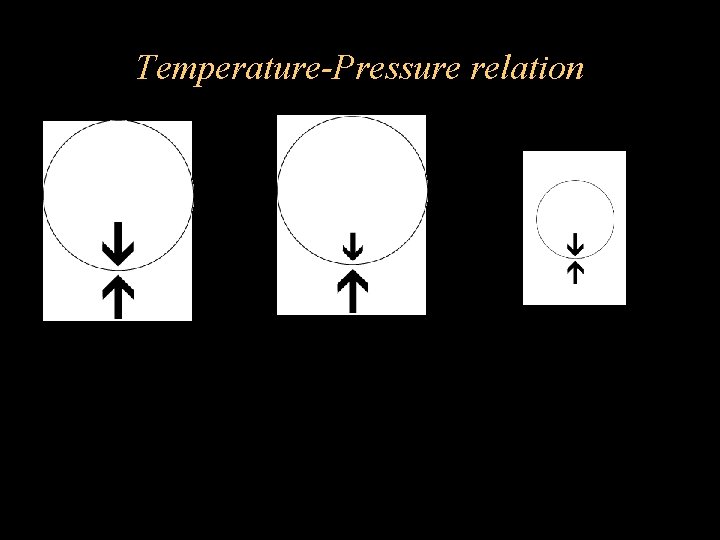
Temperature-Pressure relation Pressure inside balances Pressure outside Balloon cools, molecules inside slow down, pressure inside decreases Balloon shrinks until inside and outside pressures again balance
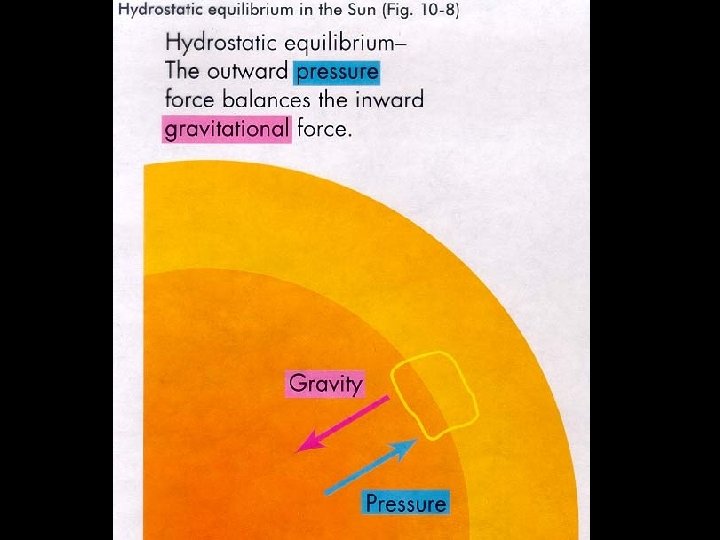
Hydrostatic Equilibrium
Stellar Structure (2) Stellar structure analogy Star is emitting light/heat, so losing energy! It should cool => P decrease => collapse BUT Sun has been stable for 5 billion years! What’s the energy source to maintain equilibrium? FUSION
Energy Generation in the Sun Energy is generated through nuclear fusion in the CENTER of the Sun! What are the conditions there? How hot are stars? Sun: 5800 K But this was a SURFACE TEMPERATURE
Central Temperature of Sun What’s the “surface”? Stars densest and hottest in the centers This is why we see dark absorption lines in stellar spectra Energy generated in the center, and flows outward Light emitted blocked by material sitting on top “Surface” = layer where star still dense enough to emit lots of light, but not so dense that light is blocked Sun’s surface Temp = 5800 K Sun’s central Temp = 1. 5 x 10⁷ K All atoms are fully ionized, electrons stripped away
Concep. Test Would a star that is more massive than the Sun have a (A) higher (B) lower or (C) same central pressure? Or (D) can you not tell from the information given? What about central temperature?
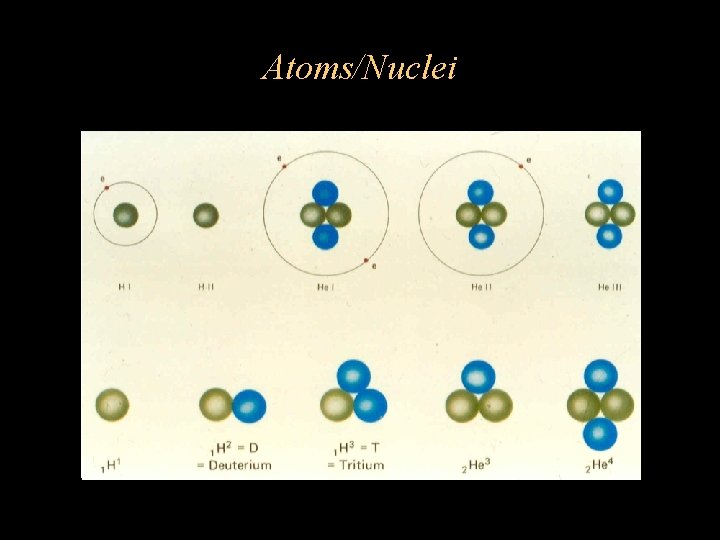
FUSION Fusion: transforms elements themselves Unlike chemical reaction Center of sun: have just nuclei and electrons, separated Nucleus made up of protons/neutrons: why don’t positive protons repel one another by electrostatic repulsion? Strong nuclear force binds them together
Atoms/Nuclei
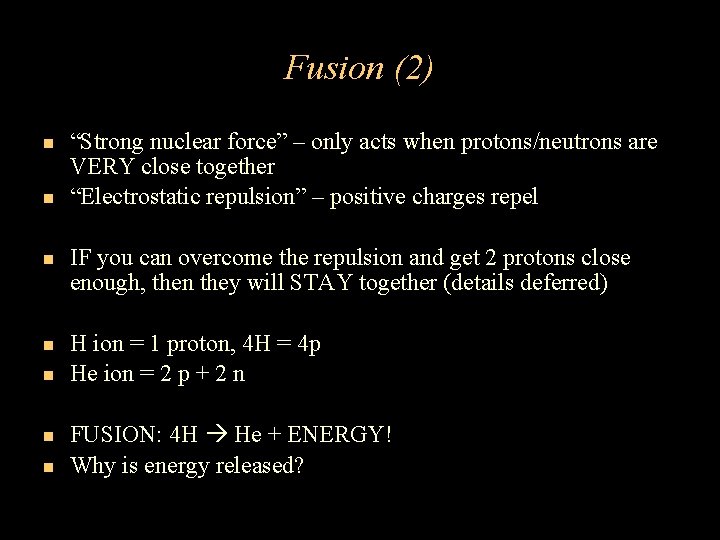
Fusion (2) “Strong nuclear force” – only acts when protons/neutrons are VERY close together “Electrostatic repulsion” – positive charges repel IF you can overcome the repulsion and get 2 protons close enough, then they will STAY together (details deferred) H ion = 1 proton, 4 H = 4 p He ion = 2 p + 2 n FUSION: 4 H He + ENERGY! Why is energy released?
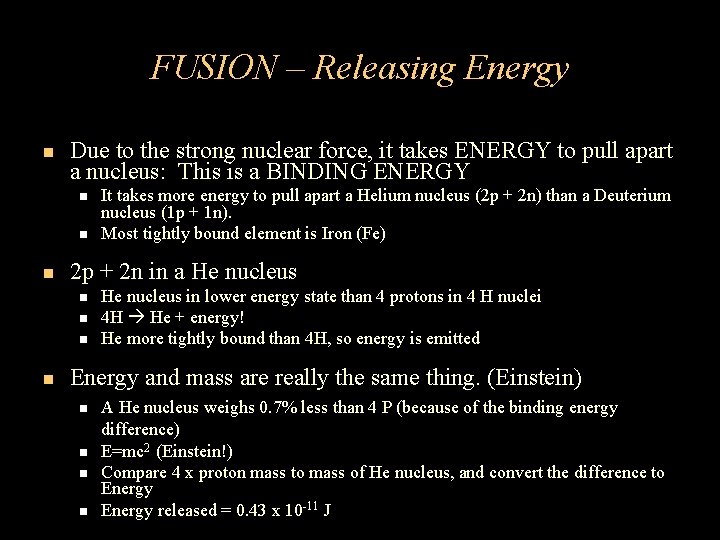
FUSION – Releasing Energy Due to the strong nuclear force, it takes ENERGY to pull apart a nucleus: This is a BINDING ENERGY 2 p + 2 n in a He nucleus It takes more energy to pull apart a Helium nucleus (2 p + 2 n) than a Deuterium nucleus (1 p + 1 n). Most tightly bound element is Iron (Fe) He nucleus in lower energy state than 4 protons in 4 H nuclei 4 H He + energy! He more tightly bound than 4 H, so energy is emitted Energy and mass are really the same thing. (Einstein) A He nucleus weighs 0. 7% less than 4 P (because of the binding energy difference) E=mc 2 (Einstein!) Compare 4 x proton mass to mass of He nucleus, and convert the difference to Energy released = 0. 43 x 10 -11 J
Fusion and the Sun transforms 5 TONS of matter into energy EVERY SECOND! Why isn’t fusion happening all the time? Over lifetime of sun, 1/10 of Sun’s H is converted to He, so 0. 07% of Sun’s mass will keep it shining 10 billion years ONLY happens when Temp high enough to overcome electrostatic repulsion between +ve ions DEMO NOT a chemical reaction! TRANSFORMS the elements.
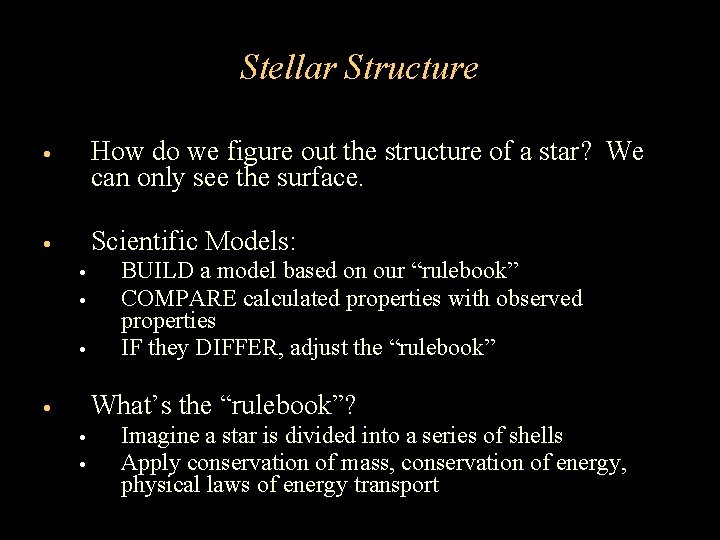
Stellar Structure • How do we figure out the structure of a star? We can only see the surface. • Scientific Models: • • • BUILD a model based on our “rulebook” COMPARE calculated properties with observed properties IF they DIFFER, adjust the “rulebook” What’s the “rulebook”? • • • Imagine a star is divided into a series of shells Apply conservation of mass, conservation of energy, physical laws of energy transport
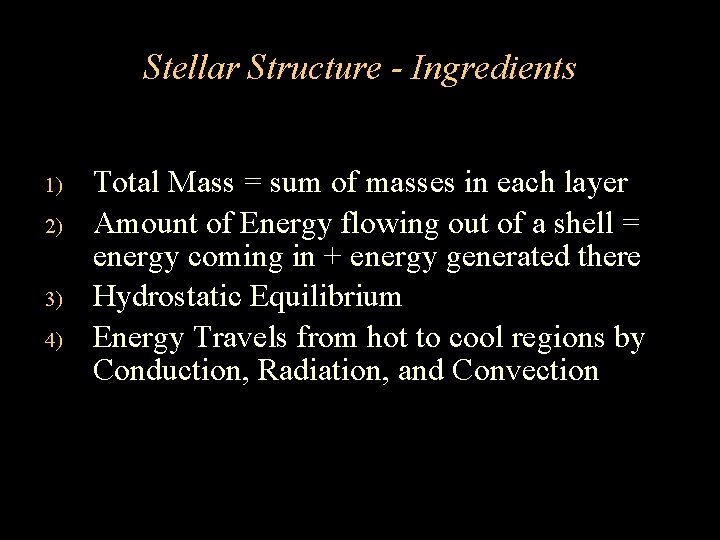
Stellar Structure - Ingredients 1) 2) 3) 4) Total Mass = sum of masses in each layer Amount of Energy flowing out of a shell = energy coming in + energy generated there Hydrostatic Equilibrium Energy Travels from hot to cool regions by Conduction, Radiation, and Convection
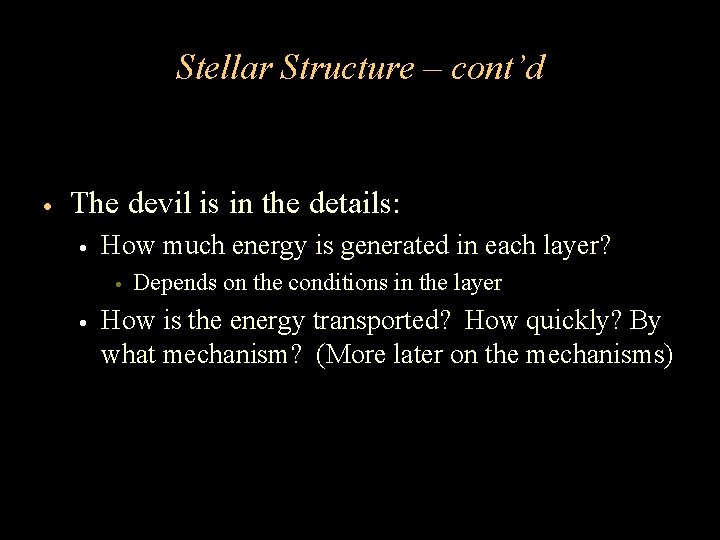
Stellar Structure – cont’d • The devil is in the details: • How much energy is generated in each layer? • • Depends on the conditions in the layer How is the energy transported? How quickly? By what mechanism? (More later on the mechanisms)
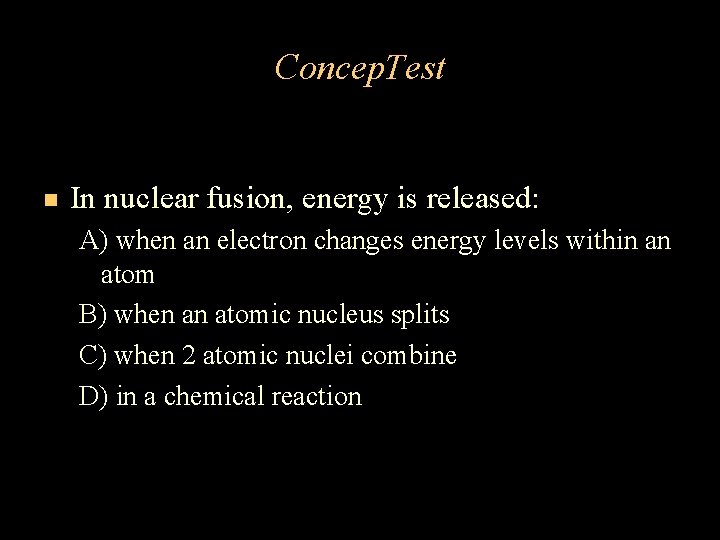
Concep. Test In nuclear fusion, energy is released: A) when an electron changes energy levels within an atom B) when an atomic nucleus splits C) when 2 atomic nuclei combine D) in a chemical reaction
Stellar Structure: Testing our Models like this correctly “predict” the radius, age, and other surface properties of the sun (luminosity, surface Temp…) Not every detail is exactly right, but these indicate we’re on the right track The results of the computer model are only as good as the assumptions that went in! We must test Predictions of the Model with Observations
Stellar Structure: Testing the Model in the Sun’s Interior Comparing surface predictions with surface properties doesn’t test the model at it’s heart – the center of the Sun where energy generation occurs! Key to testing the model’s description of the conditions INSIDE the Sun is in the BYPRODUCTS of FUSION
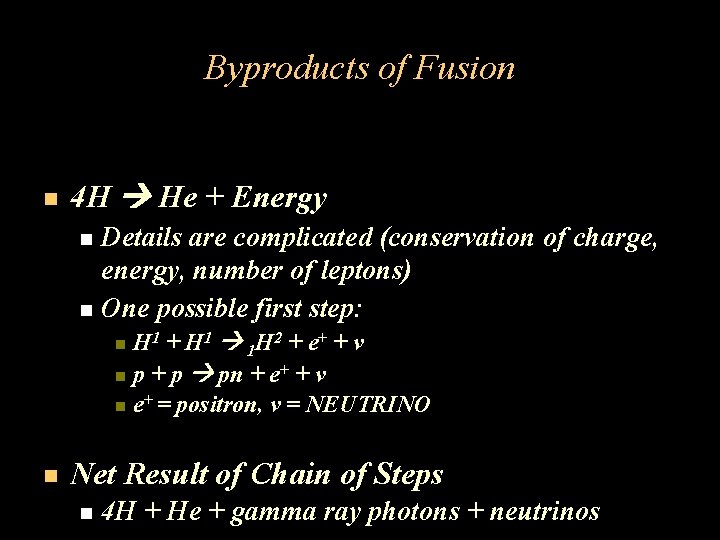
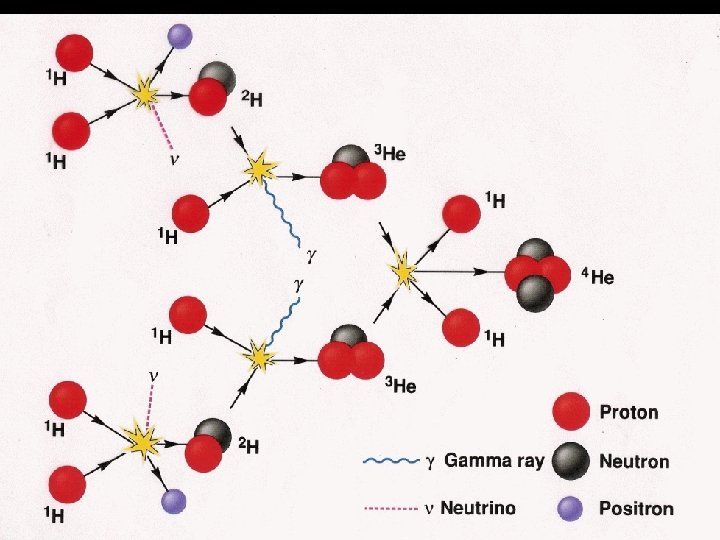
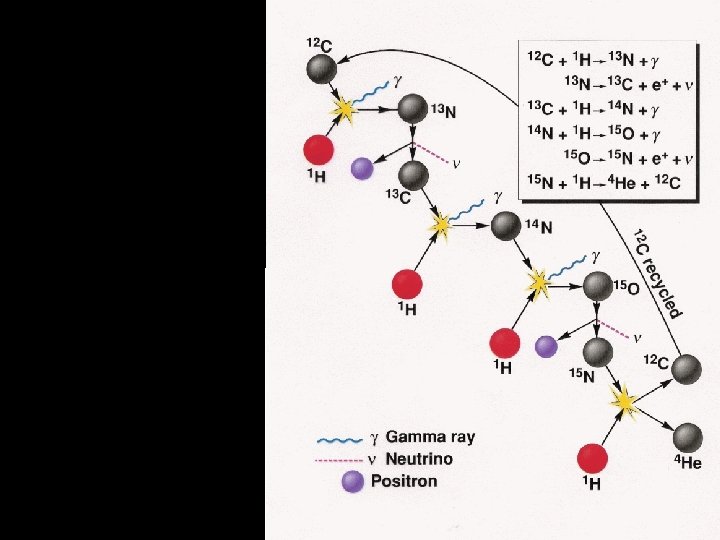
Byproducts of Fusion 4 H He + Energy Details are complicated (conservation of charge, energy, number of leptons) One possible first step: H 1 + H 1 1 H 2 + e+ + ν p + p pn + e+ + ν e+ = positron, ν = NEUTRINO Net Result of Chain of Steps 4 H + He + gamma ray photons + neutrinos
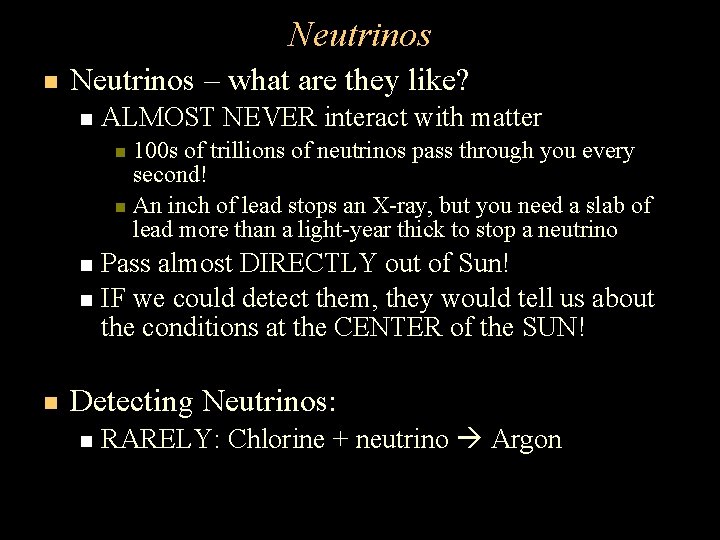
Neutrinos – what are they like? ALMOST NEVER interact with matter 100 s of trillions of neutrinos pass through you every second! An inch of lead stops an X-ray, but you need a slab of lead more than a light-year thick to stop a neutrino Pass almost DIRECTLY out of Sun! IF we could detect them, they would tell us about the conditions at the CENTER of the SUN! Detecting Neutrinos: RARELY: Chlorine + neutrino Argon
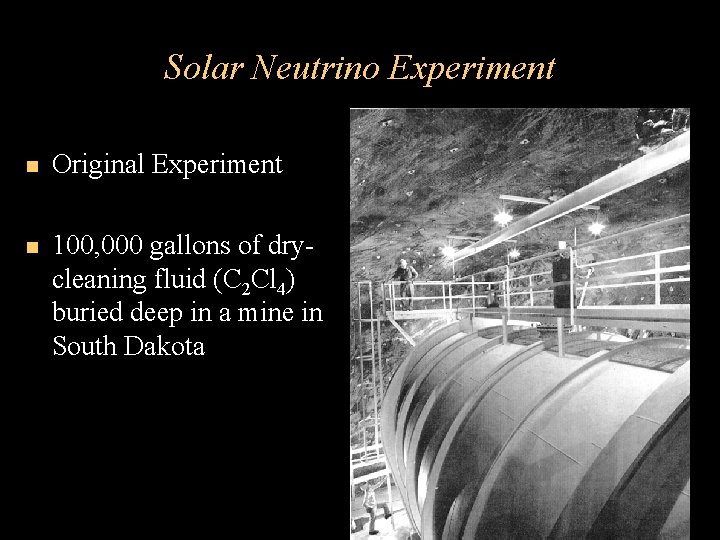
Solar Neutrino Experiment Original Experiment 100, 000 gallons of drycleaning fluid (C 2 Cl 4) buried deep in a mine in South Dakota
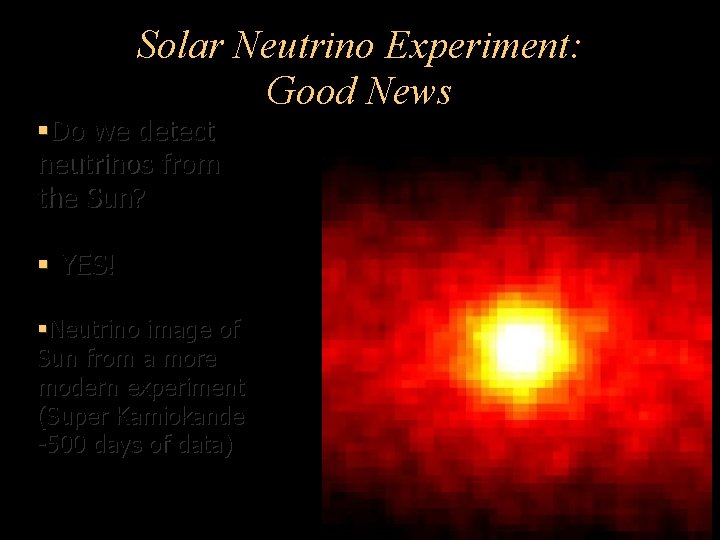
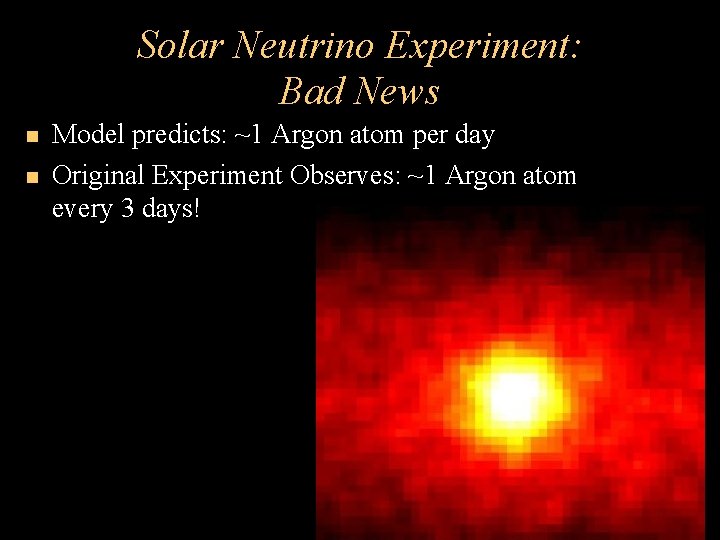
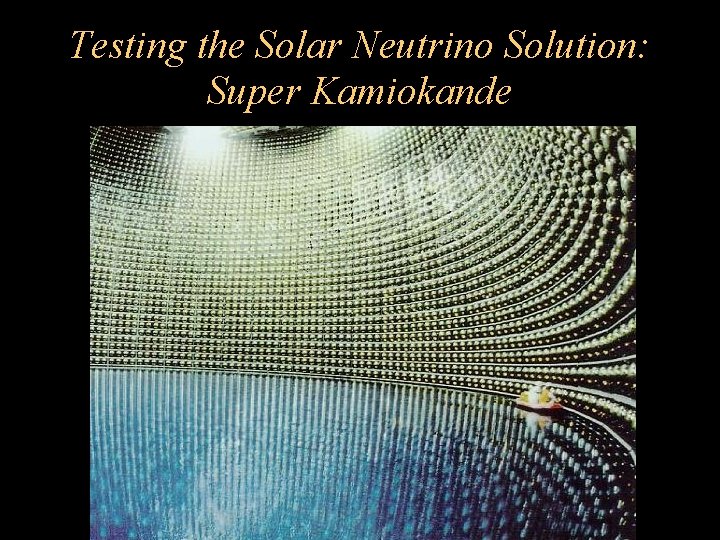
Solar Neutrino Experiment: Good News Do we detect neutrinos from the Sun? YES! Neutrino image of Sun from a more modern experiment (Super Kamiokande -500 days of data)
Solar Neutrino Experiment: Bad News Model predicts: ~1 Argon atom per day Original Experiment Observes: ~1 Argon atom every 3 days!
Solar Neutrino “Problem” Solar Models Predicted ~3 x more neutrinos than have been detected 3 options: Something wrong with the experiment Something wrong with the solar model Something wrong with basic particle physics (our understanding of neutrinos)
Solar Neutrino “Problem” (2) Something wrong with the experiment? Over 20 years of repetition and careful testing say the experiment is fine! Something wrong with the solar model? For over 30 years, the particle physicists said it was the experiment or the solar modelling, but now we believe. . . Something wrong with particle physics! Currently, we believe that the predicted behaviour of neutrinos was in error
Solar Neutrino “Solution” Neutrinos: Actually come in 3 “flavours” Only 1 interacts with Chlorine IF neutrinos have mass (in earlier models, they had none, like photons), neutrinos can “oscillate” between flavours. So we wouldn’t have detected all of the neutrinos generated by the sun! Newer experiments TEST this
Testing the Solar Neutrino Solution: Super Kamiokande
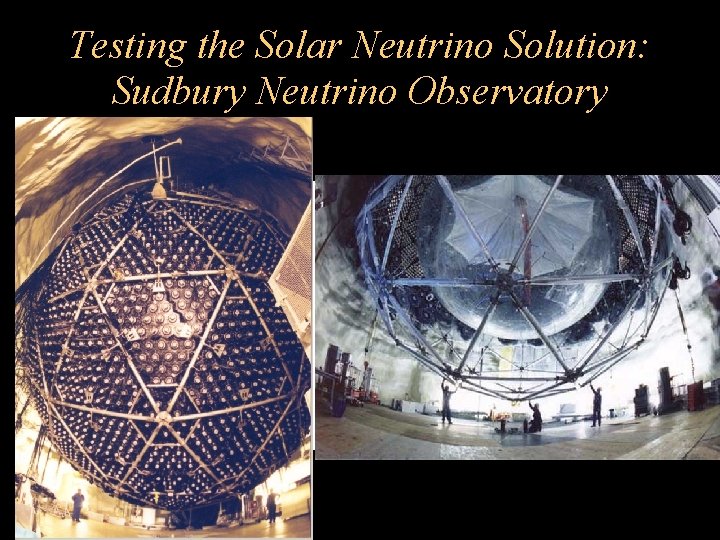
Testing the Solar Neutrino Solution: Sudbury Neutrino Observatory
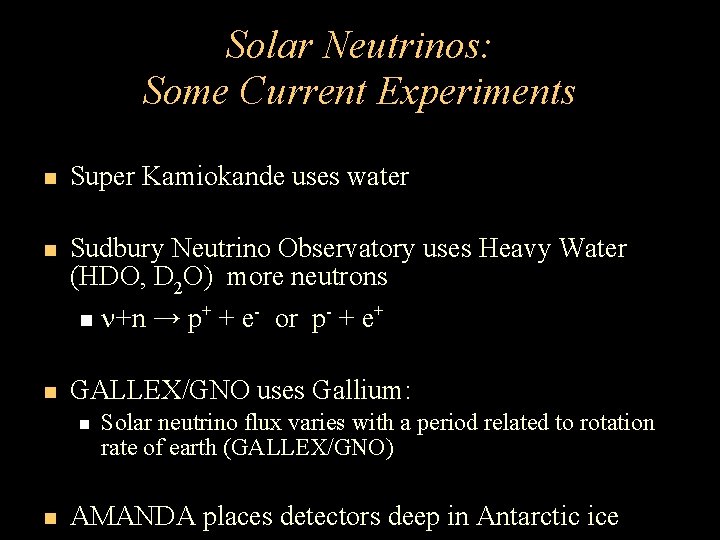
Solar Neutrinos: Some Current Experiments Super Kamiokande uses water Sudbury Neutrino Observatory uses Heavy Water (HDO, D 2 O) more neutrons n+n → p+ + e- or p- + e+ GALLEX/GNO uses Gallium: Solar neutrino flux varies with a period related to rotation rate of earth (GALLEX/GNO) AMANDA places detectors deep in Antarctic ice
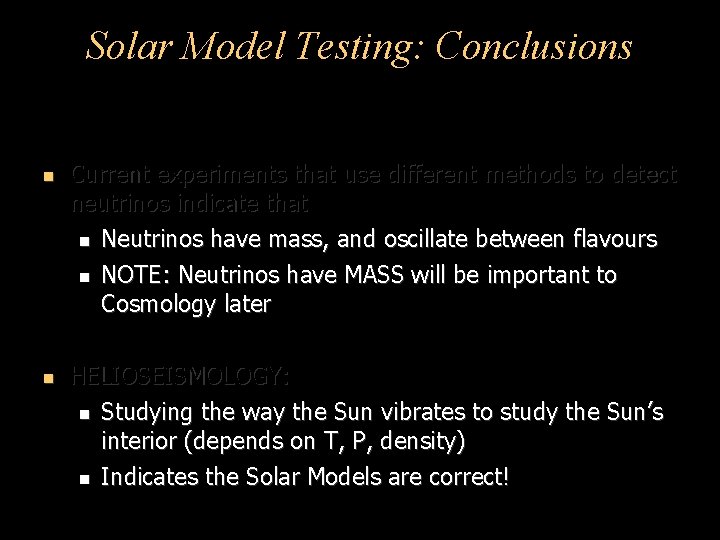
Solar Model Testing: Conclusions Current experiments that use different methods to detect neutrinos indicate that Neutrinos have mass, and oscillate between flavours NOTE: Neutrinos have MASS will be important to Cosmology later HELIOSEISMOLOGY: Studying the way the Sun vibrates to study the Sun’s interior (depends on T, P, density) Indicates the Solar Models are correct!
Pressure-Temperature Thermostat In a star, inward pull of gravity balanced by the internal pressure As the star loses energy, the T and P would drop, except nuclear fusion is generating just enough energy to maintain the balance If reactions begin to produce too much energy, this extra energy raises T, which raises P, so star expands, which cools it slightly. This slows the nuclear reactions. If reactions slow, then inner T drops, lowering P. Gravity compresses the star slightly. Compression of gas raises T & P increasing nuclear fusion rate.
Concep. Test The “solar neutrino problem” is that a) Neutrinos are impossible to detect b) Early experiments detected fewer neutrinos than the models predicted c) Experiments are detecting more neutrinos than expected d) Neutrinos cannot escape the sun
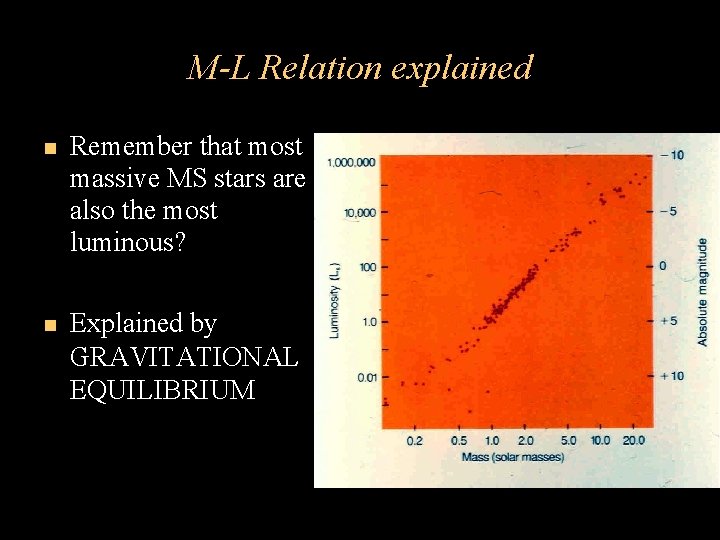
M-L Relation explained Remember that most massive MS stars are also the most luminous? Explained by GRAVITATIONAL EQUILIBRIUM
M-L Relation Explained (2) More MASSIVE star => More weight pressing down on center => higher Pressure at center => higher Temp at center => higher T + higher P = higher rate of fusion => more energy generation (ie more LUMINOUS)
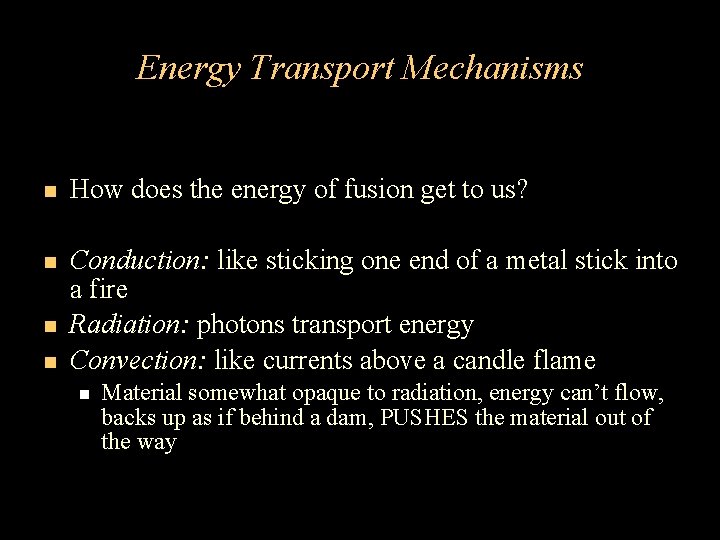
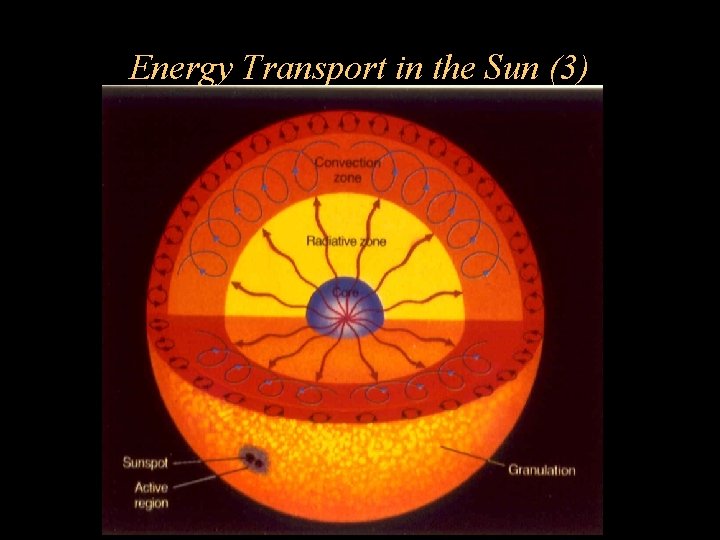
Energy Transport Mechanisms How does the energy of fusion get to us? Conduction: like sticking one end of a metal stick into a fire Radiation: photons transport energy Convection: like currents above a candle flame Material somewhat opaque to radiation, energy can’t flow, backs up as if behind a dam, PUSHES the material out of the way
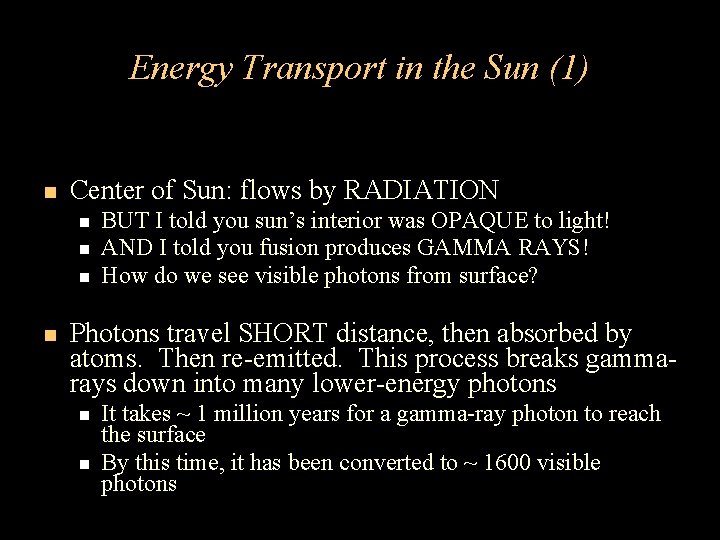
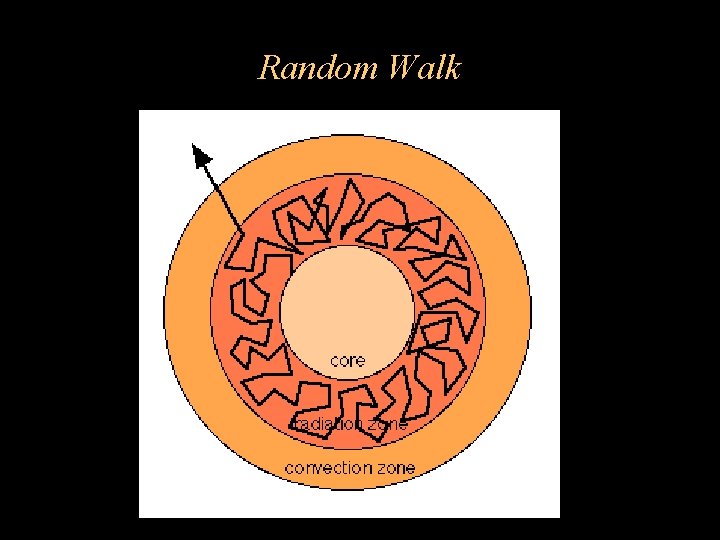
Energy Transport in the Sun (1) Center of Sun: flows by RADIATION BUT I told you sun’s interior was OPAQUE to light! AND I told you fusion produces GAMMA RAYS! How do we see visible photons from surface? Photons travel SHORT distance, then absorbed by atoms. Then re-emitted. This process breaks gammarays down into many lower-energy photons It takes ~ 1 million years for a gamma-ray photon to reach the surface By this time, it has been converted to ~ 1600 visible photons
Random Walk
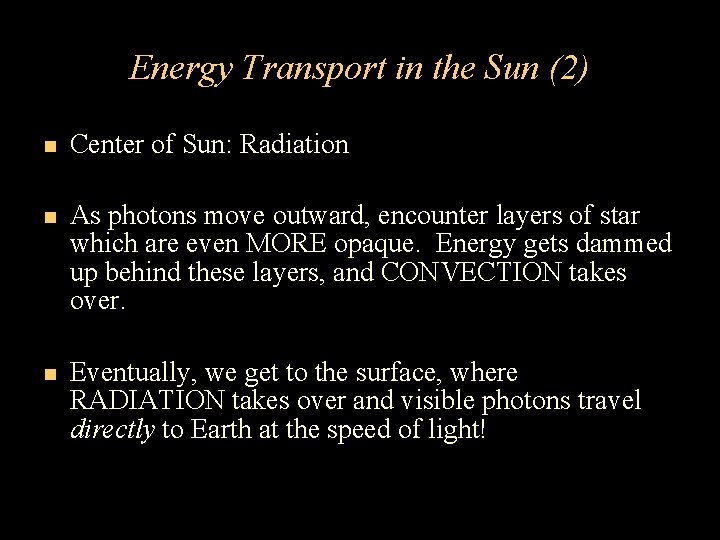
Energy Transport in the Sun (2) Center of Sun: Radiation As photons move outward, encounter layers of star which are even MORE opaque. Energy gets dammed up behind these layers, and CONVECTION takes over. Eventually, we get to the surface, where RADIATION takes over and visible photons travel directly to Earth at the speed of light!
Energy Transport in the Sun (3)
Stellar Structure Summary The structure of a star is determined by the interplay between • • Gravitational Equilibrium Energy generated through fusion Energy transport • Mass-Luminosity for MAIN-SEQUENCE STARS is explained by Gravitational Equilibrium and the Pressure-Temperature Relationship • EVIDENCE for this model provided by • • Solar neutrinos Helioseismology
Stellar Births (1) • Stars form from material between the stars – the Interstellar Medium (ISM) • ISM is ~ 75% H, 25% He, <1% other – This is ~same as the Sun! • Any cloud of dust/gas is a “nebula”
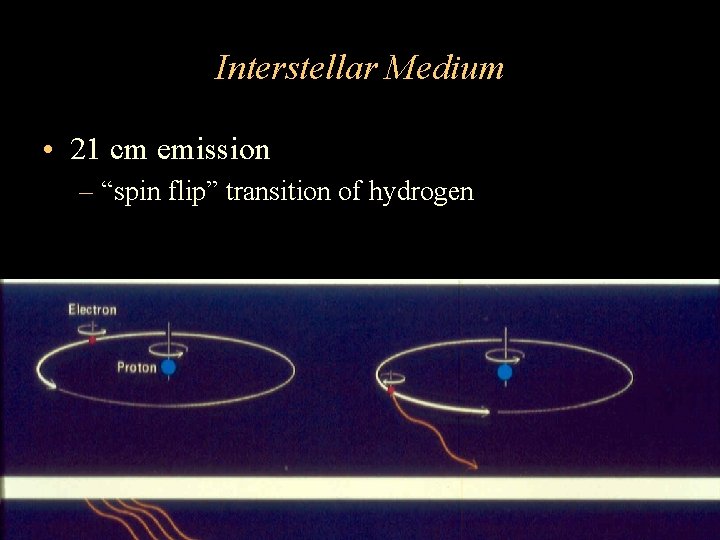
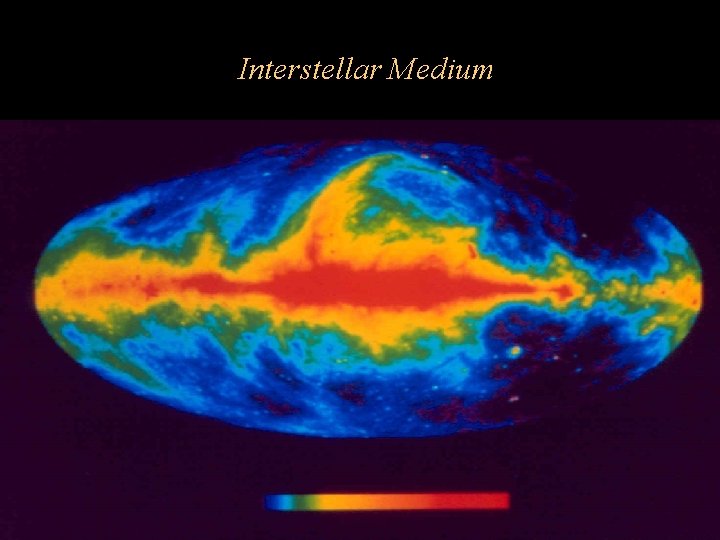
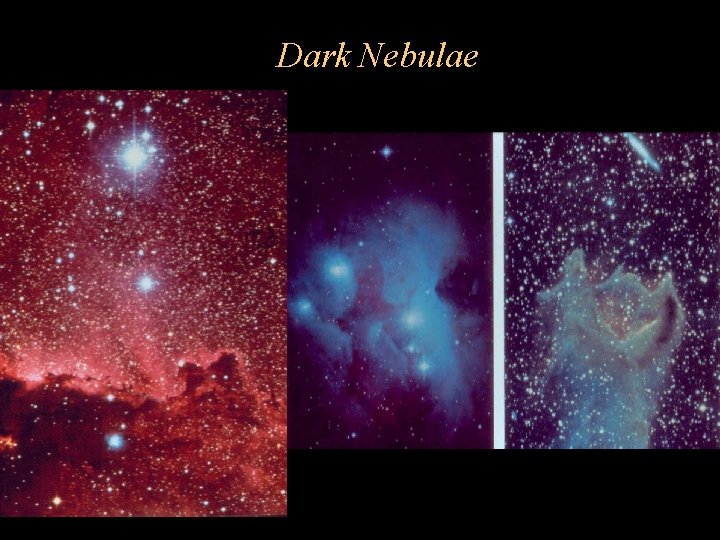
Interstellar Medium • How do we know there’s stuff between the stars? • We see it! – Emiision from hydrogen in the radio (21 cm) – Dark nebulae (block starlight) – Emission nebulae (excited by starlight, but emits own light) – Reflection nebulae (reflects starlight)
Interstellar Medium • 21 cm emission – “spin flip” transition of hydrogen
Interstellar Medium
Dark Cloud Dark Nebulae Dark Cloud / Cluster
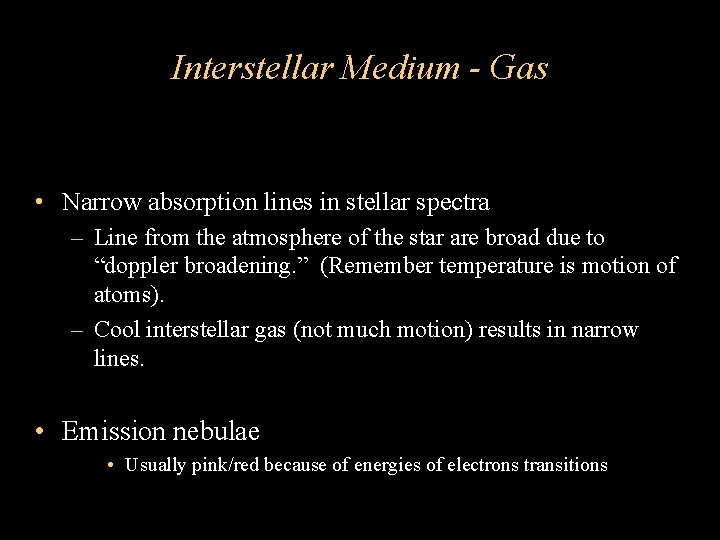
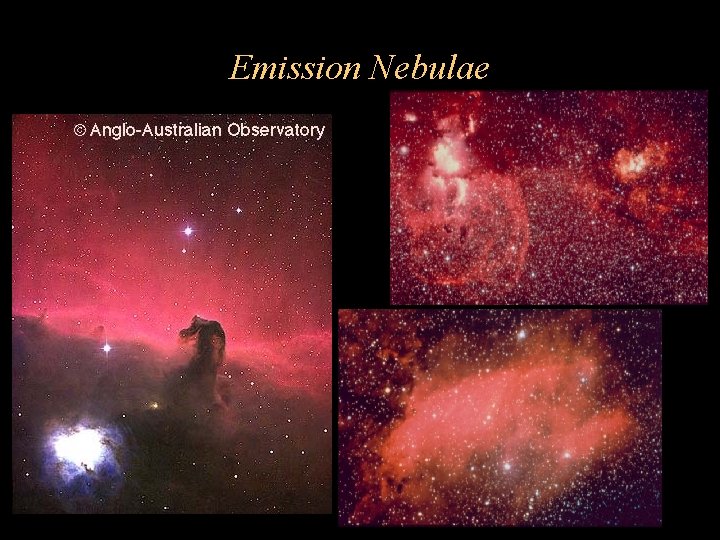
Interstellar Medium - Gas • Narrow absorption lines in stellar spectra – Line from the atmosphere of the star are broad due to “doppler broadening. ” (Remember temperature is motion of atoms). – Cool interstellar gas (not much motion) results in narrow lines. • Emission nebulae • Usually pink/red because of energies of electrons transitions
Emission Nebulae
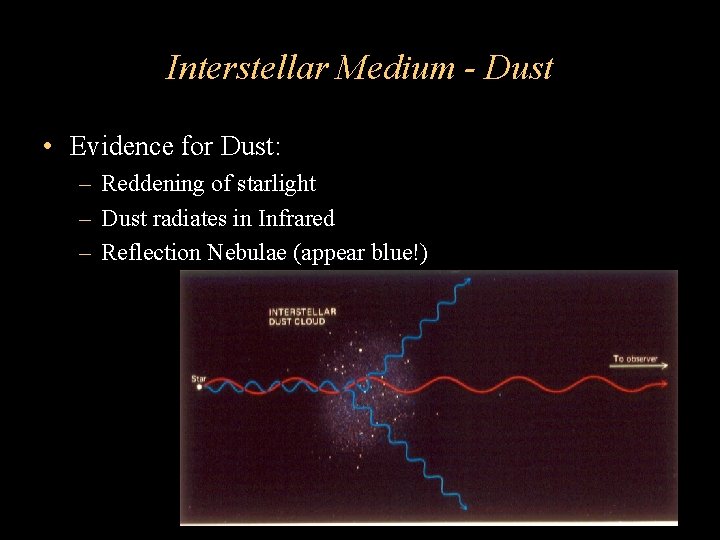
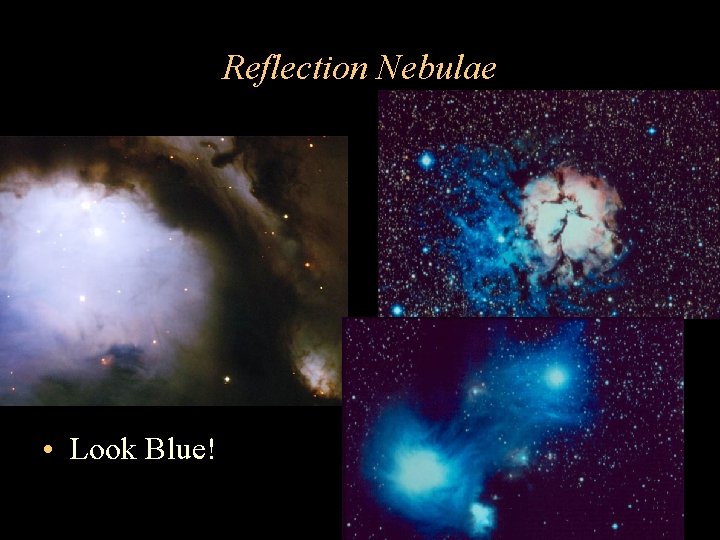
Interstellar Medium - Dust • Evidence for Dust: – Reddening of starlight – Dust radiates in Infrared – Reflection Nebulae (appear blue!) DEMO
Reflection Nebulae • Look Blue!
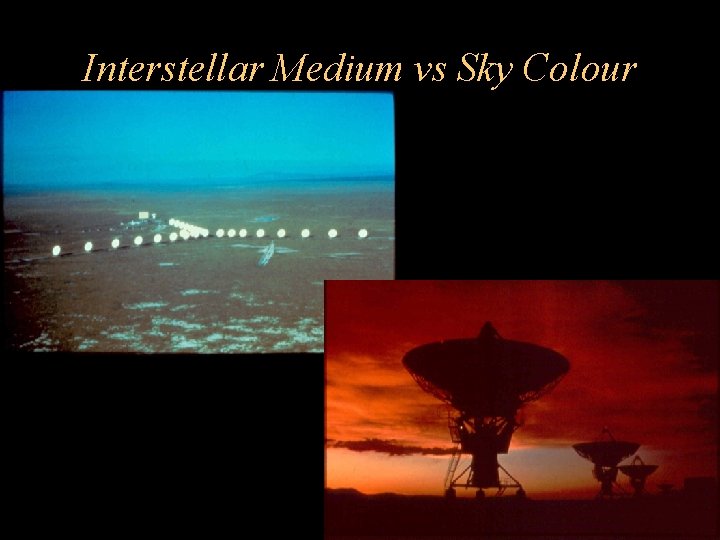
Interstellar Medium vs Sky Colour Evening Sky is Red! Daytime Sky is Blue!
Concep. Test • You see emission at a wavelength of 21 cm This is evidence for Interstellar Dust (A=yes, B=no) Infrared observations penetrate dust clouds more easily than visible observations (A=yes, B=no)