
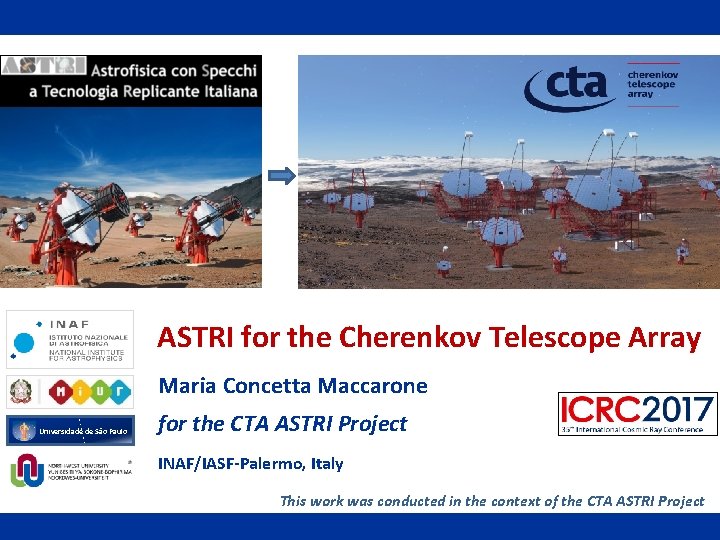
ASTRI for the Cherenkov Telescope Array Maria Concetta

- Slides: 26
ASTRI for the Cherenkov Telescope Array Maria Concetta Maccarone Universidade de São Paulo for the CTA ASTRI Project INAF/IASF-Palermo, Italy This work was conducted in the context of the CTA ASTRI Project
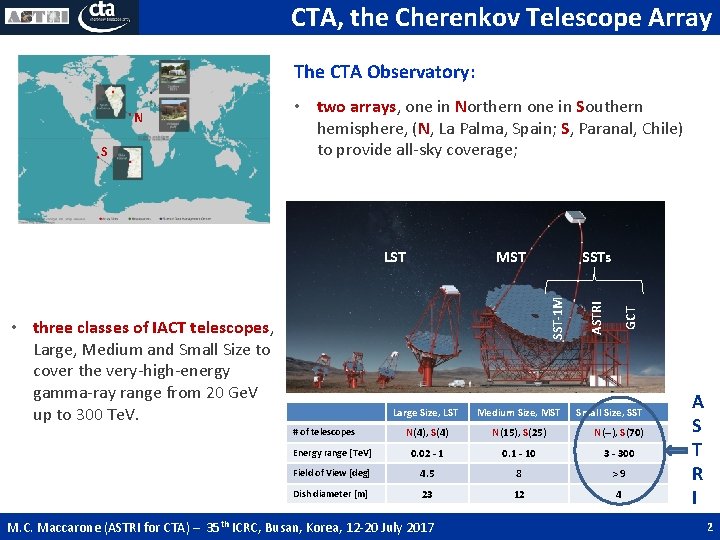
CTA, the Cherenkov Telescope Array The CTA Observatory: MST SSTs SST-1 M LST • three classes of IACT telescopes, Large, Medium and Small Size to cover the very-high-energy gamma-ray range from 20 Ge. V up to 300 Te. V. GCT S • two arrays, one in Northern one in Southern hemisphere, (N, La Palma, Spain; S, Paranal, Chile) to provide all-sky coverage; ASTRI N Large Size, LST Medium Size, MST N(4), S(4) N(15), S(25) N(--), S(70) Energy range [Te. V] 0. 02 - 1 0. 1 - 10 3 - 300 Field of View [deg] 4. 5 8 >9 Dish diameter [m] 23 12 4 # of telescopes M. C. Maccarone (ASTRI for CTA) – 35 th ICRC, Busan, Korea, 12 -20 July 2017 Small Size, SST A S T R I 2
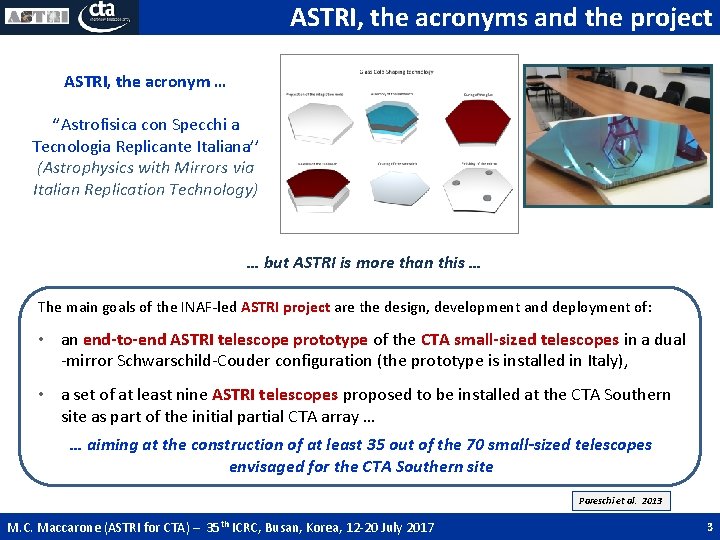
ASTRI, the acronyms and the project ASTRI, the acronym … ‘’Astrofisica con Specchi a Tecnologia Replicante Italiana’’ (Astrophysics with Mirrors via Italian Replication Technology) … but ASTRI is more than this … The main goals of the INAF-led ASTRI project are the design, development and deployment of: • an end-to-end ASTRI telescope prototype of the CTA small-sized telescopes in a dual -mirror Schwarschild-Couder configuration (the prototype is installed in Italy), • a set of at least nine ASTRI telescopes proposed to be installed at the CTA Southern site as part of the initial partial CTA array … … aiming at the construction of at least 35 out of the 70 small-sized telescopes envisaged for the CTA Southern site Pareschi et al. 2013 M. C. Maccarone (ASTRI for CTA) – 35 th ICRC, Busan, Korea, 12 -20 July 2017 3
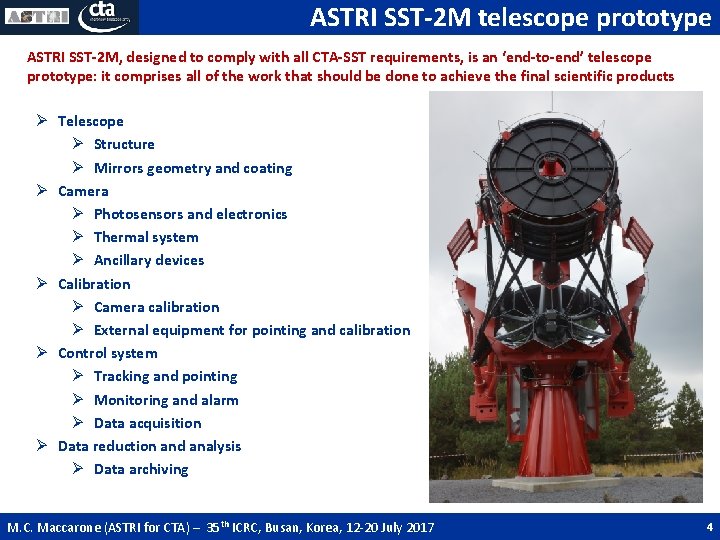
ASTRI SST-2 M telescope prototype ASTRI SST-2 M, designed to comply with all CTA-SST requirements, is an ‘end-to-end’ telescope prototype: it comprises all of the work that should be done to achieve the final scientific products Ø Telescope Ø Structure Ø Mirrors geometry and coating Ø Camera Ø Photosensors and electronics Ø Thermal system Ø Ancillary devices Ø Calibration Ø Camera calibration Ø External equipment for pointing and calibration Ø Control system Ø Tracking and pointing Ø Monitoring and alarm Ø Data acquisition Ø Data reduction and analysis Ø Data archiving M. C. Maccarone (ASTRI for CTA) – 35 th ICRC, Busan, Korea, 12 -20 July 2017 4
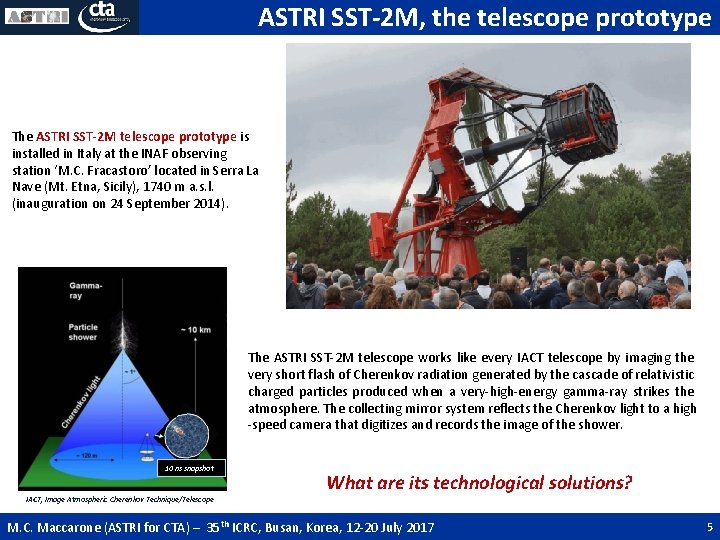
ASTRI SST-2 M, the telescope prototype The ASTRI SST-2 M telescope prototype is installed in Italy at the INAF observing station ‘M. C. Fracastoro’ located in Serra La Nave (Mt. Etna, Sicily), 1740 m a. s. l. (inauguration on 24 September 2014). The ASTRI SST-2 M telescope works like every IACT telescope by imaging the very short flash of Cherenkov radiation generated by the cascade of relativistic charged particles produced when a very-high-energy gamma-ray strikes the atmosphere. The collecting mirror system reflects the Cherenkov light to a high -speed camera that digitizes and records the image of the shower. 10 ns snapshot What are its technological solutions? IACT, Image Atmospheric Cherenkov Technique/Telescope M. C. Maccarone (ASTRI for CTA) – 35 th ICRC, Busan, Korea, 12 -20 July 2017 5
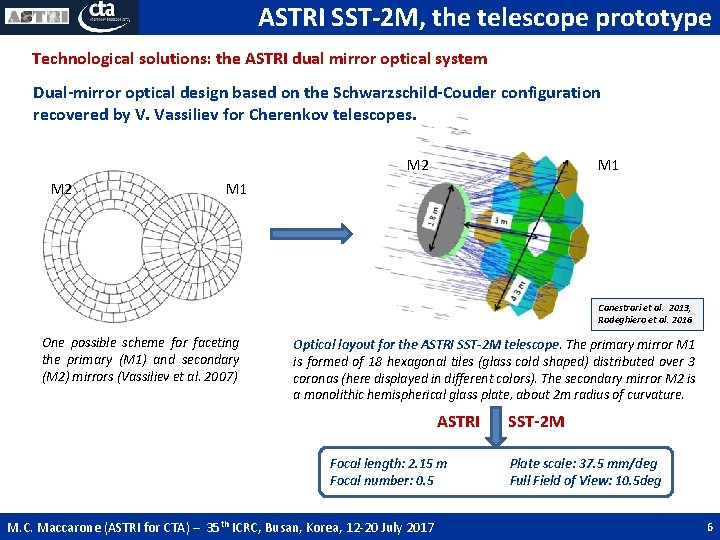
ASTRI SST-2 M, the telescope prototype Technological solutions: the ASTRI dual mirror optical system Dual-mirror optical design based on the Schwarzschild-Couder configuration recovered by V. Vassiliev for Cherenkov telescopes. M 2 M 1 Canestrari et al. 2013, Rodeghiero et al. 2016 One possible scheme for faceting the primary (M 1) and secondary (M 2) mirrors (Vassiliev et al. 2007) Optical layout for the ASTRI SST-2 M telescope. The primary mirror M 1 is formed of 18 hexagonal tiles (glass cold shaped) distributed over 3 coronas (here displayed in different colors). The secondary mirror M 2 is a monolithic hemispherical glass plate, about 2 m radius of curvature. ASTRI Focal length: 2. 15 m Focal number: 0. 5 M. C. Maccarone (ASTRI for CTA) – 35 th ICRC, Busan, Korea, 12 -20 July 2017 SST-2 M Plate scale: 37. 5 mm/deg Full Field of View: 10. 5 deg 6
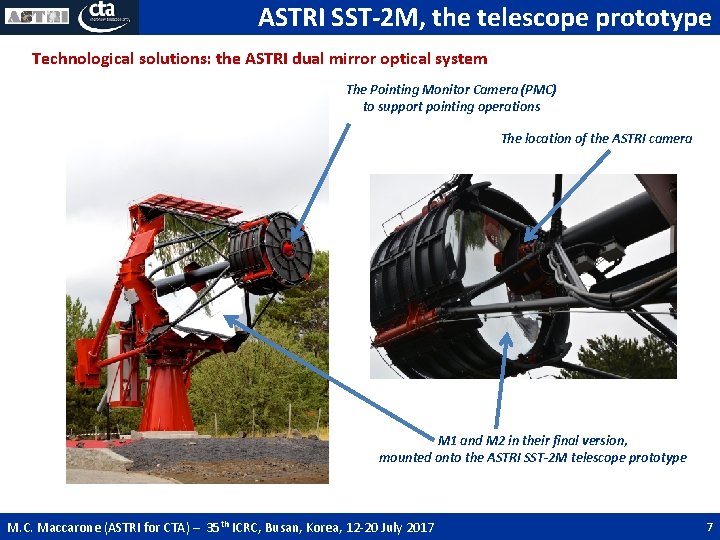
ASTRI SST-2 M, the telescope prototype Technological solutions: the ASTRI dual mirror optical system The Pointing Monitor Camera (PMC) to support pointing operations The location of the ASTRI camera M 1 and M 2 in their final version, mounted onto the ASTRI SST-2 M telescope prototype M. C. Maccarone (ASTRI for CTA) – 35 th ICRC, Busan, Korea, 12 -20 July 2017 7
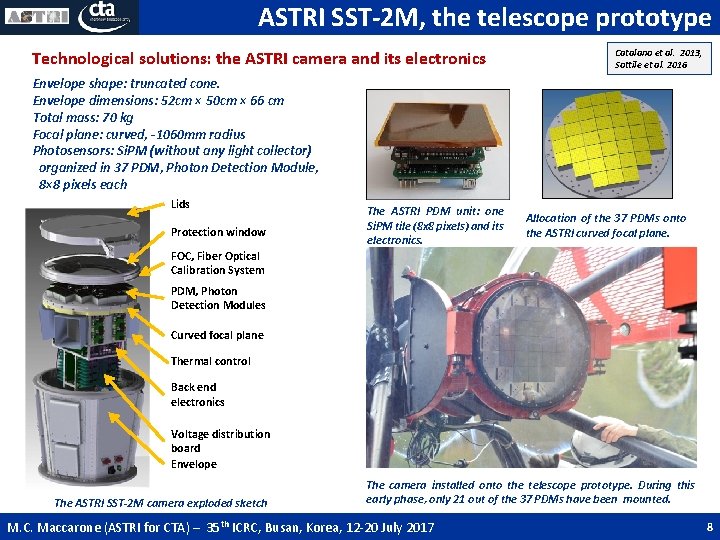
ASTRI SST-2 M, the telescope prototype Technological solutions: the ASTRI camera and its electronics Catalano et al. 2013, Sottile et al. 2016 Envelope shape: truncated cone. Envelope dimensions: 52 cm × 50 cm × 66 cm Total mass: 70 kg Focal plane: curved, -1060 mm radius Photosensors: Si. PM (without any light collector) organized in 37 PDM, Photon Detection Module, 8× 8 pixels each Lids Protection window The ASTRI PDM unit: one Si. PM tile (8 x 8 pixels) and its electronics. Allocation of the 37 PDMs onto the ASTRI curved focal plane. FOC, Fiber Optical Calibration System PDM, Photon Detection Modules Curved focal plane Thermal control Back end electronics Voltage distribution board Envelope The ASTRI SST-2 M camera exploded sketch The camera installed onto the telescope prototype. During this early phase, only 21 out of the 37 PDMs have been mounted. M. C. Maccarone (ASTRI for CTA) – 35 th ICRC, Busan, Korea, 12 -20 July 2017 8
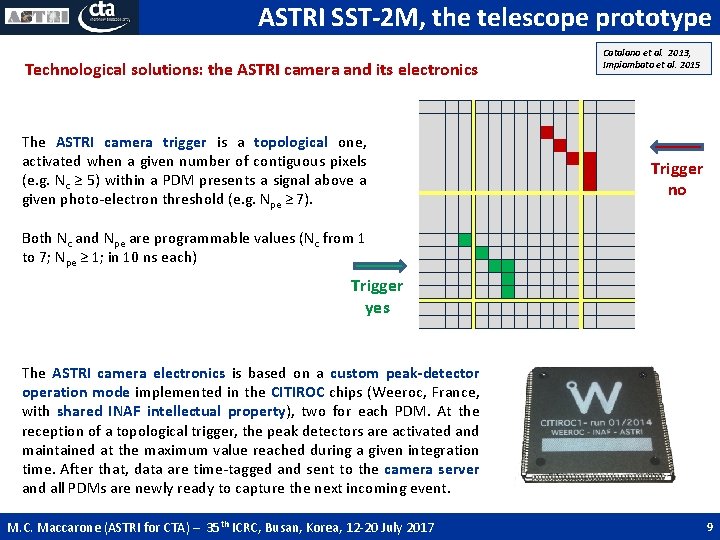
ASTRI SST-2 M, the telescope prototype Technological solutions: the ASTRI camera and its electronics The ASTRI camera trigger is a topological one, activated when a given number of contiguous pixels (e. g. Nc ≥ 5) within a PDM presents a signal above a given photo-electron threshold (e. g. Npe ≥ 7). Catalano et al. 2013, Impiombato et al. 2015 Trigger no Both Nc and Npe are programmable values (Nc from 1 to 7; Npe ≥ 1; in 10 ns each) Trigger yes The ASTRI camera electronics is based on a custom peak-detector operation mode implemented in the CITIROC chips (Weeroc, France, with shared INAF intellectual property), two for each PDM. At the reception of a topological trigger, the peak detectors are activated and maintained at the maximum value reached during a given integration time. After that, data are time-tagged and sent to the camera server and all PDMs are newly ready to capture the next incoming event. M. C. Maccarone (ASTRI for CTA) – 35 th ICRC, Busan, Korea, 12 -20 July 2017 9
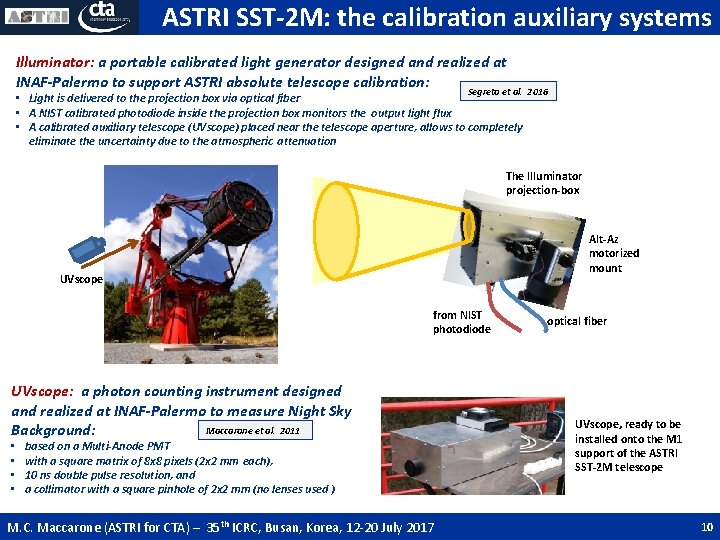
ASTRI SST-2 M: the calibration auxiliary systems Illuminator: a portable calibrated light generator designed and realized at INAF-Palermo to support ASTRI absolute telescope calibration: Segreto et al. 2016 • Light is delivered to the projection box via optical fiber • A NIST calibrated photodiode inside the projection box monitors the output light flux • A calibrated auxiliary telescope (UVscope) placed near the telescope aperture, allows to completely eliminate the uncertainty due to the atmospheric attenuation The Illuminator projection-box Alt-Az motorized mount UVscope from NIST photodiode UVscope: a photon counting instrument designed and realized at INAF-Palermo to measure Night Sky Maccarone et al. 2011 Background: • • based on a Multi-Anode PMT with a square matrix of 8 x 8 pixels (2 x 2 mm each), 10 ns double pulse resolution, and a collimator with a square pinhole of 2 x 2 mm (no lenses used ) M. C. Maccarone (ASTRI for CTA) – 35 th ICRC, Busan, Korea, 12 -20 July 2017 optical fiber UVscope, ready to be installed onto the M 1 support of the ASTRI SST-2 M telescope 10
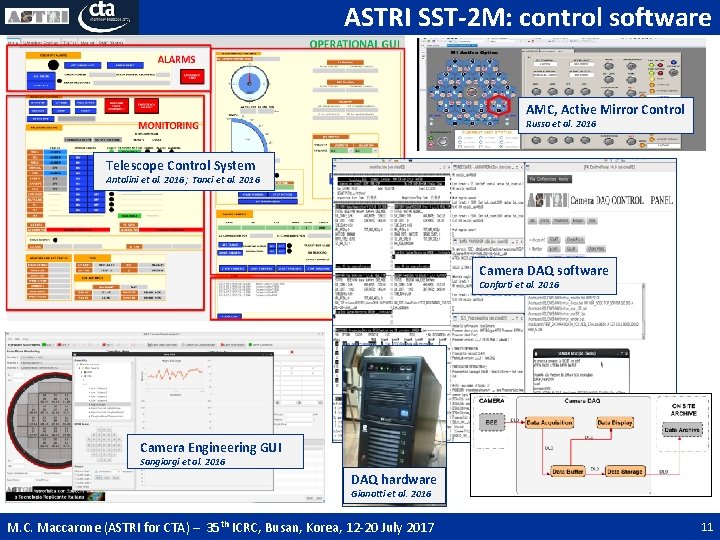
ASTRI SST-2 M: control software AMC, Active Mirror Control Russo et al. 2016 Telescope Control System Antolini et al. 2016; Tanci et al. 2016 Camera DAQ software Conforti et al. 2016 Camera Engineering GUI Sangiorgi et al. 2016 DAQ hardware Gianotti et al. 2016 M. C. Maccarone (ASTRI for CTA) – 35 th ICRC, Busan, Korea, 12 -20 July 2017 11
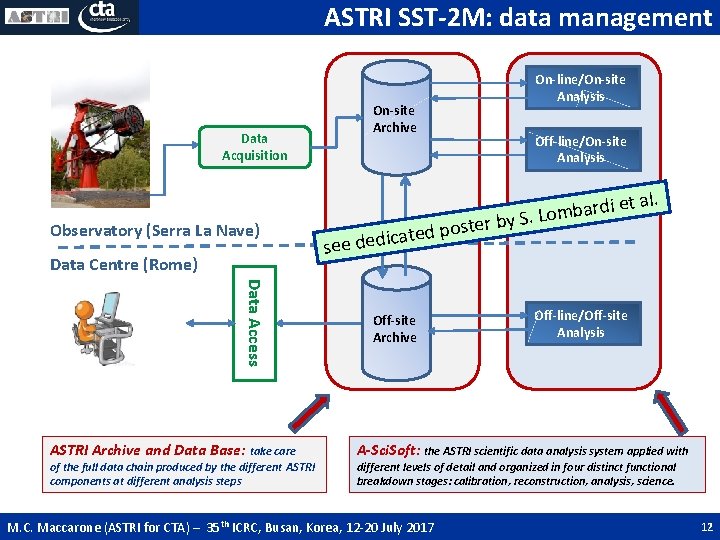
ASTRI SST-2 M: data management Data Acquisition Observatory (Serra La Nave) Data Centre (Rome) Data Access ASTRI Archive and Data Base: take care of the full data chain produced by the different ASTRI components at different analysis steps On-line/On-site Analysis On-site Archive Off-line/On-site Analysis ster d po e t a c i d e see d Off-site Archive t al. rdi e a b m o L. by S Off-line/Off-site Analysis A-Sci. Soft: the ASTRI scientific data analysis system applied with different levels of detail and organized in four distinct functional breakdown stages: calibration, reconstruction, analysis, science. M. C. Maccarone (ASTRI for CTA) – 35 th ICRC, Busan, Korea, 12 -20 July 2017 12
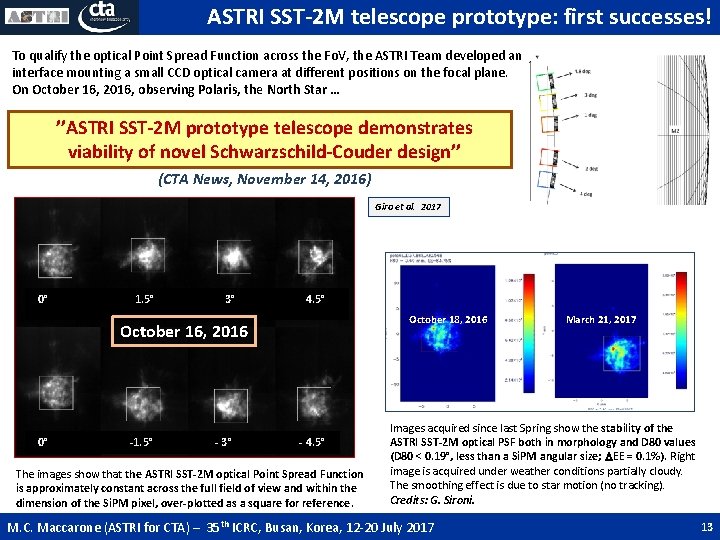
ASTRI SST-2 M telescope prototype: first successes! To qualify the optical Point Spread Function across the Fo. V, the ASTRI Team developed an interface mounting a small CCD optical camera at different positions on the focal plane. On October 16, 2016, observing Polaris, the North Star … ’’ASTRI SST-2 M prototype telescope demonstrates viability of novel Schwarzschild-Couder design’’ (CTA News, November 14, 2016) Giro et al. 2017 0° 1. 5° 3° 4. 5° October 18, 2016 October 16, 2016 0° -1. 5° - 3° - 4. 5° The images show that the ASTRI SST-2 M optical Point Spread Function is approximately constant across the full field of view and within the dimension of the Si. PM pixel, over-plotted as a square for reference. March 21, 2017 Images acquired since last Spring show the stability of the ASTRI SST-2 M optical PSF both in morphology and D 80 values (D 80 < 0. 19°, less than a Si. PM angular size; DEE = 0. 1%). Right image is acquired under weather conditions partially cloudy. The smoothing effect is due to star motion (no tracking). Credits: G. Sironi. M. C. Maccarone (ASTRI for CTA) – 35 th ICRC, Busan, Korea, 12 -20 July 2017 13
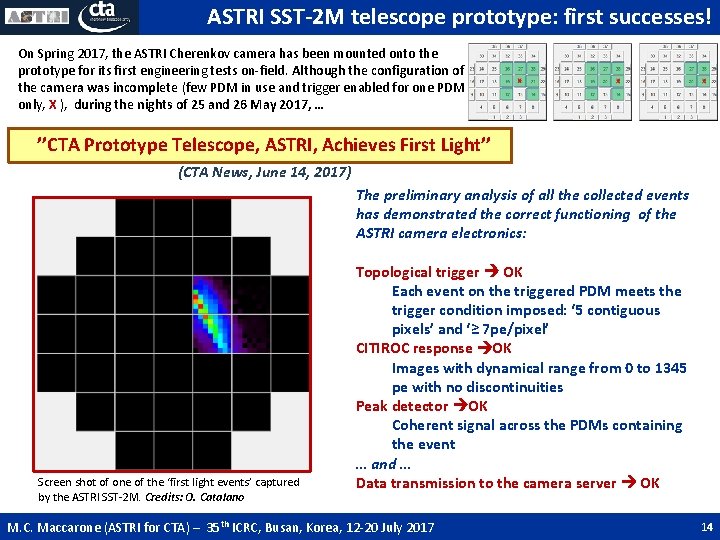
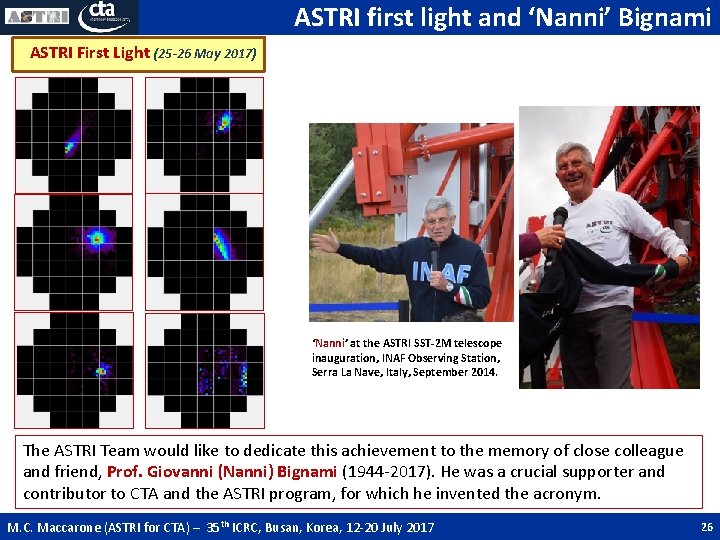
ASTRI SST-2 M telescope prototype: first successes! On Spring 2017, the ASTRI Cherenkov camera has been mounted onto the prototype for its first engineering tests on-field. Although the configuration of the camera was incomplete (few PDM in use and trigger enabled for one PDM only, X ), during the nights of 25 and 26 May 2017, … ’’CTA Prototype Telescope, ASTRI, Achieves First Light’’ (CTA News, June 14, 2017) The preliminary analysis of all the collected events has demonstrated the correct functioning of the ASTRI camera electronics: Screen shot of one of the ‘first light events’ captured by the ASTRI SST-2 M. Credits: O. Catalano Topological trigger OK Each event on the triggered PDM meets the trigger condition imposed: ‘ 5 contiguous pixels’ and ‘≥ 7 pe/pixel’ CITIROC response OK Images with dynamical range from 0 to 1345 pe with no discontinuities Peak detector OK Coherent signal across the PDMs containing the event … and … Data transmission to the camera server OK M. C. Maccarone (ASTRI for CTA) – 35 th ICRC, Busan, Korea, 12 -20 July 2017 14
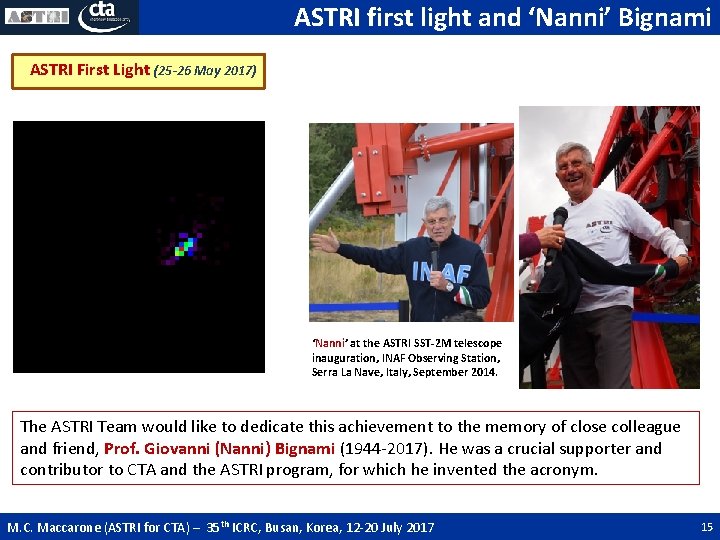
ASTRI first light and ‘Nanni’ Bignami ASTRI First Light (25 -26 May 2017) ‘Nanni’ at the ASTRI SST-2 M telescope inauguration, INAF Observing Station, Serra La Nave, Italy, September 2014. The ASTRI Team would like to dedicate this achievement to the memory of close colleague and friend, Prof. Giovanni (Nanni) Bignami (1944 -2017). He was a crucial supporter and contributor to CTA and the ASTRI program, for which he invented the acronym. M. C. Maccarone (ASTRI for CTA) – 35 th ICRC, Busan, Korea, 12 -20 July 2017 15
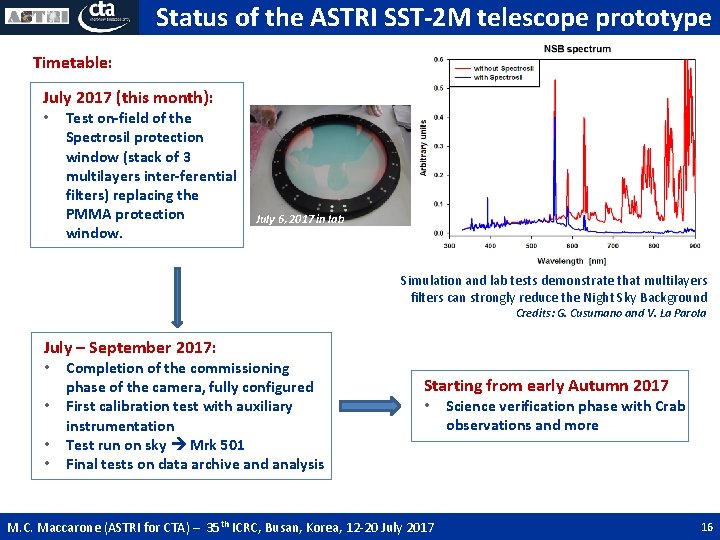
Status of the ASTRI SST-2 M telescope prototype Timetable: July 2017 (this month): • Test on-field of the Spectrosil protection window (stack of 3 multilayers inter-ferential filters) replacing the PMMA protection window. July 6, 2017 in lab Simulation and lab tests demonstrate that multilayers filters can strongly reduce the Night Sky Background Credits: G. Cusumano and V. La Parola July – September 2017: • • Completion of the commissioning phase of the camera, fully configured First calibration test with auxiliary instrumentation Test run on sky Mrk 501 Final tests on data archive and analysis Starting from early Autumn 2017 • M. C. Maccarone (ASTRI for CTA) – 35 th ICRC, Busan, Korea, 12 -20 July 2017 Science verification phase with Crab observations and more 16
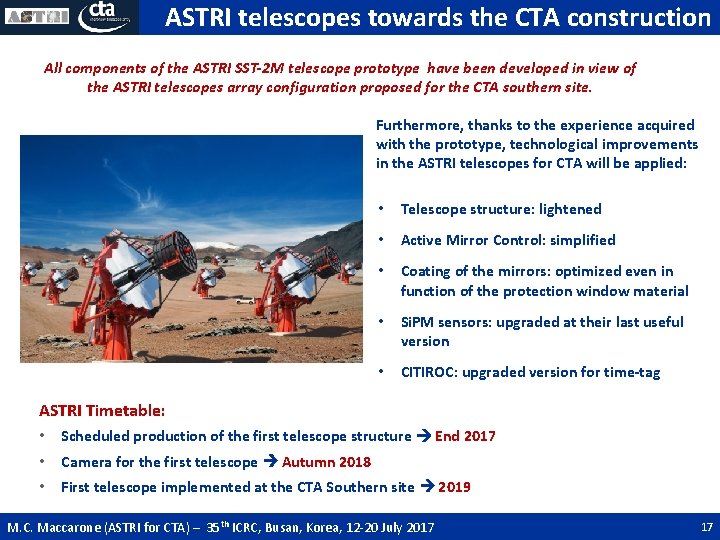
ASTRI telescopes towards the CTA construction All components of the ASTRI SST-2 M telescope prototype have been developed in view of the ASTRI telescopes array configuration proposed for the CTA southern site. Furthermore, thanks to the experience acquired with the prototype, technological improvements in the ASTRI telescopes for CTA will be applied: • Telescope structure: lightened • Active Mirror Control: simplified • Coating of the mirrors: optimized even in function of the protection window material • Si. PM sensors: upgraded at their last useful version • CITIROC: upgraded version for time-tag ASTRI Timetable: • Scheduled production of the first telescope structure End 2017 • Camera for the first telescope Autumn 2018 • First telescope implemented at the CTA Southern site 2019 M. C. Maccarone (ASTRI for CTA) – 35 th ICRC, Busan, Korea, 12 -20 July 2017 17
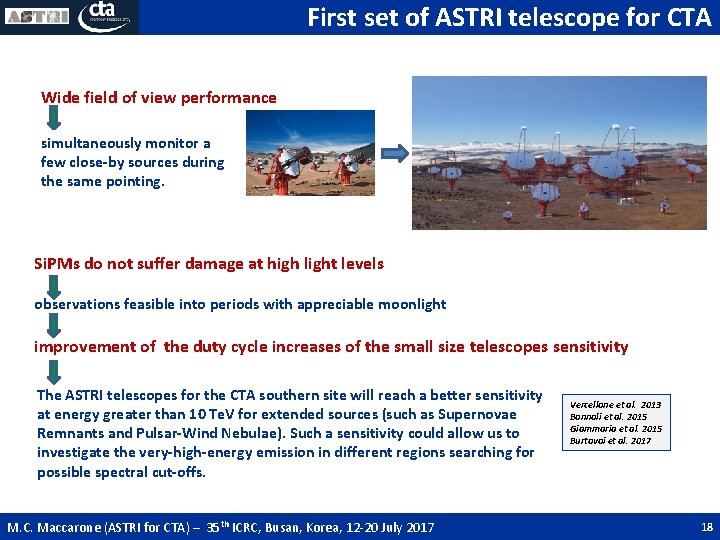
First set of ASTRI telescope for CTA Wide field of view performance simultaneously monitor a few close-by sources during the same pointing. Si. PMs do not suffer damage at high light levels observations feasible into periods with appreciable moonlight improvement of the duty cycle increases of the small size telescopes sensitivity The ASTRI telescopes for the CTA southern site will reach a better sensitivity at energy greater than 10 Te. V for extended sources (such as Supernovae Remnants and Pulsar-Wind Nebulae). Such a sensitivity could allow us to investigate the very-high-energy emission in different regions searching for possible spectral cut-offs. M. C. Maccarone (ASTRI for CTA) – 35 th ICRC, Busan, Korea, 12 -20 July 2017 Vercellone et al. 2013 Bonnoli et al. 2015 Giammaria et al. 2015 Burtovoi et al. 2017 18
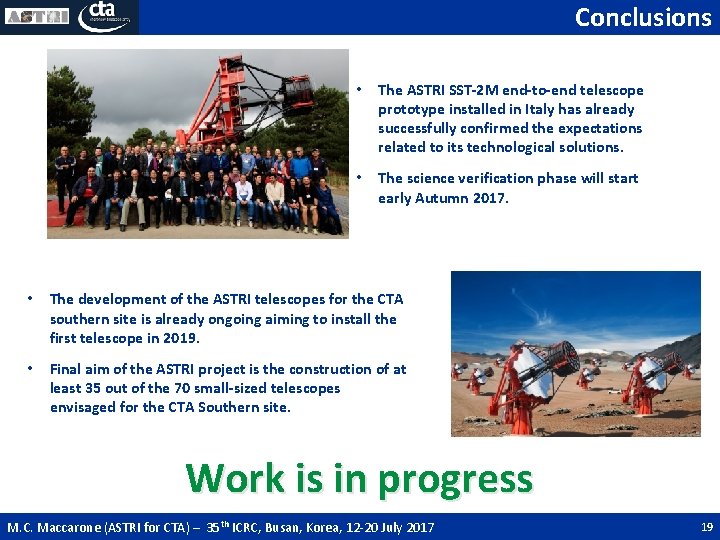
Conclusions • The ASTRI SST-2 M end-to-end telescope prototype installed in Italy has already successfully confirmed the expectations related to its technological solutions. • The science verification phase will start early Autumn 2017. • The development of the ASTRI telescopes for the CTA southern site is already ongoing aiming to install the first telescope in 2019. • Final aim of the ASTRI project is the construction of at least 35 out of the 70 small-sized telescopes envisaged for the CTA Southern site. Work is in progress M. C. Maccarone (ASTRI for CTA) – 35 th ICRC, Busan, Korea, 12 -20 July 2017 19
Thank you for your attention! We gratefully acknowledge financial support from the agencies and organizations listed here: http: //www. cta-observatory. org/consortium_acknowledgments/
ASTRI for CTA Back Up Slides M. C. Maccarone (ASTRI for CTA) – 35 th ICRC, Busan, Korea, 12 -20 July 2017 21
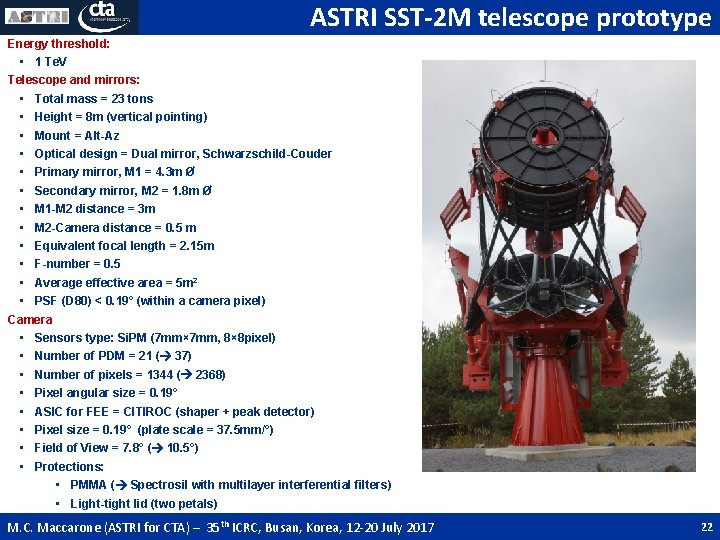
ASTRI SST-2 M telescope prototype Energy threshold: • 1 Te. V Telescope and mirrors: • Total mass = 23 tons • Height = 8 m (vertical pointing) • Mount = Alt-Az • Optical design = Dual mirror, Schwarzschild-Couder • Primary mirror, M 1 = 4. 3 m Ø • Secondary mirror, M 2 = 1. 8 m Ø • M 1 -M 2 distance = 3 m • M 2 -Camera distance = 0. 5 m • Equivalent focal length = 2. 15 m • F-number = 0. 5 • Average effective area = 5 m 2 • PSF (D 80) < 0. 19° (within a camera pixel) Camera • Sensors type: Si. PM (7 mm× 7 mm, 8× 8 pixel) • Number of PDM = 21 ( 37) • Number of pixels = 1344 ( 2368) • Pixel angular size = 0. 19° • ASIC for FEE = CITIROC (shaper + peak detector) • Pixel size = 0. 19° (plate scale = 37. 5 mm/°) • Field of View = 7. 8° ( 10. 5°) • Protections: • PMMA ( Spectrosil with multilayer interferential filters) • Light-tight lid (two petals) M. C. Maccarone (ASTRI for CTA) – 35 th ICRC, Busan, Korea, 12 -20 July 2017 22
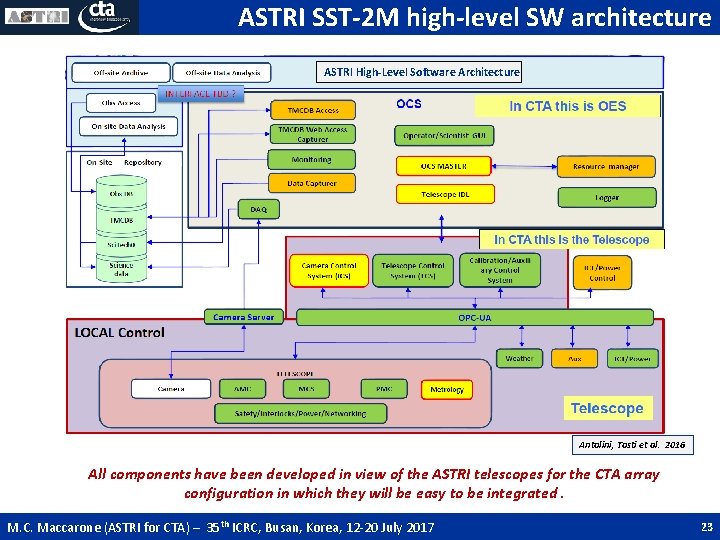
ASTRI SST-2 M high-level SW architecture ASTRI High-Level Software Architecture Antolini, Tosti et al. 2016 All components have been developed in view of the ASTRI telescopes for the CTA array configuration in which they will be easy to be integrated. M. C. Maccarone (ASTRI for CTA) – 35 th ICRC, Busan, Korea, 12 -20 July 2017 23
ASTRI for CTA M. C. Maccarone (ASTRI for CTA) – 35 th ICRC, Busan, Korea, 12 -20 July 2017 24
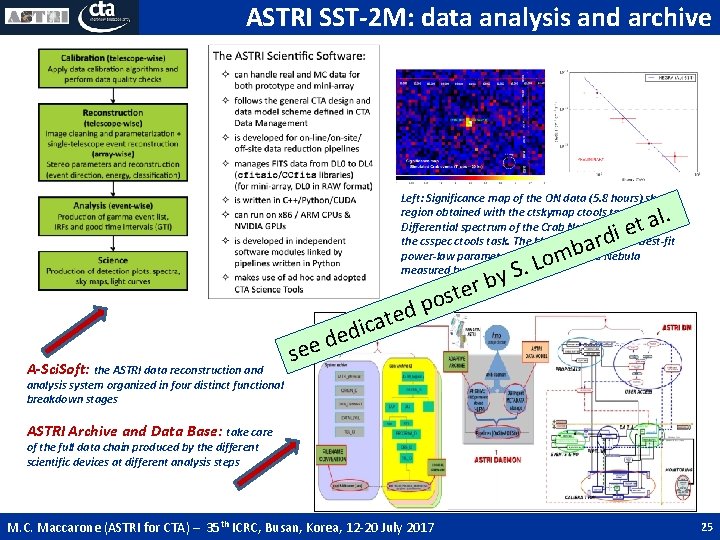
ASTRI SST-2 M: data analysis and archive Left: Significance map of the ON data (5. 8 hours) sky region obtained with the ctskymap ctools task. Right: Differential spectrum of the Crab Nebula obtained with the csspec ctools task. The blue line reprints the best-fit power-law parameterization of the Crab Nebula measured by the HEGRA Coll. l. a t ie d r a mb A-Sci. Soft: the ASTRI data reconstruction and see d d e t a edic r e t s po Lo. S by analysis system organized in four distinct functional breakdown stages ASTRI Archive and Data Base: take care of the full data chain produced by the different scientific devices at different analysis steps M. C. Maccarone (ASTRI for CTA) – 35 th ICRC, Busan, Korea, 12 -20 July 2017 25
ASTRI first light and ‘Nanni’ Bignami ASTRI First Light (25 -26 May 2017) ‘Nanni’ at the ASTRI SST-2 M telescope inauguration, INAF Observing Station, Serra La Nave, Italy, September 2014. The ASTRI Team would like to dedicate this achievement to the memory of close colleague and friend, Prof. Giovanni (Nanni) Bignami (1944 -2017). He was a crucial supporter and contributor to CTA and the ASTRI program, for which he invented the acronym. M. C. Maccarone (ASTRI for CTA) – 35 th ICRC, Busan, Korea, 12 -20 July 2017 26