
ASTM International Proficiency Test Programs and Interlaboratory Studies
ASTM International Proficiency Test Programs and Interlaboratory Studies Program Presenters: Melissa Catalano and Phillip Godorov September 2011
ASTM Proficiency Testing Programs What is a Proficiency Testing Program? § Designed as a statistical quality control tool enabling participating laboratories to assess their performance in conducting ASTM or other test methods § Uniform samples are analyzed by participating labs using specified methods and results are reported for statistical treatment September 2011
ASTM Proficiency Testing Programs ASTM : § provides management and administrative support to the program § § coordinates the preparation and distribution of test samples § § program registration, contract negotiations for sample prep and distribution, data collection and generation of statistical summary reports Sample are prepared by outside contractors provides reporting instructions, worksheets and electronic data report forms for submitting data September 2011
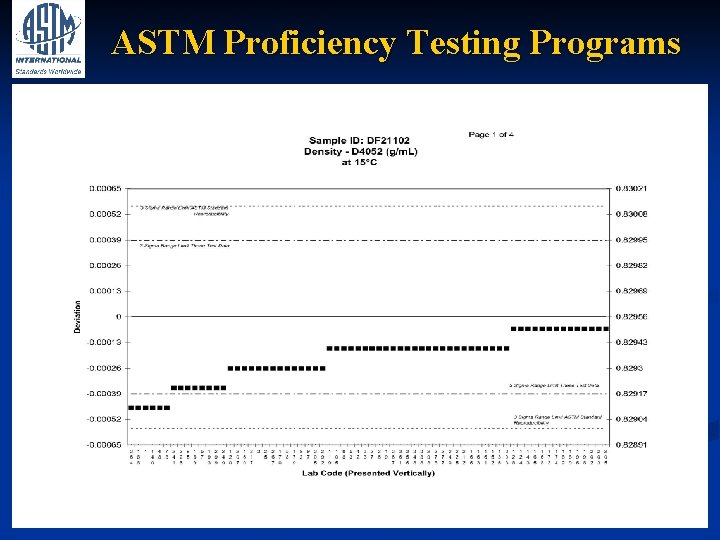
ASTM Proficiency Testing Programs ASTM statistical summary reports include: § Listing of all lab data § Charts and graphs Lab data coded to maintain lab confidentiality. Final summary reports are provided electronically to participants and appropriate Committee contacts. ASTM Custom Company Reports – provided to companies with multiple labs upon request. September 2011

ASTM #2 Diesel Fuel Sample ID: DF 21102 Acid Number – D 664 Lab data coded to maintain lab confidentiality September 2011
ASTM Proficiency Testing Programs
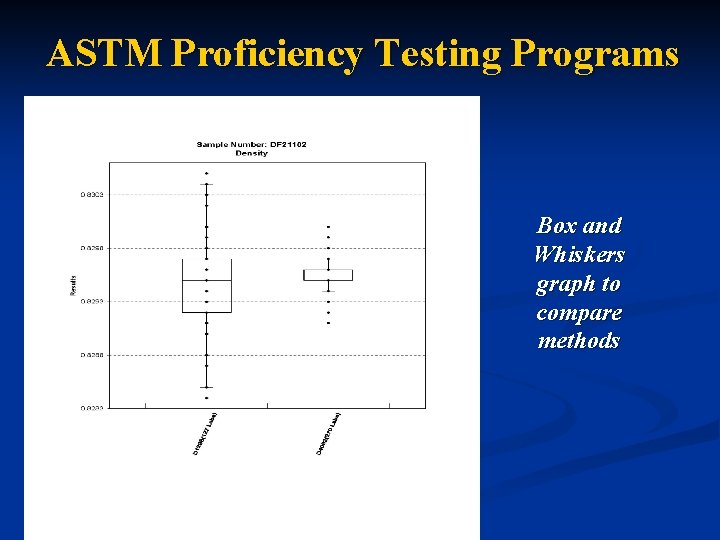
ASTM Proficiency Testing Programs Box and Whiskers graph to compare methods
ASTM Proficiency Testing Programs Globally recognized programs: § Over 2, 900 laboratories participating § Over 50% participation outside continental U. S. September 2011
ASTM Proficiency Testing Programs ww w. A ST M. org
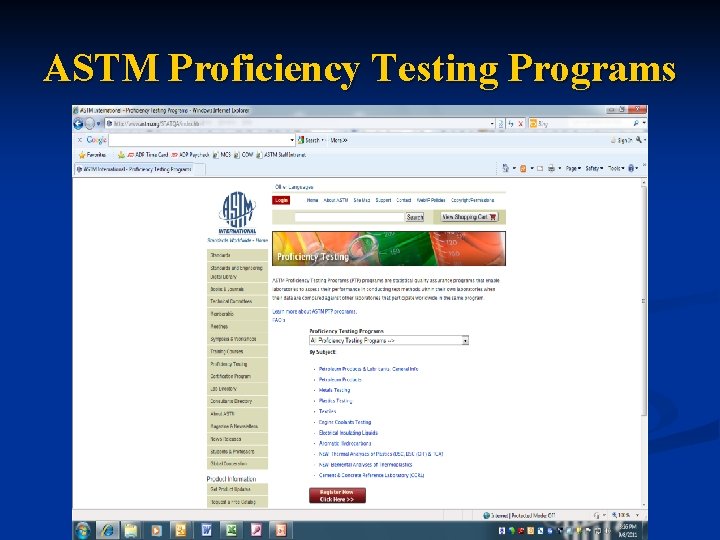
ASTM Proficiency Testing Programs
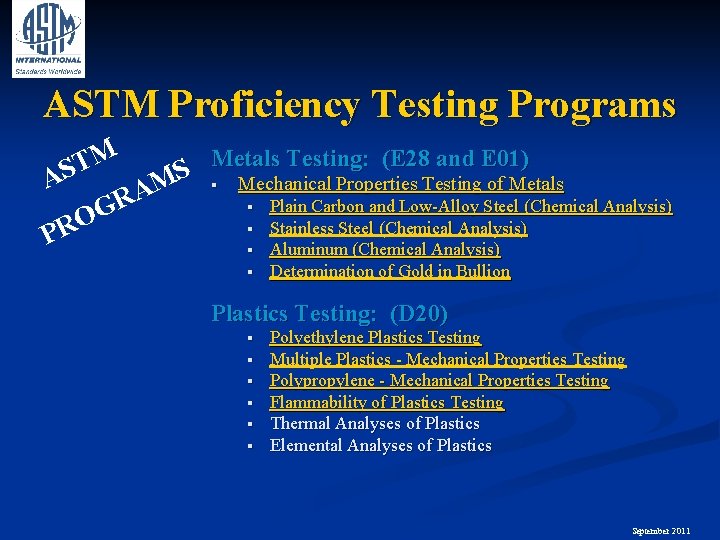
ASTM Proficiency Testing Programs M Metals Testing: (E 28 and E 01) T S § Mechanical Properties Testing of Metals AS M A R § Plain Carbon and Low-Alloy Steel (Chemical Analysis) G O § Stainless Steel (Chemical Analysis) R P § Aluminum (Chemical Analysis) § Determination of Gold in Bullion Plastics Testing: (D 20) § § § Polyethylene Plastics Testing Multiple Plastics - Mechanical Properties Testing Polypropylene - Mechanical Properties Testing Flammability of Plastics Testing Thermal Analyses of Plastics Elemental Analyses of Plastics September 2011
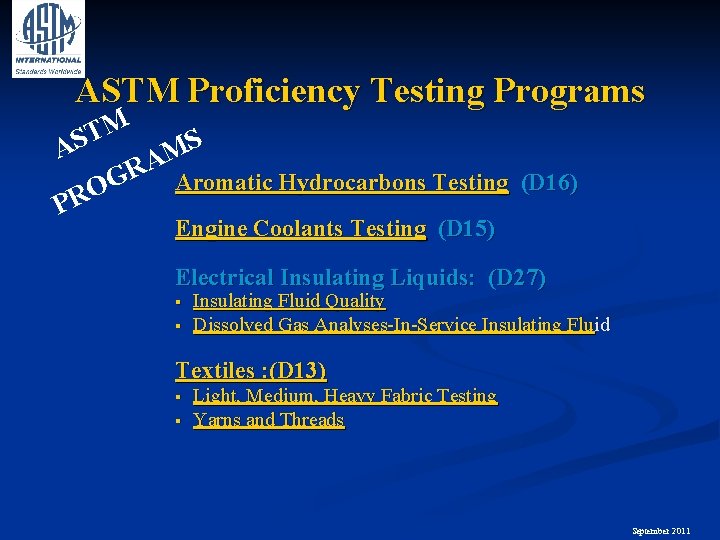
ASTM Proficiency Testing Programs M T S AS M A R G Aromatic Hydrocarbons Testing (D 16) O PR Engine Coolants Testing (D 15) Electrical Insulating Liquids: (D 27) § § Insulating Fluid Quality Dissolved Gas Analyses-In-Service Insulating Fluid Textiles : (D 13) § § Light, Medium, Heavy Fabric Testing Yarns and Threads September 2011
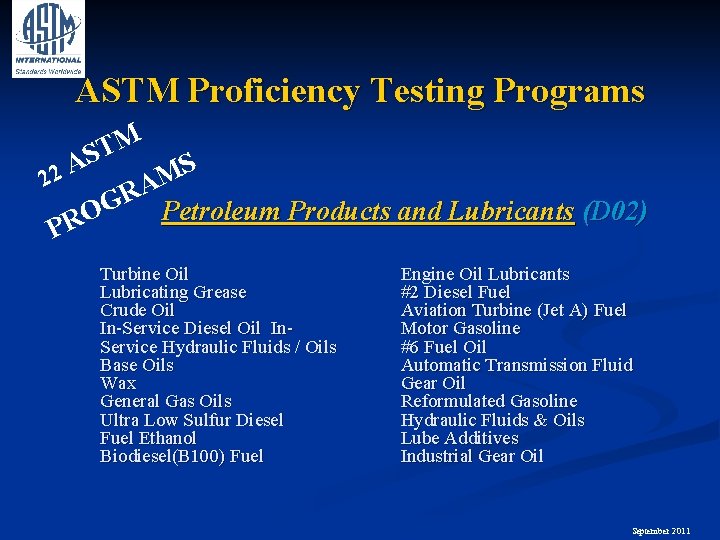
ASTM Proficiency Testing Programs M T S A S M 22 A R G Petroleum Products and Lubricants (D 02) O PR Turbine Oil Lubricating Grease Crude Oil In-Service Diesel Oil In. Service Hydraulic Fluids / Oils Base Oils Wax General Gas Oils Ultra Low Sulfur Diesel Fuel Ethanol Biodiesel(B 100) Fuel Engine Oil Lubricants #2 Diesel Fuel Aviation Turbine (Jet A) Fuel Motor Gasoline #6 Fuel Oil Automatic Transmission Fluid Gear Oil Reformulated Gasoline Hydraulic Fluids & Oils Lube Additives Industrial Gear Oil September 2011
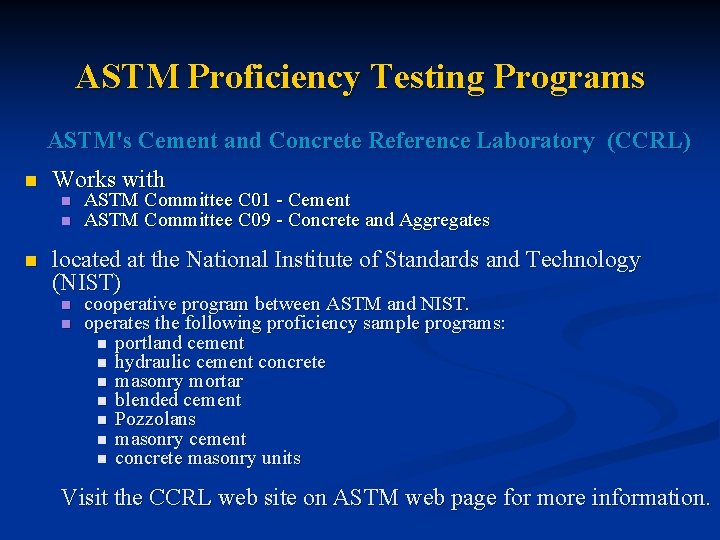
ASTM Proficiency Testing Programs ASTM's Cement and Concrete Reference Laboratory (CCRL) n Works with n n n ASTM Committee C 01 - Cement ASTM Committee C 09 - Concrete and Aggregates located at the National Institute of Standards and Technology (NIST) n n cooperative program between ASTM and NIST. operates the following proficiency sample programs: n portland cement n hydraulic cement concrete n masonry mortar n blended cement n Pozzolans n masonry cement n concrete masonry units Visit the CCRL web site on ASTM web page for more information.
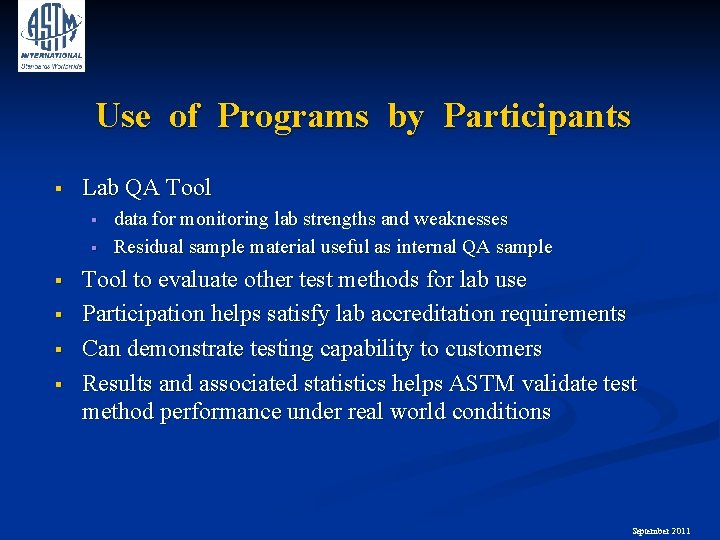
Use of Programs by Participants § Lab QA Tool § § § data for monitoring lab strengths and weaknesses Residual sample material useful as internal QA sample Tool to evaluate other test methods for lab use Participation helps satisfy lab accreditation requirements Can demonstrate testing capability to customers Results and associated statistics helps ASTM validate test method performance under real world conditions September 2011
Use of Programs by ASTM Committees § Obtain valuable feedback on methods § Resource for increased membership § Database of laboratories for test method validation September 2011
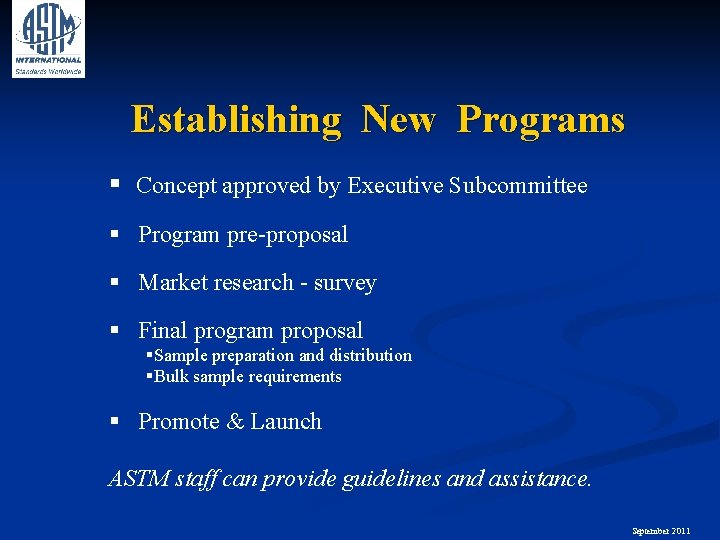
Establishing New Programs § Concept approved by Executive Subcommittee § Program pre-proposal § Market research - survey § Final program proposal §Sample preparation and distribution §Bulk sample requirements § Promote & Launch ASTM staff can provide guidelines and assistance. September 2011
ASTM Proficiency Testing Programs The programs are open to all companies and industry test professionals worldwide. September 2011
ASTM Proficiency Testing Programs For more information please contact: ASTM - PTP Liz Mitchell lizmitchell@astm. org Phone: (610) 832 -9688 “Until a measurement is in a state of statistical control, it can not be believed in any logical sense that it's measuring anything at all. " Dr. Churchill Eisenhart September 2011
ASTM International Interlaboratory Study Program (ILS) Presenter: Phillip Godorov August 2010
ASTM ILS Program Objectives u Strengthen the perceived quality of ASTM Test Methods u Produce data that will be used to develop Precision & Bias statements and Research Reports u Provide administrative support to the committees u Provide financial support to the committees u Help ensure the confidentiality of participating labs August 2010
Administrative Support u Review of Experimental Design u Assistance identifying volunteer laboratories u Identification of sample vendors u Coordination of sample distribution u Data collection u Statistical processing u Generation of reports August 2010
Strengths of the ASTM Interlaboratory Study Program u Input encouraged from active Committee volunteers, as well as non-members, broadening the range and diversity of the study participants, allowing the study to most accurately demonstrate expected “real-world” precision u Scientific neutrality of ASTM in reviewing test data u Provides value-added Quality Assurance Programs to participating laboratories August 2010
Potential Benefits of Participation u Statistical program to monitor strengths and weaknesses of lab testing when compared to peers u Assess testing performance and adherence to written procedures by lab technicians u May help meet the interlaboratory testing requirements of accreditation programs u Recognition in the final Research Report and on the Committee’s webpage August 2010
Benefits to the Committees u Obtain valuable feedback on methods, leading to the correction of errors and omissions, as well as highlighting the need for technical updates u Resource for increased membership u Database of laboratories for test method validation u Database of suppliers for common study materials August 2010
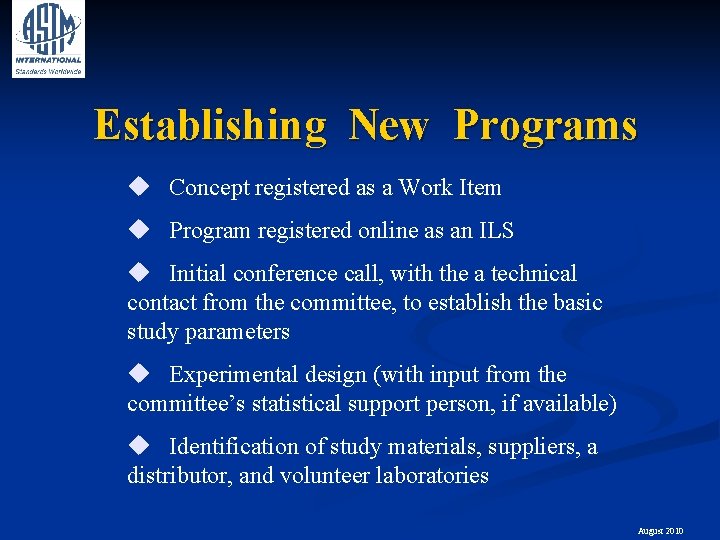
Establishing New Programs u Concept registered as a Work Item u Program registered online as an ILS u Initial conference call, with the a technical contact from the committee, to establish the basic study parameters u Experimental design (with input from the committee’s statistical support person, if available) u Identification of study materials, suppliers, a distributor, and volunteer laboratories August 2010
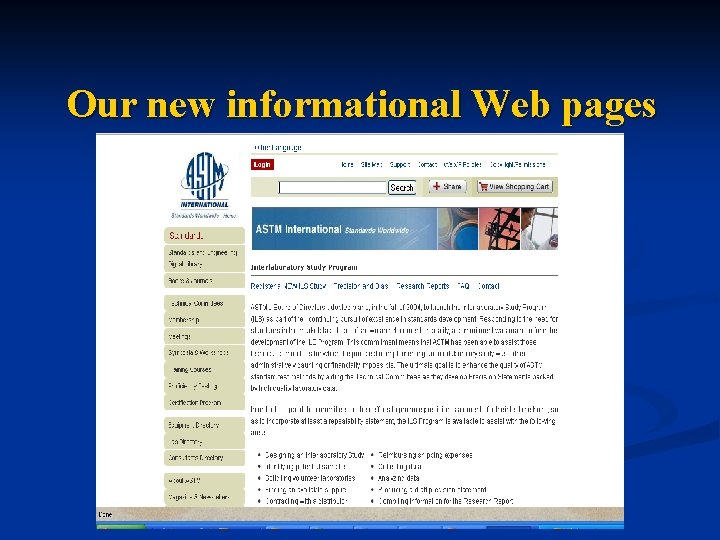
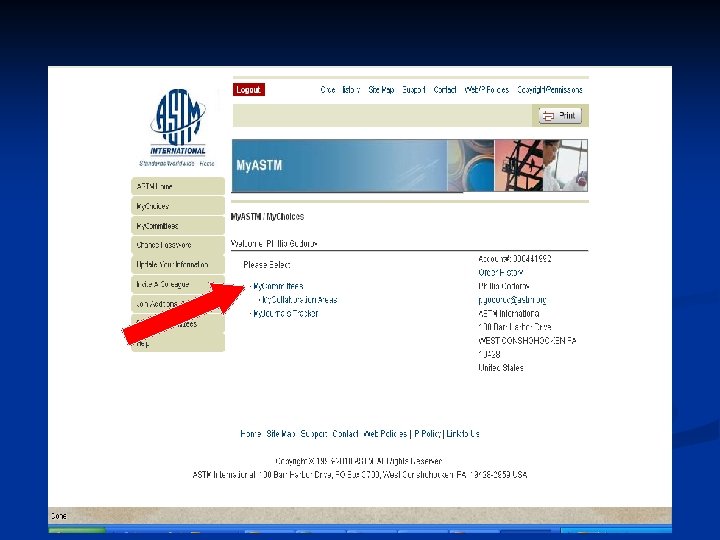
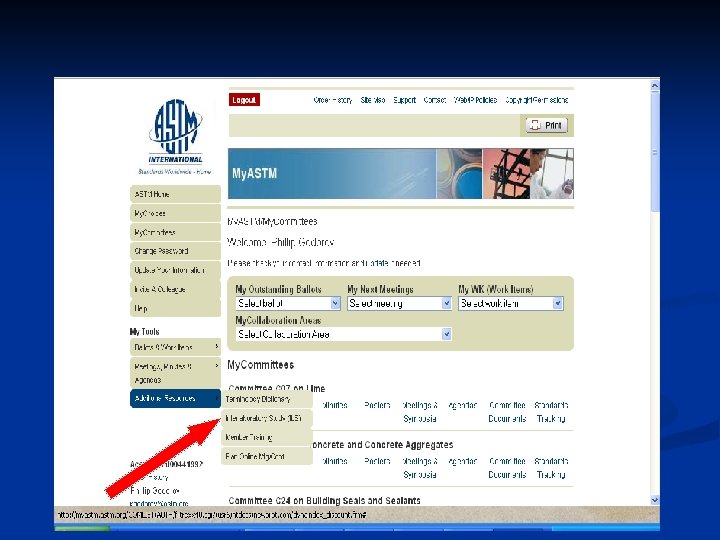
Our new informational Web pages
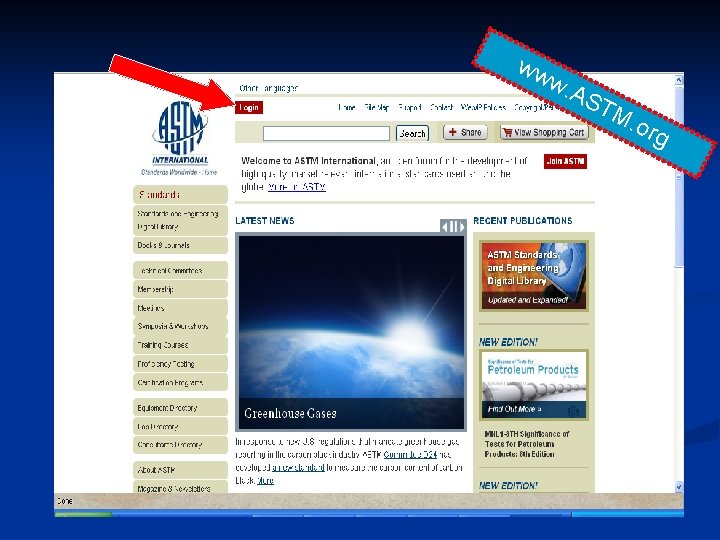
ww w. A ST M. org
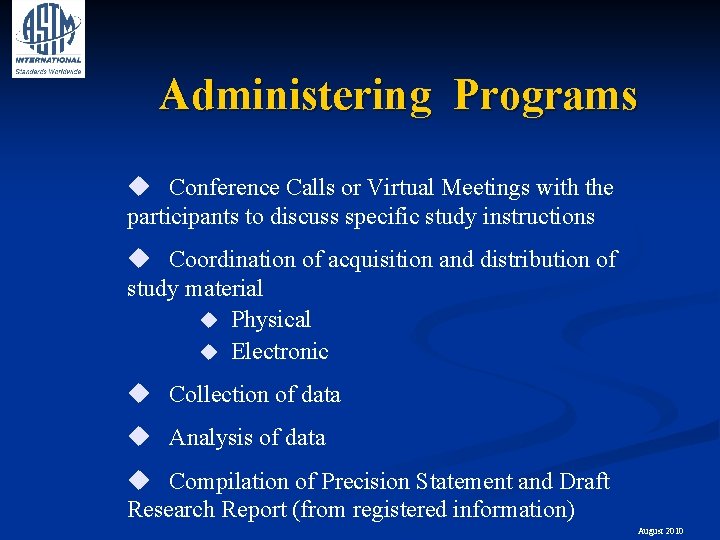
Administering Programs u Conference Calls or Virtual Meetings with the participants to discuss specific study instructions u Coordination of acquisition and distribution of study material u Physical u Electronic u Collection of data u Analysis of data u Compilation of Precision Statement and Draft Research Report (from registered information) August 2010
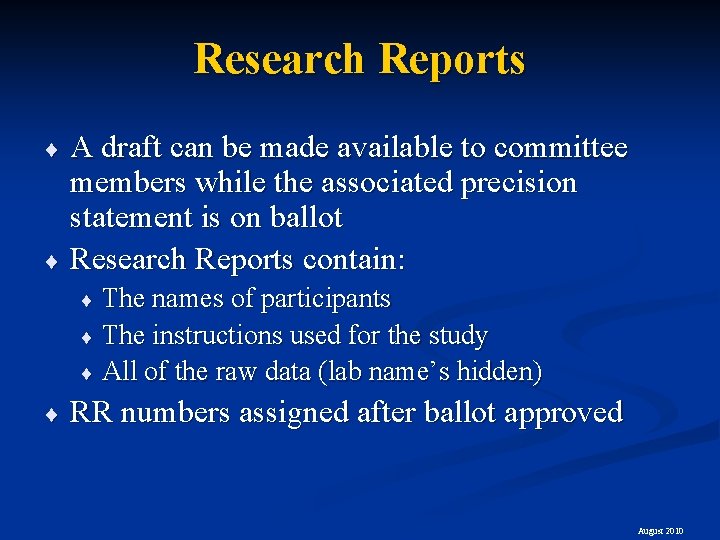
Research Reports A draft can be made available to committee members while the associated precision statement is on ballot ¨ Research Reports contain: ¨ The names of participants ¨ The instructions used for the study ¨ All of the raw data (lab name’s hidden) ¨ ¨ RR numbers assigned after ballot approved August 2010
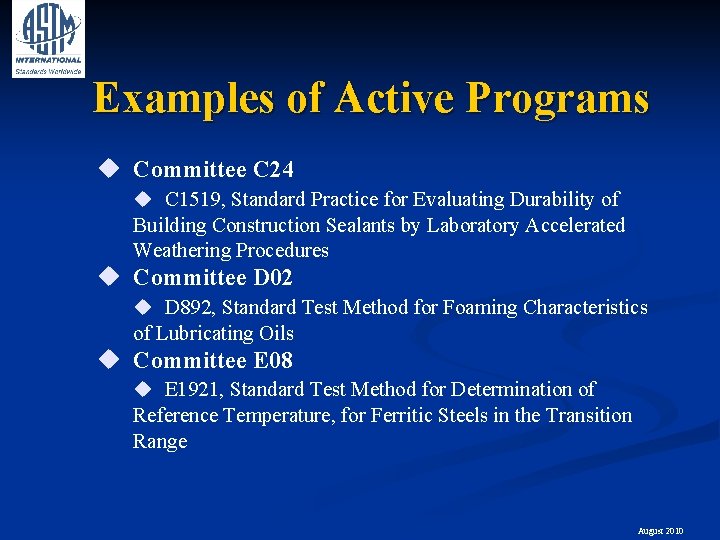
Examples of Active Programs u Committee C 24 u C 1519, Standard Practice for Evaluating Durability of Building Construction Sealants by Laboratory Accelerated Weathering Procedures u Committee D 02 u D 892, Standard Test Method for Foaming Characteristics of Lubricating Oils u Committee E 08 u E 1921, Standard Test Method for Determination of Reference Temperature, for Ferritic Steels in the Transition Range August 2010
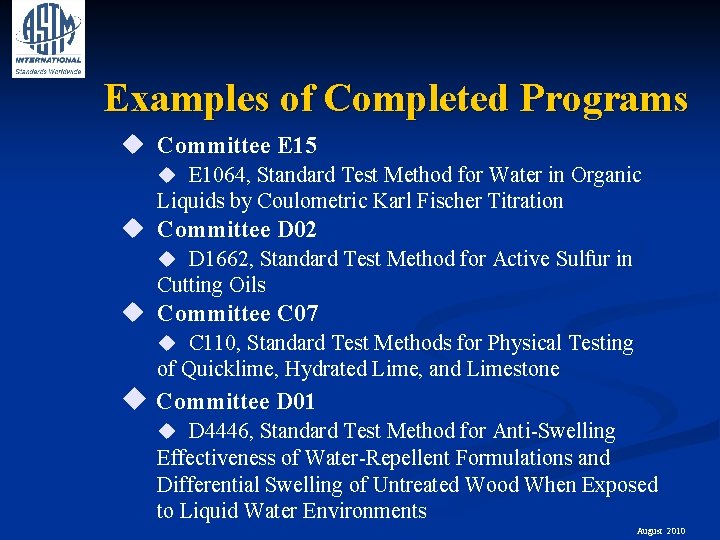
Examples of Completed Programs u Committee E 15 u E 1064, Standard Test Method for Water in Organic Liquids by Coulometric Karl Fischer Titration u Committee D 02 u D 1662, Standard Test Method for Active Sulfur in Cutting Oils u Committee C 07 u C 110, Standard Test Methods for Physical Testing of Quicklime, Hydrated Lime, and Limestone u Committee D 01 u D 4446, Standard Test Method for Anti-Swelling Effectiveness of Water-Repellent Formulations and Differential Swelling of Untreated Wood When Exposed to Liquid Water Environments August 2010
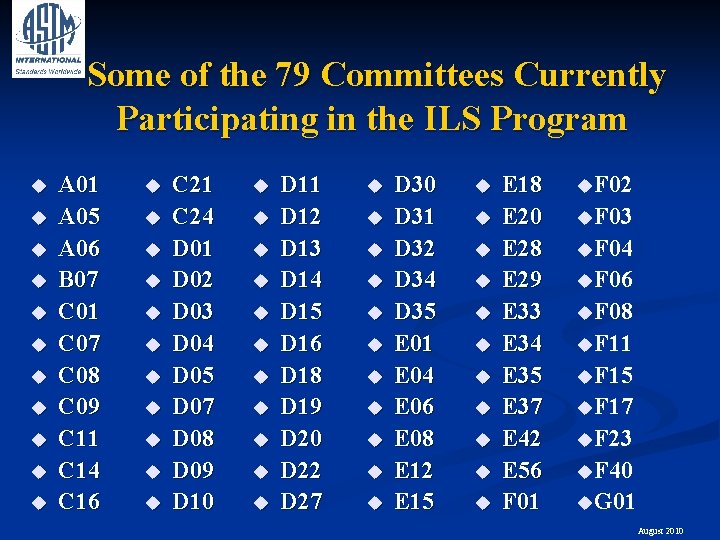
Some of the 79 Committees Currently Participating in the ILS Program u u u A 01 A 05 A 06 B 07 C 01 C 07 C 08 C 09 C 11 C 14 C 16 u u u C 21 C 24 D 01 D 02 D 03 D 04 D 05 D 07 D 08 D 09 D 10 u u u D 11 D 12 D 13 D 14 D 15 D 16 D 18 D 19 D 20 D 22 D 27 u u u D 30 D 31 D 32 D 34 D 35 E 01 E 04 E 06 E 08 E 12 E 15 u u u E 18 E 20 E 28 E 29 E 33 E 34 E 35 E 37 E 42 E 56 F 01 u. F 02 u. F 03 u. F 04 u. F 06 u. F 08 u. F 11 u. F 15 u. F 17 u. F 23 u. F 40 u. G 01 August 2010
ASTM International Interlaboratory Study Program (ILS) Phillip Godorov Director, Interlaboratory Study Program ASTM International 100 Barr Harbor Drive West Conshohocken, PA 19428 -2959 Phone: 610 -832 -9715 Fax: 610 -834 -7011 E-mail: pgodorov@astm. org August 2010
Thank you for attending the ASTM International 2010 Officer’s Conference § Proficiency / Interlaboratory Crosscheck Testing Programs § Interlaboratory Study Program (ILS) August 2010
- Slides: 38