
ASTM D 5034 09 2017 Standard Test Method
- Slides: 29
ASTM D 5034 -09 (2017) Standard Test Method for Breaking Strength and Elongation of Textile Fabrics (Grab Test) ASTM D 5035 -11 (2019) Standard Test Method for Breaking Force and Elongation of Textile Fabrics (Strip Method)
Definition • Breaking Force: the maximum force applied to a material carried to rupture – Discussion: Materials that are brittle usually rupture at the maximum force. Materials that are ductile usually experience a maximum force before rupturing. ASTM D 5034 & D 5035
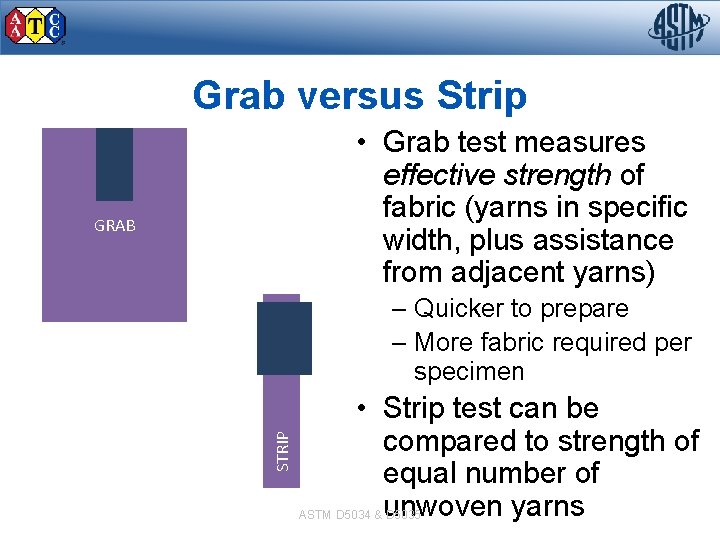
Grab versus Strip • Grab test measures effective strength of fabric (yarns in specific width, plus assistance from adjacent yarns) GRAB STRIP – Quicker to prepare – More fabric required per specimen • Strip test can be compared to strength of equal number of unwoven yarns ASTM D 5034 & D 5035
Apparatus & Materials • • Tensile testing machine (300 ± 10 mm/min) Clamps and jaw faces Pins (for high-strength fabrics) For wet test: – Distilled water – Nonionic wetting agent (if needed) • Standard fabrics (for verification) ASTM D 5034 & D 5035
Tensile Testing Machines • CRE (Constant Rate of Extension), the pulling clamp moves at a uniform rate and the forcemeasuring mechanism moves a negligible distance. • CRL (Constant Rate of Load), the rate of increase of force is uniform with time after the first 3 seconds and the specimen is free to elongate. • CRT (Constant Rate of Traverse), the pulling clamp moves at a uniform rate and the force is applied through the other clamp which moves noticeably. ASTM D 5034 & D 5035
Conditioning • Condition specimens according to ASTM D 1776 • For wet test: immerse specimens in room temperature water – Use nonionic wetting agent if needed – Test within two minutes of removal from water ASTM D 5034 & D 5035
Scope: ASTM D 5034 • Grab and modified grab procedures for determining breaking strength • Mainly used for woven fabrics – Also, nonwovens and felted fabrics – NOT recommended for glass, knitted, or highstretch (> 11%) fabrics ASTM D 5034
Test Options: ASTM D 5034 • Type of specimen: – G (Grab) – MG (Modified Grab) • Type of tensile testing machine: – E (Constant-Rate-of-Extension/CRE) – L (Constant-Rate-of-Load/CRL) – T (Constant-Rate-of-Traverse/CRT) ASTM D 5034 & D 5035
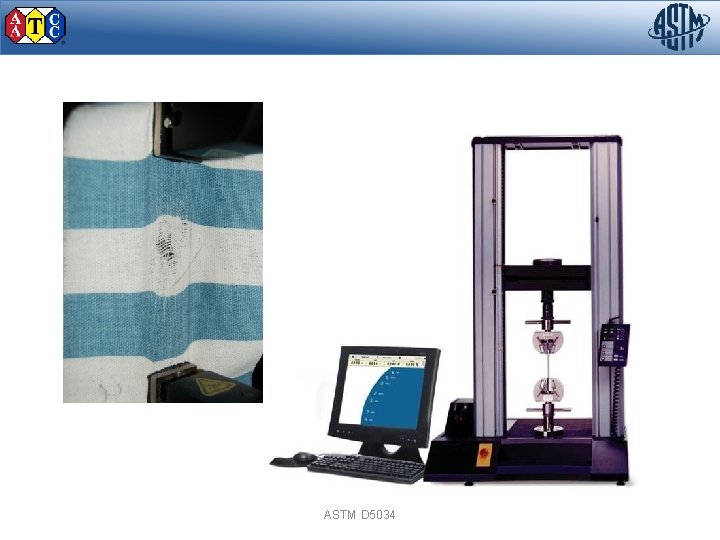
ASTM D 5034
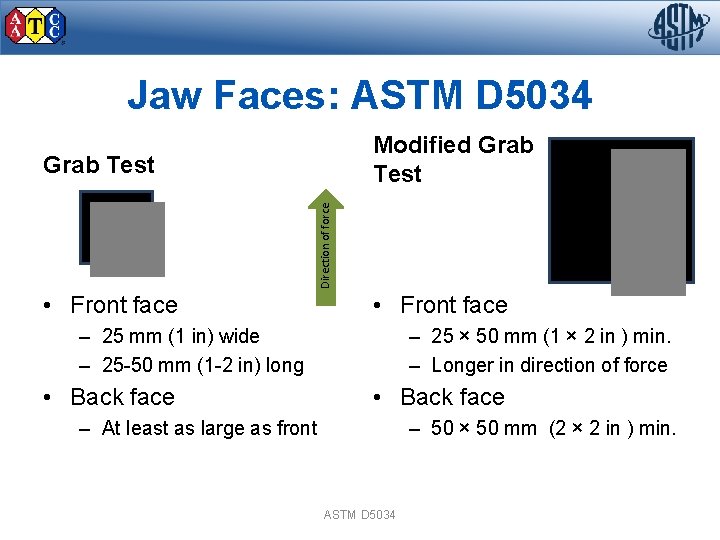
Jaw Faces: ASTM D 5034 Modified Grab Test Direction of force Grab Test • Front face – 25 mm (1 in) wide – 25 -50 mm (1 -2 in) long • Back face – 25 × 50 mm (1 × 2 in ) min. – Longer in direction of force • Back face – At least as large as front – 50 × 50 mm (2 × 2 in ) min. ASTM D 5034
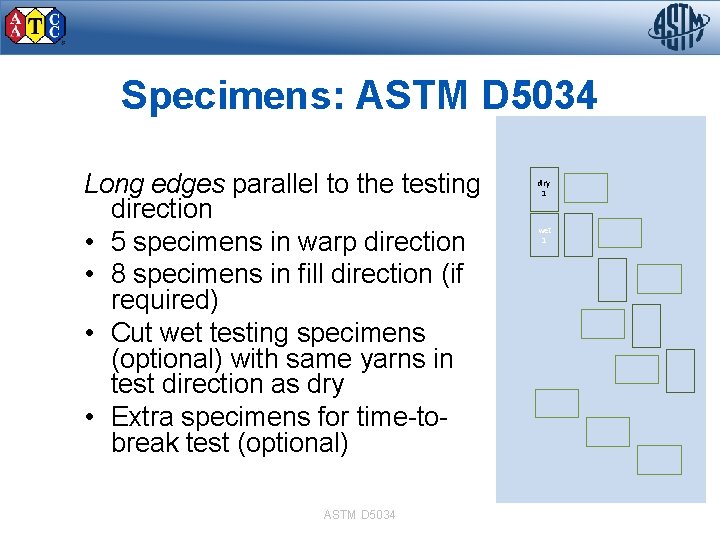
Specimens: ASTM D 5034 Long edges parallel to the testing direction • 5 specimens in warp direction • 8 specimens in fill direction (if required) • Cut wet testing specimens (optional) with same yarns in test direction as dry • Extra specimens for time-tobreak test (optional) ASTM D 5034 dry 1 wet 1
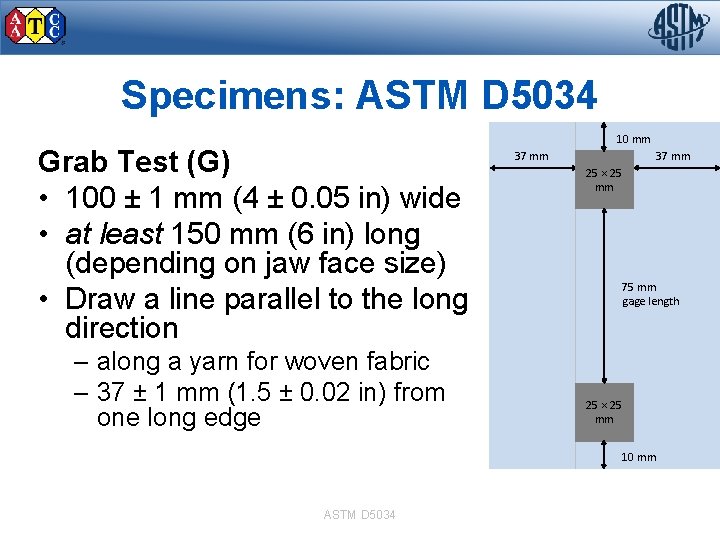
Specimens: ASTM D 5034 Grab Test (G) • 100 ± 1 mm (4 ± 0. 05 in) wide • at least 150 mm (6 in) long (depending on jaw face size) • Draw a line parallel to the long direction – along a yarn for woven fabric – 37 ± 1 mm (1. 5 ± 0. 02 in) from one long edge 10 mm 37 mm 25 × 25 mm 75 mm gage length 25 × 25 mm 10 mm ASTM D 5034
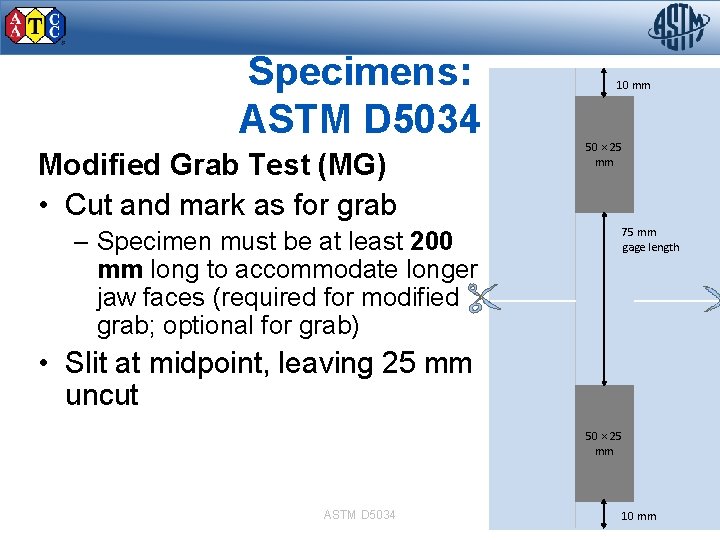
Specimens: ASTM D 5034 Modified Grab Test (MG) • Cut and mark as for grab 10 mm 50 × 25 mm 75 mm gage length – Specimen must be at least 200 mm long to accommodate longer jaw faces (required for modified grab; optional for grab) • Slit at midpoint, leaving 25 mm uncut 50 × 25 mm ASTM D 5034 10 mm
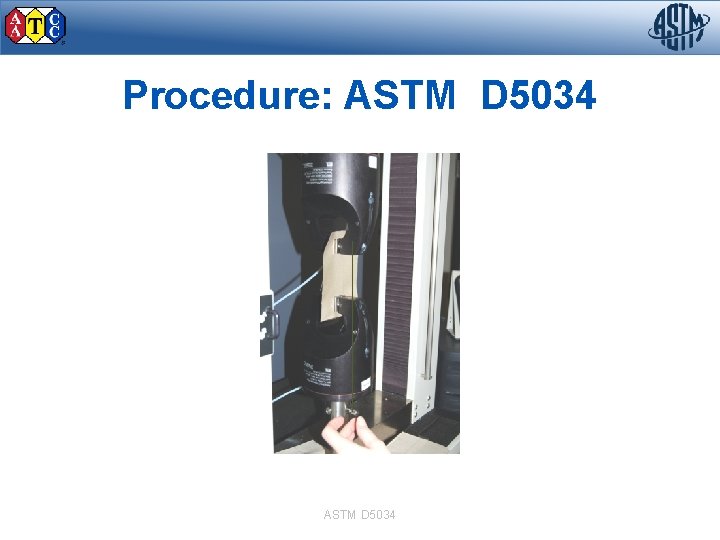
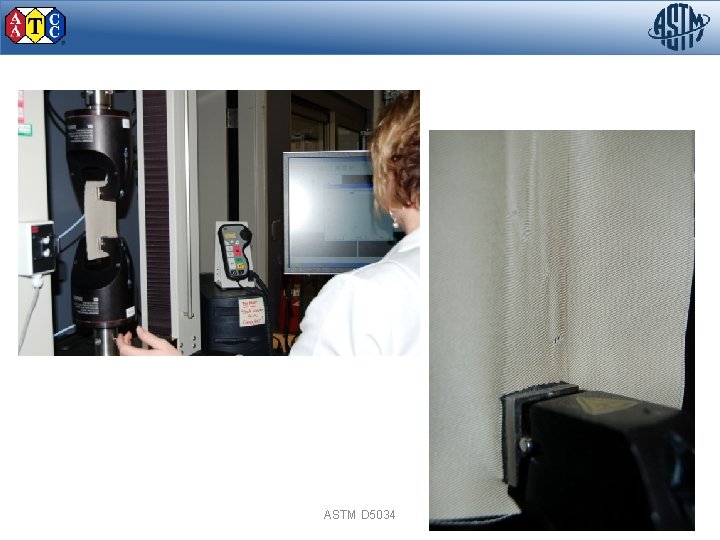
Procedure: ASTM D 5034 • Mount the specimen in the jaws with the parallel line adjacent to the side of the upper and lower front jaw faces. • The parallel line ensures the same lengthwise yarns (of woven fabrics) are gripped in both clamps and that the force application is not at an appreciable angle to the test direction of nonwoven fabrics. • Tension on the specimen should be uniform across the clamp width. ASTM D 5034
Procedure: ASTM D 5034
Procedure: ASTM D 5034 • Operate the machine and break the specimen. • Read the breaking force, and elongation if required. Record warp and fill direction results separately. • If a specimen slips in the jaws, or breaks at or in the jaws, discard and test another specimen. ASTM D 5034
ASTM D 5034
Report: ASTM D 5034 • Test method • Material tested • Average breaking force of acceptable specimens for each test condition • Average percent apparent elongation of acceptable specimens for each test condition and strip test (if calculated) • Number of specimens tested in each direction • Type of specimen and testing machine used • Maximum force obtainable in the range used for testing ASTM D 5034
Scope: ASTM D 5035 • Raveled and cut strip test procedures for determining the breaking force and elongation of most textile fabrics. • Raveled strip test is applicable to woven fabrics • Cut strip test is applicable to nonwoven, felted, dipped, and coated fabrics (that can not be raveled) • Not recommended for knitted fabrics or for other textile fabrics which have high stretch (more than 11%). ASTM D 5035
Specimens: ASTM D 5035 • • 1 R: 25 mm (1. 0 in. ) raveled strip test 2 R: 50 mm (2. 0 in. ) raveled strip test 1 C: 25 mm (1. 0 in. ) cut strip test 2 C: 50 mm (2. 0 in. ) cut strip test ASTM D 5035
Specimens: ASTM D 5035 Long edges parallel to the testing direction • 5 specimens in warp direction • 8 specimens in fill direction (if required) • Cut wet testing specimens (optional) with same yarns in test direction as dry • Extra specimens for time-to-break test (optional) ASTM D 5034 & D 5035
1 R Specimens: 1” raveled strip test ASTM D 5035 • Width – 35 mm (1. 5 in) OR – 25 mm (1 in) plus 20 yarns (whichever is wider) • Length – At least 150 mm (6 in) • Longer for larger jaw faces and high-strength test with pins • Remove an approximately equal number of yarns from each long edge, leaving a testing width of 25 mm ASTM D 5035
2 R Specimens: 2” raveled strip test ASTM D 5035 • Width – 65 mm (2. 5 in) OR – 50 mm (2. 0 in) plus 20 yarns (whichever is wider) • Length – At least 150 mm (6 in) • Remove an approximately equal number of yarns from each long edge, leaving a testing width of 50 mm ASTM D 5035
Cut Strip Specimens ASTM D 5035 1 C: 1” cut strip test 2 C: 2” cut strip test • 25 mm (1 in) wide • At least 150 mm (6 in) long • 50 mm (2 in) wide • At least 150 mm (6 in) long ASTM D 5035
Jaw Faces: ASTM D 5035 • At least 10 mm (0. 5 in) wider than specimen ≥ 35 mm (1. 5 in) for 1 R and 1 C ≥ 60 mm (2. 5 in) for 2 R and 2 C • At least 25 mm (1 in) in direction of force ASTM D 5035
Procedure: ASTM D 5035 • Mount the specimen securely in the clamps. Make sure it is centrally located and that the long dimension is as nearly parallel as possible to the direction of force application. • Operate the machine and break the specimen. • Read the breaking force, and elongation if required. Record warp and fill direction results separately. • If a specimen slips in the jaws, or breaks at or in the jaws, discard and test another specimen. ASTM D 5035
Report: ASTM D 5035 • Test method (ASTM D 5035 -11) • Material tested • Average breaking force of acceptable specimens for each test condition and strip test • Average percent apparent elongation of acceptable specimens for each test condition and strip test (if calculated) • Number of specimens tested in each direction • Type of strip test and testing machine used • Maximum force obtainable in the range used for testing ASTM D 5035
Report: ASTM D 5035 • • • Pretension (if any) Size of jaw faces Jaw padding or specimen modification (if any) Number of yarns in the width of the strip (if < 20) Average time required to break, if applicable, for all specimens giving acceptable breaks • Condition (dry or wet) • For wet specimens, note whether allowance was made for shrinkage • Sizing/finish removal method (if applicable) ASTM D 5035
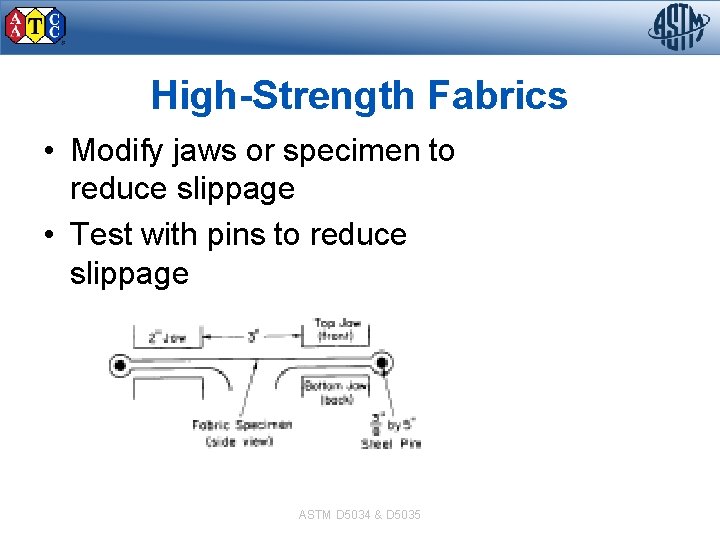
High-Strength Fabrics • Modify jaws or specimen to reduce slippage • Test with pins to reduce slippage ASTM D 5034 & D 5035