
ASTHMA MANAGEMENT PHARMACOLOGICAL THERAPY Presented by Hengameh Raissy
ASTHMA MANAGEMENT PHARMACOLOGICAL THERAPY Presented by: Hengameh Raissy, Pharm. D
Four Components of Asthma Management • Assessment and Monitoring • Control of Factors Contributing to Asthma Severity • Education for a Partnership in Asthma Care • Pharmacological Therapy NAEPP. EPR-3, page 1.
This lesson will cover: Asthma Classification Schemes Stepwise Approach to Asthma Therapy Asthma Medications and Delivery Devices New/Complementary/Alternative
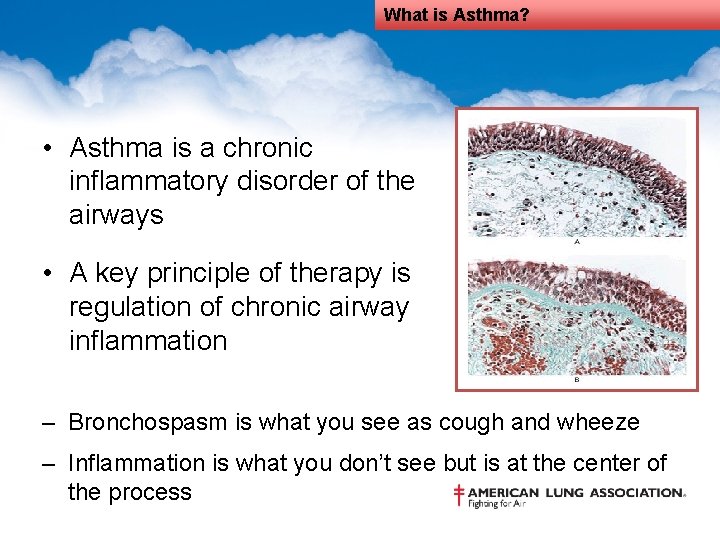
What is Asthma? • Asthma is a chronic inflammatory disorder of the airways • A key principle of therapy is regulation of chronic airway inflammation – Bronchospasm is what you see as cough and wheeze – Inflammation is what you don’t see but is at the center of the process
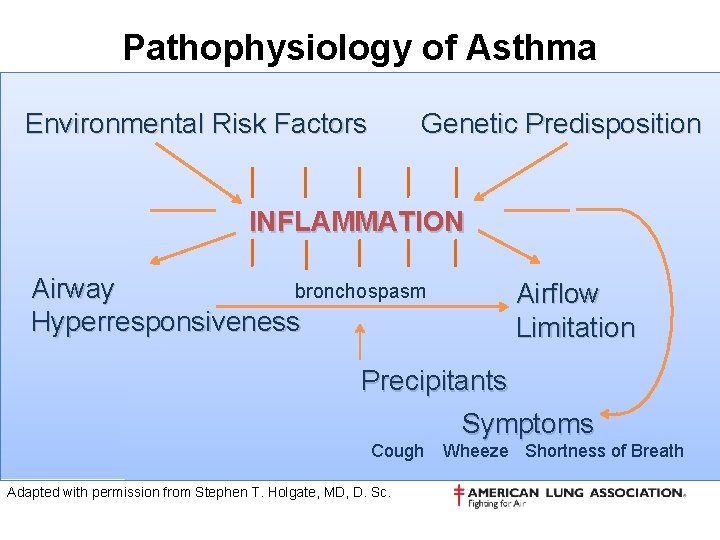
Pathophysiology of Asthma Environmental Risk Factors Genetic Predisposition INFLAMMATION Airway bronchospasm Hyperresponsiveness Airflow Limitation Precipitants Symptoms Cough Adapted with permission from Stephen T. Holgate, MD, D. Sc. Wheeze Shortness of Breath
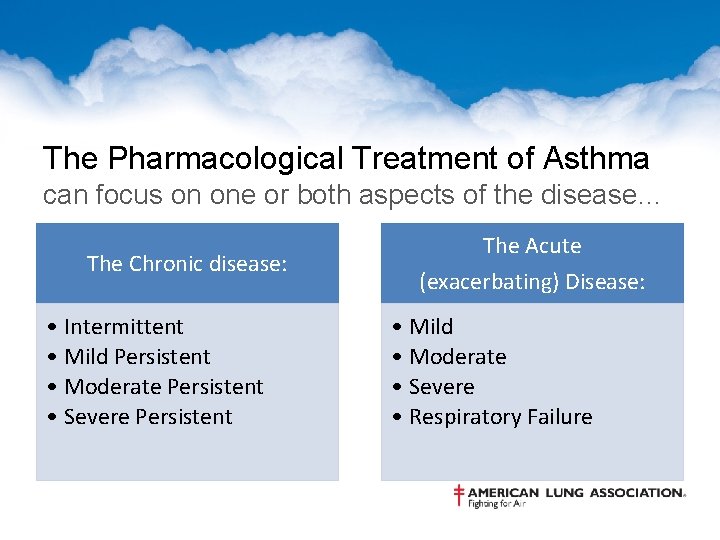
The Pharmacological Treatment of Asthma can focus on one or both aspects of the disease… The Chronic disease: • Intermittent • Mild Persistent • Moderate Persistent • Severe Persistent The Acute (exacerbating) Disease: • Mild • Moderate • Severe • Respiratory Failure
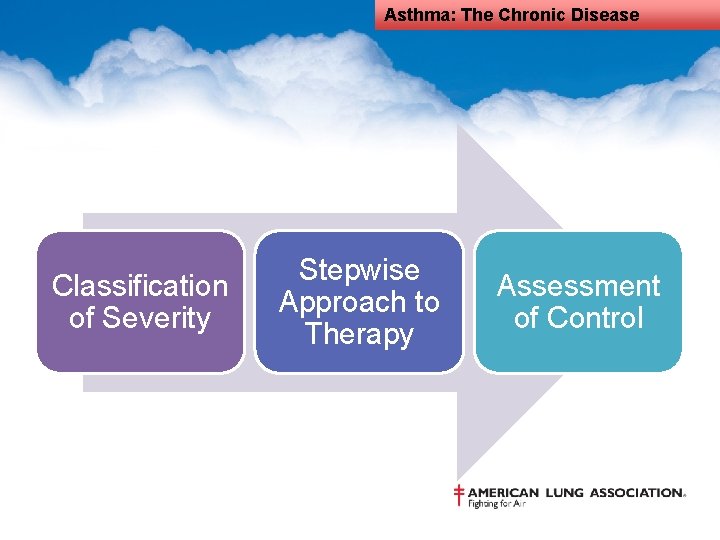
Asthma: The Chronic Disease Classification of Severity Stepwise Approach to Therapy Assessment of Control
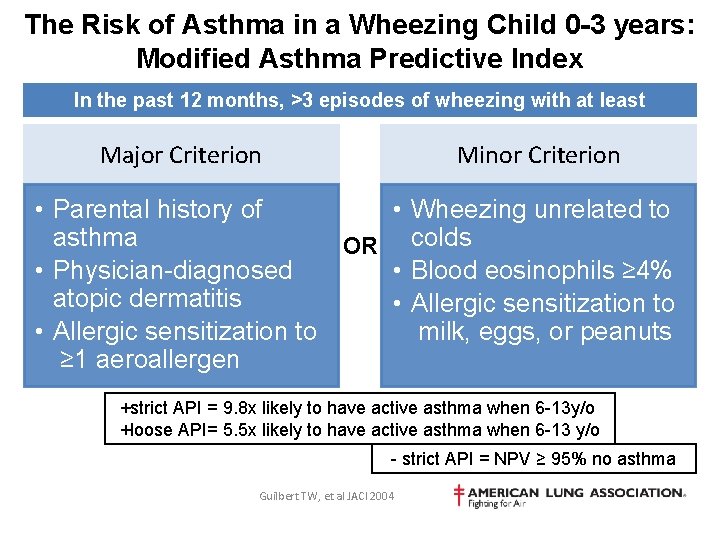
The Risk of Asthma in a Wheezing Child 0 -3 years: Modified Asthma Predictive Index In the past 12 months, >3 episodes of wheezing with at least Major Criterion Minor Criterion • Parental history of • Wheezing unrelated to asthma OR colds • Physician-diagnosed • Blood eosinophils ≥ 4% atopic dermatitis • Allergic sensitization to milk, eggs, or peanuts ≥ 1 aeroallergen +strict API = 9. 8 x likely to have active asthma when 6 -13 y/o +loose API= 5. 5 x likely to have active asthma when 6 -13 y/o - strict API = NPV ≥ 95% no asthma Guilbert TW, et al JACI 2004
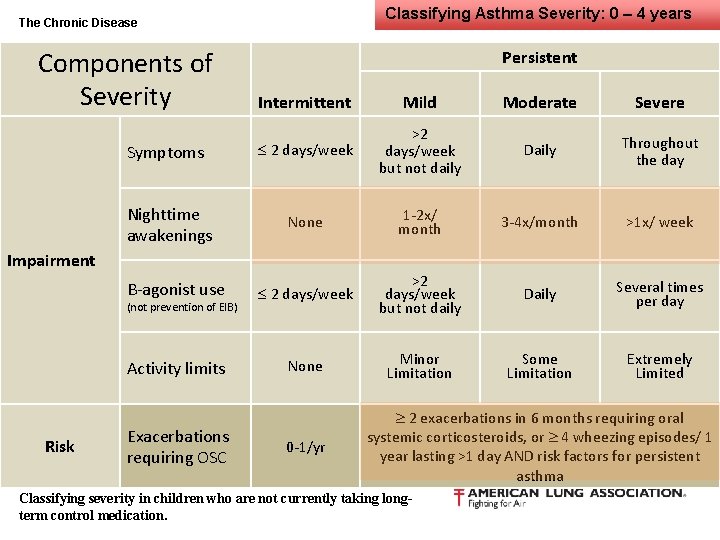
Classifying Asthma Severity: 0 – 4 years The Chronic Disease Components of Severity Persistent Intermittent Mild Moderate Severe Symptoms 2 days/week >2 days/week but not daily Daily Throughout the day Nighttime awakenings None 1 -2 x/ month 3 -4 x/month >1 x/ week B-agonist use 2 days/week >2 days/week but not daily Daily Several times per day Activity limits None Minor Limitation Some Limitation Extremely Limited Impairment (not prevention of EIB) Risk Exacerbations requiring OSC 0 -1/yr 2 exacerbations in 6 months requiring oral systemic corticosteroids, or 4 wheezing episodes/ 1 year lasting >1 day AND risk factors for persistent asthma Classifying severity in children who are not currently taking longterm control medication.

Initial Therapies / Stepwise Approach: Asthma Patients 0 -4 Years of Age Recommend consult Consider consult A Step 1 Preferred: SABA PRN Step 3 Step 2 Preferred: Low-dose ICS Mediumdose ICS D D Step 6 Step 5 Preferred: Step 4 Preferred: High-dose ICS + either LABA or Montelukast (first, check adherence, inhaler technique, environmental control) OSC Assess Control Mediumdose ICS + either LABA or Montelukast Alternative: Cromolyn or Montelukast Mild Intermittent D D Step Up If Needed Step Down If Possible Moderate Severe Persistent Each Step: Patient education, environmental control, management of co morbidities If alternative treatment is used and response is inadequate, discontinue it and use the preferred treatment before stepping up ICS = inhaled corticosteroid; LABA = long-acting beta 2 -agonist; OSC = Oral Systemic Corticosteroids. ; SABA = inhaled short-acting beta 2 -agonist. (and asthma is well controlled at least 3 months)
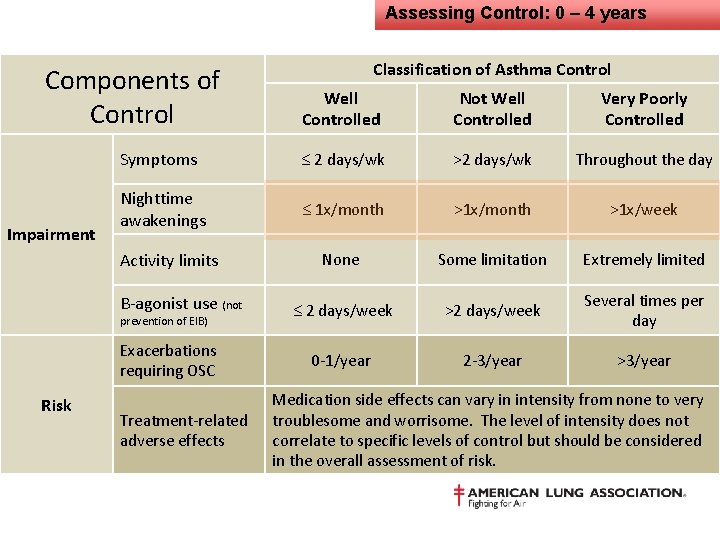
Assessing Control: 0 – 4 years Components of Control Impairment Well Controlled Not Well Controlled Very Poorly Controlled Symptoms 2 days/wk >2 days/wk Throughout the day Nighttime awakenings 1 x/month >1 x/week None Some limitation Extremely limited 2 days/week >2 days/week Several times per day 0 -1/year 2 -3/year >3/year Activity limits B-agonist use (not prevention of EIB) Exacerbations requiring OSC Risk Classification of Asthma Control Treatment-related adverse effects Medication side effects can vary in intensity from none to very troublesome and worrisome. The level of intensity does not correlate to specific levels of control but should be considered in the overall assessment of risk.
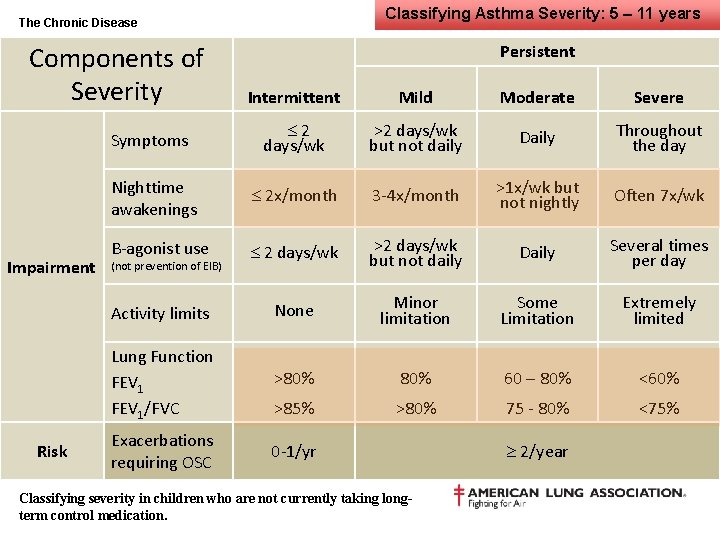
Classifying Asthma Severity: 5 – 11 years The Chronic Disease Components of Severity Impairment Risk Persistent Intermittent Mild Moderate Severe Symptoms 2 days/wk >2 days/wk but not daily Daily Throughout the day Nighttime awakenings 2 x/month 3 -4 x/month >1 x/wk but not nightly Often 7 x/wk B-agonist use 2 days/wk >2 days/wk but not daily Daily Several times per day Activity limits None Minor limitation Some Limitation Extremely limited Lung Function FEV 1/FVC >80% 60 – 80% <60% >85% >80% 75 - 80% <75% Exacerbations requiring OSC 0 -1/yr (not prevention of EIB) Classifying severity in children who are not currently taking longterm control medication. 2/year
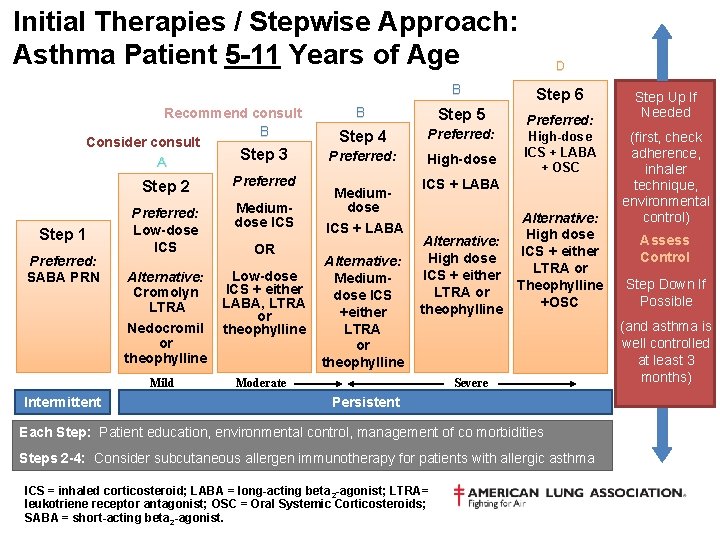
Initial Therapies / Stepwise Approach: Asthma Patient 5 -11 Years of Age B B Step 5 B Step 4 Preferred: Step 3 Preferred: High-dose Recommend consult Consider consult A Step 1 Preferred: SABA PRN Step 2 Preferred: Low-dose ICS Mediumdose ICS Alternative: Cromolyn LTRA Nedocromil or theophylline Low-dose ICS + either LABA, LTRA or theophylline Mild Intermittent OR Mediumdose ICS + LABA Alternative: Mediumdose ICS +either LTRA or theophylline D Step 6 Preferred: High-dose ICS + LABA + OSC ICS + LABA Alternative: High dose ICS + either LTRA or theophylline Moderate Alternative: High dose ICS + either LTRA or Theophylline +OSC Severe Persistent Each Step: Patient education, environmental control, management of co morbidities Steps 2 -4: Consider subcutaneous allergen immunotherapy for patients with allergic asthma ICS = inhaled corticosteroid; LABA = long-acting beta 2 -agonist; LTRA= leukotriene receptor antagonist; OSC = Oral Systemic Corticosteroids; SABA = short-acting beta 2 -agonist. Step Up If Needed (first, check adherence, inhaler technique, environmental control) Assess Control Step Down If Possible (and asthma is well controlled at least 3 months)
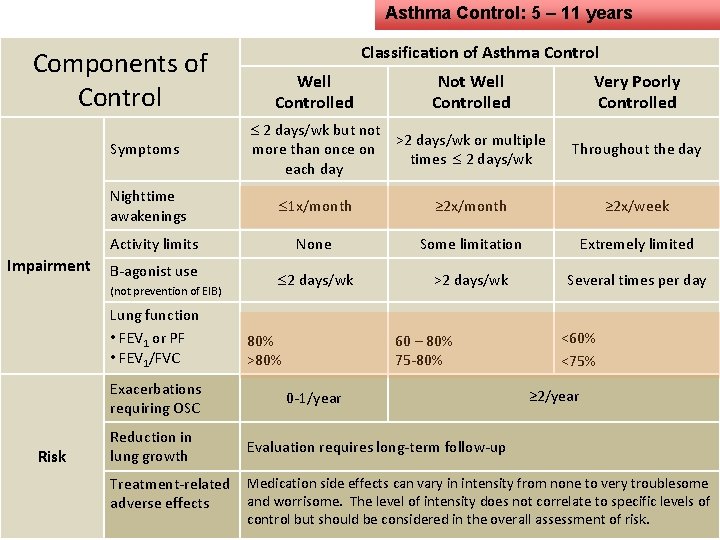
Asthma Control: 5 – 11 years Components of Control Symptoms Nighttime awakenings Impairment Well Controlled Not Well Controlled Very Poorly Controlled 2 days/wk but not >2 days/wk or multiple more than once on times 2 days/wk each day Throughout the day 1 x/month ≥ 2 x/week Activity limits None Some limitation Extremely limited B-agonist use 2 days/wk >2 days/wk Several times per day (not prevention of EIB) Lung function • FEV 1 or PF • FEV 1/FVC Exacerbations requiring OSC Risk Classification of Asthma Control Reduction in lung growth Treatment-related adverse effects 80% >80% 60 – 80% 75 -80% 0 -1/year <60% <75% ≥ 2/year Evaluation requires long-term follow-up Medication side effects can vary in intensity from none to very troublesome and worrisome. The level of intensity does not correlate to specific levels of control but should be considered in the overall assessment of risk.
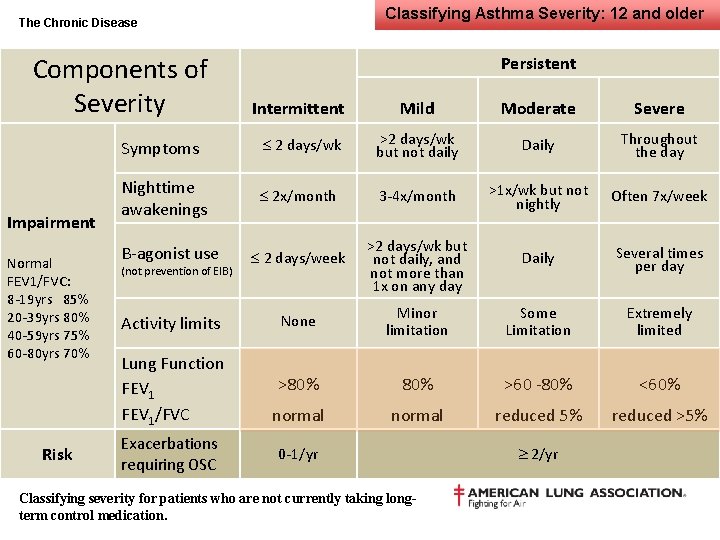
Classifying Asthma Severity: 12 and older The Chronic Disease Components of Severity Impairment Normal FEV 1/FVC: 8 -19 yrs 85% 20 -39 yrs 80% 40 -59 yrs 75% 60 -80 yrs 70% Risk Persistent Intermittent Mild Moderate Severe Symptoms 2 days/wk >2 days/wk but not daily Daily Throughout the day Nighttime awakenings 2 x/month 3 -4 x/month >1 x/wk but not nightly Often 7 x/week >2 days/wk but not daily, and not more than 1 x on any day Daily Several times per day B-agonist use 2 days/week Activity limits None Minor limitation Some Limitation Extremely limited Lung Function FEV 1/FVC >80% >60 -80% <60% normal reduced 5% reduced >5% (not prevention of EIB) Exacerbations requiring OSC 0 -1/yr Classifying severity for patients who are not currently taking longterm control medication. 2/yr
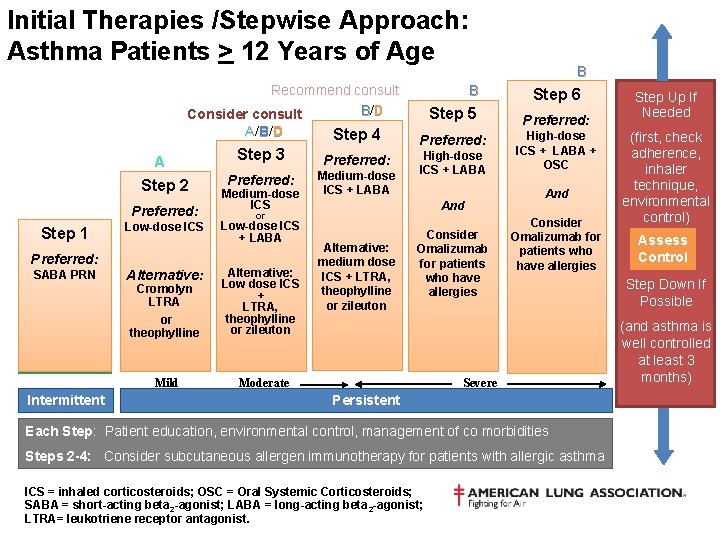
Initial Therapies /Stepwise Approach: Asthma Patients > 12 Years of Age Recommend consult Consider consult A / B/ D A Step 2 Preferred: Step 1 Preferred: SABA PRN Intermittent Low-dose ICS Step 3 Preferred: Medium-dose ICS Cromolyn LTRA or theophylline Alternative: Low dose ICS + LTRA, theophylline or zileuton Mild Moderate Alternative: B B/D Step 5 Step 4 Preferred: High-dose ICS + LABA Medium-dose ICS + LABA And or Low-dose ICS + LABA B Alternative: medium dose ICS + LTRA, theophylline or zileuton Consider Omalizumab for patients who have allergies Step 6 Preferred: High-dose ICS + LABA + OSC And Consider Omalizumab for patients who have allergies Severe Persistent Each Step: Patient education, environmental control, management of co morbidities Steps 2 -4: Consider subcutaneous allergen immunotherapy for patients with allergic asthma ICS = inhaled corticosteroids; OSC = Oral Systemic Corticosteroids; SABA = short-acting beta 2 -agonist; LABA = long-acting beta 2 -agonist; LTRA= leukotriene receptor antagonist. Step Up If Needed (first, check adherence, inhaler technique, environmental control) Assess Control Step Down If Possible (and asthma is well controlled at least 3 months)
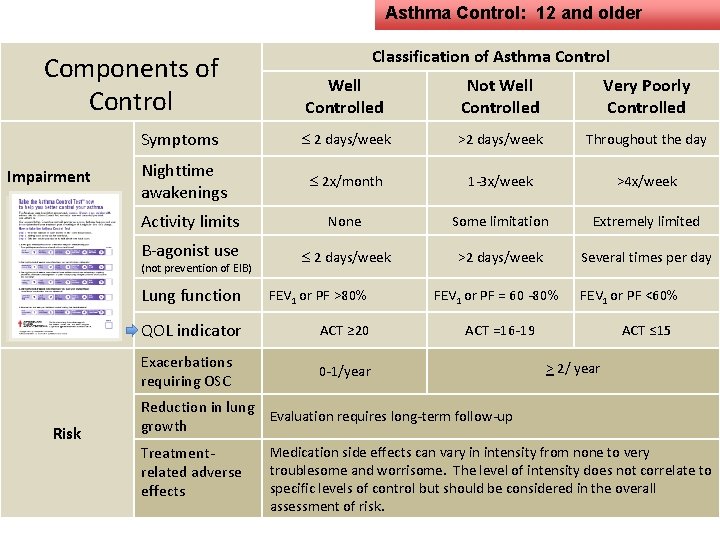
Asthma Control: 12 and older Components of Control Impairment Well Controlled Not Well Controlled Very Poorly Controlled Symptoms 2 days/week >2 days/week Throughout the day Nighttime awakenings 2 x/month 1 -3 x/week >4 x/week Activity limits None Some limitation Extremely limited B-agonist use 2 days/week >2 days/week Several times per day (not prevention of EIB) Risk Classification of Asthma Control Lung function FEV 1 or PF >80% QOL indicator ACT ≥ 20 Exacerbations requiring OSC 0 -1/year FEV 1 or PF = 60 -80% FEV 1 or PF <60% ACT =16 -19 ACT ≤ 15 > 2/ year Reduction in lung Evaluation requires long-term follow-up growth Treatmentrelated adverse effects Medication side effects can vary in intensity from none to very troublesome and worrisome. The level of intensity does not correlate to specific levels of control but should be considered in the overall assessment of risk.
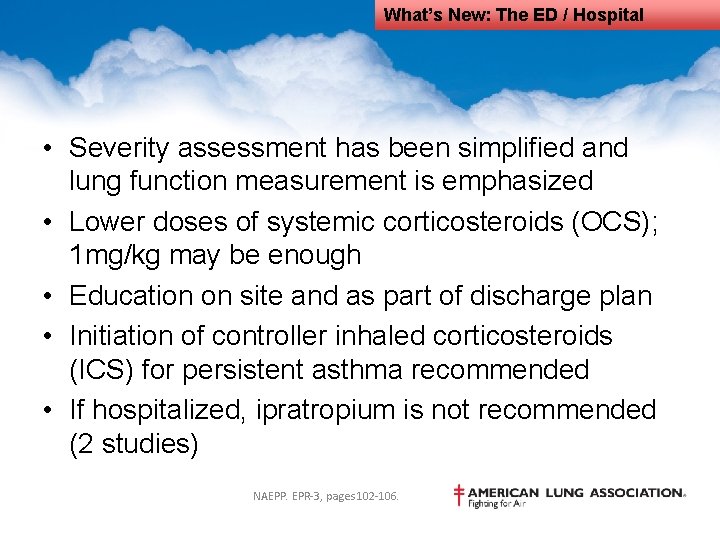
What’s New: The ED / Hospital • Severity assessment has been simplified and lung function measurement is emphasized • Lower doses of systemic corticosteroids (OCS); 1 mg/kg may be enough • Education on site and as part of discharge plan • Initiation of controller inhaled corticosteroids (ICS) for persistent asthma recommended • If hospitalized, ipratropium is not recommended (2 studies) NAEPP. EPR-3, pages 102 -106.
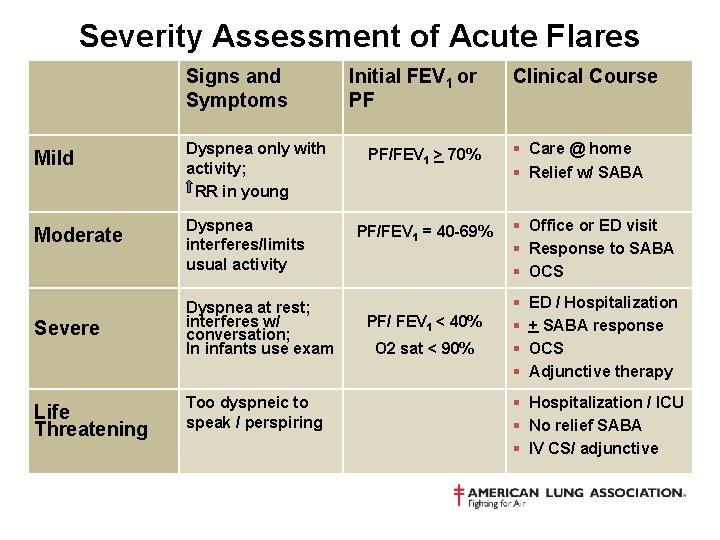
Severity Assessment of Acute Flares Signs and Symptoms Mild Dyspnea only with activity; RR in young Moderate Dyspnea interferes/limits usual activity Severe Life Threatening Dyspnea at rest; interferes w/ conversation; In infants use exam Too dyspneic to speak / perspiring Initial FEV 1 or PF PF/FEV 1 > 70% PF/FEV 1 = 40 -69% PF/ FEV 1 < 40% O 2 sat < 90% Clinical Course § Care @ home § Relief w/ SABA § Office or ED visit § Response to SABA § OCS § § ED / Hospitalization + SABA response OCS Adjunctive therapy § Hospitalization / ICU § No relief SABA § IV CS/ adjunctive
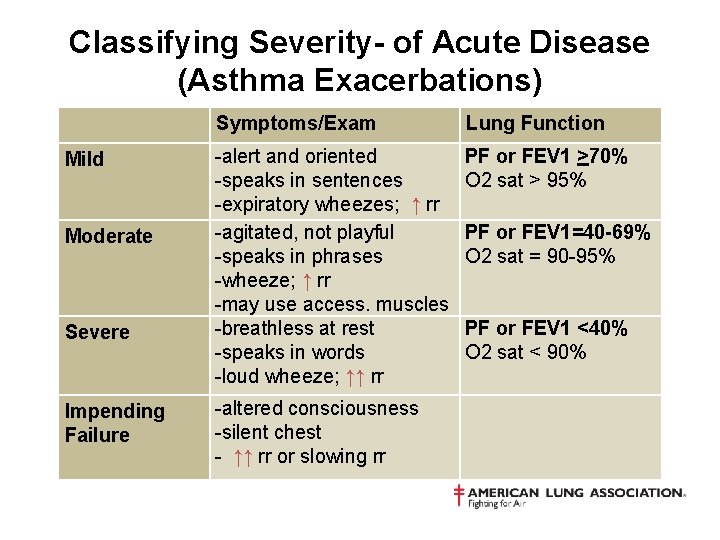
Classifying Severity- of Acute Disease (Asthma Exacerbations) Mild Moderate Severe Impending Failure Symptoms/Exam Lung Function -alert and oriented -speaks in sentences -expiratory wheezes; ↑ rr -agitated, not playful -speaks in phrases -wheeze; ↑ rr -may use access. muscles -breathless at rest -speaks in words -loud wheeze; ↑↑ rr PF or FEV 1 >70% O 2 sat > 95% -altered consciousness -silent chest - ↑↑ rr or slowing rr PF or FEV 1=40 -69% O 2 sat = 90 -95% PF or FEV 1 <40% O 2 sat < 90%
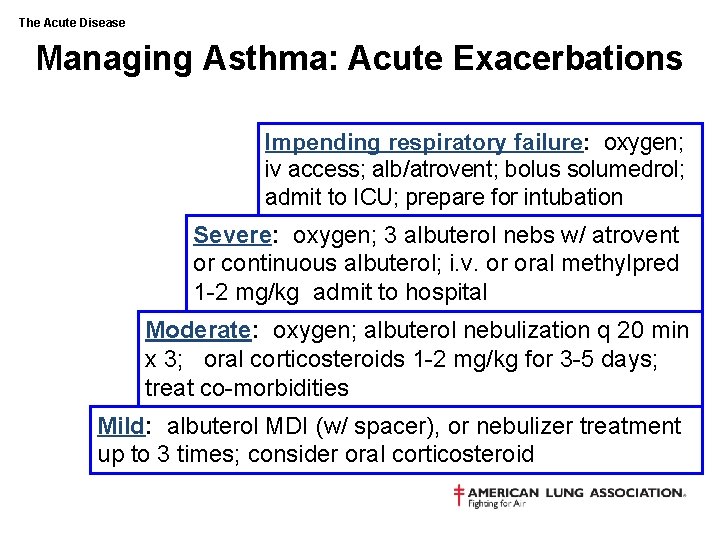
The Acute Disease Managing Asthma: Acute Exacerbations Impending respiratory failure: oxygen; iv access; alb/atrovent; bolus solumedrol; admit to ICU; prepare for intubation Severe: oxygen; 3 albuterol nebs w/ atrovent or continuous albuterol; i. v. or oral methylpred 1 -2 mg/kg admit to hospital Moderate: oxygen; albuterol nebulization q 20 min x 3; oral corticosteroids 1 -2 mg/kg for 3 -5 days; treat co-morbidities Mild: albuterol MDI (w/ spacer), or nebulizer treatment up to 3 times; consider oral corticosteroid
Medications
Pharmacological Therapy Inhaled Medication: • In general, inhaled therapy is favored over systemic (oral) therapy for asthma • The medication is delivered on site and avoids most adverse side effects NAEPP. EPR-3, page 216.

Inhaled Medication Delivery Devices Metered. Dose Inhaler (MDI) Dry Powder Inhaler (DPI) Spacer/ Holding Chamber and Face Mask Nebulizer
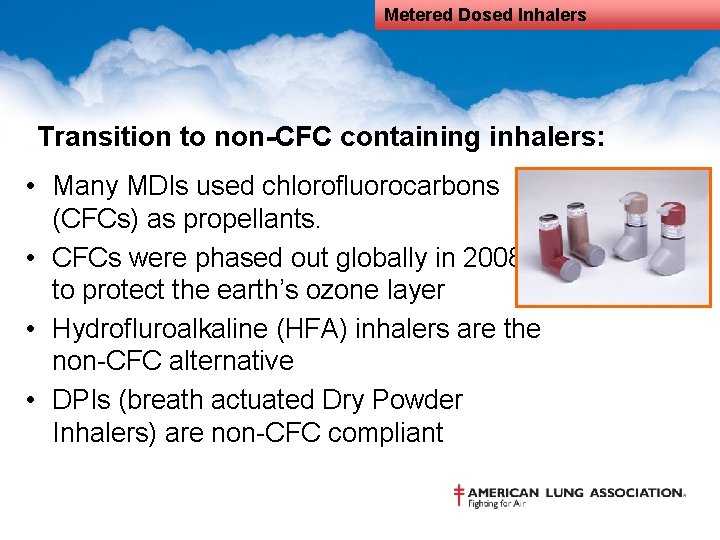
Metered Dosed Inhalers Transition to non-CFC containing inhalers: • Many MDIs used chlorofluorocarbons (CFCs) as propellants. • CFCs were phased out globally in 2008 to protect the earth’s ozone layer • Hydrofluroalkaline (HFA) inhalers are the non-CFC alternative • DPIs (breath actuated Dry Powder Inhalers) are non-CFC compliant
Overview of Asthma Medications Daily Long-Term Control: • Corticosteroids (inhaled and systemic) • Long-acting beta 2 -agonists (salmeterol, formoterol) when in combination with ICS • Leukotriene modifiers (montelukast) • Leukotriene inhibitors (zileuton) • Mast cell stabilizers (cromolyn or nedocromil) • Methylxanthines (theophylline)
Long-Term Control Inhaled Corticosteroids (ICS): • Most effective long-term-control therapy for persistent asthma • Risk for adverse events is minimal at recommended low/medium inhaled doses • Risk depends on dose and delivery method
Inhaled Corticosteroids • Benefit of daily use: – – Reduced airway inflammation Improved lung function Reduced use of quick-relief medicine Fewer symptoms and exacerbations • In usual doses ICS do not provide short-term relief • Must be used daily for full benefit
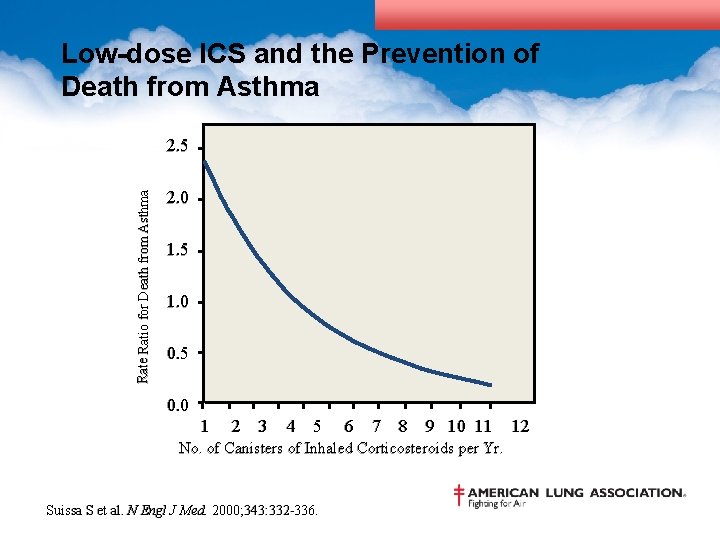
Low-dose ICS and the Prevention of Death from Asthma Rate Ratio for Death from Asthma 2. 5 2. 0 1. 5 1. 0 0. 5 0. 0 1 2 3 4 5 6 7 8 9 10 11 12 No. of Canisters of Inhaled Corticosteroids per Yr. Suissa S et al. N Engl J Med. 2000; 343: 332 -336.
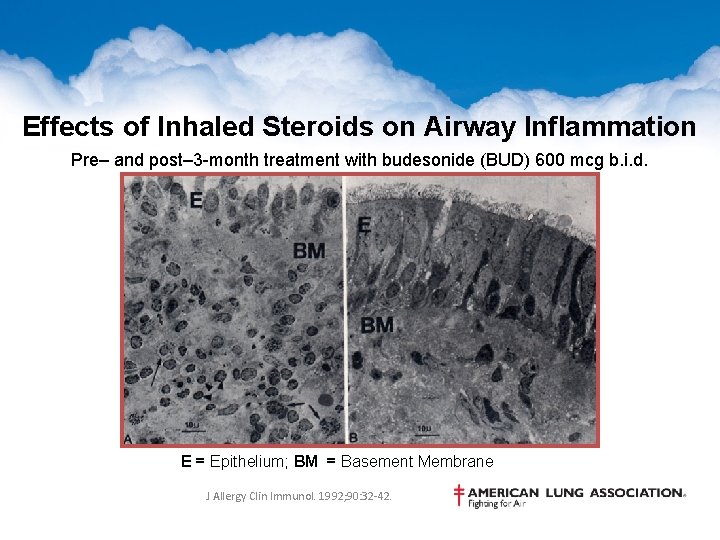
Effects of Inhaled Steroids on Airway Inflammation Pre– and post– 3 -month treatment with budesonide (BUD) 600 mcg b. i. d. E = Epithelium; BM = Basement Membrane J Allergy Clin Immunol. 1992; 90: 32 -42.
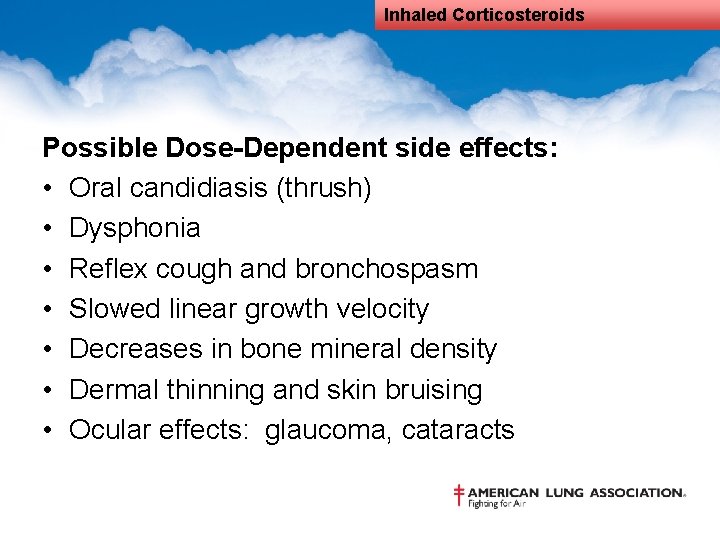
Inhaled Corticosteroids Possible Dose-Dependent side effects: • Oral candidiasis (thrush) • Dysphonia • Reflex cough and bronchospasm • Slowed linear growth velocity • Decreases in bone mineral density • Dermal thinning and skin bruising • Ocular effects: glaucoma, cataracts
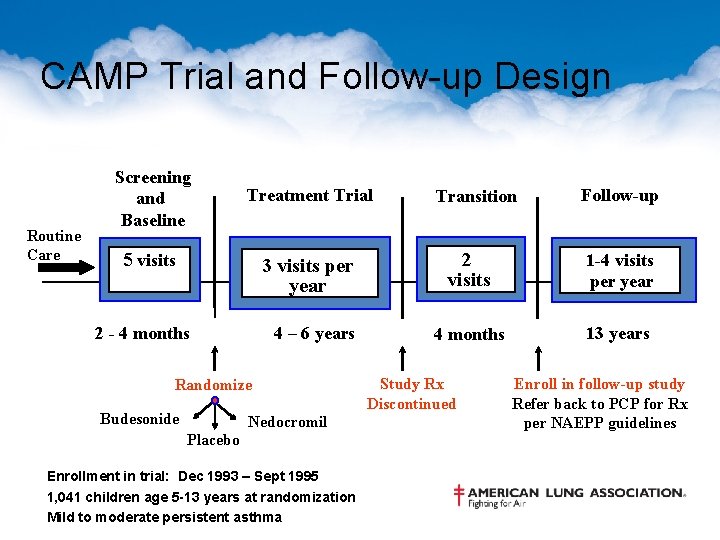
CAMP Trial and Follow-up Design Routine Care Screening and Baseline Treatment Trial 5 visits 3 visits per year 2 - 4 months 4 – 6 years Randomize Budesonide Nedocromil Placebo Enrollment in trial: Dec 1993 – Sept 1995 1, 041 children age 5 -13 years at randomization Mild to moderate persistent asthma Transition Follow-up 2 visits 1 -4 visits per year 4 months 13 years Study Rx Discontinued Enroll in follow-up study Refer back to PCP for Rx per NAEPP guidelines
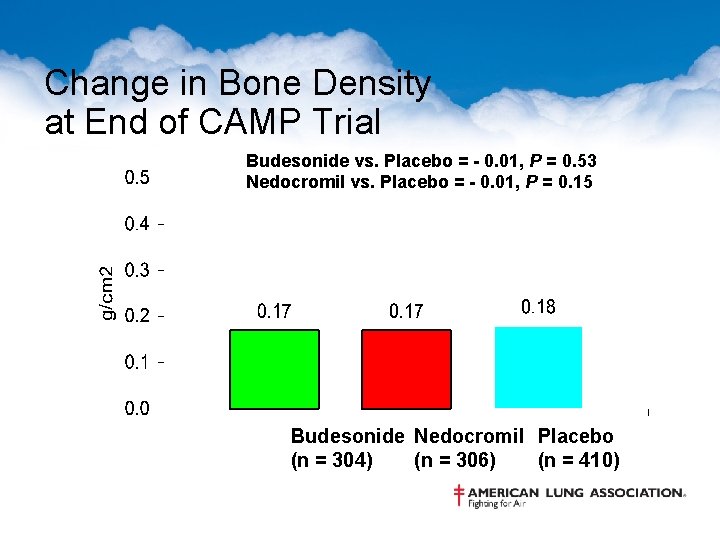
Change in Bone Density at End of CAMP Trial Budesonide vs. Placebo = - 0. 01, P = 0. 53 Nedocromil vs. Placebo = - 0. 01, P = 0. 15 Budesonide Nedocromil Placebo (n = 304) (n = 306) (n = 410)
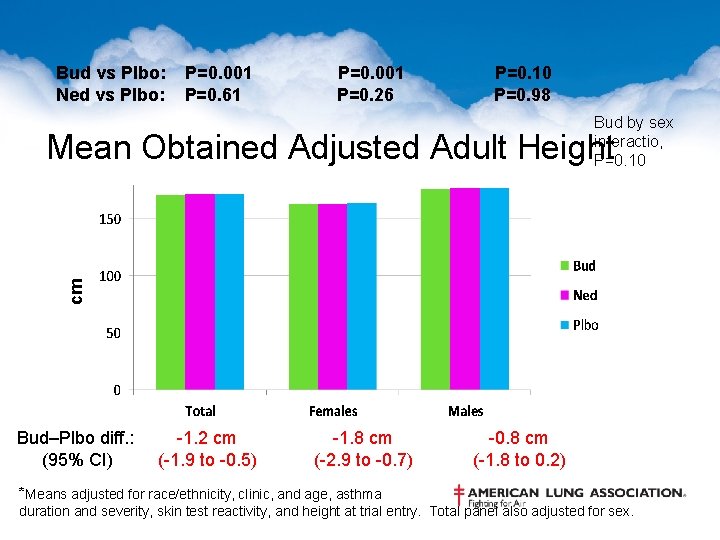
Bud vs Plbo: Ned vs Plbo: P=0. 001 P=0. 61 P=0. 001 P=0. 26 P=0. 10 P=0. 98 Bud by sex interactio, P=0. 10 cm Mean Obtained Adjusted Adult Height Bud–Plbo diff. : (95% CI) -1. 2 cm (-1. 9 to -0. 5) -1. 8 cm (-2. 9 to -0. 7) -0. 8 cm (-1. 8 to 0. 2) *Means adjusted for race/ethnicity, clinic, and age, asthma duration and severity, skin test reactivity, and height at trial entry. Total panel also adjusted for sex.
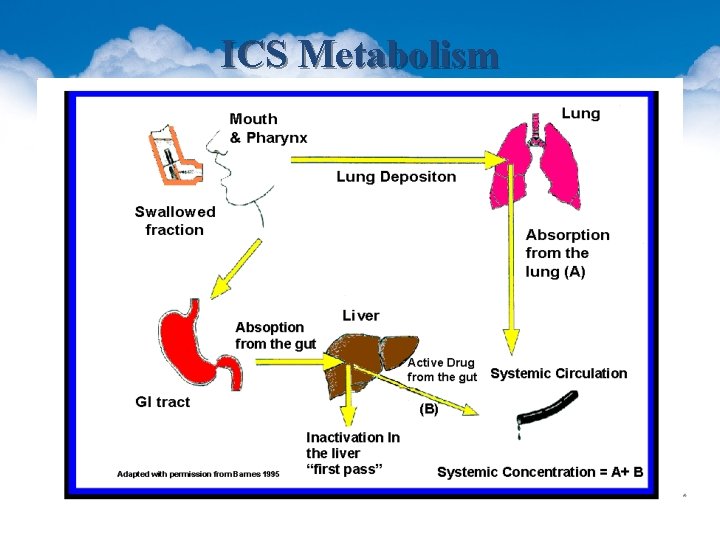
ICS Metabolism
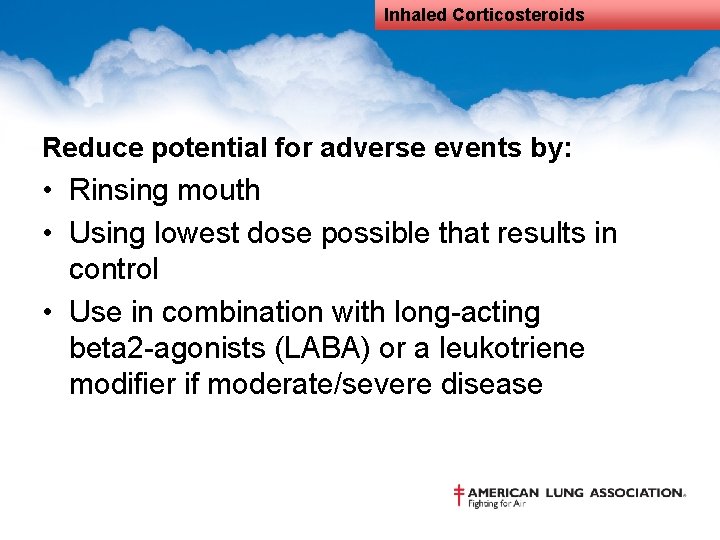
Inhaled Corticosteroids Reduce potential for adverse events by: • Rinsing mouth • Using lowest dose possible that results in control • Use in combination with long-acting beta 2 -agonists (LABA) or a leukotriene modifier if moderate/severe disease
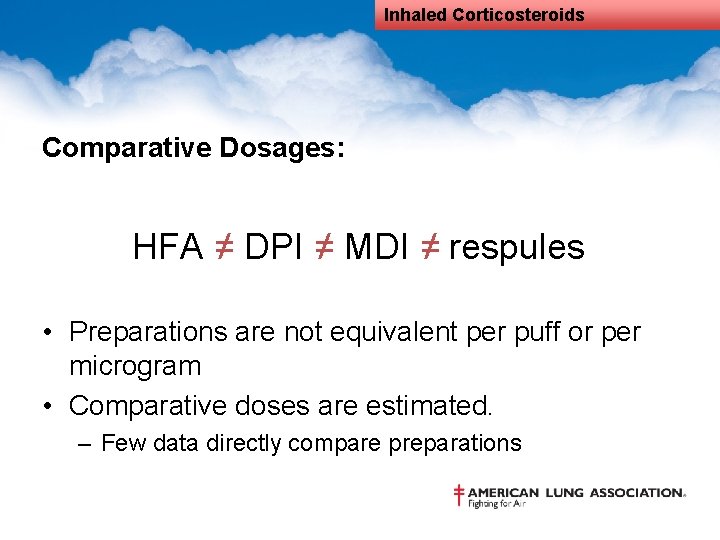
Inhaled Corticosteroids Comparative Dosages: HFA ≠ DPI ≠ MDI ≠ respules • Preparations are not equivalent per puff or per microgram • Comparative doses are estimated. – Few data directly compare preparations
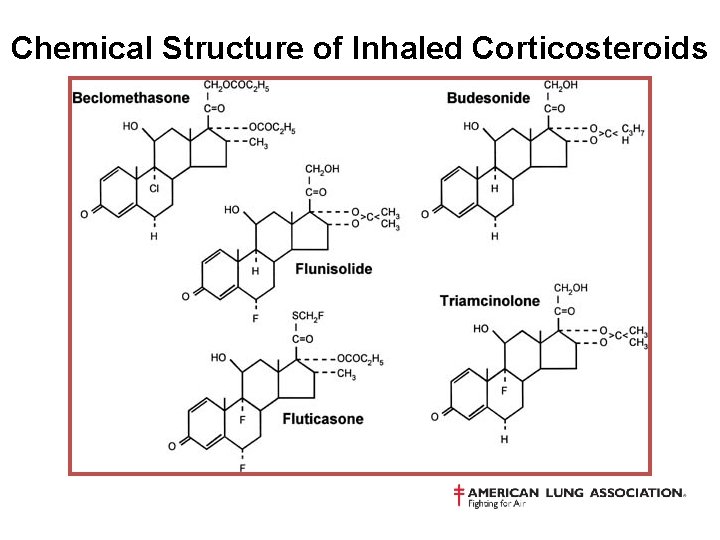
Chemical Structure of Inhaled Corticosteroids
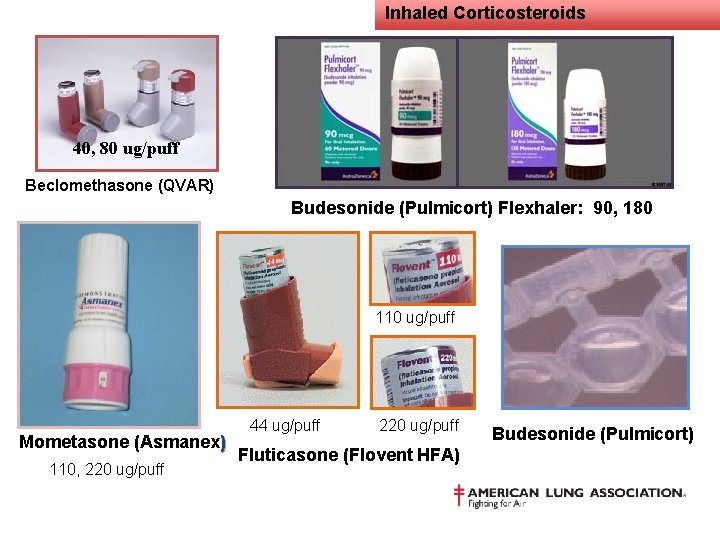
Inhaled Corticosteroids 40, 80 ug/puff Beclomethasone (QVAR) Budesonide (Pulmicort) Flexhaler: 90, 180 110 ug/puff Mometasone (Asmanex) 110, 220 ug/puff 44 ug/puff 220 ug/puff Fluticasone (Flovent HFA) Budesonide (Pulmicort). 5 mg, 1. 0 mg
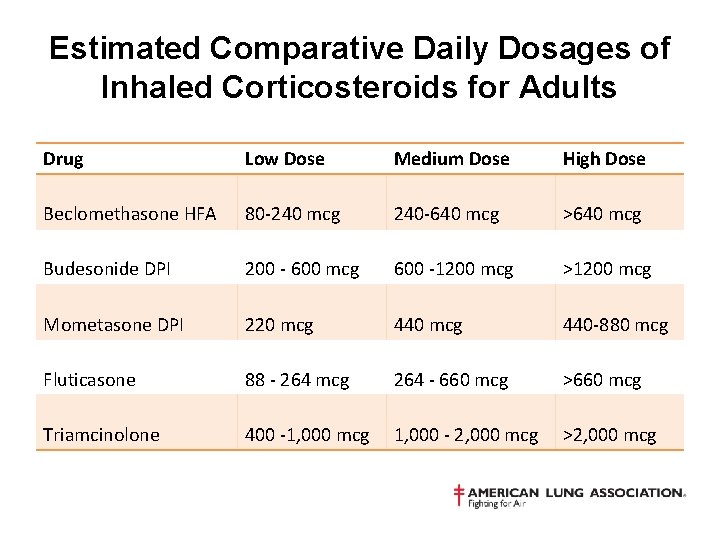
Estimated Comparative Daily Dosages of Inhaled Corticosteroids for Adults Drug Low Dose Medium Dose High Dose Beclomethasone HFA 80 -240 mcg 240 -640 mcg >640 mcg Budesonide DPI 200 - 600 mcg 600 -1200 mcg >1200 mcg Mometasone DPI 220 mcg 440 -880 mcg Fluticasone 88 - 264 mcg 264 - 660 mcg >660 mcg Triamcinolone 400 -1, 000 mcg 1, 000 - 2, 000 mcg >2, 000 mcg

Long-Acting Beta 2 -Agonists (LABA) salmeterol (serevent), formoterol (foradil) • May be beneficial when added to inhaled corticosteroids as an adjunct • Do not have anti-inflammatory properties alone • Asthma may worsen if used as mono-therapy • LABA’s are not recommended for use as monotherapy for long term control of persistent asthma • Not appropriate for quick relief
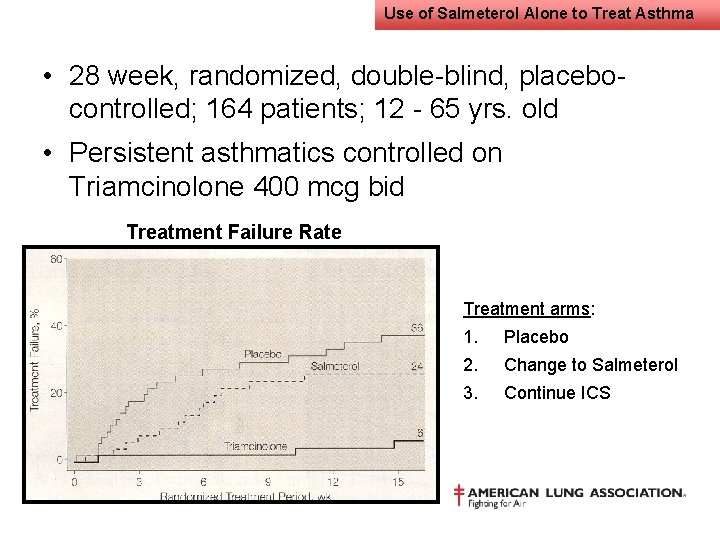
Use of Salmeterol Alone to Treat Asthma • 28 week, randomized, double-blind, placebocontrolled; 164 patients; 12 - 65 yrs. old • Persistent asthmatics controlled on Triamcinolone 400 mcg bid Treatment Failure Rate Treatment arms: JAMA 2001; 285: 2583 -93. 1. Placebo 2. Change to Salmeterol 3. Continue ICS
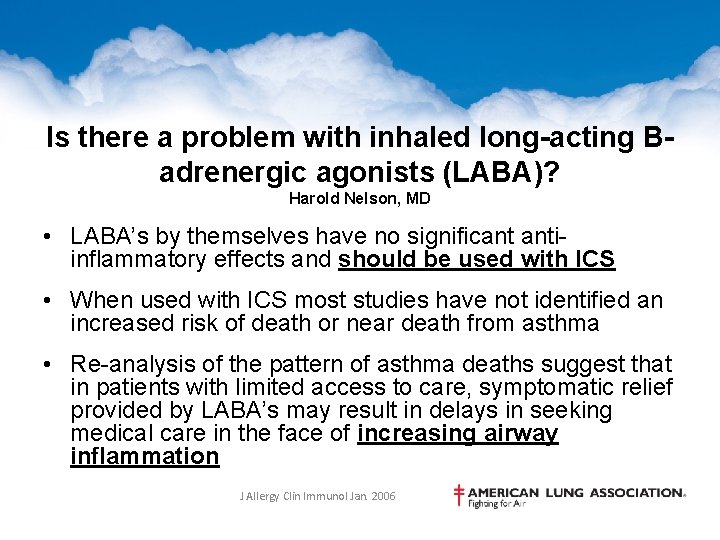
Is there a problem with inhaled long-acting Badrenergic agonists (LABA)? Harold Nelson, MD • LABA’s by themselves have no significant antiinflammatory effects and should be used with ICS • When used with ICS most studies have not identified an increased risk of death or near death from asthma • Re-analysis of the pattern of asthma deaths suggest that in patients with limited access to care, symptomatic relief provided by LABA’s may result in delays in seeking medical care in the face of increasing airway inflammation J Allergy Clin Immunol Jan. 2006
Long-Term Control Leukotriene Modifiers • Mechanisms – 5 -LO inhibitors –zileuton (Zyflo) – Cysteinyl Leuko. Triene Receptor Antagonists montelukast (Singulair), zafirlukast (Accolate) • Indications – Monotherapy in mild persistent asthma – Add-on therapy in moderate to severe persistent asthma
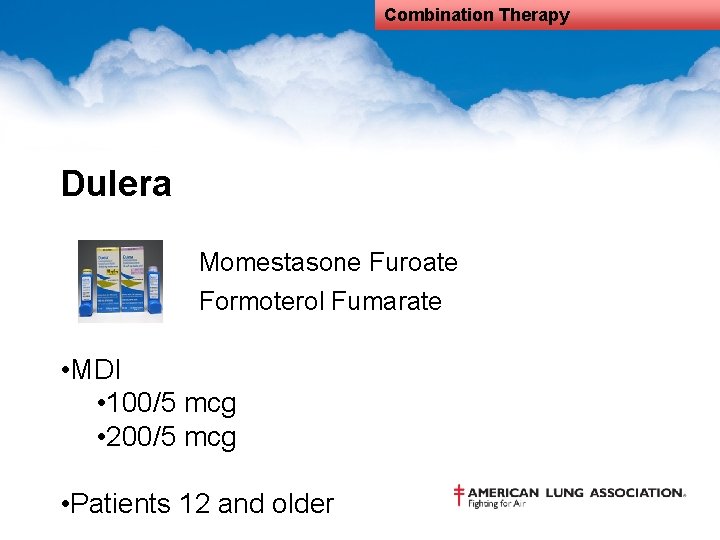
Combination Therapy Dulera Momestasone Furoate Formoterol Fumarate • MDI • 100/5 mcg • 200/5 mcg • Patients 12 and older
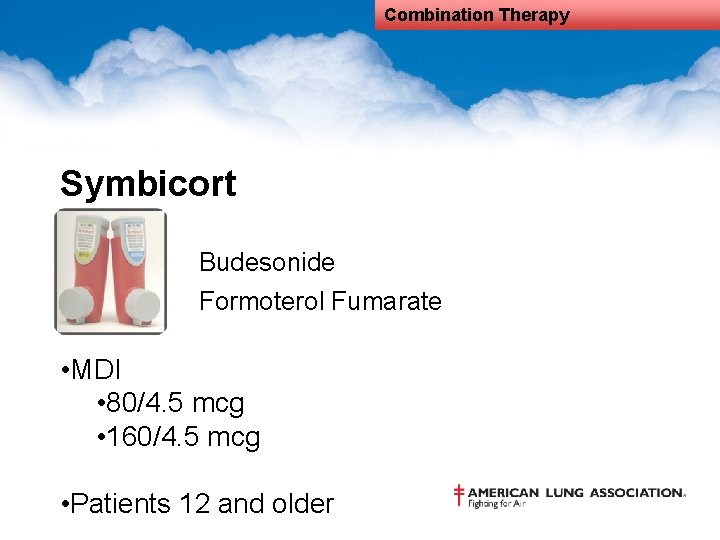
Combination Therapy Symbicort Budesonide Formoterol Fumarate • MDI • 80/4. 5 mcg • 160/4. 5 mcg • Patients 12 and older
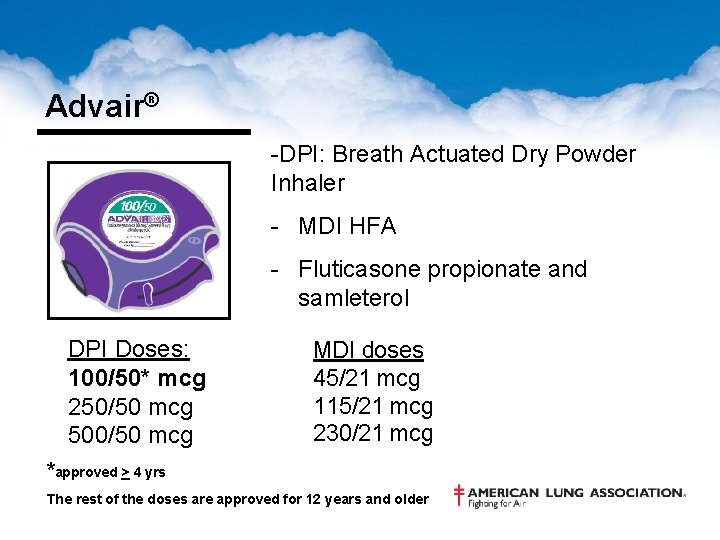
Advair® -DPI: Breath Actuated Dry Powder Inhaler - MDI HFA - Fluticasone propionate and samleterol DPI Doses: 100/50* mcg 250/50 mcg 500/50 mcg MDI doses 45/21 mcg 115/21 mcg 230/21 mcg *approved > 4 yrs The rest of the doses are approved for 12 years and older
Why use fixed combinations? DO NOT use unless both medications are necessary to control asthma…. • The asthmatic who needs moderate persistent therapy and who has failed on appropriate doses of inhaled corticosteroids • The challenging patient – Facilitate compliance – Decrease the number of inhalation devices – Improve patient inventory control
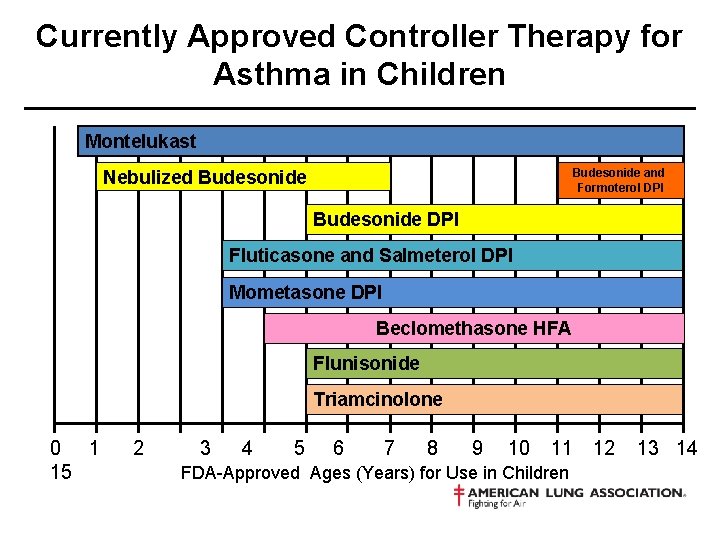
Currently Approved Controller Therapy for Asthma in Children Montelukast Budesonide and Formoterol DPI Nebulized Budesonide DPI Fluticasone and Salmeterol DPI Mometasone DPI Beclomethasone HFA Flunisonide Triamcinolone 0 1 15 2 3 4 5 6 7 8 9 10 11 12 FDA-Approved Ages (Years) for Use in Children 13 14
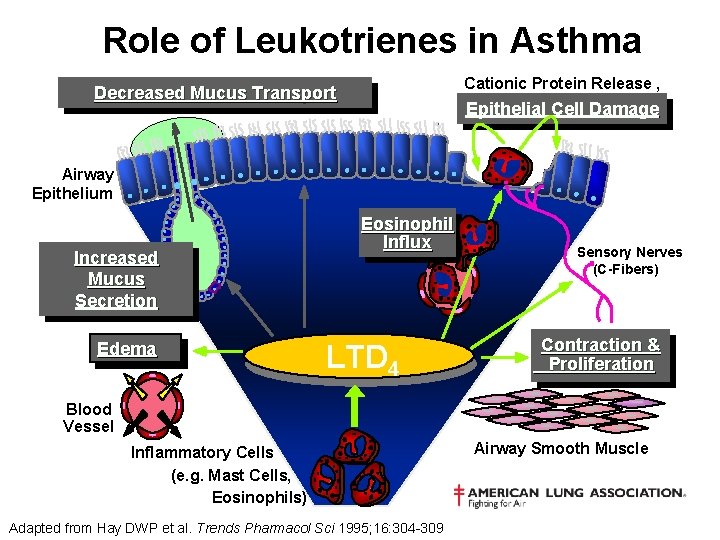
Role of Leukotrienes in Asthma Cationic Protein Release , Decreased Mucus Transport Epithelial Cell Damage Airway Epithelium Increased Mucus Secretion Edema Eosinophil Influx LTD 4 Sensory Nerves (C-Fibers) Contraction & Proliferation Blood Vessel Inflammatory Cells (e. g. Mast Cells, Eosinophils) Adapted from Hay DWP et al. Trends Pharmacol Sci 1995; 16: 304 -309 Airway Smooth Muscle
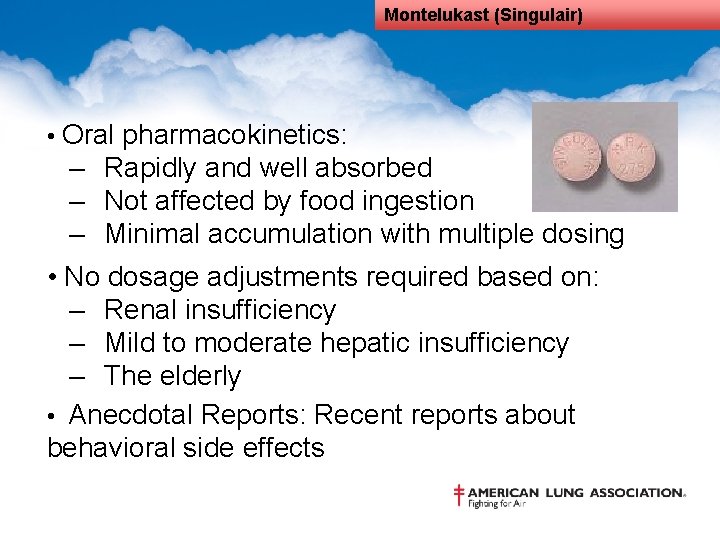
Montelukast (Singulair) • Oral pharmacokinetics: – Rapidly and well absorbed – Not affected by food ingestion – Minimal accumulation with multiple dosing • No dosage adjustments required based on: – Renal insufficiency – Mild to moderate hepatic insufficiency – The elderly • Anecdotal Reports: Recent reports about behavioral side effects
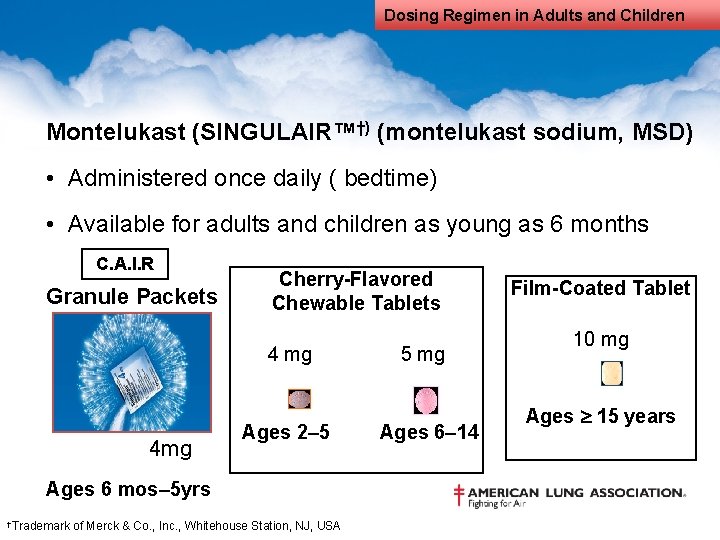
Dosing Regimen in Adults and Children Montelukast (SINGULAIR™†) (montelukast sodium, MSD) • Administered once daily ( bedtime) • Available for adults and children as young as 6 months C. A. I. R Granule Packets Cherry-Flavored Chewable Tablets 4 mg 4 mg Ages 2– 5 Ages 6 mos– 5 yrs †Trademark of Merck & Co. , Inc. , Whitehouse Station, NJ, USA 5 mg Ages 6– 14 Film-Coated Tablet 10 mg Ages 15 years
Short-acting Asthma Medications • Urgent control of Inflammation – Systemic corticosteroids (IV or PO) • Burst Tx (PO) or hospitalization/ER (IV) • As-needed: Quick Relief – Short-acting (selective) beta 2 -agonists (albuterol, pirbuterol, levalbuterol) – Anticholinergics (Ipratropium bromide)
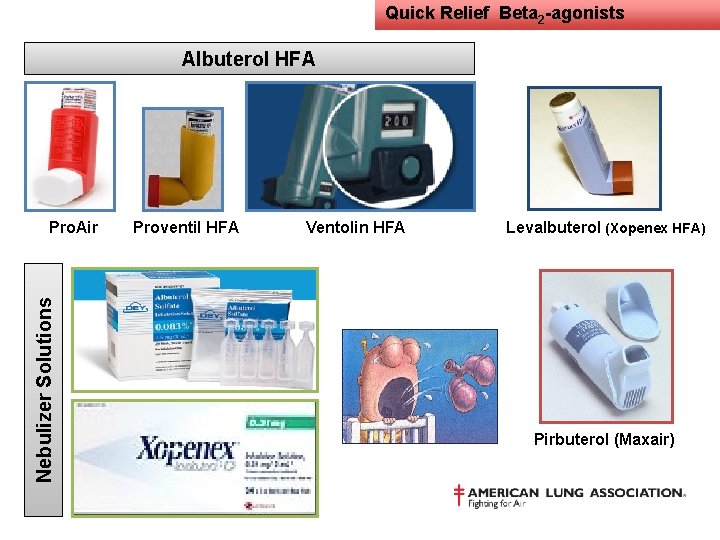
Quick Relief Beta 2 -agonists Albuterol HFA Nebulizer Solutions Pro. Air Proventil HFA Ventolin HFA Levalbuterol (Xopenex HFA) Pirbuterol (Maxair)
Quick Relief Short-Acting Beta 2 -Agonists albuterol* (Proventil, Ventolin, Pro. Air), pirbuterol** (Maxair), levalbuterol*** (Xopenex) • Most effective medication for relief of acute bronchospasm (more so than anticholinergics) • Effective as a pre exercise medication • More than one canister per month suggests inadequate asthma control * available as HFA MDI and in several nebulizer forms * * available as breath actuated brand name MDI * * * available as HFA MDI or liquid for nebulization (. 31 mg, . 63 mg, 1. 25 mg)
Short-Acting Beta 2 -Agonists: • Regularly scheduled use is not generally recommended – May lower effectiveness and increase side effects – May increase airway hyper-responsiveness • Using >2 canisters per month-risk factor for death NAEPP. EPR-3, page 377.
Special Considerations Older adults: • Older adults esp. those with ischemic heart disease may show Increased sensitivity to B-agonists (tremor, tachycardia) • Systemic corticosteroids can provoke: – confusion – agitation – changes in glucose metabolism • Inhaled corticosteroids – May be associated with dose-dependent reduction in bone mineral content – Physician may consider concurrent treatment with • Calcium supplements and Vitamin D • Bone-sparing medications (e. g. bisphonates)
Special Considerations Patients with other medical issues: • Medications for other diseases may exacerbate asthma – – NSAIDs (ASA induced asthma) Nonselective beta-blockers Beta-blockers found in some eye drops ACE inhibitors
Special Considerations Exercise Induced Asthma (EIA) Exercise Induced Bronchospasm (EIB) Transient narrowing of the airways associated with: • Physical exertion • Coughing, wheezing or shortness of breath occurring within 10 -15 minutes of starting exercise: • Exercise duration = 2 -8 min. (85 -95% max HR) • Maximal at 8 -15 minutes post exercise • Diagnosis = 12 -15% drop in FEV 1 (7% in elite athlete)
Exercise Induced Asthma Occurrence: • 90% of asthmatics • 40% of patients with allergic rhinitis • 22% of 1998 Olympic athletes • 9% of persons with EIB have no hx of asthma or allergies • 10 -50% of asthmatics on ICS still display EIB
Managing Exercise-Induced Asthma Management Strategies: • Short-acting inhaled beta 2 -agonists used shortly before exercise last 2 to 3 hours • Salmeterol may prevent EIB for 10 to 12 hours • Cromolyn if side effects a concern • A lengthy warm-up period before exercise • An aerobic conditioning program • Long-term-control therapy, if appropriate • Avoid asthma triggers during exercise
Special Considerations Over-The-Counter (OTC) Asthma Medicines: • Always include OTC’s in medical history • OTC products may provoke asthma (ASA) • Short acting bronchodilators (e. g. Primatene mist): not a substitute for prescription medicines – Often indicate need for physician referral – Very short acting and non-selective
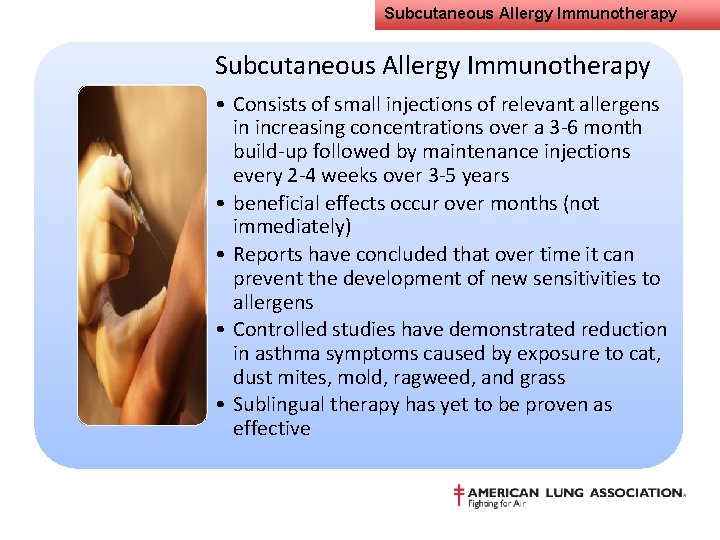
Subcutaneous Allergy Immunotherapy • Consists of small injections of relevant allergens in increasing concentrations over a 3 -6 month build-up followed by maintenance injections every 2 -4 weeks over 3 -5 years • beneficial effects occur over months (not immediately) • Reports have concluded that over time it can prevent the development of new sensitivities to allergens • Controlled studies have demonstrated reduction in asthma symptoms caused by exposure to cat, dust mites, mold, ragweed, and grass • Sublingual therapy has yet to be proven as effective
Subcutaneous Allergen Immunotherapy is considered for: Patients with persistent asthma if evidence is clear of a relationship between symptoms and exposure to an allergen Candidates for immunotherapy are generally > 5 years of age Administration should occur in an office prepared to treat a systemic allergic reaction NAEPP. EPR-3, page 177.
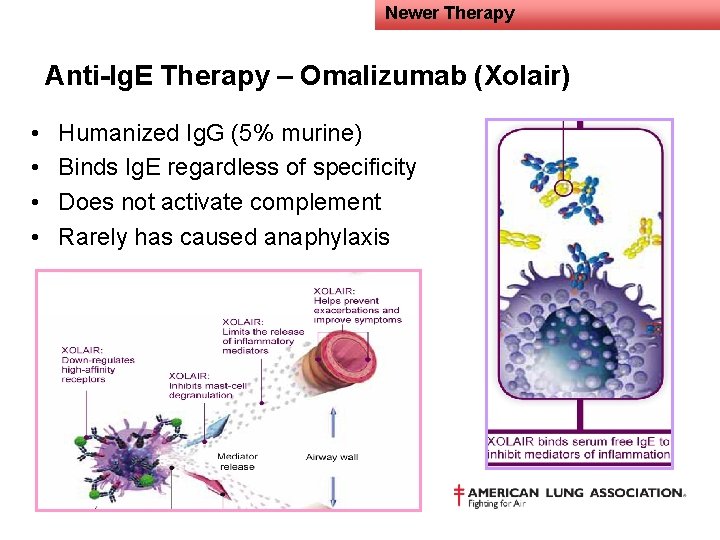
Newer Therapy Anti-Ig. E Therapy – Omalizumab (Xolair) • • Humanized Ig. G (5% murine) Binds Ig. E regardless of specificity Does not activate complement Rarely has caused anaphylaxis
Xolair (Omalizumab) • Indicated for adults and adolescents(>12) with severe persistent asthma inadequately controlled on high-dose ICS and LABA • Selected patients must have a positive skin test or in vitro reactivity to aeroallergens • Dosed every 2 -4 weeks; SQ dosing • May allow these patients to improve control, decrease dose of ICS and decrease reliance on oral corticosteroids
Alternative Therapies 40% of pts who use non-provider prescribed therapies do not report alternative medication use because they are not asked or because they do not think it is important for their medical provider to know (Eisenberg 2001). • Use of Alternative medicines may result in: – allergic reactions – intensification of drug side effects • Users may not be aware of: – potency – contaminants – covert additives – Recommended that clinician ask patient about complementary and alternative medicine use (CAM) NAEPP. EPR-3, pages 240 244.
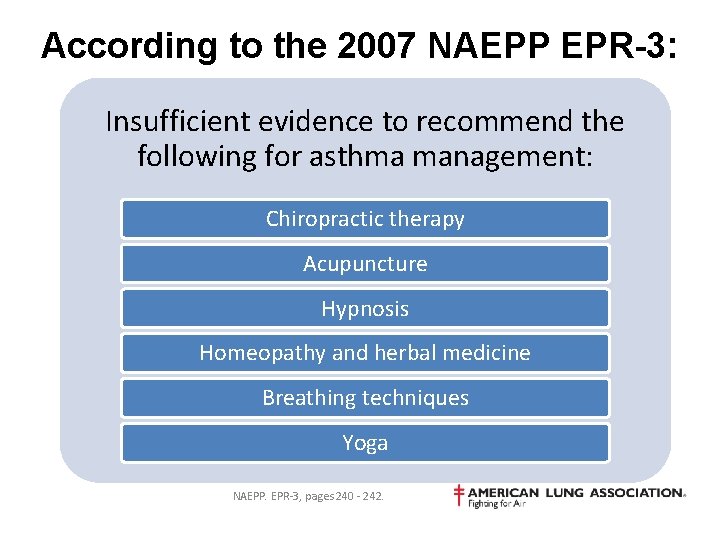
According to the 2007 NAEPP EPR-3: Insufficient evidence to recommend the following for asthma management: Chiropractic therapy Acupuncture Hypnosis Homeopathy and herbal medicine Breathing techniques Yoga NAEPP. EPR-3, pages 240 - 242.
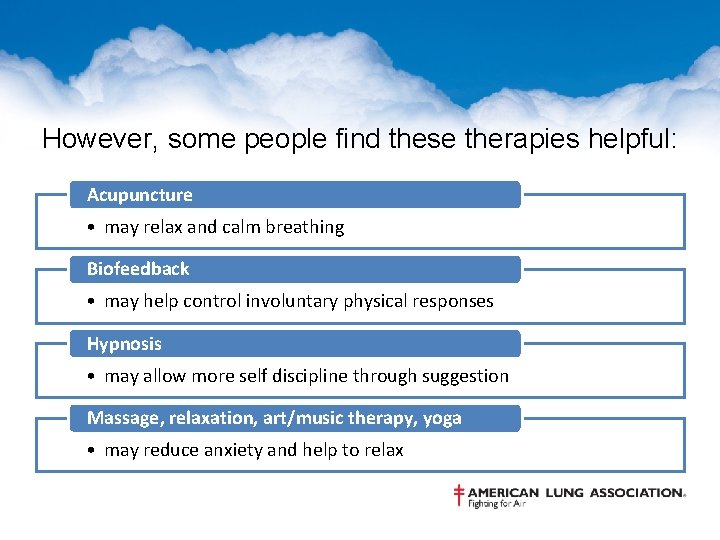
However, some people find these therapies helpful: Acupuncture • may relax and calm breathing Biofeedback • may help control involuntary physical responses Hypnosis • may allow more self discipline through suggestion Massage, relaxation, art/music therapy, yoga • may reduce anxiety and help to relax
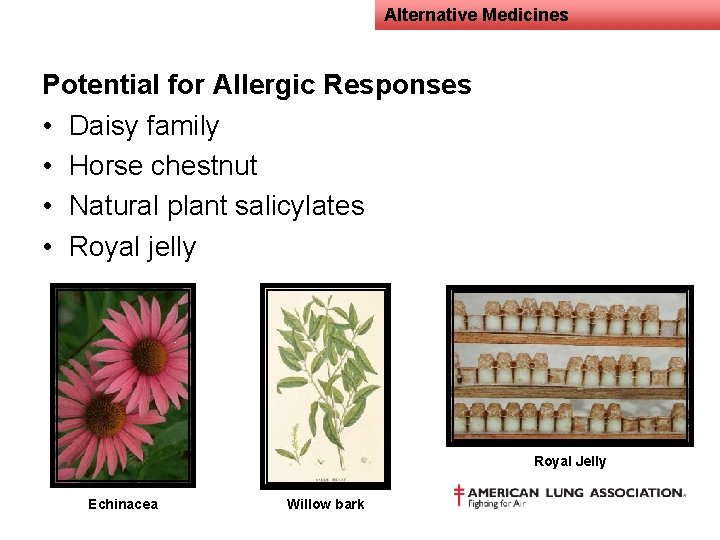
Alternative Medicines Potential for Allergic Responses • Daisy family • Horse chestnut • Natural plant salicylates • Royal jelly Royal Jelly Echinacea Willow bark
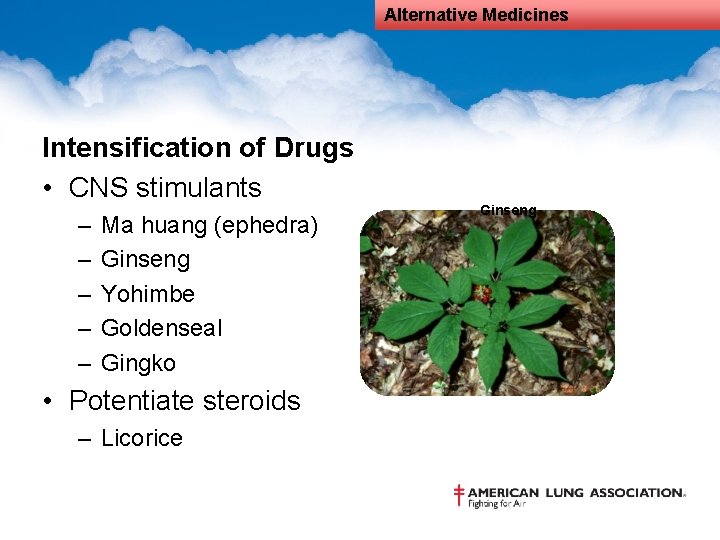
Alternative Medicines Intensification of Drugs • CNS stimulants – – – Ma huang (ephedra) Ginseng Yohimbe Goldenseal Gingko • Potentiate steroids – Licorice Ginseng
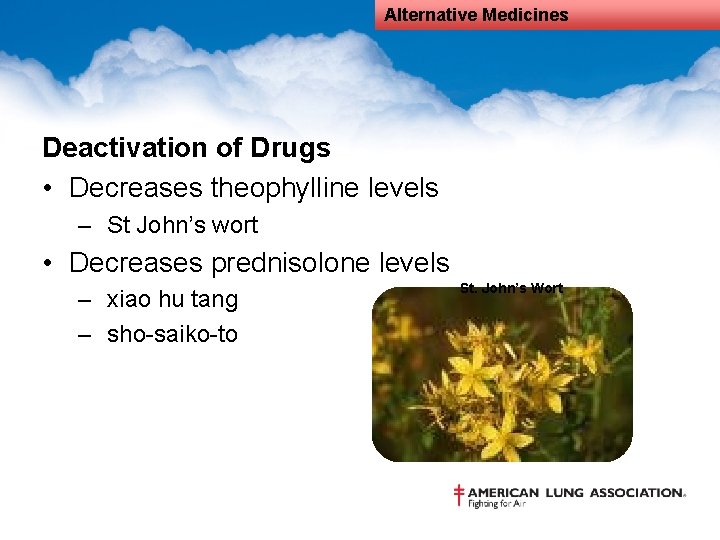
Alternative Medicines Deactivation of Drugs • Decreases theophylline levels – St John’s wort • Decreases prednisolone levels – xiao hu tang – sho-saiko-to St. John’s Wort
Asthma Pharmacological Therapy • Focus is on treating inflammation • Severity classification of the chronic disease determines therapy • Inhaled corticosteroids are the best therapy for treatment of persistent disease • New therapies on the horizon …. Updates on the guidelines are the best resources
ASTHMA MANAGEMENT PHARMACOLOGICAL THERAPY: CASE STUDIES Presented by:
Case Study #1 19 mo old with nighttime cough and 3 spells in last 6 months treated with oral corticosteroids (OCS) • He is thought to have intermittent asthma. What do you think? Mild – Moderate Persistent • What is the best treatment? Inhaled Corticosteroids - Asthma education • His mom has asthma and he has milk allergy. Will he have asthma when older? Very Likely
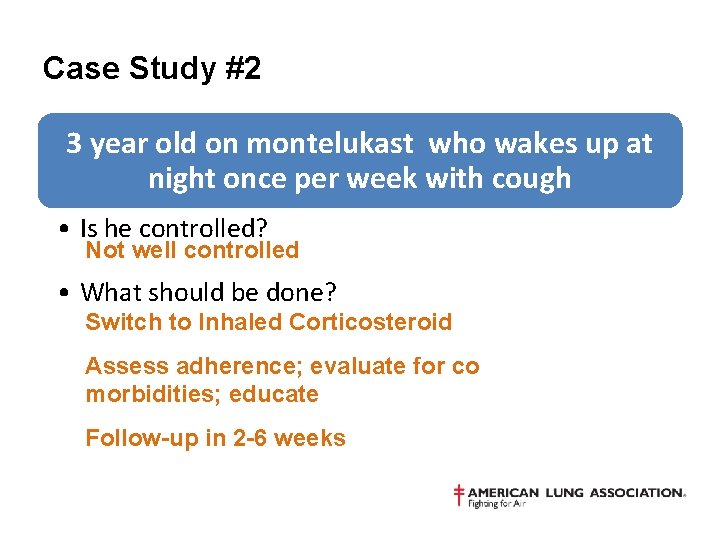
Case Study #2 3 year old on montelukast who wakes up at night once per week with cough • Is he controlled? Not well controlled • What should be done? Switch to Inhaled Corticosteroid Assess adherence; evaluate for co morbidities; educate Follow-up in 2 -6 weeks
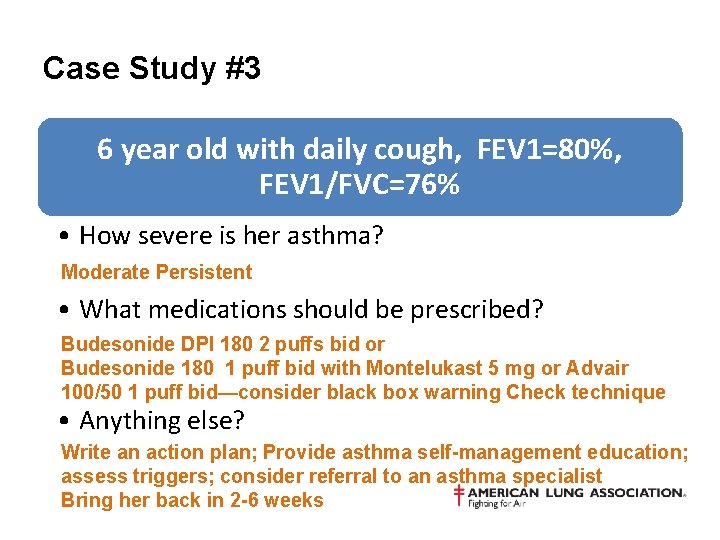
Case Study #3 6 year old with daily cough, FEV 1=80%, FEV 1/FVC=76% • How severe is her asthma? Moderate Persistent • What medications should be prescribed? Budesonide DPI 180 2 puffs bid or Budesonide 180 1 puff bid with Montelukast 5 mg or Advair 100/50 1 puff bid—consider black box warning Check technique • Anything else? Write an action plan; Provide asthma self-management education; assess triggers; consider referral to an asthma specialist Bring her back in 2 -6 weeks
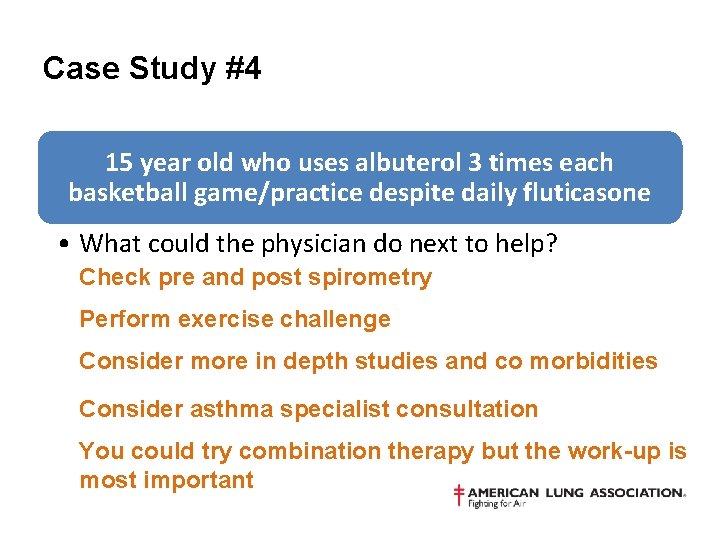
Case Study #4 15 year old who uses albuterol 3 times each basketball game/practice despite daily fluticasone • What could the physician do next to help? Check pre and post spirometry Perform exercise challenge Consider more in depth studies and co morbidities Consider asthma specialist consultation You could try combination therapy but the work-up is most important
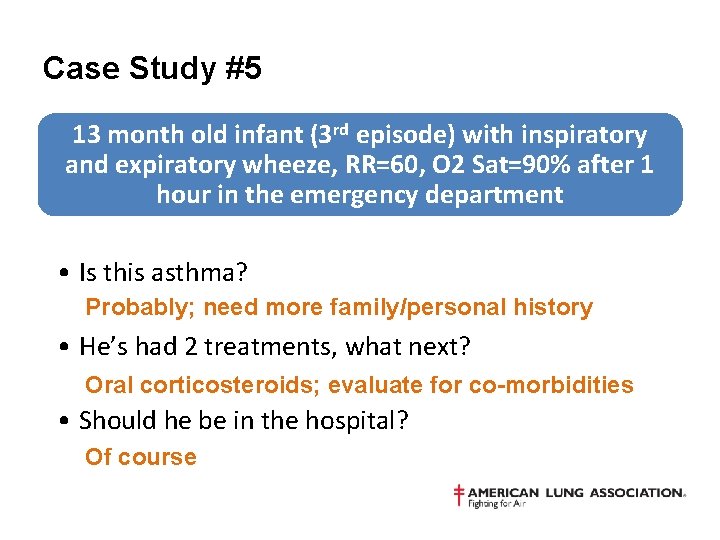
Case Study #5 13 month old infant (3 rd episode) with inspiratory and expiratory wheeze, RR=60, O 2 Sat=90% after 1 hour in the emergency department • Is this asthma? Probably; need more family/personal history • He’s had 2 treatments, what next? Oral corticosteroids; evaluate for co-morbidities • Should he be in the hospital? Of course
Acknowledgements Barbara Chilmonczyk, MD Allergy and Asthma Associates of Maine; AH! Asthma Health Program Director, Maine. Health and the Barbara Bush Children’s Hospital @ Maine Medical Center, Portland, ME (207) 662 -3325 Rhonda Vosmus, RRT-NPS, AE-C Asthma Education Specialist Maine Medical Center and Maine. Health, Portland, ME (207) 662 -4515 Janice H. Howell, MD, FRCPC, FAAP Faculty Physician, Medical Education-Pediatrics, Orlando FL (321) 841 -2121 Chris Garvey, FNP, MSN, MPA, FAACVPR Manager Pulmonary and Cardiac Rehabilitation Seton Medical Center (650) 991 -6776 Donna Beal, MPH, CHES Regional Program Director ALACA Santa Barbara, CA (805) 963 -1426 NIH. NAEPP Expert Panel Report 3: Guidelines for the Diagnosis and Management of Asthma, October 2007.
We will breathe easier when the air in every American community is clean and healthy. We will breathe easier when people are free from the addictive grip of cigarettes and the debilitating effects of lung disease. We will breathe easier when the air in our public spaces and workplaces is clear of secondhand smoke. We will breathe easier when children no longer battle airborne poisons or fear an asthma attack. Until then, we are fighting for air.
- Slides: 81