
Asthma is a lunginflammation disease COPD is a
- Slides: 27
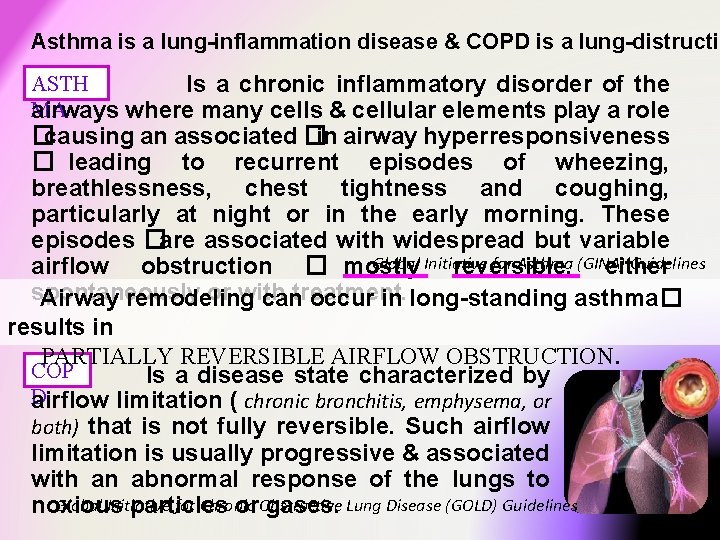
Asthma is a lung-inflammation disease & COPD is a lung-distructiv ASTH Is a chronic inflammatory disorder of the MA airways where many cells & cellular elements play a role �causing an associated �in airway hyperresponsiveness � leading to recurrent episodes of wheezing, breathlessness, chest tightness and coughing, particularly at night or in the early morning. These episodes �are associated with widespread but variable Global Initiative for Asthma (GINA) Guidelines airflow obstruction � mostly reversible, either spontaneously or with Airway remodeling cantreatment. occur in long-standing asthma� results in PARTIALLY REVERSIBLE AIRFLOW OBSTRUCTION. COP Is a disease state characterized by D airflow limitation ( chronic bronchitis, emphysema, or both) that is not fully reversible. Such airflow limitation is usually progressive & associated with an abnormal response of the lungs to Global Initiative for Chronic noxious particles or. Obstructive gases. Lung Disease (GOLD) Guidelines
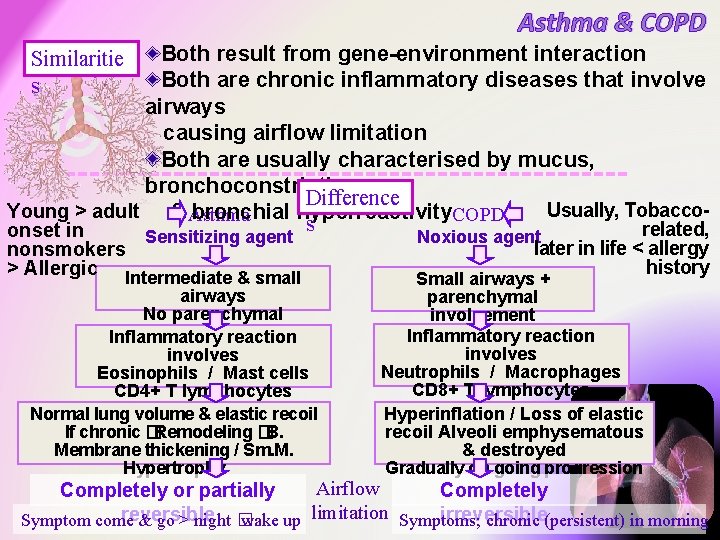
Asthma & COPD Both result from gene-environment interaction Both are chronic inflammatory diseases that involve airways causing airflow limitation Both are usually characterised by mucus, bronchoconstriction Difference Usually, Tobacco. Young > adult & Asthma bronchial hyperreactivity. COPD s related, onset in Similaritie s Sensitizing agent nonsmokers > Allergic Intermediate & small airways No parenchymal involvement Inflammatory reaction involves Eosinophils / Mast cells CD 4+ T lymphocytes Normal lung volume & elastic recoil If chronic �Remodeling �B. Membrane thickening / Sm. M. Hypertrophy Noxious agent later in life < allergy history Small airways + parenchymal involvement Inflammatory reaction involves Neutrophils / Macrophages CD 8+ T lymphocytes Hyperinflation / Loss of elastic recoil Alveoli emphysematous & destroyed Gradually on going progression Airflow Completely or partially Completely reversible irreversible Symptom come & go > night � wake up limitation Symptoms; chronic (persistent) in morning
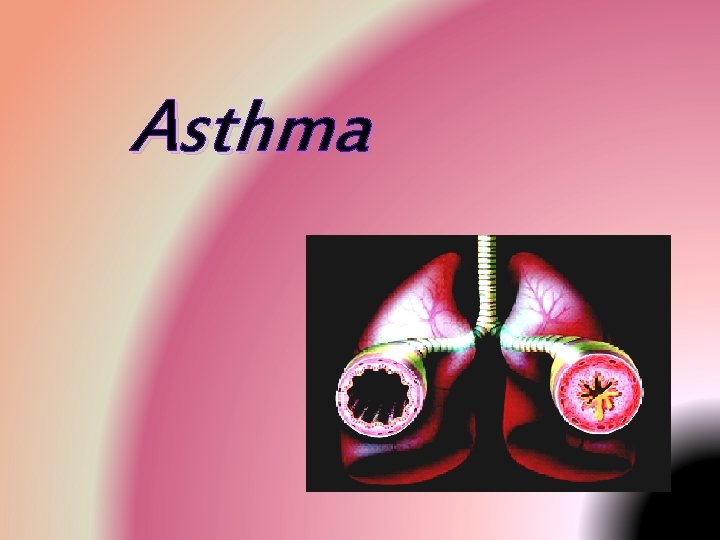
Asthma
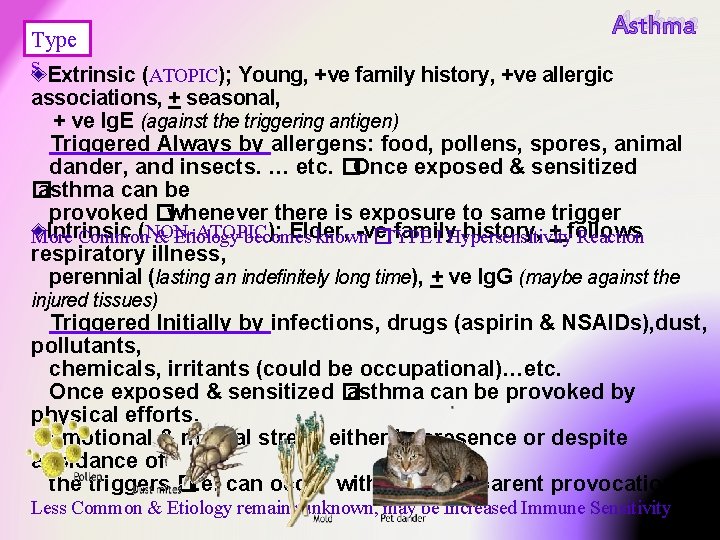
Asthma Type s Extrinsic (ATOPIC); Young, +ve family history, +ve allergic associations, + seasonal, + ve Ig. E (against the triggering antigen) Triggered Always by allergens: food, pollens, spores, animal dander, and insects. … etc. �Once exposed & sensitized � asthma can be provoked �whenever there is exposure to same trigger Intrinsic (NON-ATOPIC ); Elder, -ve family history, + follows More Common & Etiology becomes known �TYPE I Hypersensitivity Reaction respiratory illness, perennial (lasting an indefinitely long time), + ve Ig. G (maybe against the injured tissues) Triggered Initially by infections, drugs (aspirin & NSAIDs), dust, pollutants, chemicals, irritants (could be occupational)…etc. Once exposed & sensitized � asthma can be provoked by physical efforts, emotional & mental stress either in presence or despite avoidance of the triggers �i. e. can occur without an apparent provocation. Less Common & Etiology remains unknown, may be Increased Immune Sensitivity
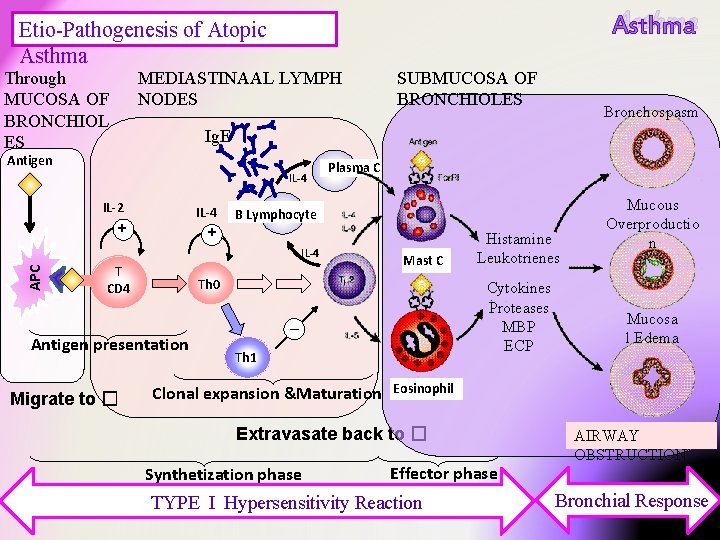
Asthma Etio-Pathogenesis of Atopic Asthma MEDIASTINAAL LYMPH NODES Through MUCOSA OF BRONCHIOL ES Bronchospasm Ig. E Antigen IL-4 IL-2 IL-4 + + Plasma C B Lymphocyte IL-4 APC SUBMUCOSA OF BRONCHIOLES T CD 4 Mast C Th 0 Cytokines Proteases MBP ECP _ Antigen presentation Migrate to � Th 1 Clonal expansion &Maturation Histamine Leukotrienes Mucosa l Edema Eosinophil Extravasate back to � Synthetization phase Mucous Overproductio n Effector phase TYPE I Hypersensitivity Reaction AIRWAY OBSTRUCTION Bronchial Response
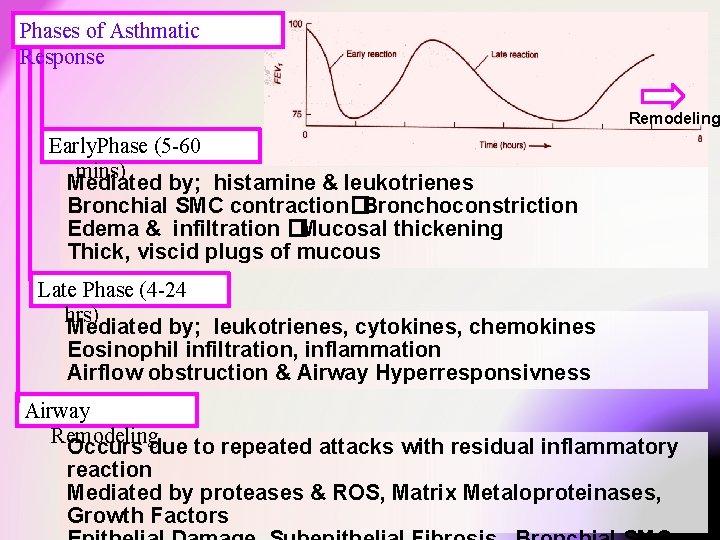
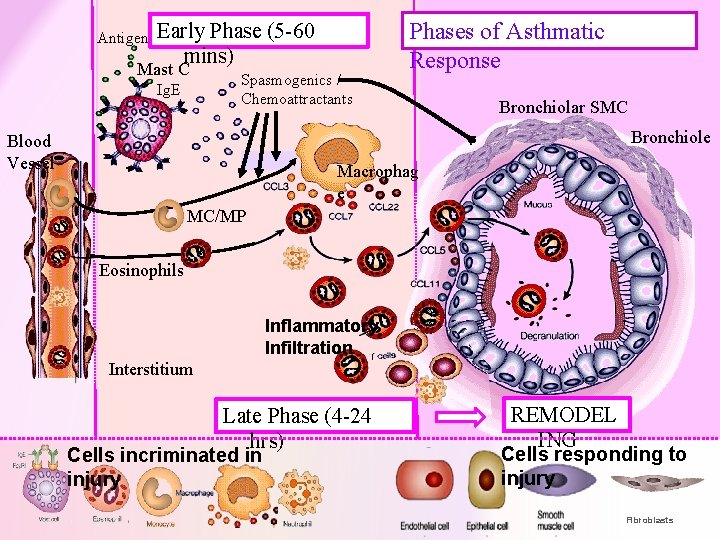
Phases of Asthmatic Response Remodeling Early. Phase (5 -60 mins) Mediated by; histamine & leukotrienes Bronchial SMC contraction�Bronchoconstriction Edema & infiltration �Mucosal thickening Thick, viscid plugs of mucous Late Phase (4 -24 hrs) Mediated by; leukotrienes, cytokines, chemokines Eosinophil infiltration, inflammation Airflow obstruction & Airway Hyperresponsivness Airway Remodeling Occurs due to repeated attacks with residual inflammatory reaction Mediated by proteases & ROS, Matrix Metaloproteinases, Growth Factors
Antigen Early Phase (5 -60 mins) Mast C Ig. E Spasmogenics / Chemoattractants Phases of Asthmatic Response Bronchiolar SMC Bronchiole Blood Vessel Macrophag e MC/MP Eosinophils Inflammatory Infiltration Interstitium Late Phase (4 -24 hrs) Cells incriminated in injury REMODEL ING Cells responding to injury Fibroblasts
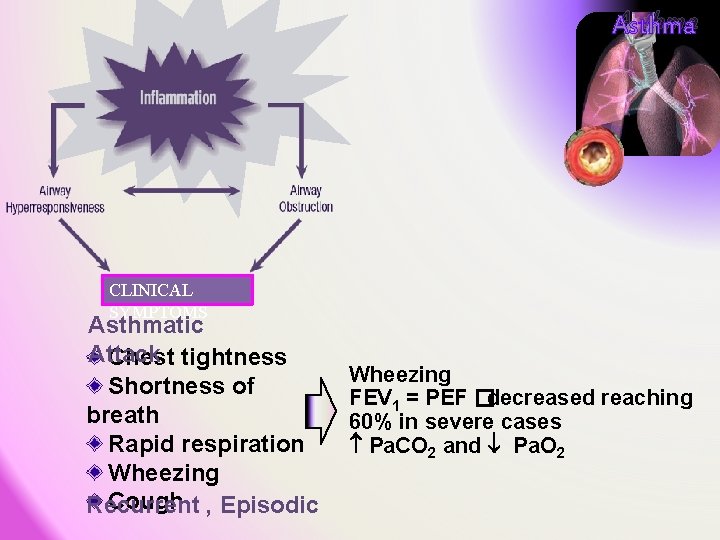
Asthma CLINICAL SYMPTOMS Asthmatic Attack Chest tightness Shortness of breath Rapid respiration Wheezing Cough , Episodic Recurrent Wheezing FEV 1 = PEF �decreased reaching 60% in severe cases Pa. CO 2 and Pa. O 2
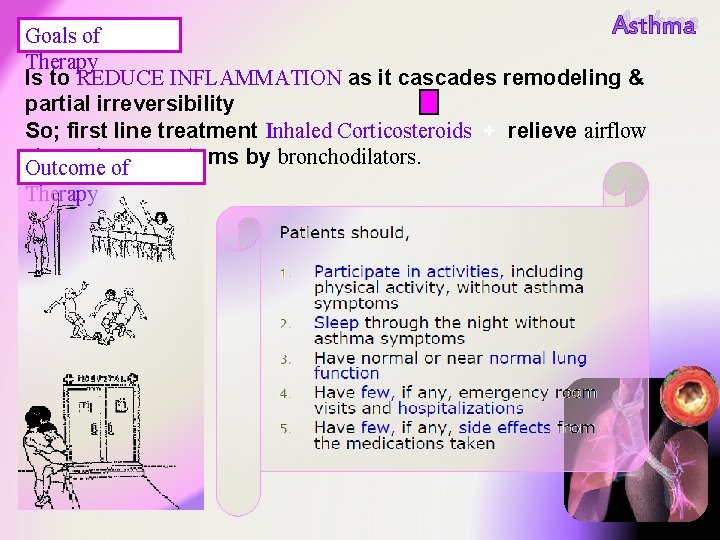
Asthma Goals of Therapy Is to REDUCE INFLAMMATION as it cascades remodeling & partial irreversibility So; first line treatment Inhaled Corticosteroids + relieve airflow obstruction Outcome ofsymptoms by bronchodilators. Therapy
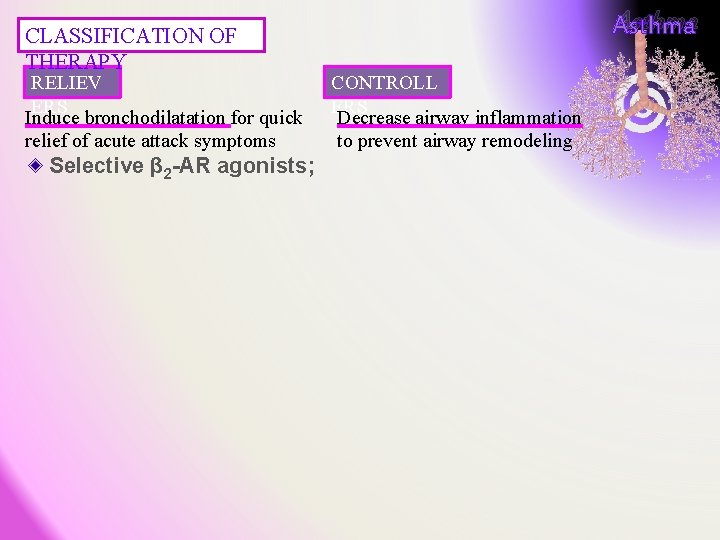
CLASSIFICATION OF THERAPY RELIEV ERS Induce bronchodilatation for quick relief of acute attack symptoms Selective β 2 -AR agonists; Asthma CONTROLL ERS Decrease airway inflammation to prevent airway remodeling
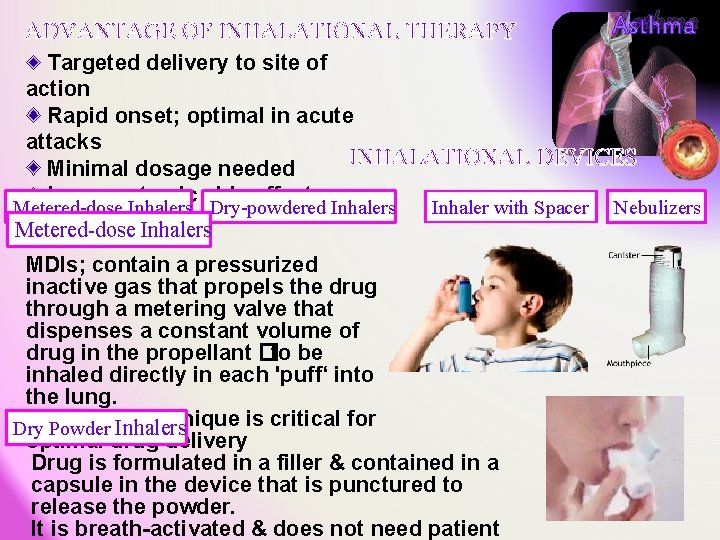
ADVANTAGE OF INHALATIONAL THERAPY Asthma Targeted delivery to site of action Rapid onset; optimal in acute attacks INHALATIONAL DEVICES Minimal dosage needed Less systemic side effects Metered-dose Inhalers Dry-powdered Inhalers Inhaler with Spacer Nebulizers Well tolerated Metered-dose Inhalers MDIs; contain a pressurized inactive gas that propels the drug through a metering valve that dispenses a constant volume of drug in the propellant �to be inhaled directly in each 'puff‘ into the lung. Inhalation technique is critical for Dry Powder Inhalers optimal drug delivery Drug is formulated in a filler & contained in a capsule in the device that is punctured to release the powder. It is breath-activated & does not need patient
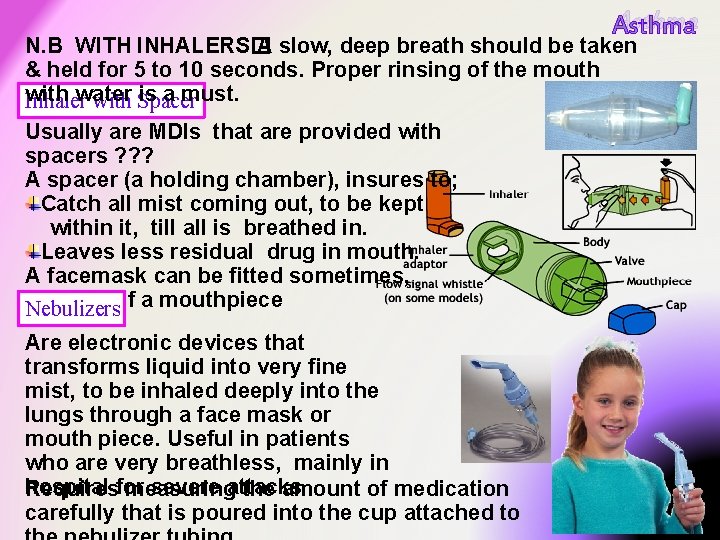
Asthma N. B WITH INHALERS� A slow, deep breath should be taken & held for 5 to 10 seconds. Proper rinsing of the mouth with water is a must. Inhaler with Spacer Usually are MDIs that are provided with spacers ? ? ? A spacer (a holding chamber), insures to; Catch all mist coming out, to be kept within it, till all is breathed in. Leaves less residual drug in mouth. A facemask can be fitted sometimes, instead of a mouthpiece Nebulizers Are electronic devices that transforms liquid into very fine mist, to be inhaled deeply into the lungs through a face mask or mouth piece. Useful in patients who are very breathless, mainly in hospital for severe attacks Requires measuring the amount of medication carefully that is poured into the cup attached to
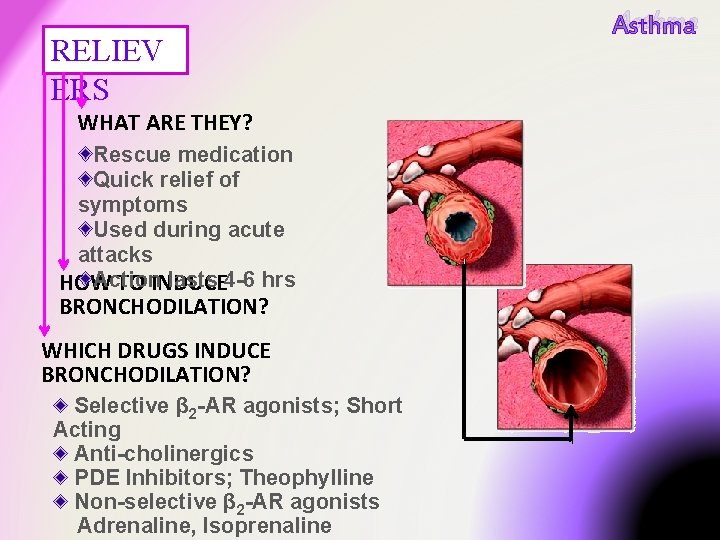
RELIEV ERS WHAT ARE THEY? Rescue medication Quick relief of symptoms Used during acute attacks Action lasts 4 -6 hrs HOW TO INDUCE BRONCHODILATION? WHICH DRUGS INDUCE BRONCHODILATION? Selective β 2 -AR agonists; Short Acting Anti-cholinergics PDE Inhibitors; Theophylline Non-selective β 2 -AR agonists Adrenaline, Isoprenaline Asthma
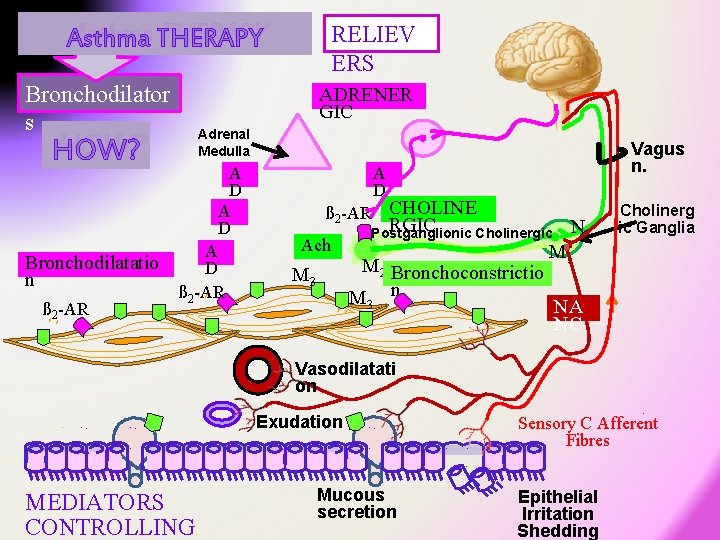
Asthma THERAPY Bronchodilator s ADRENER GIC Adrenal Medulla HOW? Bronchodilatatio n ß 2 -AR RELIEV ERS A D A D ß 2 -AR Vagus n. A D ß 2 -AR CHOLINE RGIC Postganglionic Cholinergic N Ach M 1 M 2 Bronchoconstrictio M 3 n NA NC Cholinerg ic Ganglia Vasodilatati on Exudation MEDIATORS CONTROLLING Mucous secretion Sensory C Afferent Fibres Epithelial Irritation Shedding
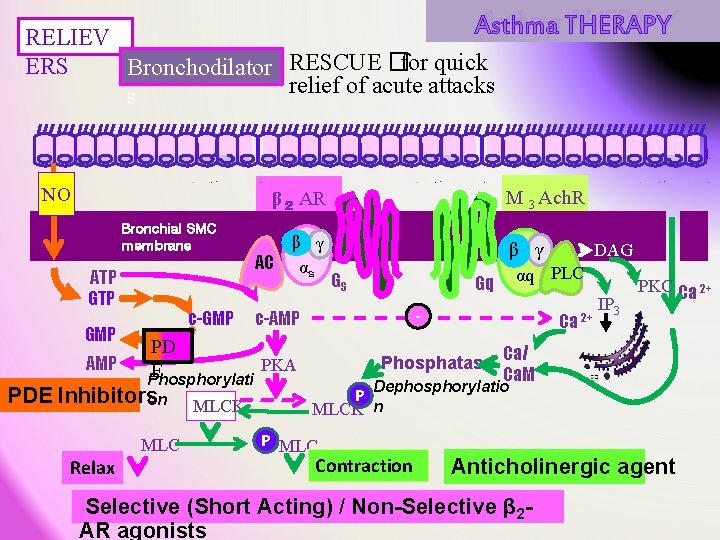
Asthma THERAPY RELIEV ERS Bronchodilator RESCUE �for quick relief of acute attacks s NO M 3 Ach. R β2 AR Bronchial SMC membrane ATP GMP AMP c-GMP MLCK β γ GS DAG αq PLC Gq - c-AMP PD PKA E Phosphorylati PDE Inhibitors on Relax β γ AC αs Ca 2+ Phosphatase IP 3 PKC Ca 2+ Ca/ Ca. M P Dephosphorylatio MLCK n P MLC Contraction Anticholinergic agent Selective (Short Acting) / Non-Selective β 2 AR agonists
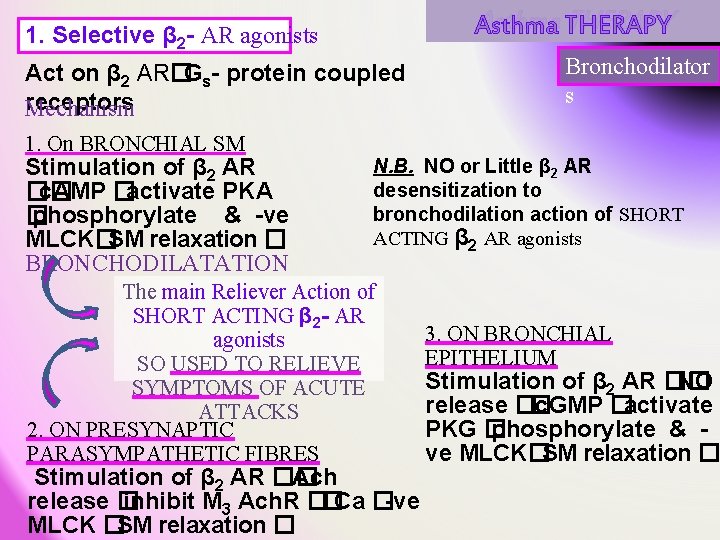
Asthma THERAPY 1. Selective β 2 - AR agonists Act on β 2 AR�Gs- protein coupled receptors Mechanism 1. On BRONCHIAL SM Stimulation of β 2 AR �� c. AMP �activate PKA � phosphorylate & -ve MLCK�SM relaxation � BRONCHODILATATION Bronchodilator s N. B. NO or Little β 2 AR desensitization to bronchodilation action of SHORT ACTING β 2 AR agonists The main Reliever Action of SHORT ACTING β 2 - AR agonists SO USED TO RELIEVE SYMPTOMS OF ACUTE ATTACKS 2. ON PRESYNAPTIC PARASYMPATHETIC FIBRES Stimulation of β 2 AR �� Ach release � inhibit M 3 Ach. R ��Ca �-ve MLCK �SM relaxation � 3. ON BRONCHIAL EPITHELIUM Stimulation of β 2 AR �� NO release �� c. GMP �activate PKG � phosphorylate & ve MLCK�SM relaxation �
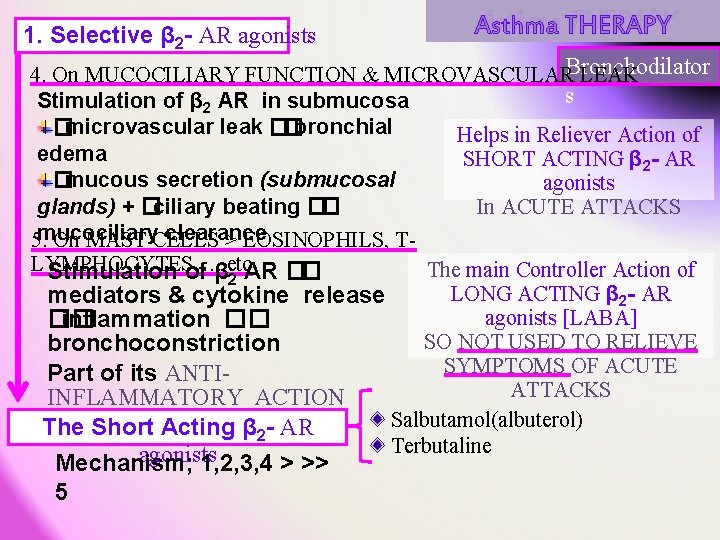
1. Selective β 2 - AR agonists Asthma THERAPY 4. On MUCOCILIARY FUNCTION & MICROVASCULARBronchodilator LEAK s Stimulation of β 2 AR in submucosa �microvascular leak ��bronchial Helps in Reliever Action of edema SHORT ACTING β 2 - AR �mucous secretion (submucosal agonists glands) + �ciliary beating �� In ACUTE ATTACKS clearance 5. mucociliary On MAST CELLS > EOSINOPHILS, TLYMPHOCYTES…. . etc The main Controller Action of Stimulation of β 2 AR �� LONG ACTING β 2 - AR mediators & cytokine release agonists [LABA] �� inflammation �� SO NOT USED TO RELIEVE bronchoconstriction SYMPTOMS OF ACUTE Part of its ANTIATTACKS INFLAMMATORY ACTION Salbutamol(albuterol) The Short Acting β 2 - AR Terbutaline agonists Mechanism; 1, 2, 3, 4 > >> 5
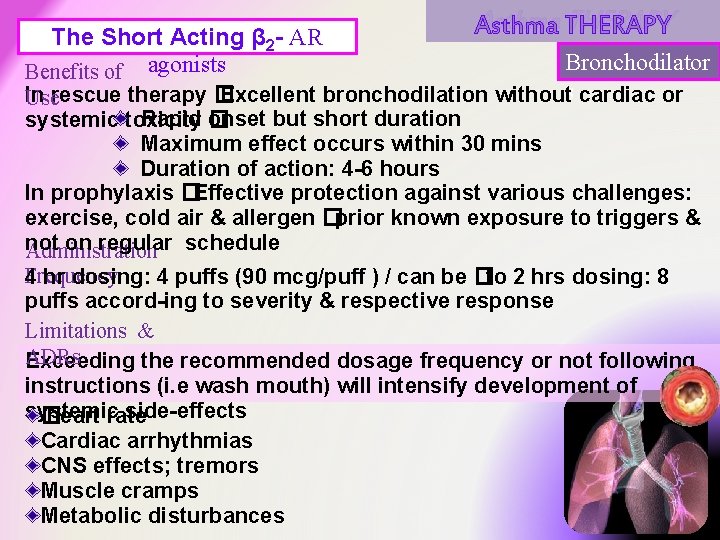
The Short Acting β 2 - AR Benefits of agonists Asthma THERAPY Bronchodilator In rescue therapy � Excellent bronchodilation withouts cardiac or Use Rapid onset but short duration systemic toxicity � Maximum effect occurs within 30 mins Duration of action: 4 -6 hours In prophylaxis �Effective protection against various challenges: exercise, cold air & allergen �prior known exposure to triggers & not on regular schedule Administration Frequency 4 hr dosing: 4 puffs (90 mcg/puff ) / can be �to 2 hrs dosing: 8 puffs accord-ing to severity & respective response Limitations & ADRs Exceeding the recommended dosage frequency or not following instructions (i. e wash mouth) will intensify development of systemic side-effects � heart rate Cardiac arrhythmias CNS effects; tremors Muscle cramps Metabolic disturbances
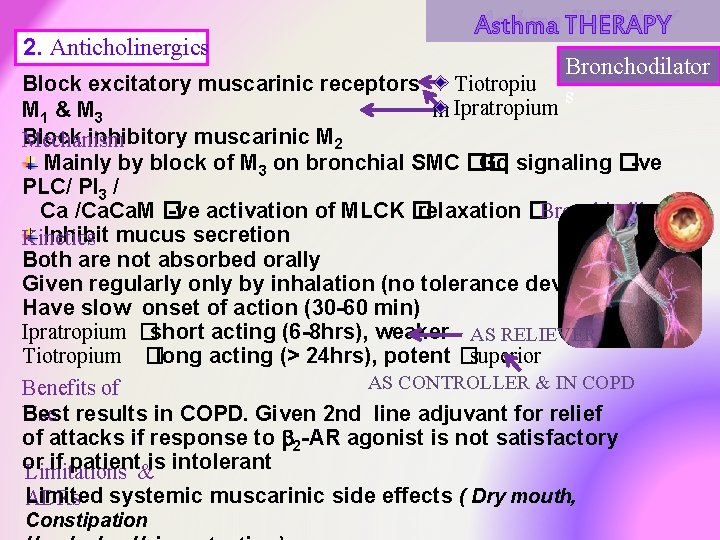
2. Anticholinergics Asthma THERAPY Bronchodilator s Tiotropiu Block excitatory muscarinic receptors m Ipratropium M 1 & M 3 Block inhibitory muscarinic M 2 Mechanism Mainly by block of M 3 on bronchial SMC �� Gq signaling �-ve PLC/ PI 3 / Ca /Ca. M � -ve activation of MLCK � relaxation �Bronchiodilatation Inhibit mucus secretion Kinetics Both are not absorbed orally Given regularly only by inhalation (no tolerance develop) Have slow onset of action (30 -60 min) Ipratropium �short acting (6 -8 hrs), weaker AS RELIEVER Tiotropium �long acting (> 24 hrs), potent �superior AS CONTROLLER & IN COPD Benefits of Best Use results in COPD. Given 2 nd line adjuvant for relief of attacks if response to b 2 -AR agonist is not satisfactory or if patient&is intolerant Limitations Limited systemic muscarinic side effects ( Dry mouth, ADRs Constipation
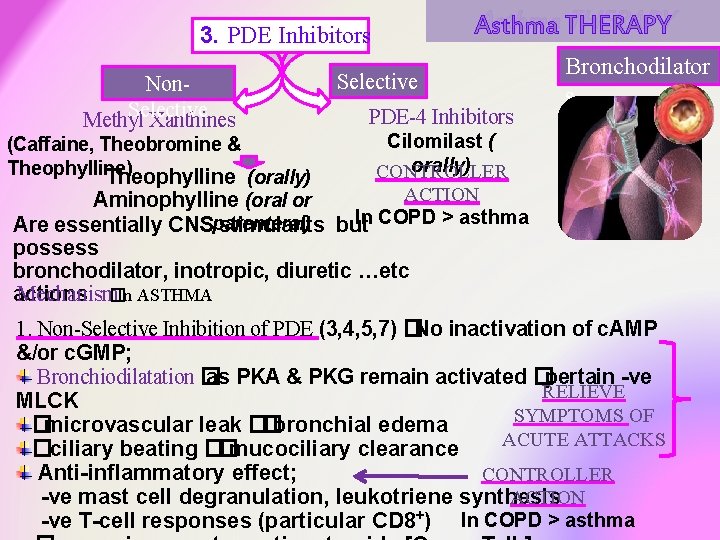
3. PDE Inhibitors Non. Selective Methyl Xanthines Asthma THERAPY Selective PDE-4 Inhibitors Bronchodilator s Cilomilast ( (Caffaine, Theobromine & orally) Theophylline) CONTROLLER Theophylline (orally) ACTION Aminophylline (oral or In COPD > asthma Are essentially CNSparenteral) stimulants but possess bronchodilator, inotropic, diuretic …etc Mechanism actions � In ASTHMA 1. Non-Selective Inhibition of PDE (3, 4, 5, 7) �No inactivation of c. AMP &/or c. GMP; Bronchiodilatation � as PKA & PKG remain activated �pertain -ve RELIEVE MLCK SYMPTOMS OF �microvascular leak ��bronchial edema ACUTE ATTACKS �ciliary beating ��mucociliary clearance Anti-inflammatory effect; CONTROLLER ACTION -ve mast cell degranulation, leukotriene synthesis -ve T-cell responses (particular CD 8+) In COPD > asthma
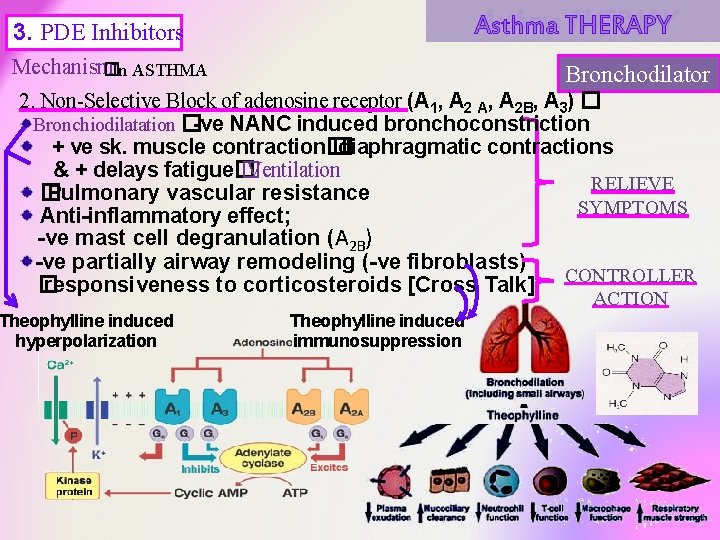
Asthma THERAPY 3. PDE Inhibitors Mechanism � In ASTHMA Bronchodilator 2. Non-Selective Block of adenosine receptor (A 1, A 2 A, A 2 B, A 3 s) � Bronchiodilatation � -ve NANC induced bronchoconstriction + ve sk. muscle contraction� � diaphragmatic contractions & + delays fatigue� � Ventilation RELIEVE � Pulmonary vascular resistance SYMPTOMS Anti-inflammatory effect; -ve mast cell degranulation (A 2 B) -ve partially airway remodeling (-ve fibroblasts) � responsiveness to corticosteroids [Cross Talk] CONTROLLER Theophylline induced hyperpolarization ACTION Theophylline induced immunosuppression
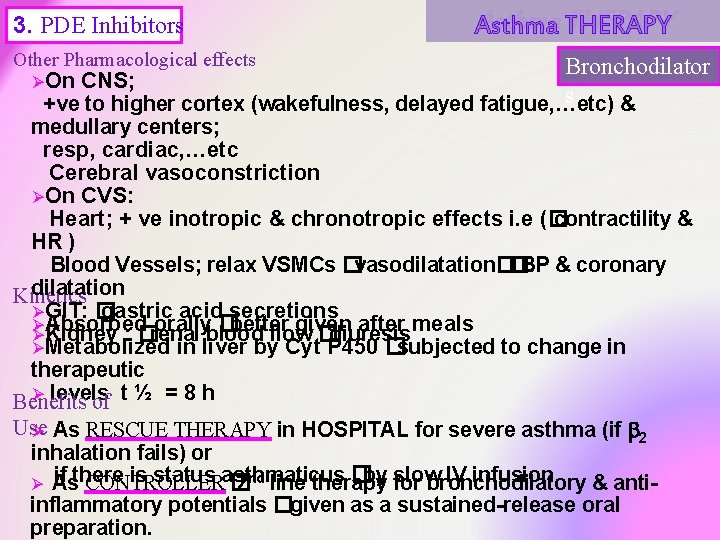
3. PDE Inhibitors Asthma THERAPY Other Pharmacological effects Bronchodilator ØOn CNS; s +ve to higher cortex (wakefulness, delayed fatigue, …etc) & medullary centers; resp, cardiac, …etc Cerebral vasoconstriction ØOn CVS: Heart; + ve inotropic & chronotropic effects i. e (� contractility & HR ) Blood Vessels; relax VSMCs �vasodilatation��BP & coronary dilatation Kinetics ØGIT: � gastric acid secretions ØAbsorbed orally � better given after meals ØKidney : � renal blood flow �diuresis ØMetabolized in liver by Cyt P 450 � subjected to change in therapeutic Ø levels t ½ = 8 h Benefits of Use Ø As RESCUE THERAPY in HOSPITAL for severe asthma (if b 2 inhalation fails) or if there is status asthmaticus �by for slow IV infusion Ø As CONTROLLER � 2 nd line therapy bronchodilatory & antiinflammatory potentials �given as a sustained-release oral preparation.
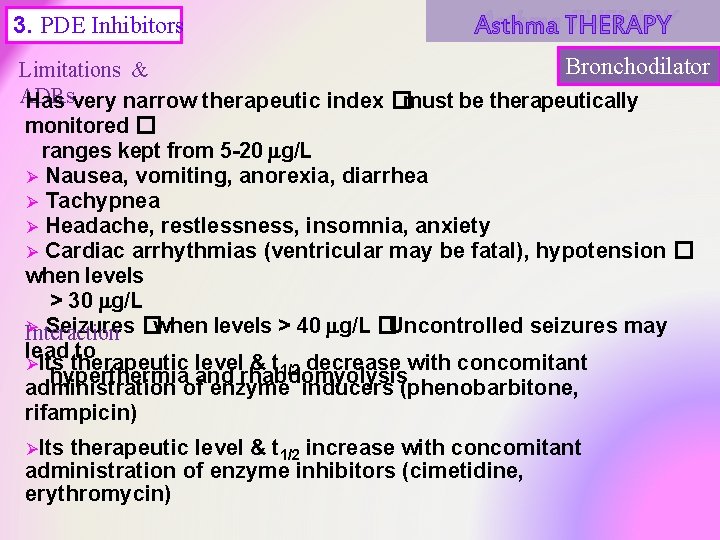
3. PDE Inhibitors Asthma THERAPY Bronchodilator Limitations & ADRs s Has very narrow therapeutic index �must be therapeutically monitored � ranges kept from 5 -20 mg/L Ø Nausea, vomiting, anorexia, diarrhea Ø Tachypnea Ø Headache, restlessness, insomnia, anxiety Ø Cardiac arrhythmias (ventricular may be fatal), hypotension � when levels > 30 mg/L Ø Seizures � when levels > 40 mg/L �Uncontrolled seizures may Interaction lead to ØIts therapeutic level & t 1/2 decrease with concomitant hyperthermia and rhabdomyolysis administration of enzyme inducers (phenobarbitone, rifampicin) ØIts therapeutic level & t 1/2 increase with concomitant administration of enzyme inhibitors (cimetidine, erythromycin)
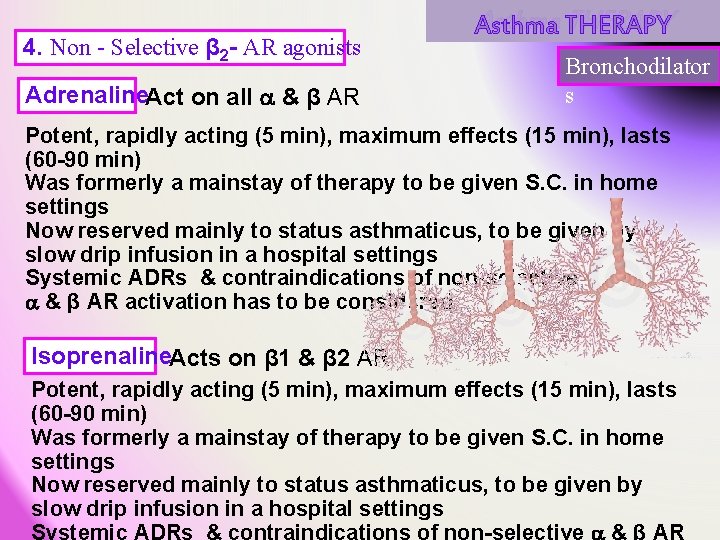
4. Non - Selective β 2 - AR agonists Adrenaline. Act on all a & β AR Asthma THERAPY Bronchodilator s Potent, rapidly acting (5 min), maximum effects (15 min), lasts (60 -90 min) Was formerly a mainstay of therapy to be given S. C. in home settings Now reserved mainly to status asthmaticus, to be given by slow drip infusion in a hospital settings Systemic ADRs & contraindications of non-selective a & β AR activation has to be considered Isoprenaline. Acts on β 1 & β 2 AR Potent, rapidly acting (5 min), maximum effects (15 min), lasts (60 -90 min) Was formerly a mainstay of therapy to be given S. C. in home settings Now reserved mainly to status asthmaticus, to be given by slow drip infusion in a hospital settings
Asthma To Be Continued