
ASTHMA ACTION PLAN Presented by Ruth Ann Begay

ASTHMA ACTION PLAN Presented by: Ruth. Ann Begay Goradia, MSN, MPH, RN, AE-C
EPR-3 Clinical Practice Guidelines 1. Use inhaled corticosteroids to control asthma. 2. Use written asthma action plans to guide patient self-management 3. Assess asthma severity 4. Assess and monitor asthma control 5. Schedule follow-up visits 6. Control environmental exposures
Why Use Asthma Action Plans? Asthma patients who spend as little as 30 minutes with a health care professional to develop a personalized self-management plan show improved adherence to medications and better disease control. Study findings were published in the April 2009 issue of “The Journal of Allergy and Clinical Immunology. ” Co-authors of the study are Kelly Wong Mc. Grath, BA; Jack K. Covington, BA; Su-Chun Cheng, DSc; and Homer A. Boushey, MD
Why Use Asthma Action Plans? • Recommended in EPR-3 as part of an Educational Program • Studies have found: – Reduced urgent care visits, emergency department visits, hospitalizations, work absences, and nocturnal asthma – Improved control
Goal Of Therapy Goal of Therapy: To Control Asthma I. Reducing impairment II. Reducing risk
Goal Of Therapy Reducing Impairment • • • Prevent symptoms Infrequent use of reliever(s) (Near) normal pulmonary function Normal activity levels Patients’ and families’ satisfaction with care EPR 3 p. 277
Goal Of Therapy Reducing Risk • Prevent recurrent exacerbations; minimize ED visits and hospitalizations • Prevent progressive lung function or loss of lung growth • Optimal pharmacotherapy with minimal or no adverse effects EPR 3 p. 277
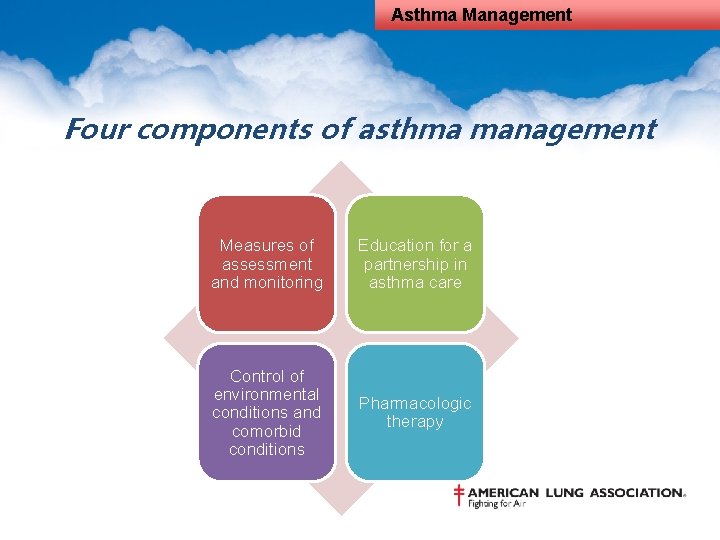
Asthma Management Four components of asthma management Measures of assessment and monitoring Education for a partnership in asthma care Control of environmental conditions and comorbid conditions Pharmacologic therapy
Asthma Action Plans A plan, or roadmap to implement the goals of asthma therapy that uses all four components of asthma management.
What Is An Asthma Action Plan? A Written Plan • Created in partnership with the patient for guided self-management • Addresses daily management to maintain control • Identifies what to do for exacerbations by recognizing and handling worsening asthma EPR 3 p. 94
What Is An Asthma Action Plan? The Purpose • Empowers the user to manage their asthma • Following a daily management plan should lead to control of asthma • Used as an education and communication tool between the provider & patient, other caregivers (e. g. , schools, childcare)
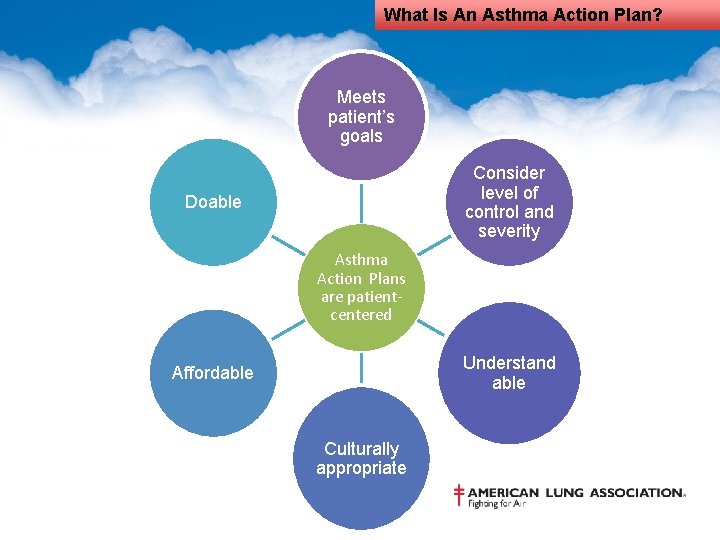
What Is An Asthma Action Plan? Meets patient’s goals Consider level of control and severity Doable Asthma Action Plans are patientcentered Understand able Affordable Culturally appropriate
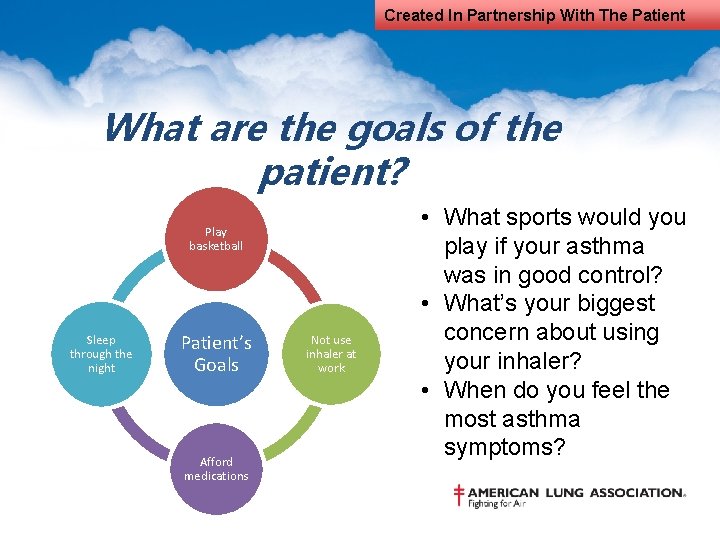
Created In Partnership With The Patient What are the goals of the patient? Play basketball Sleep through the night Patient’s Goals Afford medications Not use inhaler at work • What sports would you play if your asthma was in good control? • What’s your biggest concern about using your inhaler? • When do you feel the most asthma symptoms?
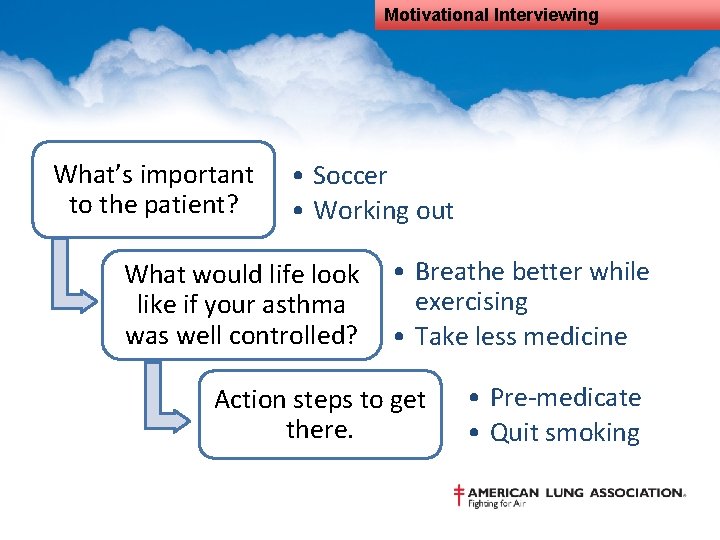
Motivational Interviewing What’s important to the patient? • Soccer • Working out What would life look like if your asthma was well controlled? • Breathe better while exercising • Take less medicine Action steps to get there. • Pre-medicate • Quit smoking
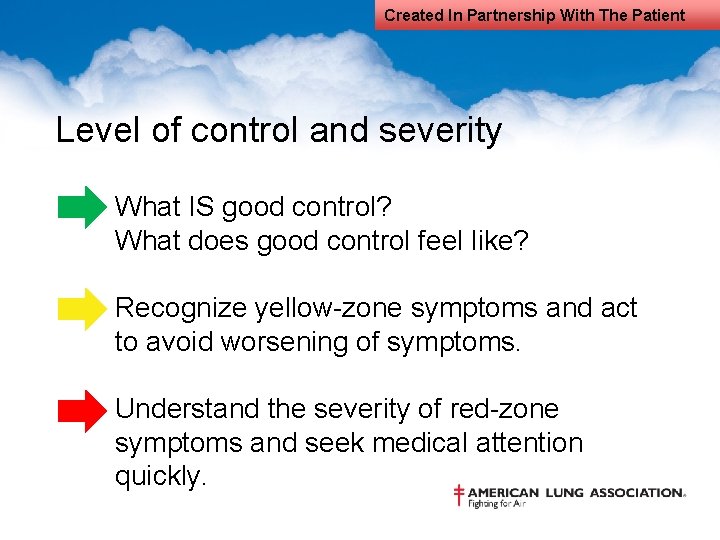
Created In Partnership With The Patient Level of control and severity What IS good control? What does good control feel like? Recognize yellow-zone symptoms and act to avoid worsening of symptoms. Understand the severity of red-zone symptoms and seek medical attention quickly.
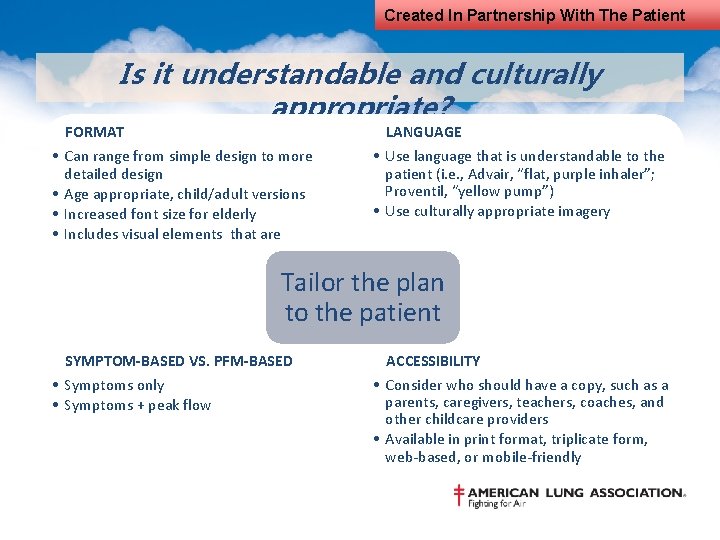
Created In Partnership With The Patient Is it understandable and culturally appropriate? • • FORMAT Can range from simple design to more detailed design Age appropriate, child/adult versions Increased font size for elderly Includes visual elements that are LANGUAGE • Use language that is understandable to the patient (i. e. , Advair, “flat, purple inhaler”; Proventil, “yellow pump”) • Use culturally appropriate imagery Tailor the plan to the patient SYMPTOM-BASED VS. PFM-BASED • Symptoms only • Symptoms + peak flow ACCESSIBILITY • Consider who should have a copy, such as a parents, caregivers, teachers, coaches, and other childcare providers • Available in print format, triplicate form, web-based, or mobile-friendly
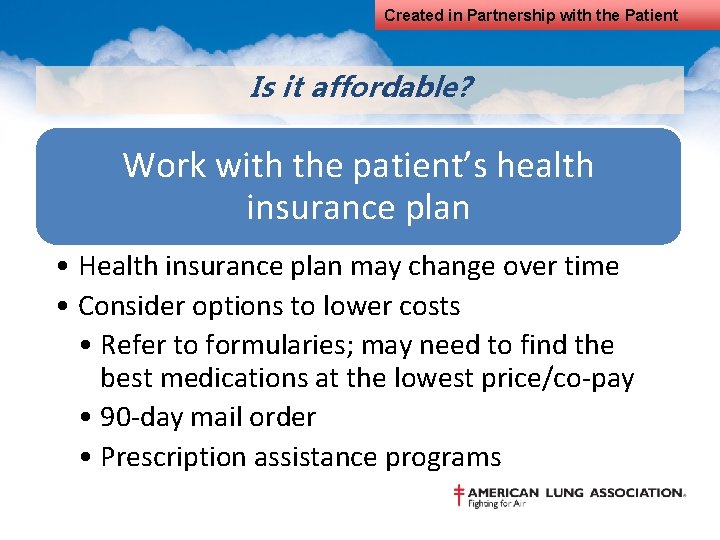
Created in Partnership with the Patient Is it affordable? Work with the patient’s health insurance plan • Health insurance plan may change over time • Consider options to lower costs • Refer to formularies; may need to find the best medications at the lowest price/co-pay • 90 -day mail order • Prescription assistance programs
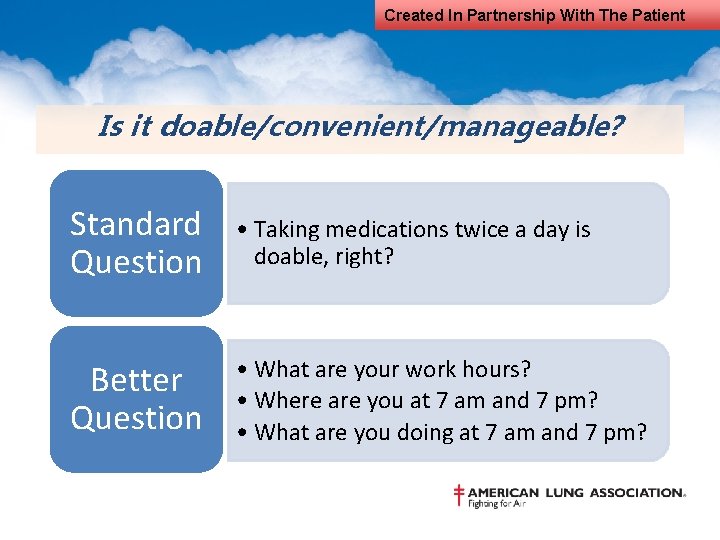
Created In Partnership With The Patient Is it doable/convenient/manageable? Standard Question • Taking medications twice a day is doable, right? Better Question • What are your work hours? • Where are you at 7 am and 7 pm? • What are you doing at 7 am and 7 pm?
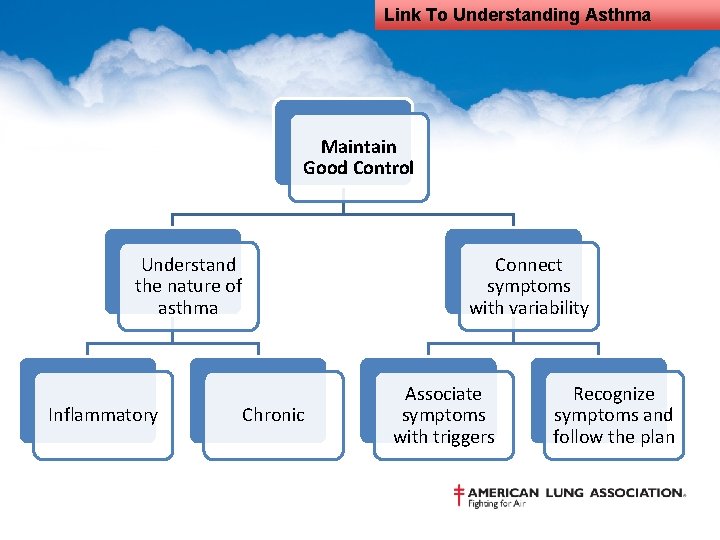
Link To Understanding Asthma Maintain Good Control Understand the nature of asthma Inflammatory Connect symptoms with variability Chronic Associate symptoms with triggers Recognize symptoms and follow the plan
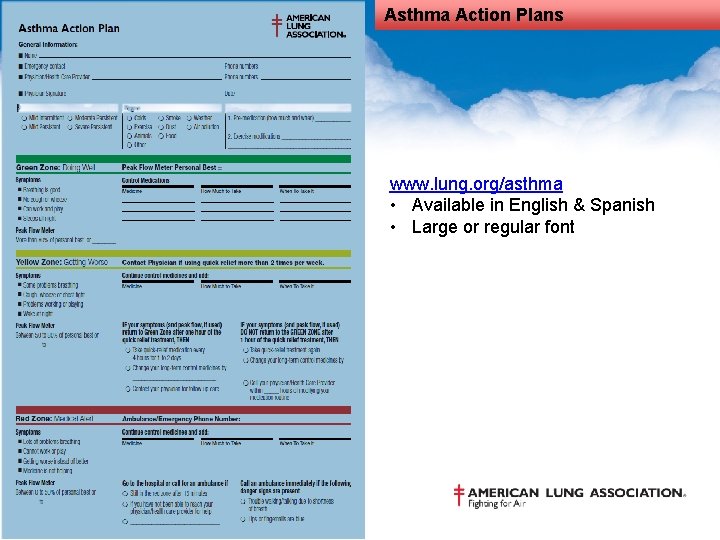
Asthma Action Plans www. lung. org/asthma • Available in English & Spanish • Large or regular font
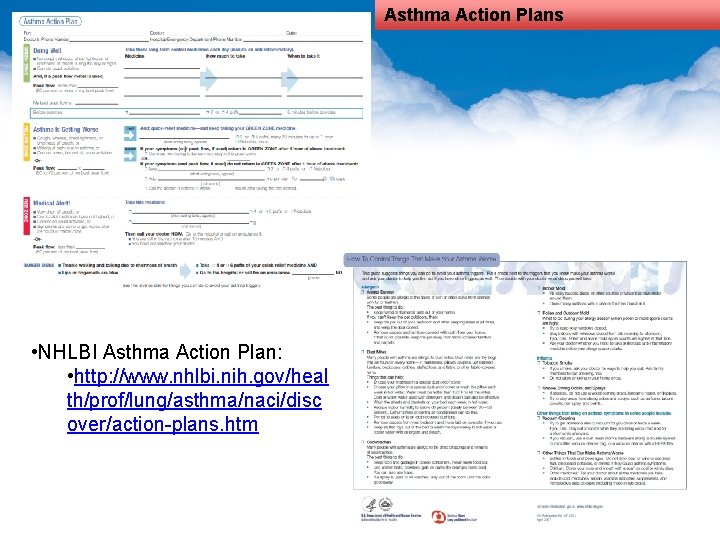
Asthma Action Plans • NHLBI Asthma Action Plan: • http: //www. nhlbi. nih. gov/heal th/prof/lung/asthma/naci/disc over/action-plans. htm
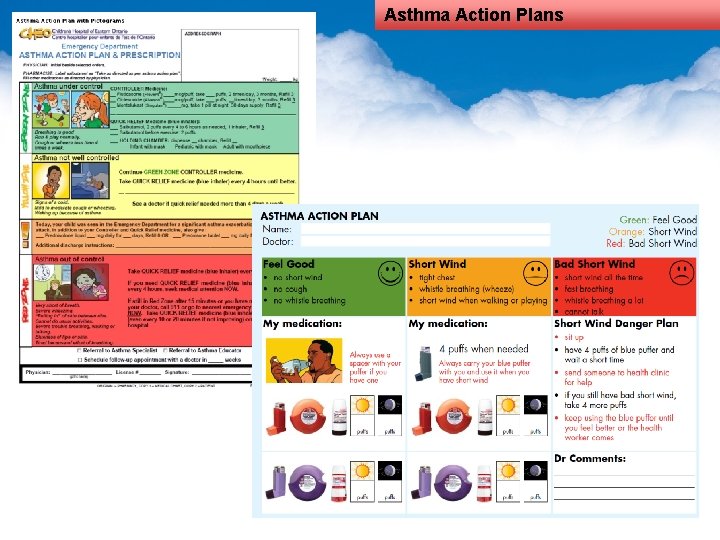
Asthma Action Plans
Asthma Action Plans Other Asthma Action Plans: • CDC: • http: //www. cdc. gov/asthma/tools_for_control. htm • • • Print and Fill forms Electronic forms Computer-based, interactive plan • New Mexico Asthma Action Plan for Schools • http: //nmhealth. org/eheb/asthma_schoolhealth. shtml
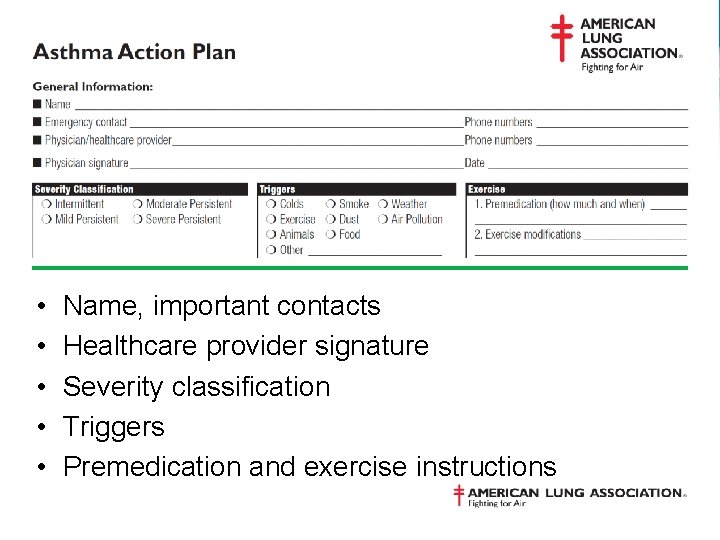
• • • Name, important contacts Healthcare provider signature Severity classification Triggers Premedication and exercise instructions
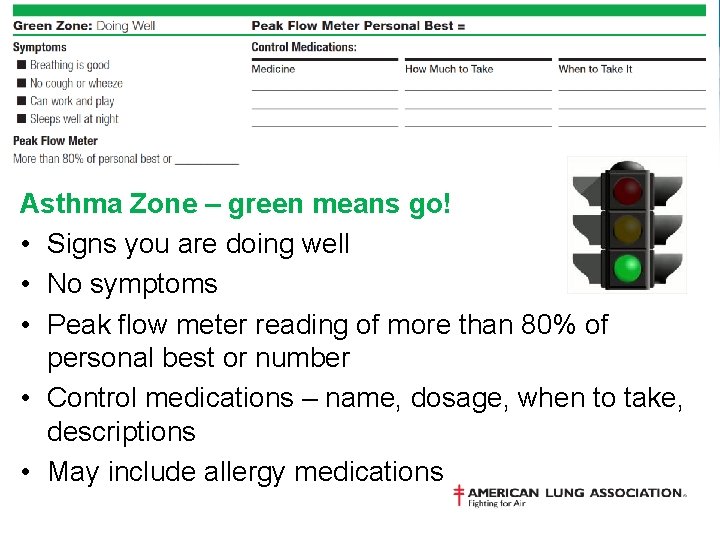
Asthma Zone – green means go! • Signs you are doing well • No symptoms • Peak flow meter reading of more than 80% of personal best or number • Control medications – name, dosage, when to take, descriptions • May include allergy medications
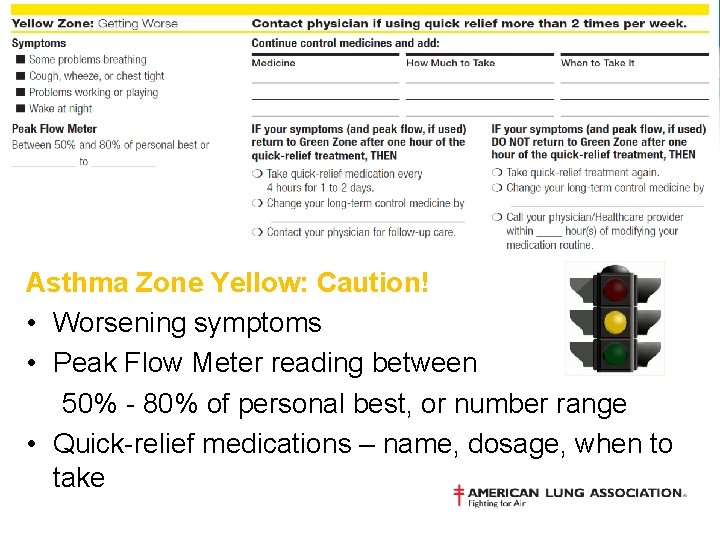
Asthma Zone Yellow: Caution! • Worsening symptoms • Peak Flow Meter reading between 50% - 80% of personal best, or number range • Quick-relief medications – name, dosage, when to take
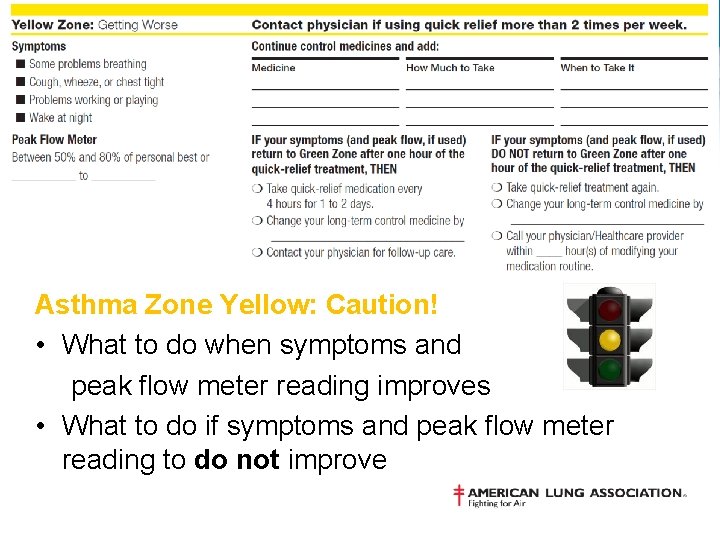
Asthma Zone Yellow: Caution! • What to do when symptoms and peak flow meter reading improves • What to do if symptoms and peak flow meter reading to do not improve
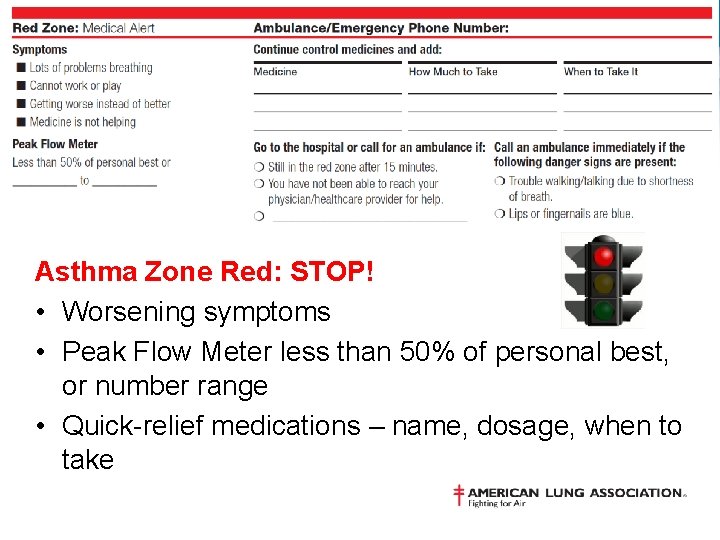
Asthma Zone Red: STOP! • Worsening symptoms • Peak Flow Meter less than 50% of personal best, or number range • Quick-relief medications – name, dosage, when to take
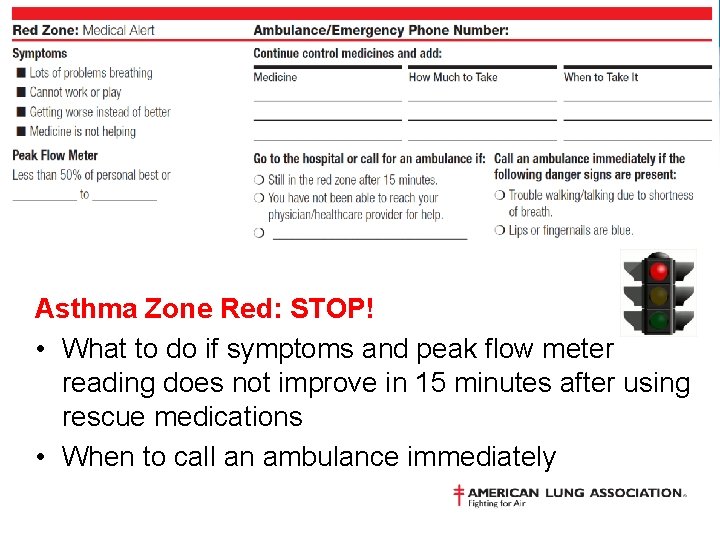
Asthma Zone Red: STOP! • What to do if symptoms and peak flow meter reading does not improve in 15 minutes after using rescue medications • When to call an ambulance immediately
Include Treatment for Comorbid Conditions If patients has other conditions, it’s also important to include. . . • Meds, relaxation, breathing techniques for COPD • Antihistamines, nasal steroids, hypertonic saline irrigation for rhinosinusitis • Meds, dietary changes, elevation of bed for GERD • Speech path, relaxation techniques for VCD
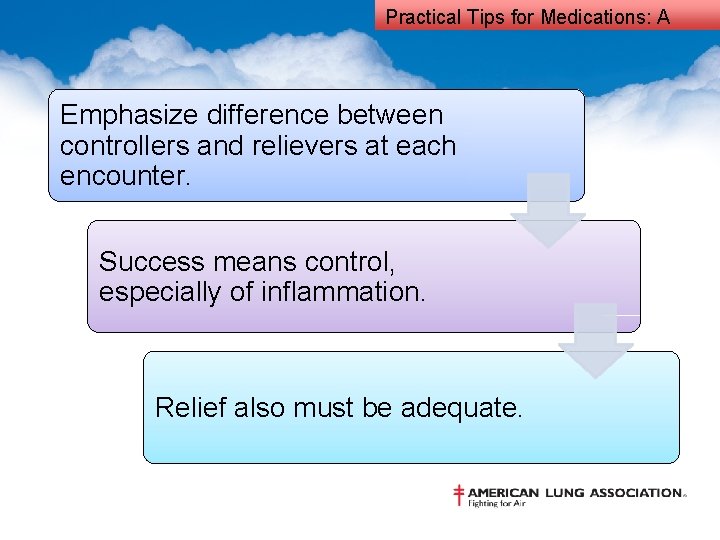
Practical Tips for Medications: A Emphasize difference between controllers and relievers at each encounter. Success means control, especially of inflammation. Relief also must be adequate.
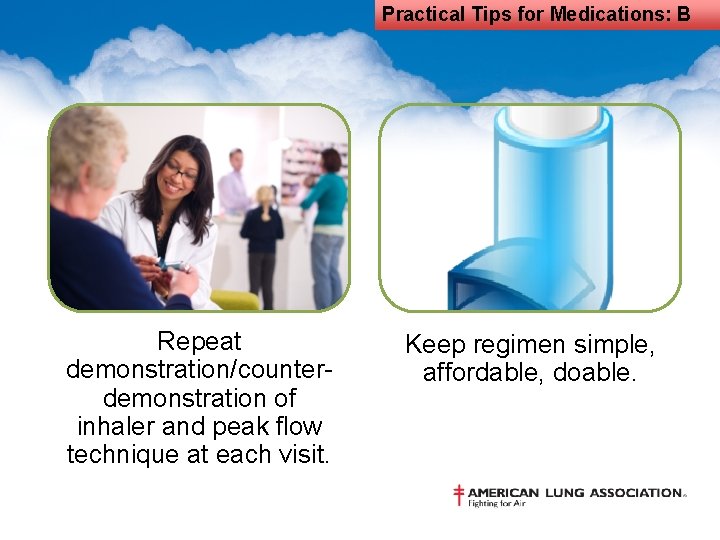
Practical Tips for Medications: B Repeat demonstration/counterdemonstration of inhaler and peak flow technique at each visit. Keep regimen simple, affordable, doable.
Coordinate All the Players on the Team • Patient and family • All caregivers – at school, after school, coaches • All professional caregivers – healthcare provider, school nurse, etc. • Copies of Asthma Action Plan for all
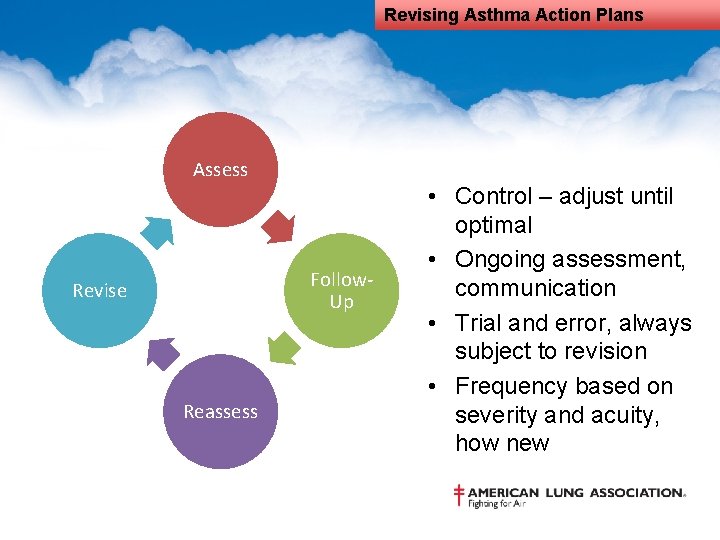
Revising Asthma Action Plans Assess Follow. Up Revise Reassess • Control – adjust until optimal • Ongoing assessment, communication • Trial and error, always subject to revision • Frequency based on severity and acuity, how new
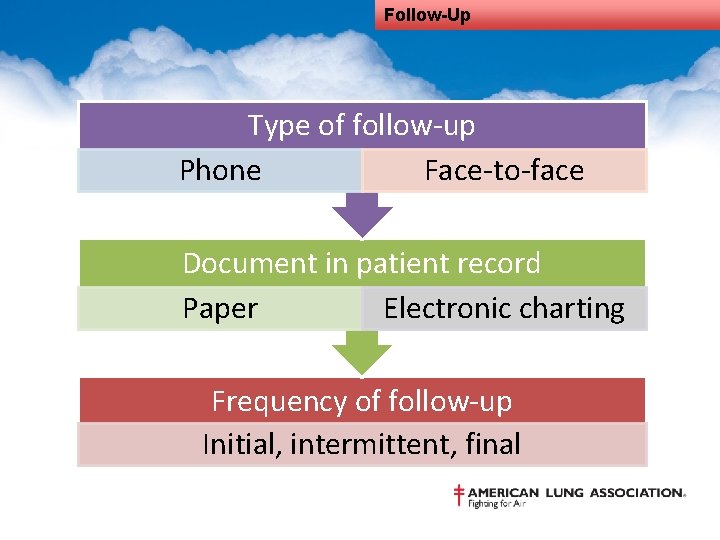
Follow-Up Type of follow-up Phone Face-to-face Document in patient record Paper Electronic charting Frequency of follow-up Initial, intermittent, final
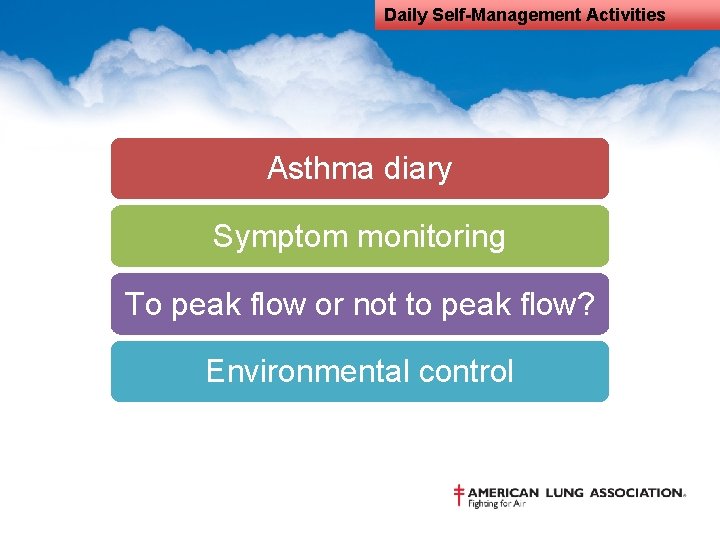
Daily Self-Management Activities Asthma diary Symptom monitoring To peak flow or not to peak flow? Environmental control
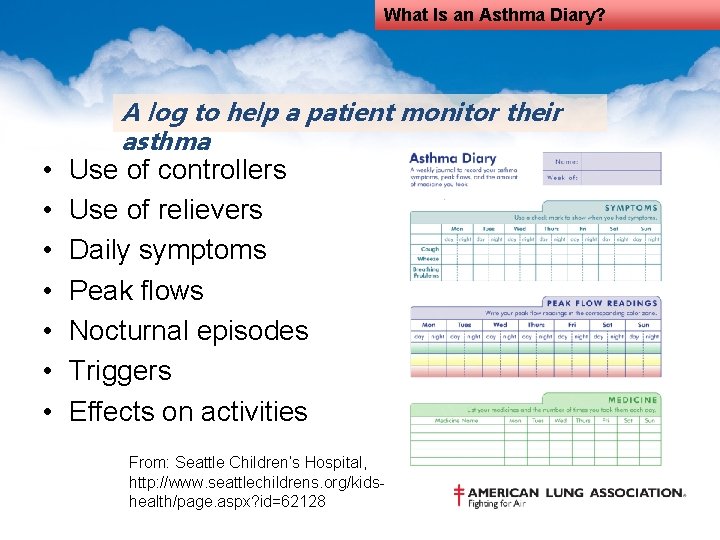
What Is an Asthma Diary? • • A log to help a patient monitor their asthma Use of controllers Use of relievers Daily symptoms Peak flows Nocturnal episodes Triggers Effects on activities From: Seattle Children’s Hospital, http: //www. seattlechildrens. org/kidshealth/page. aspx? id=62128
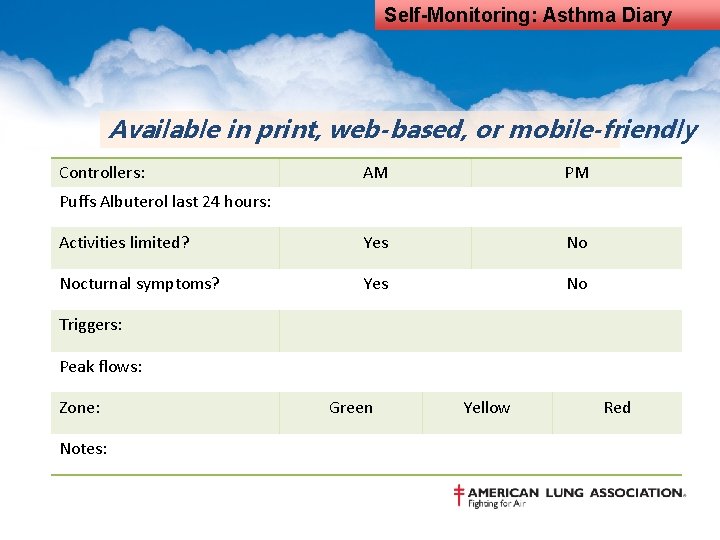
Self-Monitoring: Asthma Diary Available in print, web-based, or mobile-friendly Controllers: AM PM Activities limited? Yes No Nocturnal symptoms? Yes No Puffs Albuterol last 24 hours: Triggers: Peak flows: Zone: Notes: Green Yellow Red
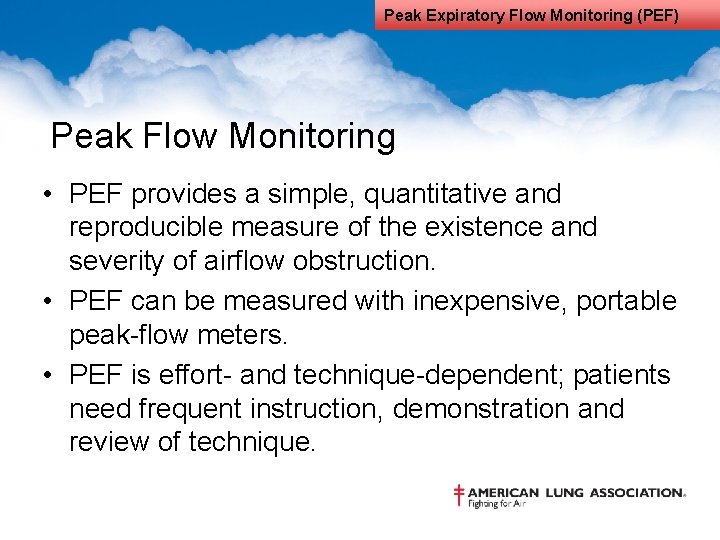
Peak Expiratory Flow Monitoring (PEF) Peak Flow Monitoring • PEF provides a simple, quantitative and reproducible measure of the existence and severity of airflow obstruction. • PEF can be measured with inexpensive, portable peak-flow meters. • PEF is effort- and technique-dependent; patients need frequent instruction, demonstration and review of technique.
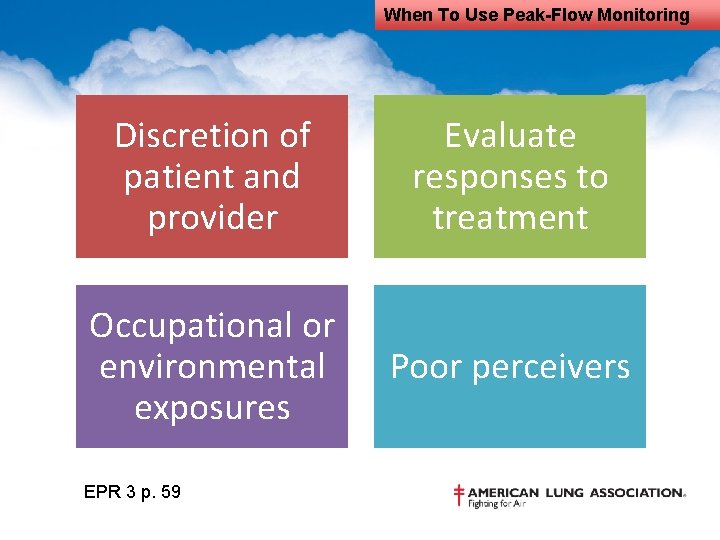
When To Use Peak-Flow Monitoring Discretion of patient and provider Evaluate responses to treatment Occupational or environmental exposures Poor perceivers EPR 3 p. 59
NAEPP-3 on Peak-Flow Monitoring “When self-management is the chosen method for maintaining asthma control, peak-flow-based self-management is equivalent to symptombased self-management as long as either method also includes a written asthma action plan with instructions on how to recognize and handle worsening asthma, including selfadjustment of medications. ” EPR 3 p. 60 -61
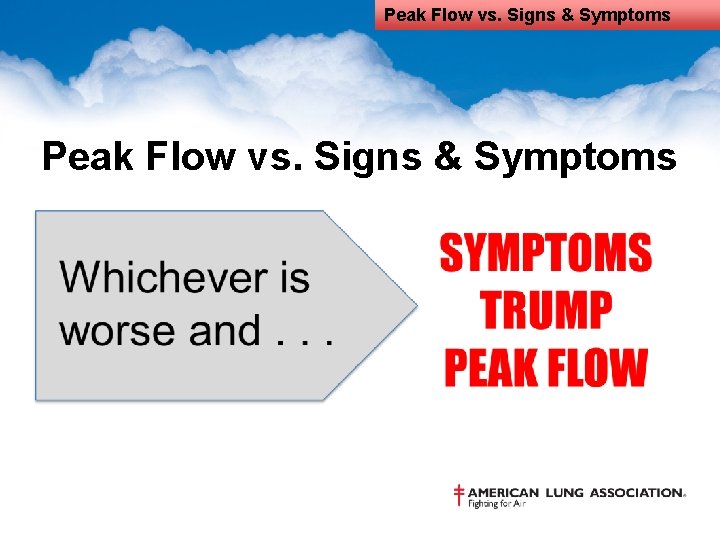
Peak Flow vs. Signs & Symptoms
Questions and Answers Clicker Time!!!
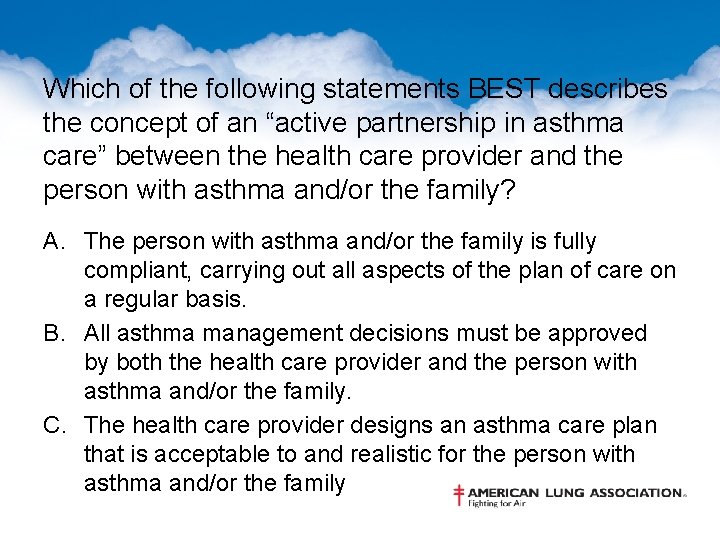
Which of the following statements BEST describes the concept of an “active partnership in asthma care” between the health care provider and the person with asthma and/or the family? A. The person with asthma and/or the family is fully compliant, carrying out all aspects of the plan of care on a regular basis. B. All asthma management decisions must be approved by both the health care provider and the person with asthma and/or the family. C. The health care provider designs an asthma care plan that is acceptable to and realistic for the person with asthma and/or the family
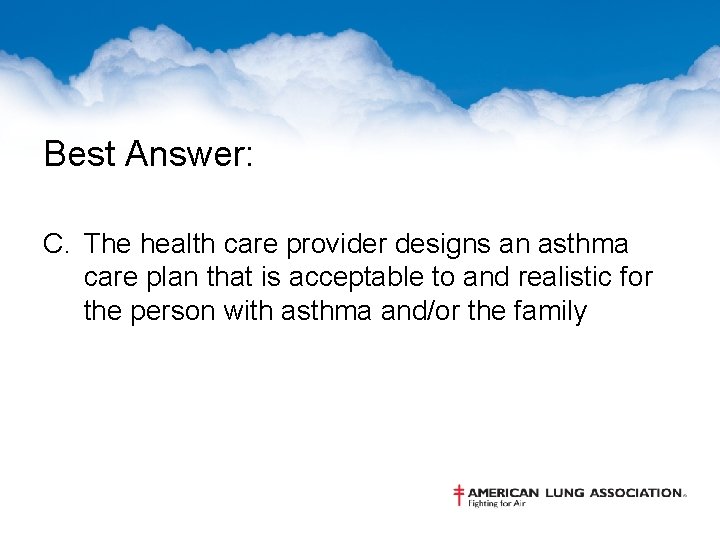
Best Answer: C. The health care provider designs an asthma care plan that is acceptable to and realistic for the person with asthma and/or the family
True or False: An Asthma Action Plan should be written according to the judgment and experience of the provider and then carefully explained to the patient. A. True B. False

Best Answer: B. False
John’s peak flow reading in the office is between 50 -80% of his personal best. This reading indicates: A. An expected level for individuals with asthma. B. A need for observation but no increase in the level of medication. C. A need for observation and an increase in the level of medication. D. A severe asthma episode.
Best Answer: C. A need for observation and an increase in the level of medication.
Which of the following signs/symptoms indicates a deteriorating or worsening asthma status that requires immediate medical intervention? A. No improvement in asthma symptoms within 5 minutes of use of a quick relief inhaler. B. Difficulty walking and talking due to shortness of breath. C. Inspiratory wheezing and persistent cough. D. A and B. E. B and C.
Best Answer: D. A and B. – – A. No improvement in asthma symptoms within 5 minutes of use of a quick relief inhaler. B. Difficulty walking and talking due to shortness of breath.
Peak flow monitoring can be used for all of the following EXCEPT: A. B. C. D. Short term monitoring. Managing exacerbations. Daily long-term monitoring. Diagnosing asthma.
Best Answer: D. Diagnosing asthma.
Asthma Action Plans should be revised: A. Whenever therapy is stepped up or down on a longterm basis. B. When a patient who has adhered well to the plan has an exacerbation requiring oral steroids. C. When a patient’s PEF/Personal Best is re-established. D. When a patient has not needed to use a short-acting beta agonist reliever for 2 consecutive months. E. Both A and C.
Best Answer: E. Both A and C. – – A. Whenever therapy is stepped up or down on a long-term basis. C. When a patient’s PEF/Personal Best is reestablished.
A person with asthma has a predicted peak flow reading of 400 L/min. Today the peak flow reading is 450 L/min. Based on the predicted reading, what is the BEST interpretation of today’s peak flow? A. B. C. D. Red zone. Yellow zone. Green zone. Personal best zone.
Best Answer: C. Green zone
Case Study: Pedro, 23 y. o. male 1. Break into groups and discuss Pedro case study 2. Think about the Asthma Action Plan for Pedro, and discuss: ü ü ü Controllers Relievers Environmental changes Monitoring Other
Acknowledgements • Ruth. Ann Goradia, MSN, MPH, RN, AE-C APS Chronic Health Needs Resource Nurse • Expert Panel Report 3 (EPR 3): Guidelines for the Diagnosis and Management of Asthma – Pages 115 -121 – Pages 124 -125 – Pages 277 -288
We will breathe easier when the air in every American community is clean and healthy. We will breathe easier when people are free from the addictive grip of cigarettes and the debilitating effects of lung disease. We will breathe easier when the air in our public spaces and workplaces is clear of secondhand smoke. We will breathe easier when children no longer battle airborne poisons or fear an asthma attack. Until then, we are fighting for air.
- Slides: 60