
ASTERIX Towards a Scalable Semistructured Data Platform for
ASTERIX: Towards a Scalable, Semistructured Data Platform for Evolving World Models Michael Carey Information Systems Group CS Department UC Irvine
Today’s Presentation • Overview of UCI’s ASTERIX project – What and why? – A few technical details – ASTERIX research agenda • Overview of UCI’s Hyracks sub-project – Runtime plan executor for ASTERIX – Data-intensive computing substrate in its own right – Early open source release • Project status, next steps, and Q & A 1
Context: Information-Rich Times • Databases have long been central to our existence, but now digital info, transactions, and connectedness are everywhere… – E-commerce: > $100 B annually in retail sales in the US – In 2009, average # of e-mails person was 110 (biz) and 45 (avg user) – Print media is suffering, while news portals and blogs are thriving • Social networks have truly exploded in popularity – End of 2009 Facebook statistics: • > 350 million active users with > 55 million status updates per day • > 3. 5 billion pieces of content per week and > 3. 5 million events per month – Facebook only 9 months later: • > 500 million active users, more than half using the site on a given day (!) • > 30 billion pieces of new content per month now • Twitter and similar services are also quite popular – Used by about 1 in 5 Internet users to share status updates – Early 2010 Twitter statistic: ~50 million Tweets per day 2
Context: Cloud DB Bandwagons • Map. Reduce and Hadoop – “Parallel programming for dummies” – But now Pig, Scope, Jaql, Hive, … – Map. Reduce is the new runtime! • GFS and HDFS – Scalable, self-managed, Really Big Files – But now Big. Table, HBase, … – HDFS is the new file storage! • Key-value stores – All charter members of the “No. SQL movement” – Includes S 3, Dynamo, Big. Table, HBase, Cassandra, … – These are the new record managers! 3
Let’s Approach This Stuff “Right”! • In my opinion… – The OS/DS folks out-scaled the (napping) DB folks – But, it’d be “crazy” to build on their foundations • Instead, identify key lessons and do it “right” – Cheap open-source S/W on commodity H/W – Non-monolithic software components – Equal opportunity data access (external sources) – Tolerant of flexible / nested / absent schemas – Little pre-planning or DBA-type work required – Fault-tolerant long query execution – Types and declarative languages (aha…!) 4
So What If We’d Meant To Do This? • What is the “right” basis for analyzing and managing the data of the future? – Runtime layer (and division of labor)? – Storage and data distribution layers? • Explore how to build new information management systems for the cloud that… – Seamlessly support external data access – Execute queries in the face of partial failures – Scale to thousands of nodes (and beyond) – Don’t require five-star wizard administrators – …. 5
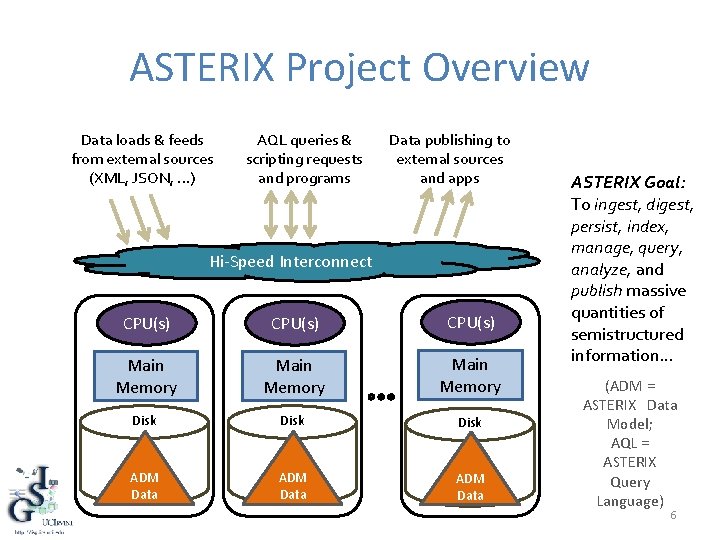
ASTERIX Project Overview Data loads & feeds from external sources (XML, JSON, …) AQL queries & scripting requests and programs Data publishing to external sources and apps Hi-Speed Interconnect CPU(s) Main Memory Disk ADM Data ASTERIX Goal: To ingest, digest, persist, index, manage, query, analyze, and publish massive quantities of semistructured information… (ADM = ASTERIX Data Model; AQL = ASTERIX Query Language) 6
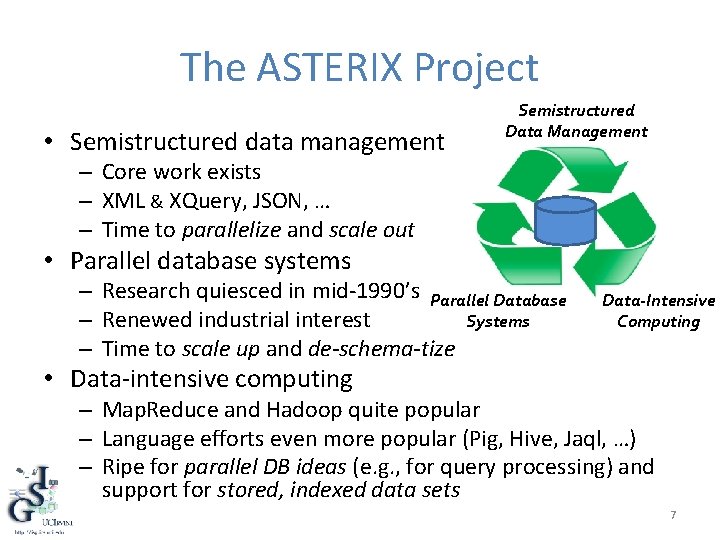
The ASTERIX Project • Semistructured data management Semistructured Data Management – Core work exists – XML & XQuery, JSON, … – Time to parallelize and scale out • Parallel database systems – Research quiesced in mid-1990’s Parallel Database – Renewed industrial interest Systems – Time to scale up and de-schema-tize Data-Intensive Computing • Data-intensive computing – Map. Reduce and Hadoop quite popular – Language efforts even more popular (Pig, Hive, Jaql, …) – Ripe for parallel DB ideas (e. g. , for query processing) and support for stored, indexed data sets 7
ASTERIX Project Objectives • Build a scalable information management platform – Targeting large commodity computing clusters – Handling mass quantities of semistructured information • Conduct timely information systems research – – Large-scale query processing and workload management Highly scalable storage and index management Fuzzy matching in a highly parallel world Apply parallel DB know-how to data intensive computing • Train a new generation of information systems R&D researchers and software engineers – “If we build it, they will learn…”( ) 8
“Mass Quantities”? Really? ? • Traditional databases store an enterprise model – Entities, relationships, and attributes – Current snapshot of the enterprise’s actual state – I know, yawn…. ! ( ) • The Web contains an unstructured world model – Scrape it/monitor it and extract (semi)structure – Then we’ll have a (semistructured) world model • Now simply stop throwing stuff away – Then we’ll get an evolving world model that we can analyze to study past events, responses, etc. ! 9
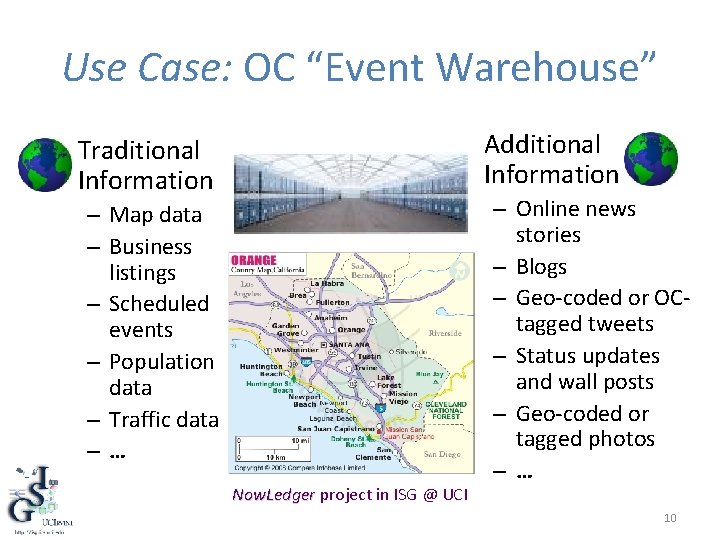
Use Case: OC “Event Warehouse” Additional Information Traditional Information – Map data – Business listings – Scheduled events – Population data – Traffic data –… Now. Ledger project in ISG @ UCI – Online news stories – Blogs – Geo-coded or OCtagged tweets – Status updates and wall posts – Geo-coded or tagged photos –… 10
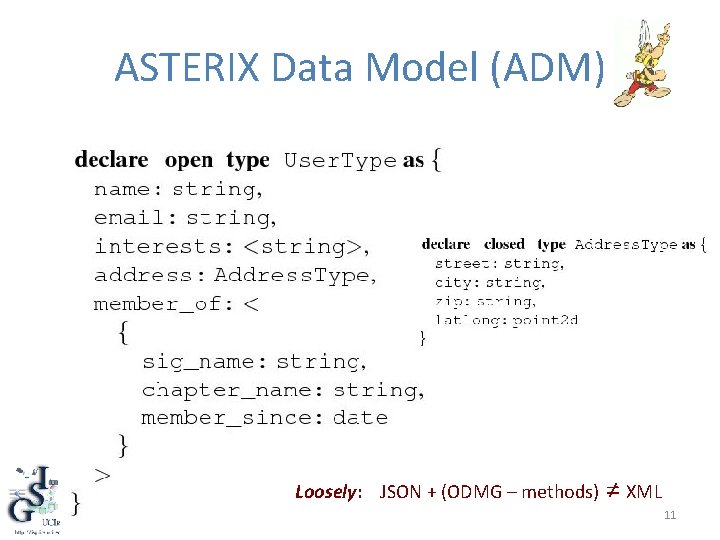
ASTERIX Data Model (ADM) Loosely: JSON + (ODMG – methods) ≠ XML 11

ADM (cont. ) (Plus equal opportunity support for both stored and external datasets) 12
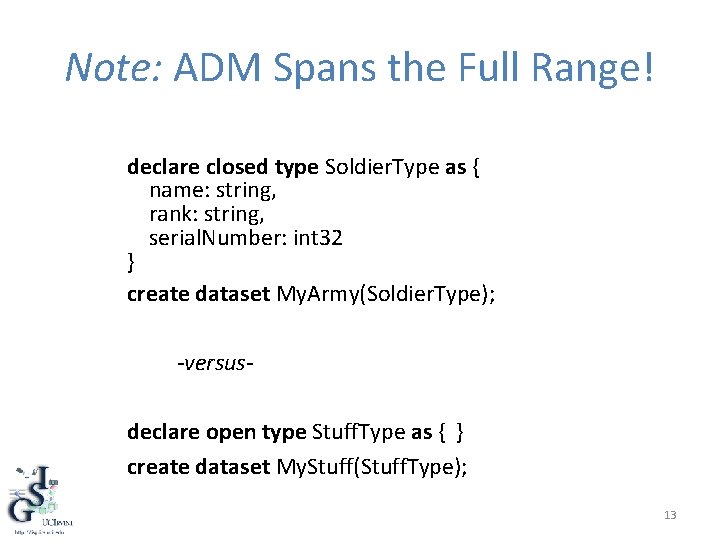
Note: ADM Spans the Full Range! declare closed type Soldier. Type as { name: string, rank: string, serial. Number: int 32 } create dataset My. Army(Soldier. Type); -versusdeclare open type Stuff. Type as { } create dataset My. Stuff(Stuff. Type); 13
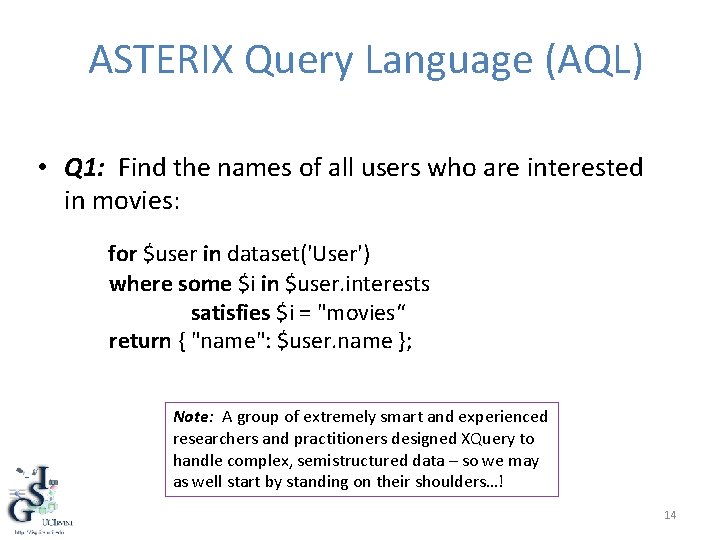
ASTERIX Query Language (AQL) • Q 1: Find the names of all users who are interested in movies: for $user in dataset('User') where some $i in $user. interests satisfies $i = "movies“ return { "name": $user. name }; Note: A group of extremely smart and experienced researchers and practitioners designed XQuery to handle complex, semistructured data – so we may as well start by standing on their shoulders…! 14
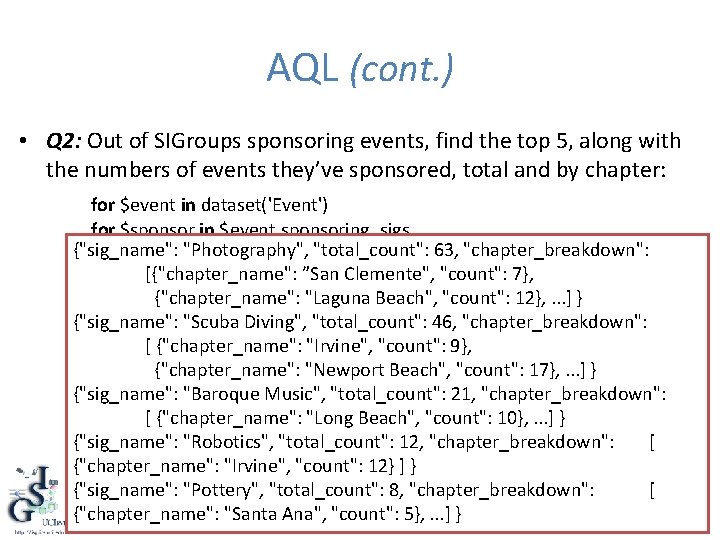
AQL (cont. ) • Q 2: Out of SIGroups sponsoring events, find the top 5, along with the numbers of events they’ve sponsored, total and by chapter: for $event in dataset('Event') for $sponsor in $event. sponsoring_sigs {"sig_name": "Photography", 63, "chapter_breakdown": let $es : = { "event": $event, "total_count": "sponsor": $sponsor } [{"chapter_name": ”San Clemente", "count": group by $sig_name : = $sponsor. sig_name with $es 7}, {"chapter_name": "Laguna Beach", "count": 12}, . . . ] } let $sig_sponsorship_count : = count($es) {"sig_name": "Scuba let $by_chapter : = Diving", "total_count": 46, "chapter_breakdown": [ {"chapter_name": "Irvine", "count": 9}, for $e in $es {"chapter_name": "Newport: =Beach", "count": 17}, . . . ] } with $es group by $chapter_name $e. sponsor. chapter_name {"sig_name": "Baroque Music", "total_count": 21, "chapter_breakdown": return { "chapter_name": $chapter_name, "count": count($es) } [ {"chapter_name": "Long Beach", "count": 10}, . . . ] } order by $sig_sponsorship_count desc limit 5 {"sig_name": "Robotics", "total_count": 12, "chapter_breakdown": [ return { "sig_name": $sig_name, {"chapter_name": "Irvine", "count": 12} ] } "total_count": $sig_sponsorship_count, {"sig_name": "Pottery", "total_count": 8, "chapter_breakdown": [ "chapter_breakdown": $by_chapter }; 15 {"chapter_name": "Santa Ana", "count": 5}, . . . ] }
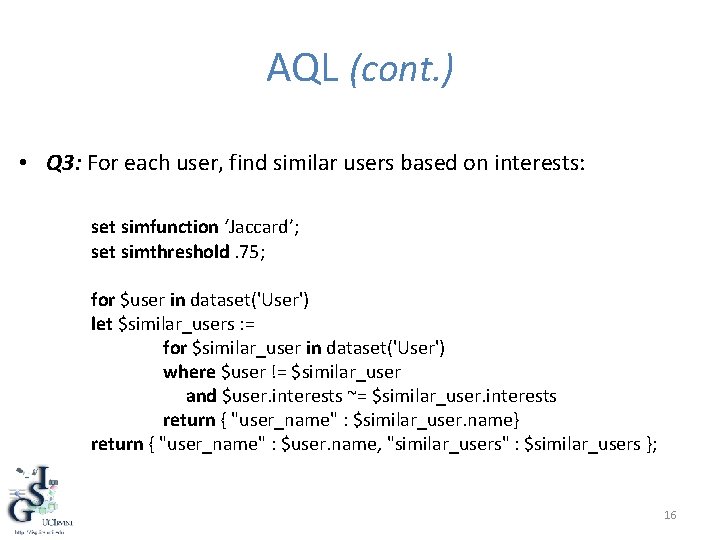
AQL (cont. ) • Q 3: For each user, find similar users based on interests: set simfunction ‘Jaccard’; set simthreshold. 75; for $user in dataset('User') let $similar_users : = for $similar_user in dataset('User') where $user != $similar_user and $user. interests ~= $similar_user. interests return { "user_name" : $similar_user. name} return { "user_name" : $user. name, "similar_users" : $similar_users }; 16
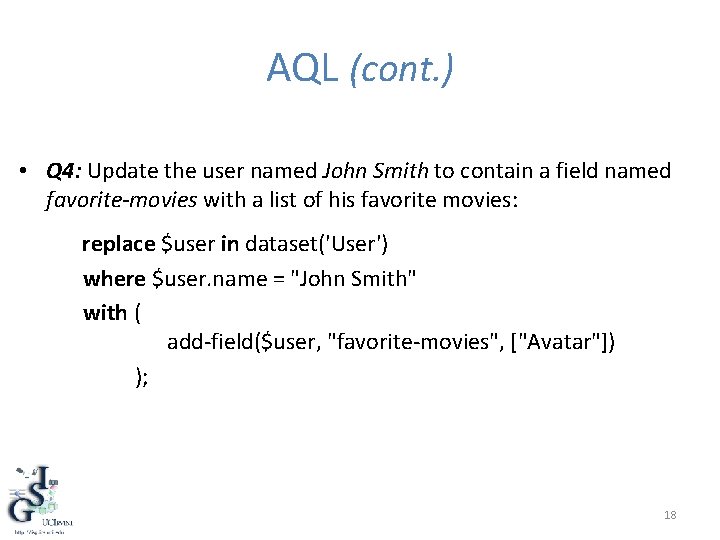
AQL (cont. ) • Q 4: Update the user named John Smith to contain a field named favorite-movies with a list of his favorite movies: replace $user in dataset('User') where $user. name = "John Smith" with ( add-field($user, "favorite-movies", ["Avatar"]) ); 18
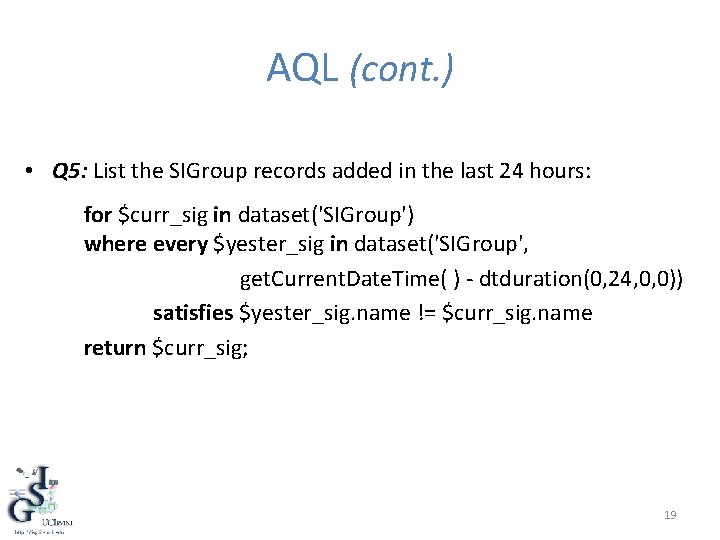
AQL (cont. ) • Q 5: List the SIGroup records added in the last 24 hours: for $curr_sig in dataset('SIGroup') where every $yester_sig in dataset('SIGroup', get. Current. Date. Time( ) - dtduration(0, 24, 0, 0)) satisfies $yester_sig. name != $curr_sig. name return $curr_sig; 19
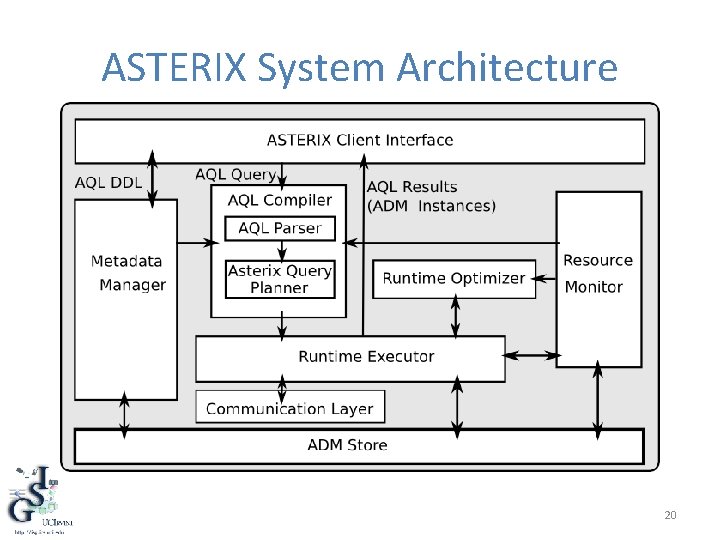
ASTERIX System Architecture 20
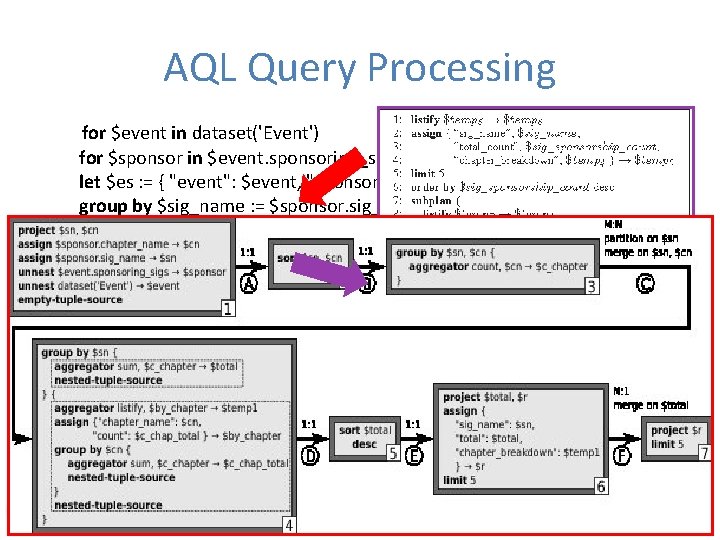
AQL Query Processing for $event in dataset('Event') for $sponsor in $event. sponsoring_sigs let $es : = { "event": $event, "sponsor": $sponsor } group by $sig_name : = $sponsor. sig_name with $es let $sig_sponsorship_count : = count($es) let $by_chapter : = for $e in $es group by $chapter_name : = $e. sponsor. chapter_name with $es return { "chapter_name": $chapter_name, "count": count($es) } order by $sig_sponsorship_count desc limit 5 return { "sig_name": $sig_name, "total_count": $sig_sponsorship_count, "chapter_breakdown": $by_chapter }; 21
ASTERIX Research Issue Sampler • Semistructured data modeling – Open/closed types, type evolution, relationships, …. – Efficient physical storage scheme(s) • Scalable storage and indexing – Self-managing scalable partitioned datasets – Ditto for indexes (hash, range, spatial, fuzzy; combos) • Large scale parallel query processing – – Division of labor between compiler and runtime Decision-making timing and basis Model-independent complex object algebra (AQUA) AQUA Fuzzy matching as well as exact-match queries • Multiuser workload management (scheduling) – Uniformly cited: Facebook, Yahoo!, e. Bay, Teradata, …. 22
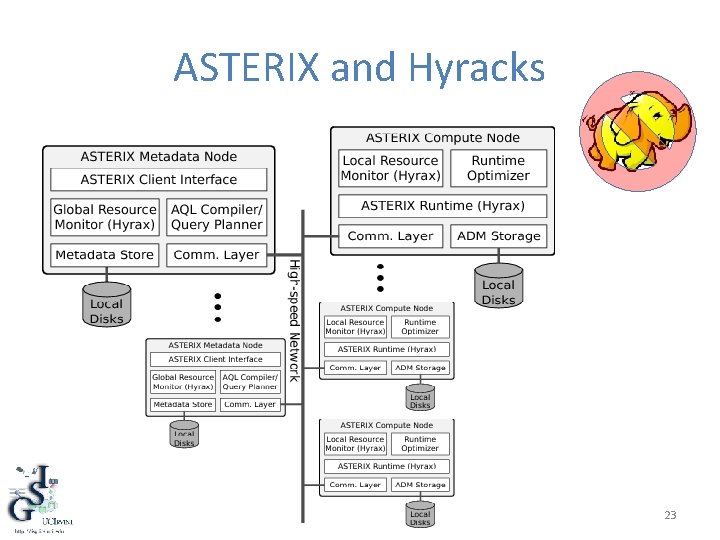
ASTERIX and Hyracks 23
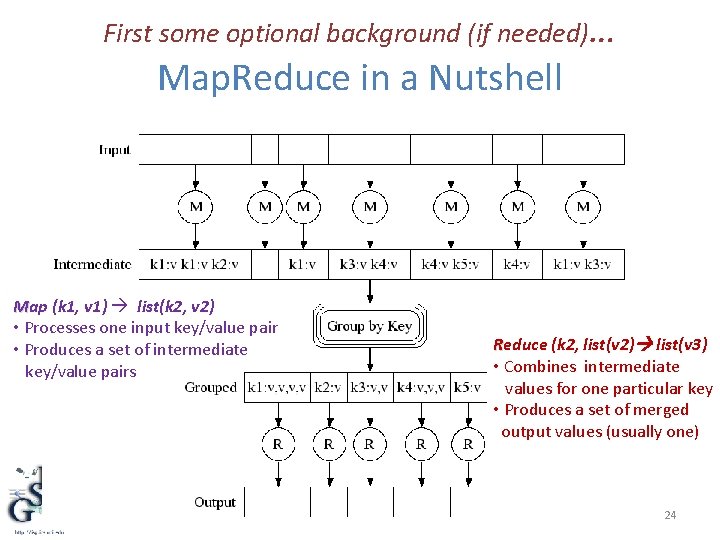
First some optional background (if needed)… Map. Reduce in a Nutshell Map (k 1, v 1) list(k 2, v 2) • Processes one input key/value pair • Produces a set of intermediate key/value pairs Reduce (k 2, list(v 2) list(v 3) • Combines intermediate values for one particular key • Produces a set of merged output values (usually one) 24
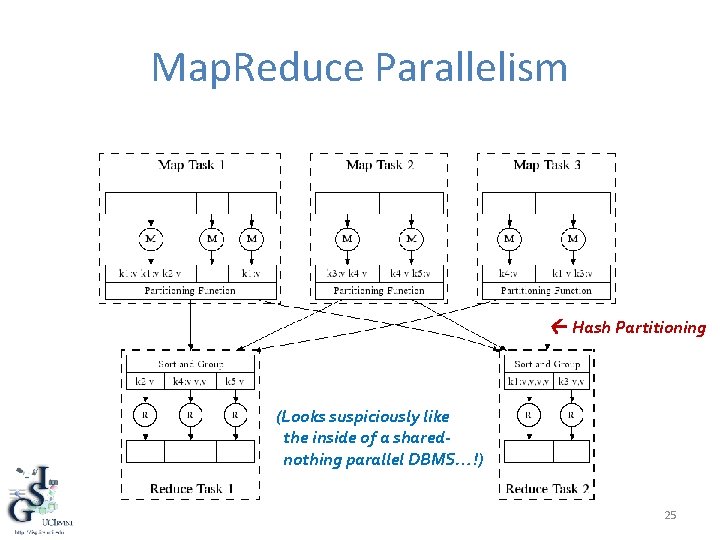
Map. Reduce Parallelism Hash Partitioning (Looks suspiciously like the inside of a sharednothing parallel DBMS…!) 25
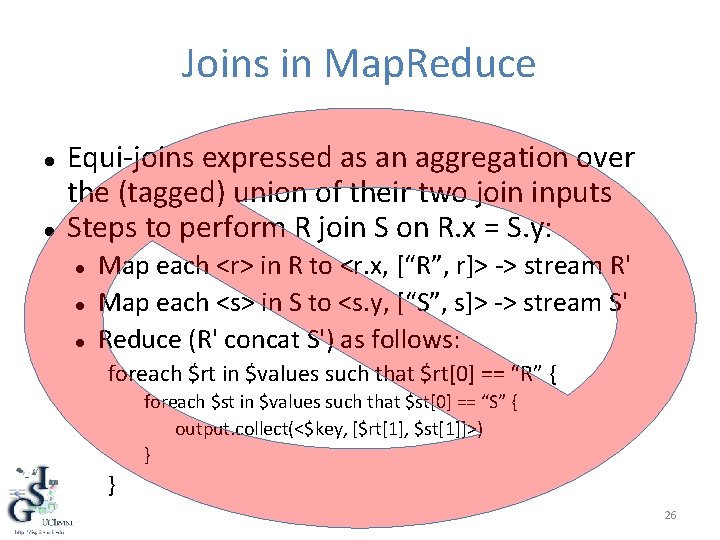
Joins in Map. Reduce Equi-joins expressed as an aggregation over the (tagged) union of their two join inputs Steps to perform R join S on R. x = S. y: Map each <r> in R to <r. x, [“R”, r]> -> stream R' Map each <s> in S to <s. y, [“S”, s]> -> stream S' Reduce (R' concat S') as follows: foreach $rt in $values such that $rt[0] == “R” { foreach $st in $values such that $st[0] == “S” { output. collect(<$key, [$rt[1], $st[1]]>) } } 26
Hyracks: ASTERIX’s Underbelly �Map. Reduce and Hadoop excel at providing support for “Parallel Programming for Dummies” Map(), reduce(), and (for extra credit) combine() Massive scalability through partitioned parallelism Fault-tolerance as well, via persistence and replication Networks of Map. Reduce tasks for complex problems �Widely recognized need for higher-level languages Numerous examples: Sawzall, Pig, Jaql, Hive (SQL), … Currently popular approach: Compile to execute on Hadoop But again: What if we’d “meant to do this” in the first place…? 27
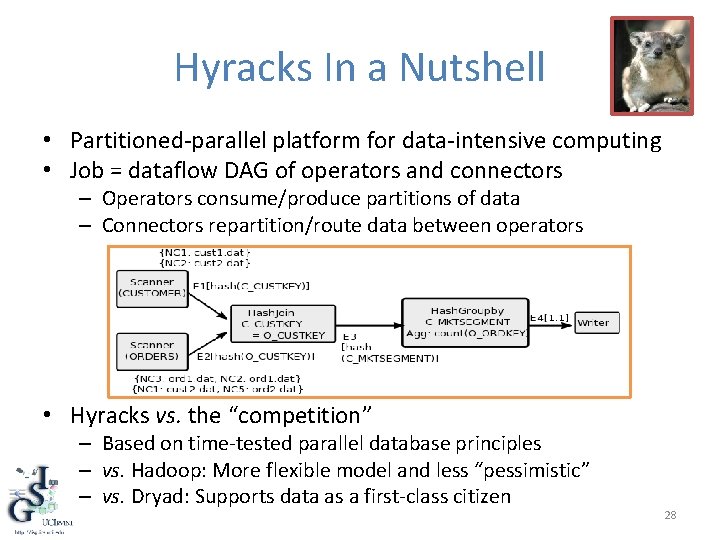
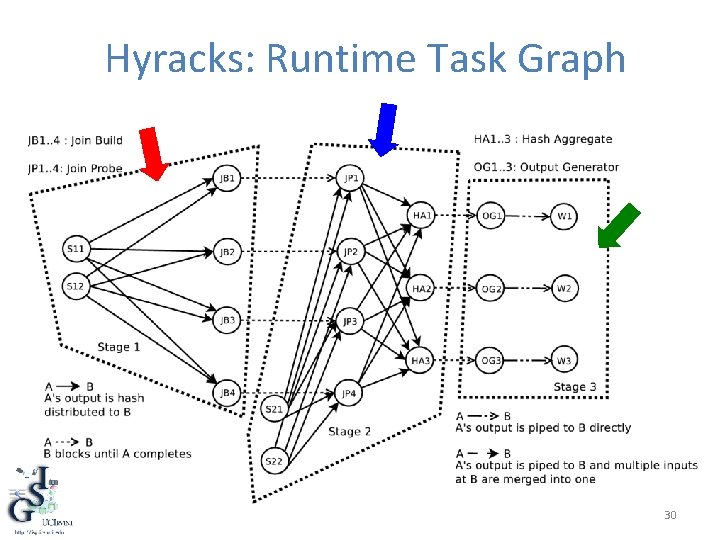
Hyracks In a Nutshell • Partitioned-parallel platform for data-intensive computing • Job = dataflow DAG of operators and connectors – Operators consume/produce partitions of data – Connectors repartition/route data between operators • Hyracks vs. the “competition” – Based on time-tested parallel database principles – vs. Hadoop: More flexible model and less “pessimistic” – vs. Dryad: Supports data as a first-class citizen 28
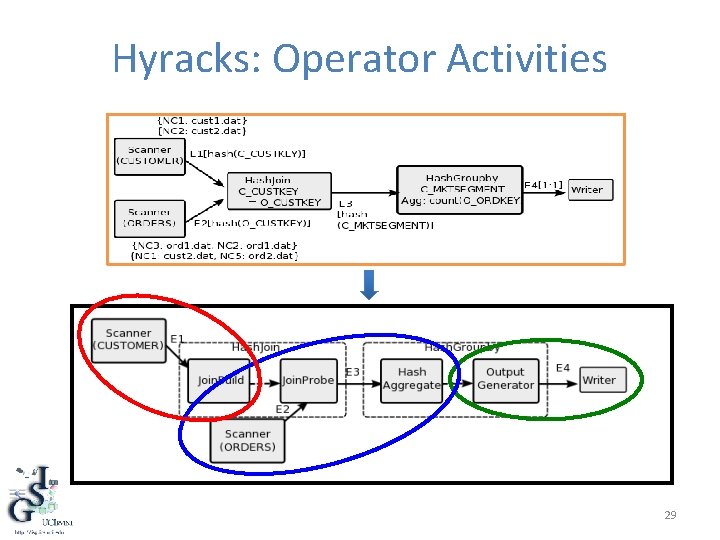
Hyracks: Operator Activities 29
Hyracks: Runtime Task Graph 30
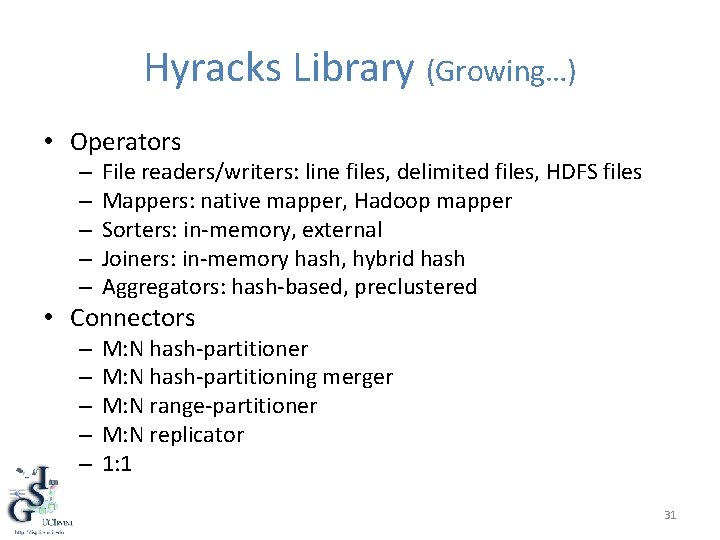
Hyracks Library (Growing…) • Operators – – – File readers/writers: line files, delimited files, HDFS files Mappers: native mapper, Hadoop mapper Sorters: in-memory, external Joiners: in-memory hash, hybrid hash Aggregators: hash-based, preclustered • Connectors – – – M: N hash-partitioner M: N hash-partitioning merger M: N range-partitioner M: N replicator 1: 1 31
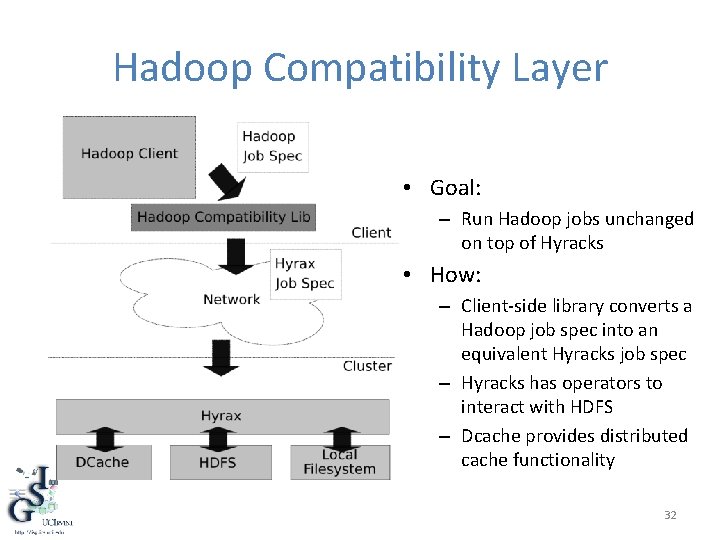
Hadoop Compatibility Layer • Goal: – Run Hadoop jobs unchanged on top of Hyracks • How: – Client-side library converts a Hadoop job spec into an equivalent Hyracks job spec – Hyracks has operators to interact with HDFS – Dcache provides distributed cache functionality 32
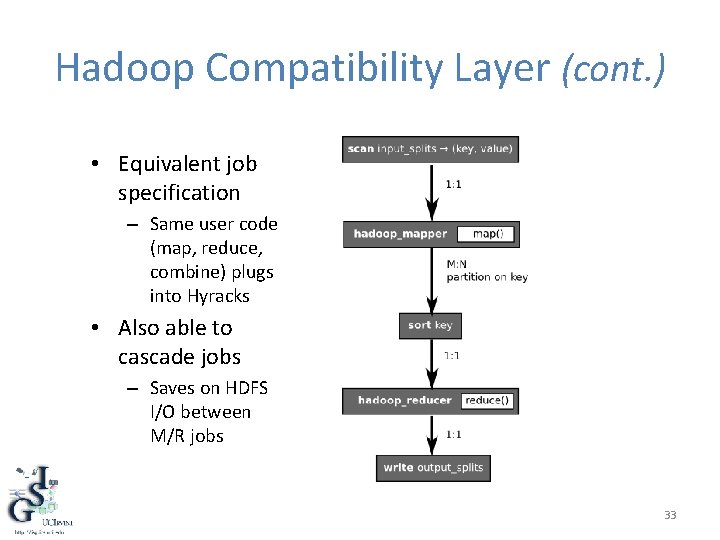
Hadoop Compatibility Layer (cont. ) • Equivalent job specification – Same user code (map, reduce, combine) plugs into Hyracks • Also able to cascade jobs – Saves on HDFS I/O between M/R jobs 33
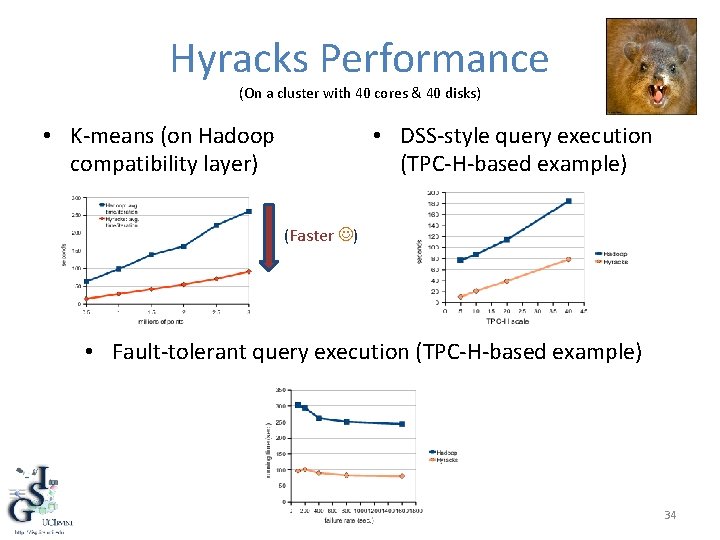
Hyracks Performance (On a cluster with 40 cores & 40 disks) • K-means (on Hadoop compatibility layer) • DSS-style query execution (TPC-H-based example) (Faster ) • Fault-tolerant query execution (TPC-H-based example) 34
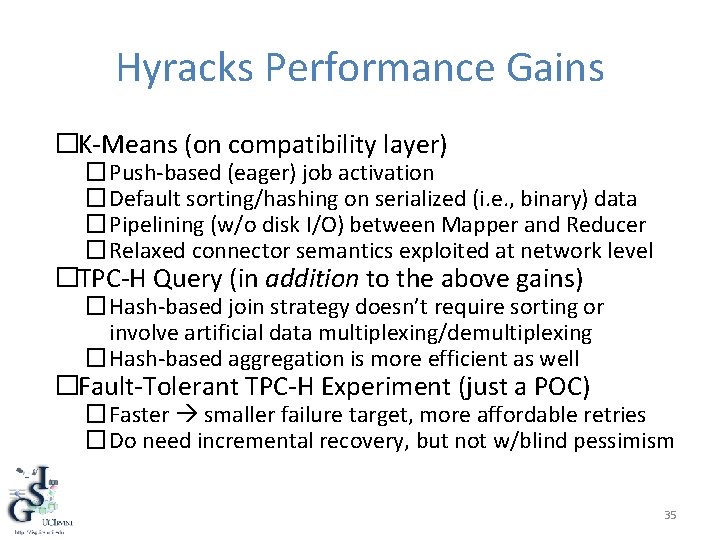
Hyracks Performance Gains �K-Means (on compatibility layer) �Push-based (eager) job activation �Default sorting/hashing on serialized (i. e. , binary) data �Pipelining (w/o disk I/O) between Mapper and Reducer �Relaxed connector semantics exploited at network level �TPC-H Query (in addition to the above gains) �Hash-based join strategy doesn’t require sorting or involve artificial data multiplexing/demultiplexing �Hash-based aggregation is more efficient as well �Fault-Tolerant TPC-H Experiment (just a POC) �Faster smaller failure target, more affordable retries �Do need incremental recovery, but not w/blind pessimism 35
Hyracks – Next Steps �Fine-grained fault tolerance/recovery �Restart failed jobs in a more fine-grained manner �Exploit operator properties (natural blocking points) to obtain fault-tolerance at marginal (or no) extra cost �Automatic scheduling �Use operator constraints and resource needs to decide on parallelism level and locations for operator evaluation � Memory requirements � CPU and I/O consumption (or at least balance) �Protocol for interacting with HLL query planners �Interleaving of compilation and execution, sources of decision-making information, etc. 36
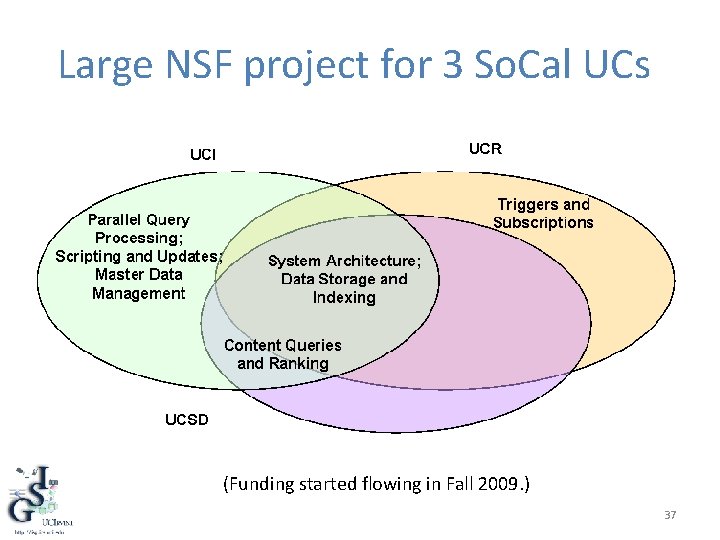
Large NSF project for 3 So. Cal UCs (Funding started flowing in Fall 2009. ) 37
Semistructured Data Management In Summary Parallel Database Systems Data-Intensive Computing • Our approach: Ask not what cloud software can do for us, but what we can do for cloud software…! • We’re asking exactly that in our current work at UCI: – ASTERIX: Parallel semistructured data management platform – Hyracks: Partitioned-parallel data-intensive computing runtime • Current status (early 2011): – – – Lessons from a fuzzy join case study Hyracks 0. 1. 4 was “released” AQL is up and limping – in parallel Also working on Hivesterix Storage work underway (Student Rares V. scarred for life) (In open source, at Google Code) (Both DDL(ish) and DML) (Model-neutral QP: AQUA) AQUA (ADM, B+ trees, R* trees, text, …) 38
Semistructured Data Management Partial Cast List Parallel Database Systems Data-Intensive Computing • Faculty and research scientists – UCI: Michael Carey, Chen Li; Vinayak Borkar, Nicola Onose – UCSD/UCR: Alin Deutsch, Yannis Papakonstantinou, Vassilis Tsotras • Ph. D students – UCI: Rares Vernica, Alex Behm, Raman Grover, Yingyi Bu, Yassar Altowim, Hotham Altwaijry, Sattam Alsubaiee – UCSD/UCR: Nathan Bales, Jarod Wen • MS students – UCI: Guangqiang Li, Sadek Noureddine, Vandana Ayyalasomayajula, Siripen Pongpaichet , Ching-Wei Huang • BS students – UCI: Roman Vorobyov, Dustin Lakin 39
- Slides: 39