
Assuring Quality Testing Module 2 Lab Systems and
Assuring Quality Testing Module 2: Lab Systems and POC Testing POC EID Training Toolkit v. May 2019 1
Agenda 1 Learning Objectives 2 POC Quality Management Systems 3 Safety and Waste Management 4 Connectivity and Data Management 5 Supply Chain and Device Management 2
Learning Objectives 1 By the end of this module, participants should be able to: q Understand the critical role of the laboratory system for POC testing q Explain the systems approach to laboratory quality assurance and its benefits q Identify the essential elements of laboratory quality systems and how they apply to POC testing; recognize key factors that may compromise the quality of POC testing q Understand the importance of safety practices and waste management q Understand the importance of correct documentation for data collection, supply chain and device management 3
Agenda 1 Learning Objectives 2 POC Quality Management Systems 3 Safety and Waste Management 4 Connectivity and Data Management 5 Supply Chain and Device Management 4
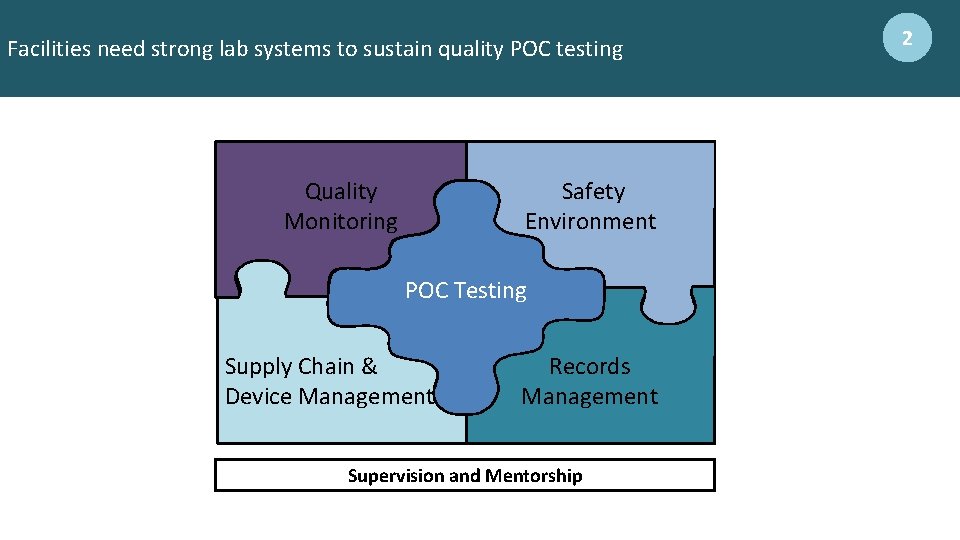
Facilities need strong lab systems to sustain quality POC testing Quality Monitoring Safety Environment POC Testing Supply Chain & Device Management Records Management Supervision and Mentorship 2
What Is “Quality? ” • The ability of a product or service to satisfy stated or implied needs of a specific customer • Quality is achieved by conforming to established requirements and standards 2
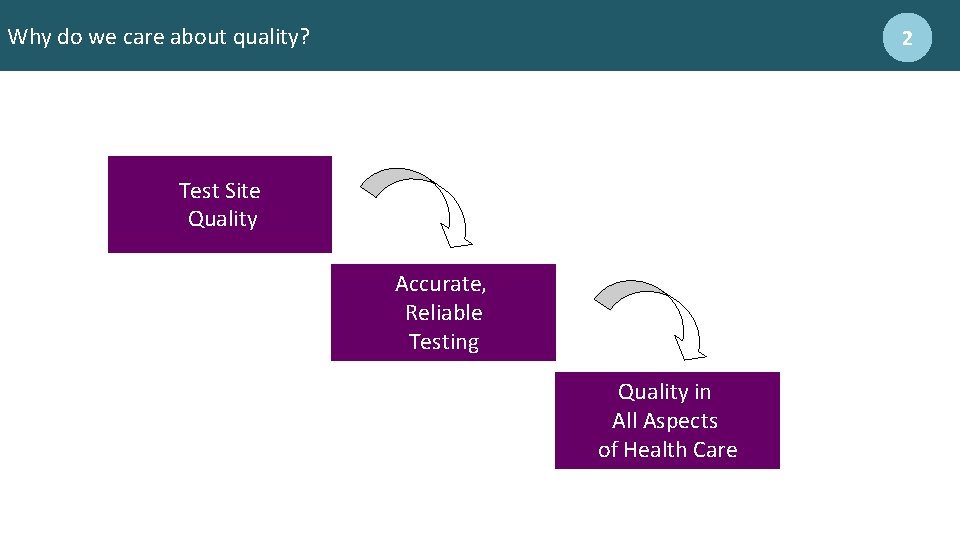
Why do we care about quality? 2 Test Site Quality Accurate, Reliable Testing Quality in All Aspects of Health Care
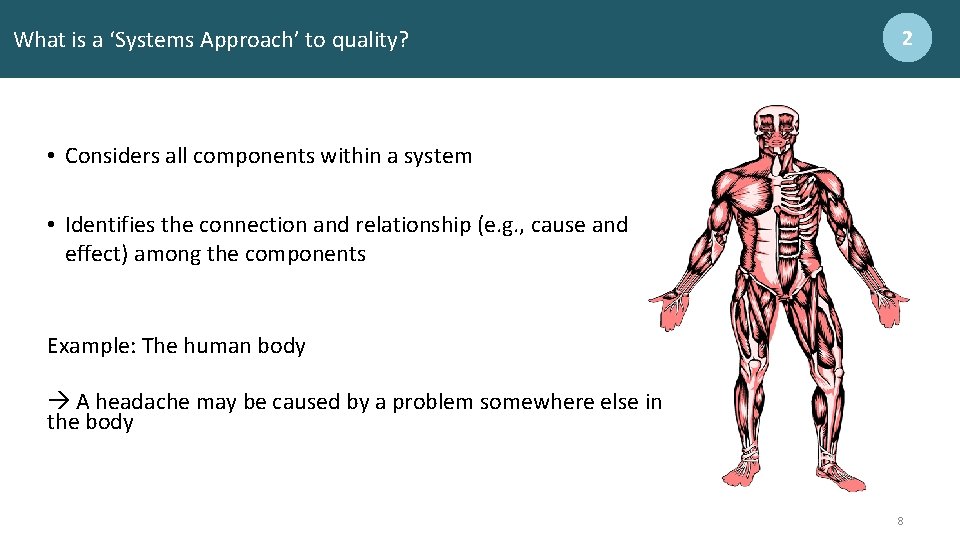
What is a ‘Systems Approach’ to quality? 2 • Considers all components within a system • Identifies the connection and relationship (e. g. , cause and effect) among the components Example: The human body A headache may be caused by a problem somewhere else in the body 8
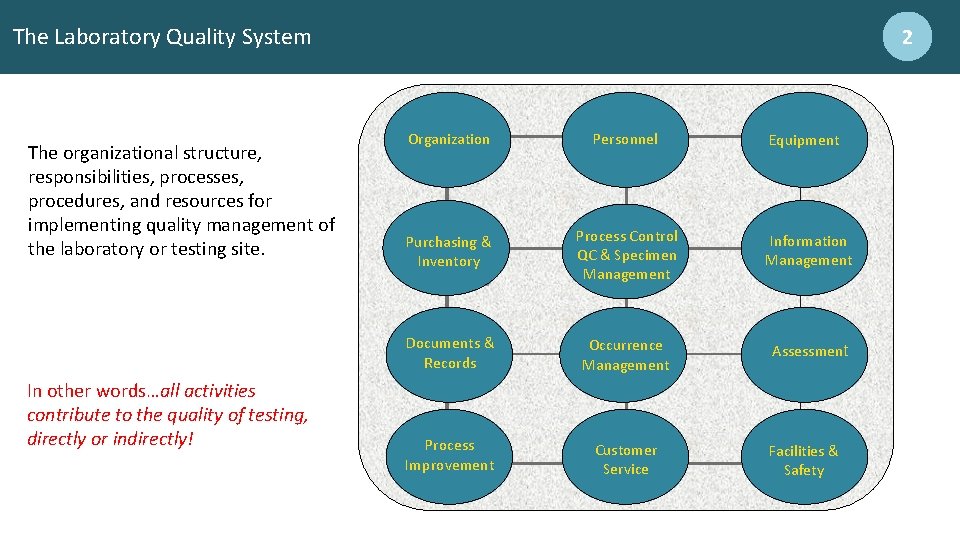
The Laboratory Quality System The organizational structure, responsibilities, processes, procedures, and resources for implementing quality management of the laboratory or testing site. In other words…all activities contribute to the quality of testing, directly or indirectly! 2 Organization Personnel Purchasing & Inventory Process Control QC & Specimen Management Information Management Documents & Records Occurrence Management Assessment Process Improvement Customer Service Equipment Facilities & Safety
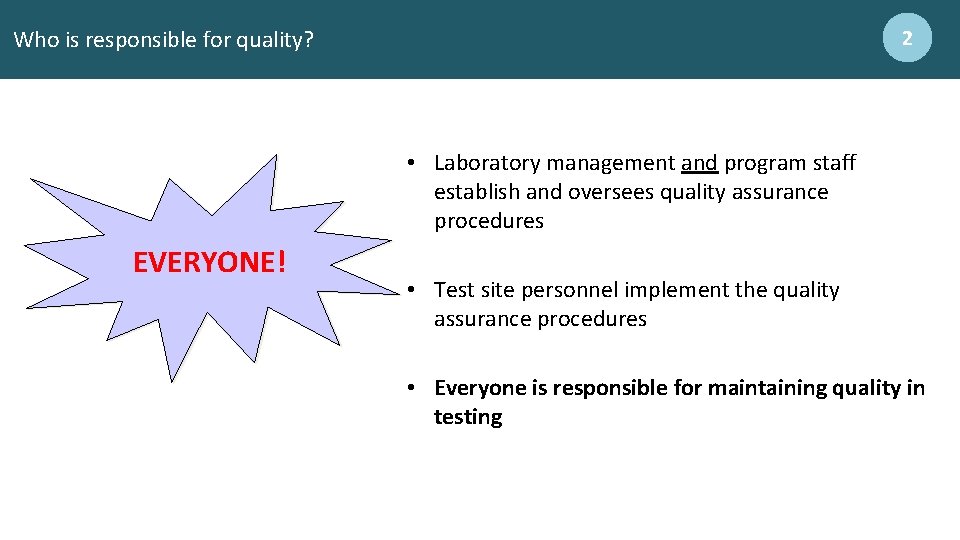
2 Who is responsible for quality? • Laboratory management and program staff establish and oversees quality assurance procedures EVERYONE! • Test site personnel implement the quality assurance procedures • Everyone is responsible for maintaining quality in testing
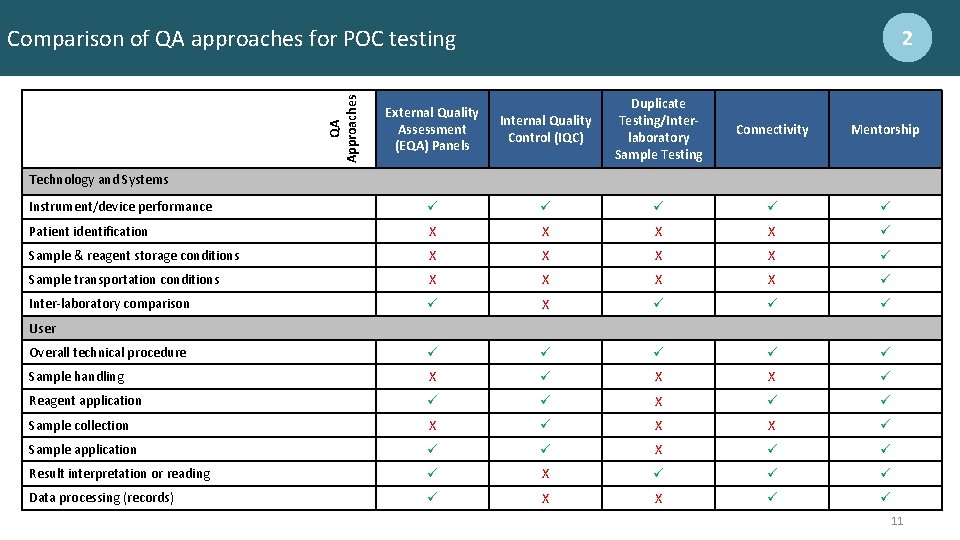
QA Approaches Comparison of QA approaches for POC testing 2 Internal Quality Control (IQC) Duplicate Testing/Interlaboratory Sample Testing Connectivity Mentorship Patient identification X X Sample & reagent storage conditions X X Sample transportation conditions X X Inter-laboratory comparison X Overall technical procedure Sample handling X X X Reagent application X Sample collection X X X Sample application X Result interpretation or reading X Data processing (records) X X External Quality Assessment (EQA) Panels Instrument/device performance Technology and Systems User 11
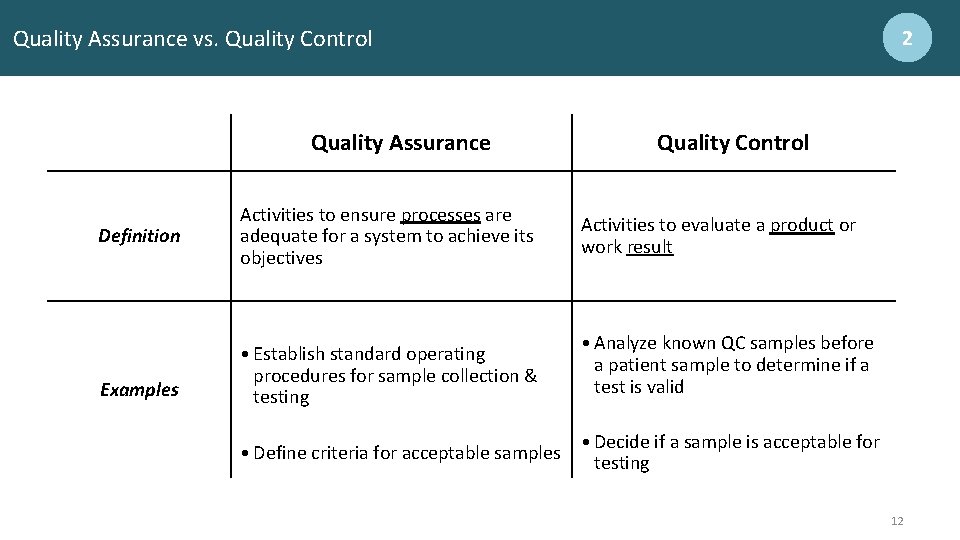
Quality Assurance vs. Quality Control Quality Assurance Definition Examples Activities to ensure processes are adequate for a system to achieve its objectives • Establish standard operating procedures for sample collection & testing • Define criteria for acceptable samples 2 Quality Control Activities to evaluate a product or work result • Analyze known QC samples before a patient sample to determine if a test is valid • Decide if a sample is acceptable for testing 12
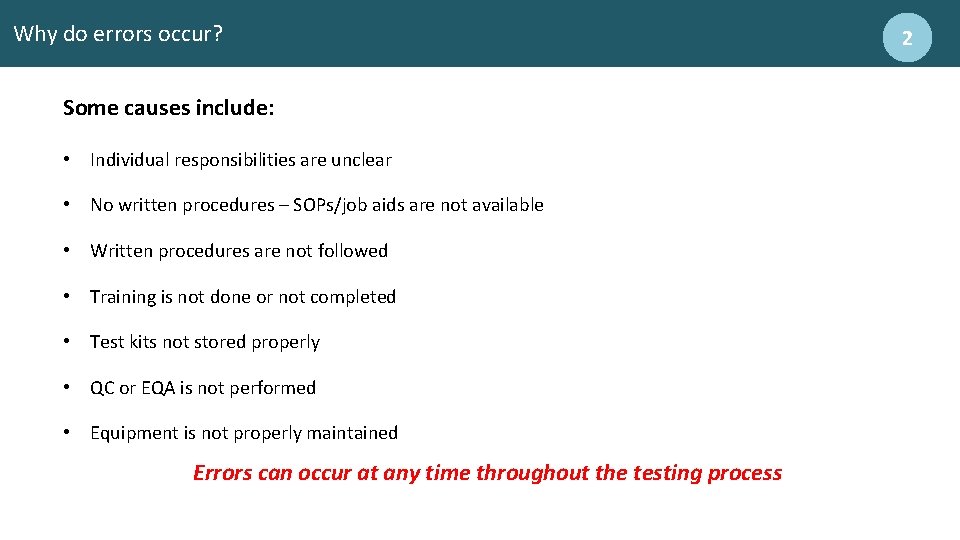
Why do errors occur? Some causes include: • Individual responsibilities are unclear • No written procedures – SOPs/job aids are not available • Written procedures are not followed • Training is not done or not completed • Test kits not stored properly • QC or EQA is not performed • Equipment is not properly maintained Errors can occur at any time throughout the testing process 2
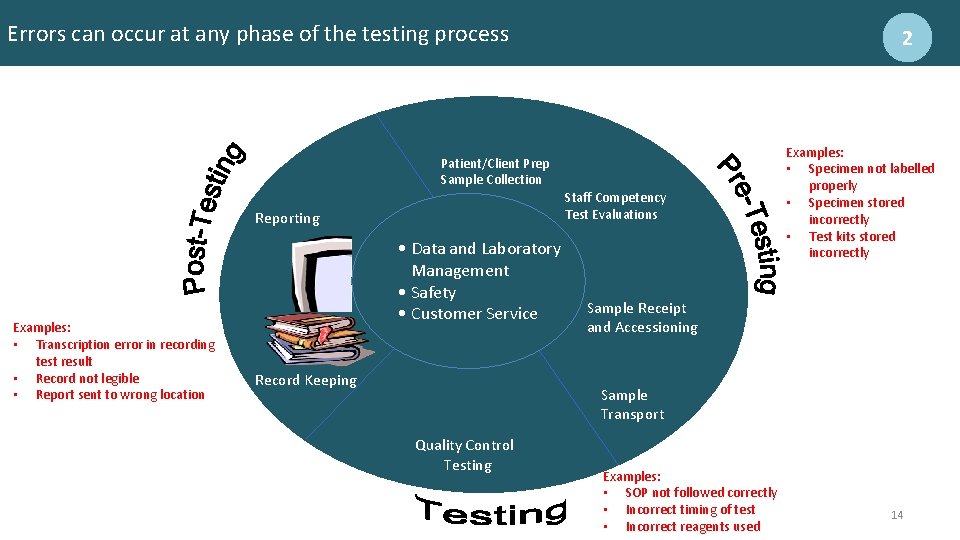
Errors can occur at any phase of the testing process 2 Patient/Client Prep Sample Collection Staff Competency Test Evaluations Reporting Examples: • Transcription error in recording test result • Record not legible • Report sent to wrong location • Data and Laboratory Management • Safety • Customer Service Record Keeping Examples: • Specimen not labelled properly • Specimen stored incorrectly • Test kits stored incorrectly Sample Receipt and Accessioning Sample Transport Quality Control Testing Examples: • SOP not followed correctly • Incorrect timing of test • Incorrect reagents used 14
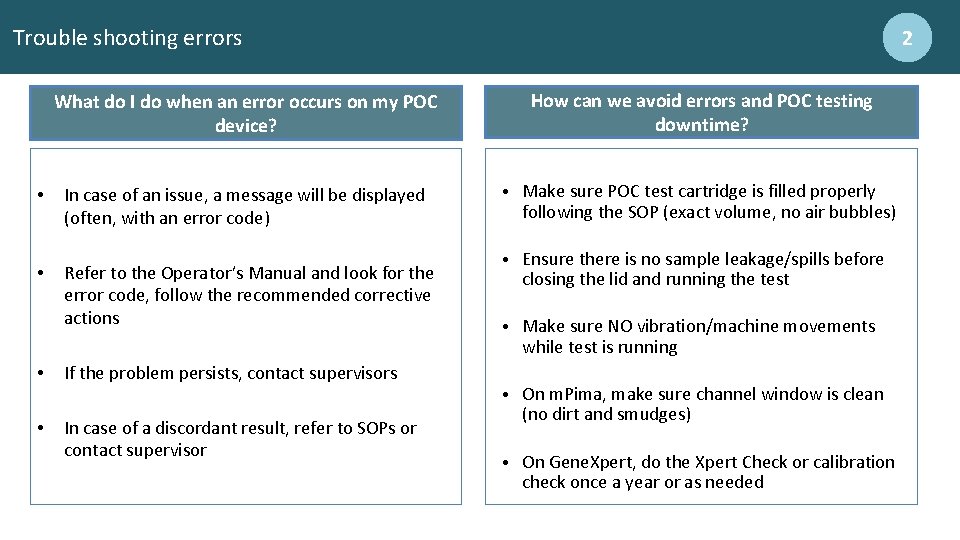
Trouble shooting errors 2 What do I do when an error occurs on my POC device? How can we avoid errors and POC testing downtime? • In case of an issue, a message will be displayed (often, with an error code) • Make sure POC test cartridge is filled properly following the SOP (exact volume, no air bubbles) • Refer to the Operator’s Manual and look for the error code, follow the recommended corrective actions • If the problem persists, contact supervisors • In case of a discordant result, refer to SOPs or contact supervisor • Ensure there is no sample leakage/spills before closing the lid and running the test • Make sure NO vibration/machine movements while test is running • On m. Pima, make sure channel window is clean (no dirt and smudges) • On Gene. Xpert, do the Xpert Check or calibration check once a year or as needed
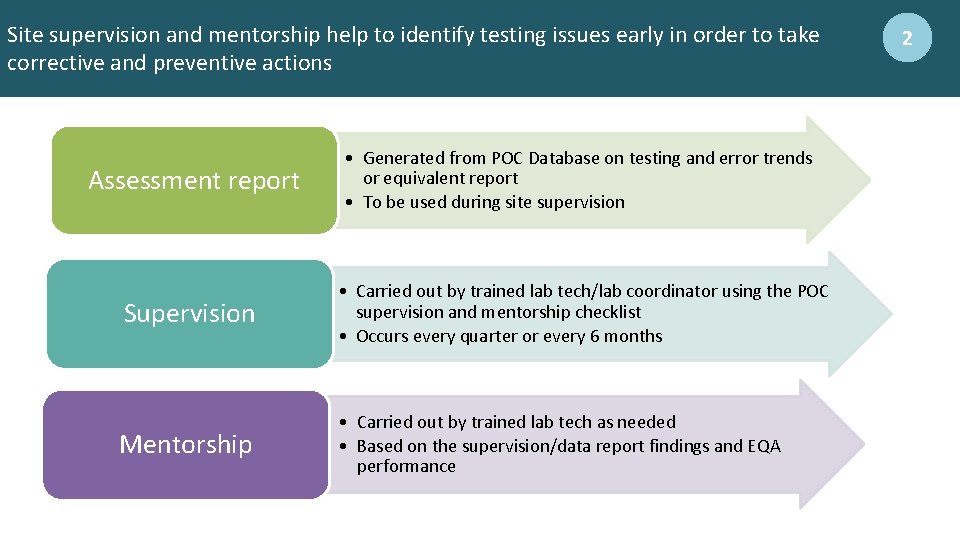
Site supervision and mentorship help to identify testing issues early in order to take corrective and preventive actions Assessment report • Generated from POC Database on testing and error trends or equivalent report • To be used during site supervision Supervision • Carried out by trained lab tech/lab coordinator using the POC supervision and mentorship checklist • Occurs every quarter or every 6 months Mentorship • Carried out by trained lab tech as needed • Based on the supervision/data report findings and EQA performance 2
Summary: Why is a Quality System important for POC testing? • Quality is the foundation of everything we do • The Quality System sets the standard for the level of quality the facility will achieve • Prevents misdiagnoses that affect the quality of life of the clients/patients • Allows facility to meet client/patient expectations • Provides means to prevent, detect and correct problems/errors – monitors all parts of testing system • Is the core of a monitoring, evaluation, & improvement system consistent between testing sites • Reduces costs by reducing wastage Even the simplest test is not foolproof!!! 2
Agenda 1 Learning Objectives 2 POC Quality Management Systems 3 Safety and Waste Management 4 Connectivity and Data Management 5 Supply Chain and Device Management 18
What is a biohazard and why is it important to take safety precautions in the lab? A biohazard is a biological agent, infectious material or derived products capable of causing harm to humans, animals and plants Coming in contact with biohazards – such human blood or blood products – is potentially dangerous Safety involves taking precautions to protect you, your colleagues, the client/patient or the environment against infection Laboratory safety is achieved through administrative controls, engineering controls, the use of personal protective equipment, practices and behavior 3
What are universal or standard precautions? Universal precautions are the recommended physical requirements, procedural actions and precautions for safe work with human pathogenic materials or microbes in healthcare, laboratory and other work environments Every specimen should be treated as infectious 3
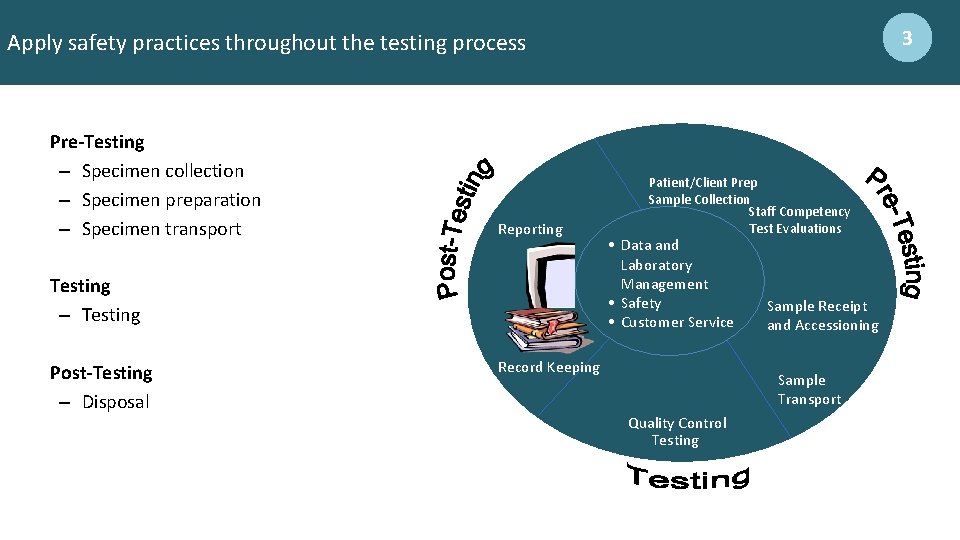
3 Apply safety practices throughout the testing process • Pre-Testing – Specimen collection – Specimen preparation – Specimen transport Reporting • Testing – Testing • Post-Testing – Disposal Patient/Client Prep Sample Collection Staff Competency Test Evaluations • Data and Laboratory Management • Safety • Customer Service Record Keeping Sample Receipt and Accessioning Sample Transport Quality Control Testing
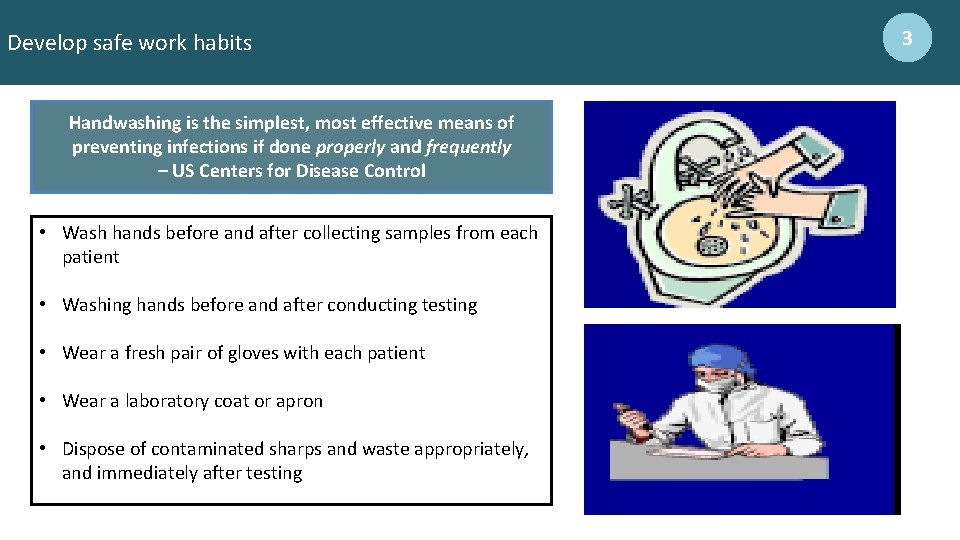
Develop safe work habits Handwashing is the simplest, most effective means of preventing infections if done properly and frequently – US Centers for Disease Control • Wash hands before and after collecting samples from each patient • Washing hands before and after conducting testing • Wear a fresh pair of gloves with each patient • Wear a laboratory coat or apron • Dispose of contaminated sharps and waste appropriately, and immediately after testing 3
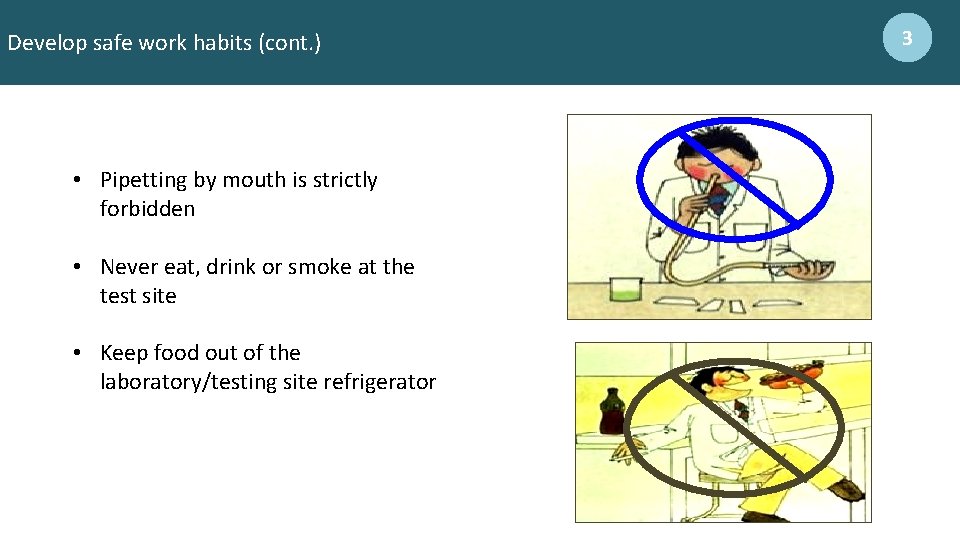
Develop safe work habits (cont. ) • Pipetting by mouth is strictly forbidden • Never eat, drink or smoke at the test site • Keep food out of the laboratory/testing site refrigerator 3
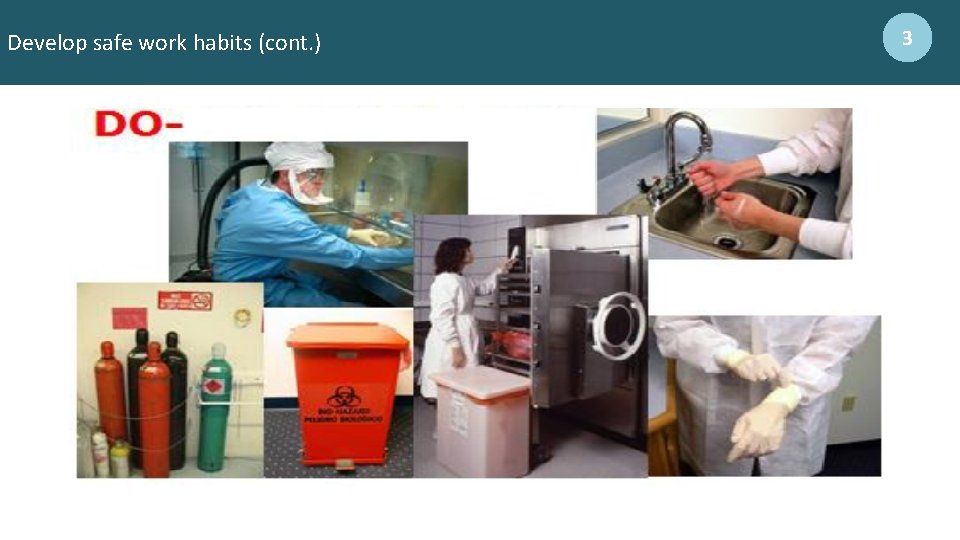
Develop safe work habits (cont. ) 3
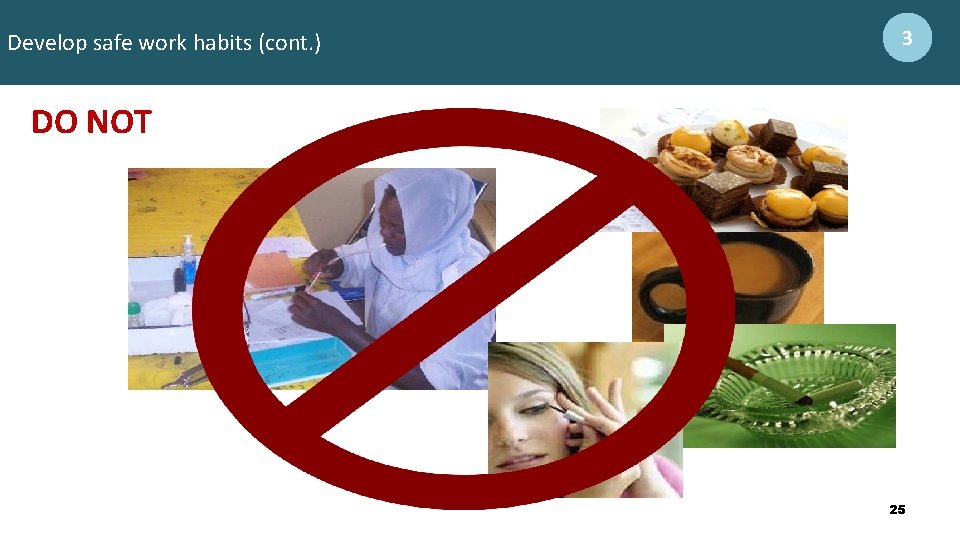
Develop safe work habits (cont. ) 3 DO NOT 25
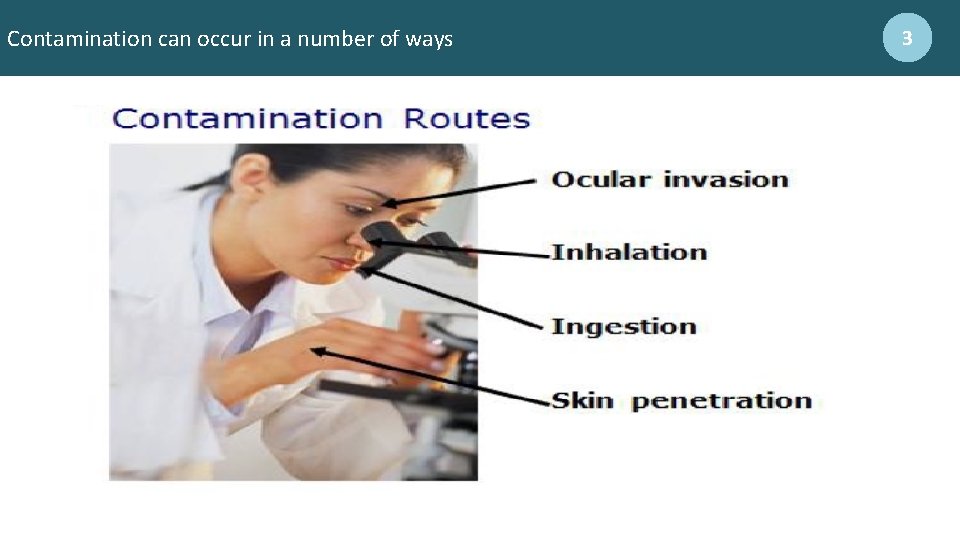
Contamination can occur in a number of ways 3
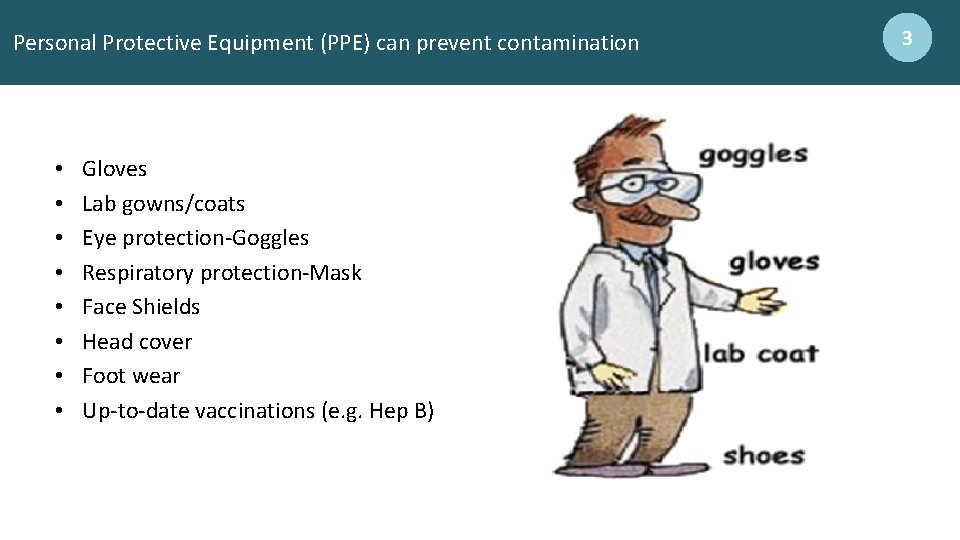
Personal Protective Equipment (PPE) can prevent contamination • • Gloves Lab gowns/coats Eye protection-Goggles Respiratory protection-Mask Face Shields Head cover Foot wear Up-to-date vaccinations (e. g. Hep B) 3
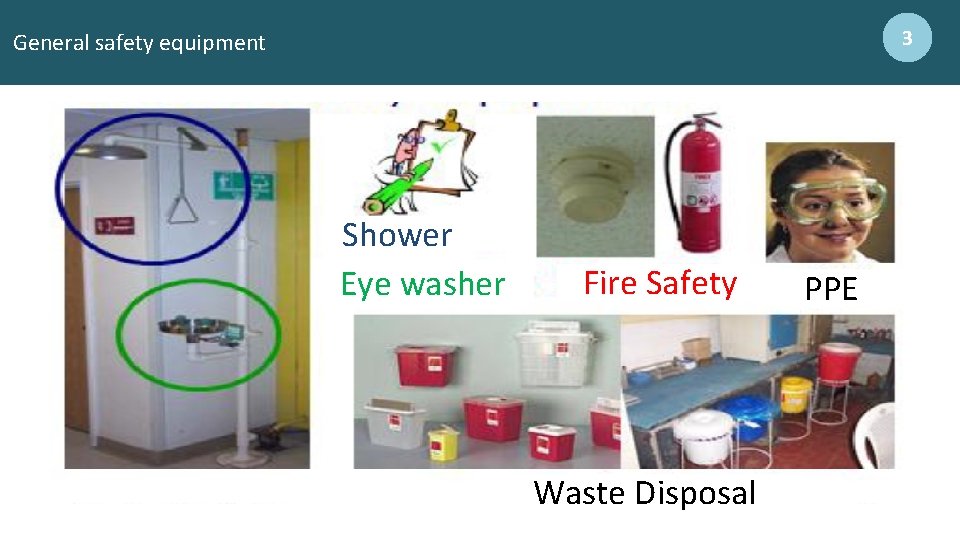
3 General safety equipment Shower Eye washer Fire Safety Waste Disposal PPE
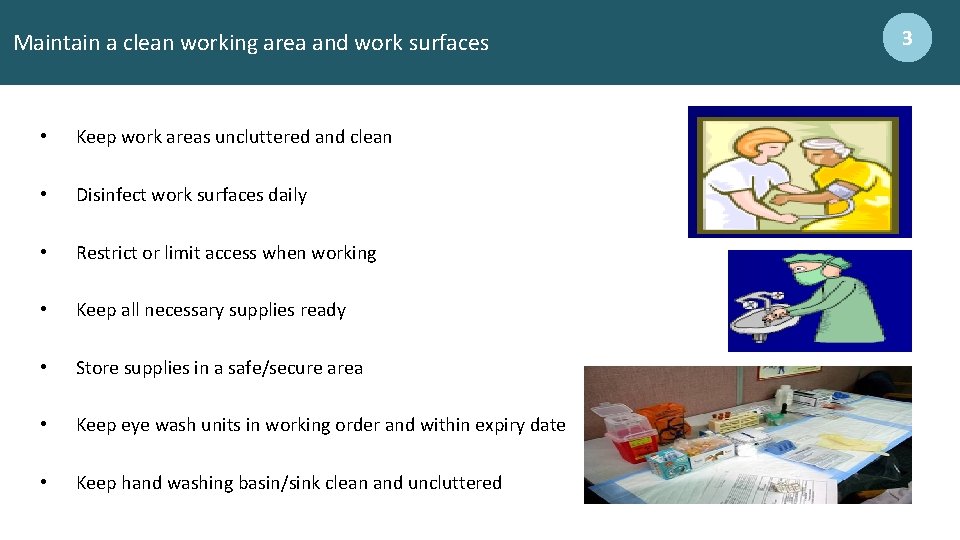
Maintain a clean working area and work surfaces • Keep work areas uncluttered and clean • Disinfect work surfaces daily • Restrict or limit access when working • Keep all necessary supplies ready • Store supplies in a safe/secure area • Keep eye wash units in working order and within expiry date • Keep hand washing basin/sink clean and uncluttered 3
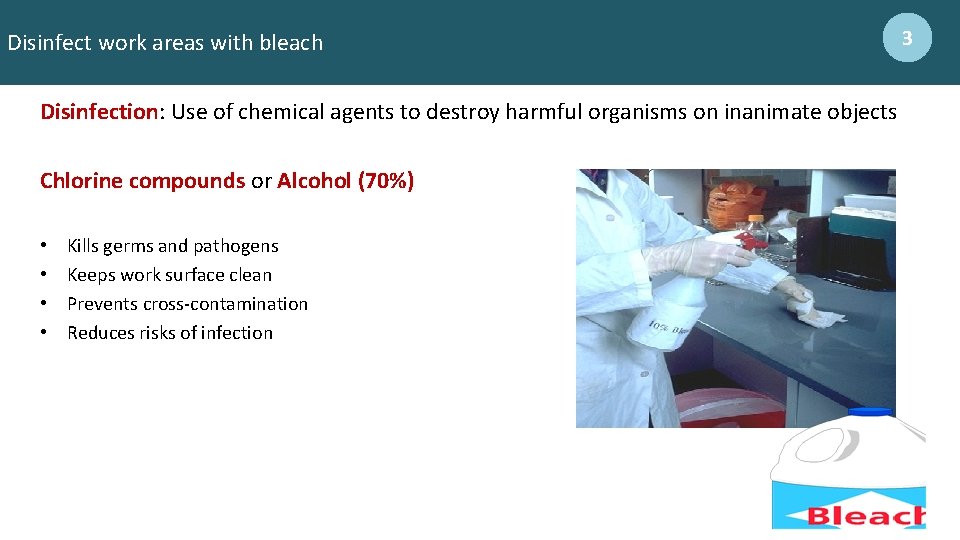
Disinfect work areas with bleach Disinfection: Use of chemical agents to destroy harmful organisms on inanimate objects Chlorine compounds or Alcohol (70%) • • Kills germs and pathogens Keeps work surface clean Prevents cross-contamination Reduces risks of infection 3
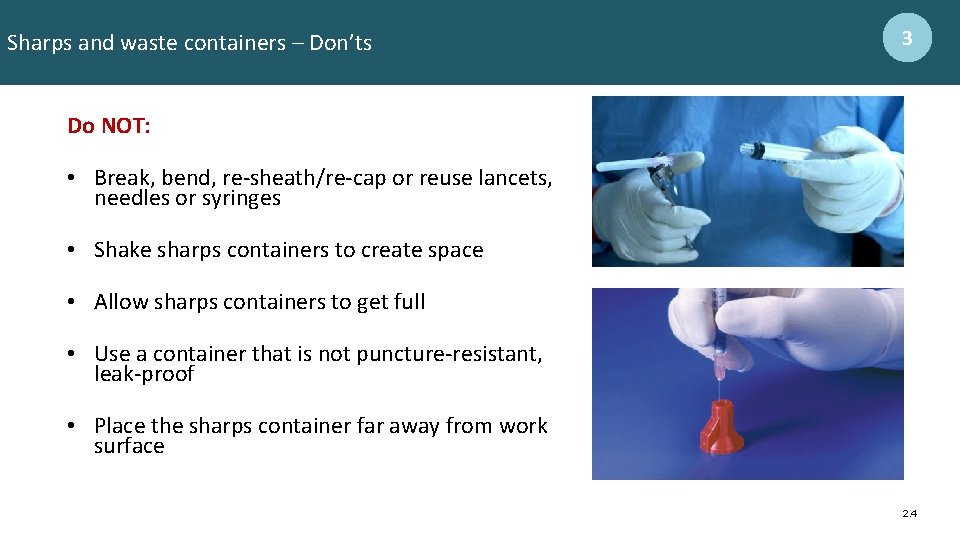
Sharps and waste containers – Don’ts 3 Do NOT: • Break, bend, re-sheath/re-cap or reuse lancets, needles or syringes • Shake sharps containers to create space • Allow sharps containers to get full • Use a container that is not puncture-resistant, leak-proof • Place the sharps container far away from work surface 2. 4
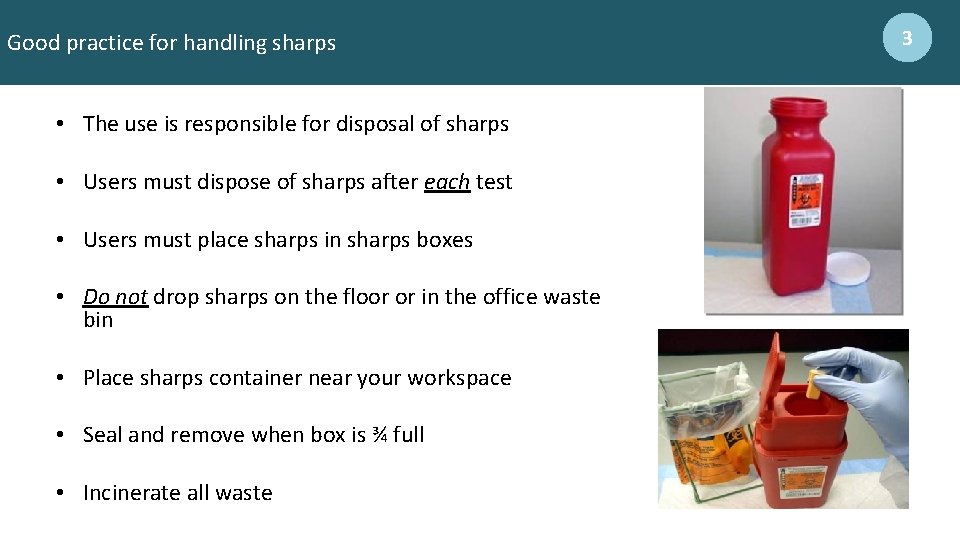
Good practice for handling sharps • The use is responsible for disposal of sharps • Users must dispose of sharps after each test • Users must place sharps in sharps boxes • Do not drop sharps on the floor or in the office waste bin • Place sharps container near your workspace • Seal and remove when box is ¾ full • Incinerate all waste 3
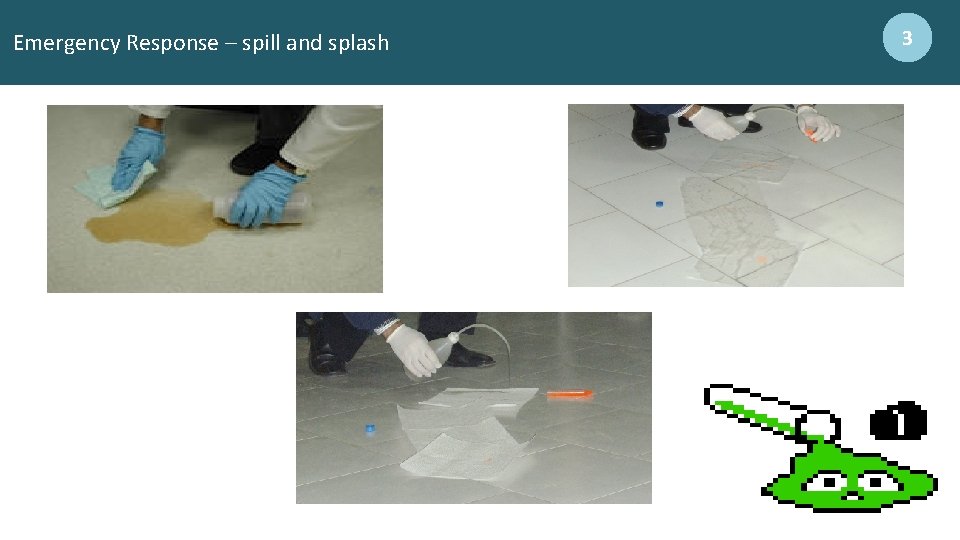
Emergency Response – spill and splash 3
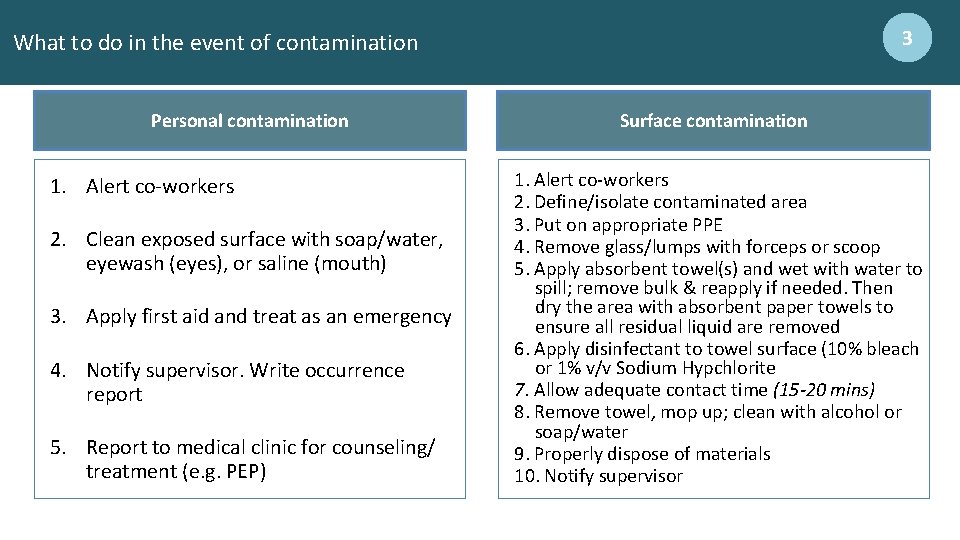
3 What to do in the event of contamination Personal contamination 1. Alert co-workers 2. Clean exposed surface with soap/water, eyewash (eyes), or saline (mouth) 3. Apply first aid and treat as an emergency 4. Notify supervisor. Write occurrence report 5. Report to medical clinic for counseling/ treatment (e. g. PEP) Surface contamination 1. Alert co-workers 2. Define/isolate contaminated area 3. Put on appropriate PPE 4. Remove glass/lumps with forceps or scoop 5. Apply absorbent towel(s) and wet with water to spill; remove bulk & reapply if needed. Then dry the area with absorbent paper towels to ensure all residual liquid are removed 6. Apply disinfectant to towel surface (10% bleach or 1% v/v Sodium Hypchlorite 7. Allow adequate contact time (15 -20 mins) 8. Remove towel, mop up; clean with alcohol or soap/water 9. Properly dispose of materials 10. Notify supervisor
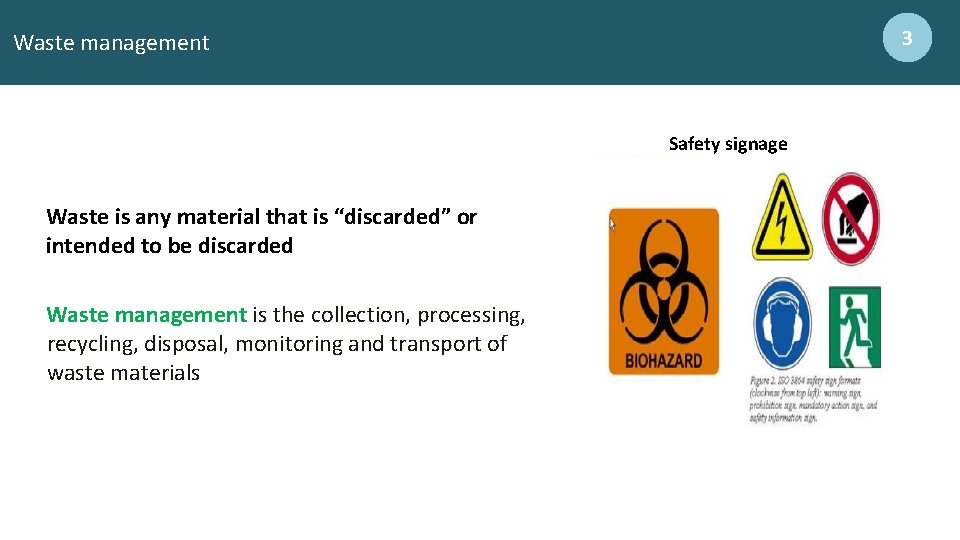
3 Waste management Safety signage Waste is any material that is “discarded” or intended to be discarded Waste management is the collection, processing, recycling, disposal, monitoring and transport of waste materials 35
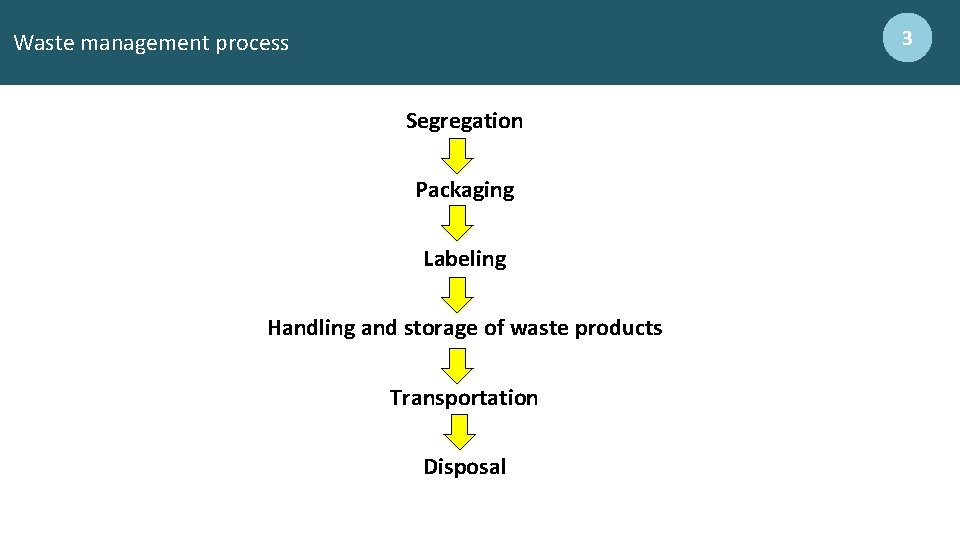
3 Waste management process Segregation Packaging Labeling Handling and storage of waste products Transportation Disposal 36
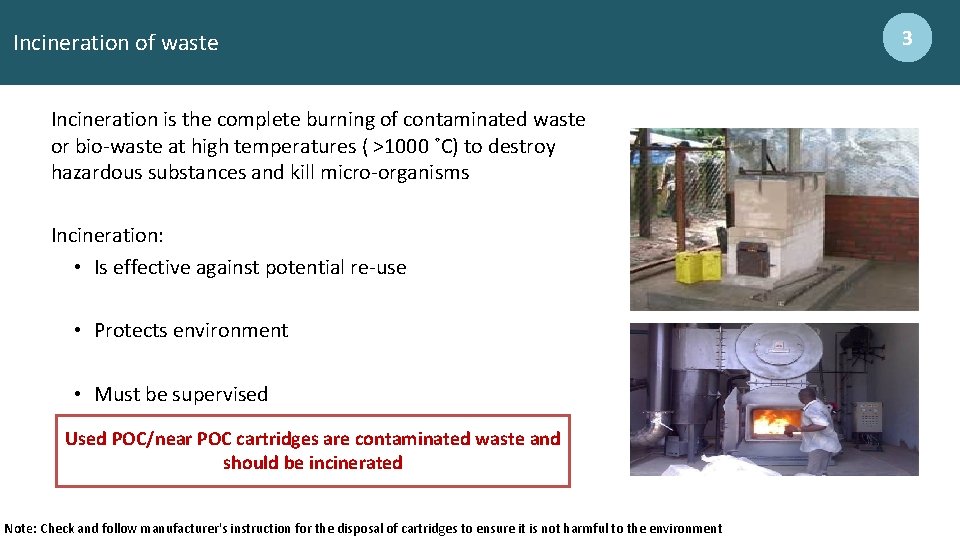
Incineration of waste Incineration is the complete burning of contaminated waste or bio-waste at high temperatures ( >1000 ˚C) to destroy hazardous substances and kill micro-organisms Incineration: • Is effective against potential re-use • Protects environment • Must be supervised Used POC/near POC cartridges are contaminated waste and should be incinerated Note: Check and follow manufacturer's instruction for the disposal of cartridges to ensure it is not harmful to the environment 3
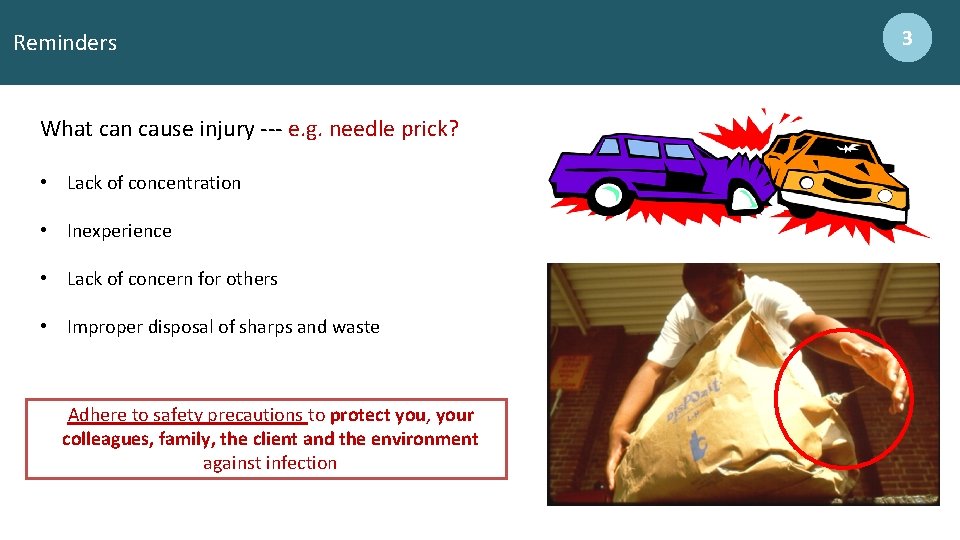
Reminders What can cause injury --- e. g. needle prick? • Lack of concentration • Inexperience • Lack of concern for others • Improper disposal of sharps and waste Adhere to safety precautions to protect you, your colleagues, family, the client and the environment against infection 3
Agenda 1 Learning Objectives 2 POC Quality Management Systems 3 Safety and Waste Management 4 Connectivity and Data Management 5 Supply Chain and Device Management 39
Data/record management 4 Record Management is the mechanism that ensures information is captured correctly, kept confidential, and is available and accessible when needed. If using paper based records… Ø The register and logs used in the lab or clinic that record tests that are performed, and can be used to trace patients records when necessary If using electronic records. . . Ø Testing data should be routinely transmitted to a central database for back up Ø This system simplifies reporting, monitoring and evaluation 40
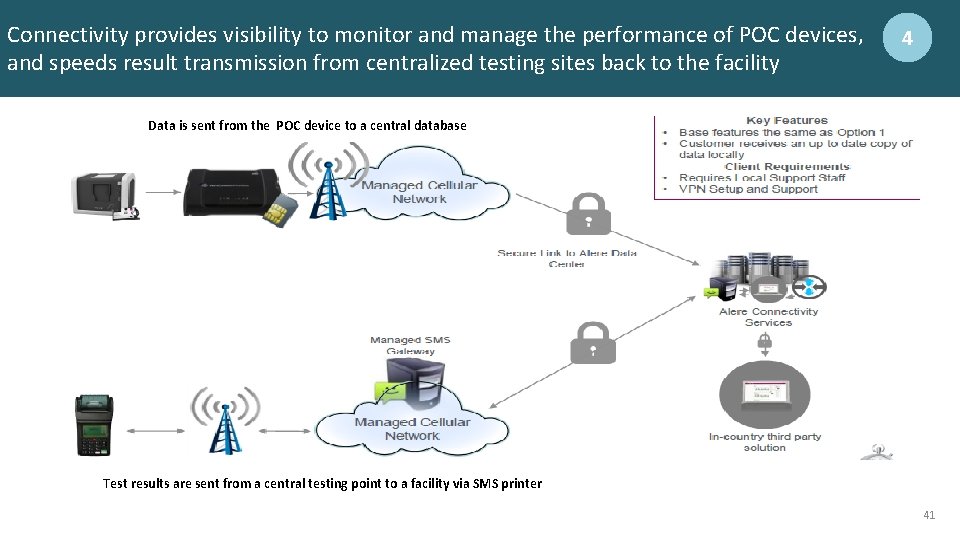
Connectivity provides visibility to monitor and manage the performance of POC devices, and speeds result transmission from centralized testing sites back to the facility 4 Data is sent from the POC device to a central database Test results are sent from a central testing point to a facility via SMS printer 41
Agenda 1 Learning Objectives 2 POC Quality Management Systems 3 Safety and Waste Management 4 Connectivity and Data Management 5 Supply Chain and Device Management 42
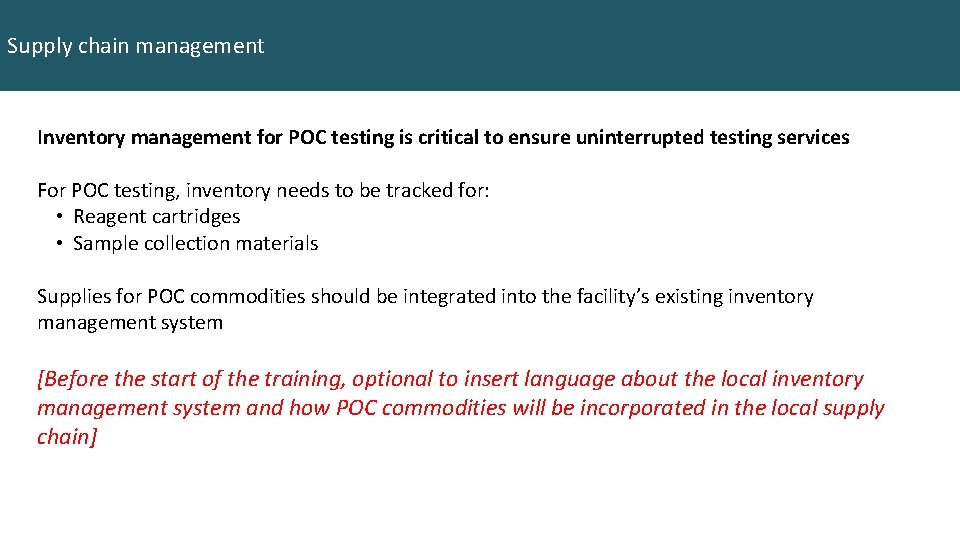
Supply chain management Inventory management for POC testing is critical to ensure uninterrupted testing services For POC testing, inventory needs to be tracked for: • Reagent cartridges • Sample collection materials Supplies for POC commodities should be integrated into the facility’s existing inventory management system [Before the start of the training, optional to insert language about the local inventory management system and how POC commodities will be incorporated in the local supply chain]
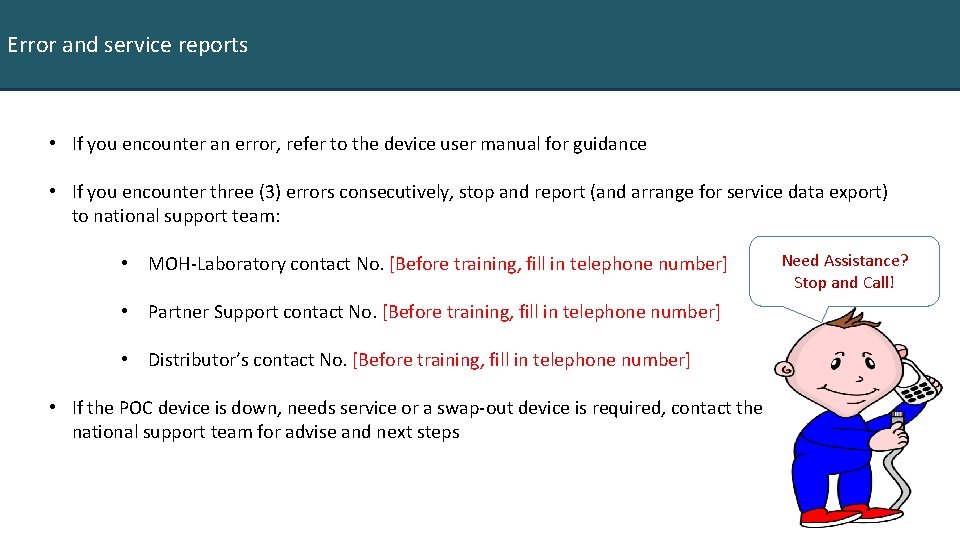
Error and service reports • If you encounter an error, refer to the device user manual for guidance • If you encounter three (3) errors consecutively, stop and report (and arrange for service data export) to national support team: • MOH-Laboratory contact No. [Before training, fill in telephone number] • Partner Support contact No. [Before training, fill in telephone number] • Distributor’s contact No. [Before training, fill in telephone number] • If the POC device is down, needs service or a swap-out device is required, contact the national support team for advise and next steps Need Assistance? Stop and Call!
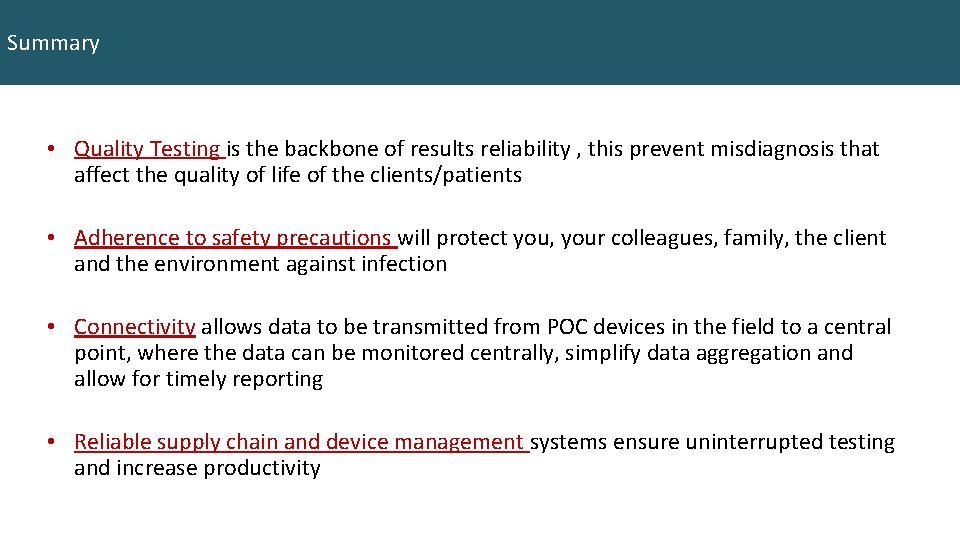
Summary • Quality Testing is the backbone of results reliability , this prevent misdiagnosis that affect the quality of life of the clients/patients • Adherence to safety precautions will protect you, your colleagues, family, the client and the environment against infection • Connectivity allows data to be transmitted from POC devices in the field to a central point, where the data can be monitored centrally, simplify data aggregation and allow for timely reporting • Reliable supply chain and device management systems ensure uninterrupted testing and increase productivity

Questions? Thank You! 46
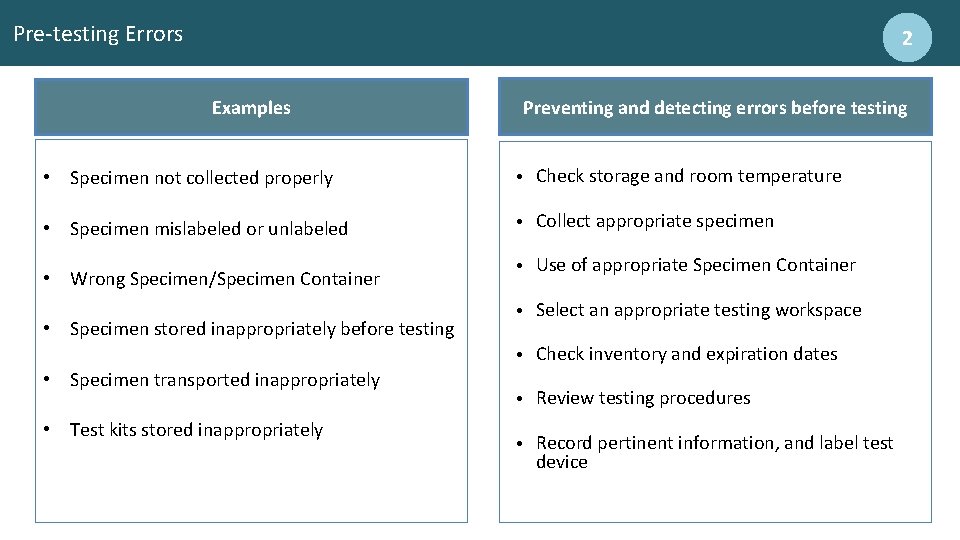
Pre-testing Errors 2 Examples Preventing and detecting errors before testing • Specimen not collected properly • Check storage and room temperature • Specimen mislabeled or unlabeled • Collect appropriate specimen • Wrong Specimen/Specimen Container • Specimen stored inappropriately before testing • Use of appropriate Specimen Container • Select an appropriate testing workspace • Check inventory and expiration dates • Specimen transported inappropriately • Test kits stored inappropriately • Review testing procedures • Record pertinent information, and label test device
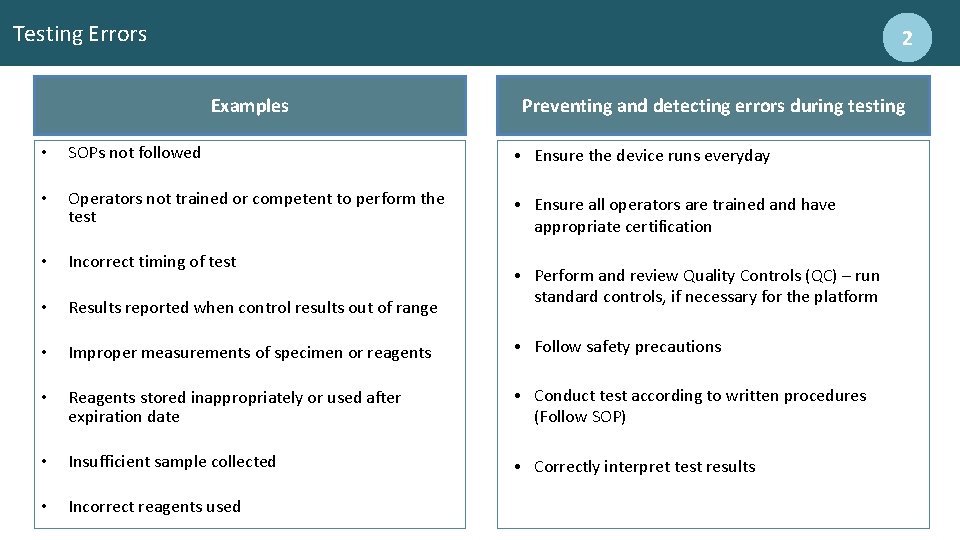
Testing Errors 2 Examples Preventing and detecting errors during testing • SOPs not followed • Ensure the device runs everyday • Operators not trained or competent to perform the test • Ensure all operators are trained and have appropriate certification • Incorrect timing of test • Results reported when control results out of range • Improper measurements of specimen or reagents • Follow safety precautions • Reagents stored inappropriately or used after expiration date • Conduct test according to written procedures (Follow SOP) • Insufficient sample collected • Correctly interpret test results • Incorrect reagents used • Perform and review Quality Controls (QC) – run standard controls, if necessary for the platform
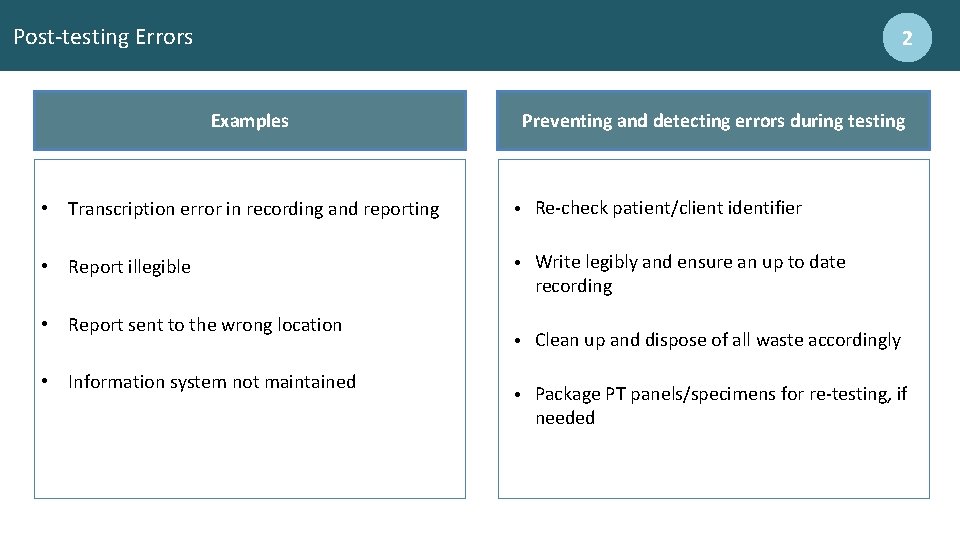
Post-testing Errors 2 Examples Preventing and detecting errors during testing • Transcription error in recording and reporting • Re-check patient/client identifier • Report illegible • Write legibly and ensure an up to date recording • Report sent to the wrong location • Information system not maintained • Clean up and dispose of all waste accordingly • Package PT panels/specimens for re-testing, if needed
Acknowledgments The development of the POC EID Training Package was made possible thanks to Unitaid’s support. Unitaid accelerates access to innovation so that critical health products can reach the people who need them.
- Slides: 50