
Assurance Cases in Planning and Execution of NASA
- Slides: 36
Assurance Cases in Planning and Execution of NASA IV&V Projects T. Dawson, TASC 9/11/13 © 2012 TASC, Inc. | TASC Proprietary
History of Evidence-Based Assurance at IV&V © 2012 TASC, Inc. | TASC Proprietary
Evidence-Based Assurance at NASA IV&V § Evidence-Based Assurance, that is, providing mission and safety assurance based on documented, objective evidence, is a component of the NASA IV&V Program Mission Statement and Strategic Plan – The NASA IV&V Mission Statement reads, in part, “To provide our customers assurance that their safety and mission-critical software will operate reliably and safely and to advance the systems and software engineering disciplines. ” – The NASA IV&V Vision Outcome 1. 2 of that Plan reads: “We produce results that are empirically-derived and clearly indicate the reliability and safety of operating the system” -- “epirically-derived” means, in part, based on objective, documented evidence § For years NASA IV&V managers have struggled with determining the best ways to infuse Evidence-Based Assurance principles into the IV&V culture, and with implementing appropriate techniques and tools – Evidence-based assurance* (working definition): providing assurance, through a structured argument based on evidence, that some mission need will be met – Assurance Cases provide one approach to meeting these needs that is currently gaining momentum within the Program § Evidence-Based Assurance is the need. The approach taken to fill this need is the use of Assurance Case methodologies * Sometimes contrasted with process-based assurance © 2012 TASC, Inc. | TASC Proprietary
Evidence at NASA IV&V § Since the NASA IV&V program was founded in 1993, there have been a very large number of activity types used in performing IV&V § Many of these activities depend on subject matter expertise to perform the analysis. IV&V has subject matter expertise in a number of subject areas, including: – software and its many aspects – hardware and its many aspects – mission types – various systems domains, e. g. GN&C and propulsion systems § The level of documentation from these analyses has varied from project to project – Human-rated mission typically produce more detailed documentation – For example, the IV&V report to support the return to flight decision following the Columbia disaster was over 1500 pages long, with detailed technical discussion of the analysis approaches used along with supporting detail 4 © 2012 TASC, Inc. | TASC Proprietary
Evidence at NASA IV&V (cont. ) § Many IV&V efforts have been well documented – This includes not only human-rated systems – The fact remains that the level of documentation generated has been inconsistent from project to project § From time to time, the analysis has consisted of the subject matter experts simply applying their expertise to the system under evaluation and providing conclusions, with the only documentation resulting from this process being the conclusions themselves – There would be no documentation of the approach taken, the evaluation criteria, or any other aspect of the analysis that supports the conclusions – This does not meet Program needs, in that the results are not repeatable or reviewable – It is not our assertion that subject matter expertise is unnecessary or can be replaced by process – only that mere existence of the expertise without documentation is insufficient 5 © 2012 TASC, Inc. | TASC Proprietary
Evidence at NASA IV&V (cont. ) § Lack of documentation is not the only possible shortcoming of evidencebased assurance § Even if the process is fully documented, that documentation does not constitute evidence in an evidence-based assurance sense unless it supports a structured argument to make a given assurance claim – This means documentation is necessary but not sufficient for evidence-based assurance – In recent years there has been increased emphasis on documentation to ensure better consistency across all projects – Less emphasis has been placed on performing evidence-based assurance in any structured sense, e. g. using assurance cases § Summarizing, IV&V activities sometimes (not universally) have had the following limitations: – Activities not being documented sufficiently for reproduction or review – Activities not planned and executed in a structured, evidence-based assurance manner 6 © 2012 TASC, Inc. | TASC Proprietary
Assurance Cases © 2012 TASC, Inc. | TASC Proprietary
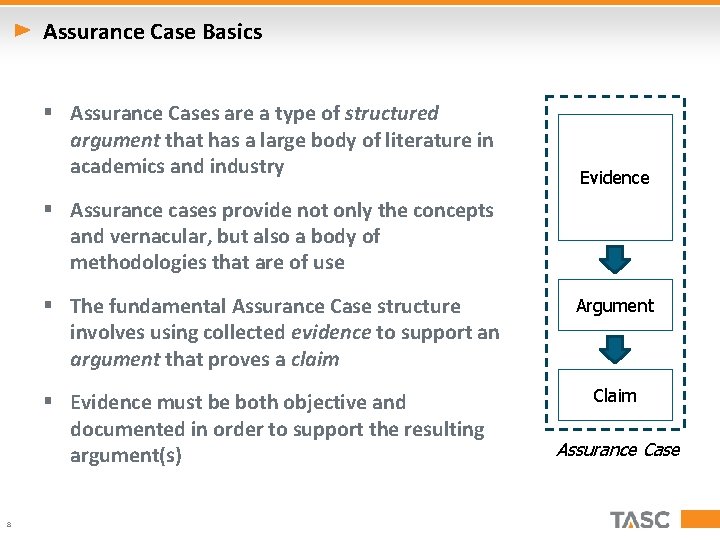
Assurance Case Basics § Assurance Cases are a type of structured argument that has a large body of literature in academics and industry Evidence § Assurance cases provide not only the concepts and vernacular, but also a body of methodologies that are of use § The fundamental Assurance Case structure involves using collected evidence to support an argument that proves a claim § Evidence must be both objective and documented in order to support the resulting argument(s) 8 © 2012 TASC, Inc. | TASC Proprietary Argument Claim Assurance Case
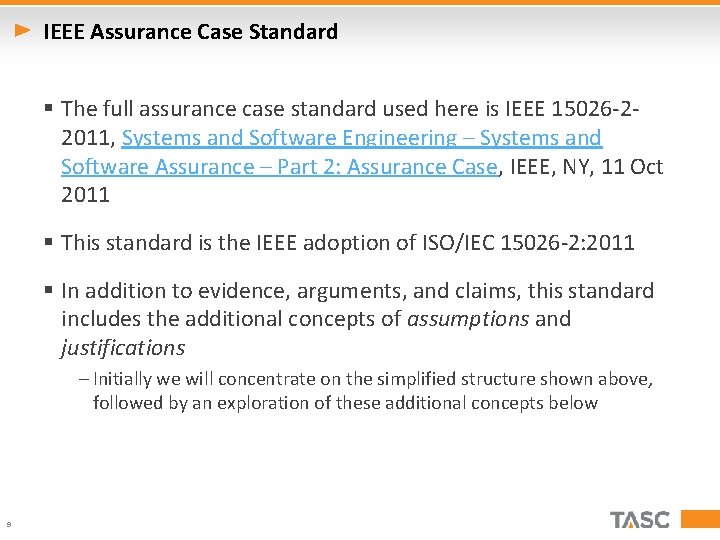
IEEE Assurance Case Standard § The full assurance case standard used here is IEEE 15026 -22011, Systems and Software Engineering – Systems and Software Assurance – Part 2: Assurance Case, IEEE, NY, 11 Oct 2011 § This standard is the IEEE adoption of ISO/IEC 15026 -2: 2011 § In addition to evidence, arguments, and claims, this standard includes the additional concepts of assumptions and justifications – Initially we will concentrate on the simplified structure shown above, followed by an exploration of these additional concepts below 9 © 2012 TASC, Inc. | TASC Proprietary
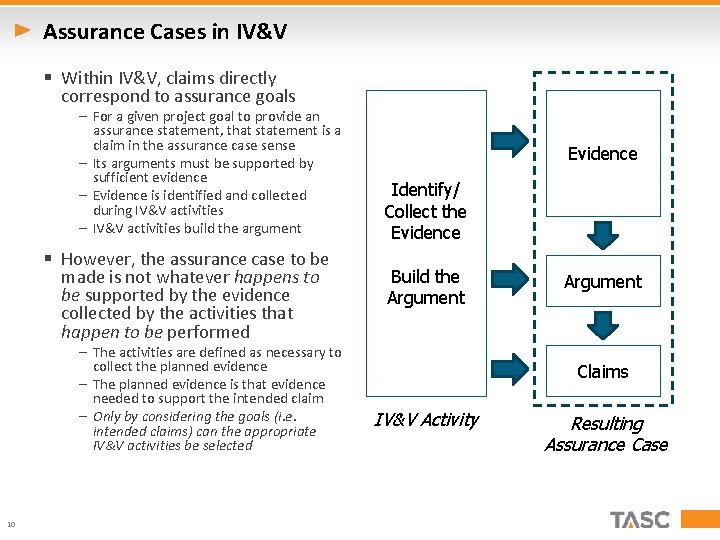
Assurance Cases in IV&V § Within IV&V, claims directly correspond to assurance goals – For a given project goal to provide an assurance statement, that statement is a claim in the assurance case sense – Its arguments must be supported by sufficient evidence – Evidence is identified and collected during IV&V activities – IV&V activities build the argument § However, the assurance case to be made is not whatever happens to be supported by the evidence collected by the activities that happen to be performed – The activities are defined as necessary to collect the planned evidence – The planned evidence is that evidence needed to support the intended claim – Only by considering the goals (i. e. intended claims) can the appropriate IV&V activities be selected 10 Evidence Identify/ Collect the Evidence Build the Argument Claims IV&V Activity © 2012 TASC, Inc. | TASC Proprietary Resulting Assurance Case
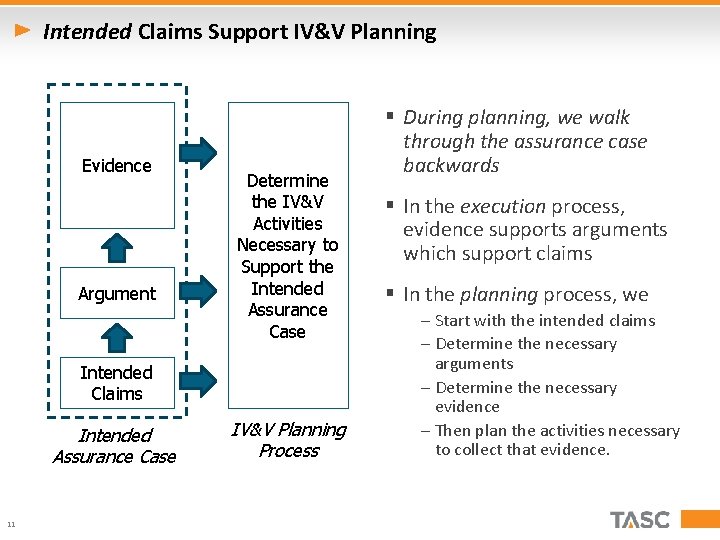
Intended Claims Support IV&V Planning Evidence Argument Determine the IV&V Activities Necessary to Support the Intended Assurance Case Intended Claims Intended Assurance Case 11 IV&V Planning Process § During planning, we walk through the assurance case backwards § In the execution process, evidence supports arguments which support claims § In the planning process, we – Start with the intended claims – Determine the necessary arguments – Determine the necessary evidence – Then plan the activities necessary to collect that evidence. © 2012 TASC, Inc. | TASC Proprietary
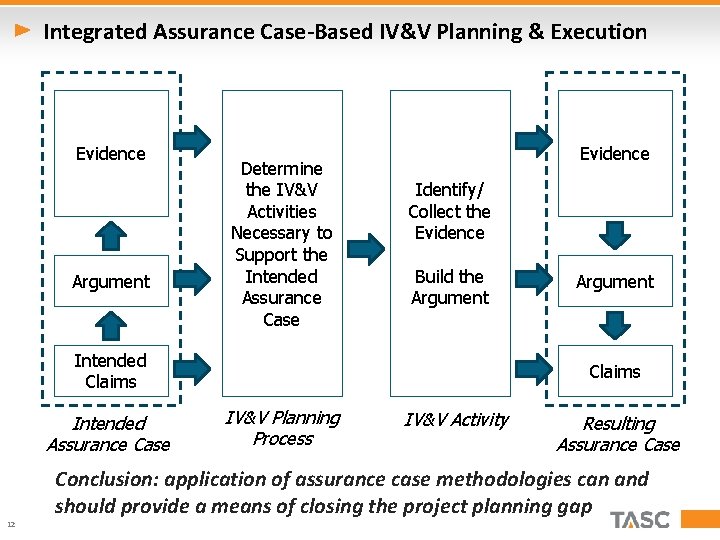
Integrated Assurance Case-Based IV&V Planning & Execution Evidence Argument Determine the IV&V Activities Necessary to Support the Intended Assurance Case Evidence Identify/ Collect the Evidence Build the Argument Intended Claims Intended Assurance Case Argument Claims IV&V Planning Process IV&V Activity Resulting Assurance Case Conclusion: application of assurance case methodologies can and should provide a means of closing the project planning gap 12 © 2012 TASC, Inc. | TASC Proprietary
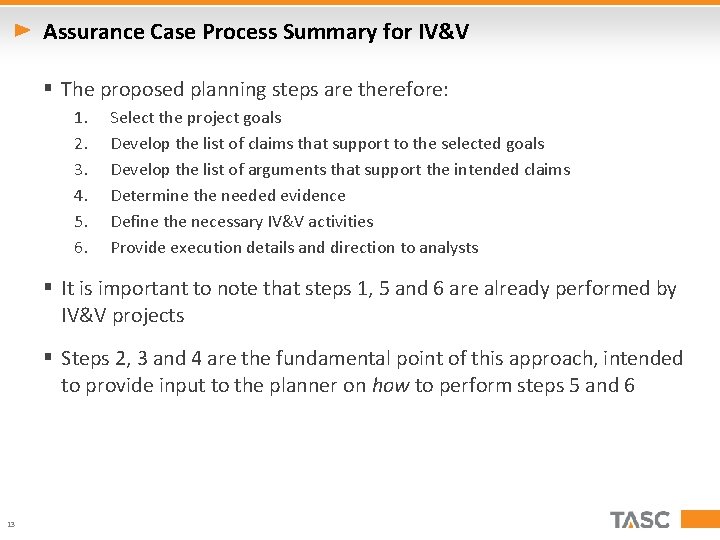
Assurance Case Process Summary for IV&V § The proposed planning steps are therefore: 1. 2. 3. 4. 5. 6. Select the project goals Develop the list of claims that support to the selected goals Develop the list of arguments that support the intended claims Determine the needed evidence Define the necessary IV&V activities Provide execution details and direction to analysts § It is important to note that steps 1, 5 and 6 are already performed by IV&V projects § Steps 2, 3 and 4 are the fundamental point of this approach, intended to provide input to the planner on how to perform steps 5 and 6 13 © 2012 TASC, Inc. | TASC Proprietary
Process Example © 2012 TASC, Inc. | TASC Proprietary
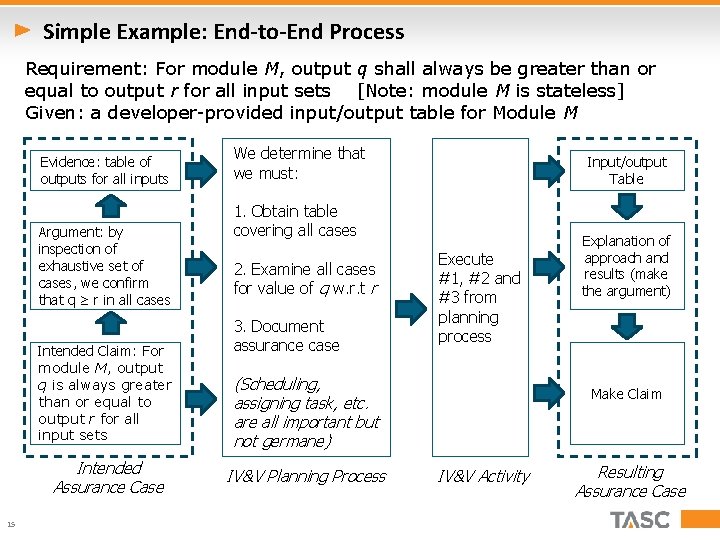
Simple Example: End-to-End Process Requirement: For module M, output q shall always be greater than or equal to output r for all input sets [Note: module M is stateless] Given: a developer-provided input/output table for Module M Evidence: table of outputs for all inputs Argument: by inspection of exhaustive set of cases, we confirm that q ≥ r in all cases Intended Claim: For module M, output q is always greater than or equal to output r for all input sets Intended Assurance Case 15 We determine that we must: Input/output Table 1. Obtain table covering all cases 2. Examine all cases for value of q w. r. t r 3. Document assurance case Execute #1, #2 and #3 from planning process (Scheduling, assigning task, etc. are all important but not germane) IV&V Planning Process © 2012 TASC, Inc. | TASC Proprietary Explanation of approach and results (make the argument) Make Claim IV&V Activity Resulting Assurance Case
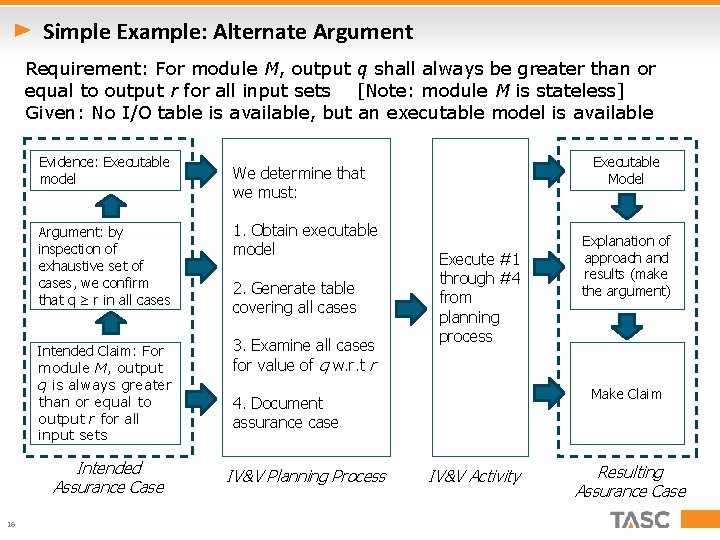
Simple Example: Alternate Argument Requirement: For module M, output q shall always be greater than or equal to output r for all input sets [Note: module M is stateless] Given: No I/O table is available, but an executable model is available Evidence: Executable model Argument: by inspection of exhaustive set of cases, we confirm that q ≥ r in all cases Intended Claim: For module M, output q is always greater than or equal to output r for all input sets Intended Assurance Case 16 Executable Model We determine that we must: 1. Obtain executable model 2. Generate table covering all cases 3. Examine all cases for value of q w. r. t r Execute #1 through #4 from planning process Make Claim 4. Document assurance case IV&V Planning Process © 2012 TASC, Inc. | TASC Proprietary Explanation of approach and results (make the argument) IV&V Activity Resulting Assurance Case
Comments on the Example § Do we really go through this process for every requirement? – Not necessarily – we won’t build 5, 000 assurance cases for a requirement set with 5, 000 requirements – There may be individual requirements that merit this – There is generally a one-to-one relationship between activities and assurance cases – In picking an example, a simple example was necessary to illustrate the process – This thought process could be used in the requirements analysis, i. e. in the analyst notes wherever those are currently captured (“Verified by examination of exhaustive I/O table that q ≥ r in all cases”) 17 © 2012 TASC, Inc. | TASC Proprietary
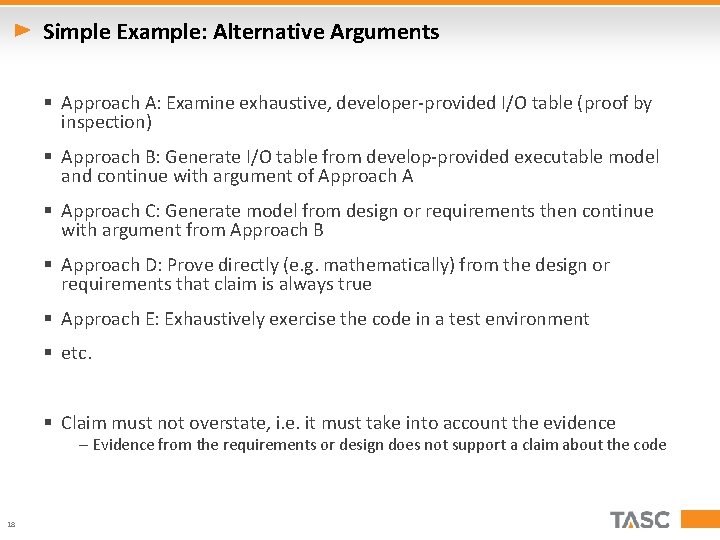
Simple Example: Alternative Arguments § Approach A: Examine exhaustive, developer-provided I/O table (proof by inspection) § Approach B: Generate I/O table from develop-provided executable model and continue with argument of Approach A § Approach C: Generate model from design or requirements then continue with argument from Approach B § Approach D: Prove directly (e. g. mathematically) from the design or requirements that claim is always true § Approach E: Exhaustively exercise the code in a test environment § etc. § Claim must not overstate, i. e. it must take into account the evidence – Evidence from the requirements or design does not support a claim about the code 18 © 2012 TASC, Inc. | TASC Proprietary
Real-World Considerations • Claim elaboration • Iterative planning process © 2012 TASC, Inc. | TASC Proprietary
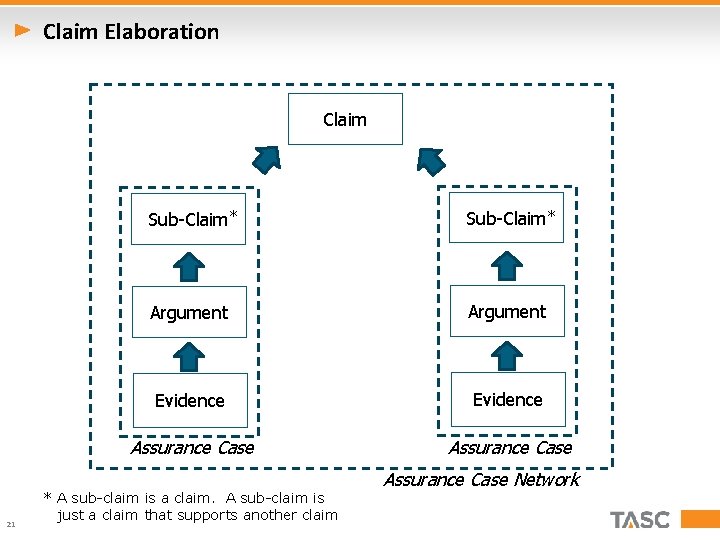
Assurance Case Elaboration § The project goals selected in step 1 may not lend themselves directly to claim development since – Project goals are often high level – Useful claims need to be relatively low-level in order to be directly relatable to IV&V activities § If the initial project goals are too high-level, a necessary step is to decompose the claim into sub-claims – The sub-claims then have their own associated arguments and evidence, or potentially further sub-claims – IV&V planning is then performed for each lowest-level claim § This introduces the concept of a claim being supported by something other than a single argument, specifically that of a claim being supported by one or more sub-claims – Claims can also be supported by assumptions (unsubstantiated claims) in addition to sub-claims and arguments. © 2012 TASC, Inc. | TASC Proprietary
Claim Elaboration Claim 21 Sub-Claim * Argument Evidence Assurance Case * A sub-claim is a claim. A sub-claim is just a claim that supports another claim Assurance Case Network © 2012 TASC, Inc. | TASC Proprietary
Planning Process Iteration § There may also be unintended results during evidence collection, which include: – Conflicting evidence – Incomplete evidence – Inability to collect planned evidence – The appropriate claim (based on actual vs. intended evidence) may emerge to be different from the originally-intended claim § These considerations are handled through planning process iteration, allowing mid-course corrections or revisions to IV&V plans 22 © 2012 TASC, Inc. | TASC Proprietary
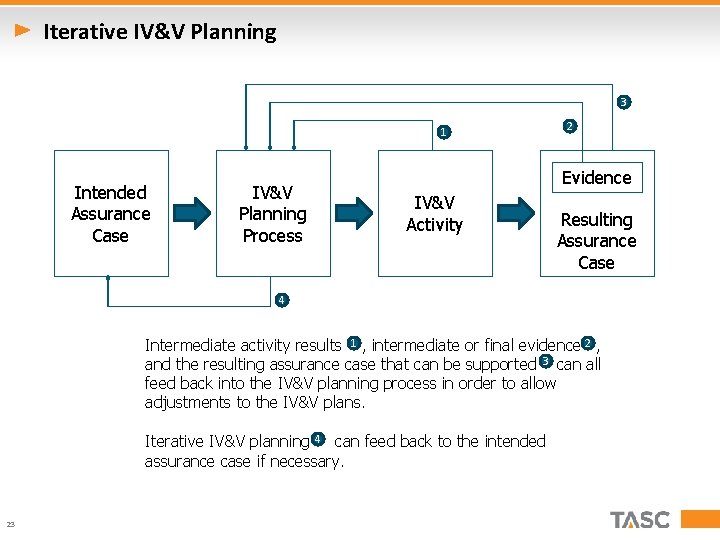
Iterative IV&V Planning 3 1 Intended Assurance Case IV&V Planning Process 2 Evidence IV&V Activity Resulting Assurance Case 4 Intermediate activity results 1 , intermediate or final evidence 2 , and the resulting assurance case that can be supported 3 can all feed back into the IV&V planning process in order to allow adjustments to the IV&V plans. Iterative IV&V planning 4 can feed back to the intended assurance case if necessary. 23 © 2012 TASC, Inc. | TASC Proprietary
Claim Considerations for IV&V © 2012 TASC, Inc. | TASC Proprietary
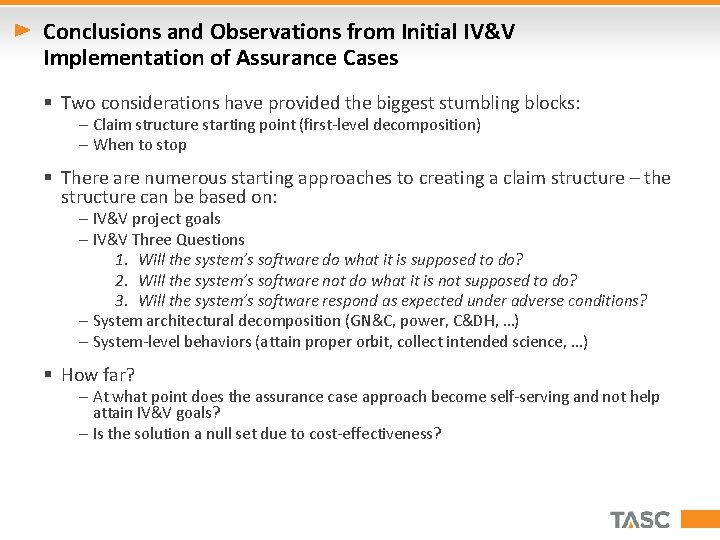
Conclusions and Observations from Initial IV&V Implementation of Assurance Cases § Two considerations have provided the biggest stumbling blocks: – Claim structure starting point (first-level decomposition) – When to stop § There are numerous starting approaches to creating a claim structure – the structure can be based on: – IV&V project goals – IV&V Three Questions 1. Will the system’s software do what it is supposed to do? 2. Will the system’s software not do what it is not supposed to do? 3. Will the system’s software respond as expected under adverse conditions? – System architectural decomposition (GN&C, power, C&DH, …) – System-level behaviors (attain proper orbit, collect intended science, …) § How far? – At what point does the assurance case approach become self-serving and not help attain IV&V goals? – Is the solution a null set due to cost-effectiveness? © 2012 TASC, Inc. | TASC Proprietary
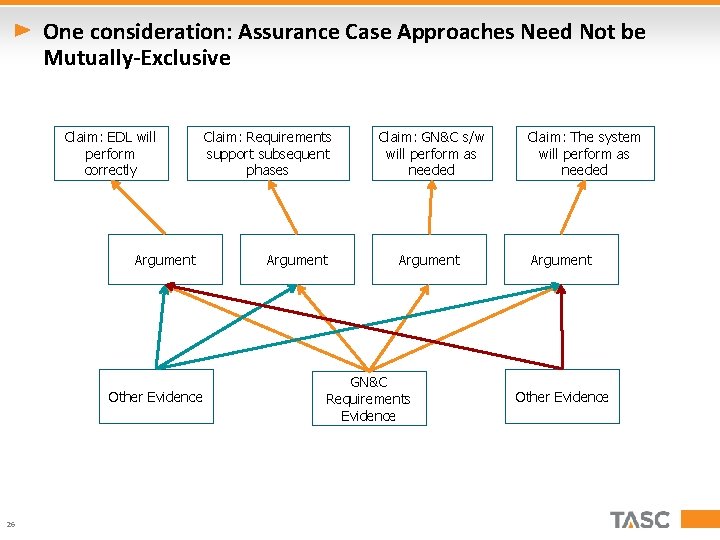
One consideration: Assurance Case Approaches Need Not be Mutually-Exclusive Claim: EDL will perform correctly Argument Other Evidence 26 Claim: Requirements support subsequent phases Argument Claim: GN&C s/w will perform as needed Argument GN&C Requirements Evidence © 2012 TASC, Inc. | TASC Proprietary Claim: The system will perform as needed Argument Other Evidence
Notation and Tools © 2012 TASC, Inc. | TASC Proprietary
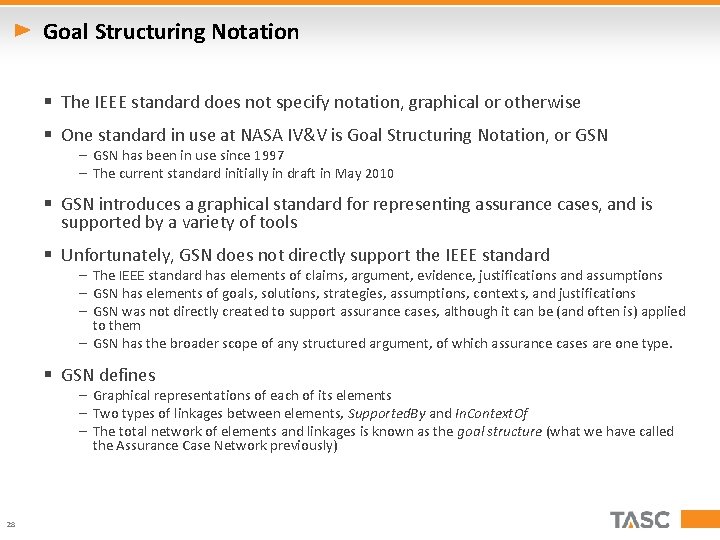
Goal Structuring Notation § The IEEE standard does not specify notation, graphical or otherwise § One standard in use at NASA IV&V is Goal Structuring Notation, or GSN – GSN has been in use since 1997 – The current standard initially in draft in May 2010 § GSN introduces a graphical standard for representing assurance cases, and is supported by a variety of tools § Unfortunately, GSN does not directly support the IEEE standard – The IEEE standard has elements of claims, argument, evidence, justifications and assumptions – GSN has elements of goals, solutions, strategies, assumptions, contexts, and justifications – GSN was not directly created to support assurance cases, although it can be (and often is) applied to them – GSN has the broader scope of any structured argument, of which assurance cases are one type. § GSN defines – Graphical representations of each of its elements – Two types of linkages between elements, Supported. By and In. Context. Of – The total network of elements and linkages is known as the goal structure (what we have called the Assurance Case Network previously) 28 © 2012 TASC, Inc. | TASC Proprietary
Claims-Arguments-Evidence (CAE) & ASCE § Claim-argument-evidence (CAE) notation was created by Adelard and supported by their COTS ASCE tool – ASCE stands for Assurance and Safety Case Environment – CAE more closely follows the IEEE terminology, but does not include justifications or assumptions – In the IEEE standard, an assumption is just a special case of a claim, so a CAE claim can fill that need – CAE also has the element other, which can attach general text to any element, which can fill the need for IEEE justifications – The fifth and final CAE element is caption, which is used to provide annotation over the graph – CAE also introduces linkages of various types between elements. § As a tool (vs. a standard), ASCE provides functionality in addition to the graphical network representation, including reports, exporting, and others. § ASCE was introduced here in the context of CAE, but ASCE supports both GSN and CAE 29 © 2012 TASC, Inc. | TASC Proprietary
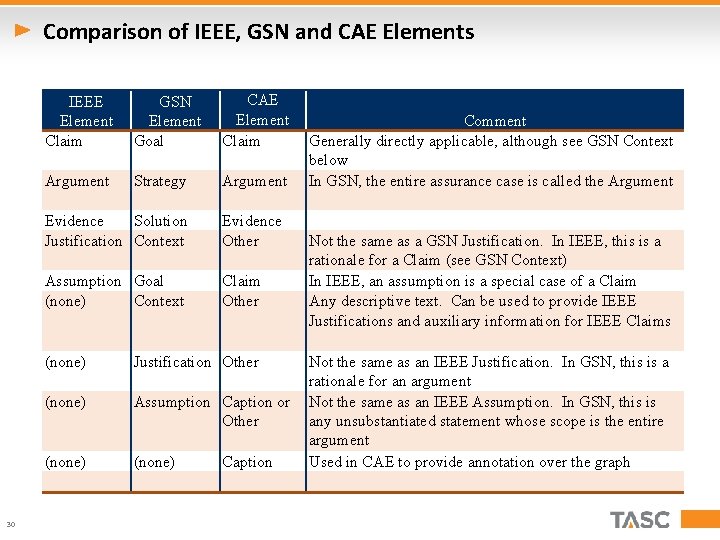
Comparison of IEEE, GSN and CAE Elements 30 IEEE Element Claim GSN Element Goal CAE Element Claim Argument Strategy Argument Evidence Solution Justification Context Evidence Other Assumption Goal (none) Context Claim Other (none) Justification Other (none) Assumption Caption or Other (none) Caption Comment Generally directly applicable, although see GSN Context below In GSN, the entire assurance case is called the Argument Not the same as a GSN Justification. In IEEE, this is a rationale for a Claim (see GSN Context) In IEEE, an assumption is a special case of a Claim Any descriptive text. Can be used to provide IEEE Justifications and auxiliary information for IEEE Claims Not the same as an IEEE Justification. In GSN, this is a rationale for an argument Not the same as an IEEE Assumption. In GSN, this is any unsubstantiated statement whose scope is the entire argument Used in CAE to provide annotation over the graph © 2012 TASC, Inc. | TASC Proprietary
Structured Assurance Case Metamodel (SACM) § Developed by the Object Management Group (OMG) § SACM is a combination of two other metamodels – Argumentation Metamodel (ARM) – Software Assurance Evidence Metamodel (SAEM) – The are also OMG products § SACM combines GSN, CAE and other formats into a formal model § ASCE is adding support for SACM 31 © 2012 TASC, Inc. | TASC Proprietary
Tools § ASCE (discussed earlier) § Cert. Ware – Eclipse plug-in developed to support safety cases by Kestrel under the sponsorship and management of NASA Langley – Cert. Ware is freely downloadable and supports the standards mentioned above and other features related to safety assurance § Microsoft Visio – Simple and easy to use, but feature-light (with respect to assurance cases) – A standard tool at the NASA IV&V facility and TASC – Allows drawing all of the elements of GSN or CAE (or virtually any other line drawing), and allows creation of a shape library for the various elements – Visio provides no analysis or reporting capability – Shape libraries have been created and are easily shared among analysts. 32 © 2012 TASC, Inc. | TASC Proprietary
Conclusions © 2012 TASC, Inc. | TASC Proprietary
Summary § Evidence-based assurance is a key goal of the NASA IV&V program, and therefore should be a key consideration during both planning and execution of IV&V projects § Assurance case methodologies are well-supported in the literature and provide a rich set of solutions to address this IV&V goal § As simply a structured way to formulate the activity necessary to support the project goals, assurance cases are non-invasive, i. e. do not require sweeping changes to current IV&V methods – They do bring a level of formality and a measure of support to those performing IV&V planning – They add structure to IV&V analysts executing IV&V activities 34 © 2012 TASC, Inc. | TASC Proprietary
References § NASA IV&V Program Strategic Plan, September 2012 § IEEE 15026 -2 -2011, Systems and Software Engineering – Systems and Software Assurance – Part 2: Assurance Case, IEEE, NY, 11 Oct 2011 § GSN Community Standard, Version 1, November 2011 § Adelard (general): http: //www. adelard. com/asce/choosing-asce/index. html § CAE: http: //www. adelard. com/asce/choosing-asce/cae. html § SACM: http: //www. omg. org/spec/SACM/ § Cert. Ware: http: //nasa. github. com/Cert. Ware/ § S 3106, PBRA and RBA Process, on the NASA IV&V Management System (IMS) § The TS&R doc template on ECM § The Technical Reference folder on ECM § The Assurance Cases for Project Planning and Scoping CD initiative folder on ECM § IV&V Project Management on IMS: IVV 09 -4 § IV&V Technical Framework on IMS: IVV 09 -1 35 © 2012 TASC, Inc. | TASC Proprietary
36 © 2012 TASC, Inc. | TASC Proprietary