
Association Rules and Sequential Patterns Road map n

- Slides: 64
Association Rules and Sequential Patterns
Road map n n n n Basic concepts of Association Rules Apriori algorithm Different data formats for mining Mining with multiple minimum supports Mining class association rules Sequential pattern mining Summary CS 583, Bing Liu, UIC 2
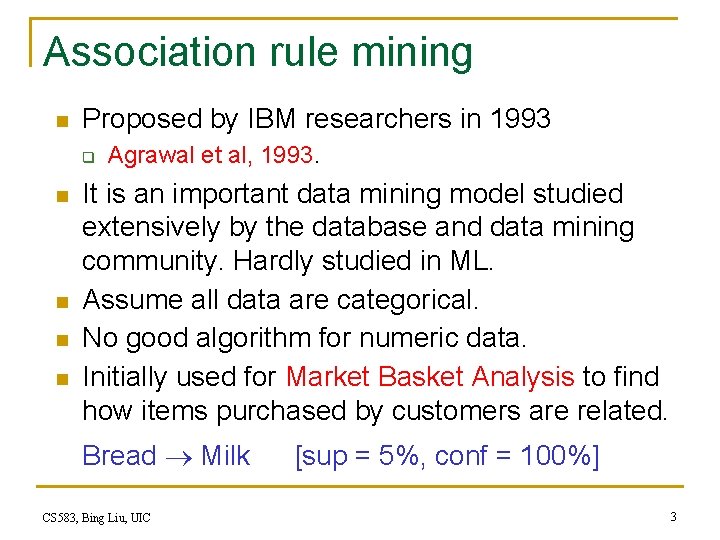
Association rule mining n Proposed by IBM researchers in 1993 q n n Agrawal et al, 1993. It is an important data mining model studied extensively by the database and data mining community. Hardly studied in ML. Assume all data are categorical. No good algorithm for numeric data. Initially used for Market Basket Analysis to find how items purchased by customers are related. Bread Milk CS 583, Bing Liu, UIC [sup = 5%, conf = 100%] 3
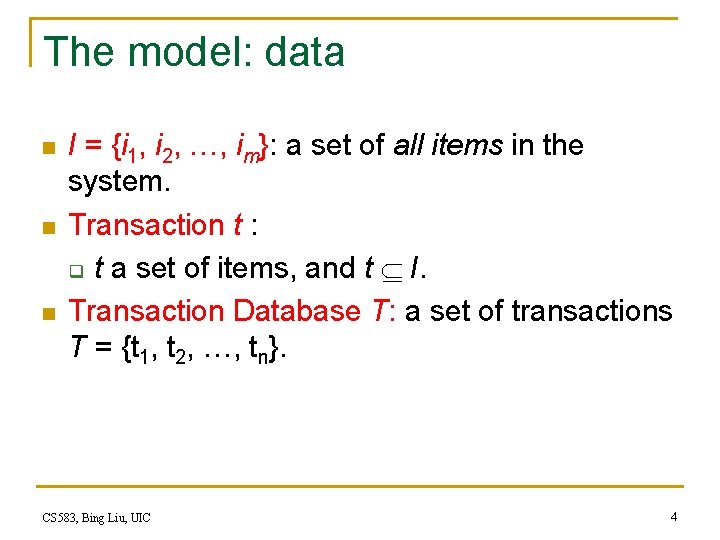
The model: data n n n I = {i 1, i 2, …, im}: a set of all items in the system. Transaction t : q t a set of items, and t I. Transaction Database T: a set of transactions T = {t 1, t 2, …, tn}. CS 583, Bing Liu, UIC 4
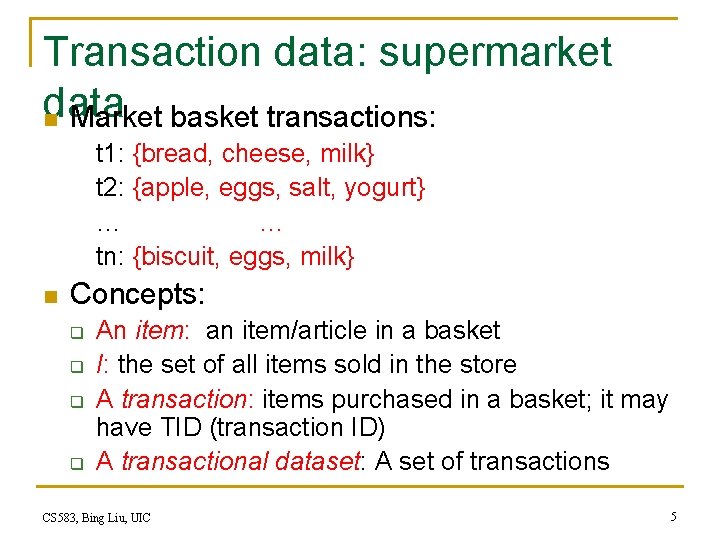
Transaction data: supermarket data n Market basket transactions: t 1: {bread, cheese, milk} t 2: {apple, eggs, salt, yogurt} … … tn: {biscuit, eggs, milk} n Concepts: q q An item: an item/article in a basket I: the set of all items sold in the store A transaction: items purchased in a basket; it may have TID (transaction ID) A transactional dataset: A set of transactions CS 583, Bing Liu, UIC 5
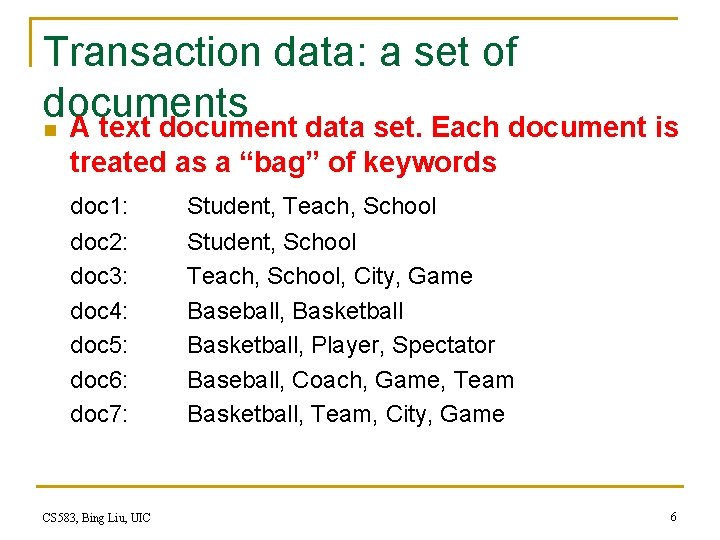
Transaction data: a set of documents n A text document data set. Each document is treated as a “bag” of keywords doc 1: doc 2: doc 3: doc 4: doc 5: doc 6: doc 7: CS 583, Bing Liu, UIC Student, Teach, School Student, School Teach, School, City, Game Baseball, Basketball, Player, Spectator Baseball, Coach, Game, Team Basketball, Team, City, Game 6
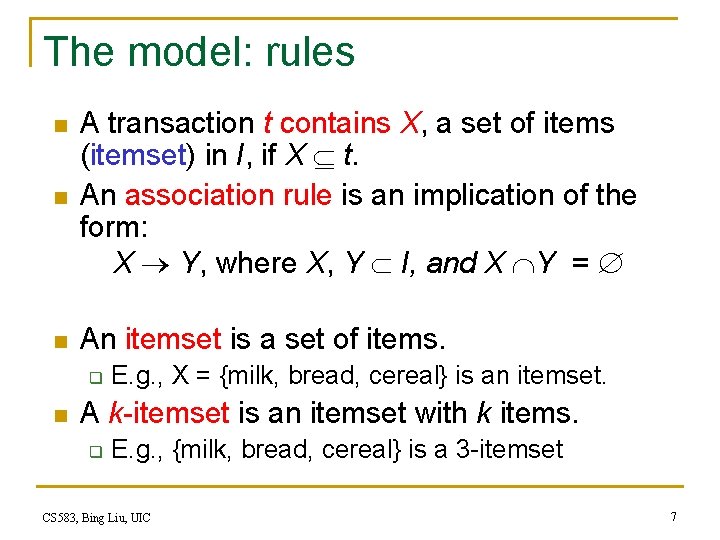
The model: rules n A transaction t contains X, a set of items (itemset) in I, if X t. An association rule is an implication of the form: X Y, where X, Y I, and X Y = n An itemset is a set of items. n q n E. g. , X = {milk, bread, cereal} is an itemset. A k-itemset is an itemset with k items. q E. g. , {milk, bread, cereal} is a 3 -itemset CS 583, Bing Liu, UIC 7
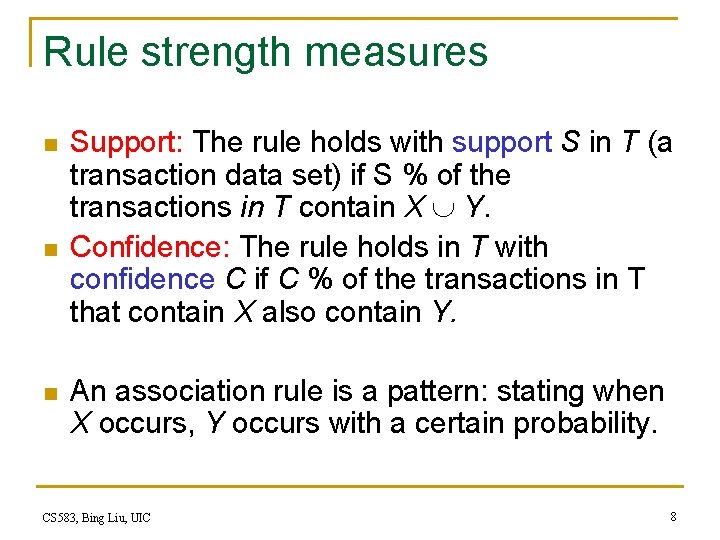
Rule strength measures n n n Support: The rule holds with support S in T (a transaction data set) if S % of the transactions in T contain X Y. Confidence: The rule holds in T with confidence C if C % of the transactions in T that contain X also contain Y. An association rule is a pattern: stating when X occurs, Y occurs with a certain probability. CS 583, Bing Liu, UIC 8
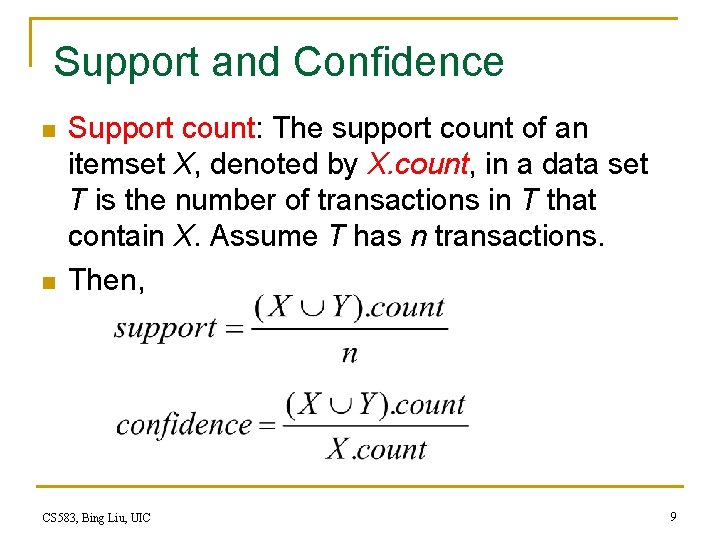
Support and Confidence n n Support count: The support count of an itemset X, denoted by X. count, in a data set T is the number of transactions in T that contain X. Assume T has n transactions. Then, CS 583, Bing Liu, UIC 9
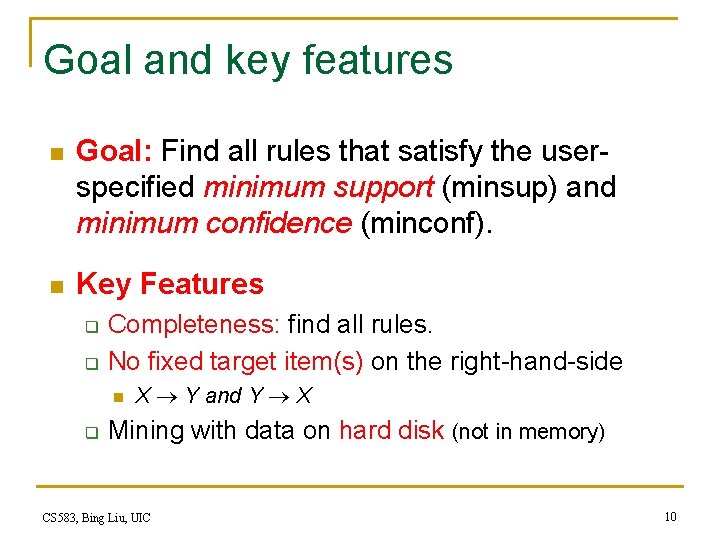
Goal and key features n Goal: Find all rules that satisfy the userspecified minimum support (minsup) and minimum confidence (minconf). n Key Features q q Completeness: find all rules. No fixed target item(s) on the right-hand-side n q X Y and Y X Mining with data on hard disk (not in memory) CS 583, Bing Liu, UIC 10
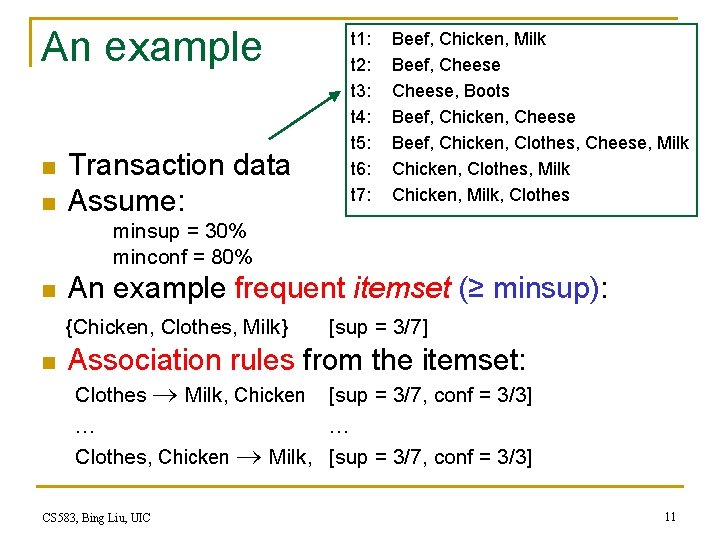
An example n n Transaction data Assume: t 1: t 2: t 3: t 4: t 5: t 6: t 7: Beef, Chicken, Milk Beef, Cheese, Boots Beef, Chicken, Cheese Beef, Chicken, Clothes, Cheese, Milk Chicken, Clothes, Milk Chicken, Milk, Clothes minsup = 30% minconf = 80% n An example frequent itemset (≥ minsup): {Chicken, Clothes, Milk} n [sup = 3/7] Association rules from the itemset: Clothes Milk, Chicken [sup = 3/7, conf = 3/3] … … Clothes, Chicken Milk, [sup = 3/7, conf = 3/3] CS 583, Bing Liu, UIC 11
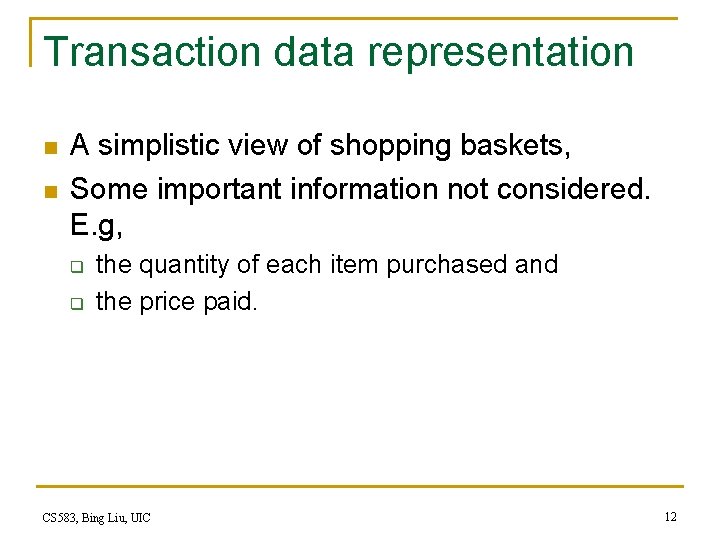
Transaction data representation n n A simplistic view of shopping baskets, Some important information not considered. E. g, q q the quantity of each item purchased and the price paid. CS 583, Bing Liu, UIC 12
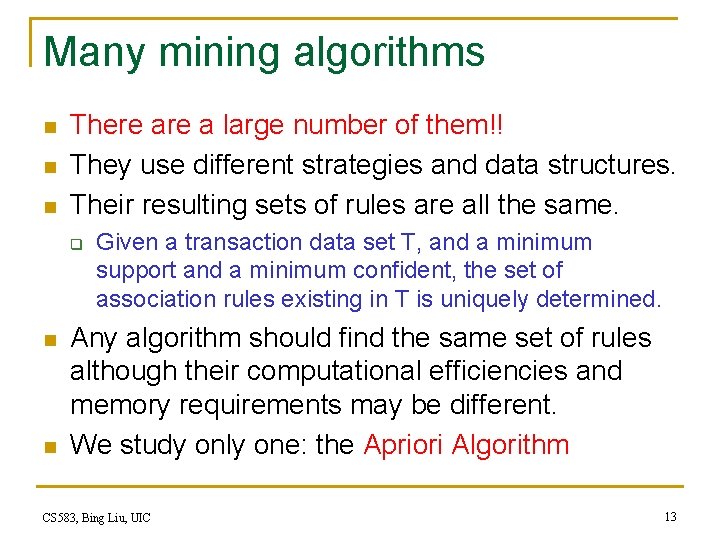
Many mining algorithms n n n There a large number of them!! They use different strategies and data structures. Their resulting sets of rules are all the same. q n n Given a transaction data set T, and a minimum support and a minimum confident, the set of association rules existing in T is uniquely determined. Any algorithm should find the same set of rules although their computational efficiencies and memory requirements may be different. We study only one: the Apriori Algorithm CS 583, Bing Liu, UIC 13
Road map n n n n Basic concepts of Association Rules Apriori algorithm Different data formats for mining Mining with multiple minimum supports Mining class association rules Sequential pattern mining Summary CS 583, Bing Liu, UIC 14
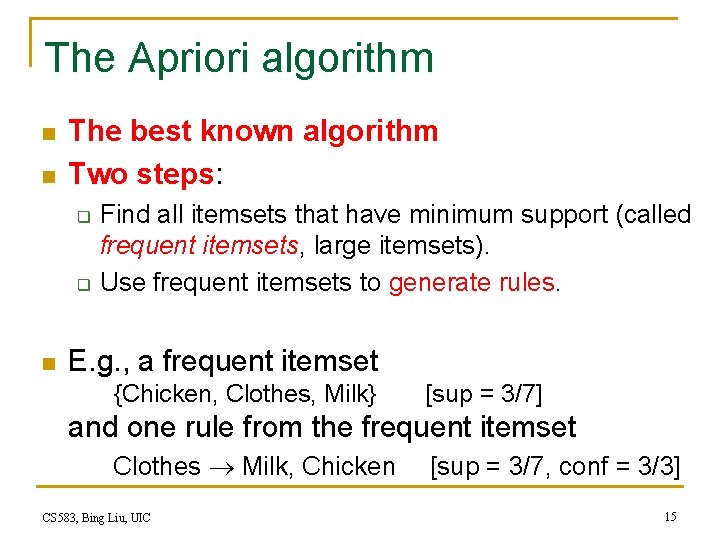
The Apriori algorithm n n The best known algorithm Two steps: q q n Find all itemsets that have minimum support (called frequent itemsets, large itemsets). Use frequent itemsets to generate rules. E. g. , a frequent itemset {Chicken, Clothes, Milk} [sup = 3/7] and one rule from the frequent itemset Clothes Milk, Chicken CS 583, Bing Liu, UIC [sup = 3/7, conf = 3/3] 15
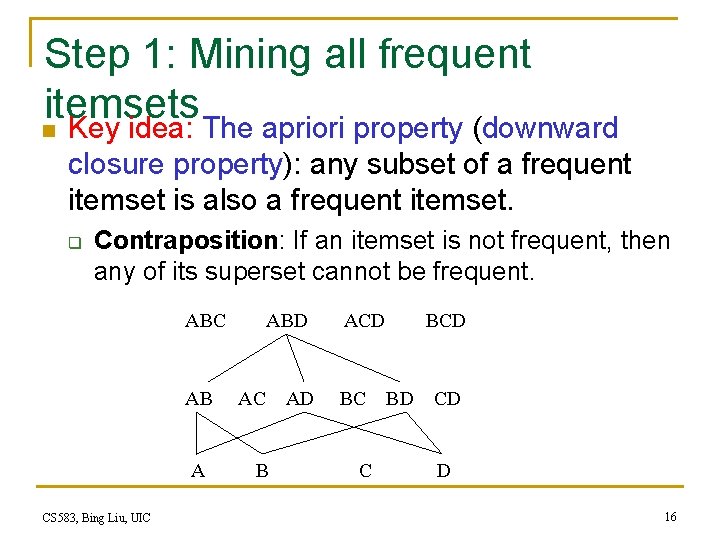
Step 1: Mining all frequent itemsets n Key idea: The apriori property (downward closure property): any subset of a frequent itemset is also a frequent itemset. q Contraposition: If an itemset is not frequent, then any of its superset cannot be frequent. ABC AB A CS 583, Bing Liu, UIC ABD AC B AD ACD BC C BCD BD CD D 16
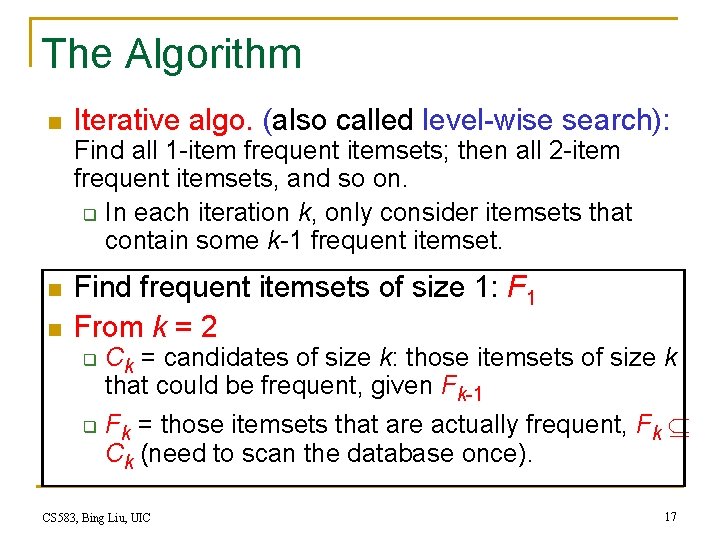
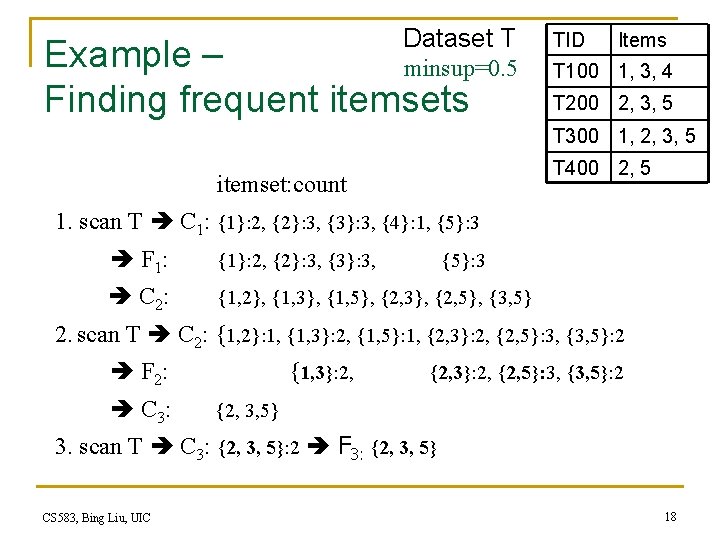
The Algorithm n Iterative algo. (also called level-wise search): Find all 1 -item frequent itemsets; then all 2 -item frequent itemsets, and so on. q In each iteration k, only consider itemsets that contain some k-1 frequent itemset. n n Find frequent itemsets of size 1: F 1 From k = 2 q q Ck = candidates of size k: those itemsets of size k that could be frequent, given Fk-1 Fk = those itemsets that are actually frequent, Fk Ck (need to scan the database once). CS 583, Bing Liu, UIC 17
Dataset T Example – minsup=0. 5 Finding frequent itemsets TID Items T 100 1, 3, 4 T 200 2, 3, 5 T 300 1, 2, 3, 5 T 400 2, 5 itemset: count 1. scan T C 1: {1}: 2, {2}: 3, {3}: 3, {4}: 1, {5}: 3 F 1: {1}: 2, {2}: 3, {3}: 3, C 2: {1, 2}, {1, 3}, {1, 5}, {2, 3}, {2, 5}, {3, 5} {5}: 3 2. scan T C 2: {1, 2}: 1, {1, 3}: 2, {1, 5}: 1, {2, 3}: 2, {2, 5}: 3, {3, 5}: 2 F 2: C 3: {1, 3}: 2, {2, 3}: 2, {2, 5}: 3, {3, 5}: 2 {2, 3, 5} 3. scan T C 3: {2, 3, 5}: 2 F 3: {2, 3, 5} CS 583, Bing Liu, UIC 18
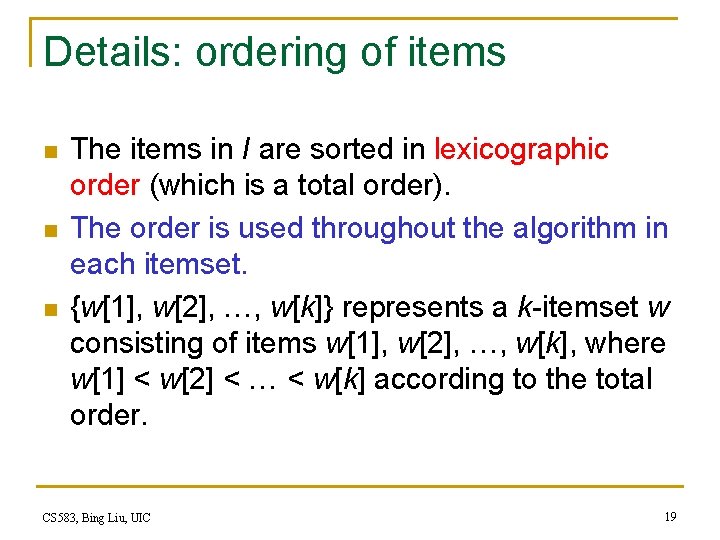
Details: ordering of items n n n The items in I are sorted in lexicographic order (which is a total order). The order is used throughout the algorithm in each itemset. {w[1], w[2], …, w[k]} represents a k-itemset w consisting of items w[1], w[2], …, w[k], where w[1] < w[2] < … < w[k] according to the total order. CS 583, Bing Liu, UIC 19
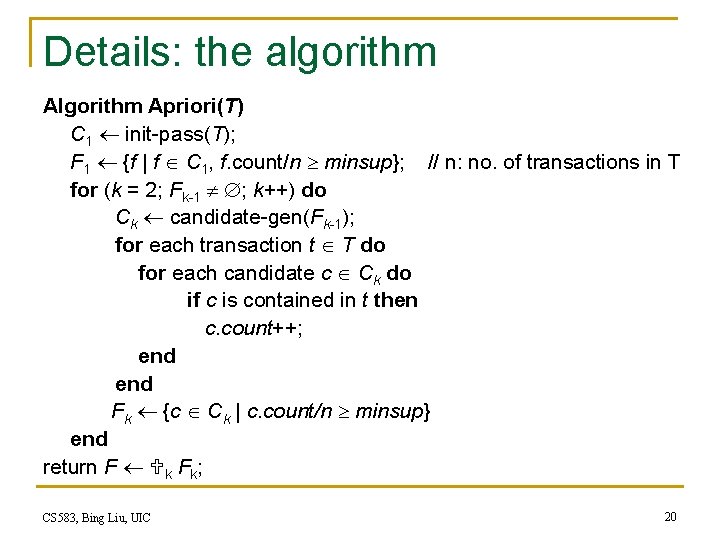
Details: the algorithm Apriori(T) C 1 init-pass(T); F 1 {f | f C 1, f. count/n minsup}; // n: no. of transactions in T for (k = 2; Fk-1 ; k++) do Ck candidate-gen(Fk-1); for each transaction t T do for each candidate c Ck do if c is contained in t then c. count++; end Fk {c Ck | c. count/n minsup} end return F k Fk; CS 583, Bing Liu, UIC 20
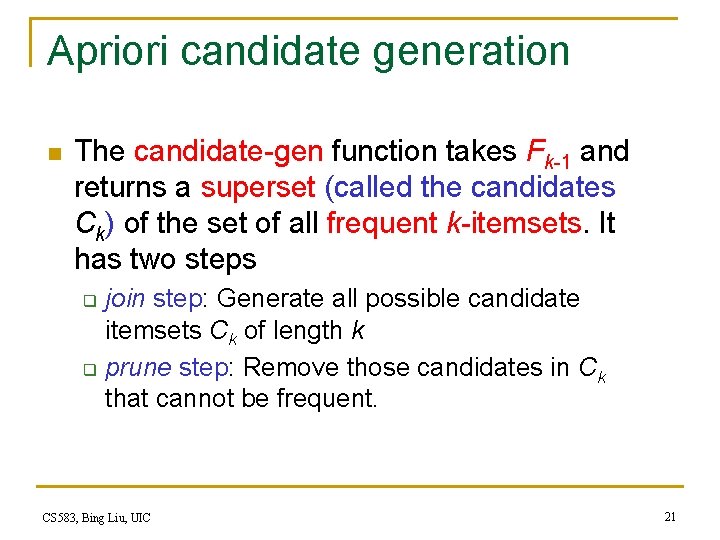
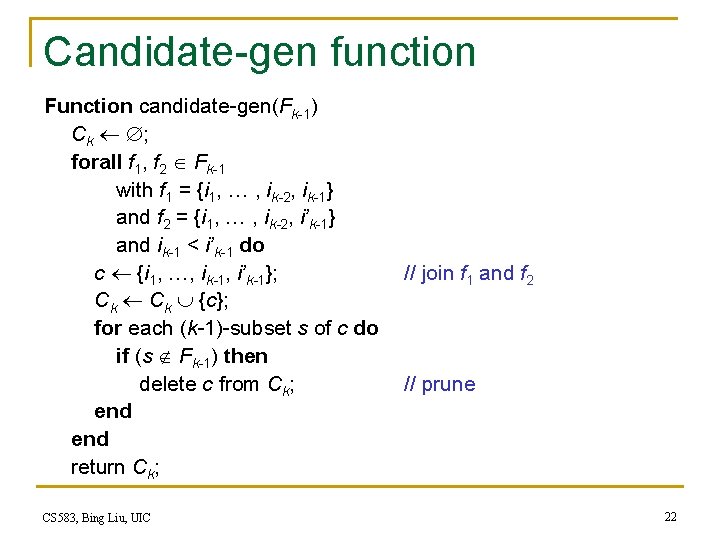
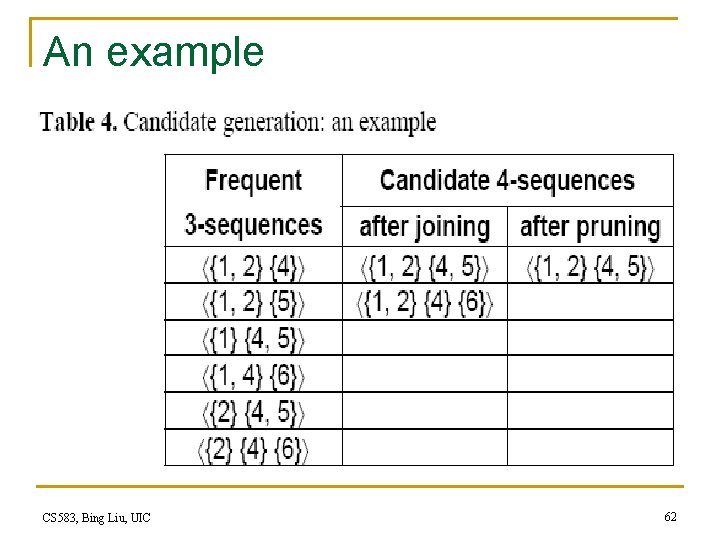
Apriori candidate generation n The candidate-gen function takes Fk-1 and returns a superset (called the candidates Ck) of the set of all frequent k-itemsets. It has two steps q q join step: Generate all possible candidate itemsets Ck of length k prune step: Remove those candidates in Ck that cannot be frequent. CS 583, Bing Liu, UIC 21
Candidate-gen function Function candidate-gen(Fk-1) Ck ; forall f 1, f 2 Fk-1 with f 1 = {i 1, … , ik-2, ik-1} and f 2 = {i 1, … , ik-2, i’k-1} and ik-1 < i’k-1 do c {i 1, …, ik-1, i’k-1}; Ck {c}; for each (k-1)-subset s of c do if (s Fk-1) then delete c from Ck; end return Ck; CS 583, Bing Liu, UIC // join f 1 and f 2 // prune 22
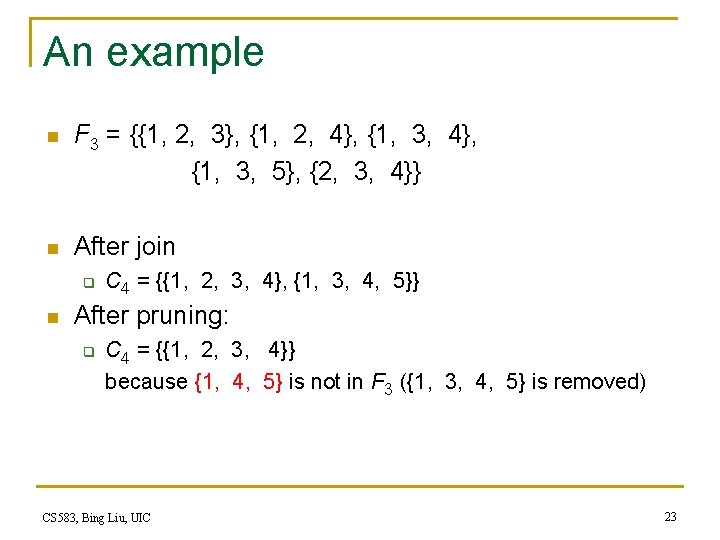
An example n F 3 = {{1, 2, 3}, {1, 2, 4}, {1, 3, 5}, {2, 3, 4}} n After join q n C 4 = {{1, 2, 3, 4}, {1, 3, 4, 5}} After pruning: q C 4 = {{1, 2, 3, 4}} because {1, 4, 5} is not in F 3 ({1, 3, 4, 5} is removed) CS 583, Bing Liu, UIC 23
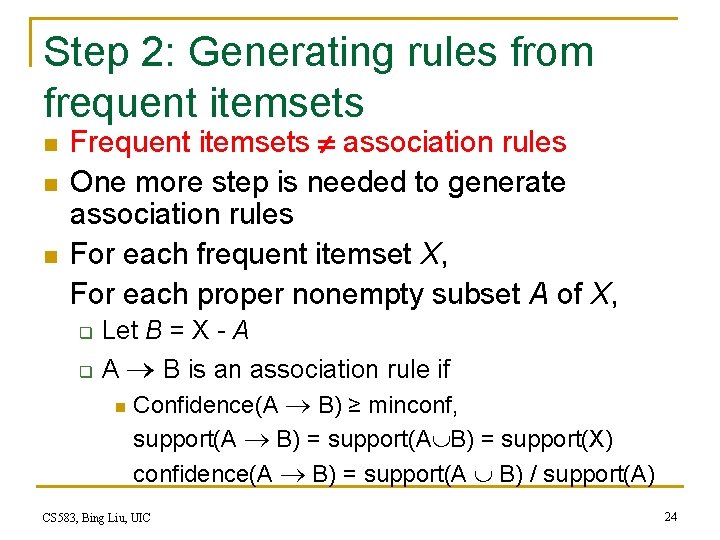
Step 2: Generating rules from frequent itemsets n n n Frequent itemsets association rules One more step is needed to generate association rules For each frequent itemset X, For each proper nonempty subset A of X, q q Let B = X - A A B is an association rule if n Confidence(A B) ≥ minconf, support(A B) = support(A B) = support(X) confidence(A B) = support(A B) / support(A) CS 583, Bing Liu, UIC 24
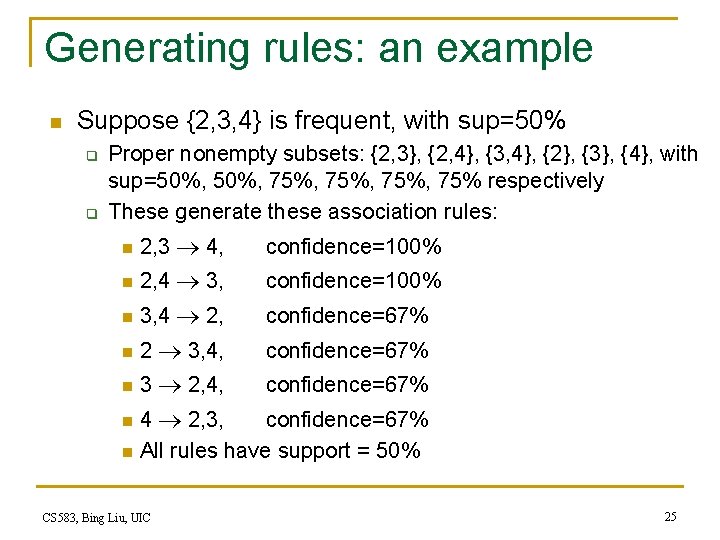
Generating rules: an example n Suppose {2, 3, 4} is frequent, with sup=50% q q Proper nonempty subsets: {2, 3}, {2, 4}, {3, 4}, {2}, {3}, {4}, with sup=50%, 75%, 75% respectively These generate these association rules: n 2, 3 4, confidence=100% n 2, 4 3, confidence=100% n 3, 4 2, confidence=67% n 2 3, 4, confidence=67% n 3 2, 4, confidence=67% n n 4 2, 3, confidence=67% All rules have support = 50% CS 583, Bing Liu, UIC 25
Generating rules: summary n n n To recap, in order to obtain A B, we need to have support(A B) and support(A) All the required information for confidence computation has already been recorded in itemset generation. No need to see the data T any more. This step is not as time-consuming as frequent itemsets generation. CS 583, Bing Liu, UIC 26
On Apriori Algorithm Seems to be very expensive n n n Level-wise search K = the size of the largest itemset It makes at most K passes over data In practice, K is bounded (10). The algorithm is very fast. Under some conditions, all rules can be found in linear time. Scale up to large data sets CS 583, Bing Liu, UIC 27
More on association rule mining n n n Clearly the space of all association rules is exponential, O(2 m), where m is the number of items in I. The mining exploits sparseness of data, and high minimum support and high minimum confidence values. Still, it always produces a huge number of rules, thousands, tens of thousands, millions, and more CS 583, Bing Liu, UIC 28
Road map n n n n Basic concepts of Association Rules Apriori algorithm Different data formats for mining Mining with multiple minimum supports Mining class association rules Sequential pattern mining Summary CS 583, Bing Liu, UIC 29
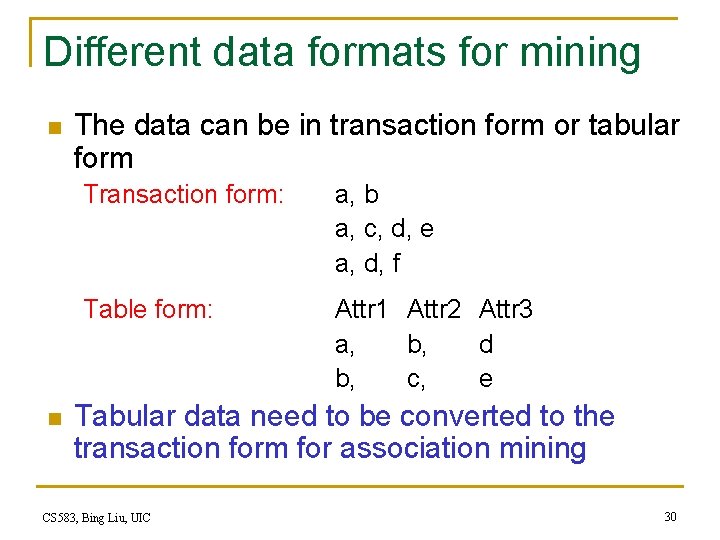
Different data formats for mining n n The data can be in transaction form or tabular form Transaction form: a, b a, c, d, e a, d, f Table form: Attr 1 Attr 2 Attr 3 a, b, d b, c, e Tabular data need to be converted to the transaction form for association mining CS 583, Bing Liu, UIC 30
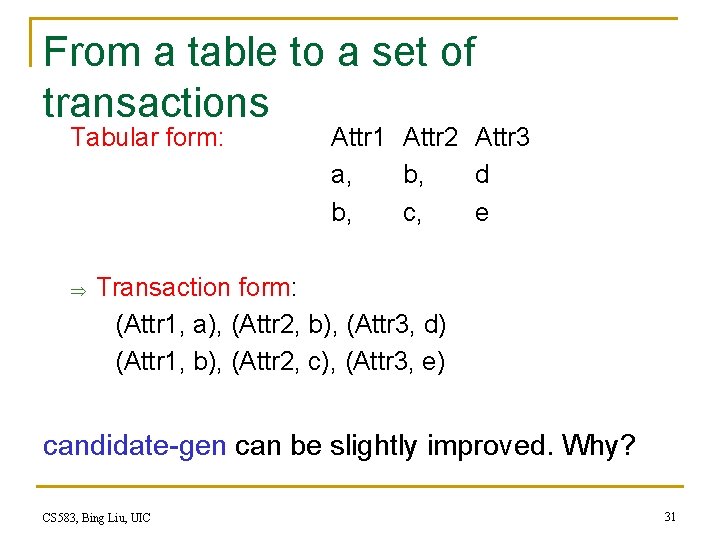
From a table to a set of transactions Tabular form: Þ Attr 1 Attr 2 Attr 3 a, b, d b, c, e Transaction form: (Attr 1, a), (Attr 2, b), (Attr 3, d) (Attr 1, b), (Attr 2, c), (Attr 3, e) candidate-gen can be slightly improved. Why? CS 583, Bing Liu, UIC 31
Road map n n n n Basic concepts of Association Rules Apriori algorithm Different data formats for mining Mining with multiple minimum supports Mining class association rules Sequential pattern mining Summary CS 583, Bing Liu, UIC 32
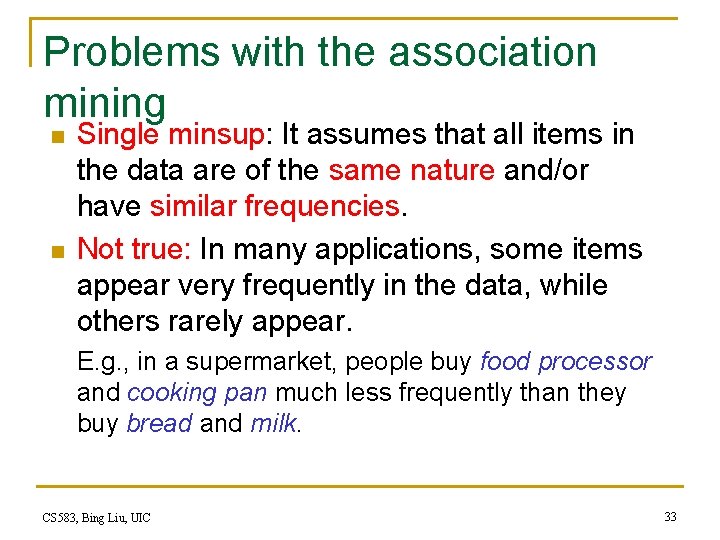
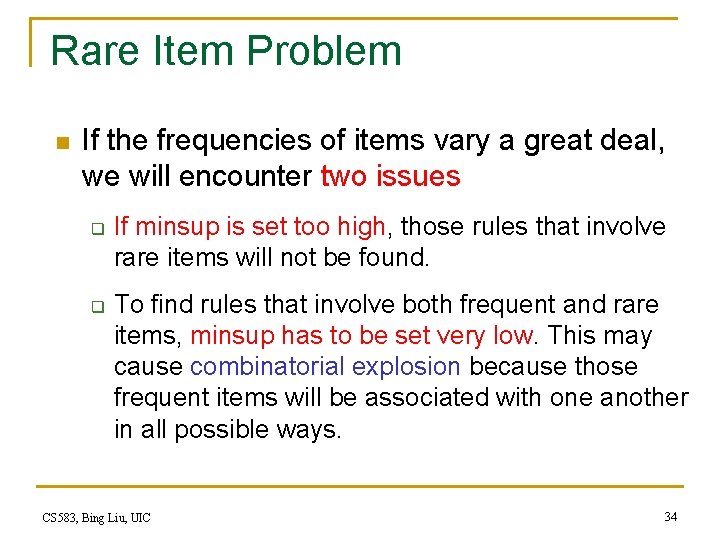
Problems with the association mining n n Single minsup: It assumes that all items in the data are of the same nature and/or have similar frequencies. Not true: In many applications, some items appear very frequently in the data, while others rarely appear. E. g. , in a supermarket, people buy food processor and cooking pan much less frequently than they buy bread and milk. CS 583, Bing Liu, UIC 33
Rare Item Problem n If the frequencies of items vary a great deal, we will encounter two issues q q If minsup is set too high, those rules that involve rare items will not be found. To find rules that involve both frequent and rare items, minsup has to be set very low. This may cause combinatorial explosion because those frequent items will be associated with one another in all possible ways. CS 583, Bing Liu, UIC 34
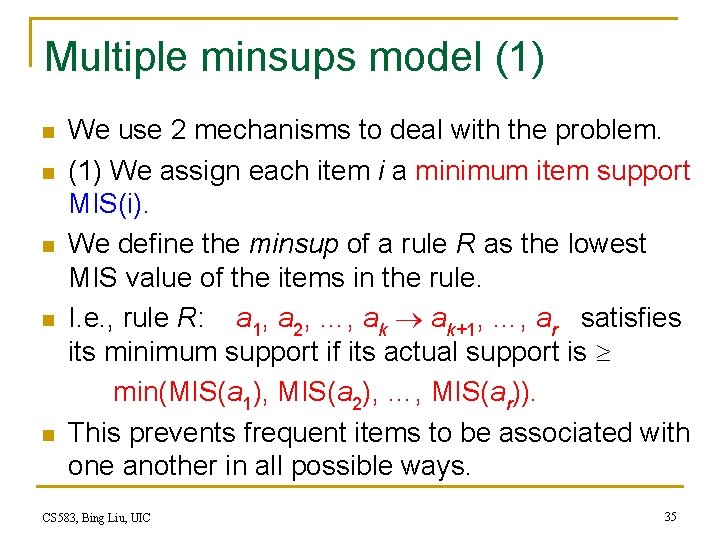
Multiple minsups model (1) n n n We use 2 mechanisms to deal with the problem. (1) We assign each item i a minimum item support MIS(i). We define the minsup of a rule R as the lowest MIS value of the items in the rule. I. e. , rule R: a 1, a 2, …, ak ak+1, …, ar satisfies its minimum support if its actual support is min(MIS(a 1), MIS(a 2), …, MIS(ar)). This prevents frequent items to be associated with one another in all possible ways. CS 583, Bing Liu, UIC 35
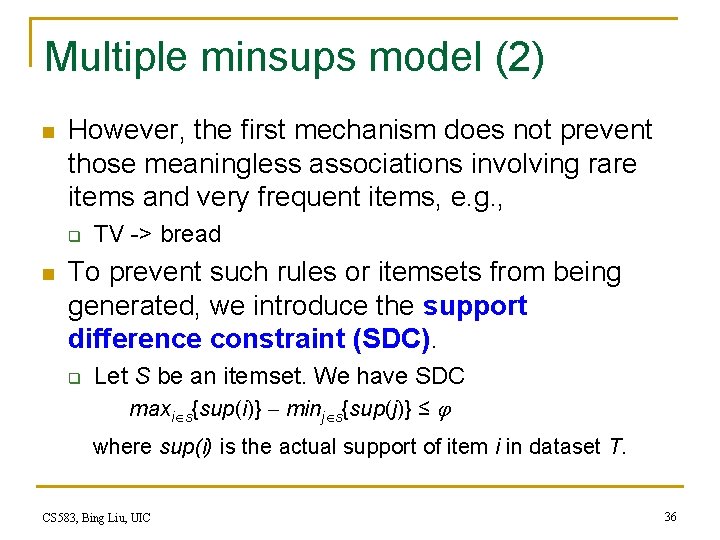
Multiple minsups model (2) n However, the first mechanism does not prevent those meaningless associations involving rare items and very frequent items, e. g. , q n TV -> bread To prevent such rules or itemsets from being generated, we introduce the support difference constraint (SDC). q Let S be an itemset. We have SDC maxi s{sup(i)} minj s{sup(j)} ≤ where sup(i) is the actual support of item i in dataset T. CS 583, Bing Liu, UIC 36
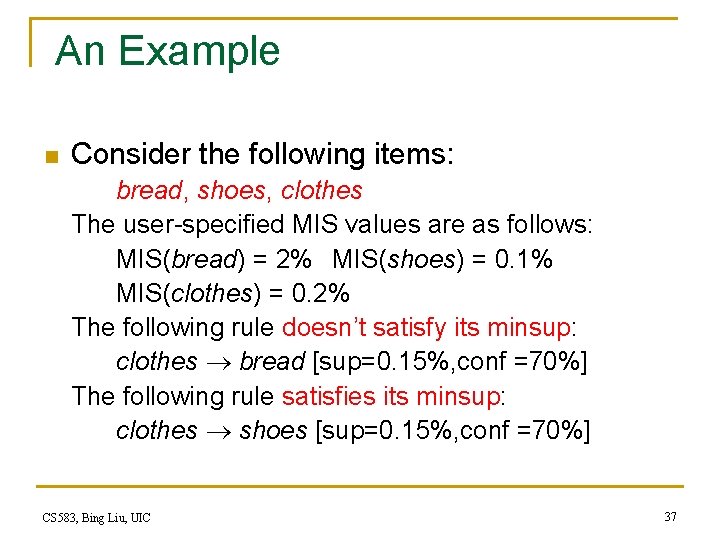
An Example n Consider the following items: bread, shoes, clothes The user-specified MIS values are as follows: MIS(bread) = 2% MIS(shoes) = 0. 1% MIS(clothes) = 0. 2% The following rule doesn’t satisfy its minsup: clothes bread [sup=0. 15%, conf =70%] The following rule satisfies its minsup: clothes shoes [sup=0. 15%, conf =70%] CS 583, Bing Liu, UIC 37
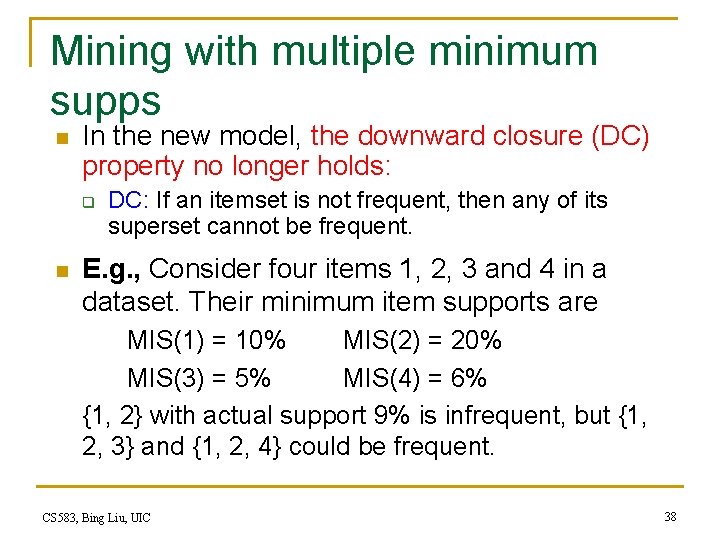
Mining with multiple minimum supps n In the new model, the downward closure (DC) property no longer holds: q n DC: If an itemset is not frequent, then any of its superset cannot be frequent. E. g. , Consider four items 1, 2, 3 and 4 in a dataset. Their minimum item supports are MIS(1) = 10% MIS(2) = 20% MIS(3) = 5% MIS(4) = 6% {1, 2} with actual support 9% is infrequent, but {1, 2, 3} and {1, 2, 4} could be frequent. CS 583, Bing Liu, UIC 38
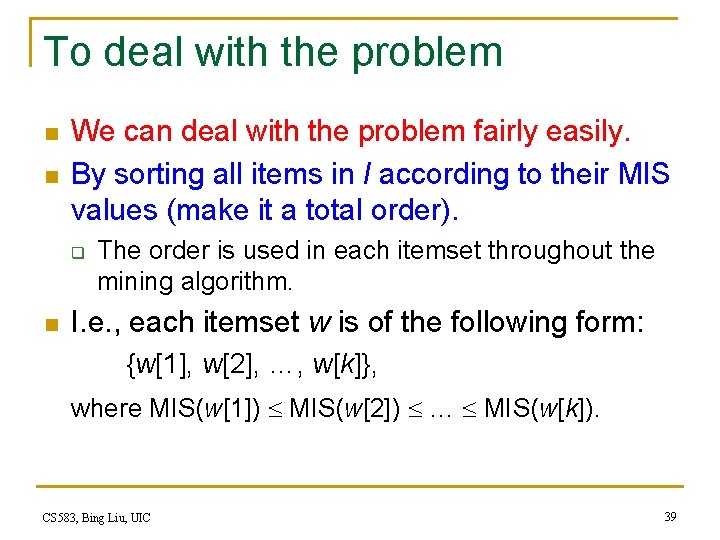
To deal with the problem n n We can deal with the problem fairly easily. By sorting all items in I according to their MIS values (make it a total order). q n The order is used in each itemset throughout the mining algorithm. I. e. , each itemset w is of the following form: {w[1], w[2], …, w[k]}, where MIS(w[1]) MIS(w[2]) … MIS(w[k]). CS 583, Bing Liu, UIC 39
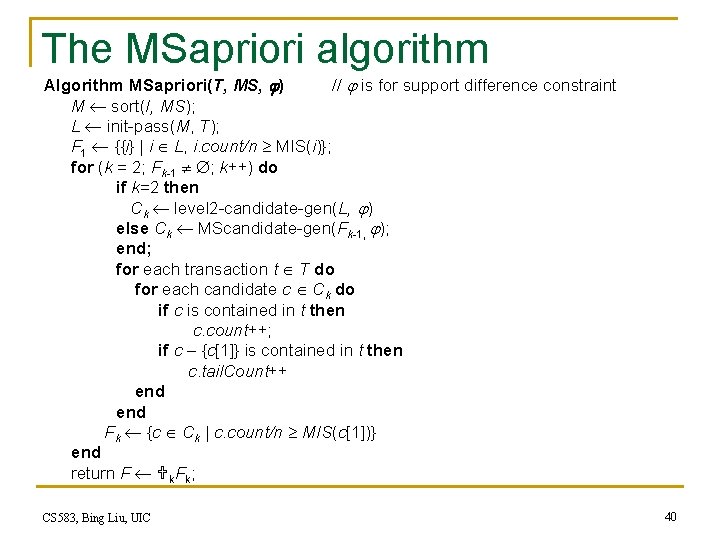
The MSapriori algorithm Algorithm MSapriori(T, MS, ) // is for support difference constraint M sort(I, MS); L init-pass(M, T); F 1 {{i} | i L, i. count/n MIS(i)}; for (k = 2; Fk-1 ; k++) do if k=2 then Ck level 2 -candidate-gen(L, ) else Ck MScandidate-gen(Fk-1, ); end; for each transaction t T do for each candidate c Ck do if c is contained in t then c. count++; if c – {c[1]} is contained in t then c. tail. Count++ end Fk {c Ck | c. count/n MIS(c[1])} end return F k. Fk; CS 583, Bing Liu, UIC 40
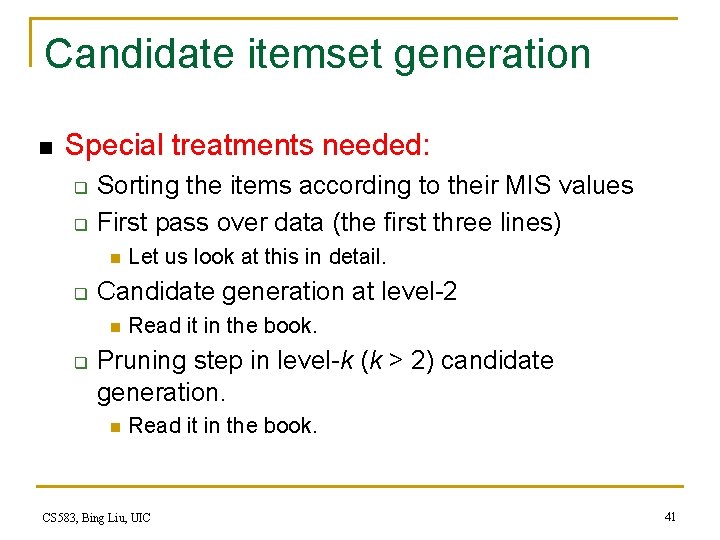
Candidate itemset generation n Special treatments needed: q q Sorting the items according to their MIS values First pass over data (the first three lines) n q Candidate generation at level-2 n q Let us look at this in detail. Read it in the book. Pruning step in level-k (k > 2) candidate generation. n Read it in the book. CS 583, Bing Liu, UIC 41
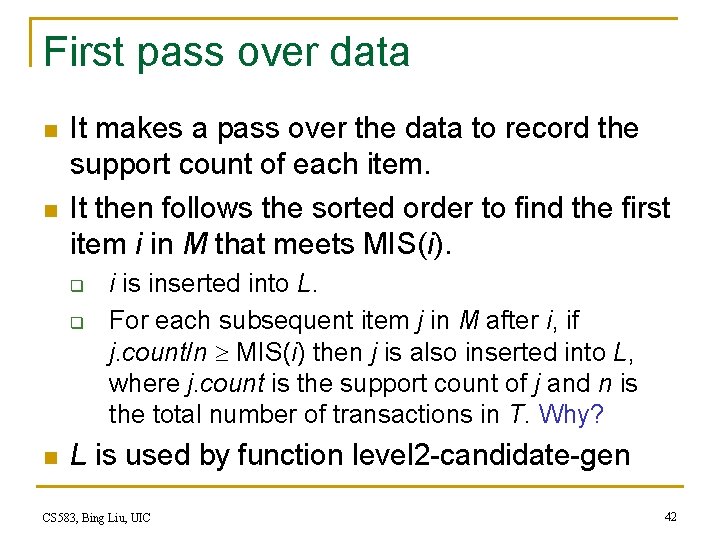
First pass over data n n It makes a pass over the data to record the support count of each item. It then follows the sorted order to find the first item i in M that meets MIS(i). q q n i is inserted into L. For each subsequent item j in M after i, if j. count/n MIS(i) then j is also inserted into L, where j. count is the support count of j and n is the total number of transactions in T. Why? L is used by function level 2 -candidate-gen CS 583, Bing Liu, UIC 42
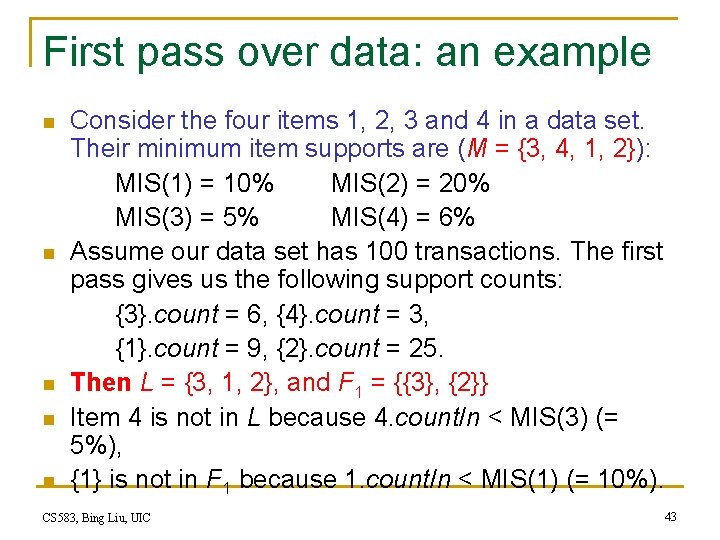
First pass over data: an example n n n Consider the four items 1, 2, 3 and 4 in a data set. Their minimum item supports are (M = {3, 4, 1, 2}): MIS(1) = 10% MIS(2) = 20% MIS(3) = 5% MIS(4) = 6% Assume our data set has 100 transactions. The first pass gives us the following support counts: {3}. count = 6, {4}. count = 3, {1}. count = 9, {2}. count = 25. Then L = {3, 1, 2}, and F 1 = {{3}, {2}} Item 4 is not in L because 4. count/n < MIS(3) (= 5%), {1} is not in F 1 because 1. count/n < MIS(1) (= 10%). CS 583, Bing Liu, UIC 43
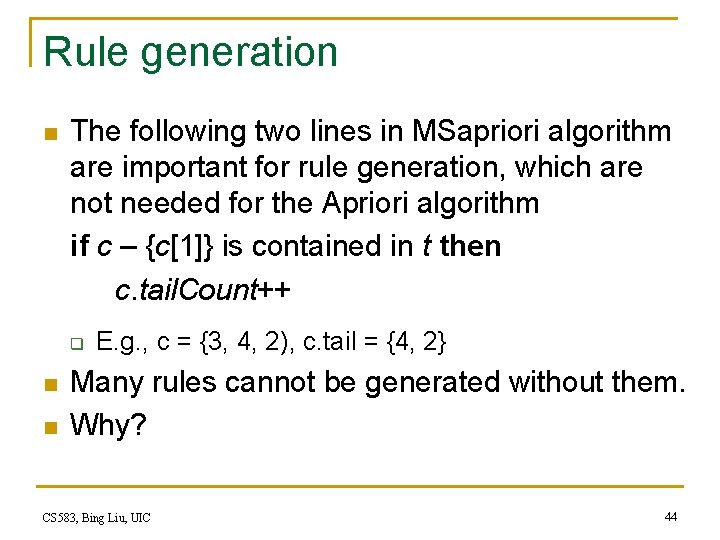
Rule generation n The following two lines in MSapriori algorithm are important for rule generation, which are not needed for the Apriori algorithm if c – {c[1]} is contained in t then c. tail. Count++ q n n E. g. , c = {3, 4, 2), c. tail = {4, 2} Many rules cannot be generated without them. Why? CS 583, Bing Liu, UIC 44
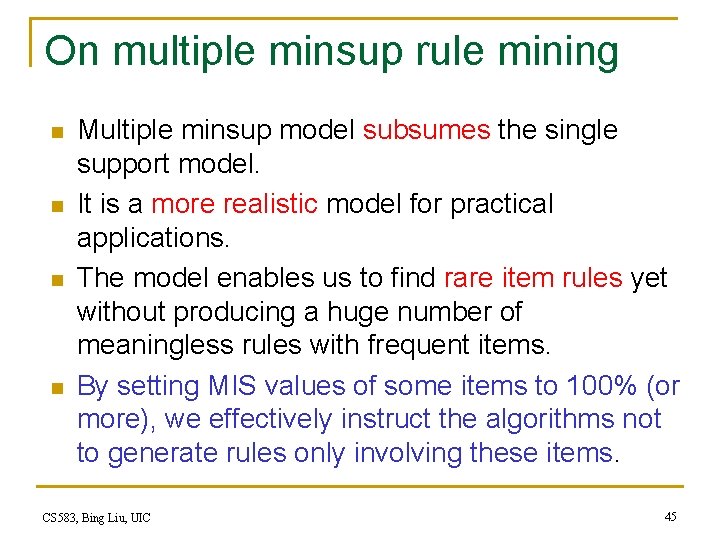
On multiple minsup rule mining n n Multiple minsup model subsumes the single support model. It is a more realistic model for practical applications. The model enables us to find rare item rules yet without producing a huge number of meaningless rules with frequent items. By setting MIS values of some items to 100% (or more), we effectively instruct the algorithms not to generate rules only involving these items. CS 583, Bing Liu, UIC 45
Road map n n n n Basic concepts of Association Rules Apriori algorithm Different data formats for mining Mining with multiple minimum supports Mining class association rules Sequential pattern mining Summary CS 583, Bing Liu, UIC 46
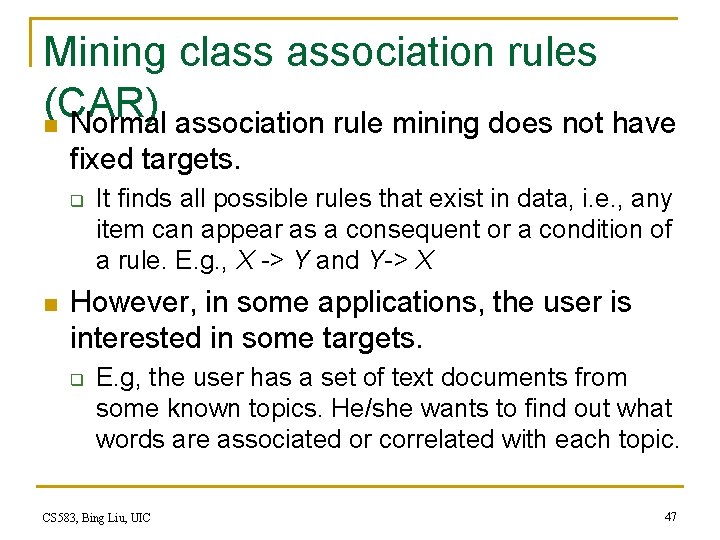
Mining class association rules (CAR) n Normal association rule mining does not have fixed targets. q n It finds all possible rules that exist in data, i. e. , any item can appear as a consequent or a condition of a rule. E. g. , X -> Y and Y-> X However, in some applications, the user is interested in some targets. q E. g, the user has a set of text documents from some known topics. He/she wants to find out what words are associated or correlated with each topic. CS 583, Bing Liu, UIC 47
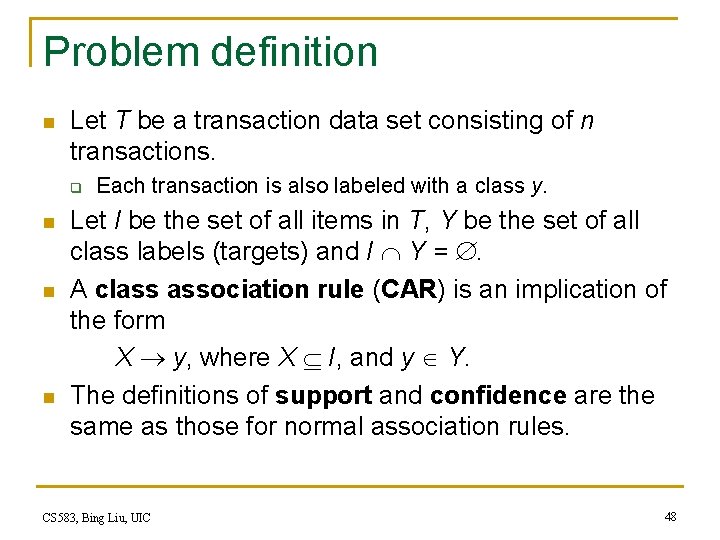
Problem definition n Let T be a transaction data set consisting of n transactions. q n n n Each transaction is also labeled with a class y. Let I be the set of all items in T, Y be the set of all class labels (targets) and I Y = . A class association rule (CAR) is an implication of the form X y, where X I, and y Y. The definitions of support and confidence are the same as those for normal association rules. CS 583, Bing Liu, UIC 48
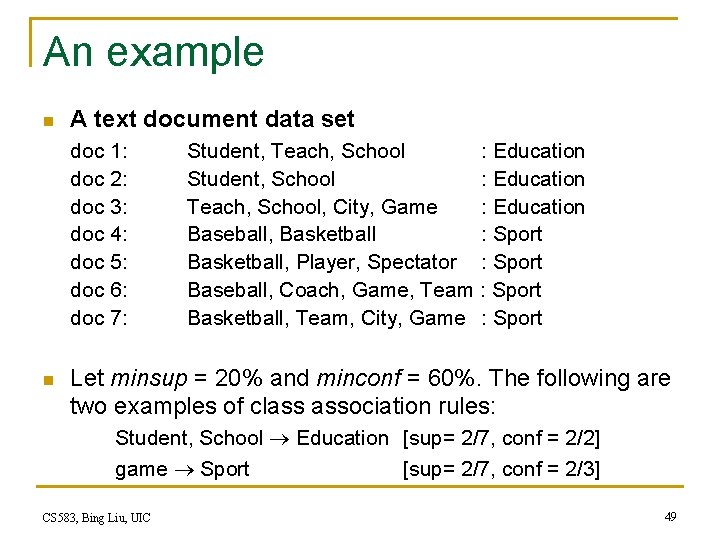
An example n A text document data set doc 1: doc 2: doc 3: doc 4: doc 5: doc 6: doc 7: n Student, Teach, School : Education Student, School : Education Teach, School, City, Game : Education Baseball, Basketball : Sport Basketball, Player, Spectator : Sport Baseball, Coach, Game, Team : Sport Basketball, Team, City, Game : Sport Let minsup = 20% and minconf = 60%. The following are two examples of class association rules: Student, School Education [sup= 2/7, conf = 2/2] game Sport [sup= 2/7, conf = 2/3] CS 583, Bing Liu, UIC 49
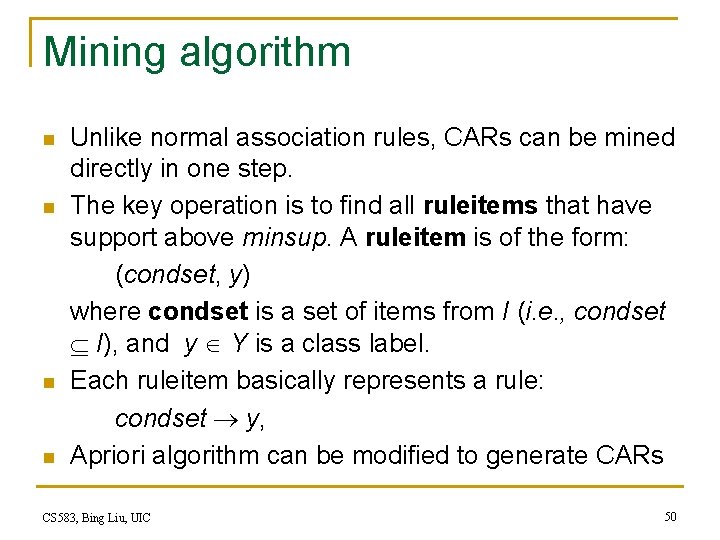
Mining algorithm n n Unlike normal association rules, CARs can be mined directly in one step. The key operation is to find all ruleitems that have support above minsup. A ruleitem is of the form: (condset, y) where condset is a set of items from I (i. e. , condset I), and y Y is a class label. Each ruleitem basically represents a rule: condset y, Apriori algorithm can be modified to generate CARs CS 583, Bing Liu, UIC 50
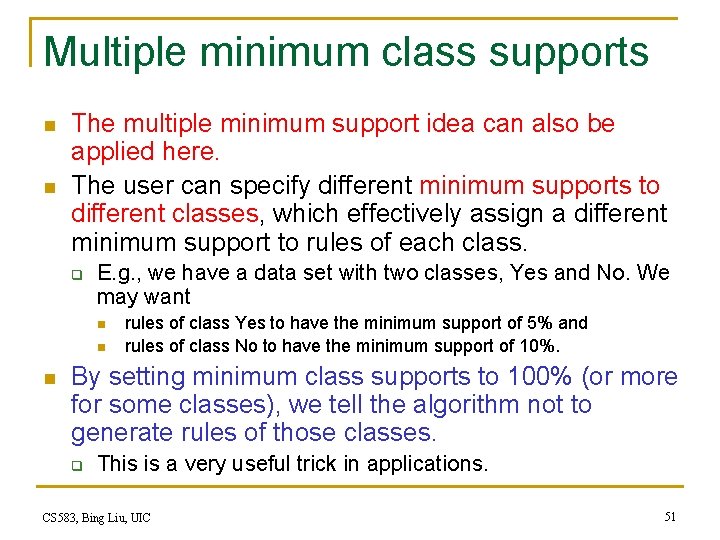
Multiple minimum class supports n n The multiple minimum support idea can also be applied here. The user can specify different minimum supports to different classes, which effectively assign a different minimum support to rules of each class. q E. g. , we have a data set with two classes, Yes and No. We may want n n n rules of class Yes to have the minimum support of 5% and rules of class No to have the minimum support of 10%. By setting minimum class supports to 100% (or more for some classes), we tell the algorithm not to generate rules of those classes. q This is a very useful trick in applications. CS 583, Bing Liu, UIC 51
Road map n n n n Basic concepts of Association Rules Apriori algorithm Different data formats for mining Mining with multiple minimum supports Mining class association rules Sequential pattern mining Summary CS 583, Bing Liu, UIC 52
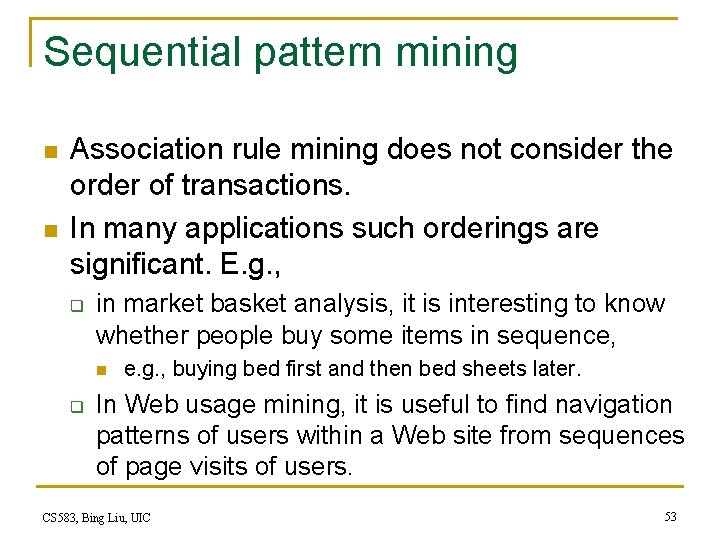
Sequential pattern mining n n Association rule mining does not consider the order of transactions. In many applications such orderings are significant. E. g. , q in market basket analysis, it is interesting to know whether people buy some items in sequence, n q e. g. , buying bed first and then bed sheets later. In Web usage mining, it is useful to find navigation patterns of users within a Web site from sequences of page visits of users. CS 583, Bing Liu, UIC 53
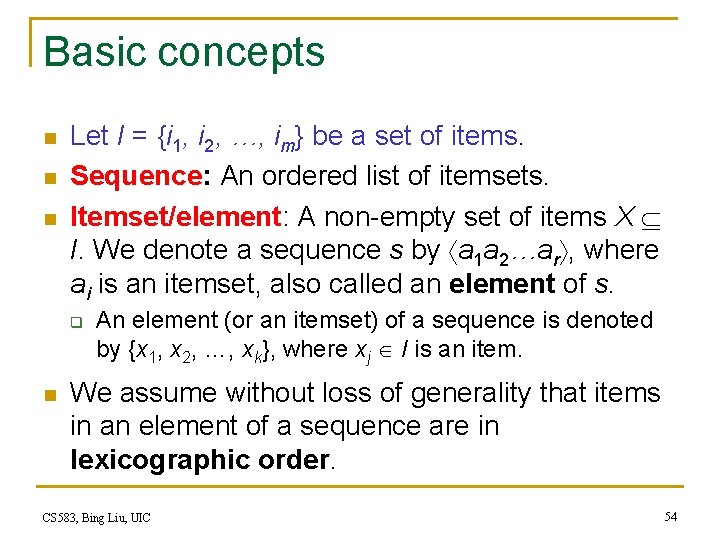
Basic concepts n n n Let I = {i 1, i 2, …, im} be a set of items. Sequence: An ordered list of itemsets. Itemset/element: A non-empty set of items X I. We denote a sequence s by a 1 a 2…ar , where ai is an itemset, also called an element of s. q n An element (or an itemset) of a sequence is denoted by {x 1, x 2, …, xk}, where xj I is an item. We assume without loss of generality that items in an element of a sequence are in lexicographic order. CS 583, Bing Liu, UIC 54
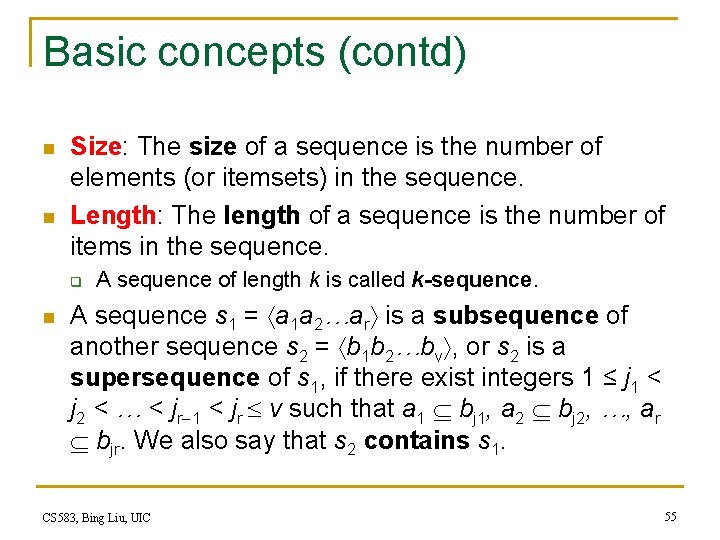
Basic concepts (contd) n n Size: The size of a sequence is the number of elements (or itemsets) in the sequence. Length: The length of a sequence is the number of items in the sequence. q n A sequence of length k is called k-sequence. A sequence s 1 = a 1 a 2…ar is a subsequence of another sequence s 2 = b 1 b 2…bv , or s 2 is a supersequence of s 1, if there exist integers 1 ≤ j 1 < j 2 < … < jr 1 < jr v such that a 1 bj 1, a 2 bj 2, …, ar bjr. We also say that s 2 contains s 1. CS 583, Bing Liu, UIC 55
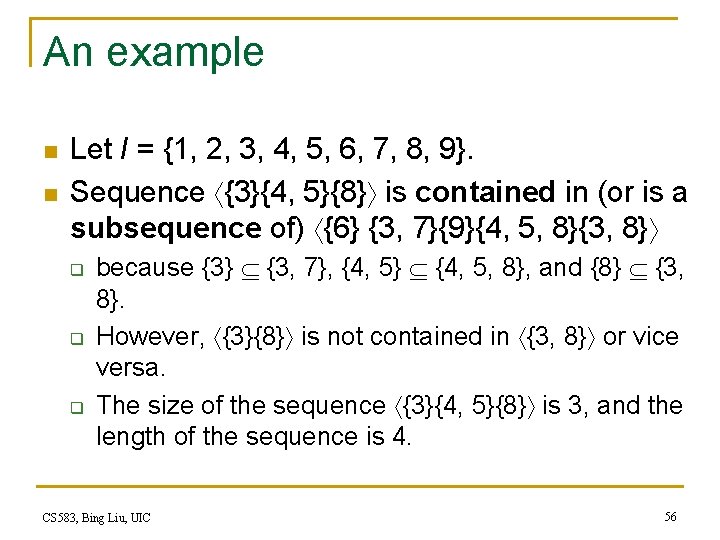
An example n n Let I = {1, 2, 3, 4, 5, 6, 7, 8, 9}. Sequence {3}{4, 5}{8} is contained in (or is a subsequence of) {6} {3, 7}{9}{4, 5, 8}{3, 8} q q q because {3} {3, 7}, {4, 5} {4, 5, 8}, and {8} {3, 8}. However, {3}{8} is not contained in {3, 8} or vice versa. The size of the sequence {3}{4, 5}{8} is 3, and the length of the sequence is 4. CS 583, Bing Liu, UIC 56
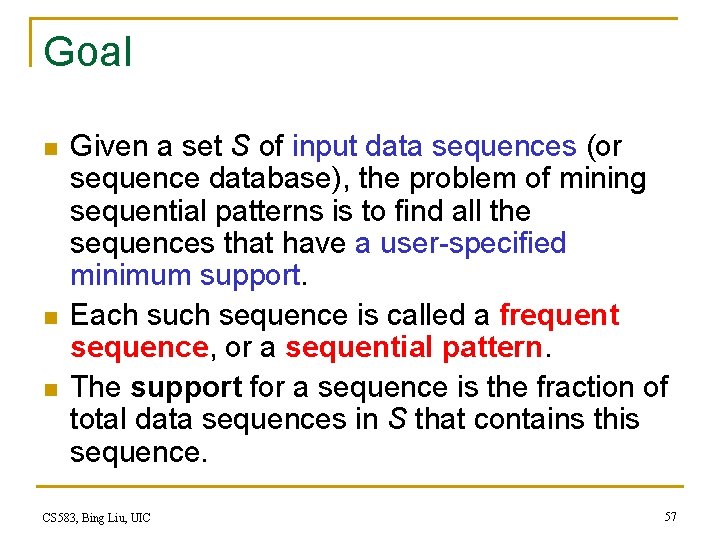
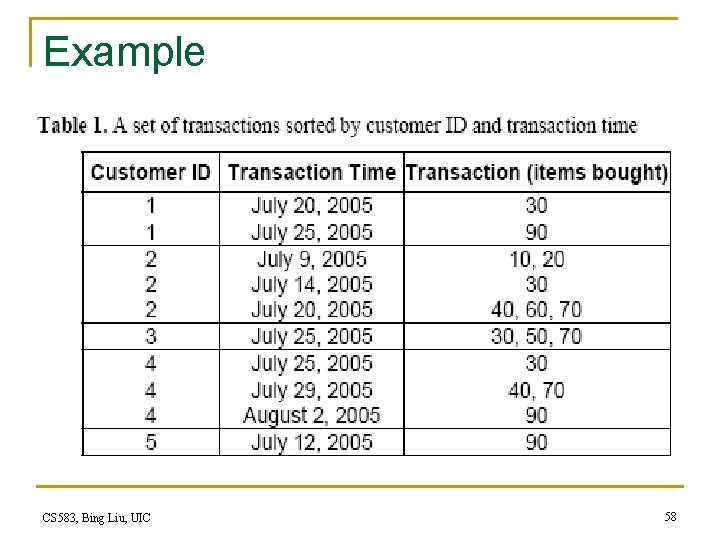
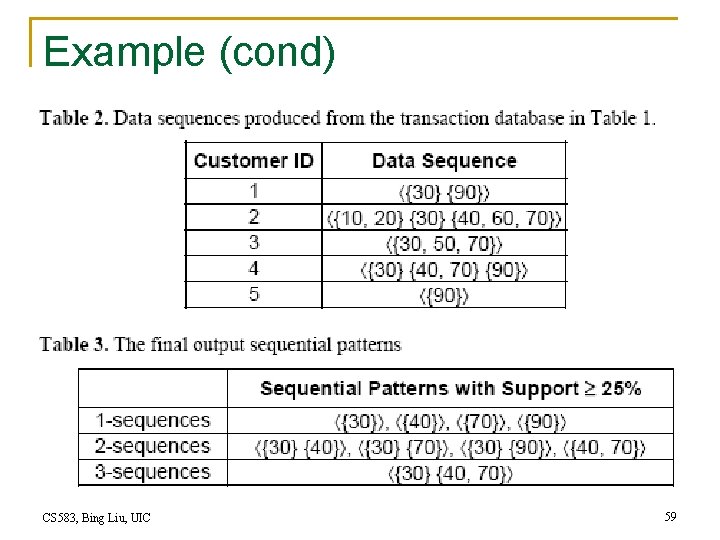
Goal n n n Given a set S of input data sequences (or sequence database), the problem of mining sequential patterns is to find all the sequences that have a user-specified minimum support. Each such sequence is called a frequent sequence, or a sequential pattern. The support for a sequence is the fraction of total data sequences in S that contains this sequence. CS 583, Bing Liu, UIC 57
Example CS 583, Bing Liu, UIC 58
Example (cond) CS 583, Bing Liu, UIC 59
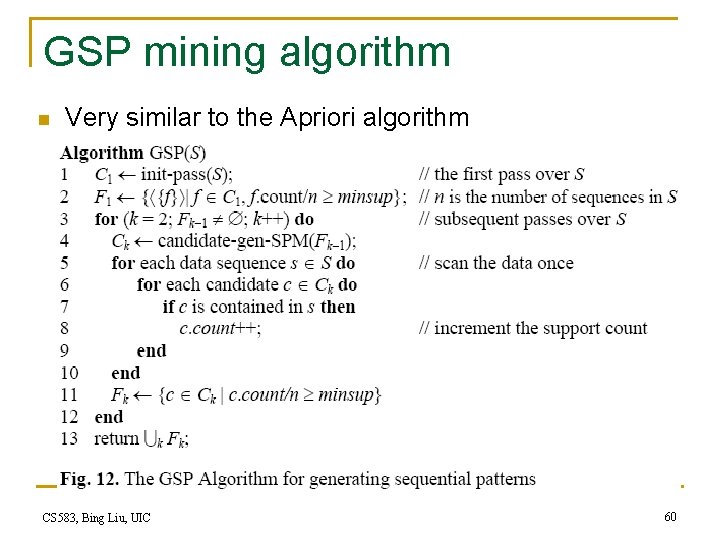
GSP mining algorithm n Very similar to the Apriori algorithm CS 583, Bing Liu, UIC 60
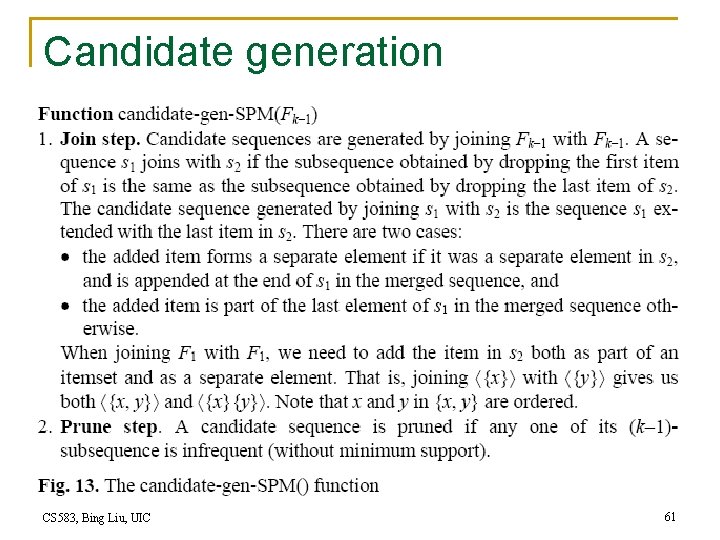
Candidate generation CS 583, Bing Liu, UIC 61
An example CS 583, Bing Liu, UIC 62
Road map n n n n Basic concepts of Association Rules Apriori algorithm Different data formats for mining Mining with multiple minimum supports Mining class association rules Sequential pattern mining Summary CS 583, Bing Liu, UIC 63
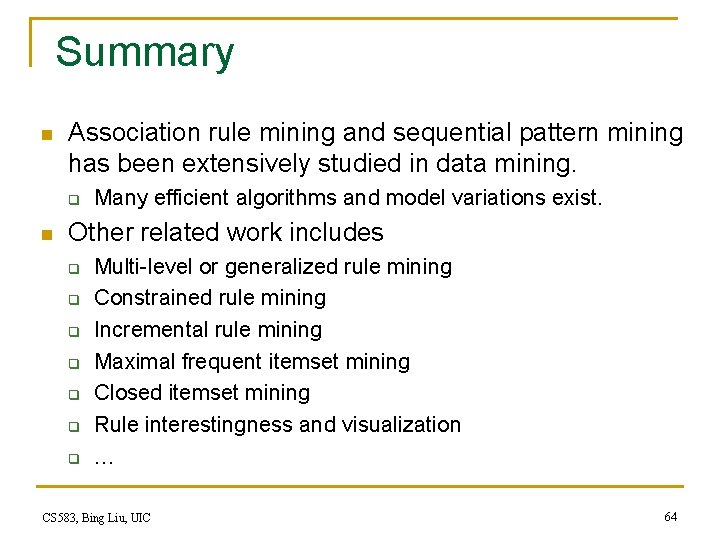
Summary n Association rule mining and sequential pattern mining has been extensively studied in data mining. q n Many efficient algorithms and model variations exist. Other related work includes q q q q Multi-level or generalized rule mining Constrained rule mining Incremental rule mining Maximal frequent itemset mining Closed itemset mining Rule interestingness and visualization … CS 583, Bing Liu, UIC 64