
Association Rule Mining Debapriyo Majumdar Data Mining Fall
Association Rule Mining Debapriyo Majumdar Data Mining – Fall 2014 Indian Statistical Institute Kolkata August 4 and 7, 2014
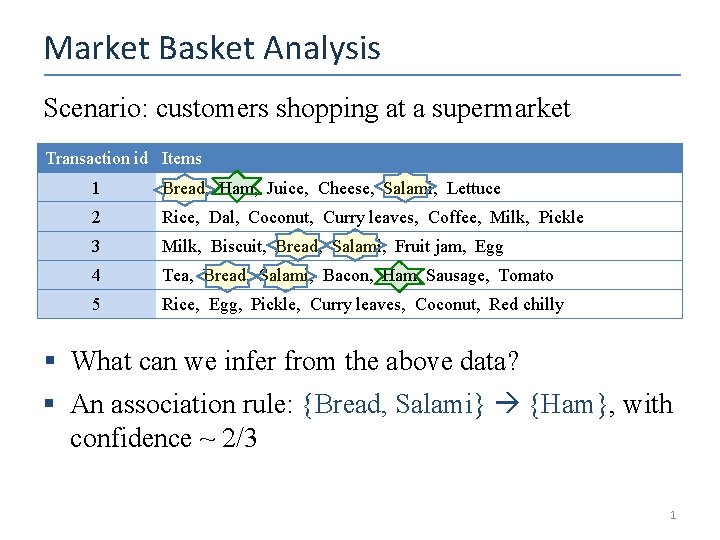
Market Basket Analysis Scenario: customers shopping at a supermarket Transaction id Items 1 Bread, Ham, Juice, Cheese, Salami, Lettuce 2 Rice, Dal, Coconut, Curry leaves, Coffee, Milk, Pickle 3 Milk, Biscuit, Bread, Salami, Fruit jam, Egg 4 Tea, Bread, Salami, Bacon, Ham, Sausage, Tomato 5 Rice, Egg, Pickle, Curry leaves, Coconut, Red chilly § What can we infer from the above data? § An association rule: {Bread, Salami} {Ham}, with confidence ~ 2/3 1
Applications § § Information driven marketing Catalog design Store layout Customer segmentation based on buying patterns § Several papers by Rakesh Agrawal and others in the 1990 s § Rakesh Agrawal and Ramakrishnan Srikant Fast Algorithms for Mining Association Rules The VLDB 1994 2
The Market-Basket Model § A (large) set of binary attributes, called items I = {i 1, …, in} e. g. milk, bread, the items sold at the market § A transaction T consists of a (small) subset of I e. g. the list of items (bill) bought by one customer at once § The database D is a (large) set of transactions D = {T 1, …, TN} 3
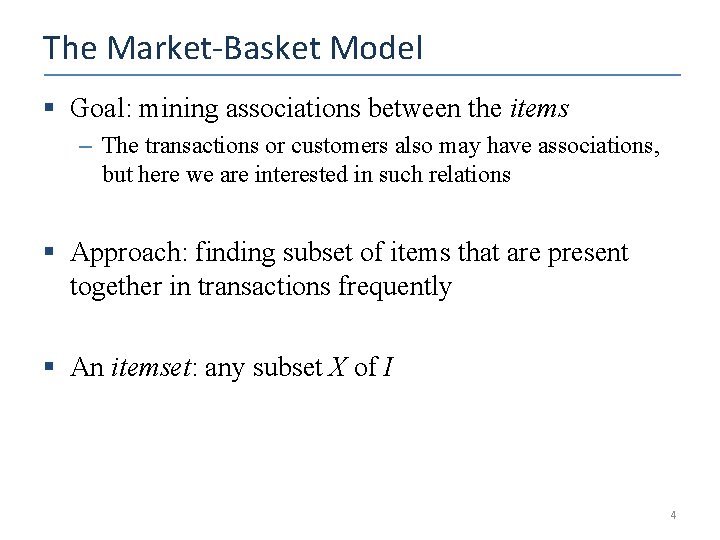
The Market-Basket Model § Goal: mining associations between the items – The transactions or customers also may have associations, but here we are interested in such relations § Approach: finding subset of items that are present together in transactions frequently § An itemset: any subset X of I 4
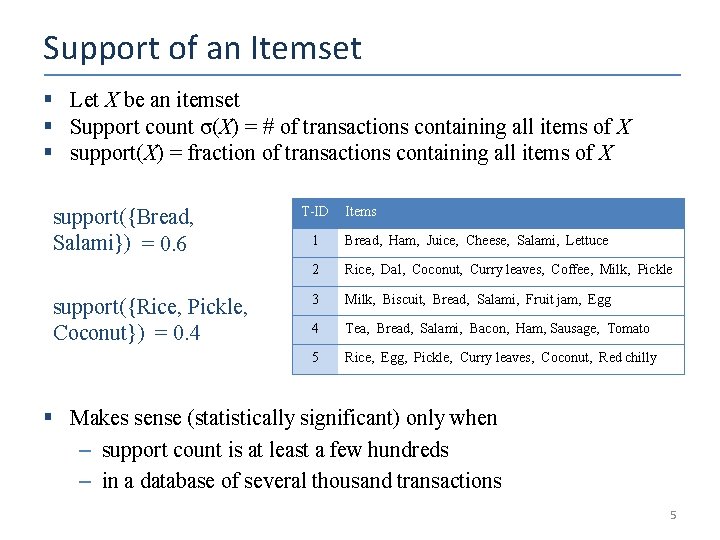
Support of an Itemset § Let X be an itemset § Support count σ(X) = # of transactions containing all items of X § support(X) = fraction of transactions containing all items of X support({Bread, Salami}) = 0. 6 support({Rice, Pickle, Coconut}) = 0. 4 T-ID Items 1 Bread, Ham, Juice, Cheese, Salami, Lettuce 2 Rice, Dal, Coconut, Curry leaves, Coffee, Milk, Pickle 3 Milk, Biscuit, Bread, Salami, Fruit jam, Egg 4 Tea, Bread, Salami, Bacon, Ham, Sausage, Tomato 5 Rice, Egg, Pickle, Curry leaves, Coconut, Red chilly § Makes sense (statistically significant) only when – support count is at least a few hundreds – in a database of several thousand transactions 5
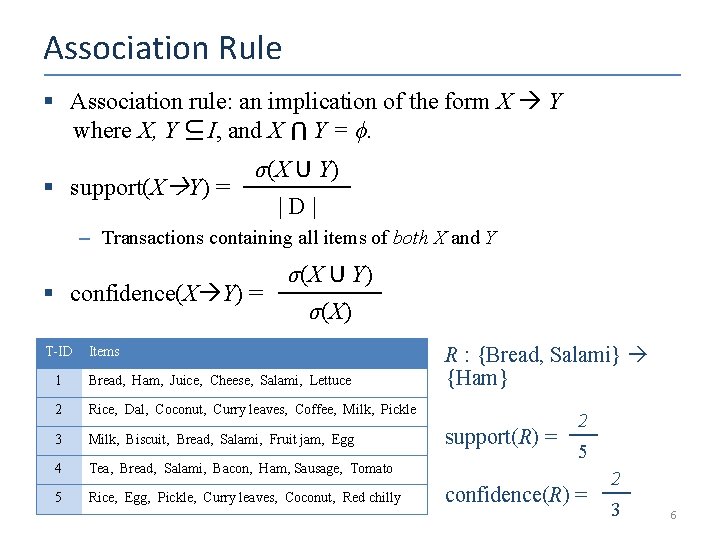
Association Rule § Association rule: an implication of the form X Y where X, Y I, and X Y = ϕ. U UI § support(X Y) = σ(X U Y) |D| – Transactions containing all items of both X and Y § confidence(X Y) = T-ID σ(X U Y) σ(X) Items 1 Bread, Ham, Juice, Cheese, Salami, Lettuce 2 Rice, Dal, Coconut, Curry leaves, Coffee, Milk, Pickle 3 Milk, Biscuit, Bread, Salami, Fruit jam, Egg 4 Tea, Bread, Salami, Bacon, Ham, Sausage, Tomato 5 Rice, Egg, Pickle, Curry leaves, Coconut, Red chilly R : {Bread, Salami} {Ham} support(R) = 2 5 confidence(R) = 2 3 6
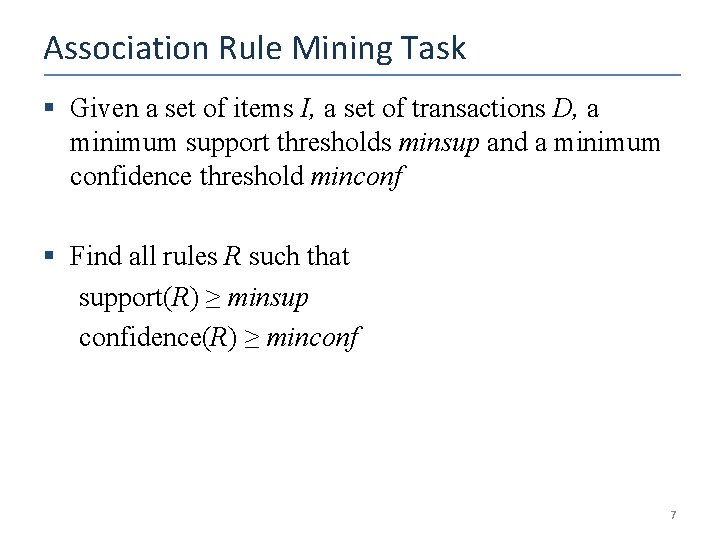
Association Rule Mining Task § Given a set of items I, a set of transactions D, a minimum support thresholds minsup and a minimum confidence threshold minconf § Find all rules R such that support(R) ≥ minsup confidence(R) ≥ minconf 7
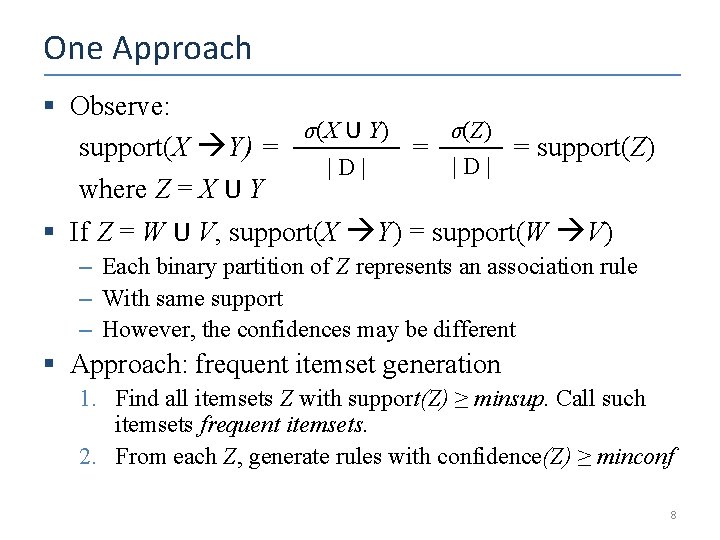
One Approach § Observe: σ(X U Y) σ(Z) support(X Y) = = = support(Z) |D| where Z = X U Y § If Z = W U V, support(X Y) = support(W V) – Each binary partition of Z represents an association rule – With same support – However, the confidences may be different § Approach: frequent itemset generation 1. Find all itemsets Z with support(Z) ≥ minsup. Call such itemsets frequent itemsets. 2. From each Z, generate rules with confidence(Z) ≥ minconf 8
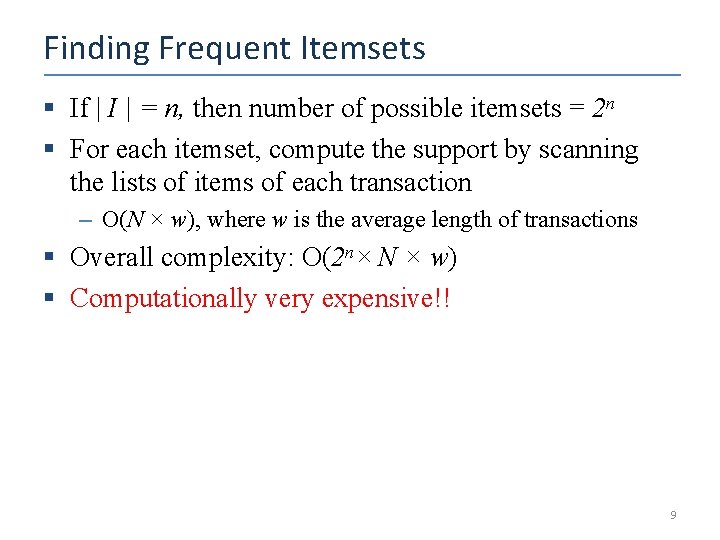
Finding Frequent Itemsets § If | I | = n, then number of possible itemsets = 2 n § For each itemset, compute the support by scanning the lists of items of each transaction – O(N × w), where w is the average length of transactions § Overall complexity: O(2 n× N × w) § Computationally very expensive!! 9
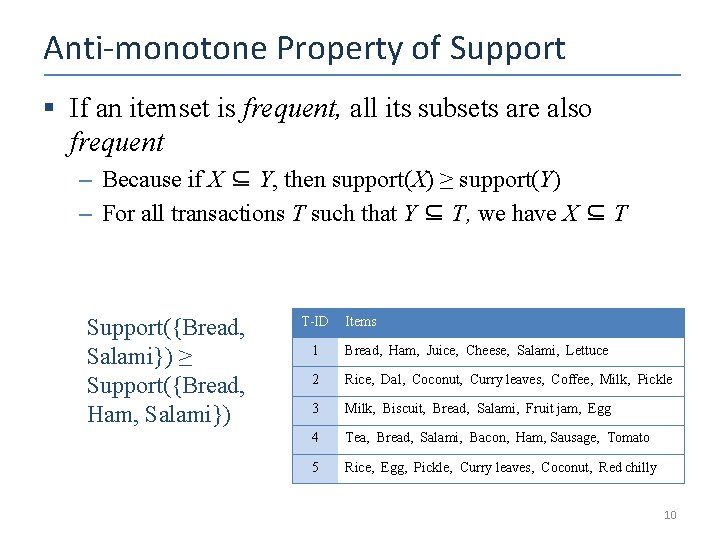
Anti-monotone Property of Support § If an itemset is frequent, all its subsets are also frequent – Because if X ⊆ Y, then support(X) ≥ support(Y) – For all transactions T such that Y ⊆ T, we have X ⊆ T Support({Bread, Salami}) ≥ Support({Bread, Ham, Salami}) T-ID Items 1 Bread, Ham, Juice, Cheese, Salami, Lettuce 2 Rice, Dal, Coconut, Curry leaves, Coffee, Milk, Pickle 3 Milk, Biscuit, Bread, Salami, Fruit jam, Egg 4 Tea, Bread, Salami, Bacon, Ham, Sausage, Tomato 5 Rice, Egg, Pickle, Curry leaves, Coconut, Red chilly 10
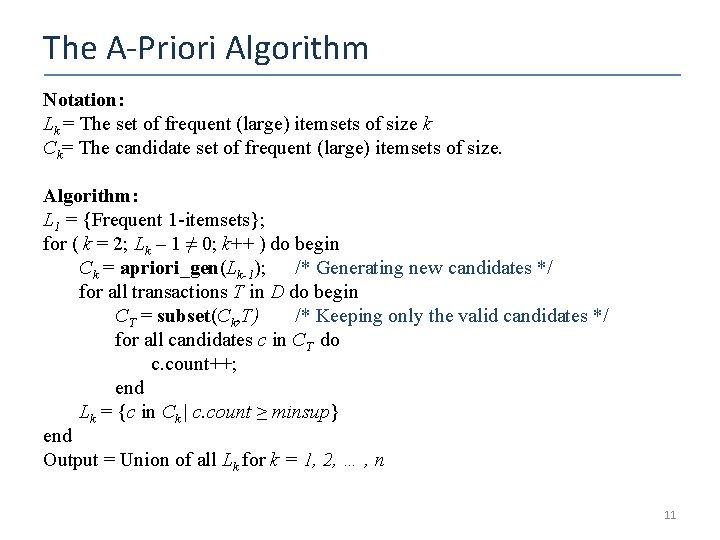
The A-Priori Algorithm Notation: Lk = The set of frequent (large) itemsets of size k Ck= The candidate set of frequent (large) itemsets of size. Algorithm: L 1 = {Frequent 1 -itemsets}; for ( k = 2; Lk – 1 ≠ 0; k++ ) do begin Ck = apriori_gen(Lk-1); /* Generating new candidates */ for all transactions T in D do begin CT = subset(Ck, T) /* Keeping only the valid candidates */ for all candidates c in CT do c. count++; end Lk = {c in Ck | c. count ≥ minsup} end Output = Union of all Lk for k = 1, 2, … , n 11
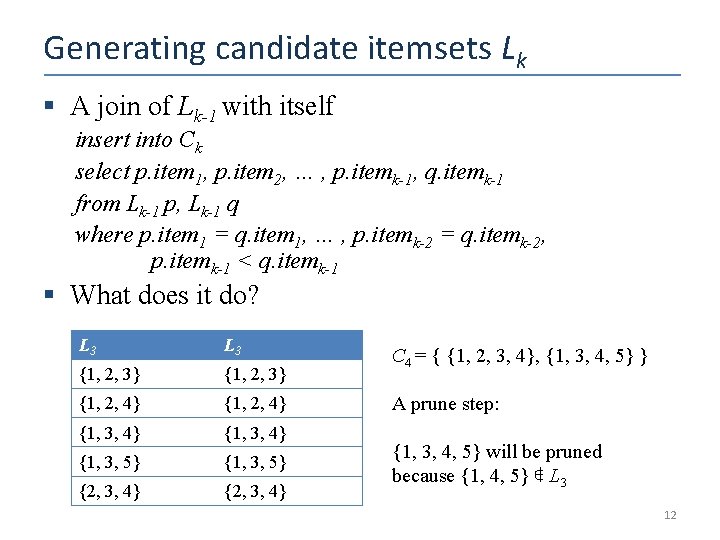
Generating candidate itemsets Lk § A join of Lk-1 with itself insert into Ck select p. item 1, p. item 2, … , p. itemk-1, q. itemk-1 from Lk-1 p, Lk-1 q where p. item 1 = q. item 1, … , p. itemk-2 = q. itemk-2, p. itemk-1 < q. itemk-1 § What does it do? L 3 {1, 2, 3} {1, 2, 4} {1, 3, 5} {2, 3, 4} C 4 = { {1, 2, 3, 4}, {1, 3, 4, 5} } A prune step: {1, 3, 4, 5} will be pruned because {1, 4, 5} ∉ L 3 12
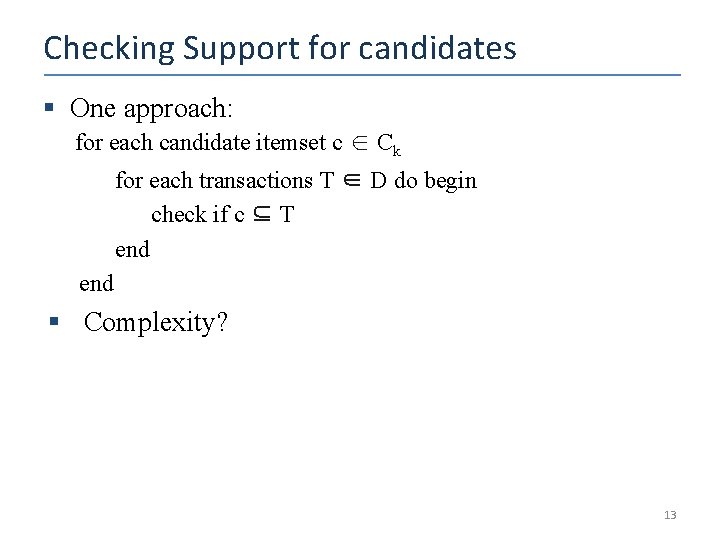
Checking Support for candidates § One approach: for each candidate itemset c ∈ Ck for each transactions T ∈ D do begin check if c ⊆ T end § Complexity? 13
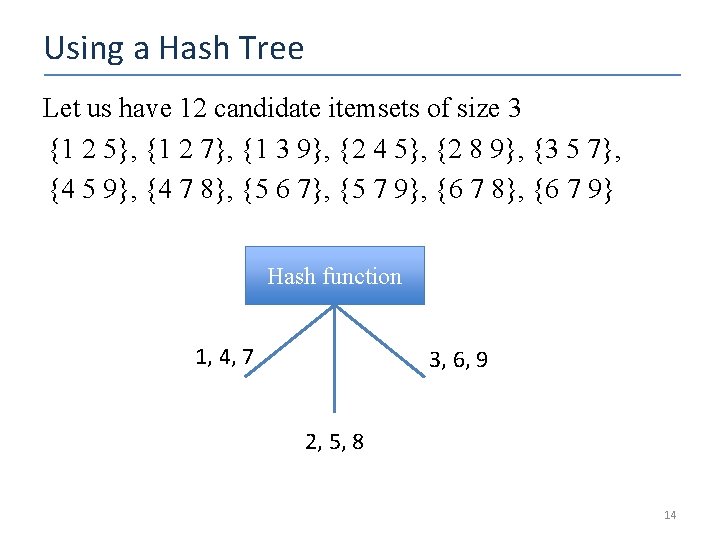
Using a Hash Tree Let us have 12 candidate itemsets of size 3 {1 2 5}, {1 2 7}, {1 3 9}, {2 4 5}, {2 8 9}, {3 5 7}, {4 5 9}, {4 7 8}, {5 6 7}, {5 7 9}, {6 7 8}, {6 7 9} Hash function 1, 4, 7 3, 6, 9 2, 5, 8 14
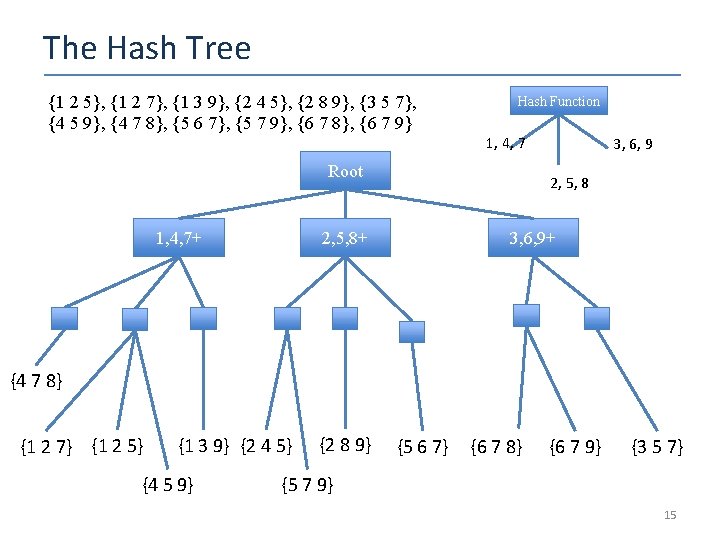
The Hash Tree {1 2 5}, {1 2 7}, {1 3 9}, {2 4 5}, {2 8 9}, {3 5 7}, {4 5 9}, {4 7 8}, {5 6 7}, {5 7 9}, {6 7 8}, {6 7 9} Hash Function 1, 4, 7 Root 1, 4, 7+ 3, 6, 9 2, 5, 8+ 3, 6, 9+ {4 7 8} {1 2 7} {1 2 5} {1 3 9} {2 4 5} {4 5 9} {2 8 9} {5 6 7} {6 7 8} {6 7 9} {3 5 7} {5 7 9} 15
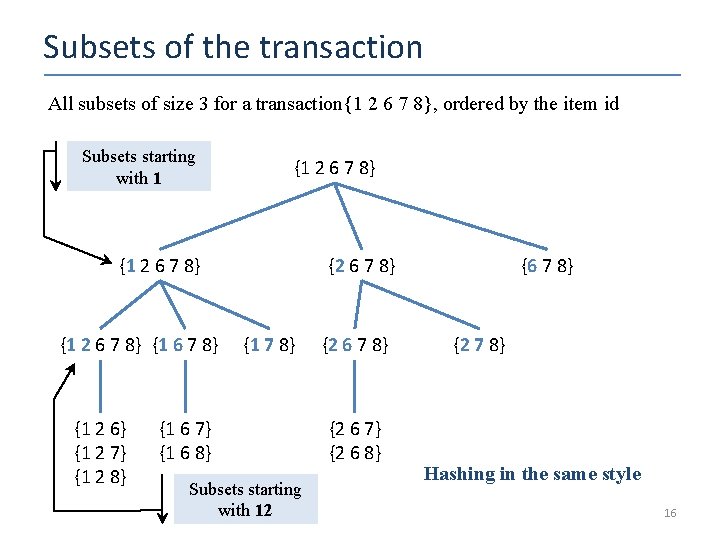
Subsets of the transaction All subsets of size 3 for a transaction{1 2 6 7 8}, ordered by the item id Subsets starting with 1 {1 2 6 7 8} {1 2 6} {1 2 7} {1 2 8} {2 6 7 8} {1 6 7} {1 6 8} Subsets starting with 12 {2 6 7 8} {2 6 7} {2 6 8} {6 7 8} {2 7 8} Hashing in the same style 16
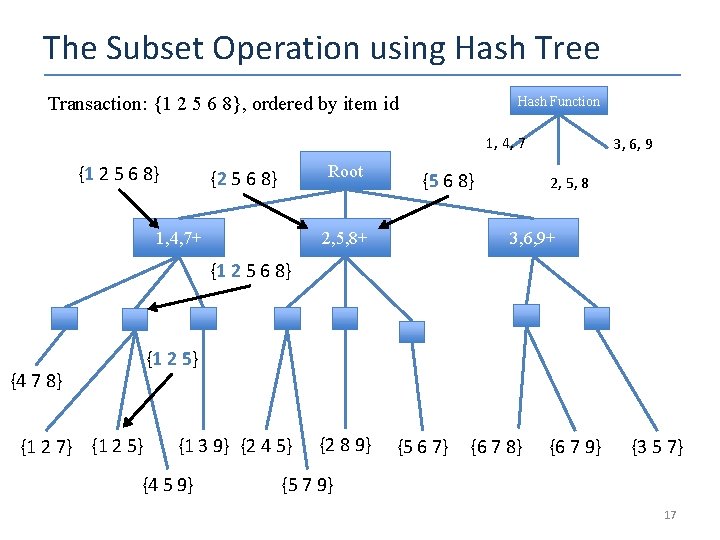
The Subset Operation using Hash Tree Transaction: {1 2 5 6 8}, ordered by item id Hash Function 1, 4, 7 {1 2 5 6 8} Root {2 5 6 8} 1, 4, 7+ {5 6 8} 2, 5, 8+ 3, 6, 9 2, 5, 8 3, 6, 9+ {1 2 5 6 8} {1 2 5} {4 7 8} {1 2 7} {1 2 5} {1 3 9} {2 4 5} {4 5 9} {2 8 9} {5 6 7} {6 7 8} {6 7 9} {3 5 7} {5 7 9} 17
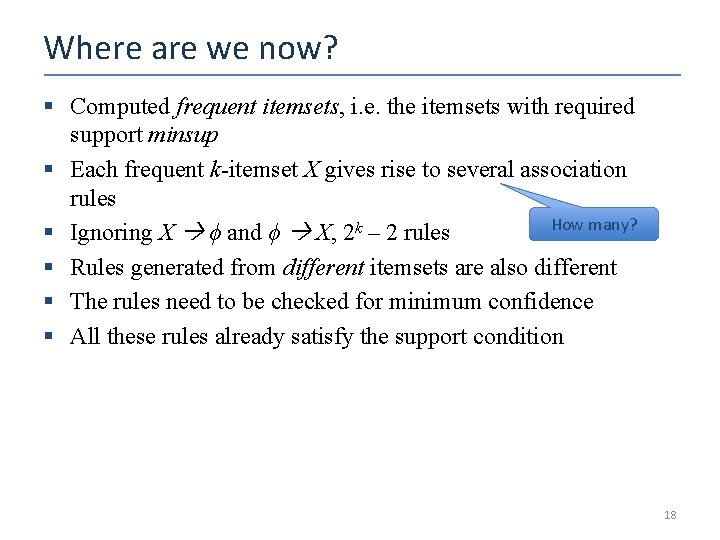
Where are we now? § Computed frequent itemsets, i. e. the itemsets with required support minsup § Each frequent k-itemset X gives rise to several association rules How many? § Ignoring X ϕ and ϕ X, 2 k – 2 rules § Rules generated from different itemsets are also different § The rules need to be checked for minimum confidence § All these rules already satisfy the support condition 18
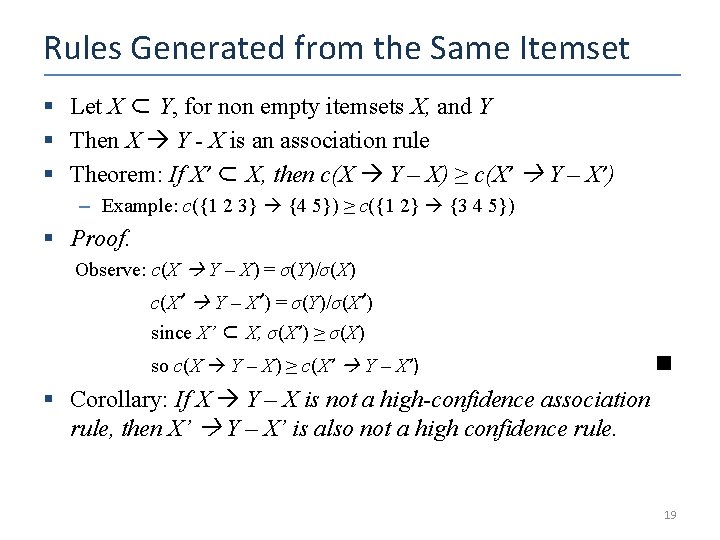
Rules Generated from the Same Itemset § Let X ⊂ Y, for non empty itemsets X, and Y § Then X Y - X is an association rule § Theorem: If X’ ⊂ X, then c(X Y – X) ≥ c(X’ Y – X’) – Example: c({1 2 3} {4 5}) ≥ c({1 2} {3 4 5}) § Proof. Observe: c(X Y – X) = σ(Y)/σ(X) c(X’ Y – X’) = σ(Y)/σ(X’) since X’ ⊂ X, σ(X’) ≥ σ(X) so c(X Y – X) ≥ c(X’ Y – X’) § Corollary: If X Y – X is not a high-confidence association rule, then X’ Y – X’ is also not a high confidence rule. 19
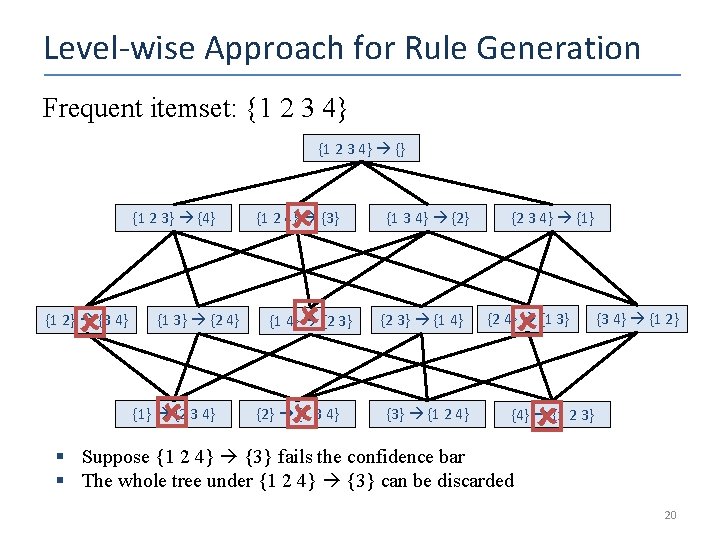
Level-wise Approach for Rule Generation Frequent itemset: {1 2 3 4} {} {1 2 3} {4} {1 2} {3 4} {1 3} {2 4} {1} {2 3 4} {1 2 4} {3} {1 4} {2 3} {2} {1 3 4} {2} {2 3} {1 4} {3} {1 2 4} {2 3 4} {1} {2 4} {1 3} {3 4} {1 2} {4} {1 2 3} § Suppose {1 2 4} {3} fails the confidence bar § The whole tree under {1 2 4} {3} can be discarded 20
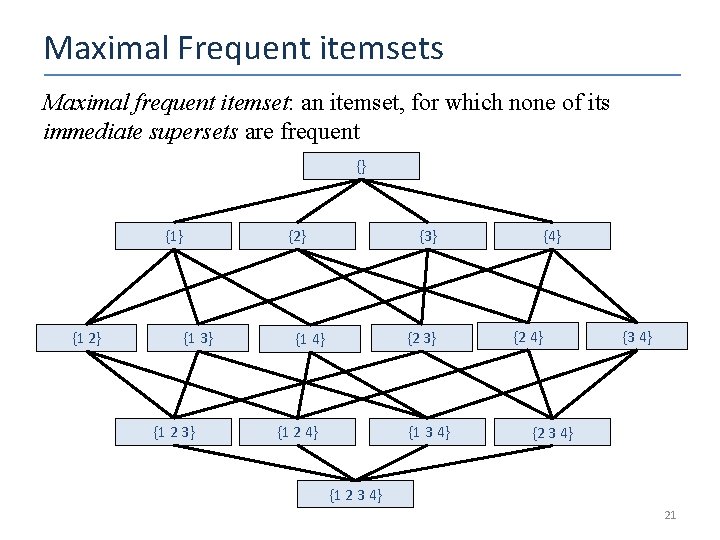
Maximal Frequent itemsets Maximal frequent itemset: an itemset, for which none of its immediate supersets are frequent {} {2} {1 3} {1 2 3} {4} {3} {2 3} {1 4} {1 2 4} {1 3 4} {2 4} {3 4} {2 3 4} {1 2 3 4} 21
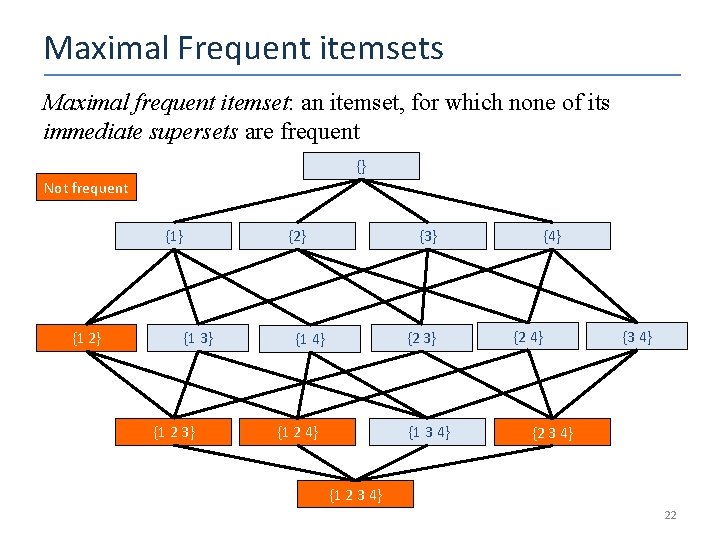
Maximal Frequent itemsets Maximal frequent itemset: an itemset, for which none of its immediate supersets are frequent {} Not frequent {2} {1 3} {1 2 3} {4} {3} {2 3} {1 4} {1 2 4} {1 3 4} {2 4} {3 4} {2 3 4} {1 2 3 4} 22
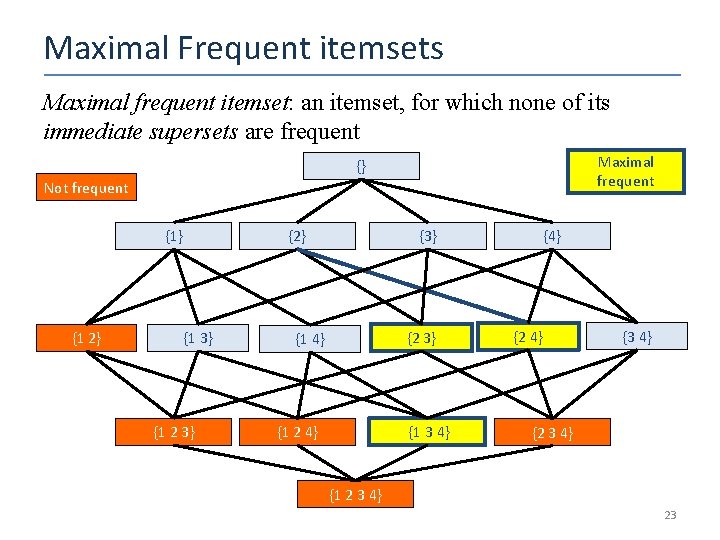
Maximal Frequent itemsets Maximal frequent itemset: an itemset, for which none of its immediate supersets are frequent Maximal frequent {} Not frequent {2} {1 3} {1 2 3} {4} {3} {2 3} {1 4} {1 2 4} {1 3 4} {2 4} {3 4} {2 3 4} {1 2 3 4} 23
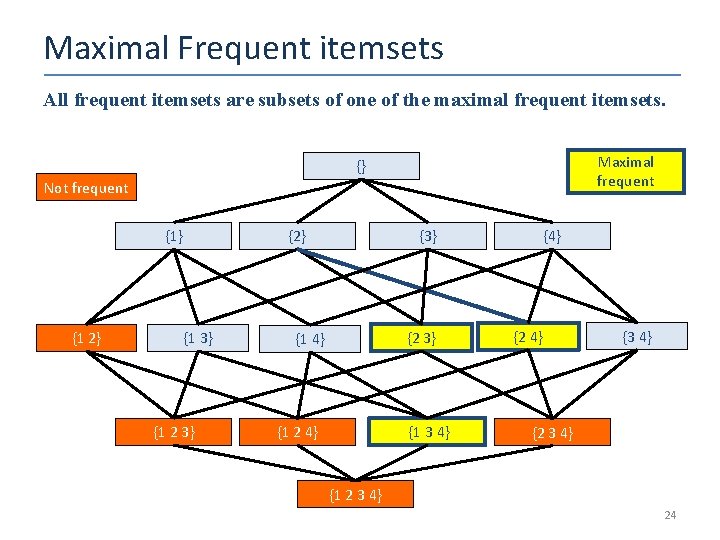
Maximal Frequent itemsets All frequent itemsets are subsets of one of the maximal frequent itemsets. Maximal frequent {} Not frequent {2} {1 3} {1 2 3} {4} {3} {2 3} {1 4} {1 2 4} {1 3 4} {2 4} {3 4} {2 3 4} {1 2 3 4} 24
Maximal Frequent Itemsets § Valuable compact representation of the frequent itemsets But § Do not contain the support information of the subsets – Says all supersets have lesser support, but does not say if any subset also has the same support 25
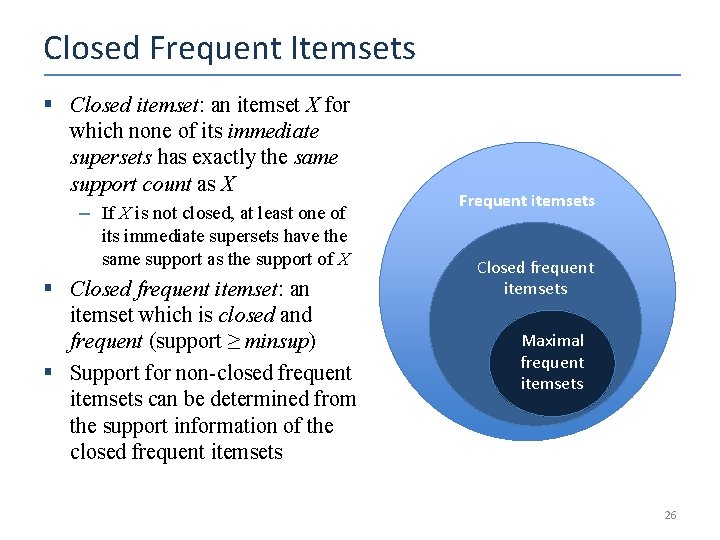
Closed Frequent Itemsets § Closed itemset: an itemset X for which none of its immediate supersets has exactly the same support count as X – If X is not closed, at least one of its immediate supersets have the same support as the support of X § Closed frequent itemset: an itemset which is closed and frequent (support ≥ minsup) § Support for non-closed frequent itemsets can be determined from the support information of the closed frequent itemsets Frequent itemsets Closed frequent itemsets Maximal frequent itemsets 26
Evaluation of Association Rules § Even from a small dataset a very large number of rules can be generated – For example, as support and confidence conditions are relaxed, number of rules explode § Interestingness measure for patterns / rules is required § Objective interestingness measure: a measure that uses statistics derived from the data – Support, confidence, correlation, … – Domain independent – Requires minimal human involvement 27
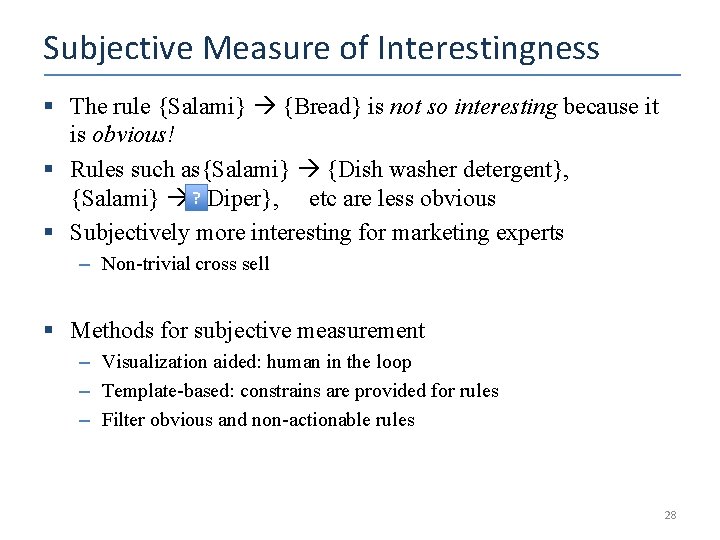
Subjective Measure of Interestingness § The rule {Salami} {Bread} is not so interesting because it is obvious! § Rules such as{Salami} {Dish washer detergent}, {Salami} ? {Diper}, etc are less obvious § Subjectively more interesting for marketing experts – Non-trivial cross sell § Methods for subjective measurement – Visualization aided: human in the loop – Template-based: constrains are provided for rules – Filter obvious and non-actionable rules 28
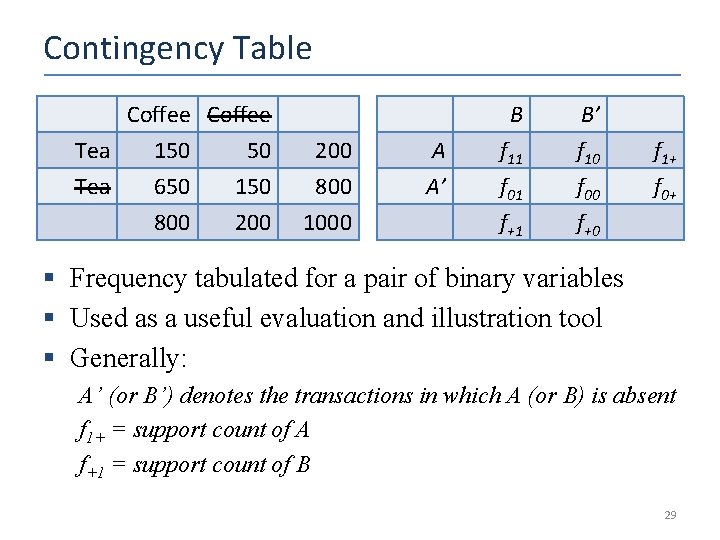
Contingency Table Coffee Tea 150 50 Tea 650 150 800 200 B 200 800 1000 A A’ f 11 f 01 f+1 B’ f 10 f 00 f+0 f 1+ f 0+ § Frequency tabulated for a pair of binary variables § Used as a useful evaluation and illustration tool § Generally: A’ (or B’) denotes the transactions in which A (or B) is absent f 1+ = support count of A f+1 = support count of B 29
Limitations of Support & Confidence § Tuning the support threshold is tricky § Low threshold – Too many rules generated! § High threshold – Potentially interesting patterns may fall below the support threshold 30
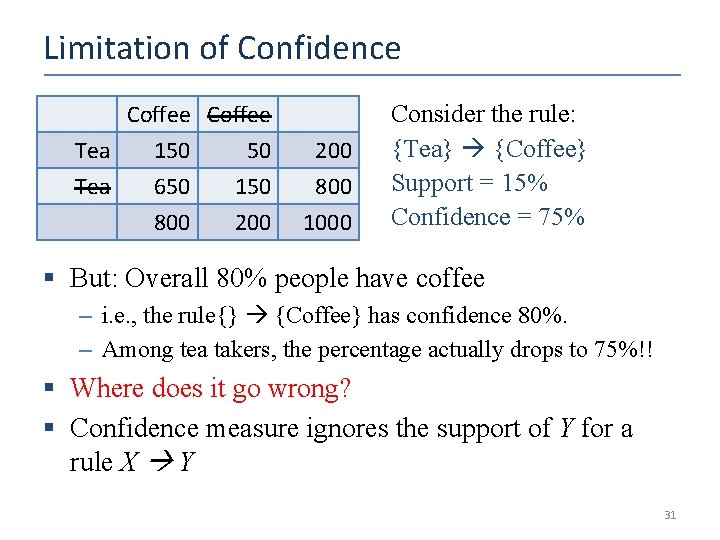
Limitation of Confidence Coffee Tea 150 50 Tea 650 150 800 200 800 1000 Consider the rule: {Tea} {Coffee} Support = 15% Confidence = 75% § But: Overall 80% people have coffee – i. e. , the rule{} {Coffee} has confidence 80%. – Among tea takers, the percentage actually drops to 75%!! § Where does it go wrong? § Confidence measure ignores the support of Y for a rule X Y 31
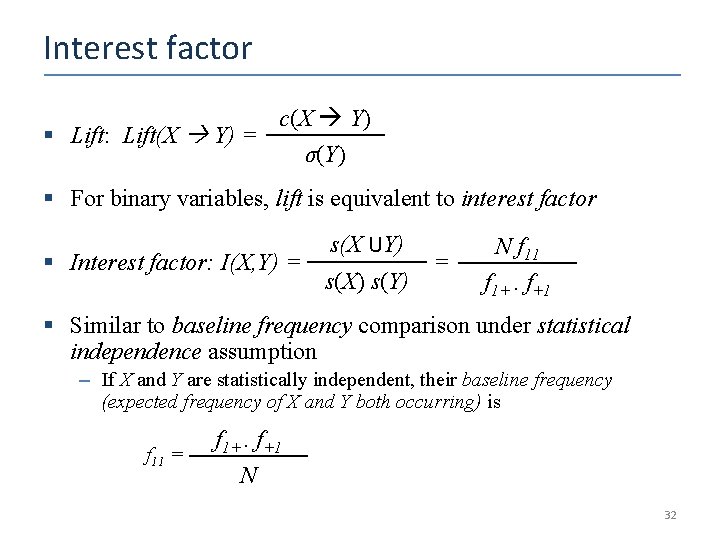
Interest factor § Lift: Lift(X Y) = c(X Y) σ(Y) § For binary variables, lift is equivalent to interest factor § Interest factor: I(X, Y) = s(X UY) s(X) s(Y) = N f 11 f 1+. f+1 § Similar to baseline frequency comparison under statistical independence assumption – If X and Y are statistically independent, their baseline frequency (expected frequency of X and Y both occurring) is f 11 = f 1+. f+1 N 32
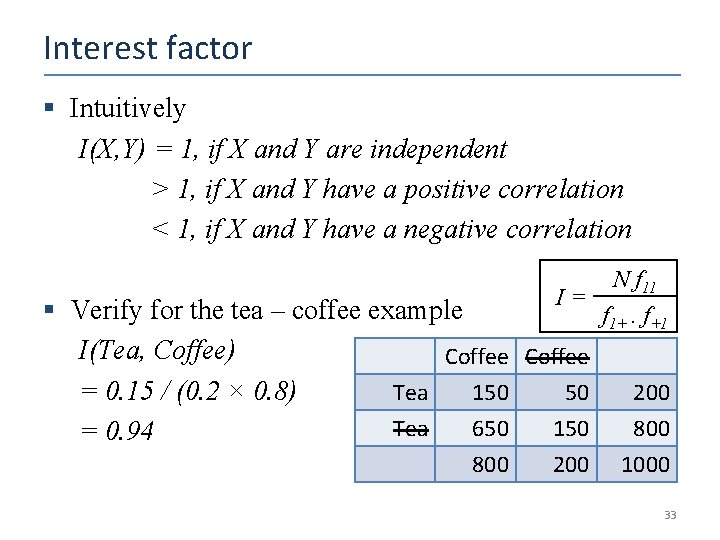
Interest factor § Intuitively I(X, Y) = 1, if X and Y are independent > 1, if X and Y have a positive correlation < 1, if X and Y have a negative correlation N f 11 I= f 1+. f+1 § Verify for the tea – coffee example I(Tea, Coffee) Coffee = 0. 15 / (0. 2 × 0. 8) Tea 150 50 Tea 650 150 = 0. 94 800 200 800 1000 33
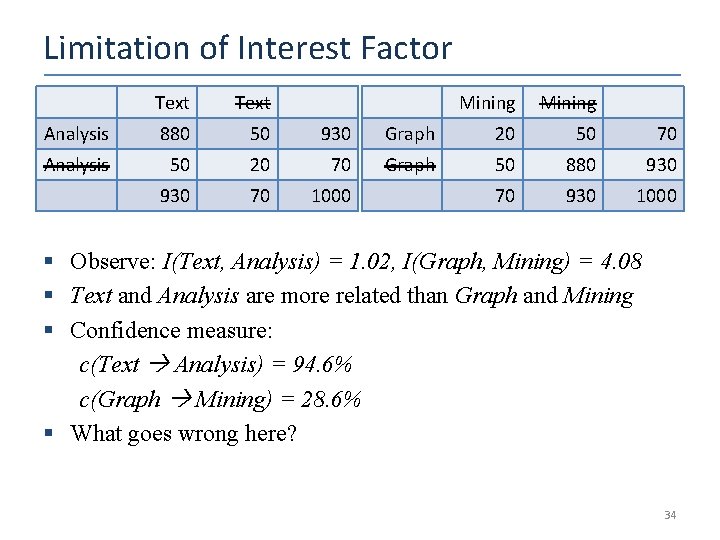
Limitation of Interest Factor Text Analysis 880 50 930 Analysis 50 20 70 930 70 1000 Mining Graph 20 50 70 Graph 50 880 930 70 930 1000 § Observe: I(Text, Analysis) = 1. 02, I(Graph, Mining) = 4. 08 § Text and Analysis are more related than Graph and Mining § Confidence measure: c(Text Analysis) = 94. 6% c(Graph Mining) = 28. 6% § What goes wrong here? 34
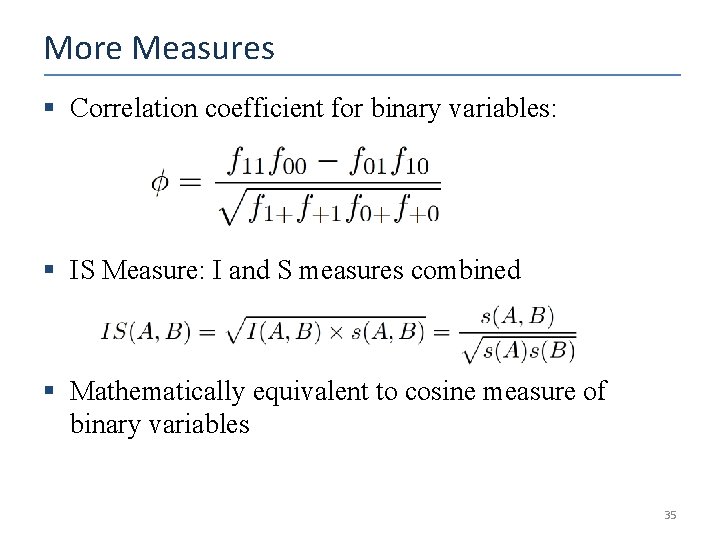
More Measures § Correlation coefficient for binary variables: § IS Measure: I and S measures combined § Mathematically equivalent to cosine measure of binary variables 35
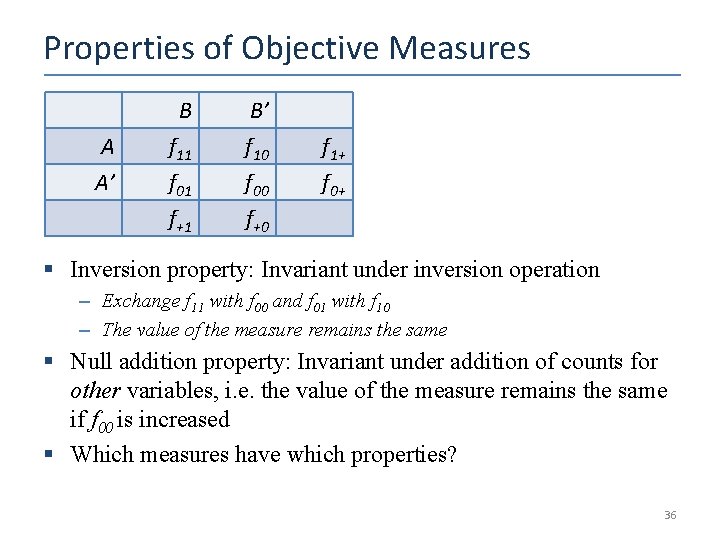
Properties of Objective Measures B A A’ f 11 f 01 f+1 B’ f 10 f 00 f+0 f 1+ f 0+ § Inversion property: Invariant under inversion operation – Exchange f 11 with f 00 and f 01 with f 10 – The value of the measure remains the same § Null addition property: Invariant under addition of counts for other variables, i. e. the value of the measure remains the same if f 00 is increased § Which measures have which properties? 36
References § Rakesh Agrawal and Ramakrishnan Srikant Fast Algorithms for Mining Association Rules VLDB 1994 § Introduction to Data Mining, by Tan, Steinbach, Kumar – The webpage: http: //www-users. cs. umn. edu/~kumar/dmbook/index. php – Chapter 6 is available online: http: //wwwusers. cs. umn. edu/~kumar/dmbook/ch 6. pdf 37
- Slides: 38