
ASSOCIATION BETWEEN INTERVALRATIO VARIABLES Scattergrams Allow quick identification

ASSOCIATION BETWEEN INTERVAL-RATIO VARIABLES
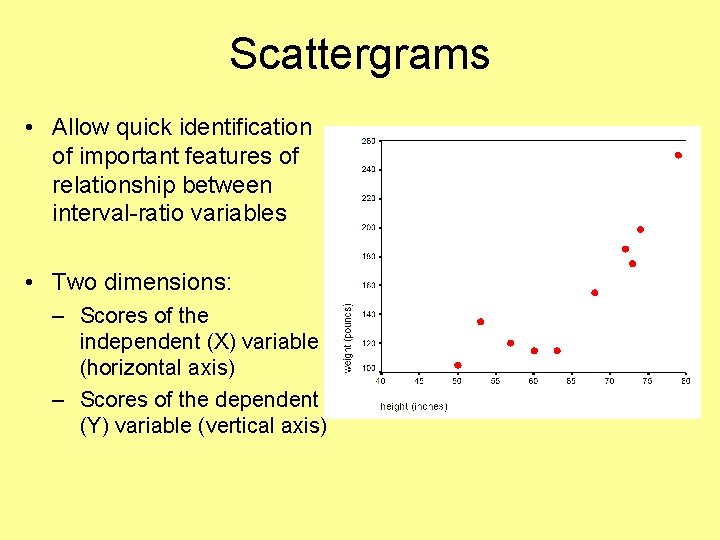
Scattergrams • Allow quick identification of important features of relationship between interval-ratio variables • Two dimensions: – Scores of the independent (X) variable (horizontal axis) – Scores of the dependent (Y) variable (vertical axis)
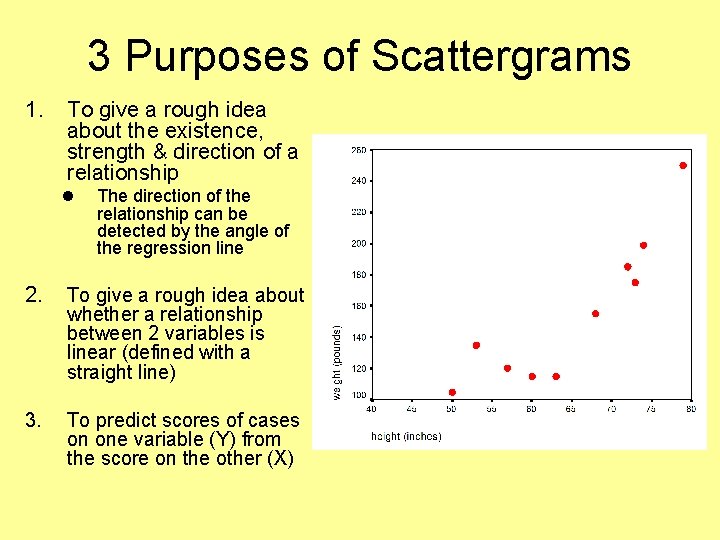
3 Purposes of Scattergrams 1. To give a rough idea about the existence, strength & direction of a relationship l The direction of the relationship can be detected by the angle of the regression line 2. To give a rough idea about whether a relationship between 2 variables is linear (defined with a straight line) 3. To predict scores of cases on one variable (Y) from the score on the other (X)

• IV and DV? • What is the direction of this relationship?
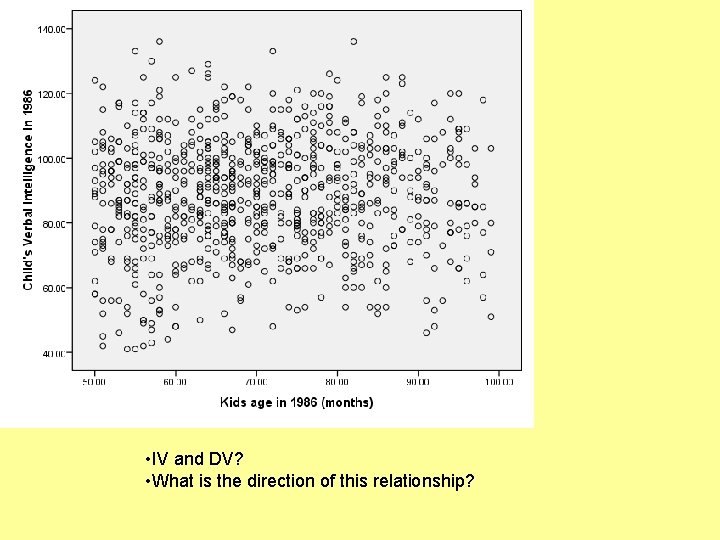
• IV and DV? • What is the direction of this relationship?
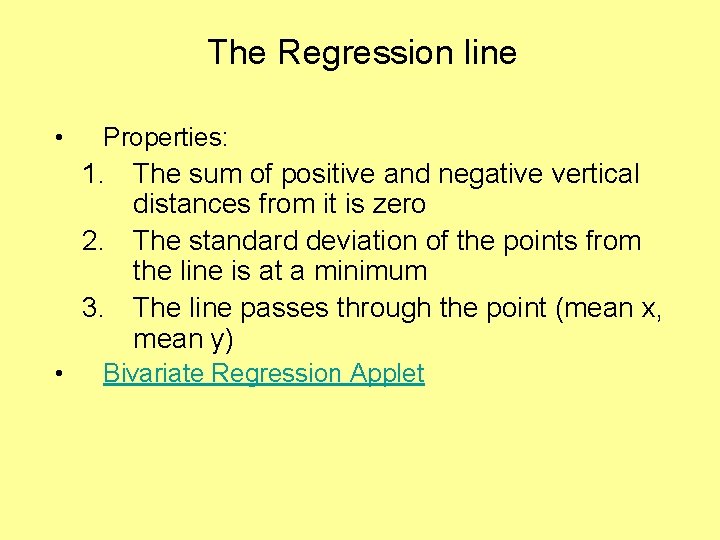
The Regression line • Properties: 1. The sum of positive and negative vertical distances from it is zero 2. The standard deviation of the points from the line is at a minimum 3. The line passes through the point (mean x, mean y) • Bivariate Regression Applet
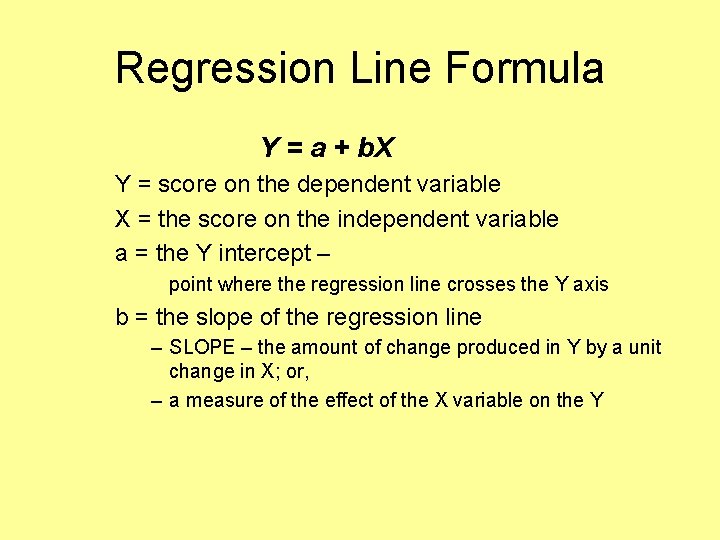
Regression Line Formula Y = a + b. X Y = score on the dependent variable X = the score on the independent variable a = the Y intercept – point where the regression line crosses the Y axis b = the slope of the regression line – SLOPE – the amount of change produced in Y by a unit change in X; or, – a measure of the effect of the X variable on the Y
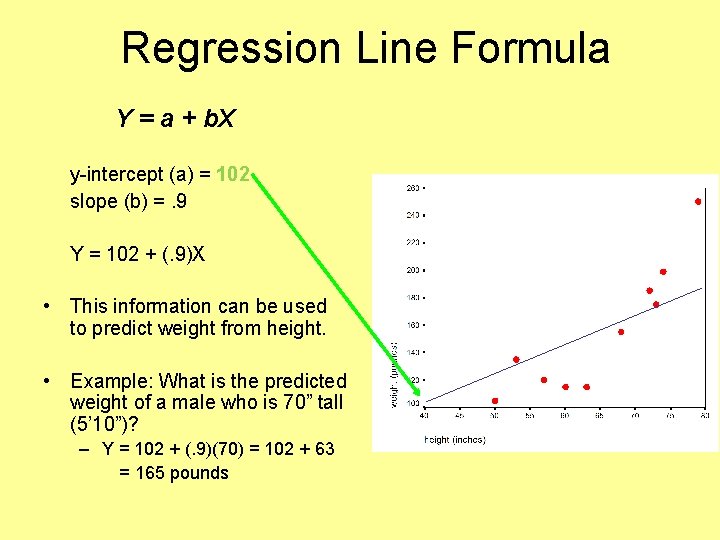
Regression Line Formula Y = a + b. X y-intercept (a) = 102 slope (b) =. 9 Y = 102 + (. 9)X • This information can be used to predict weight from height. • Example: What is the predicted weight of a male who is 70” tall (5’ 10”)? – Y = 102 + (. 9)(70) = 102 + 63 = 165 pounds
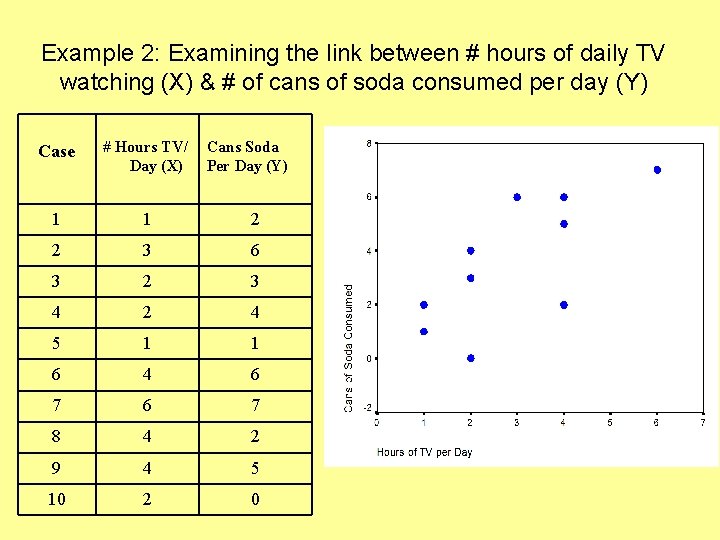
Example 2: Examining the link between # hours of daily TV watching (X) & # of cans of soda consumed per day (Y) Case # Hours TV/ Day (X) Cans Soda Per Day (Y) 1 1 2 2 3 6 3 2 3 4 2 4 5 1 1 6 4 6 7 8 4 2 9 4 5 10 2 0
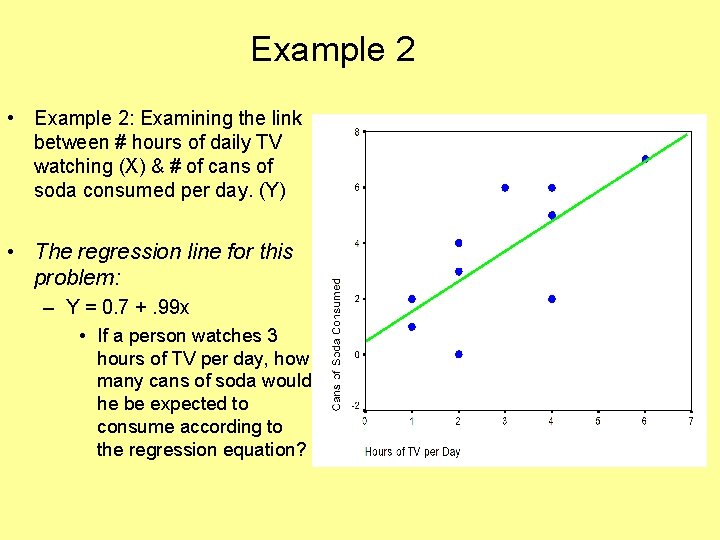
Example 2 • Example 2: Examining the link between # hours of daily TV watching (X) & # of cans of soda consumed per day. (Y) • The regression line for this problem: – Y = 0. 7 +. 99 x • If a person watches 3 hours of TV per day, how many cans of soda would he be expected to consume according to the regression equation?
The Slope (b) – A Strength & A Weakness – We know that b indicates the change in Y for a unit change in X, but b is not really a good measure of strength – Weakness – It is unbounded (can be >1 or <-1) making it hard to interpret • The size of b is influenced by the scale that each variable is measured on
Pearson’s r Correlation Coefficient • By contrast, Pearson’s r is bounded – a value of 0. 0 indicates no linear relationship and a value of +/-1. 00 indicates a perfect linear relationship
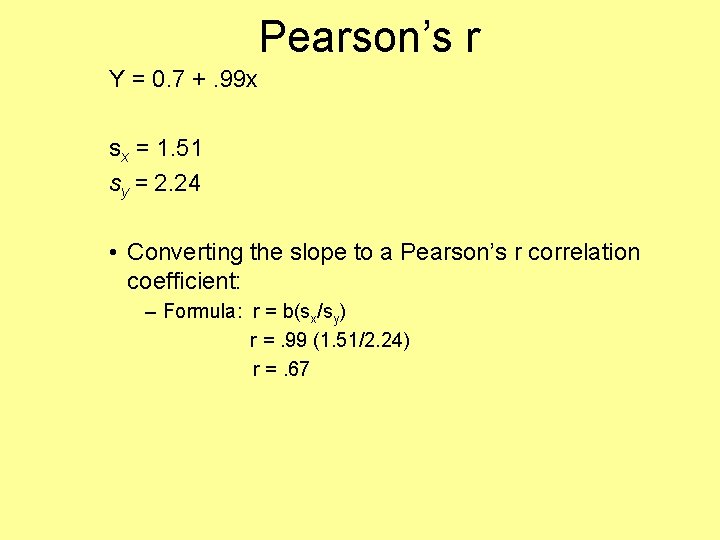
Pearson’s r Y = 0. 7 +. 99 x sx = 1. 51 sy = 2. 24 • Converting the slope to a Pearson’s r correlation coefficient: – Formula: r = b(sx/sy) r =. 99 (1. 51/2. 24) r =. 67
The Coefficient of Determination • The interpretation of Pearson’s r (like Cramer’s V) is not straightforward – What is a “strong” or “weak” correlation? » Subjective • The coefficient of determination (r 2) is a more direct way to interpret the association between 2 variables • r 2 represents the amount of variation in Y explained by X • You can interpret r 2 with PRE logic: 1. predict Y while ignoring info. supplied by X 2. then account for X when predicting Y
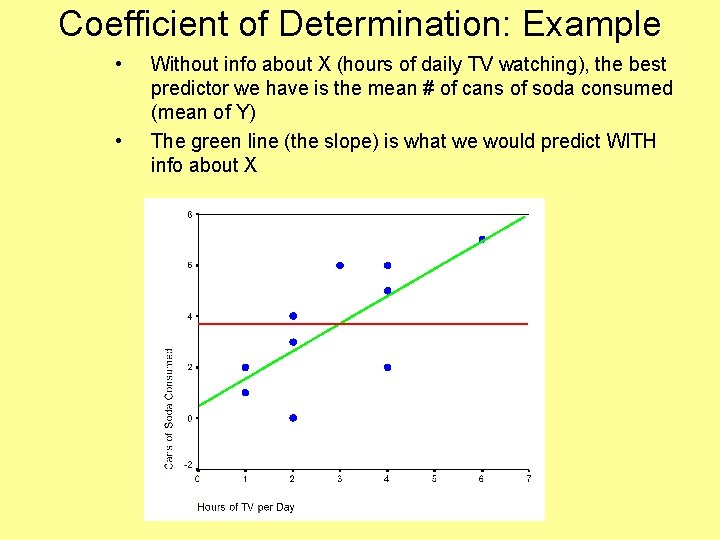
Coefficient of Determination: Example • • Without info about X (hours of daily TV watching), the best predictor we have is the mean # of cans of soda consumed (mean of Y) The green line (the slope) is what we would predict WITH info about X
Coefficient of Determination • Conceptually, the formula for r 2 is: r 2 = Explained variation Total variation “The proportion of the total variation in Y that is attributable or explained by X. ” • The variation not explained by r 2 is called the unexplained variation – Usually attributed to measurement error, random chance, or some combination of other variables
Coefficient of Determination – Interpreting the meaning of the coefficient of determination in the example: • Squaring Pearson’s r (. 67) gives us an r 2 of. 45 • Interpretation: – The # of hours of daily TV watching (X) explains 45% of the total variation in soda consumed (Y)
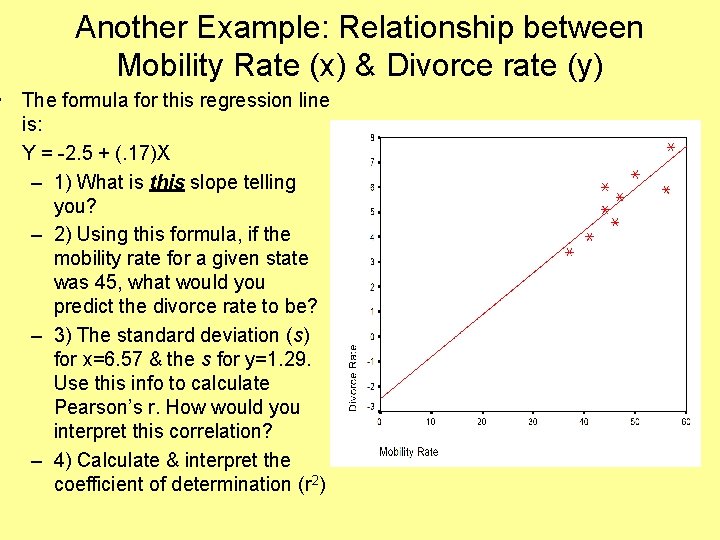
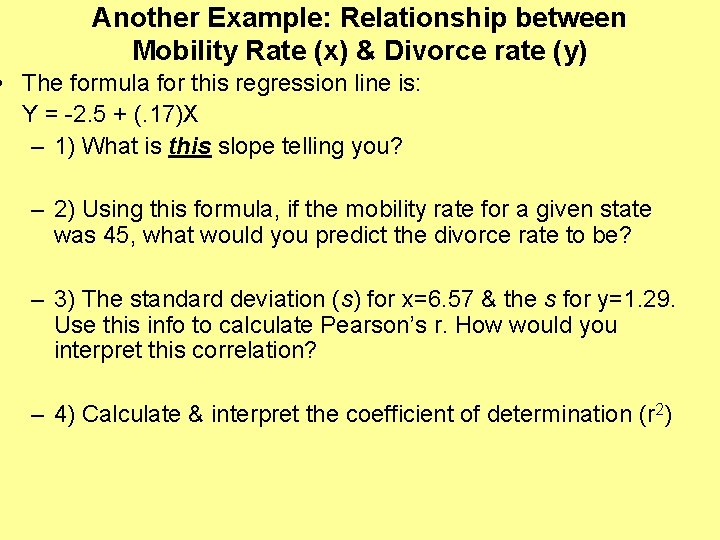
Another Example: Relationship between Mobility Rate (x) & Divorce rate (y) • The formula for this regression line is: Y = -2. 5 + (. 17)X – 1) What is this slope telling you? – 2) Using this formula, if the mobility rate for a given state was 45, what would you predict the divorce rate to be? – 3) The standard deviation (s) for x=6. 57 & the s for y=1. 29. Use this info to calculate Pearson’s r. How would you interpret this correlation? – 4) Calculate & interpret the coefficient of determination (r 2)
Another Example: Relationship between Mobility Rate (x) & Divorce rate (y) • The formula for this regression line is: Y = -2. 5 + (. 17)X – 1) What is this slope telling you? – 2) Using this formula, if the mobility rate for a given state was 45, what would you predict the divorce rate to be? – 3) The standard deviation (s) for x=6. 57 & the s for y=1. 29. Use this info to calculate Pearson’s r. How would you interpret this correlation? – 4) Calculate & interpret the coefficient of determination (r 2)
Regression Output • Scatterplot – Graphs Legacy Simple Scatter • Regression – Analyze Regression Linear • Example: How much you work predicts how much time you have to relax – X = Hours worked in past week – Y = Hours relaxed in past week
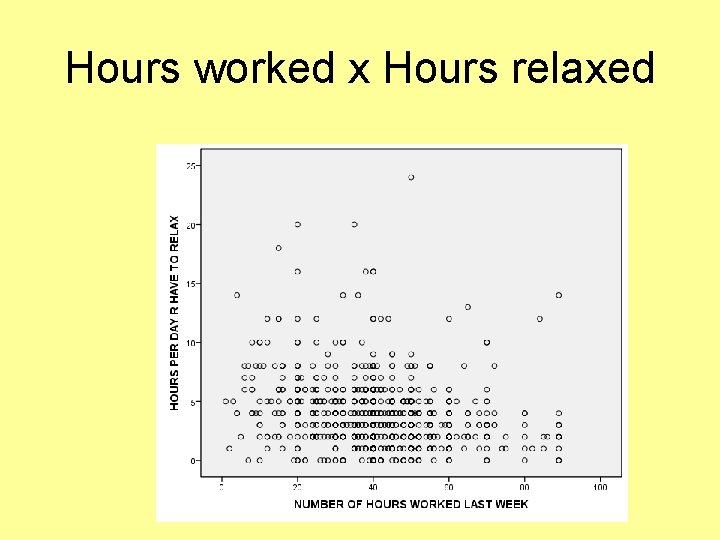
Hours worked x Hours relaxed
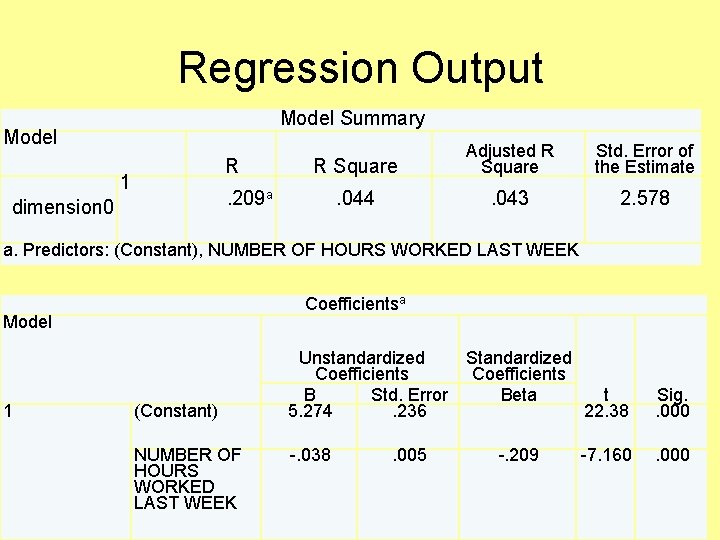
Regression Output Model Summary Model R 1 R Square Adjusted R Square Std. Error of the Estimate . 044 . 043 2. 578 . 209 a dimension 0 a. Predictors: (Constant), NUMBER OF HOURS WORKED LAST WEEK Coefficientsa Model 1 (Constant) NUMBER OF HOURS WORKED LAST WEEK Unstandardized Coefficients B Std. Error 5. 274. 236 -. 038 . 005 Standardized Coefficients Beta -. 209 t 22. 38 Sig. . 000 -7. 160 . 000
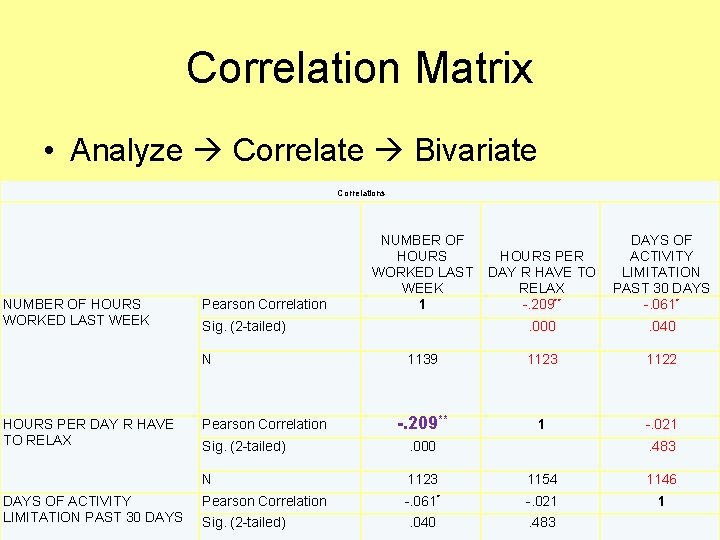
Correlation Matrix • Analyze Correlate Bivariate Correlations NUMBER OF HOURS WORKED LAST WEEK Pearson Correlation DAYS OF ACTIVITY LIMITATION PAST 30 DAYS HOURS PER DAY R HAVE TO RELAX -. 209** DAYS OF ACTIVITY LIMITATION PAST 30 DAYS -. 061* . 000 . 040 1139 1123 1122 -. 209** 1 -. 021 Sig. (2 -tailed) N HOURS PER DAY R HAVE TO RELAX NUMBER OF HOURS WORKED LAST WEEK 1 Pearson Correlation Sig. (2 -tailed) . 000 . 483 N 1123 1154 1146 Pearson Correlation -. 061* -. 021 1 Sig. (2 -tailed) . 040 . 483
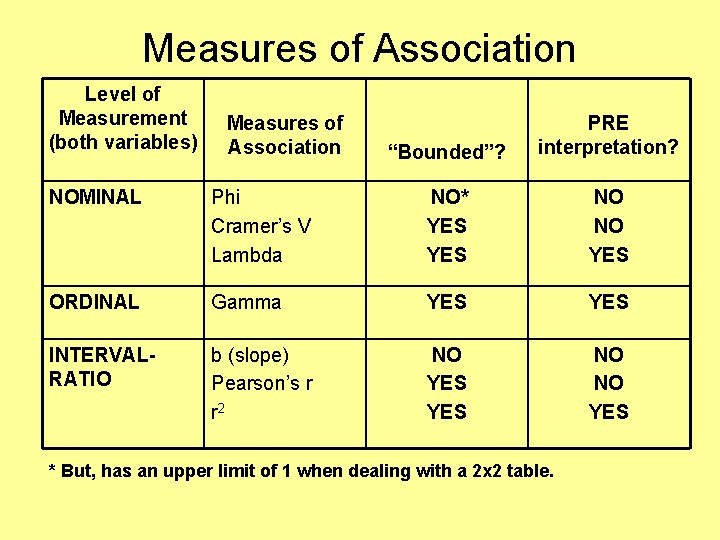
Measures of Association Level of Measurement (both variables) Measures of Association “Bounded”? PRE interpretation? NOMINAL Phi Cramer’s V Lambda NO* YES NO NO YES ORDINAL Gamma YES INTERVALRATIO b (slope) Pearson’s r r 2 NO YES NO NO YES * But, has an upper limit of 1 when dealing with a 2 x 2 table.
- Slides: 24