
Associate Professor Deirdre RussellBowie University of Western Sydney
Associate Professor Deirdre Russell-Bowie University of Western Sydney Integrating the Arts and the Multiple Intelligences 1
Multiple Intelligences • Not: • How SMART are you? • BUT • HOW are you smart? • Every child is 100% Intelligent – (Bookmarks) Integrating the Arts and the Multiple Intelligences 2
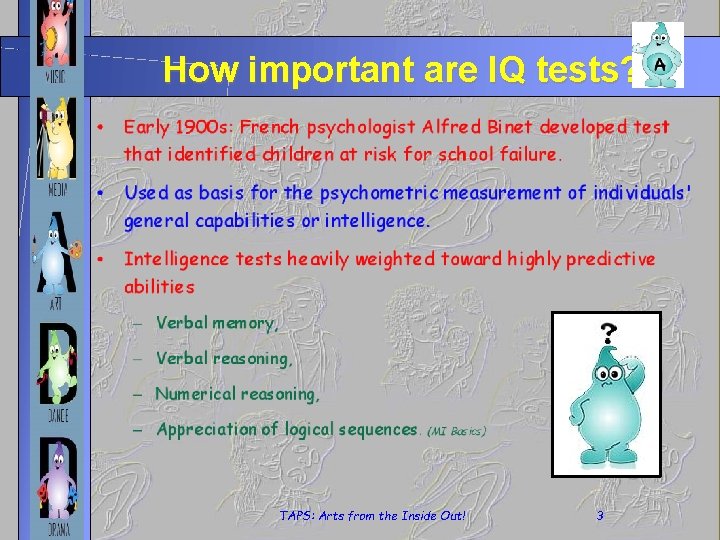
How important are IQ tests? TAPS: Arts from the Inside Out! 3
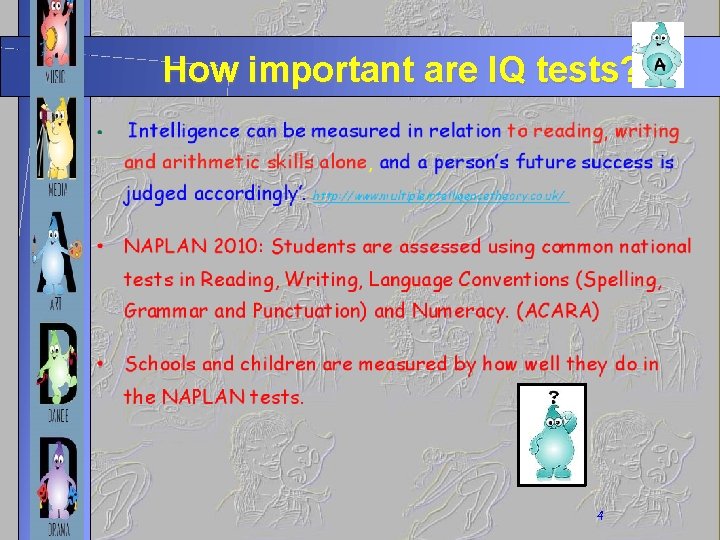
How important are IQ tests? 4
Discussion: How important are IQ tests? • Howard Gardner: • We should not judge others according to this narrow definition of IQ intelligence. Integrating the Arts and the Multiple Intelligences 5
Multiple Intelligences • From the 8 primary intelligences, an individual may excel in one, two or even three of these, but nobody is good at them all. • The same rule applies to a child prodigy or mentally/physically disadvantaged person. • A brain damaged child could have a severely impaired use of language, but be able to paint or play music magnificently. • (http: //www. multipleintelligencetheory. co. uk/) Integrating the Arts and the Multiple Intelligences 6
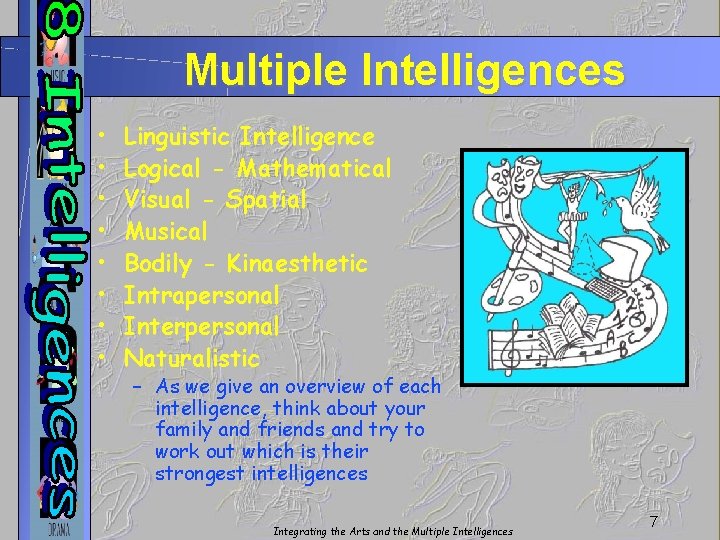
Multiple Intelligences • • Linguistic Intelligence Logical - Mathematical Visual - Spatial Musical Bodily - Kinaesthetic Intrapersonal Interpersonal Naturalistic – As we give an overview of each intelligence, think about your family and friends and try to work out which is their strongest intelligences Integrating the Arts and the Multiple Intelligences 7
Multiple Intelligences • Verbal-Linguistic Intelligence: • The ability to use language to excite, please, convince, stimulate or convey information • Those with this intelligence are people who: • • • Love stories, jokes and riddles Enjoy word games Spend time reading Can spell easily Enjoy crosswords Can read and write well Integrating the Arts and the Multiple Intelligences 8
Multiple Intelligences • Visual-Spatial intelligence • The ability to perceive and mentally manipulate a form or object, and to perceive and create tension, balance and composition in a visual or spatial display • Those with this intelligence are people who: • Enjoy art and craft activities • Act in plays • Have a clear picture of things • Enjoy jigsaws and mazes, • Enjoy photos and videos • Like to draw and create Integrating the Arts and the Multiple Intelligences 9
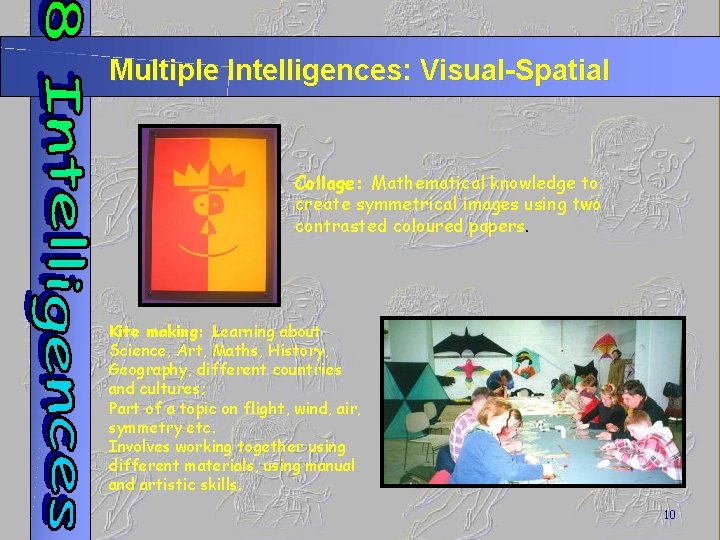
Multiple Intelligences: Visual-Spatial Collage: Mathematical knowledge to create symmetrical images using two contrasted coloured papers. Kite making: Learning about Science, Art, Maths, History, Geography, different countries and cultures; Part of a topic on flight, wind, air, symmetry etc. Involves working together using different materials, using manual and artistic skills. 10
Multiple Intelligences • Bodily - Kinaesthetic Intelligence • The ability to use fine and gross motor skills in sports, the performing arts or arts and crafts production • Those with this intelligence are people who: • Like dancing / like athletics • • • Use body language to send messages Like to be active Like to touch Enjoy acting and role playing Like fixing things Integrating the Arts and the Multiple Intelligences 11
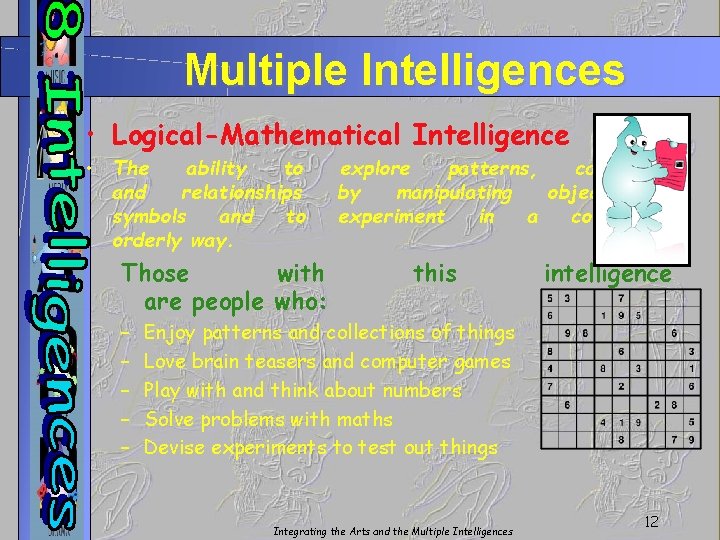
Multiple Intelligences • Logical-Mathematical Intelligence • The ability to and relationships symbols and to orderly way. Those with are people who: – – – explore patterns, categories by manipulating objects or experiment in a controlled, this intelligence Enjoy patterns and collections of things Love brain teasers and computer games Play with and think about numbers Solve problems with maths Devise experiments to test out things Integrating the Arts and the Multiple Intelligences 12
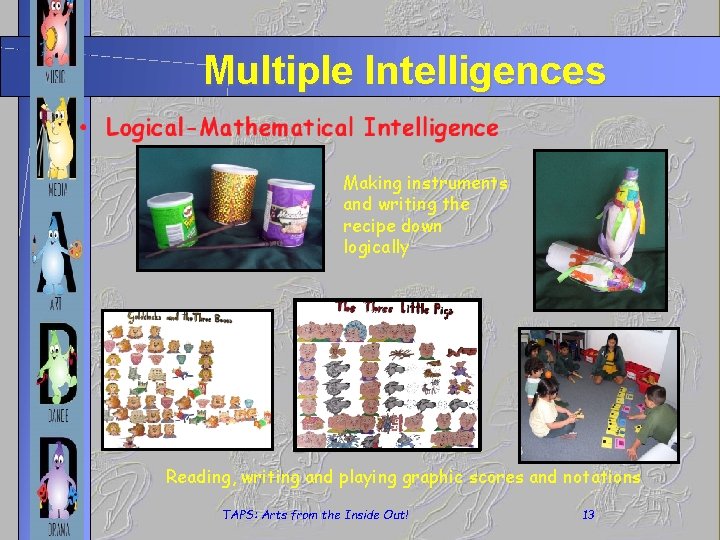
Multiple Intelligences Making instruments and writing the recipe down logically Reading, writing and playing graphic scores and notations TAPS: Arts from the Inside Out! 13
Multiple Intelligences • Musical Intelligence : • The ability to enjoy, compose a musical piece perform or • Those with this intelligence are people who: • Love to sing, hum, chant and rap • Enjoy music • Remember melodies • Listen to music / perform music • Play instruments / make instruments • Keep time rhythmically to music Integrating the Arts and the Multiple Intelligences 14
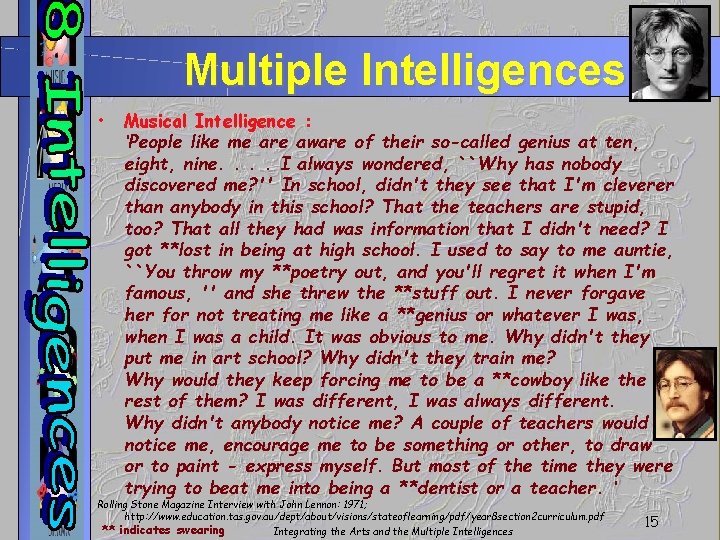
Multiple Intelligences • Musical Intelligence : ‘People like me are aware of their so-called genius at ten, eight, nine. . I always wondered, ``Why has nobody discovered me? '' In school, didn't they see that I'm cleverer than anybody in this school? That the teachers are stupid, too? That all they had was information that I didn't need? I got **lost in being at high school. I used to say to me auntie, ``You throw my **poetry out, and you'll regret it when I'm famous, '' and she threw the **stuff out. I never forgave her for not treating me like a **genius or whatever I was, when I was a child. It was obvious to me. Why didn't they put me in art school? Why didn't they train me? Why would they keep forcing me to be a **cowboy like the rest of them? I was different, I was always different. Why didn't anybody notice me? A couple of teachers would notice me, encourage me to be something or other, to draw or to paint - express myself. But most of the time they were trying to beat me into being a **dentist or a teacher. ‘ Rolling Stone Magazine Interview with John Lennon: 1971; http: //www. education. tas. gov. au/dept/about/visions/stateoflearning/pdf/year 8 section 2 curriculum. pdf ** indicates swearing Integrating the Arts and the Multiple Intelligences 15
Multiple Intelligences • Interpersonal Intelligence • The ability to understand get along with others • Those with this intelligence are people who: • Make friends easily • • Like to be with other people Love cooperative games Enjoy group problem solving Feel a lot for others Integrating the Arts and the Multiple Intelligences 16
Multiple Intelligences Working together to: Write and play music; Dramatise a book they have read; Create a collage for Science, Create a dance to explore emotions Multiple Intelligences 17
Multiple Intelligences • Intrapersonal Intelligence • The ability to gain access to and understand one’s inner feelings, dreams and ideas. • Those with this intelligence are people who: • • • Enjoy their own company Like imagining things Have a strong opinion or feeling about things Keep a diary Like hobbies Motivate themselves to do projects Integrating the Arts and the Multiple Intelligences 18
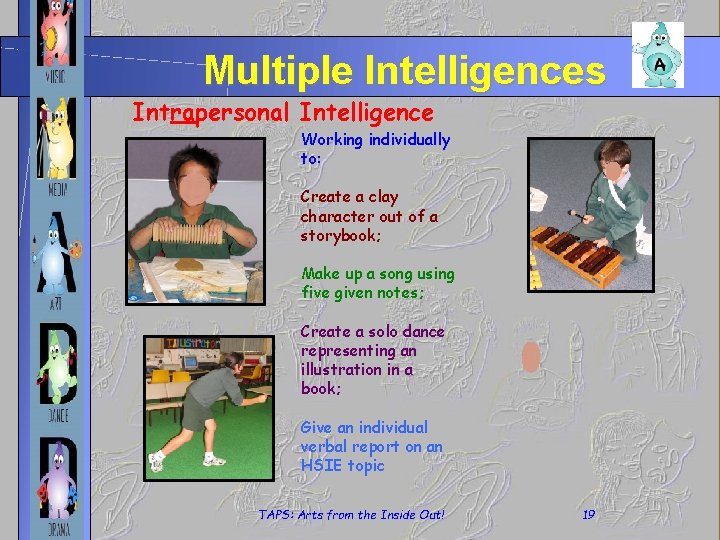
Multiple Intelligences Intrapersonal Intelligence Working individually to: Create a clay character out of a storybook; Make up a song using five given notes; Create a solo dance representing an illustration in a book; Give an individual verbal report on an HSIE topic TAPS: Arts from the Inside Out! 19
Multiple Intelligences • Naturalistic Intelligence • The ability to use the natural world as a means to view the rest of the world and to help them organise their own world • Those with this intelligence are people who: • • • Are observant Enjoy identifying and classifying Prefer to work outdoors Enjoy categorising to find connections Enjoy recognising and devising patterns in their work Integrating the Arts and the Multiple Intelligences 20
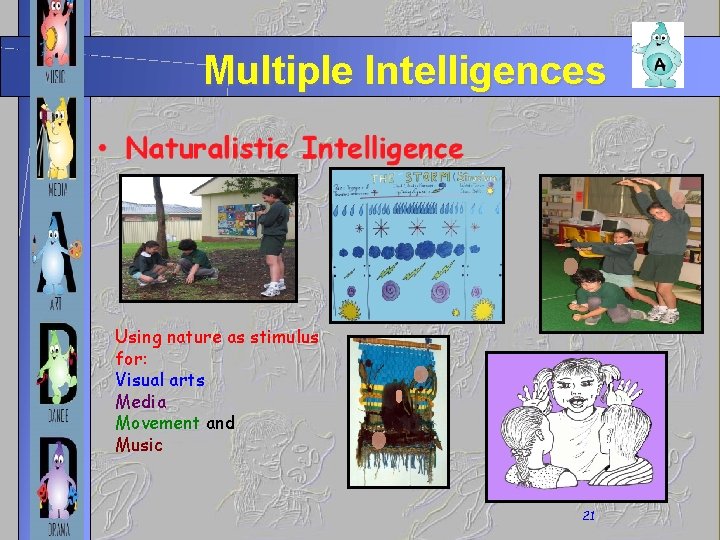
Multiple Intelligences Using nature as stimulus for: Visual arts Media Movement and Music 21
Multiple Intelligences Revising the Multiple Intelligences To the tune Botany Bay: Let’s look at the seven intelligences, There’s Logic and Maths, think it through, There’s Linguistic, with books and with poetry, And Musical intelligence, too. There’s Spatial with maps, charts and pictures, There’s Bodily / Kinaesthetic, let’s move! There’s Inter-personal, with you and me, And Intra-personal with just me! Integrating the Arts and the Multiple Intelligences 22
Multiple Intelligences • Haw are YOU smart? – Check your own Intelligences Profile – Use other web-based MI tests – Also have your pupils use them so they can take ownership of their own learning Integrating the Arts and the Multiple Intelligences 23
HOW are you smart? • Write these down the side of a page: – – – – Verbal-Linguistic Intelligence Logical-Mathematical Visual-Spatial Musical Bodily-Kinaesthetic Intrapersonal Interpersonal Naturalistic • As sentences are read, keep a quick tally of those that describe YOU against each word. Integrating the Arts and the Multiple Intelligences 24
HOW are you smart? • Verbal/Linguistic Intelligence • • I enjoy telling stories and jokes I have a good memory for trivia I enjoy word games (e. g. Scrabble, puzzles) I read books just for fun I am a good speller (most of the time) In an argument I tend to use put-downs or sarcasm I like talking and writing about my ideas If I have to memorise something I create a rhyme or saying to help me remember • If something breaks and won't work, I read the instruction book first • For a group presentation I prefer to do the writing and library research Integrating the Arts and the Multiple Intelligences 25
HOW are you smart? – Logical/Mathematical Intelligence • • • I really enjoy my maths class I like logical maths puzzles or brain teasers I find solving maths problems to be fun If I have to memorise something I tend to place events in a logical order I like to find out how things work I enjoy computer and any maths games I love playing chess, checkers or Monopoly In an argument, I try to find a fair and logical solution If something breaks and won't work, I look at the pieces and try to figure out how it works For a group presentation I prefer to create the charts and graphs Integrating the Arts and the Multiple Intelligences 26
HOW are you smart? – Visual-Spatial intelligence • • • I prefer a map to written directions I daydream a lot I enjoy hobbies such as photography I like to draw and create If I have to memorise something I draw a diagram to help me remember I like to doodle on paper whenever I can In a magazine, I prefer looking at the pictures rather than reading the text In an argument I try to keep my distance, keep silent or visualize some solution If something breaks and won't work I tend to study the diagram of how it works For a group presentation I prefer to draw all the pictures Integrating the Arts and the Multiple Intelligences 27
HOW are you smart? – Bodily/Kinesthetic Intelligence • My favourite subject is gym since I like sports • I enjoy activities such as woodworking, sewing and building models • When looking at things, I like touching them • I have trouble sitting still for any length of time • I use a lot of body movements when talking • If I have to memorise something I write it out a number of times until I know it • I tend to tap my fingers or play with my pencil during class • In a argument I tend to strike out and hit or run away • If something breaks and won't work I tend to play with the pieces to try to fit them together • For a group presentation I prefer to move the props around, hold things up or build a model Integrating the Arts and the Multiple Intelligences 28
HOW are you smart? – Musical/Rhythmic Intelligence • • • I enjoy listening to CD's and the radio I tend to hum to myself when working I like to sing I play a musical instrument quite well I like to have music playing when doing homework or studying If I have to memorise something I try to create a rhyme about the event In an argument I tend to shout or punch or move in some sort of rhythm I can remember the melodies of many songs If something breaks and won't work I tend to tap my fingers to a beat while I figure it out For a group presentation I prefer to put new words to a popular tune or use music Integrating the Arts and the Multiple Intelligences 29
HOW are you smart? – Interpersonal Intelligence • • • I get along well with others I like to belong to clubs and organisations I have several very close friends I like helping teach other students I like working with others in groups Friends ask my advice because I seem to be a natural leader If I have to memorise something I ask someone to quiz me to see if I know it In an argument I tend ask a friend or some person in authority for help If something breaks and won't work I try to find someone who can help me For a group presentation I like to help organise the group's efforts Integrating the Arts and the Multiple Intelligences 30
HOW are you smart? – Intrapersonal Intelligence • • • I like to work alone without anyone bothering me I like to keep a diary I like myself (most of the time) I don't like crowds I know what I am good at and what I am weak at I find that I am strong-willed, independent and don't follow the crowd If I have to memorise something I tend to close my eyes and feel the situation In an argument I will usually walk away until I calm down If something breaks and won't work, I wonder if it's worth fixing it For a group presentation I like to contribute something that is uniquely mine, often based on how I feel Integrating the Arts and the Multiple Intelligences 31
HOW are you smart? – Naturalist Intelligence • I am keenly aware of my surroundings and of what goes on around me • I love walking in the woods, looking at the trees and flowers • I enjoy gardening • I like to collect things (e. g. , rocks, sports cards, stamps, etc) • I like to get away from the city and enjoy nature • If I have to memorise something, I tend to organize it into categories • I enjoy learning the names of living things in our environment, such as flowers and trees • In an argument I tend to compare my opponent to someone or something I have read or heard about and react accordingly • If something breaks down, I look around me to try and see what I can find to fix the problem • For a group presentation I prefer to organise and classify the information into categories so it makes sense Integrating the Arts and the Multiple Intelligences 32
HOW are you smart? • TOTAL UP YOUR for each intelligence: indicate your preferred intelligences: – – – – SCORES highest will Verbal-Linguistic Logical-Mathematical Visual-Spatial Musical Bodily-Kinaesthetic Intrapersonal Interpersonal Naturalistic • Everyone has a different intelligence profile Integrating the Arts and the Multiple Intelligences 33
MI in the classroom • Teachers tend to teach using their own preferred intelligences • Be aware of this • Plan to include ALL intelligences in children’s learning experiences • Use the creative arts to cover the multiple intelligences Integrating the Arts and the Multiple Intelligences 34
Multiple Intelligences in the Classroom • Through involvement in all the art forms: Music • Dance • Drama • Visual arts • children can learn using their preferred intelligences. Integrating the Arts and the Multiple Intelligences 35
The arts cover all intelligences • If a child is not learning the way you are teaching, then you must teach in the way the child learns. How can YOU use the Multiple Intelligences in the classroom to enhance learning for ALL children? Integrating the Arts and the Multiple Intelligences 36
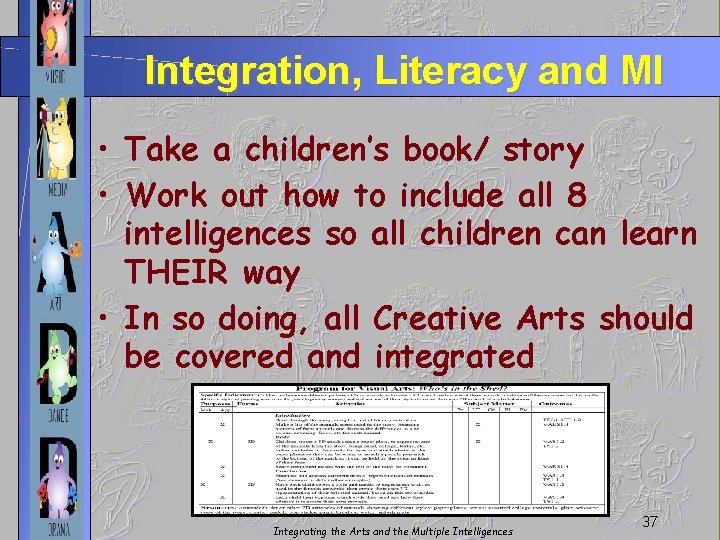
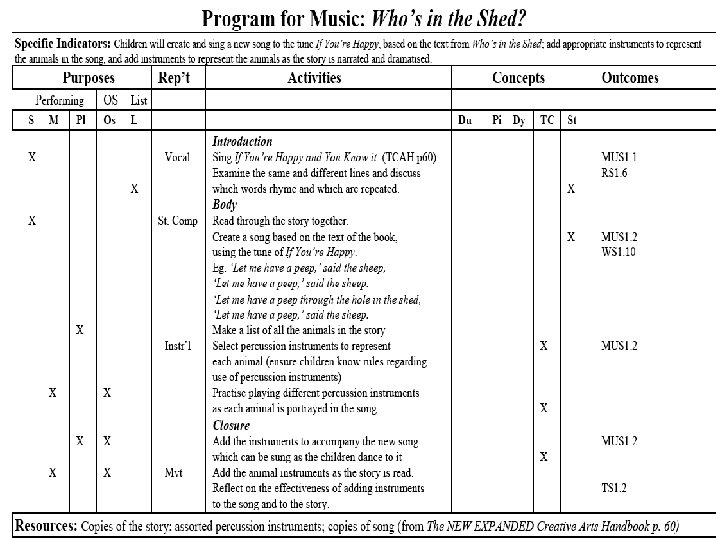
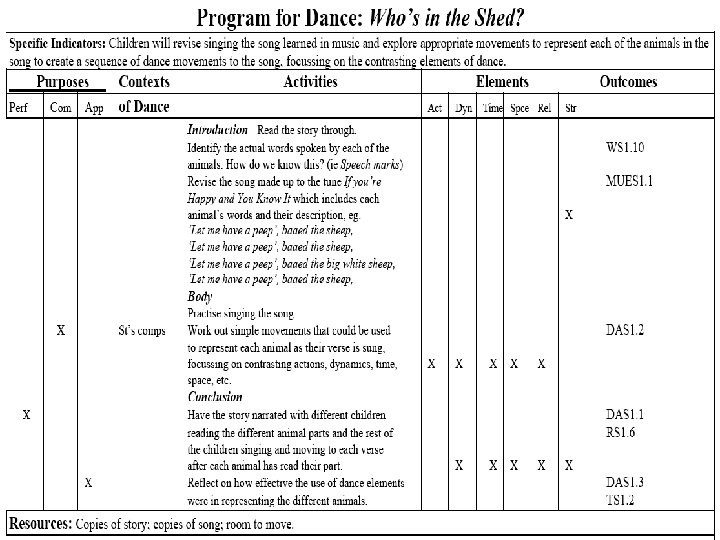
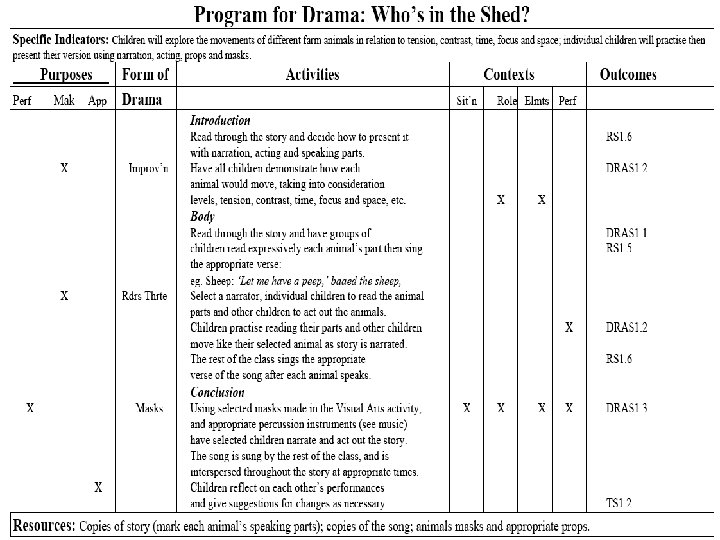
Integration, Literacy and MI • Take a children’s book/ story • Work out how to include all 8 intelligences so all children can learn THEIR way • In so doing, all Creative Arts should be covered and integrated Integrating the Arts and the Multiple Intelligences 37
Integrating the Arts and the Multiple Intelligences 38
Integrating the Arts and the Multiple Intelligences 39
Integrating the Arts and the Multiple Intelligences 40
Integrating the Arts and the Multiple Intelligences 41
Integrating the Arts and the Multiple Intelligences 42
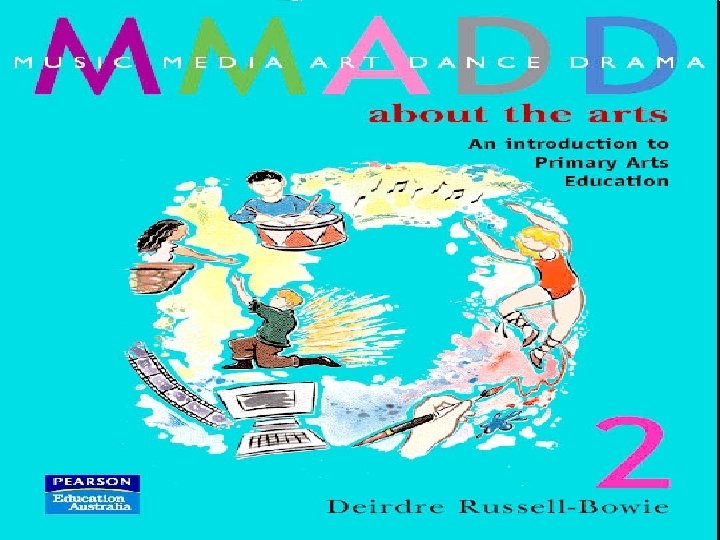
Multiple Intelligences For further information, see Chapter 8 in MMADD: About the Arts: An introduction to Primary Arts Education by Deirdre Russell-Bowie, published by Pearson Education Australia
- Slides: 43