
ASSOC PROF DR ADA OTO ANATOMY LECTURE o

- Slides: 17
ASSOC. PROF. DR. ÇAĞDAŞ OTO
ANATOMY LECTURE o PURPOSE The aim of the lecture is provide the knowledge about Anatomy science and general body structures of the domestic mammals. The lessons will be taught on systematic aspect in comperatively between the animal species. After this course, the students have basic knowledge about the animal body for the other veterinary courses such as histology, physiology, pathology, surgery and clinics. o REFERENCE BOOKS FOR THIS COURSE KÖNİG, H. G. , LİEBİCH, H. E (2009) Veterinary Anatomy of Domestic Mammals PASQUINI, C. , SPURGEON, T. (1997) Anatomy of Domestic Animals DYCE, K. M. , SACK, W. O (2010) Textbook of Veterinary Anatomy Coto
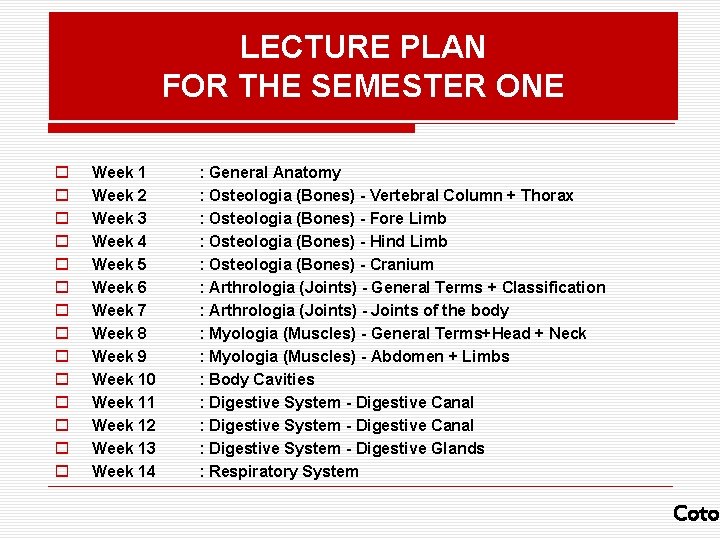
LECTURE PLAN FOR THE SEMESTER ONE o o o o Week 1 Week 2 Week 3 Week 4 Week 5 Week 6 Week 7 Week 8 Week 9 Week 10 Week 11 Week 12 Week 13 Week 14 : General Anatomy : Osteologia (Bones) - Vertebral Column + Thorax : Osteologia (Bones) - Fore Limb : Osteologia (Bones) - Hind Limb : Osteologia (Bones) - Cranium : Arthrologia (Joints) - General Terms + Classification : Arthrologia (Joints) - Joints of the body : Myologia (Muscles) - General Terms+Head + Neck : Myologia (Muscles) - Abdomen + Limbs : Body Cavities : Digestive System - Digestive Canal : Digestive System - Digestive Glands : Respiratory System Coto
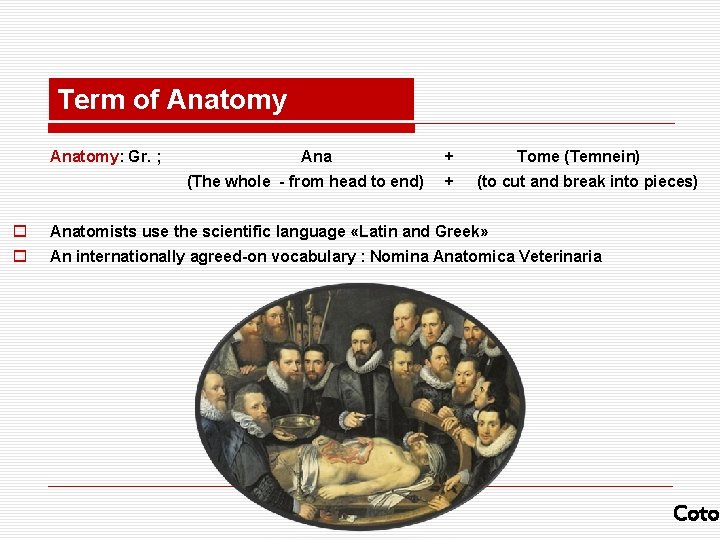
Term of Anatomy: Gr. ; Ana (The whole - from head to end) + + Tome (Temnein) (to cut and break into pieces) o Anatomists use the scientific language «Latin and Greek» o An internationally agreed-on vocabulary : Nomina Anatomica Veterinaria Coto
Anatomy - Anatomy is one of the basic essential sciences of medicine - Anatomy is the branch of biology. - Anatomy is concerned with the form, disposition and structure of organisms and their parts. - Anatomy prospects the NORMAL shape, color, size and position of the tissues and organs and their relationship with the other parts Coto
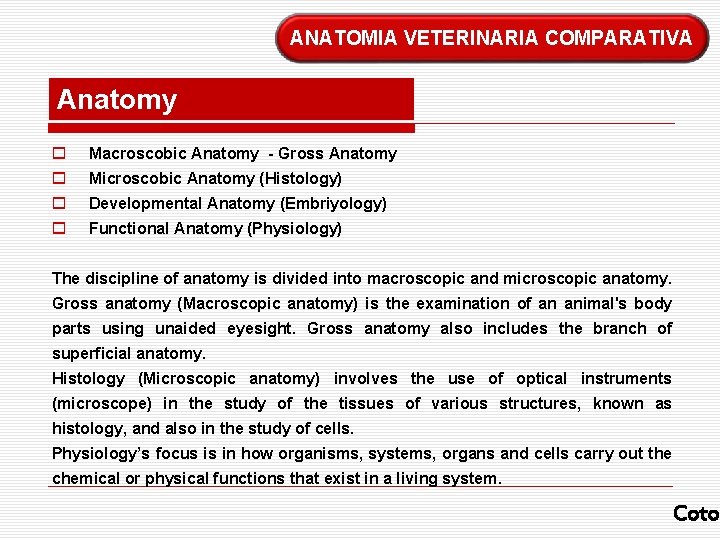
ANATOMIA VETERINARIA COMPARATIVA Anatomy o Macroscobic Anatomy - Gross Anatomy o Microscobic Anatomy (Histology) o Developmental Anatomy (Embriyology) o Functional Anatomy (Physiology) The discipline of anatomy is divided into macroscopic and microscopic anatomy. Gross anatomy (Macroscopic anatomy) is the examination of an animal's body parts using unaided eyesight. Gross anatomy also includes the branch of superficial anatomy. Histology (Microscopic anatomy) involves the use of optical instruments (microscope) in the study of the tissues of various structures, known as histology, and also in the study of cells. Physiology’s focus is in how organisms, systems, organs and cells carry out the chemical or physical functions that exist in a living system. Coto
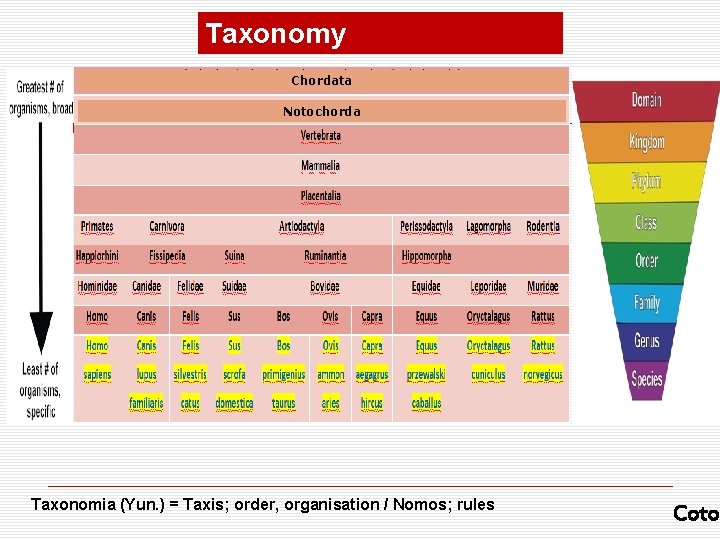
Taxonomy Chordata Notochorda Taxonomia (Yun. ) = Taxis; order, organisation / Nomos; rules Coto
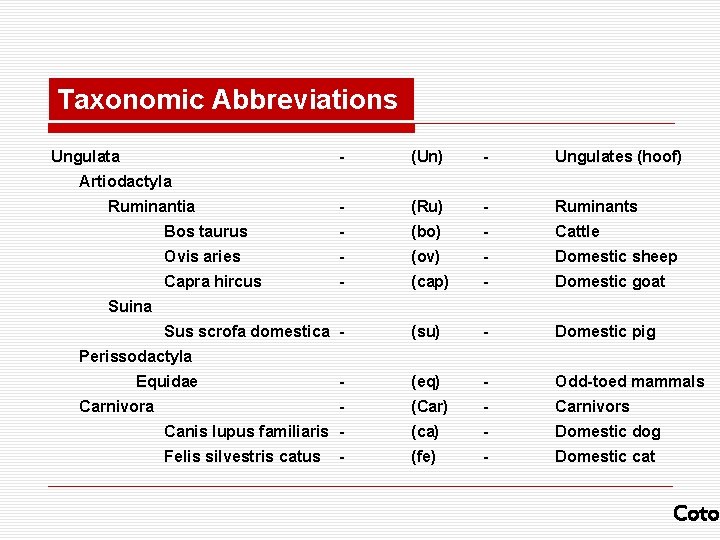
Taxonomic Abbreviations Ungulata - (Un) - Ungulates (hoof) - (Ru) - Ruminants Bos taurus - (bo) - Cattle Ovis aries - (ov) - Domestic sheep Capra hircus - (cap) - Domestic goat (su) - Domestic pig - (eq) - Odd-toed mammals - (Car) - Carnivors Canis lupus familiaris - (ca) - Domestic dog Felis silvestris catus (fe) - Domestic cat Artiodactyla Ruminantia Suina Sus scrofa domestica Perissodactyla Equidae Carnivora - Coto
DIRECTIONAL TERMS and PLANES o The first step in Veterinary Anatomy education, the terms that indicate position and direction must be learned in quadruped animal o An anatomical planes are the hypothetical planes used to transect the body, in order to describe the location of structures or the direction of movements. o In anatomy, four principal planes are used: 1 -) Planum medianum (median plane) 2 -) Planum sagittale (sagittal plane) 3 -) Planum transversum (transversal plane) 4 -) Planum horizontale (horizontal plane) Coto
DIRECTIONAL TERMS and PLANES o The essential (touchstone) points in the animal body - Cranium: Head or skull - Rostrum: Beak (in birds), Muzzle (in mammals) - Cauda: Tail - Dorsum: Back of the trunk or limb - Venter: Abdomen or stomach - Palma: Palm of the hand (forelimb) - Planta: Sole of the foot (hindlimb) - Medianus: Middle of the body - Latus: Side (or flank) of the body Coto
Plana Corporis Planum Medianum (Median-Midsagittal Plane) o In quadruped animals, the median plane is a plane perpendicular to the ground in head-tail direction o It divides the body into symmetrical left and right halves. - Median : In the middle, Center point or direction in the body - Dexter: Right side - Sinister: Left side Coto
Plana Corporis Planum Sagittale (Sagittal Planes) o The sagittal plane is numerous planes parallel to median plane in head-tail direction. o The term originates from in latin term «sagitta» (arrow). The position of the archer is parallel the median plane. o The planes divides the body into insight - outside according to the median plane. - Medial: Near the medianus - Lateral: Near the flank (side) Coto
Plana Corporis Planum Transversum (Transverse Plane) o In quadruped animals, the transverse plane is a plane perpendicular to the median plane and the long axis of the body (and limbs). o The plane divides the body into anterior-posterior to the tail from the head o The plane divides the head into anterior-posterior to base of skull from the muzzle o The plane also divides the limbs into up-down to the long axis of the limbs - Cranial: the structures lie toward the head - Caudal: the structures lie toward the tail - Rostral: the structures are close to muzzle - Proximal: the structures are near the body - Distal: the structures are stand away from the body Coto
Plana Corporis Planum Horizontale (Horizontal-Dorsal-Frontal Planes) o In quadruped animals, the horizontal plane is a plane perpendicular to the median plane but parallel the long axis of the body or the ground (horizon). o The plane divides the body into superior-inferior to the abdomen from the back o The plane divides the heat into superior-anterior to the sinciput from the jaw o The plane also divides the limbs anterior-posterior parallel the long axis of the limb - Dorsal: the structures lie toward the back - Ventral: the structures lie toward the abdomen - Frontal: the structures lie toward the forehead - Mandibular: the structures lie toward the jaw - Palmar: near the palm in forelimb - Plantar: near the sole in hindlimb Coto
Plana Corporis Planum Horizontale (Horizontal-Dorsal-Frontal Planes) o In quadruped animals, the horizontal plane is a plane perpendicular to the median plane but parallel the long axis of the body or the ground (horizon). o The plane divides the body into superior-inferior to the abdomen from the back o The plane divides the heat into superior-anterior to the sinciput from the jaw o The plane also divides the limbs anterior-posterior parallel the long axis of the limb - Dorsal: the structures lie toward the back - Ventral: the structures lie toward the abdomen - Frontal: the structures lie toward the forehead - Mandibular: the structures lie toward the jaw - Palmar: near the palm in forelimb - Plantar: near the sole in hindlimb Coto
General Terms in Anatomy o Dorsal – Ventral o Cranial – Caudal o Lateral – Medial o External – Internal o Superficial – Profund o Dexter – Sinister o Anterior – Posterior o Superior – Inferior Coto
SYSTEMATIC ANATOMY o SYSTEMA LOCOMOTORIUM (Locomotor system) n Osteologia (Bones) n Arthrologia (Joints) n Myologia (Muscles) o SYSTEMA DIGESTORIUM (Digestive system) o SYSTEMA RESPIRATORIUM (Respiratory system) o SYSTEMA UROGENITALE (Urogenital system) o SYSTEMA VASORUM (Circular system) o SYSTEMA NERVOSUM (Nervous system) o AESTHESIOLOGY (Special Sense Organs)