
Assistive Technology for Classroom Teachers MICCA March 20

- Slides: 24
Assistive Technology for Classroom Teachers MICCA March 20, 2002 Baltimore, Maryland March 20, 2002 Com. Tek: Dave Rose
New Teacher Technology Competency Program of Queen Anne’s County Public Schools March 20, 2002 Com. Tek: Dave Rose
The Superintendent’s Initiative “In the immediate future teachers will need to demonstrate a basic level of technology proficiency. Therefore, all newly hired instructors will be assessed, then trained according to predetermined technology competencies. ” March 20, 2002 Com. Tek: Dave Rose 3
The first step…. . …. Assess existing staff development. March 20, 2002 Com. Tek: Dave Rose 4
Part II. ASSESSMENT March 20, 2002 Com. Tek: Dave Rose
Part III Identification of Training Pathways March 20, 2002 Com. Tek: Dave Rose 6
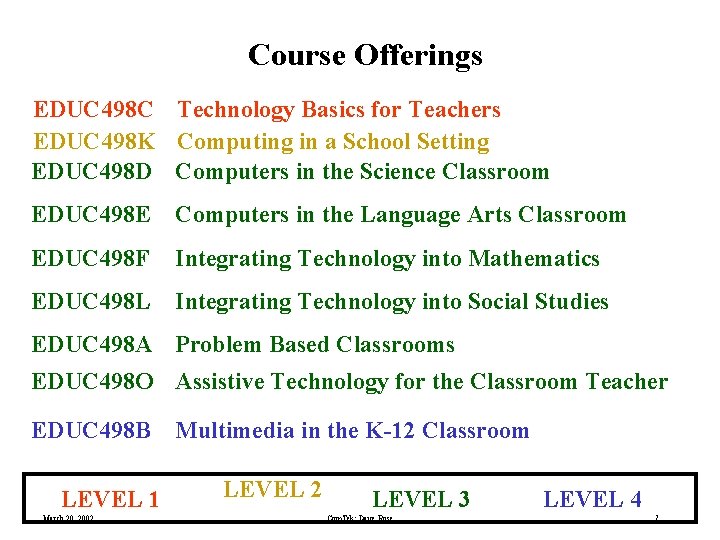
Course Offerings EDUC 498 C Technology Basics for Teachers EDUC 498 K Computing in a School Setting EDUC 498 D Computers in the Science Classroom EDUC 498 E Computers in the Language Arts Classroom EDUC 498 F Integrating Technology into Mathematics EDUC 498 L Integrating Technology into Social Studies EDUC 498 A Problem Based Classrooms EDUC 498 O Assistive Technology for the Classroom Teacher EDUC 498 B LEVEL 1 March 20, 2002 Multimedia in the K-12 Classroom LEVEL 2 LEVEL 3 Com. Tek: Dave Rose LEVEL 4 7
College Park College of Education Technology Outreach Professional Development Courses Davina Pruitt-Mentle March 20, 2002 Com. Tek: Dave Rose 8
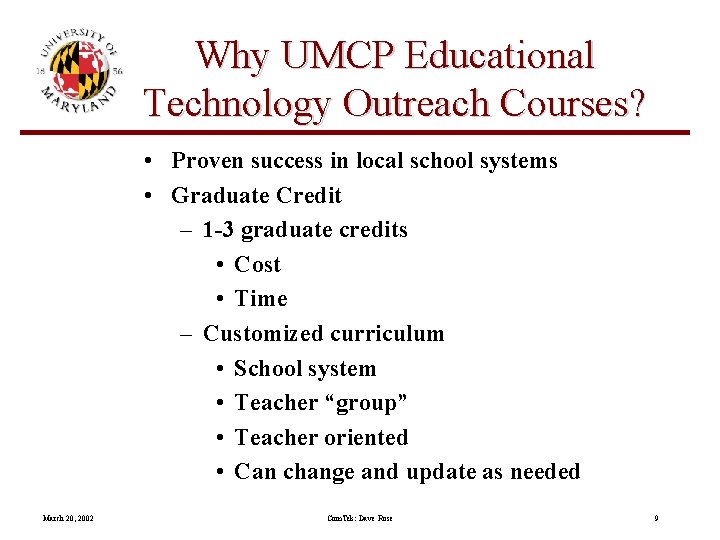
Why UMCP Educational Technology Outreach Courses? • Proven success in local school systems • Graduate Credit – 1 -3 graduate credits • Cost • Time – Customized curriculum • School system • Teacher “group” • Teacher oriented • Can change and update as needed March 20, 2002 Com. Tek: Dave Rose 9
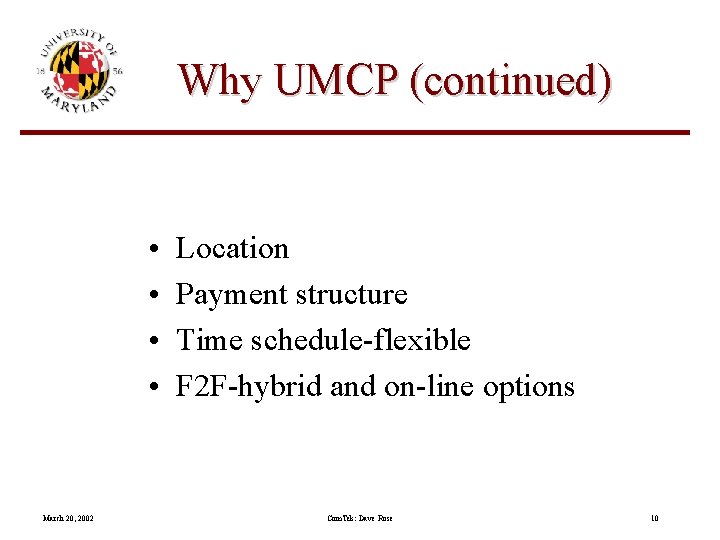
Why UMCP (continued) • • March 20, 2002 Location Payment structure Time schedule-flexible F 2 F-hybrid and on-line options Com. Tek: Dave Rose 10
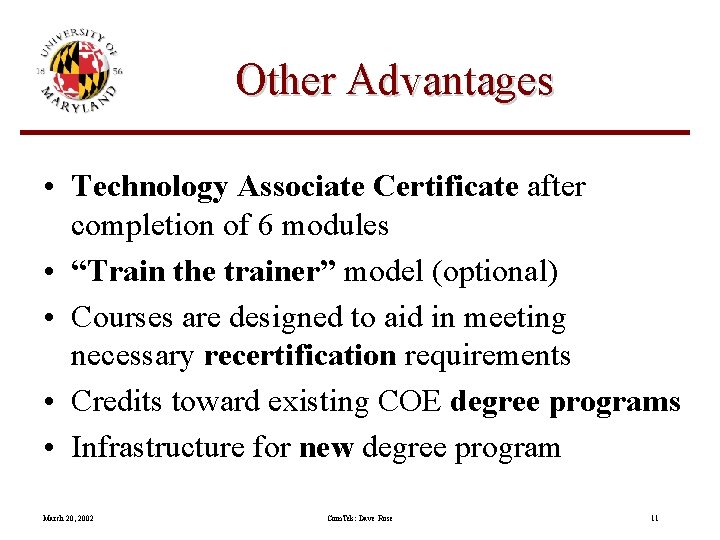
Other Advantages • Technology Associate Certificate after completion of 6 modules • “Train the trainer” model (optional) • Courses are designed to aid in meeting necessary recertification requirements • Credits toward existing COE degree programs • Infrastructure for new degree program March 20, 2002 Com. Tek: Dave Rose 11
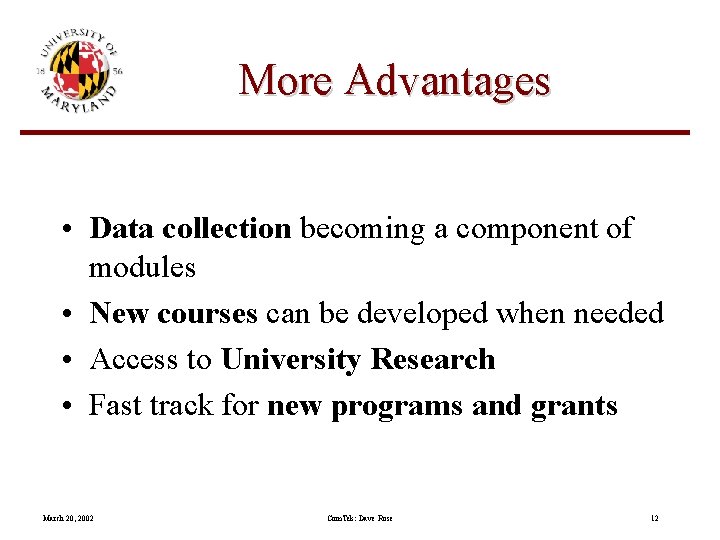
More Advantages • Data collection becoming a component of modules • New courses can be developed when needed • Access to University Research • Fast track for new programs and grants March 20, 2002 Com. Tek: Dave Rose 12
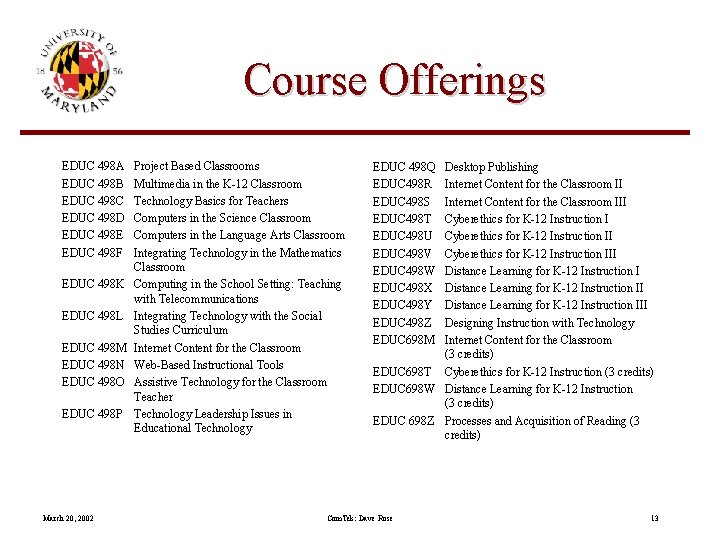
Course Offerings EDUC 498 A EDUC 498 B EDUC 498 C EDUC 498 D EDUC 498 E EDUC 498 F EDUC 498 K EDUC 498 L EDUC 498 M EDUC 498 N EDUC 498 O EDUC 498 P March 20, 2002 Project Based Classrooms Multimedia in the K-12 Classroom Technology Basics for Teachers Computers in the Science Classroom Computers in the Language Arts Classroom Integrating Technology in the Mathematics Classroom Computing in the School Setting: Teaching with Telecommunications Integrating Technology with the Social Studies Curriculum Internet Content for the Classroom Web-Based Instructional Tools Assistive Technology for the Classroom Teacher Technology Leadership Issues in Educational Technology EDUC 498 Q EDUC 498 R EDUC 498 S EDUC 498 T EDUC 498 U EDUC 498 V EDUC 498 W EDUC 498 X EDUC 498 Y EDUC 498 Z EDUC 698 M Desktop Publishing Internet Content for the Classroom III Cyberethics for K-12 Instruction III Distance Learning for K-12 Instruction III Designing Instruction with Technology Internet Content for the Classroom (3 credits) EDUC 698 T Cyberethics for K-12 Instruction (3 credits) EDUC 698 W Distance Learning for K-12 Instruction (3 credits) EDUC 698 Z Processes and Acquisition of Reading (3 credits) Com. Tek: Dave Rose 13
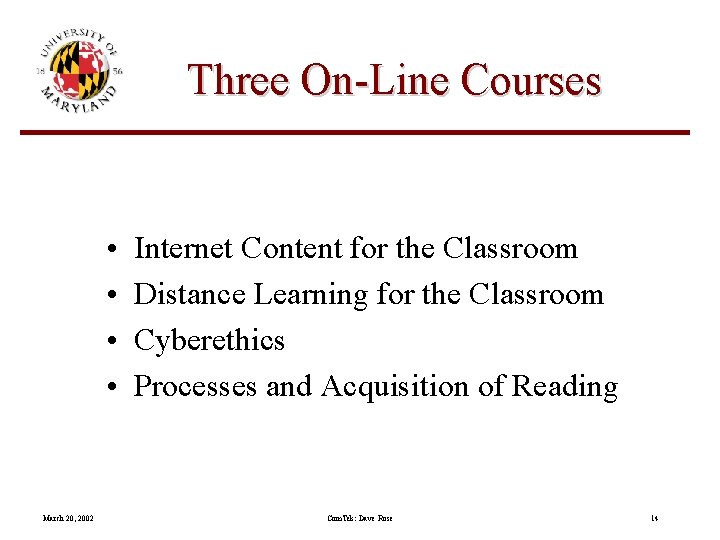
Three On-Line Courses • • March 20, 2002 Internet Content for the Classroom Distance Learning for the Classroom Cyberethics Processes and Acquisition of Reading Com. Tek: Dave Rose 14
Education Technology Outreach To Get Involved In Our Staff Development Graduate Outreach Program Contact: Davina Pruitt-Mentle (301) 405 – 8202 dp 151@umail. umd. edu www. edtechoutreach. umd. edu March 20, 2002 Com. Tek: Dave Rose 15
March 20, 2002 Com. Tek: Dave Rose 16
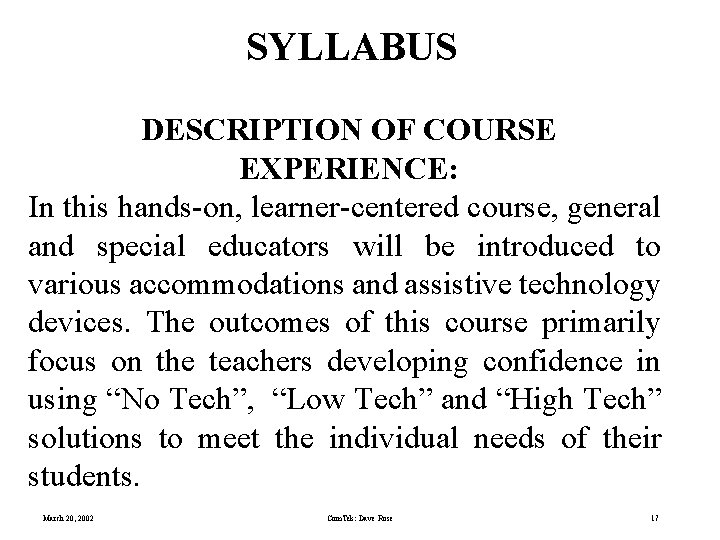
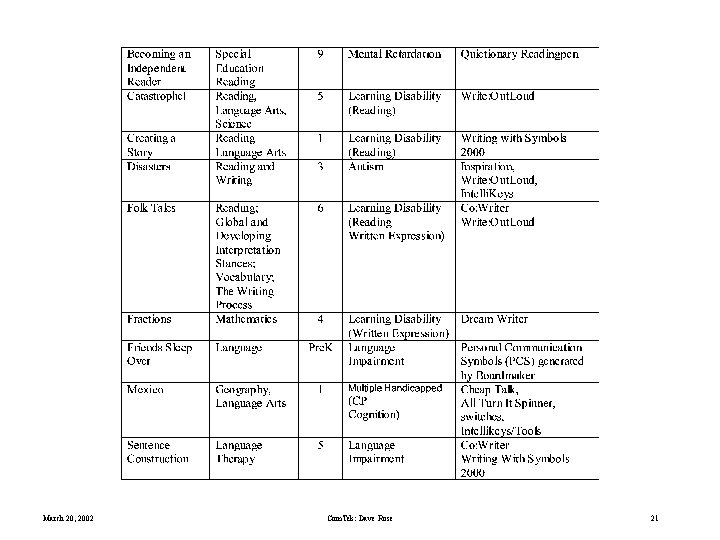
SYLLABUS DESCRIPTION OF COURSE EXPERIENCE: In this hands-on, learner-centered course, general and special educators will be introduced to various accommodations and assistive technology devices. The outcomes of this course primarily focus on the teachers developing confidence in using “No Tech”, “Low Tech” and “High Tech” solutions to meet the individual needs of their students. March 20, 2002 Com. Tek: Dave Rose 17
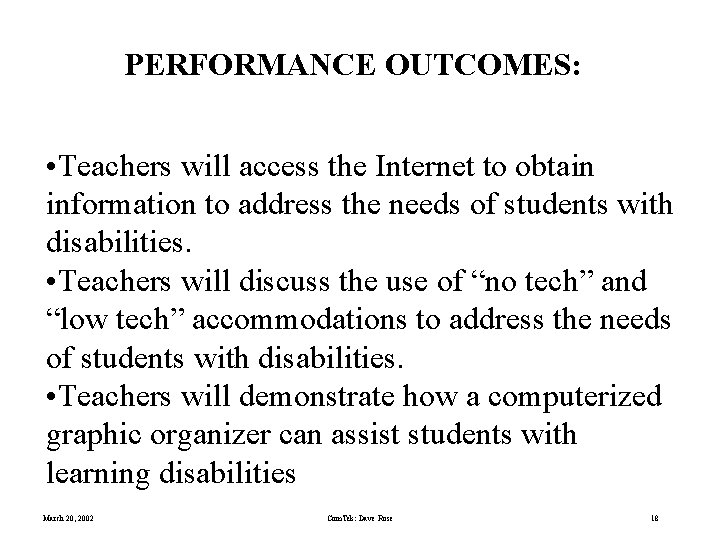
PERFORMANCE OUTCOMES: • Teachers will access the Internet to obtain information to address the needs of students with disabilities. • Teachers will discuss the use of “no tech” and “low tech” accommodations to address the needs of students with disabilities. • Teachers will demonstrate how a computerized graphic organizer can assist students with learning disabilities March 20, 2002 Com. Tek: Dave Rose 18
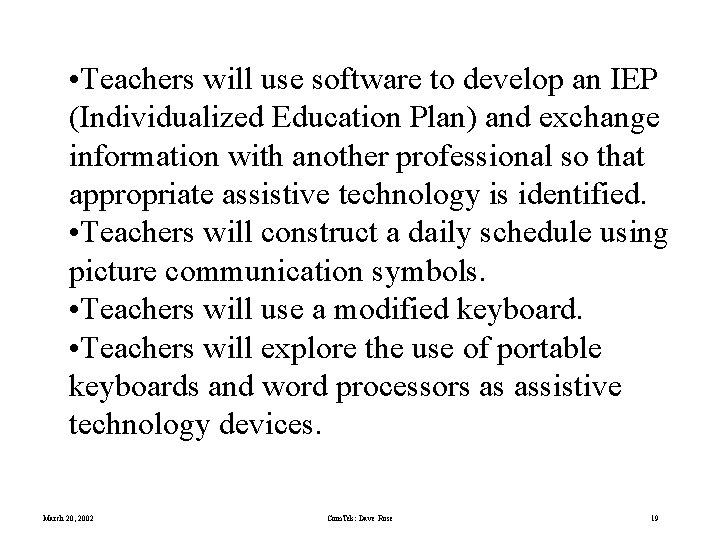
• Teachers will use software to develop an IEP (Individualized Education Plan) and exchange information with another professional so that appropriate assistive technology is identified. • Teachers will construct a daily schedule using picture communication symbols. • Teachers will use a modified keyboard. • Teachers will explore the use of portable keyboards and word processors as assistive technology devices. March 20, 2002 Com. Tek: Dave Rose 19
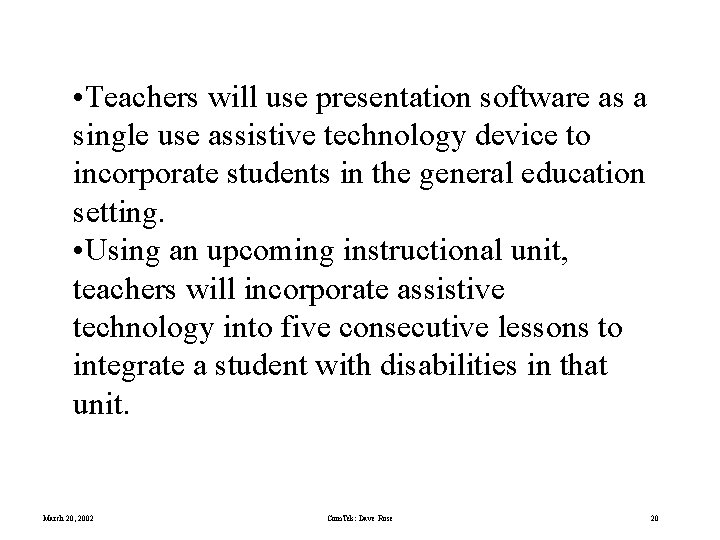
• Teachers will use presentation software as a single use assistive technology device to incorporate students in the general education setting. • Using an upcoming instructional unit, teachers will incorporate assistive technology into five consecutive lessons to integrate a student with disabilities in that unit. March 20, 2002 Com. Tek: Dave Rose 20
March 20, 2002 Com. Tek: Dave Rose 21
March 20, 2002 Com. Tek: Dave Rose 22
March 20, 2002 Com. Tek: Dave Rose 23
NO March 20, 2002 YES Com. Tek: Dave Rose 24