
Assisting in Phlebotomy Chapter 52 Copyright 2007 by
Assisting in Phlebotomy Chapter 52 Copyright © 2007 by Saunders, Inc. , an imprint of Elsevier Inc.
Phlebotomy n n The practice of drawing blood. The most common method of obtaining blood is by venipuncture. Copyright © 2007 by Saunders, Inc. , an imprint of Elsevier Inc. 2
Venipuncture Equipment n Gloves: – Glove use during venipuncture is mandated by OSHA. n Tourniquet – Prevents venous flow out of the site, causing veins to bulge. – Makes veins easier to locate and puncture. Copyright © 2007 by Saunders, Inc. , an imprint of Elsevier Inc. 3
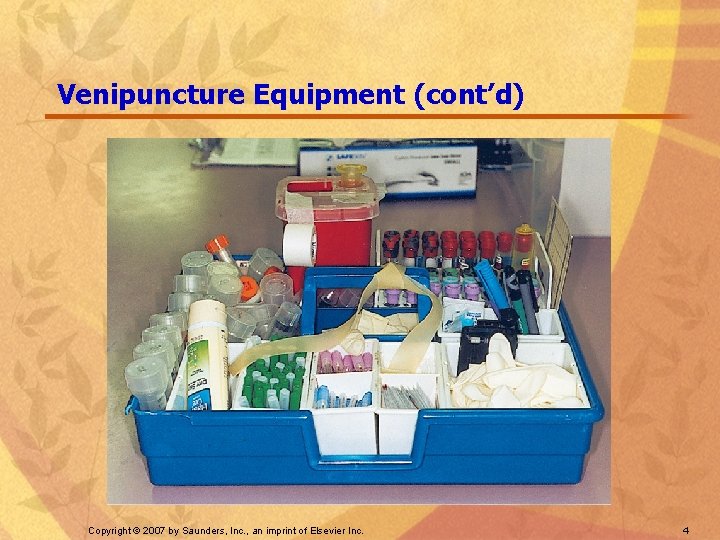
Venipuncture Equipment (cont’d) Copyright © 2007 by Saunders, Inc. , an imprint of Elsevier Inc. 4
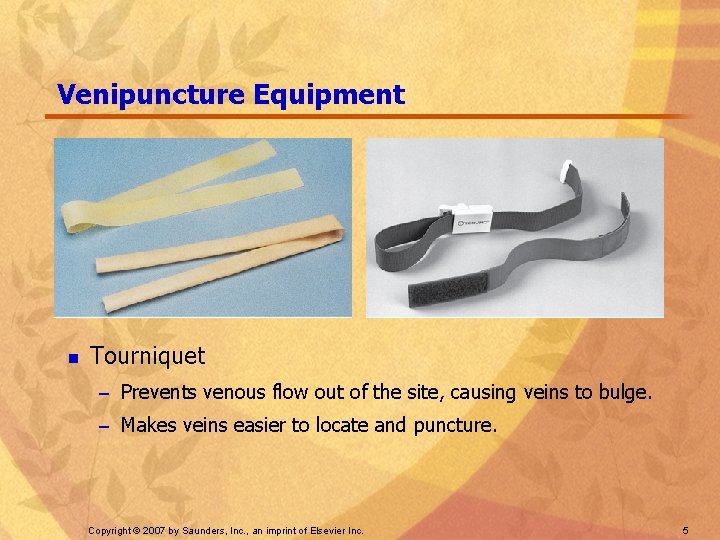
Venipuncture Equipment n Tourniquet – Prevents venous flow out of the site, causing veins to bulge. – Makes veins easier to locate and puncture. Copyright © 2007 by Saunders, Inc. , an imprint of Elsevier Inc. 5
Venipuncture Equipment n Antiseptics – The most commonly used is 70% isopropyl alcohol, also known as rubbing alcohol. n Evacuated collection tubes – Consists of evacuated tubes of various sizes, with color-coded tops indicating tube contents (Table 52 -1). Copyright © 2007 by Saunders, Inc. , an imprint of Elsevier Inc. 6
Tube Additives n Red-topped tube – No additive n Ethylenediaminetetraacetic acid (EDTA) – Lavender-topped tube n Thixotropic gel – SST and the PST green-gray marbled topped tubes by Becton. Dickinson Copyright © 2007 by Saunders, Inc. , an imprint of Elsevier Inc. 7
Order of Collection Order applies to the filling of tubes when blood is collected in a syringe. 1. Blood culture tubes. 2. Red-topped tubes. 3. Light blue-topped tubes with sodium citrate. 4. Serum tubes without (red stopper) or with (red-gold or speckle stopper) clot-activator. 5. Green-topped tubes. 6. Lavender-topped tubes follow. 7. Red/gray marble-topped tubes are next. 8. Gray-topped tube. Copyright © 2007 by Saunders, Inc. , an imprint of Elsevier Inc. 8
Needles n n n The venipuncture needle has a shaft with one end cut at an angle (bevel). The other end attaches to the syringe or to an adaptor (hub). Gauge is designated by a numeric value. – The higher the number, the smaller the lumen. Copyright © 2007 by Saunders, Inc. , an imprint of Elsevier Inc. 9
Syringes n n n Used when there is concern that the strong vacuum in a stoppered tube will collapse the vein. The syringe needle fits on the end of the barrel and comes in different gauges. It must be transferred immediately to another tube because the blood will clot in the syringe barrel. Copyright © 2007 by Saunders, Inc. , an imprint of Elsevier Inc. 10
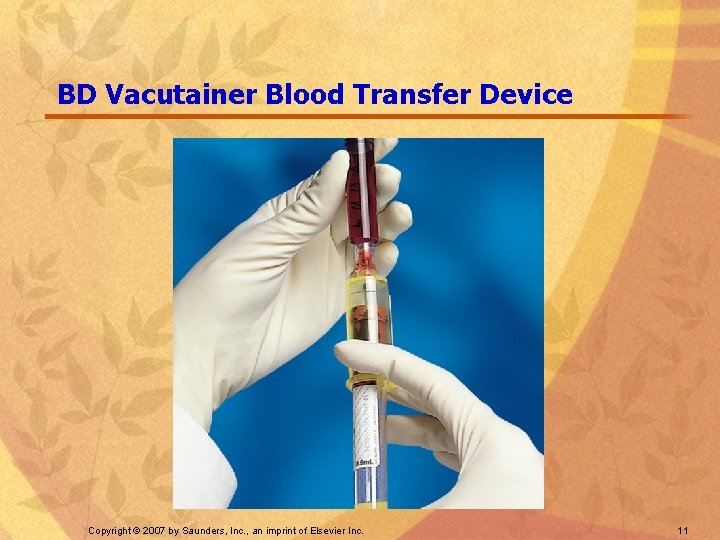
BD Vacutainer Blood Transfer Device Copyright © 2007 by Saunders, Inc. , an imprint of Elsevier Inc. 11
Winged Infusion Sets (Butterfly Needles) n n n Designed for use on small veins such as those in the hand or in pediatric patients. Needle size is 23 gauge. Needle is ½ to ¾ inch long with a plastic, flexible butterfly-shaped grip attached to a short length of tubing. Copyright © 2007 by Saunders, Inc. , an imprint of Elsevier Inc. 12
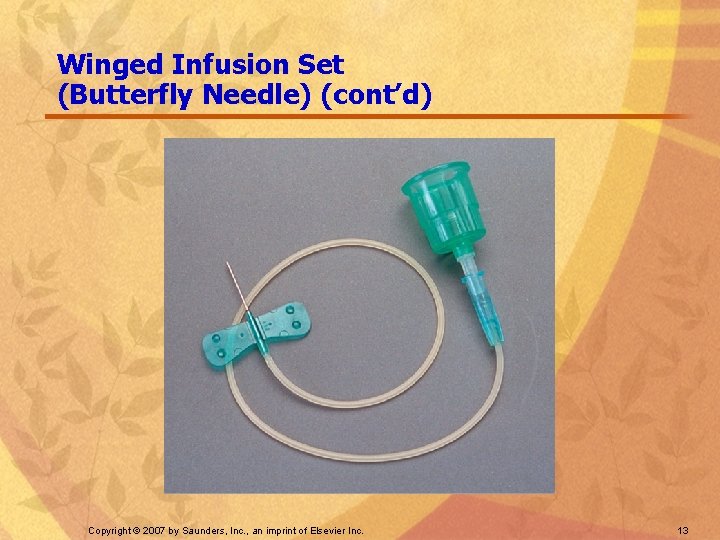
Winged Infusion Set (Butterfly Needle) (cont’d) Copyright © 2007 by Saunders, Inc. , an imprint of Elsevier Inc. 13
Needle Holders n n n Translucent cylinders. Cylinders have a ring that indicates how far the tube can be pushed onto the needle without losing the vacuum. Needles are not removed from the needle holder, and the safety feature must be activated before disposal. Copyright © 2007 by Saunders, Inc. , an imprint of Elsevier Inc. 14
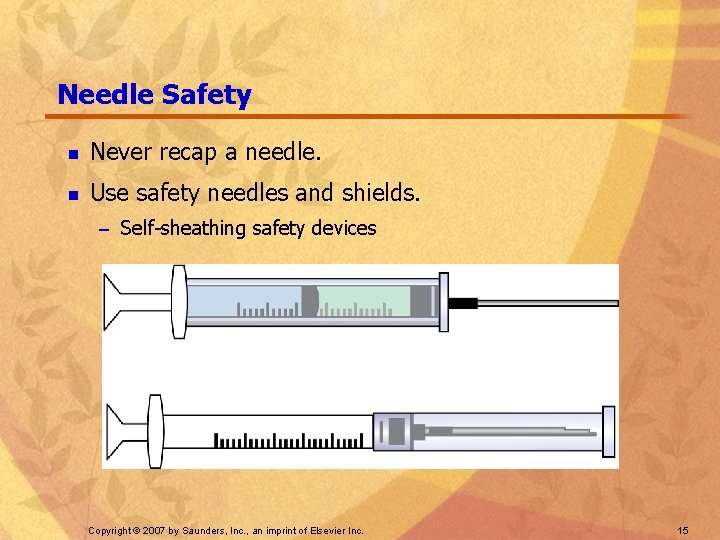
Needle Safety n Never recap a needle. n Use safety needles and shields. – Self-sheathing safety devices Copyright © 2007 by Saunders, Inc. , an imprint of Elsevier Inc. 15
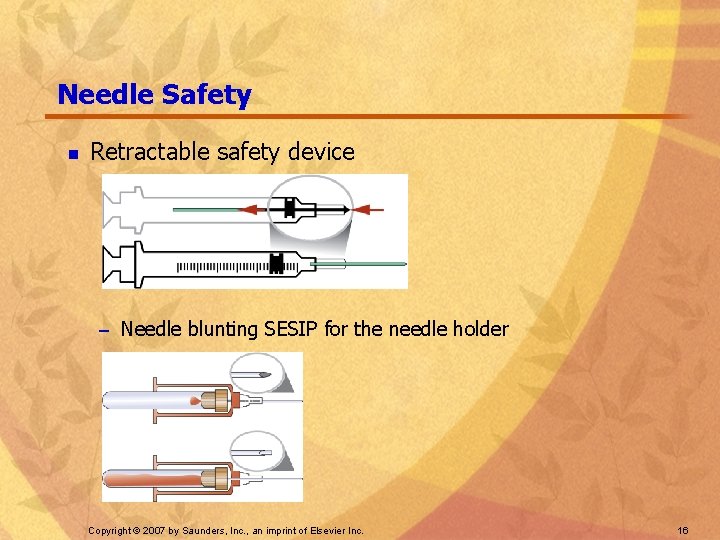
Needle Safety n Retractable safety device – Needle blunting SESIP for the needle holder Copyright © 2007 by Saunders, Inc. , an imprint of Elsevier Inc. 16
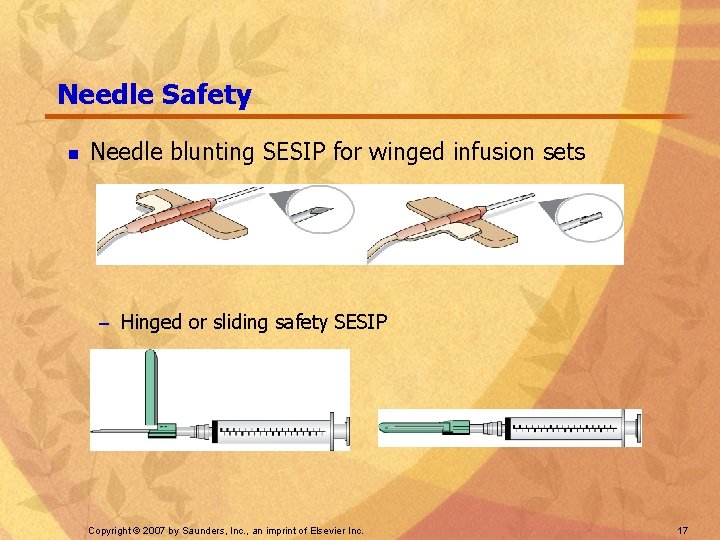
Needle Safety n Needle blunting SESIP for winged infusion sets – Hinged or sliding safety SESIP Copyright © 2007 by Saunders, Inc. , an imprint of Elsevier Inc. 17
Needle Safety n Postexposure management of needlesticks n Care of the exposure site n Evaluation of the exposure n Follow-up care and testing Copyright © 2007 by Saunders, Inc. , an imprint of Elsevier Inc. 18
Routine Venipuncture n Prepare the patient n Prepare for the venipuncture n Perform the venipuncture n Complete the procedure Copyright © 2007 by Saunders, Inc. , an imprint of Elsevier Inc. 19
Problems Associated with Venipuncture n Failure to obtain blood n Hematoma n Syncope n Refer to Table 52 -4 Copyright © 2007 by Saunders, Inc. , an imprint of Elsevier Inc. 20
Specimen Recollection n Unlabeled or mislabeled specimen n Quantity not sufficient n Defective tube n Incorrect tube used for test ordered n Hemolysis n Clotted blood in an anticoagulated specimen n Improper handling Copyright © 2007 by Saunders, Inc. , an imprint of Elsevier Inc. 21
Capillary Puncture n n n n Patients at risk for venous thrombosis n Patients who require frequent glucose monitoring Patients who are severely dehydrated n Tests that require a small volume of blood Patients with burns or scars in venipuncture sites n Older patients Pediatric patients (especially under the age of 2 years) Obese patients When venous blood and capillary blood are not identical Patients receiving intravenous therapy Patients who have had a mastectomy Copyright © 2007 by Saunders, Inc. , an imprint of Elsevier Inc. 22
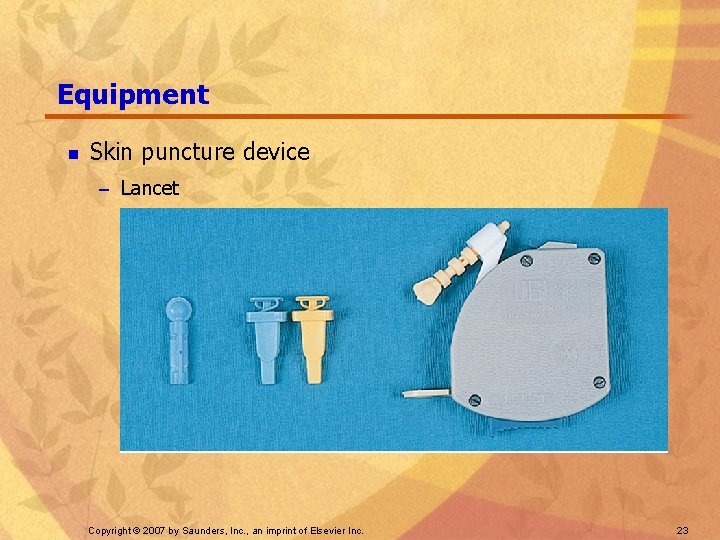
Equipment n Skin puncture device – Lancet Copyright © 2007 by Saunders, Inc. , an imprint of Elsevier Inc. 23
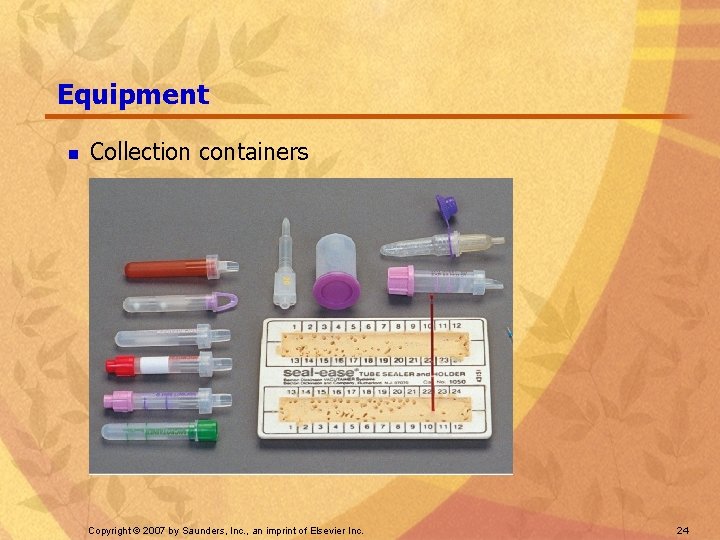
Equipment n Collection containers Copyright © 2007 by Saunders, Inc. , an imprint of Elsevier Inc. 24
Equipment – Unopette system – Manufacturers also provide various collection devices designed to obtain small quantities of blood for “point-of-care” testing for such analytes as glucose, hemoglobin A 1 c, and cholesterol – Paper cards Copyright © 2007 by Saunders, Inc. , an imprint of Elsevier Inc. 25
Capillary Puncture n Site selection n Patient preparation n Collection of the specimen n Specimen handling Copyright © 2007 by Saunders, Inc. , an imprint of Elsevier Inc. 26
Patient Education n n The medical assistant must maintain a professional attitude and still be sympathetic to the fears and apprehensions of the patient. Use the patient’s suggestion in choosing the site for the removal of a blood specimen. Copyright © 2007 by Saunders, Inc. , an imprint of Elsevier Inc. 27
- Slides: 27